
Atlas F Site 578-4 Missile Silo, Denton Valley / Denton Community Texas
Longitude: -99.5413766649353
Site Type: Atlas F vertical silo launch facility
Missile Type: SM-65F Atlas
Number of Launchers/Missiles: 1
Parent Base: Dyess AFB
Missile Wing: 96th Bombardment Wing; 96th Strategic Aerospace Wing after 1963-02-01
Missile Squadron: 578th Strategic Missile Squadron
Current Site Use: Private property / former Atlas F silo complex; original Quonset hut reportedly remains.
Site Ownership: Private/non-federal ownership after surplus disposal; exact current owner not verified.
Accessible: No public access verified; private property / owner permission required.
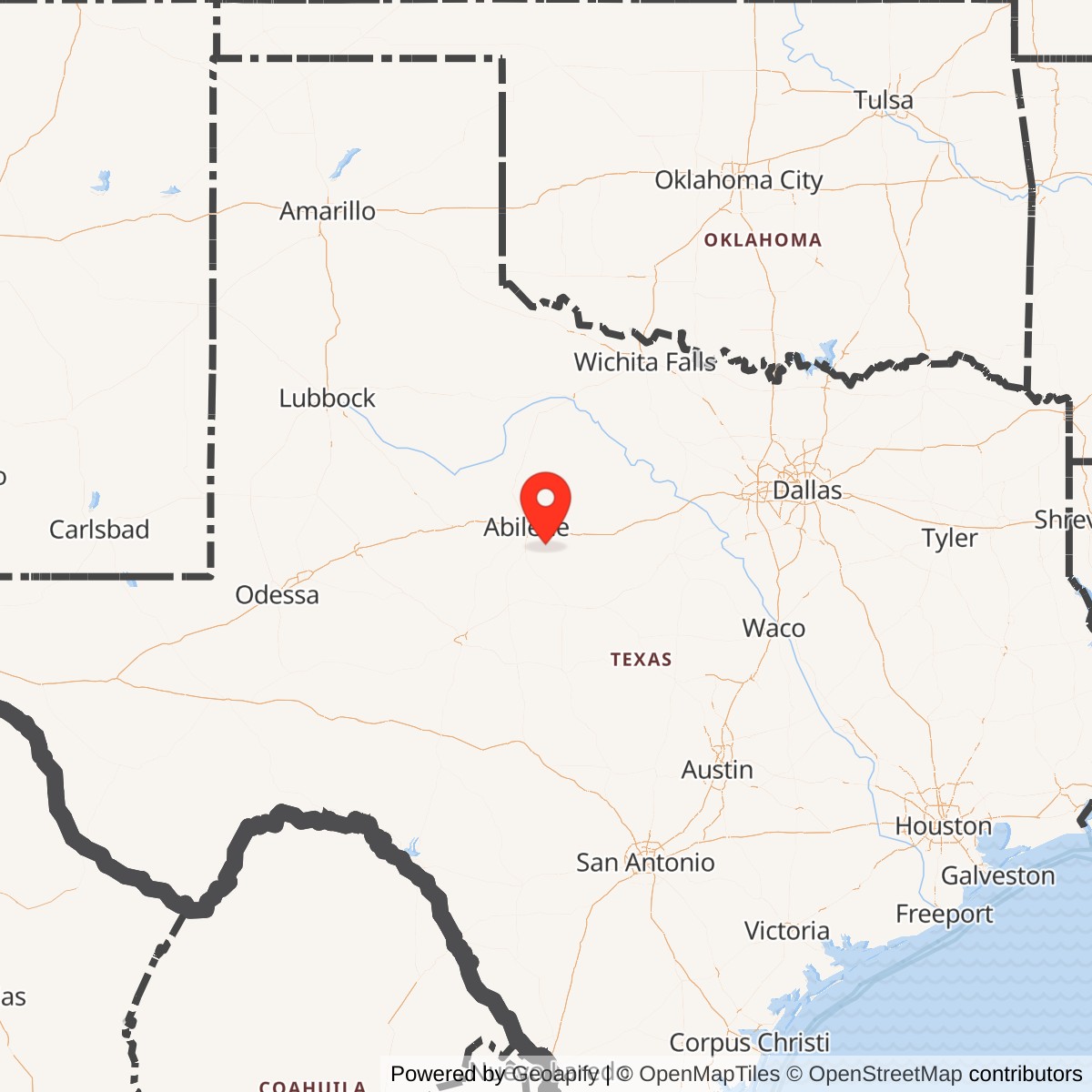
Atlas F Site 578-4 was one of the twelve SM-65F Atlas intercontinental ballistic missile launch complexes assigned to the 578th Strategic Missile Squadron at Dyess Air Force Base, Texas. The site was a single Atlas F vertical silo launch facility in Callahan County near Denton Valley / Denton Community, south-southwest of Clyde, Texas.
The launch facility belonged to the 96th Bombardment Wing, redesignated the 96th Strategic Aerospace Wing in 1963, through the 578th Strategic Missile Squadron. Like the other Atlas F sites around Dyess, 578-4 did not have a separate Minuteman-style remote parent Launch Control Center. The Atlas F launch complex incorporated its own hardened launch-control/support functions within the individual site.
The site was constructed during the Dyess Atlas F missile-field building program that began in 1960. The official squadron chronology gives the 578th Strategic Missile Squadron's turnover to Strategic Air Command as 1962-11-04 and operational date as 1962-11-15.
Atlas F Site 578-4 is inactive and decommissioned. It is no longer an active missile facility. The missile squadron was inactivated on 1965-03-25 as part of the accelerated phaseout of Atlas E, Atlas F, and Titan I cryogenic ICBMs. The former launch complex is now private property, and no public access has been verified. Public sources indicate that an original Quonset hut remains at the Site 4 property.
Location, Landscape, and Site Description
Site 578-4 was built in the rural Callahan County landscape associated with Denton Valley / Denton Community, a farming and ranching area southeast of Abilene and south-southwest of Clyde. The site's location reflects the standard Atlas F deployment pattern around Dyess Air Force Base: the launch complexes were dispersed around the base rather than concentrated on the main installation. This separation improved survivability, complicated enemy targeting, and placed each missile in its own hardened vertical silo.A completed Atlas F launch complex was far more than a simple hole in the ground. The underground launch facility contained a hardened vertical silo, launch platform, work platforms, mechanical and electrical systems, propellant-loading systems, environmental-control systems, communications equipment, power systems, and access features needed to maintain a liquid-fueled Atlas missile on alert. The site also had aboveground support structures, utilities, road access, security fencing, antennas and communications features, and maintenance and security access points. Atlas Missile Museum of Texas material for Site 4 states that an original Quonset hut remains, which is a useful visible marker that some surface support infrastructure survived after the missile mission ended.
The Atlas F launch complex's defining feature was the silo-lift launcher. The missile was stored vertically underground inside the hardened silo, but it was not launched from inside the silo. Before launch, the missile and launch platform were raised to the surface, the silo doors opened, and the missile was fired from the elevated platform. This made the Atlas F more protected than earlier aboveground or coffin-style Atlas sites, while still retaining the technical limitations of a liquid-fueled, pressure-stabilized missile.
Strategic and Cold War Context
Atlas F Site 578-4 existed because the early Cold War created an urgent requirement for intercontinental-range nuclear delivery systems that could be held on alert inside the continental United States. The Atlas program produced the United States' first operational ICBM, and the Atlas F represented the most hardened and operationally mature version of the Atlas family. The National Park Service summarizes the Atlas deployment sequence as a progression from Atlas D to Atlas E and Atlas F, noting that the Atlas F was fielded in blast-proof silo-lift configuration and that seventy-two Atlas F missiles were deployed at six Air Force bases, including Dyess.The Atlas F was still a first-generation liquid-fueled ICBM. It used the Atlas family's thin stainless-steel, pressure-stabilized airframe, which made the missile light enough for its engines and range requirement but imposed demanding maintenance and safety requirements. While earlier Atlas variants relied on less survivable launch arrangements, the Atlas F was placed in hardened individual silos. The launch complex had to protect the missile, permit a rapid response, support propellant loading and missile checkout, and connect the isolated site to Strategic Air Command command-and-control systems.
The Dyess missile field was part of a national pattern of dispersed Atlas F deployment. Each of the twelve Dyess sites represented a single nuclear-capable missile held away from the parent base. That arrangement reduced the vulnerability of the missile force to a single attack on Dyess AFB. It also distributed construction, maintenance, security, utilities, transportation, and emergency-response burdens across a large area of central Texas. Site 578-4 was one node in that wider missile field, but its isolated silo was itself a complete launch complex.
Construction and Activation
The construction history of Site 578-4 is inseparable from the larger Dyess Atlas F construction program. Official unit-history material for the 578th Strategic Missile Squadron states that initial responsibility for constructing the twelve Atlas F silos fell to the Corps of Engineers Fort Worth District. The same account notes that the Fort Worth District also received responsibility for nationwide procurement of the Atlas F propellant-loading system. When the Corps of Engineers Ballistic Missile Construction Office, or CEBMCO, was formed in 1960, the Fort Worth District was relieved of silo construction oversight. Bids were opened at Abilene on 1960-05-26, and the low bid of about $20 million came from the H.B. Zachry Company and Brown & Root, Inc. joint venture. Construction commenced on 1960-06-07. The official unit-history summary lists the twelve lift-launcher locations as Abilene, Albany, Clyde, Denton County, Oplin, Lawn, Bradshaw, Winters, Shep, Nolan, Anson, and Corinth; the Denton wording corresponds to Site 4.The Corps of Engineers' Dyess Area Office history provides the most detailed public construction context for the missile field. The Dyess Area Office was activated on 1960-04-18 under the U.S. Army Engineer District, Fort Worth. Lieutenant Colonel Albert M. Antonelli assumed command as Acting Area Engineer on 1960-04-26; the designation changed to Area Engineer on 1960-06-27. On 1960-12-01, the Dyess Area Office became a component of CEBMCO. The office expected to close in spring 1962 as the missile-field construction workload wound down and remaining work shifted elsewhere.
The Dyess Area Office described its mission as supervision, inspection, engineering control, and technical assistance for twelve hardened weapon-system launch-and-control facilities. The work was unusual because most of the personnel had not previously built this type of facility, because the tolerances were tight, and because the schedule was compressed. The sites were arranged in a broad circular pattern through six counties in west-central Texas, with Dyess Air Force Base near Abilene as the approximate hub. Most were placed near small towns or communities, which is why Site 4 carried the Denton / Denton Community label.
The construction office had to coordinate much more than excavation. Its work included contract administration, safety inspections, engineering review, construction inspection, materials and equipment expediting, as-built drawings, transfer documentation, and final acceptance testing. The construction branch coordinated schedules, tracked field changes, monitored progress, reviewed proposed changes for construction feasibility, arranged project photographs at important stages, and administered elements of the Defense Materials System to ensure timely arrival of materials and equipment. A specialized Propellant Loading System section provided technical advice, inspection, testing oversight, and liaison for one of the most critical parts of an Atlas F site: the system that handled liquid oxygen, RP-1 fuel, nitrogen, helium, and related ground-support equipment.
The engineering branch reviewed plans and specifications, shop drawings, material samples, design changes, and special tests. It also maintained as-built drawings and equipment lists. That level of technical control mattered because an Atlas F launch facility combined heavy civil construction, high-pressure gases, cryogenic oxidizer handling, missile support equipment, blast doors, mechanical and electrical systems, and hardened underground spaces in one complex. The Air Force could not accept a site simply because the major concrete work was complete; each subsystem had to be installed, tested, validated, documented, and signed off.
The official Air Force unit history notes that the Dyess project was unusual among major missile construction efforts because it was completed on time. It also states that there were no work stoppages due to labor unrest, but that the construction program came at a human cost: three fatalities and thirty-three disabling injuries were associated with the project.
Site 578-4's own construction start is not known to the day. Contracts and field work began in 1960, the 578th Strategic Missile Squadron was organized at Dyess in 1961, missiles and systems were accepted and delivered during 1962, and the squadron became operational in November 1962. The Site 4 missile was General Dynamics missile serial number 61-2567, manufacturing number 81F, Air Force tail number 567. It gives a missile acceptance date of 1962-05-16 and a delivery date of 1962-05-29.
Atlas Missile Museum of Texas preserves a site-specific Site 4 construction-photo page for "Denton Valley" (note: those are Air Force photographs attributed by USAF as "Dyes Construction Photos", not specific to any particular site). The page states that Site 4 was the Denton Valley site and that an original Quonset hut remains. It includes multiple construction images for the site, although the page provides little written captioning beyond the site name. The construction-photo collection is still important because it documents that Site 4 was part of the same Air Force and Army Corps of Engineers construction campaign represented by the larger Dyess Atlas F photographic collections.
HAER's Site S-8 documentation describes the basic construction process that turned a rural Texas parcel into a hardened Atlas F launch facility: open-cut excavation, shaft excavation, shoring, reinforced concrete placement, slip-form construction of the silo wall, installation of the steel crib, installation of the propellant-loading tanks and associated piping, installation of mechanical and electrical systems, and casting of the silo cap and doors.
The HAER S-8 description is especially valuable because it shows the scale of construction. At that representative Dyess silo, open-cut excavation began in late June 1960, followed by shaft excavation. When excavation reached harder gypsum, limestone, and shale, the contractor had to drill and shoot with explosives. The shaft required circular I-beam ring beams, welded wire mesh, pneumatic concrete, and shoring to resist earth pressure. The floor was sealed with reinforced concrete, reinforcing steel for the silo walls was installed, and a slip-form system allowed concrete to be placed in stages as the silo wall rose. The octagonal steel crib that held the missile support equipment was suspended within the completed silo and isolated from ground shock.
The same representative HAER material describes the Atlas F crib as a large suspended structure with eight work levels, a facility elevator to level eight, spiral stairs to level seven, and a ladder to level eight. It gives the crib's overall dimensions as about forty-two feet wide and 151 feet deep, with a rattle space between crib and silo wall to allow movement. The crib suspension system used wall brackets and shock struts to isolate the crib, support equipment, and missile from the damaging effects of ground shock. Propellant Loading System equipment included a 23,000-gallon liquid oxygen tank and gaseous nitrogen tanks, and later installation work included floor grating, stairs, ladders, handrails, piping, electrical equipment, mechanical units, counterweights, and drive mechanisms.
The final launch structure was equally demanding. The launch platform was an elevator-type structure that raised the missile to the surface before firing. The representative HAER account describes the platform as roughly forty-nine feet tall, approximately sixteen feet square, and about 222,000 pounds without the missile and ground equipment. It was raised and lowered by motors, gear reducers, cable drums, steel cables, and counterweights. Two steel silo doors capped the launching silo; each door was about twenty-two feet wide, two and a half feet thick, and about 150,000 pounds. The silo cap itself was a nine-foot-thick reinforced-concrete slab. Those details help explain why the Dyess Atlas F sites were major engineering works even though, from the surface, they could appear as modest fenced rural compounds.
Activation required much more than construction completion. The Corps of Engineers, the Site Activation Task Force, and contractor personnel validated systems and checklist items before the Air Force could accept and operate the site.
Missile System and Technical Role
Site 578-4 housed the SM-65F Atlas, the final operational Atlas ICBM variant. The Atlas F was a liquid-fueled, pressure-stabilized missile using RP-1 fuel and liquid oxygen oxidizer. The missile's thin stainless-steel structure had to remain pressurized to maintain its shape, a feature that made Atlas engineering distinctive but operationally demanding. The National Park Service describes the Atlas F as a taller and more advanced Atlas variant deployed in blast-proof silo-lift configuration, with a launch response time of approximately ten minutes. Official Air Force museum-style material notes that an elevator raised the Atlas to ground level for launch and that the Atlas missile family was phased out in 1965.The Atlas F launch complex was designed around the tension between protection and launch practicality. The missile was stored vertically underground for survivability, but could not be launched from within the silo. When ordered through proper command channels, the missile would be readied, raised with its launch platform, exposed by opening the massive silo doors, fueled and prepared according to technical procedures, and fired from the raised platform. That meant the launch facility had to combine a hardened shelter, a missile elevator, propellant loading and pressurization systems, electrical power, environmental control, guidance and checkout equipment, communications, security, and crew-support spaces.
The site was not continuously manned in the same way as a main base, but Atlas F complexes were operationally staffed and visited by missile crews, maintenance teams, security personnel, and specialists as required. The twelve 578th SMS sites around Abilene were manned around the clock during the squadron's active period. In practical terms, Site 578-4 functioned as an isolated operational missile complex tied to Dyess AFB and Strategic Air Command procedures, with the parent squadron responsible for alert readiness, inspections, maintenance, training, and security.
For Site 578-4 the assigned missile was General Dynamics serial number 61-2567, manufacturing number 81F, Air Force tail number 567. The missile acceptance date as 1962-05-16 and the delivery date as 1962-05-29. After the operational Atlas force was retired, the same missile was later launched from Vandenberg on 1967-10-27 with an ABRES payload.
The National Air and Space Museum identifies the Mark 4 reentry vehicle as used on U.S. Air Force Titan I and Atlas E/F ICBMs in the early 1960s and states that it carried a W-38 nuclear warhead with a yield of about 3.75 megatons.
Operational History
The 578th Strategic Missile Squadron was redesignated and activated on 1961-01-25, organized at Dyess AFB on 1961-07-01, assigned to the 96th Bombardment Wing, and operated SM-65F Atlas missiles during the early 1960s. Official unit-history material lists Dyess AFB as the squadron's station from 1961-07-01 to 1965-03-25 and the SM-65F Atlas as its missile system in 1962. The 96th Bombardment Wing became the 96th Strategic Aerospace Wing in 1963, reflecting the mixed bomber and missile character of Dyess during that era.Site 578-4 entered that operational system as one of twelve dispersed launchers around Abilene. Its purpose was not independent local defense; it was part of SAC's strategic nuclear deterrent. Day-to-day operational history at a site like 578-4 involved alert readiness, missile checks, equipment maintenance, security checks, environmental-control monitoring, propellant-system maintenance, crew proficiency, emergency procedures, communications tests, and periodic inspections. The site's isolation meant that maintenance or security teams traveling from Dyess or other support points had to reach the compound by road, work within a hardened and hazardous technical environment, and maintain accountability for sensitive equipment.
The Cuban Missile Crisis occurred during the Dyess Atlas F activation period. During the crisis all operational 578th sites were at a high alert level and ready to launch if necessary. The official unit-history summary states that the 578th became operational in 1962 and that its twelve missiles were all placed on alert status during the Cuban missile crisis. The squadron-level operational date, however, is listed as 1962-11-15, after the peak public confrontation in October 1962.
Once operational, the site's active service was brief. Atlas F represented a major advance over earlier Atlas launch configurations, but it was overtaken quickly by solid-fueled Minuteman missiles and by changing strategic priorities. The National Park Service notes that Atlas sites were operational at their peak from December 1962 through May 1964 and then phased out in favor of Minuteman and Titan systems. For the 578th SMS, that meant only about two years of full operational service between squadron operational status in November 1962 and the first Dyess Atlas F removal from alert in December 1964.
Deactivation and Disposal
Atlas F Site 578-4 left active missile service during the accelerated retirement of first-generation cryogenic ICBMs. On 1964-05-16, Secretary of Defense Robert S. McNamara directed accelerated phaseout of the Series E Atlas, Series F Atlas, and Titan I ICBMs. The SAC Missile Chronology records the decision and states that the phaseout was intended to save approximately $188 million and allow completion no later than the end of fiscal year 1965. This decision reflected the transition away from Atlas and Titan I systems toward more survivable, less operationally burdensome solid-fueled Minuteman missiles and other strategic systems.Official unit-history material for the 578th SMS gives the deactivation sequence for the Dyess Atlas F force: the first Dyess Atlas F missile was removed from alert on 1964-12-01, the last ICBM was removed from alert on 1965-02-03, the last ICBM was shipped on 1965-02-10, and the squadron was inactivated on 1965-03-25. The exact date on which the individual Site 578-4 missile came off alert or was physically shipped was not found.
The Atlas E/F and Titan I phaseout was a formal process rather than a simple abandonment of sites. Deactivation planning documents describe phases that included removal and preparation for shipment of reentry vehicles, missiles, classified components, and excess mobile equipment; disposal or redistribution of propellants and gases; shutdown of unnecessary power and equipment; protection of systems left in place; and transfer of sites to base civil-engineer care and custody until real estate disposal. AFLC had responsibility for overall program guidance, missile shipments, and disposition of missile assets, while SAC retained accountability until assets were disposed of and helped secure facilities and prepare them for care and custody.
The same phaseout documentation describes practical difficulties unique to Atlas F silos. Cryogenic liquids could not be off-loaded from Atlas F sites until the silo suspension system was preloaded by installation of stanchions, a task requiring special tool kits and substantial labor. Missile shipments were conducted largely overland rather than by air. Equipment and spares were screened for redistribution, reuse, donation, salvage, or disposal. Airframes removed from deactivated sites were sent to storage pending final disposition for booster-support or other requirements.
After deactivation, Site 578-4 was no longer a Strategic Air Command missile site. Public evidence does not show preservation as a formal historic site. USACE's 2015 Texas FUDS inventory lists the property as "DENTON ATLAS AF FACILITY S-4," property number K06TX0109, in Callahan County, with category BD/DR, meaning Building Demolition and Debris Removal. ProPublica's public DERP table, which summarizes Defense Environmental Restoration Program records, lists "ATLAS AF FACILITY S-4" at Denton Community, Callahan County, as Response Complete.
Current Status and Site Use
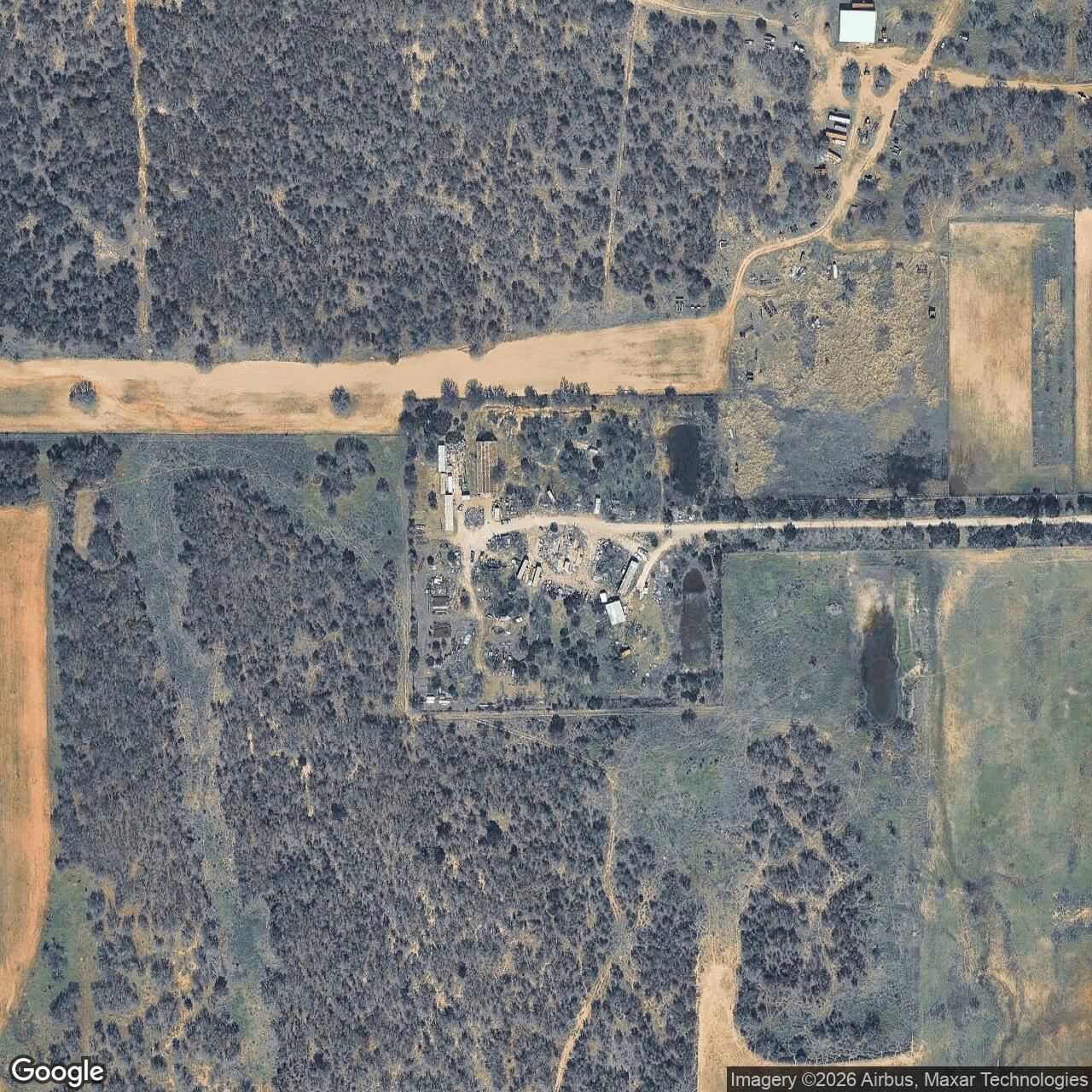
Atlas F Site 578-4 is a former missile complex on private property. No public access is verified, and the site should be treated as private land unless a current owner or operator explicitly grants permission.Atlas Missile Museum of Texas states that an original Quonset hut remains at Site 4 but provides no further written current-use detail. Satellite images for Site 4 show the former missile-site footprint in a rural setting. The site is not known to be a museum, park, or officially interpreted historic site. The underground silo and support structures may have been altered, sealed, salvaged, or otherwise reused after deactivation, but no definitive public source documents the full post-1965 physical-disposal sequence for this specific site.
Chronology
- 1960-04-18 The Corps of Engineers Dyess Area Office was activated under the U.S. Army Engineer District, Fort Worth, to support the Dyess Atlas F construction program.
- 1960-05-26 Bids for the Dyess Atlas F silo construction program were opened at Abilene; the low bid was submitted by the H.B. Zachry Company and Brown & Root, Inc. joint venture.
- 1960-06-07 Construction commenced on the Dyess Atlas F lift-launcher program.
- 1960-12-01 The Dyess Area Office became a component of the Corps of Engineers Ballistic Missile Construction Office.
- 1961-01-25 The 578th Strategic Missile Squadron was redesignated and activated.
- 1961-07-01 The 578th Strategic Missile Squadron was organized at Dyess AFB.
- 1962-05-16 Site 4 missile, Atlas 81F / serial 61-2567 / tail number 567, was accepted.
- 1962-05-29 The Site 4 missile was delivered.
- 1962-11-04 Official squadron chronology lists turnover of the 578th Strategic Missile Squadron to Strategic Air Command.
- 1962-11-15 Official squadron chronology lists the 578th Strategic Missile Squadron as operational.
- 1964-05-16 Secretary of Defense Robert S. McNamara directed accelerated phaseout of the remaining Series E Atlas, Series F Atlas, and Titan I ICBMs.
- 1964-12-01 The first Dyess Atlas F missile was removed from alert ahead of schedule to avoid costly maintenance.
- 1965-02-03 Official squadron chronology lists the last 578th SMS ICBM as removed from alert.
- 1965-02-10 Official squadron chronology lists the last 578th SMS ICBM as shipped.
- 1965-03-25 The 578th Strategic Missile Squadron was inactivated.
- 1967-10-27 The former Site 4 missile airframe, Atlas 81F, was later launched with an ABRES payload.
- 2015-09-30 The USACE Texas FUDS inventory listed DENTON ATLAS AF FACILITY S-4 / K06TX0109 in Callahan County with BD/DR category.
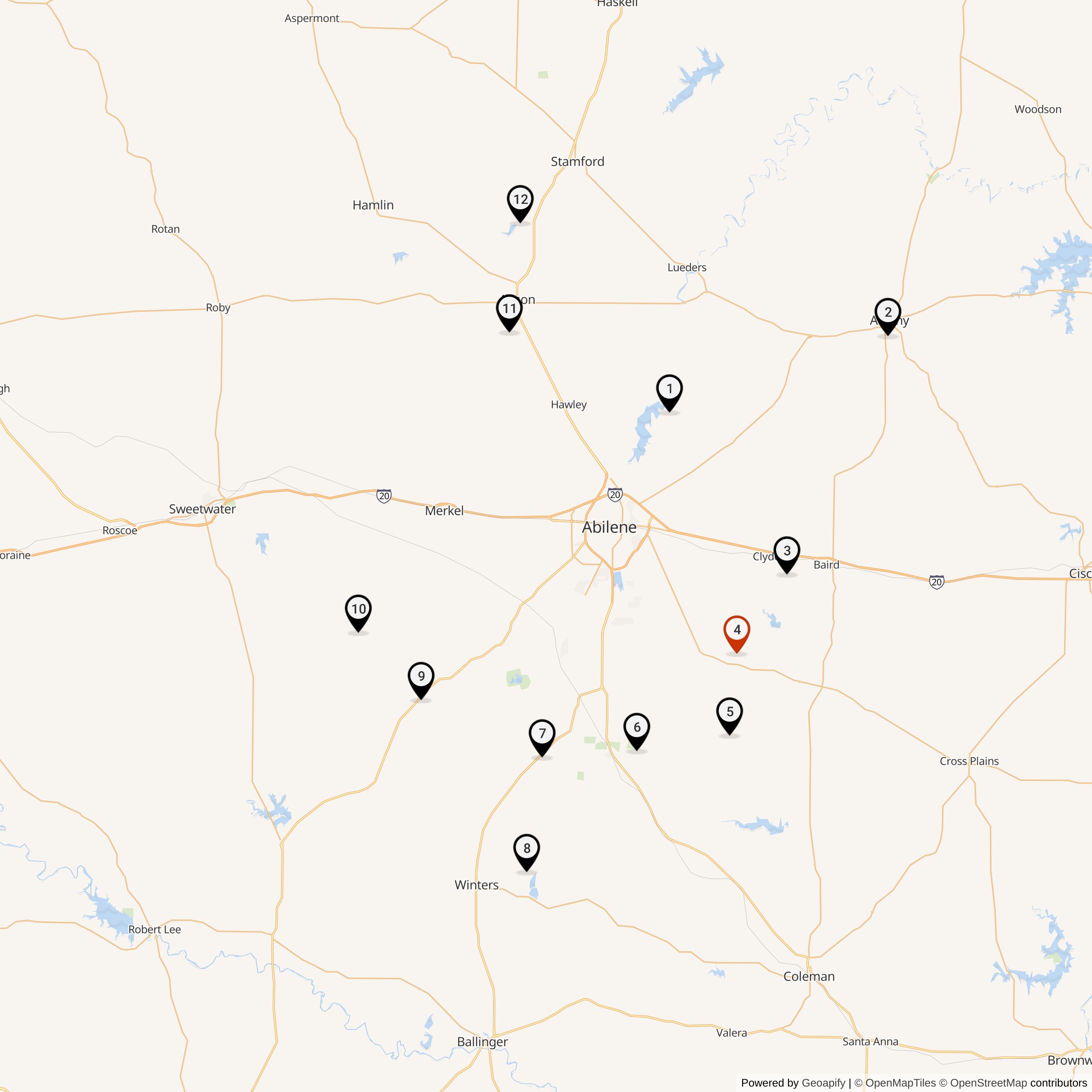
Read about the Atlas at Dyess AFB
All Atlas Missile Silo Locations