
Atlas F Site 579-6 Missile Silo, Hagerman New Mexico
Longitude: -104.120213010861
Site Type: Atlas F vertical silo launch facility
Missile Type: SM-65F Atlas
Missile Assigned to this Silo: GD mfg 79F; GD serial 61-2565; AF tail 565
Number of Launchers/Missiles: 1
Parent Base: Walker AFB
Missile Wing: 6th Strategic Aerospace Wing
Missile Squadron: 579th Strategic Missile Squadron
Corps of Engineers Site ID: 4
Approximate Base Size: 5.93 site acres; DOD originally acquired 28.93 fee acres plus 108 easement acres and 170 withdrawn public-domain acres
Current Site Use: Former Atlas F launch complex; 2009 EPA/NMED Ready for Reuse determination covers surface property for current/anticipated industrial operation; current physical use not independently verified.
Site Ownership: Former USAF; DOD acquired 28.93 fee acres plus easements/withdrawn public domain; GSA conveyed 5.93-acre site to W.L. Pennington and Cliff C. Henderson in 1967; 2009 EPA letter identified Windell Petree as owner; current ownership not reverified.
Accessible: No public access; treat as private property and a former missile/industrial site.
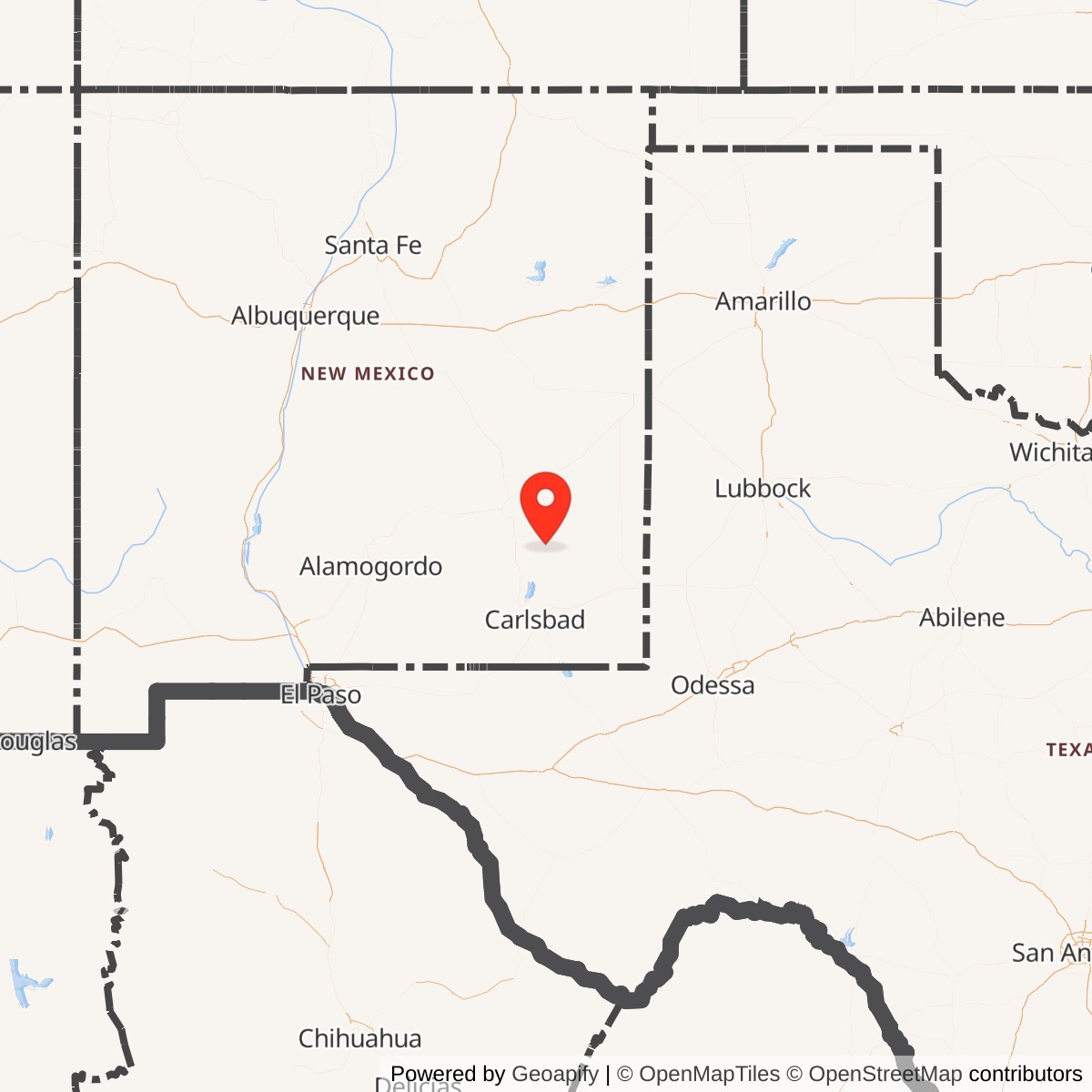
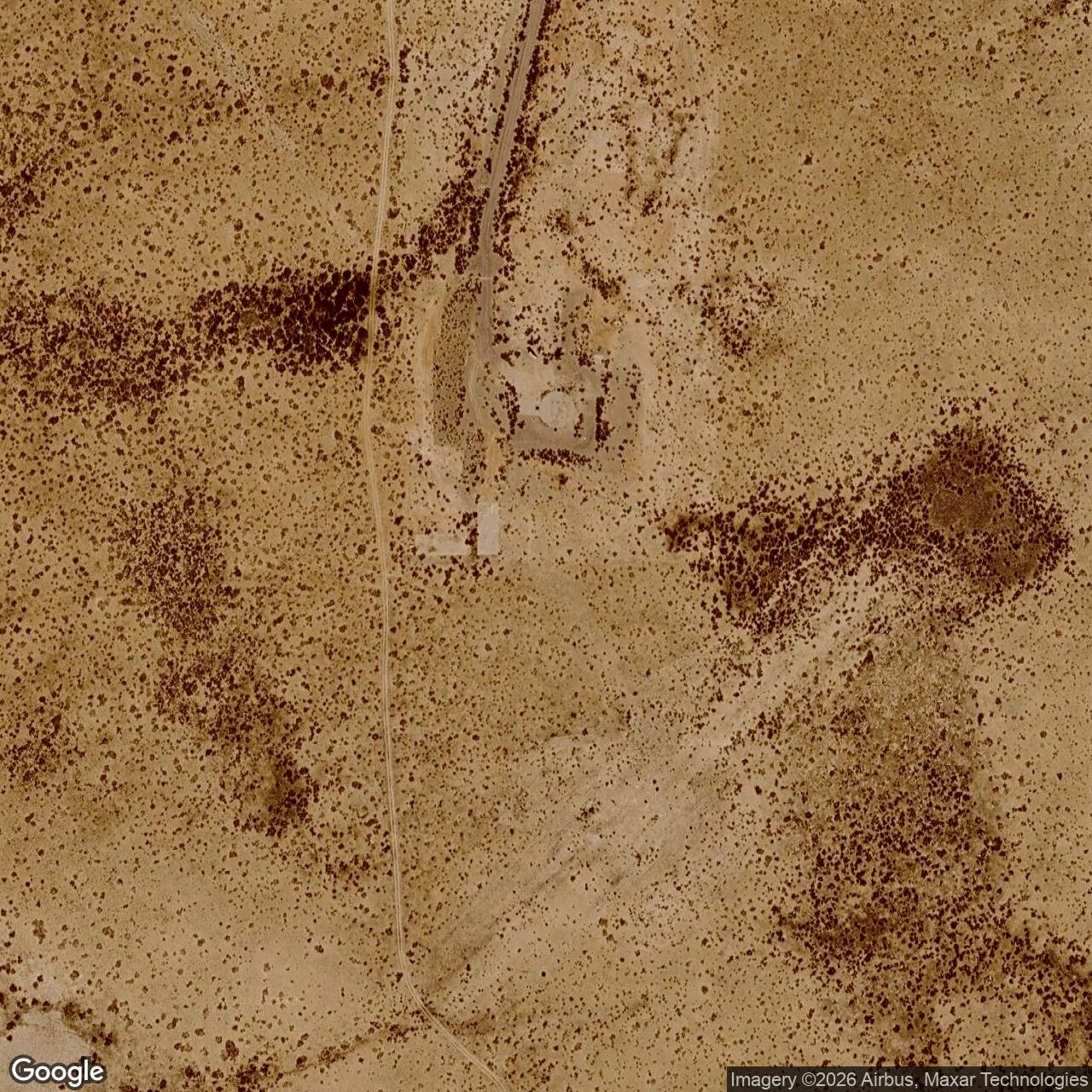
East-southeast of Hagerman, New Mexico, an ordinary-looking patch of Chaves County desert once held a weapon that demanded extraordinary choreography. Atlas F Site 579-6 was not a roadside monument or a museum piece. It was a hardened vertical launch complex where a first-generation American intercontinental ballistic missile sat underground, connected to its own launch control center, waiting for a launch sequence that would have required doors, elevator machinery, pressure systems, kerosene fuel, cryogenic liquid oxygen, and a trained crew to work perfectly under the worst imaginable circumstances. The site never fired a missile, and unlike three other Walker Atlas F sites, it was not destroyed in an operational accident. Its afterlife is therefore just as important as its Cold War service: it survived the missile era, passed out of federal hands, entered environmental investigation, and by 2009 had received an EPA and New Mexico Environment Department Ready for Reuse determination for its surface property.
Atlas F Site 579-6 was an SM-65F Atlas intercontinental ballistic missile launch facility assigned to Walker Air Force Base near Roswell, New Mexico. It belonged to the 579th Strategic Missile Squadron, under the 6th Bombardment Wing, later the 6th Strategic Aerospace Wing. The site code was 579-6. Its missile system was the SM-65F Atlas, the final operational Atlas ICBM variant and the Atlas model deployed in hardened silo-lift launch complexes.
The site became part of the operational 579th Strategic Missile Squadron force during 1962, with squadron operational turnover recorded on 1962-11-30. It left active missile service with the Atlas phaseout and the 579th Strategic Missile Squadron's inactivation on 1965-03-25. The site is no longer an active military installation. It is a decommissioned former Atlas F missile site on private property, with no public access. The surface property received an EPA/NMED Ready for Reuse determination in 2009 for current and anticipated industrial use.
Location, Landscape, and Site Description
Site 579-6 sat in the rural missile belt southeast of Roswell and east of Hagerman. The landscape is open, arid to semi-arid, and sparsely developed, with desert scrub, ranching and agricultural uses, oil-and-gas country, and long rural roads defining the region. Its separation from Walker Air Force Base was not accidental. Atlas F sites were dispersed around the support base so that no single enemy strike could destroy the entire squadron. At Walker, the twelve Atlas F complexes formed a wide ring around the Roswell area, each holding one missile and each operating as its own launch complex.
The 1962 Atlas site tour bulletin for the Walker missile field described the general Atlas F launch facility in terms that help explain what was built at Site 579-6. Each launching facility included a deep cylindrical launch silo, a launch control center, and a connecting underground tunnel. The silo was about 178 feet deep and had a 26-foot, 1-inch inside radius, producing an inside diameter of roughly 52 feet, 2 inches. The launch control center was about 40 feet in inside diameter. The missile silo walls were heavily reinforced concrete, and the interior held a suspended steel crib supported from shock mounts. The launch control center also used suspended floors, a design meant to protect personnel and equipment from shock. Above ground, the complex included the access road, security fencing, surface utility and support features, blast-door structures, and space for operations, maintenance, and security activity.
The EPA Ready for Reuse documentation provides unusually specific land-disposal detail for Site 579-6. The Department of Defense acquired 28.93 acres for development of the site. The actual missile facility occupied 5.93 acres, and the government also used 108 acres in easements and 170 acres withdrawn from public domain. This distinction matters because Atlas launch properties often included both the hardened missile facility and rights-of-way or ancillary land interests needed for construction, access, utility lines, and operational support.
Strategic and Cold War Context
Atlas F Site 579-6 existed because, in the early 1960s, the United States was racing to place survivable nuclear-armed missiles on operational alert. Atlas was the Air Force's first operational ICBM family. It was a remarkable machine, but also an awkward one: its very thin stainless-steel structure had to be pressurized, and its propulsion system used RP-1 kerosene and liquid oxygen. That made Atlas both powerful and demanding. It could reach intercontinental ranges, but it required careful handling, continuous attention to pressure systems, and a launch process that was more elaborate than the later solid-fueled Minuteman.
The Atlas F was the last and most advanced operational Atlas missile type. Unlike Atlas D gantry and coffin-launcher arrangements, the Atlas F was stored vertically underground in a hardened silo-lift complex. The National Park Service summarizes the Atlas F as an 82-foot missile held in a blast-proof silo-lift configuration and capable of launch in roughly ten minutes. Seventy-two Atlas F missiles were deployed, including twelve based from Walker Air Force Base.
The purpose of Site 579-6 was therefore not local defense of Roswell or Hagerman. It was part of national strategic deterrence. Its isolated location, hardened construction, on-site launch control center, security fencing, and dispersal from the other Walker sites were all physical expressions of Cold War logic: keep missiles spread apart, protect them from a first strike as much as first-generation technology allowed, and maintain enough weapons on alert that an adversary could not confidently neutralize the force.
For Atlas F sites, the phrase "operational launch-ready alert posture" needs explanation. It did not mean that the missile was continuously raised above ground. It also did not mean that it was continuously loaded with liquid oxygen. In normal alert conditions, the missile sat vertically in its underground silo on the elevator launcher. The RP-1 fuel was kept aboard, the missile and facility systems were maintained in readiness, and the missile remained pressurized. Liquid oxygen, a cryogenic oxidizer, would be loaded as part of the launch sequence. The heavy silo doors would open, the missile and launcher would be raised, and the crew could top off liquid oxygen during a hold before the final "missile away" command. During a crisis, readiness meant crews, security, communications, propellant systems, and missiles were brought to the highest practicable state of serviceability, including returning degraded or training missiles to alert status where possible. It did not mean a continuously elevated, continuously LOX-loaded Atlas F waiting exposed in the open.
Construction and Activation
Planning for the Walker Atlas F launch facilities moved quickly. A 1962 Army Corps of Engineers tour bulletin stated that the decision to build Atlas launching facilities in the area was reached in early January 1960. The Albuquerque District was then asked to perform soil investigations to determine whether the geology could support the proposed installations. Those investigations were completed by Spencer J. Buchanan Company and Gordon Herkenhoff & Associates with favorable results. Design began in early March 1960. The project was advertised for bids on 1960-05-16, bids opened on 1960-06-15, and a construction contract of $22,125,828 was awarded on 1960-06-16 to a joint venture of Macco Corporation, Raymond International, Inc., The Kaiser Company, and Puget Sound Bridge & Dry Dock Company. Notice to proceed followed on 1960-06-20, and work began on 1960-06-23.
The same tour bulletin gives a useful sense of the scale of each Atlas F site. Construction required open excavation for the launch control center and silo area, shaft excavation to about 178 feet below original ground surface, extensive concrete placement, installation of structural crib steel, and careful installation of mechanical, electrical, and propellant-loading systems. The document estimated about 48,000 cubic yards of material excavated by open-cut methods and another 24,000 cubic yards excavated by silo shafting. About 6,000 cubic yards of Portland cement concrete went into each site. The silo crib steel alone weighed about 600 tons; with fueling vessels, motor generators, propellant-loading skids, and related equipment, the suspended interior system weighed approximately 1,800,000 pounds.
Site 579-6 was one of the twelve Walker Atlas F complexes constructed under this effort. It was Corps of Engineers Construction Site Number 4 and Air Force Operational Site Number 6. The EPA Ready for Reuse determination states that construction of the missile launching facility was completed in November 1961. Installation, checkout, missile delivery, and operational acceptance followed in 1962. The missile assigned to Site 6 was General Dynamics serial number 61-2565, General Dynamics manufacturing number 79F, Air Force missile tail number 565, accepted on 1962-06-08 and delivered on 1962-06-13. The 579th Strategic Missile Squadron history records operational turnover to Strategic Air Command and operational status on 1962-11-30.
Missile System and Technical Role
The missile assigned to Site 579-6 was an SM-65F Atlas, the final deployed ICBM version of the Atlas family. The Atlas F was a liquid-fueled missile using RP-1 kerosene and liquid oxygen. In the Atlas F arrangement, the missile stood vertically in a hardened underground silo on a large elevator launcher. To launch, the silo doors opened, the launcher raised the missile above ground, liquid oxygen loading and topping procedures were completed as required, and the missile launched from the raised position.
The National Park Service describes the Atlas F as carrying a roughly 4.5-megaton-class warhead. The Smithsonian National Air and Space Museum's Mark 4 reentry vehicle entry identifies the Mark 4 reentry vehicle used on Atlas E/F and Titan I as carrying a W-38 nuclear warhead with a yield of about 3.75 megatons.
Unlike later Minuteman launch facilities, which were normally unmanned silos controlled from a remote launch control center, Atlas F sites were self-contained launch complexes. The site included its own underground launch control center connected to the missile silo. Launch crews, security personnel, maintenance teams, propellant specialists, communications technicians, and other support personnel were all part of keeping the site ready. The 579th Squadron history states that the twelve Walker sites were manned continuously while the squadron was active. In practice, that meant Site 579-6 was not simply an empty hole with a missile inside. It was a round-the-clock technical and security workplace built around a dangerous liquid-fueled weapon.
Operational History
The 579th Strategic Missile Squadron was activated in 1961 and organized at Walker Air Force Base on 1961-09-01. It was assigned to the 6th Bombardment Wing, later the 6th Strategic Aerospace Wing. Its weapon system was the SM-65F Atlas, and by 1962 the squadron was the missile arm of Walker's strategic mission.
Site 579-6 entered that mission during a tense year. The squadron's first ICBM arrived in January 1962. Site 6's assigned missile was accepted in June 1962 and delivered shortly thereafter. By late 1962, the 579th reached operational status. The Cuban Missile Crisis of October-November 1962 then gave the new missile field its first great test. Squadron-level historical sources state that all operational 579th sites were at a high level of alert during the crisis and ready to launch if ordered. For Site 579-6, that meant participation in the same force-wide readiness posture as the other operational Walker Atlas F sites, not a separate site-specific launch or accident.
Operational life at Site 579-6 was demanding because Atlas F readiness depended on constant maintenance. The missile had to remain pressurized. Propellant-loading equipment had to be kept clean and reliable. The site had to maintain communications with the command chain, keep launch-control equipment functional, and protect both classified equipment and nuclear weapon components. The 1962 construction bulletin emphasized the extreme cleanliness requirements of the propellant loading system; hydrocarbons or foreign material in the wrong place could create violent hazards. That warning was not theoretical. The Atlas program suffered several catastrophic propellant-loading accidents, including three at Walker sister sites: Site 579-1 on 1963-06-01, Site 579-5 on 1964-02-13, and Site 579-2 on 1964-03-09. Site 579-6 was not one of the destroyed sites, but those accidents formed the operational environment in which its crews worked.
The Atlas F system was overtaken quickly by newer technology. Solid-fueled Minuteman missiles did not require the same liquid-oxygen loading process, could remain on alert more easily, and represented the future of U.S. ICBM operations. Secretary of Defense Robert S. McNamara announced the early phaseout of the remaining Atlas missiles in November 1964. The 579th Strategic Missile Squadron history records the first 579th ICBM off alert on 1965-01-05, the last ICBM off alert on 1965-02-04, and the last ICBM shipped on 1965-02-09. The squadron inactivated on 1965-03-25.
Deactivation and Disposal
The end of Site 579-6's active missile role was part of the broader Atlas phaseout. Atlas had been America's first operational ICBM, but by the mid-1960s it was a transitional system. Its liquid-fueled operations, cryogenic oxidizer requirements, and maintenance burden made it less attractive than solid-fueled Minuteman. In November 1964, the Defense Department announced that remaining Atlas missiles would be phased out earlier than previously planned. The 579th Strategic Missile Squadron then moved rapidly through de-alerting, missile shipment, and inactivation.
The 579th history gives the key squadron dates: first ICBM off alert on 1965-01-05, last ICBM off alert on 1965-02-04, last ICBM shipped on 1965-02-09, and squadron inactivation on 1965-03-25. The Site 6 missile, 79F, was not launched and was ultimately salvaged as scrap.
Property disposal followed. The EPA Ready for Reuse determination states that in February 1966, Silo Site 6 was declared excess to the General Services Administration. In October 1967, GSA conveyed the 5.93-acre site to W. L. Pennington and Cliff C. Henderson. The EPA letter identifies the owner as Windell Petree at the time of the 2009 Ready for Reuse action.
Environmental review occurred under the Defense Environmental Restoration Program and Formerly Used Defense Sites process. The USACE FUDS inventory lists WAFB FAC SITE #6, property number K06NM0484, in Hagerman, Chaves County, with Site 01 categorized as CON/HTRW and Site 02 categorized as HTRW. EPA's 2009 determination summarizes the investigation history. A preliminary assessment and site inspection were conducted to evaluate whether Defense Department activities created an immediate or potential threat to human health or the environment. The site inspection examined three potential source areas: the former underground storage tank area, the septic leachfield, and the sump outfall. Arsenic detected in soil samples was determined to be naturally occurring and not indicative of contamination. PCB Aroclor-1260 was detected in soil in the sump outfall area above evaluation criteria, and USACE removed the impacted soil, placed it in a stockpile, transported it, and disposed of it at a licensed facility. Follow-up sampling documented that PCB concentrations were either not detected above laboratory reporting limits or were below evaluation criteria.
The EPA determination also noted metals in groundwater samples from monitoring wells, but stated that groundwater samples collected at the site contained total dissolved solids above 10,000 mg/L, the New Mexico Water Quality Control Commission threshold for application of groundwater protection standards. EPA concluded, with NMED concurrence, that environmental conditions on the surface property were protective for current and anticipated future use and that no further remedial action was needed for the property based on the reviewed conditions. The letter also cautioned that if property conditions, land use, or receptors change, the suitability for reuse may need to be revisited.
Current Status and Site Use
Atlas F Site 579-6 is decommissioned and no longer active. It is a former missile launch complex on private property east of Hagerman, New Mexico, at approximately 33.072692, -104.120213. There is no public access, and the site should be treated as private property and a former industrial/military facility.
The surface property received a Ready for Reuse determination in 2009 for current and anticipated industrial use. That finding is important but limited: it speaks to environmental suitability for the surface property based on the investigation and conditions reviewed by EPA, NMED, and USACE. It does not turn the former silo into a public attraction, nor does it eliminate normal safety concerns associated with abandoned or reused underground military structures.
Chronology
- 1960-01 The decision to build Atlas launching facilities in the Walker AFB/Roswell area was reached, and the Albuquerque District began soils-investigation work for the proposed installations.
- 1960-03 Design work for the Walker Atlas launch facilities began after completion of initial geologic investigations.
- 1960-05-16 The Walker Atlas F construction project was advertised for bids.
- 1960-06-15 Bids were opened for the Walker Atlas F construction project.
- 1960-06-16 The construction contract was awarded to the joint venture of Macco Corporation, Raymond International, Inc., The Kaiser Company, and Puget Sound Bridge & Dry Dock Company.
- 1960-06-20 Notice to proceed was issued for the Walker Atlas F construction contract.
- 1960-06-23 Construction work began on the Walker Atlas F launch facilities.
- 1961-09-01 The 579th Strategic Missile Squadron was organized at Walker Air Force Base.
- 1961-11 Construction of the missile launching facility at Site 579-6 was completed, according to the EPA Ready for Reuse determination.
- 1962-06-08 The missile later associated with Site 579-6, General Dynamics serial number 61-2565 / manufacturing number 79F / Air Force tail number 565, was accepted.
- 1962-06-13 Missile 79F was delivered.
- 1962-10 During the Cuban Missile Crisis, operational 579th Strategic Missile Squadron Atlas F sites were placed at a high level of readiness.
- 1962-11-30 The 579th Strategic Missile Squadron recorded turnover to Strategic Air Command and operational status.
- 1963-06-01 Sister Site 579-1 was destroyed in an explosion during a propellant-loading exercise.
- 1964-02-13 Sister Site 579-5 was destroyed in an explosion during a propellant-loading exercise.
- 1964-03-09 Sister Site 579-2 was destroyed in an explosion during a propellant-loading exercise.
- 1964-11 The Department of Defense announced the early phaseout of liquid-fueled Atlas missiles.
- 1965-01-05 The 579th Strategic Missile Squadron recorded its first ICBM off alert.
- 1965-02-04 The 579th Strategic Missile Squadron recorded its last ICBM off alert.
- 1965-02-09 The 579th Strategic Missile Squadron recorded its last ICBM shipped.
- 1965-03-25 The 579th Strategic Missile Squadron was inactivated, and Site 579-6 is recorded as decommissioned.
- 1966-02 Silo Site 6 was declared excess to the General Services Administration.
- 1967-10 GSA conveyed the 5.93-acre site to W. L. Pennington and Cliff C. Henderson.
- 2005-11 USACE completed a site inspection for Atlas Missile Silo Site 6.
- 2006-02 USACE completed a site inspection report addendum for the Site 6 sump outfall area.
- 2007-09 The New Mexico Environment Department and USACE issued a Finding of No Defense Action Indicated for Site 6.
- 2009-09-16 EPA Region 6, with NMED concurrence, issued a Ready for Reuse determination and Ready for Reuse Certificate for the former Atlas Missile Silo Site 6 surface property.
- 2015-09-30 The USACE New Mexico FUDS inventory listed WAFB FAC SITE #6 / K06NM0484 with CON/HTRW and HTRW project categories.
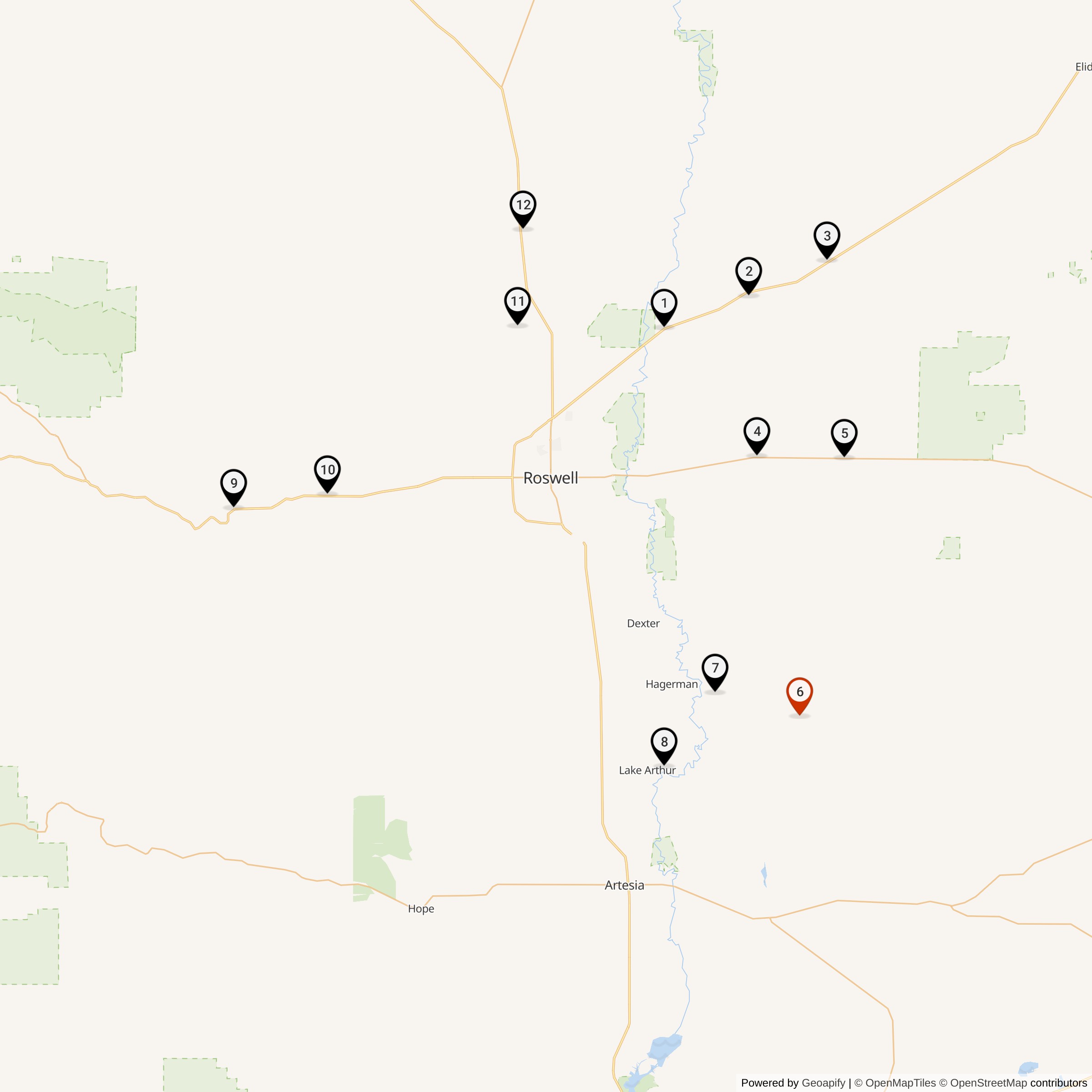
Read about the Atlas at Walker AFB
All Atlas Missile Silo Locations