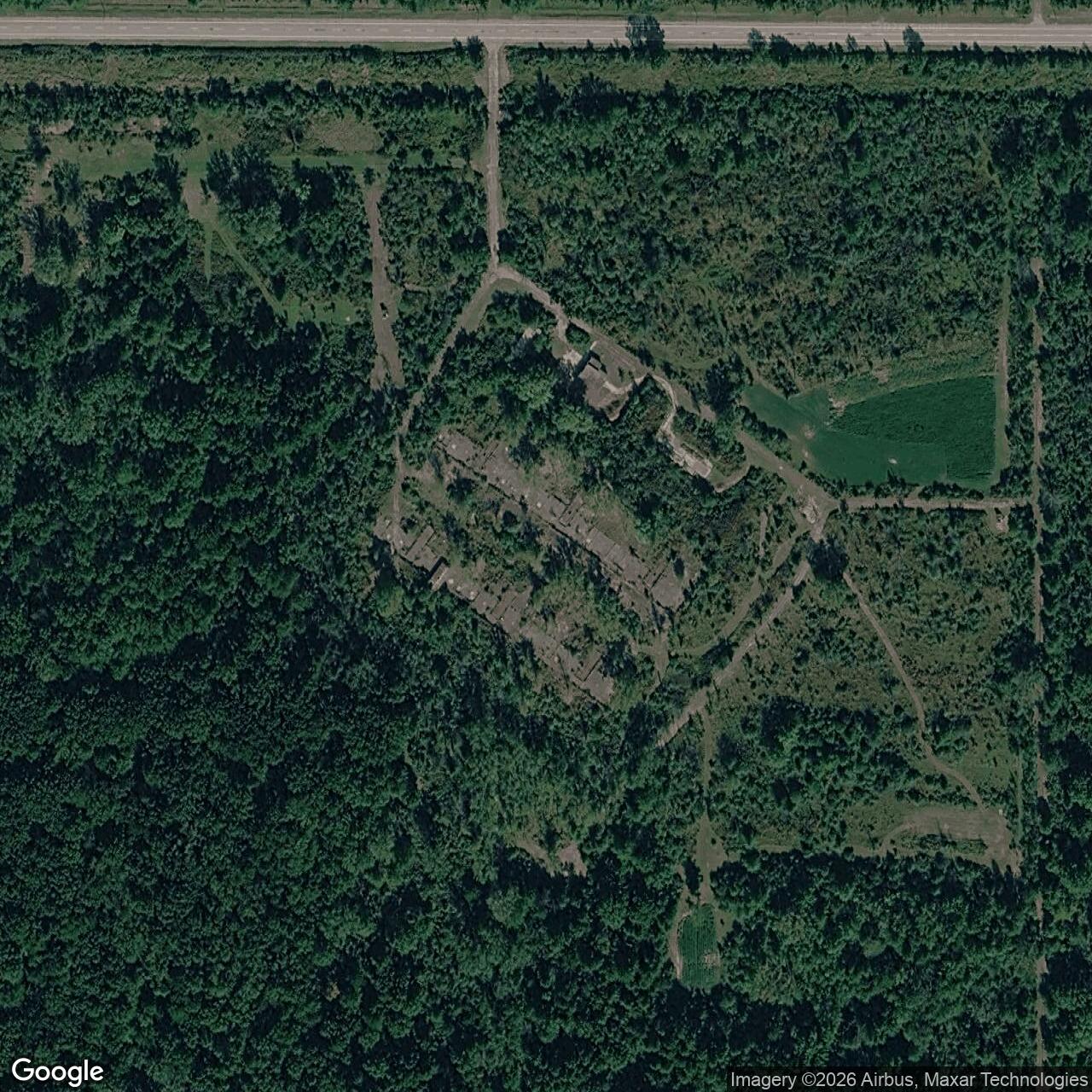
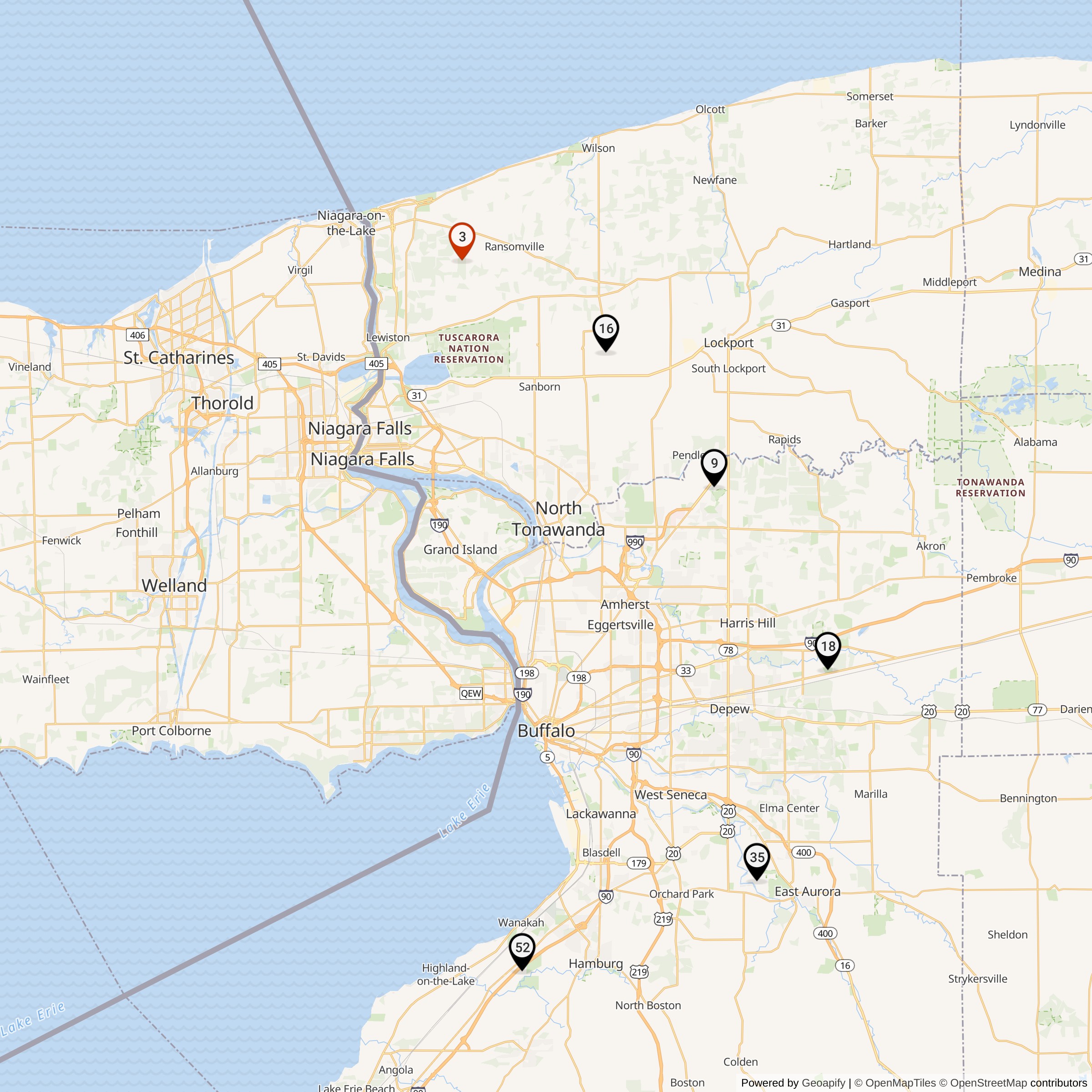
Nike Missile Site NF-03 Launcher, Model City / Lewiston / Porter New York
Longitude: -78.9619517654416
This location was part of the Niagara Falls-Buffalo Defense Area
Site ID: NF-03
Missile / battery configuration: Nike 2B,4C/60A/24L-AA
The missiles at this Launch Area were controlled by the Integrated Fire Control site located here.
Site Role: Launcher
A typical Nike air defense site consisted of two separate parcels of land. One area was known as the Integrated Fire Control (IFC) Area. This site contained the Nike system's ground-based radar and computer systems designed to detect and track hostile aircraft, and to guide the missiles to their targets.
The second parcel of land was known as the Launcher Area. At the launcher area, Nike missiles were stored horizontally within heavily constructed underground missile magazines. A large, missile elevator brought the Nikes to the surface of the site where they would be pushed across twin steel rails to one of four satellite launchers.
Elaboration on how Nike worked here.
Missile Type: Ajax
The Nike Ajax was the first in the Army's family of guided missiles, and the world's first operational, guided, surface-to-air missile system. Nike Ajax had a burnout speed of Mach 2.3, a range of 25-30 miles, and a ceiling of 65,000 feet.
Designed to carry either nuclear and/or high-explosive warheads, the Nike Hercules missile could attack supersonic aircraft operating at altitudes in excess of 150,000 feet and at a range of more than 87 miles.
NF-03 was built where one generation of American war planning had already left an enormous footprint. The Army placed this double Nike Ajax battery inside the former Lake Ontario Ordnance Works, a sprawling World War II industrial reservation north of Niagara Falls that had become known locally as Model City. From that reclaimed military landscape, sixty missiles and twenty-four launchers guarded the Niagara frontier during the tense opening years of the Cold War.
The site was designed as a dual battery rather than an ordinary Nike position. Two fire-control sections operated with an expanded launcher complex containing six underground magazines. Battery A of the Regular Army's 44th Antiaircraft Artillery Missile Battalion took up the mission in 1955. The unit later became Battery A, 1st Missile Battalion, 4th Artillery. In 1960, two New York Army National Guard batteries assumed the double position and kept it operational until the regional Ajax force was retired in 1963.
NF-03 never converted to Nike Hercules. Its military story did not end with the Army, however. The former launch property passed to the Air Force and became the Youngstown Test Site, later called the Youngstown Test Annex. It served as the western end of a tropospheric-scatter communications test range under Griffiss Air Force Base. That unusual second mission makes NF-03 one of the most distinctive Nike properties in New York.
The physical site has endured a far less orderly afterlife. The former fire-control area became wooded and overgrown, with deteriorating buildings reported on the east side of Porter Center Road. The former launch and Air Force test property was listed by the federal government in 2007 as 98.62 overgrown acres containing six deteriorated buildings. Later local planning records discussed possible private purchase and development, but the present ownership and condition of every surviving feature have not been conclusively verified.
Location in the Model City Landscape
NF-03 stood north of Niagara Falls in the former Lake Ontario Ordnance Works tract, between the Lewiston, Youngstown, and Town of Porter areas of Niagara County. The Model City name referred to the large industrial and government landscape created during World War II rather than to a conventional incorporated city.
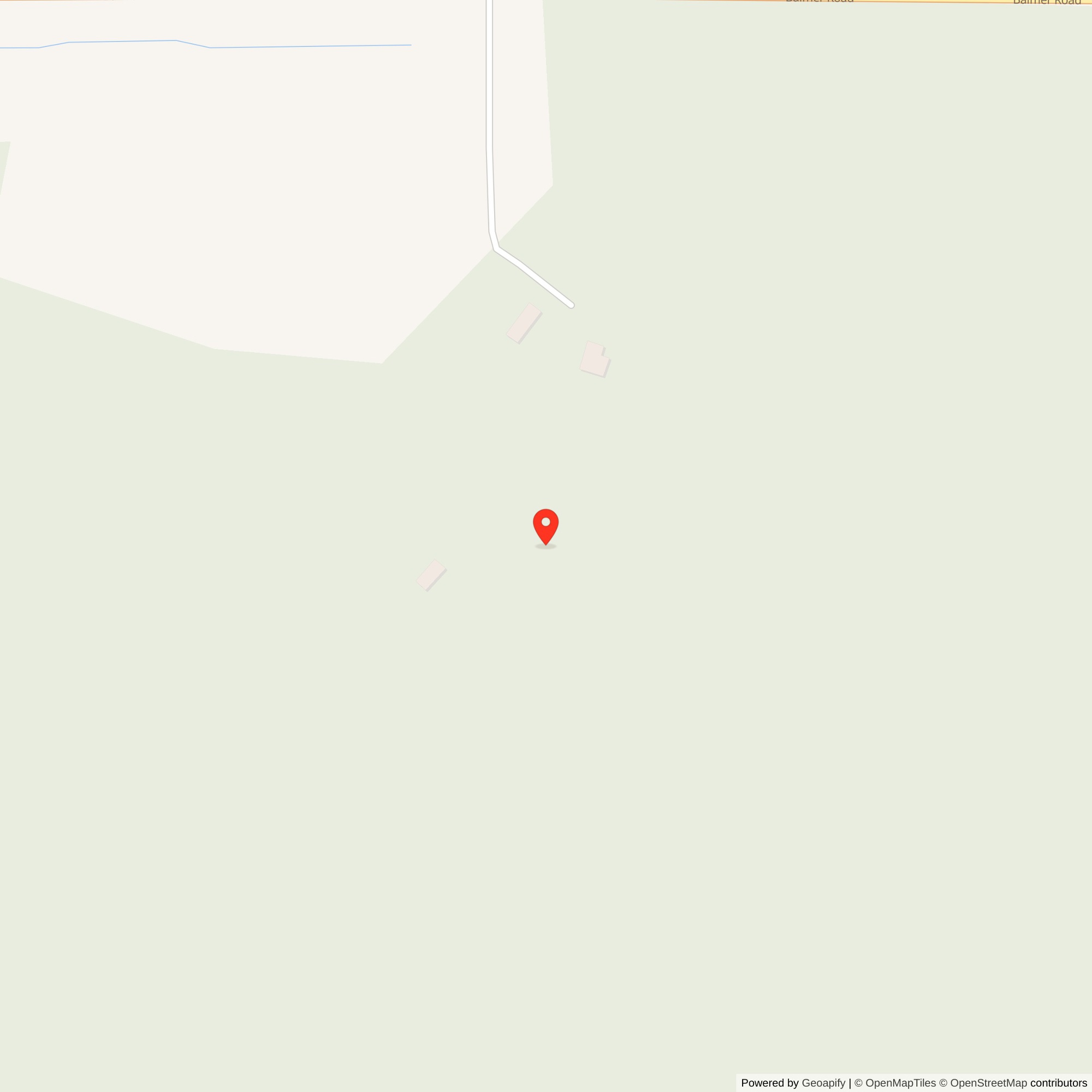
The Integrated Fire Control, or IFC, property was associated with Porter Center Road. Later site descriptions state that the road divided the former control property into eastern and western sections. Buildings remained on the east side, while the western section became largely wooded. The launch property lay farther north near the Balmer Road and Porter Center Road area.
This separation followed standard Nike design principles. The control crews needed clear radar horizons and enough distance from the launchers to track both the target and the missile accurately. The launch crews needed a separate secured property for magazines, missiles, propellants, assembly work, generators, barracks, and launcher operations.
The site also sat within an already complicated federal landscape. The former ordnance works had been acquired for wartime explosive production, and later portions supported storage, industrial, research, waste-management, and military activities. The Nike battery must therefore be understood as one defined installation within the much larger Model City and Lake Ontario Ordnance Works area.
Why the Niagara Frontier Required Air Defense
Niagara Falls was a strategic target because of its hydroelectric power, industry, transportation links, and position along the international border. The region's generating plants supplied electricity to military production, industrial plants, and cities across western New York. A successful bomber attack could have damaged both local targets and a wider network dependent on Niagara power.
The defense area also protected military facilities, including Niagara Falls Air Force Base and Fort Niagara, as well as the approaches to Buffalo. Soviet bombers approaching from northern routes could have crossed Canada and the Great Lakes before reaching targets in the northeastern United States.
The Army initially defended the Niagara frontier with radar-directed 90-millimeter antiaircraft guns. Those batteries were useful against conventional aircraft but increasingly inadequate against faster and higher-flying jet bombers. Nike Ajax was the Army's answer, a guided missile able to reach targets beyond the effective envelope of the gun batteries.
NF-03 covered the northwestern side of the Niagara Falls defense ring. Cambria guarded the eastern approaches, and Grand Island covered the south. Together, the sites created overlapping fields of fire around the Niagara power and industrial region. Fort Niagara served as the original command headquarters for the local Army air-defense organization.
Construction in the Former Ordnance Works
The regional air-defense history identifies Model City as the first dual Nike Ajax site built in Niagara County. Construction was underway by the middle of the 1950s in the former Lake Ontario Ordnance Works.
The site's placement offered practical advantages. The federal government already controlled substantial land in the area. The landscape was relatively open, away from dense neighborhoods, and close enough to Niagara Falls to protect the principal targets. Roads and former industrial infrastructure also made construction and support easier than at an undeveloped remote location.
The Army built a double-capacity site. The IFC area supported two firing sections, and the launch area contained six underground magazines instead of the three usually found at a standard Ajax battery. The expanded complex required more land, more personnel, and more support equipment.
The national Nike program moved quickly, and Model City became operational during the first major wave of Ajax deployments. The site's accepted service period begins in 1955, although the exact dates for construction completion, equipment acceptance, and full operational alert are not identical in every source.
Site Code: NF-03, NF-05, or NF-03/05
The site's designation requires explanation.
The national missile inventory and the U.S. Army Corps of Engineers Formerly Used Defense Sites inventory identify the property as NF-03.
The New York State Military Museum describes Model City as NF-05. The detailed regional unit history frequently uses NF-03/05. These alternate references likely reflect the site's paired or dual-battery identity, but the reviewed sources do not provide a definitive administrative explanation for the difference.
The discrepancy should not be interpreted as evidence for two unrelated Model City installations. The sources consistently describe one dual Ajax complex at Model City. The paired references belong to the same integrated installation, with two firing sections and one expanded launcher complex.
Site Configuration and Decoded Meaning
The recorded configuration for NF-03 is Nike 2B,4C/60A/24L-AA.
Decoded in plain English, the launch area contained two B-type and four C-type underground missile magazines. The six magazines supported a nominal inventory of sixty Nike Ajax missiles. The site had twenty-four Ajax launchers and two Ajax fire-control sections.
The final AA indicates a dual Ajax arrangement. This was not simply a standard battery with extra storage. Two firing sections could conduct separate engagements, allowing the site to track and attack two hostile aircraft at the same time.
A standard Ajax battery generally had three magazines, thirty missiles, and twelve launchers. Model City doubled those figures. Its size matched the importance of the northern Niagara sector and the Army's early concern about concentrated bomber raids.
The B and C letters identify underground magazine types. The C design was built for Ajax. The B design could be modified at selected sites for the larger Nike Hercules, but NF-03 remained an Ajax battery throughout its service. The mere presence of B magazines did not mean that Hercules was installed.
The underground structures are sometimes called silos in popular accounts. Magazine is the more accurate term. Ajax missiles were stored horizontally below ground, raised to the surface by elevators, moved along rails, and positioned on launchers. They did not stand vertically in ballistic-missile silos.
The Integrated Fire Control Area
The IFC area was the electronic center of NF-03. Each firing section required radar, computers, communications equipment, power, and trained crews.
The acquisition radar searched the assigned airspace and displayed possible targets. When higher headquarters assigned an aircraft to Model City, the Target Tracking Radar locked onto it. The Missile Tracking Radar followed the Nike Ajax after launch. A ground-based computer continuously compared the two tracks and calculated steering commands.
Those commands were transmitted to the missile by radio. Ajax was not an autonomous homing weapon. It depended on the ground system throughout the engagement. At the computed intercept point, the IFC issued the burst command for the missile's three high-explosive fragmentation warheads.
Because Model City was a dual site, the control property supported two engagement channels. The arrangement imposed a heavy maintenance burden. Radar alignment, computer accuracy, communications, and generator reliability had to be maintained around the clock.
Later descriptions place former buildings on the eastern side of Porter Center Road and wooded ground on the western side. Some observers reported unusual radar-tower designs at the IFC property. The site's exact surviving structural inventory has changed over time, and access should not be assumed.
The Launch Area
The launch property was a large, secured industrial compound. It contained the six underground magazines, twenty-four launcher positions, missile assembly and testing facilities, propellant-handling areas, generators, storage structures, barracks, and security infrastructure.
Nike Ajax combined a solid-fueled booster with a liquid-fueled sustainer. The liquid fuel and nitric-acid oxidizer required careful handling. Launch crews worked with hazardous materials under procedures designed to prevent spills, fires, corrosion, and personnel exposure.
Missiles were inspected and assembled before being placed in magazine storage. During an alert, an elevator raised a missile to the surface. Rail equipment moved it toward a launcher, where crews connected the necessary systems and erected it for firing.
A double site required extensive coordination. Sixty missiles, six magazines, and twenty-four launchers created more maintenance work than a normal battery. The crews needed to maintain immediate readiness while allowing other launchers and missiles to cycle through service and inspection.
The launcher compound later became important to the Air Force because it offered a large, secure federal property with buildings, utilities, open ground, and a position suitable for communications testing.
The 44th Antiaircraft Artillery Missile Battalion
The first operational unit at Model City was Battery A, 44th Antiaircraft Artillery Missile Battalion.
The 44th had previously operated antiaircraft guns in the Niagara region. Its soldiers completed a thirty-two-week Nike Ajax course at the Army Air Defense School at Fort Bliss. The battalion was redesignated from a gun organization to the 44th AAA Missile Battalion on 1955-03-22.
On 1955-06-15, the battalion passed in review at Fort Niagara before its personnel moved to the newly completed Nike positions at Model City and Grand Island, with Cambria following. That ceremony marked a decisive shift in local air defense from guns to guided missiles.
Battery A manned Model City. The regional history lists the unit at NF-03 from March 1955 through September 1958. Captain Raymond R. Allen was identified as Battery A's commander in 1957.
The soldiers' work combined constant routine with the possibility of immediate combat. Crews calibrated radars, maintained missiles, tested communications, inspected launch equipment, guarded the two compounds, operated generators, and practiced engagement drills.
The site was distant from the urban center it protected. Soldiers and their families became part of the Fort Niagara and Niagara County military community, while the battery's mission remained largely hidden behind fences and security procedures.
The 1957 Outstanding Service Practice Award
Model City earned a notable operational distinction in 1957.
The regional history reports that the Model City and Cambria batteries received the U.S. Army Air Defense Command Outstanding Service Practice Award. The awards were presented to Lieutenant Colonel Tom D. Collison, commander of the 44th AAA Missile Battalion, and to the two battery commanders. Captain Raymond R. Allen represented Battery A at Model City.
A service practice evaluated far more than ceremonial appearance. It tested the battery's ability to operate the weapon system under demanding conditions. Crews had to demonstrate target acquisition, radar tracking, missile preparation, command procedures, communications, and engagement accuracy.
For NF-03, the award provides specific evidence that the new double battery was not merely complete on paper. Its soldiers had developed the proficiency necessary to operate one of the Army's most complex early guided-missile systems.
The award also matters because Model City's operational period was short. The site existed for less than a decade, but it achieved documented recognition during the first years of Nike deployment.
Redesignation as the 1st Missile Battalion, 4th Artillery
On 1958-09-01, the Army reorganized many combat-arms units under the Combat Arms Regimental System. The 44th AAA Missile Battalion became the 1st Missile Battalion, 4th Artillery.
Battery A remained at Model City. The personnel, missiles, and mission continued, but the unit carried a new lineage and designation. The regional assignment tables place Battery A, 1st Missile Battalion, 4th Artillery at NF-03 until August 1960.
This period coincided with the arrival of Nike Hercules at selected Niagara-Buffalo batteries. Cambria, Grand Island, and Lancaster were chosen for conversion. Model City was not.
The Army's decision reflected a larger shift. Hercules offered longer range, higher altitude, solid-fuel handling, and nuclear capability. Fewer Hercules sites could cover a larger region. The double Ajax battery at Model City was powerful by first-generation standards, but its sixty missiles still had the shorter range and conventional warheads of Ajax.
Transfer to the New York Army National Guard
The New York Army National Guard prepared for the Nike mission before it took control of Model City. A 1959 report described Guard personnel training at Model City, Orchard Park, and Hamburg. Another report stated that Guard units had been training since February 1958 to operate the missile sites.
In July or August 1960, Batteries B and C of the 2nd Missile Battalion, 106th Artillery, NYARNG assumed the Model City double battery. Two Guard batteries were assigned because NF-03 had two firing sections.
The transfer represented a major change in continental defense. Full-time Regular Army troops gave way to a combination of full-time Guard technicians and traditional Guardsmen. The site still had to remain secure and operational every hour of the day.
The Guard unit's motto, Aeterna Vigilia, meant Constant Vigilance. It was an appropriate description of the Nike mission. Even when most citizen-soldiers were away from the site, full-time personnel maintained equipment and readiness so the batteries could respond to an alert.
On 1962-05-01, the 2nd Missile Battalion, 106th Artillery was redesignated as the 2nd Missile Battalion, 209th Artillery. Batteries B and C continued at Model City under the new designation until closure.
Closing Date and a Source Contradiction
The best-supported closing date for NF-03 is March 1963.
The regional unit-assignment tables list Batteries B and C of the New York Army National Guard at Model City from August 1960 through March 1963. The battery listings explicitly state that the site closed in 1963. The national Nike inventory also uses a 1955 to 1963 service period.
One summary paragraph in the regional history states that Model City and Orchard Park were transferred to the Guard and remained operational until August 1960, when they were closed. That sentence conflicts with the detailed tables, later unit narrative, and Guard redesignation history.
The internal evidence strongly suggests that the August 1960 closure statement is a drafting error. August 1960 was the transfer period, not the closure. This history uses March 1963.
By 1963, the Niagara-Buffalo defense had been reduced to Hercules batteries at Cambria, Grand Island, and Lancaster. The Army closed the remaining Ajax positions as bomber-defense strategy shifted toward fewer, longer-range sites.
Role in the Wider Military Network
NF-03 never operated alone.
At the site level, its two IFC sections and shared launch area formed one double weapon system.
At the Niagara Falls level, Model City overlapped with Cambria and Grand Island to protect the power and industrial region.
At the broader regional level, the Niagara Falls batteries complemented the Buffalo ring at Millersport, Lancaster, Orchard Park, and Hamburg.
Fort Niagara initially housed the 2nd Artillery Group and the manual Army Air Defense Command Post. Higher headquarters assigned targets and coordinated the batteries to prevent multiple sites from engaging the same aircraft unnecessarily.
In 1961, the regional Army Air Defense Command Post moved to Lockport Air Force Station near Shawnee and Sanborn. The move placed Army missile control alongside Air Force radar and communications systems. Missile Master, and later BIRDIE, equipment helped integrate the Nike batteries with the larger air-defense network.
The sites also relied on the Combined Field Maintenance Shop at the Niagara Falls U.S. Army Support Center. Specialized technicians supported radar, computers, missiles, launchers, generators, and communications beyond the capabilities of an individual battery.
Model City thus belonged to a system extending from local radar towers to regional command posts and continental warning networks.
The Air Force Takes Over the Launch Property
NF-03's most unusual second life began after the Army missile mission ended.
Available installation histories state that the Air Force acquired the former launch area around 1965. The property became the Youngstown Test Site, with the Air Force identification code ZQER and installation number 9728 appearing in later directories.
The site served as the western end of a tropospheric-scatter communications test range under Griffiss Air Force Base. Troposcatter systems transmitted microwave signals beyond the normal line of sight by scattering radio energy through the lower atmosphere.
This mission required separated transmitting and receiving locations, specialized antennas, electronics, open test corridors, and secure support areas. The former Nike launch property was well suited to adaptation because it offered federal land, utilities, buildings, and a relatively isolated setting.
The Air Force use changed the meaning of the site. The Army had used the property as the firing half of a local antiaircraft battery. The Air Force used it as one endpoint in a communications research and testing network.
The site's relationship to Griffiss also connected Model City to the Air Force's research and development infrastructure centered in the Rome area of New York.
Youngstown Test Site and Youngstown Test Annex
The Air Force called the property Youngstown Test Site and later Youngstown Test Annex. Both names appear in installation directories and disposal records.
A 1982 worldwide Air Force installation directory listed Youngstown Test Site, confirming that the property remained on the active Air Force installation inventory long after the Nike period. Later Department of Defense facility inventories continued to list the site in connection with research, development, test, and evaluation facilities.
The exact dates when every Air Force activity began and ended are not fully documented in the readily available sources. One directory history identifies organizational assignments beginning in November 1966 and again in August 1970, but those dates do not necessarily define the entire period of site use.
Surplus Disposal and the 2007 Federal Listing
By 2007, the Youngstown Test Annex was no longer an active Air Force facility and was being processed as surplus federal property.
A Federal Register notice described the property as 98.62 overgrown acres on Porter Center Road in the Town of Porter. It contained six deteriorated buildings and abutted an industrial waste-treatment facility. The General Services Administration listed it as surplus under property number 54200620004 and GSA number 1-D-NY-0879-1A.
The description captures the site's condition at an important moment. The former missile and communications property was still large and recognizable as a federal tract, but its buildings had deteriorated and vegetation had overtaken much of the ground.
A contemporary account reported that the General Services Administration offered the parcel through an online auction with a minimum opening bid of $100,000. The sale process brought public attention to the site's military history and its relationship to the surrounding former ordnance works.
The federal surplus listing should not be read as a description of the entire NF-03 installation. It primarily concerned the former launch and Air Force test property. The IFC property had a separate physical and disposal history.
Later Development Interest
Town of Porter Planning Board records from March 2018 noted that a prospective buyer might be interested in purchasing the former Nike site on Balmer Road and Porter Center Road for possible subdivision or development.
That reference indicates that the property remained a recognizable local planning issue more than a decade after the federal surplus listing. It does not by itself prove that a sale or development was completed.
The current ownership and development status should therefore be described cautiously. The property has passed through federal surplus and local planning processes, but a complete recent chain of title and current structural survey were not available.
The site is not an established public museum, park, or interpreted historic attraction. Any visit would require respect for private property, environmental restrictions, deteriorated structures, and active neighboring land uses.
Environmental and Industrial Context
NF-03 sits within one of western New York's most complicated former federal industrial landscapes.
The broader Lake Ontario Ordnance Works and Model City area hosted wartime explosive production, chemical and industrial operations, radioactive-material storage, waste facilities, and later federal and private uses. Those surrounding activities created environmental issues that are much larger than the Nike battery itself.
The U.S. Army Corps of Engineers listed NIKE NF 03 as a Formerly Used Defense Site in Lewiston under property number C02NY0074. The inventory category included containerized hazardous, toxic, or radioactive waste investigation or response authority.
This classification does not mean that every environmental problem in Model City came from the Nike battery. It means that the former military property entered the federal FUDS inventory for evaluation. Source attribution is especially important here because later Air Force use and neighboring industrial facilities could leave conditions unrelated to the Army missile mission.
The 2007 surplus notice specifically stated that the Youngstown Test Annex abutted an industrial waste-treatment facility. That adjacency influenced both public concern and the property's redevelopment context.
Current Condition and Access
The former IFC area has been described as abandoned and overgrown. Porter Center Road divides the site. Deteriorated buildings reportedly survive on the eastern side, while the western section is largely wooded with little visible evidence of the original military use.
The former launch area experienced more extensive reuse. It became the Youngstown Test Site and Test Annex, then entered federal surplus disposal. The 2007 listing documented six deteriorated buildings on the 98.62-acre Air Force property.
Secondary site inventories report that portions of the former launcher complex and building foundations remained visible, while the magazine condition was uncertain and likely affected by water and vegetation.
The property is not a public historic site. Deteriorated buildings, hidden underground structures, vegetation, possible environmental hazards, and uncertain ownership make unauthorized exploration unsafe and inappropriate.
Chronology
- 1955-03-22 The 44th Antiaircraft Artillery Battalion was redesignated as a Nike missile battalion.
- 1955-06-15 Battery A personnel departed Fort Niagara to man the newly completed Model City dual Ajax installation.
- 1957 Model City received the U.S. Army Air Defense Command Outstanding Service Practice Award.
- 1958-09-01 Battery A became part of the 1st Missile Battalion, 4th Artillery.
- 1960-08 Batteries B and C, 2nd Missile Battalion, 106th Artillery, New York Army National Guard, assumed the dual site.
- 1962-05-01 The Guard organization was redesignated as the 2nd Missile Battalion, 209th Artillery.
- 1963-03 NF-03 closed as the regional defense was reduced around the surviving Hercules batteries.
- About 1965 The Air Force acquired the former launch property and developed the Youngstown Test Site.
- 1966 and 1970 Later installation histories record organizational assignments associated with the Air Force test mission.
- 1982 The Youngstown Test Site remained listed in the Air Force worldwide installation directory.
- 2007-03-02 The federal government listed the Youngstown Test Annex as 98.62 acres of surplus property with six deteriorated buildings.
- 2018-03-01 Town of Porter planning records noted possible private purchase and development interest.
List of all Nike Installations in the Niagara Falls-Buffalo Defense Area
List of all Nike Installations in New York