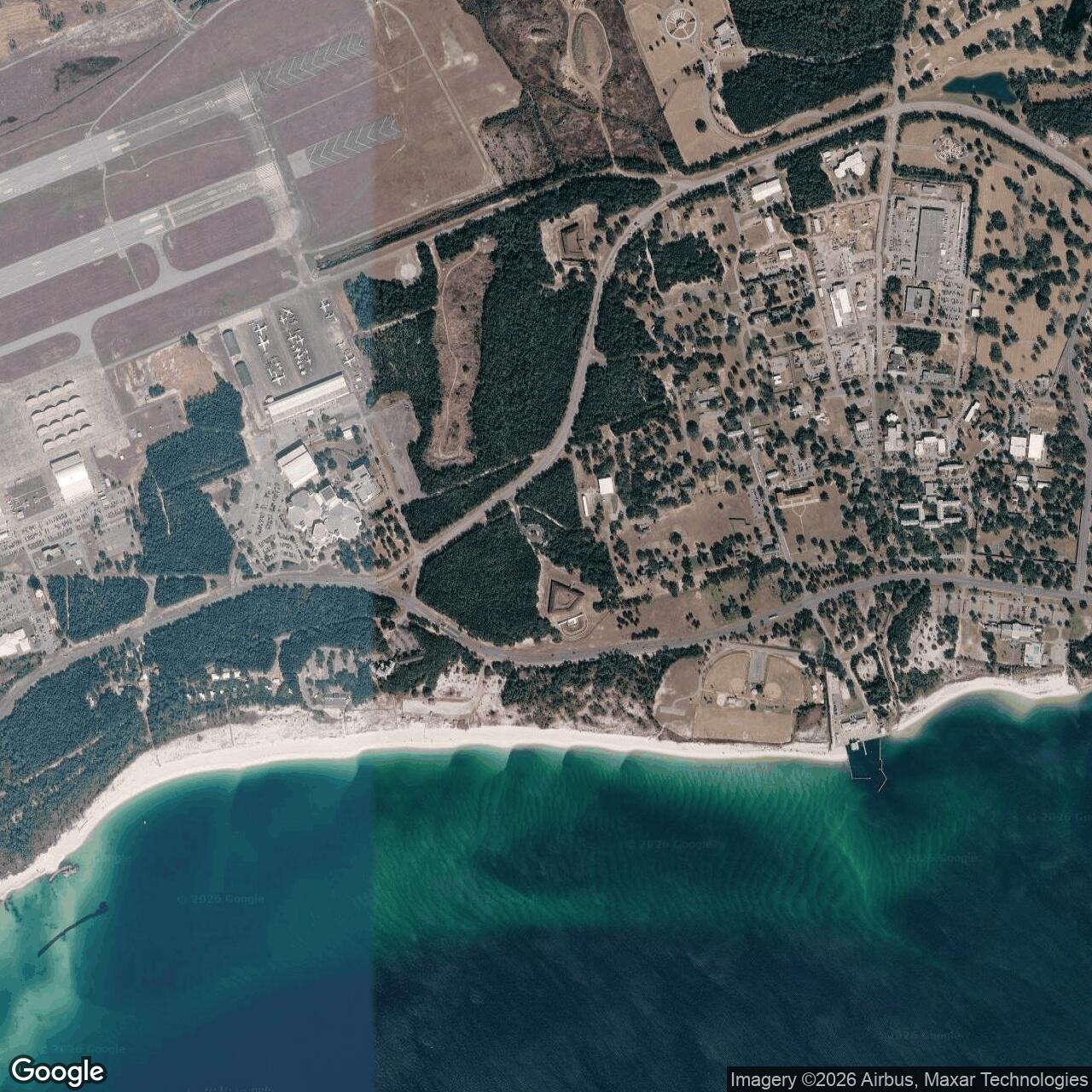
Fort Barrancas Army Base, Pensacola Florida
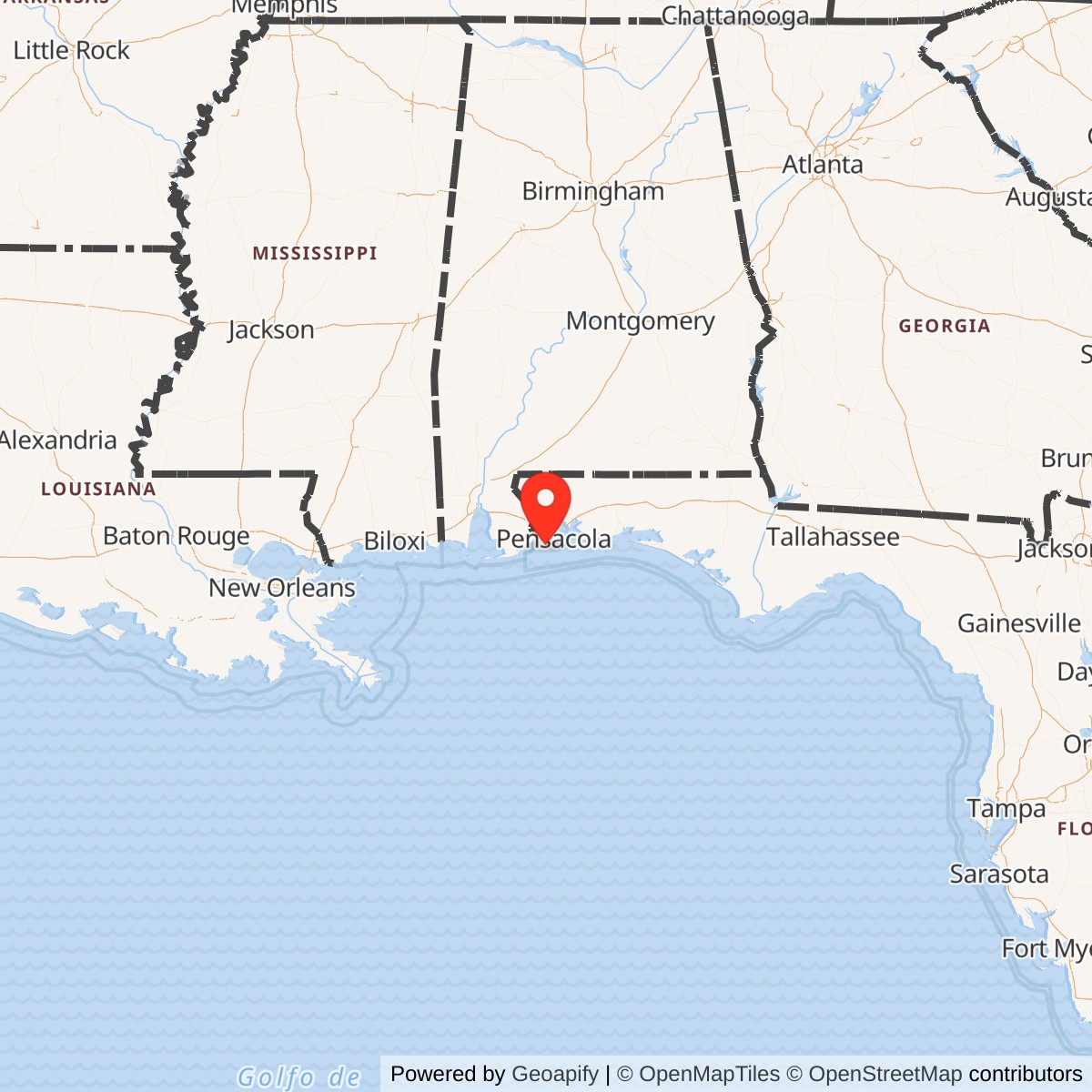
Longitude: -87.298
Official Base Website: NPS visitor center, Fort Barrancas
Current Role: Gulf Islands National Seashore Fort Barrancas Area aboard Naval Air Station Pensacola; NPS visitor center, Fort Barrancas, Spanish Water Battery/Bateria de San Antonio, Advanced Redoubt, trails, and interpretation, with access subject to NAS Pensacola rules.
Fort Barrancas is one of the clearest places in the Gulf Coast where geography dictated military history for centuries. The bluff above Pensacola Bay gave whoever held it a commanding view over the harbor entrance, the Navy Yard approach, and the water route between the Gulf of Mexico and one of the best deep-water anchorages on the northern Gulf Coast. Spanish, French, British, and American forces all recognized the same thing: control of the barrancas, the high bluff, helped control Pensacola Bay.
The U.S. Army fort most commonly called Fort Barrancas was completed in 1844 as part of the American Third System of seacoast fortifications. It was not the first work on the site. The American fort rose over and beside earlier Spanish and colonial defenses, especially the water battery known as Bateria de San Antonio or Battery San Antonio. The United States inherited the Pensacola defense problem after the Adams-Onis Treaty brought Florida into American possession, and the Army Corps of Engineers turned the old bluff and shoreline works into a masonry fortification system designed to protect the Pensacola Navy Yard, the harbor, and the bay entrance.
Fort Barrancas should be understood as a linked installation rather than a single isolated brick fort. The Fort Barrancas Area includes the main diamond- or kite-shaped Fort Barrancas on the bluff, the older Spanish Water Battery at the lower shoreline level, and the Advanced Redoubt north of the fort. The main fort and the water battery were connected by a tunnel, making the high and low works part of one tactical system. The Advanced Redoubt was added to protect the landward approaches to Fort Barrancas and the Navy Yard. Together these works formed the mainland side of the Pensacola harbor-defense triangle, facing Fort Pickens across the bay entrance and supporting Fort McRee on Perdido Key.
The Army maintained the Barrancas area until 1947, after which the former Army coastal-defense landscape was incorporated into Naval Air Station Pensacola and later into Gulf Islands National Seashore. Today the fort is preserved and interpreted by the National Park Service, but it remains physically inside an active Navy installation. That current arrangement reflects the whole history of the place: an Army-built harbor-defense system designed to protect a Navy Yard, later preserved as a national historic site within a continuing military reservation.
Site Design, Defenses, and Physical Plant
Fort Barrancas' design exploited height, mass, and interlocking fields of fire. NPS describes the fort as built with about six million bricks, walls four feet thick and twenty feet high, and a commanding position above the entrance to Pensacola Bay. The main fort is a four-sided kite- or diamond-shaped masonry and earth-filled structure. It was designed to resist attack on both seaward and landward faces, with a dry moat, scarp and counterscarp walls, loopholed galleries, brick arches, vaulted spaces, and gun positions that could sweep attackers caught in the ditch.
The Spanish Water Battery, or Bateria de San Antonio, was the lower shore battery that predated the American Fort Barrancas but became part of the American system. National Register documentation identifies the Bateria as a semicircular masonry shore battery with a glacis, counterscarp, dry ditch, rampart, terreplein, and vaulted bombproofs below the firing platform. Its position closer to the water allowed guns to bear directly on ships entering the harbor. The American fort above it supplied height, additional firepower, and landward defense. The connecting tunnel made the two levels operate as a combined defensive work.
The construction story is also a labor story. NPS's tour interpretation states that construction of Fort Barrancas began in June 1840 and that enslaved people labored on the fort. No more than about sixty enslaved workers were used at any one time, but they dug the ditch into the bluff, moved more than 16,000 tons of sand, and worked long days under brutal seasonal conditions. That labor created the physical geometry visitors still see: the ditch, the brick walls, the heavy arches, and the mass of the fort pressed into the bluff.
The Advanced Redoubt completed the landward defense. Located north of Fort Barrancas, it was intended to protect the main fort and Navy Yard from attack across the peninsula rather than from the bay. NPS describes it as a "fort to protect a fort." Construction began with enslaved labor in 1845 and was not completed until 1870, making it the last of the Third System forts to be completed. Its trapezoidal form, dry ditch, scarp and counterscarp walls, interior parade, cannon positions, and enclosed brick arches made it a specialized defense against infantry and artillery approaching from inland.
Together the three major structures show how the Army thought about Pensacola. A hostile ship had to be stopped in the channel by the big harbor-defense forts and batteries. A landing force had to be stopped on the peninsula by landward defenses. A raid on the Navy Yard had to pass a layered complex of masonry, cannon, musketry loopholes, ditches, and covered positions. Barrancas was not simply an old fort overlooking the water. It was the mainland anchor of an engineered defense system built around the Navy Yard and the bay entrance.
Mission and Military Role
Fort Barrancas' mission was the defense of Pensacola Bay and the Pensacola Navy Yard. That mission made it different from many inland frontier posts. Its purpose was not settlement protection, treaty enforcement, or troop maneuver over a wide district. It existed to control water, to protect federal naval infrastructure, and to deny an enemy the ability to enter or use the harbor.
The fort's mission depended on Fort Pickens and Fort McRee. Fort Pickens guarded the Santa Rosa Island side of the pass. Fort McRee guarded the western channel approach from Foster's Bank and Perdido Key. Barrancas guarded the mainland bluff and the Navy Yard side of the entrance. When all three belonged to the United States, they created overlapping fields of fire across Pensacola Bay. When Fort Pickens stayed in Union hands in 1861 while Barrancas and McRee were occupied by Confederate forces, that same system became a battlefield.
The Barrancas works also had a land-defense mission. The main fort and the Spanish Water Battery faced the bay, but the Advanced Redoubt faced the possibility of an enemy attacking from the north or west. That concern became more important as the Navy Yard grew. The Army had to protect not only ships in the channel but also docks, workshops, magazines, stores, and personnel on shore. Fort Barrancas and the Advanced Redoubt therefore combined seacoast artillery with landward fortification.
After the Civil War, the fort's original masonry-defense mission steadily declined. Rifled artillery, ironclads, and later steel warships made brick forts less useful as front-line weapons. Yet the Army did not abandon the Barrancas area immediately. It kept the reservation as part of the wider Pensacola defense system, maintained the old works, and used the area for military functions through World War II and into the immediate postwar period. The mission shifted from active masonry fort to maintained military reservation, range and support area, and historic but still military-controlled landscape.
Colonial and Early American Background
The Barrancas bluff was military ground before the United States controlled Florida. NPS notes that the bluff was so strategic that the Army Corps of Engineers later built Fort Barrancas over the ruins of forts used by Spanish, French, and British forces as early as the late seventeenth century. This continuity matters because the American fort was not a random site selection. It was the latest layer in a long imperial competition over Pensacola Bay.
The Spanish Bateria de San Antonio is the surviving colonial element most directly tied to the present historic site. National Register documentation dates the Spanish battery to 1797, during the closing years of Spanish authority in Florida. It was designed as a water battery facing the bay entrance. The name Fort San Carlos de Barrancas or Castillo de San Carlos also appears in the history of the site, reflecting the Spanish fortification tradition at the bluff.
The War of 1812 brought Pensacola's defenses into American strategic thinking even before Florida became U.S. territory. NPS's Andrew Jackson interpretation describes Jackson's 1814 move against Pensacola after he learned that British forces were using Spanish-held Pensacola. On November 7, 1814, Jackson attacked the Spanish-built Fort Barrancas, and British troops retreated, destroying Spanish works as they left. Jackson then continued toward New Orleans. The episode showed both the vulnerability and importance of Pensacola: a neutral Spanish port could become a base for British operations against the United States.
Jackson returned in 1818 during the First Seminole War context. NPS describes his invasion of Spanish West Florida on May 24, 1818, the Spanish surrender on May 28, and the temporary U.S. occupation of Pensacola before it was returned to Spain in early 1819. Florida was formally transferred to the United States in 1821. National Register documentation states that U.S. troops were garrisoned at Barrancas until 1825, when the area was turned over to the Department of the Navy. That early U.S. garrison period helped bridge the Spanish fortification landscape and the later American Army-engineered system.
Construction of the American Fort
The American reconstruction of Barrancas came from the decision to make Pensacola a major Navy Yard and to protect it with permanent harbor defenses. The Territory of Florida sold the peninsula between Bayou Grande and Pensacola Bay to the United States as a naval reserve in 1832. National Register documentation states that the U.S. Department of Engineers built Fort Barrancas on the site of Castillo de San Carlos and connected it to the rebuilt Bateria de San Antonio. The Navy lands were then transferred to the War Department in 1844.
The construction chronology is usually given as 1839-1844 or 1840-1844, depending on whether preliminary work or active construction is emphasized. NPS tour interpretation identifies June 1840 as the beginning of Fort Barrancas construction, and NPS's main fort page states that the completed fort dates to 1844. The important historical point is that the Army completed a new masonry work in the same period that Fort Pickens and Fort McRee were completing the larger Pensacola defense triangle.
The completed fort reflected the Third System ideal of durable masonry forts guarding major harbors. Thick brick walls, dry ditches, vaulted galleries, heavy gun platforms, hot-shot furnaces, and protected interior spaces were all intended to resist enemy attack and maximize the destructive power of coastal artillery. The position above the bay gave Barrancas a view and field of fire unavailable to low barrier-island sites, while the water battery below kept guns close to the channel.
The Advanced Redoubt expanded the system after the main fort was completed. Its construction began in 1845 and continued intermittently until 1870. That long construction period shows the strain of a system already being overtaken by military technology even before all of its works were complete. Still, the redoubt was an important part of the Barrancas military landscape because it guarded the land approaches to the Navy Yard and main fort.
Civil War Service
Fort Barrancas' only major combat came during the Civil War. The crisis began even before the formal firing on Fort Sumter. On January 10, 1861, the day Florida seceded from the Union, federal forces moved to Fort Pickens. NPS states that two days later Alabama and Florida state militias occupied Fort Barrancas, Fort McRee, the Advanced Redoubt, and the Pensacola Navy Yard. The result was a dangerous standoff: Union troops held Fort Pickens across the bay, while Confederate forces held the mainland and Perdido Key defenses.
The Confederate occupation turned Fort Barrancas into an artillery position aimed at the very fort that had been designed to work with it. General Braxton Bragg took command at Pensacola in March 1861 and imposed a strict training and discipline regime. Confederate troops improved batteries, drilled, and prepared for the possibility that Fort Pickens and U.S. Navy ships would attack. Disease and harsh conditions affected the garrison, as NPS notes in its account of sickness among troops drilling under heavy uniforms in the Gulf heat.
Combat escalated in the autumn of 1861. Federal Marines and sailors from Fort Pickens raided the Navy Yard in September. In October, Bragg sent about 1,000 men in a night attack on Santa Rosa Island, burning the camp of the 6th New York Infantry before withdrawing. These actions increased pressure on the opposing sides and set the stage for the heavy bombardment that followed.
On November 22 and 23, 1861, Federal forces opened a major bombardment from Fort Pickens and supporting naval vessels. NPS describes the barrage as heavily damaging the outer defenses of Fort Barrancas, while Bragg wrote that for number and caliber of guns and weight of metal it ranked with the heaviest bombardments in the world. Fort McRee suffered especially severe damage, but Barrancas, the Navy Yard, and related Confederate batteries were all part of the artillery battle. The bombardment showed how the Pensacola defense system could become self-destructive when divided between opposing armies.
Confederate forces abandoned Pensacola in May 1862, after the fall of New Orleans changed the strategic balance on the Gulf Coast. Union forces reoccupied the area, and Fort Barrancas saw no further major combat of the 1861 bombardment type. The site did, however, remain militarily active. NPS states that the Advanced Redoubt was attacked on October 8, 1863, when Confederate Brigadier General James Clanton led an assault against the Fort Barrancas area. The defenders included members of the 14th Regiment Corps d'Afrique and the 7th Vermont Infantry. The Confederate attack was repulsed, and a renewed attack the next day ended without casualties on either side.
Fort Barrancas' Civil War history therefore has two layers. In 1861-1862 it was a Confederate-held fort facing Union-held Fort Pickens across Pensacola Bay. In 1863 it became part of the Union-held defense of the Navy Yard and mainland works against Confederate attack. That reversal makes Barrancas a good example of how fixed forts could change meaning depending on who held the surrounding system.
Post-Civil War Obsolescence and Continuing Army Use
The Civil War proved that masonry forts were vulnerable to modern artillery and changing naval warfare. Fort Barrancas survived, but its original logic was increasingly obsolete. Rifled cannon, ironclad ships, and later steel warships made brick fortifications less credible as the primary defense of a harbor. The Army's late nineteenth-century solution was not to demolish all masonry forts, but to supplement or replace their combat function with new concrete batteries, minefields, fire-control systems, and dispersed harbor-defense installations.
At Barrancas, the brick works were not rebuilt into the center of a new Endicott-era heavy-gun complex in the same way some other sites were. The old fort and battery remained part of the Army-controlled landscape, while newer defenses around Pensacola were developed elsewhere in the wider harbor-defense network. The Advanced Redoubt, completed in 1870, was itself almost immediately a relic of an older fortification logic.
By the 1930s, the preservation problem was already visible. National Register documentation states that Works Progress Administration labor repaired the brick walls of both Fort Barrancas and the water battery during the 1930s, though some repairs obscured original details and covered openings. Those repairs reflected an important shift: the fort was no longer valuable only as a military work, but also as a historic structure needing stabilization.
The Army maintained the Barrancas area until 1947. National Register documentation says the brick fortifications were abandoned after the Civil War, but that the U.S. Army maintained the area collectively known as Fort Barrancas until 1947, when it was turned over to Naval Air Station Pensacola. That post-Civil War maintenance period should not be confused with the fort's earlier combat role. The installation remained under military control, but the old brick fort was no longer the primary fighting instrument it had been designed to be.
World War II and Deactivation
World War II gave Pensacola renewed military importance, but not because Fort Barrancas itself was a modern coastal artillery centerpiece. The Navy installation at Pensacola was already a major aviation and training center, and the Gulf Coast was part of a larger wartime defense and training system. The old fort remained inside that military landscape, but fixed masonry works were no longer decisive against aircraft, submarines, long-range naval weapons, and modern amphibious warfare.
The Army's remaining role at Barrancas ended with the postwar dismantling of the old coast-defense system. The former Fort Barrancas Army area was deactivated in 1947 and incorporated into Naval Air Station Pensacola. That date marks the end of the Army's direct installation identity at the site. The fort's function shifted from military reservation to preserved historic property located within a continuing military base.
This transition paralleled the broader end of fixed seacoast artillery in the United States. Fort Pickens and Fort McRee also ceased military use in the same general postwar period. The Pensacola defense triangle that had mattered so much in the nineteenth century no longer answered the strategic questions of the Cold War. The old forts survived not because they still defended the bay, but because they had become nationally significant historic structures.
Role in the Wider Military Network
Fort Barrancas mattered because it was never alone. It was one part of the Pensacola harbor-defense network. The main fort, the Spanish Water Battery, the Advanced Redoubt, Fort Pickens, Fort McRee, the Pensacola Navy Yard, later concrete batteries, and surrounding military roads and support facilities formed a defensive system intended to protect the harbor from both seaborne and landward threats.
The Navy Yard made Pensacola strategically important, but the Army built and maintained the fortifications intended to protect it. Barrancas was the mainland Army post in an Army-Navy defense relationship: Army artillery and fortifications guarded Navy infrastructure.
Fort Barrancas also illustrates a broader national pattern. In the early republic and antebellum period, the United States built permanent coastal defenses around major harbors. During the Civil War, some of those works were divided between Union and Confederate control and used against each other. After the war, many masonry forts became obsolete but remained under Army control as reservations, storage areas, range spaces, or historic properties. In the twentieth century, their military value faded and their preservation value grew.
The Pensacola case is especially strong because the three major forts create a readable defensive triangle. Fort Pickens survives as the Santa Rosa Island element, Fort McRee survives mainly as a vanished site and later battery landscape on Perdido Key, and Fort Barrancas survives as the most accessible mainland fortification complex. Together they show how the Army defended a Gulf Coast harbor before aircraft and missiles changed coastal defense forever.
Preservation and Current Status
Fort Barrancas today is part of Gulf Islands National Seashore. The National Park Service manages the Fort Barrancas Area, which includes Fort Barrancas, the Spanish Water Battery, the Advanced Redoubt, a visitor center, trails, exhibits, and interpretive grounds. The area is unusual because it is an NPS historic site located aboard Naval Air Station Pensacola, an active military base. Visitors must follow current NAS Pensacola access rules.
The preservation story unfolded in stages. The site was recognized as nationally important before the National Park Service began full public interpretation. Fort San Carlos de Barrancas / Bateria de San Antonio became a National Historic Landmark, the Fort Barrancas historic resources were documented through Historic American Buildings Survey and National Register records, and Congress created Gulf Islands National Seashore in 1971. National Register documentation states that NPS acquired Bateria de San Antonio and Fort Barrancas as part of the National Seashore on July 1, 1972.
Restoration followed. The Advanced Redoubt was stabilized and restored in 1975-1976. Fort Barrancas underwent extensive restoration that the NPS completed by 1980. The restored site now presents multiple periods at once: Spanish colonial fortification, U.S. Third System engineering, Civil War combat, postwar military maintenance, New Deal-era stabilization, and National Park Service interpretation.
The current Fort Barrancas Area was also recognized as part of the National Underground Railroad Network to Freedom. That recognition is appropriate because the site's interpretation now includes not only military engineering and battles, but also enslaved labor, freedom-seeking history, Black military service, and the complex social history tied to Gulf Coast forts and military occupation. Fort Barrancas' preserved walls therefore carry more than artillery history. They also preserve the labor, coercion, military service, and contested sovereignty that shaped the Gulf Coast.
Chronology
- Late 1600s The strategic bluff above Pensacola Bay was already being used for European military works; NPS notes Spanish, French, and British fortifications on or near the Barrancas site beginning as early as the late seventeenth century.
- 1797 The Spanish Bateria de San Antonio was constructed during the closing period of Spanish authority in Florida.
- 1814-11-07 Andrew Jackson attacked the Spanish-built Fort Barrancas during the War of 1812 campaign context; British troops retreated and destroyed Spanish works as they withdrew.
- 1818-05-24 Jackson invaded Spanish West Florida and occupied Pensacola.
- 1818-05-28 Spanish forces surrendered Pensacola to Jackson's force.
- 1819-02-08 Pensacola was returned to Spain after the temporary American occupation.
- 1821 Florida passed to the United States, and U.S. troops garrisoned Barrancas after the Spanish transfer.
- 1825 The Barrancas area was turned over to the Department of the Navy.
- 1832 The Territory of Florida sold the peninsula between Bayou Grande and Pensacola Bay, including Barrancas, to the United States as a naval reserve.
- 1834-1844 The United States redesigned and rebuilt the Bateria de San Antonio / water battery and developed the American Barrancas fortification system.
- 1839-1844 Fort Barrancas was constructed on the site of the earlier Castillo de San Carlos / Fort San Carlos position, according to National Register documentation.
- 1840-06 NPS tour interpretation identifies June 1840 as the beginning of Fort Barrancas construction, including major ditch excavation into the bluff.
- 1844 Fort Barrancas was completed, and Navy lands at Barrancas were transferred to the War Department.
- 1845 Construction began on the Advanced Redoubt north of Fort Barrancas to protect the fort and Navy Yard from land attack.
- 1861-01-10 Federal troops moved to Fort Pickens as Florida seceded, leaving Barrancas and other mainland/Perdido Key positions vulnerable.
- 1861-01-12 Alabama and Florida state militias occupied Fort Barrancas, Fort McRee, the Advanced Redoubt, and the Pensacola Navy Yard.
- 1861-03 General Braxton Bragg took command of Confederate forces at Pensacola.
- 1861-09 Federal Marines and sailors from Fort Pickens raided the Pensacola Navy Yard.
- 1861-10 Confederate troops attacked Santa Rosa Island and burned the camp of the 6th New York Infantry before withdrawing.
- 1861-11-22 to 1861-11-23 Union forces at Fort Pickens and supporting naval vessels bombarded Confederate positions including Fort Barrancas, Fort McRee, shore batteries, and the Navy Yard.
- 1862-05 Confederate forces abandoned Pensacola and Fort Barrancas after the fall of New Orleans changed the Gulf Coast strategic situation.
- 1863-10-08 Confederate Brigadier General James Clanton attacked the Fort Barrancas / Advanced Redoubt area; Union defenders included members of the 14th Regiment Corps d'Afrique and the 7th Vermont Infantry.
- 1863-10-09 Confederate forces renewed the Advanced Redoubt attack but withdrew after small-arms and artillery engagement.
- 1870 The Advanced Redoubt was completed by free labor, making it the last completed work of the Third System fortification program.
- 1930s WPA workers repaired Fort Barrancas and the water battery, stabilizing parts of the brickwork while also obscuring some earlier details.
- 1947 The U.S. Army deactivated / transferred the Fort Barrancas area, and it became part of Naval Air Station Pensacola.
- 1960 Fort San Carlos de Barrancas / the Barrancas historic works received National Historic Landmark recognition.
- 1971 Congress established Gulf Islands National Seashore, bringing the Pensacola harbor-defense historic sites into a new preservation framework.
- 1972-07-01 National Register documentation states that NPS acquired Bateria de San Antonio and Fort Barrancas as part of Gulf Islands National Seashore.
- 1975-1976 The National Park Service stabilized and restored the Advanced Redoubt.
- 1978-1980 Fort Barrancas underwent extensive National Park Service restoration and was opened to the public as a restored historic fort.
- 2023 NPS identified the Fort Barrancas Area as recently recognized as a Network to Freedom site.
- Present Fort Barrancas remains a National Park Service historic area within Gulf Islands National Seashore, located aboard active Naval Air Station Pensacola and interpreted with the Spanish Water Battery and Advanced Redoubt.