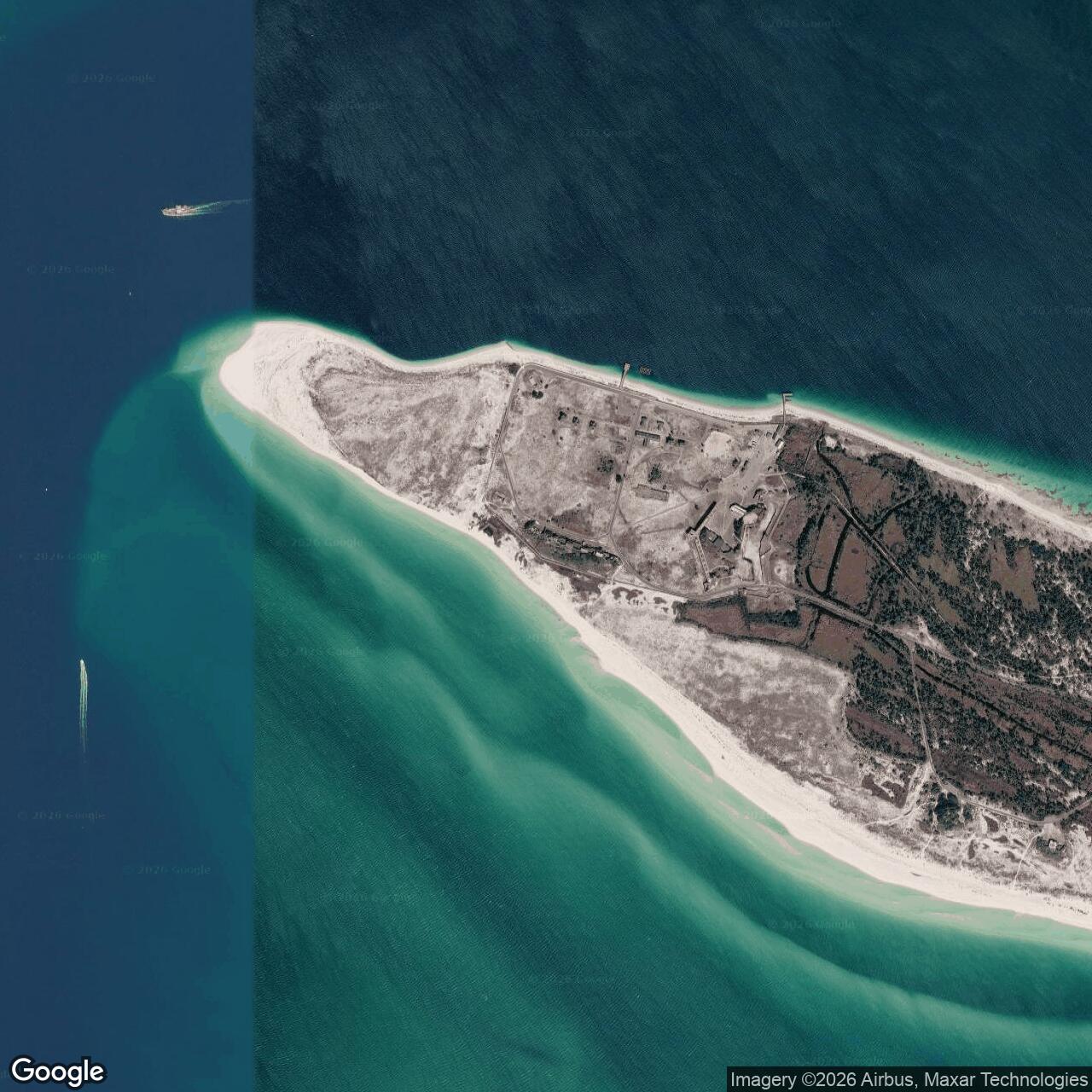
Fort Pickens Army Base, Pensacola Florida
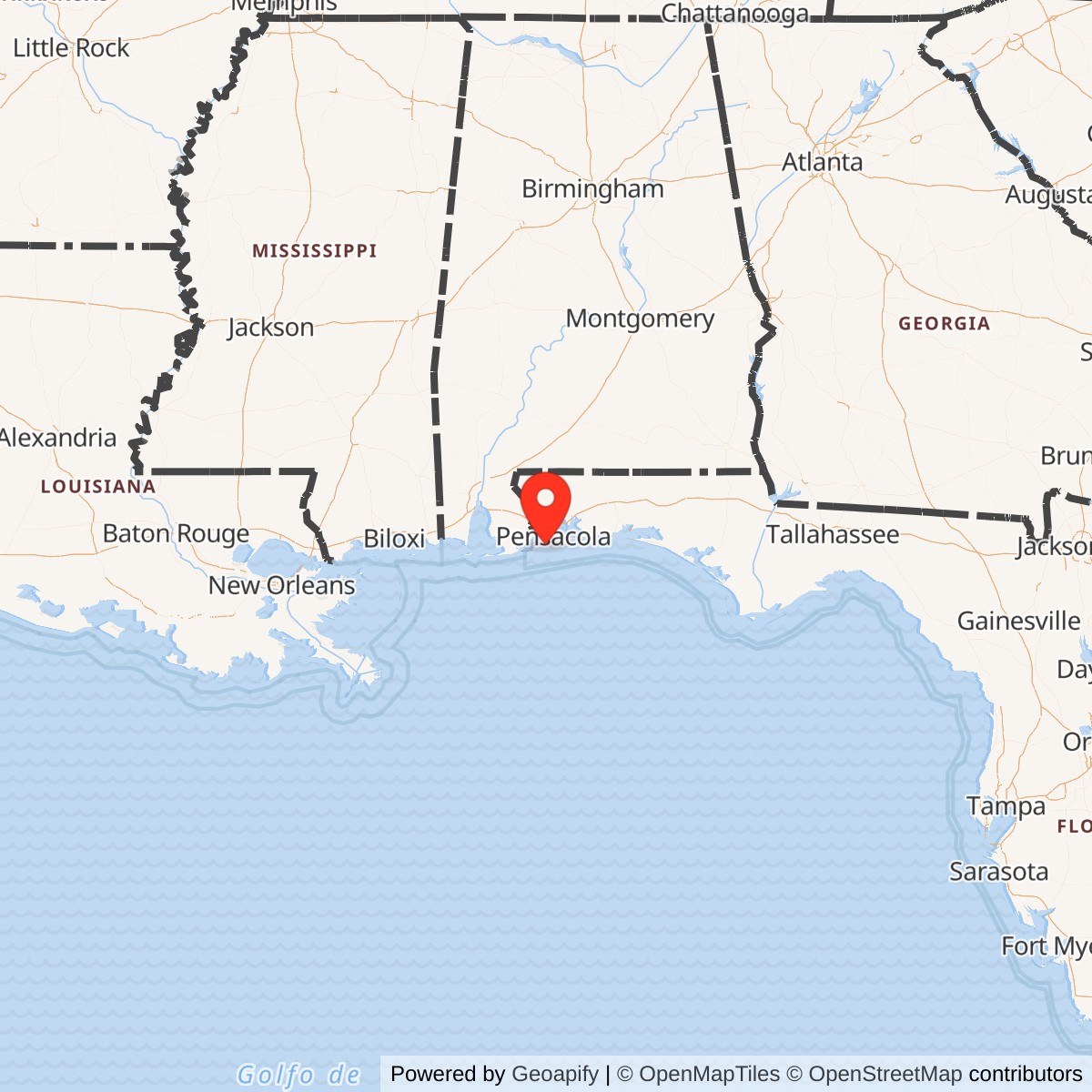
Longitude: -87.295
Official Base Website: https://www.nps.gov/places/000/fort-pickens.htm
Current Role: Gulf Islands National Seashore Fort Pickens Area; preserved Third System fort, Endicott-era batteries, visitor facilities, campground, beaches, trails, and active USACE FUDS munitions-response documentation for the former military reservation.
Fort Pickens was one of the most important U.S. Army seacoast-defense installations on the Gulf Coast. Built on the western end of Santa Rosa Island between 1829 and 1834, it guarded the entrance to Pensacola Bay and protected the U.S. Navy Yard at Pensacola. Its geography explains almost everything about its history. Pensacola Bay was one of the best deep-water harbors on the Gulf Coast, and any hostile naval force that could enter the channel could threaten the harbor, the navy yard, and the mainland communities around Pensacola. Fort Pickens sat on the barrier island side of that channel, working with Fort McRee on Perdido Key and Fort Barrancas on the mainland to make the bay entrance difficult to force.
The post should be understood as both a masonry Third System fort and a later military reservation. The original brick fort was a massive pentagonal work designed for smoothbore cannon and close harbor defense. Over time, the Army adapted the same reservation to rifled artillery, underwater mine defense, electric power, concrete Endicott-era batteries, rapid-fire batteries, range-finding stations, command posts, searchlights, narrow-gauge railway support, and World War II harbor-control functions. By the end of its Army career, Fort Pickens was not just the old five-sided brick fort. It was the Fort Pickens Military Reservation, a wider coastal-defense landscape of gun batteries, mine buildings, roads, railroad remnants, seawalls, fire-control structures, support buildings, and training/range areas on the west end of Santa Rosa Island.
Fort Pickens is historically unusual because it remained in U.S. hands during the Civil War. When Florida seceded in January 1861, U.S. troops under Lieutenant Adam J. Slemmer abandoned the more vulnerable mainland positions at Fort Barrancas and the Pensacola Navy Yard and withdrew to Fort Pickens. Confederate forces controlled the mainland forts for a time, but they never captured Fort Pickens. That unbroken Union hold gave the United States a strong point at the mouth of Pensacola Bay, denied the Confederacy full use of one of the Gulf Coast's most important harbors, and made the fort part of the larger Union blockade system. It also made Fort Pickens one of the rare Southern seacoast forts where the U.S. flag did not come down during the war.
The fort's history also includes painful chapters that cannot be separated from its military importance. National Park Service interpretation emphasizes that enslaved Black laborers were forced to build and later repair the fort. During the Civil War, Fort Pickens also became a place of refuge for freedom-seeking African Americans who reached Union lines. After the Apache Wars, the Army used Fort Pickens as a prison for Chiricahua Apache men, including Geronimo and Naiche, separating them from their families before later reuniting some families at the fort. The installation's story is therefore not only one of engineering and artillery. It is also a story of forced labor, military imprisonment, resistance, refuge, and memory.
Site Design and Physical Plant
The original Fort Pickens was a large pentagonal brick fortification with bastions at each of its five corners. The National Register documentation describes the fort's walls as roughly forty feet high and twelve feet thick, with protected passageways, a dry ditch, flanking outworks, and gun positions in bombproof casemates plus an additional tier of guns mounted above the walls en barbette. The intended armament was 252 guns of various types and calibers. Its design embodied the Third System of coastal fortifications: permanent masonry works, heavy cannon, overlapping fields of fire, and intimidating mass placed at strategic harbor entrances.
The fort's position on Santa Rosa Island shaped its engineering. Building a large masonry fort on a shifting sand barrier island required careful foundation work, cisterns for drinking water, magazines, quarters, casemates, and systems to move ammunition and stores inside a confined but heavily armed structure. The fort's casemates served not only as gun rooms but also as quarters, storerooms, power spaces, and later support rooms for newer technologies. The dry ditch and bastions were intended to make a landward assault costly; attackers who reached the ditch would be exposed to crossfire along the walls.
The larger Pensacola system included four major U.S. works built after the War of 1812: Fort Pickens, Fort McRee, Fort Barrancas, and the Advanced Redoubt. Fort Pickens and Fort McRee covered the channel entrance from opposite sides, while Fort Barrancas and Advanced Redoubt protected the mainland side and the navy yard from water and land attack. This system made sense in an era when hostile fleets, rather than aircraft or missiles, were the most plausible strategic threat to coastal installations. Fort Pickens was the island anchor of that system.
The fort was repeatedly altered. Battery Pensacola, a reinforced concrete battery completed in 1899, was built inside the brick fort itself, dramatically changing the old structure. Two 12-inch guns on disappearing carriages were mounted there, with ammunition and equipment stored in the fort. Mine support spaces also changed the old casemates; in 1894, part of the fort was converted to support electric batteries for an underwater minefield across the channel. A central power station was installed in the early twentieth century to support electrical needs. These changes show how the Army adapted a pre-Civil War fort to late nineteenth- and early twentieth-century harbor-defense technology instead of simply abandoning it.
Outside the brick fort, the Army built a dispersed Coast Artillery landscape. NPS identifies four concrete batteries built in the Fort Pickens area between 1895 and 1899: Batteries Cullum-Sevier, Battery Pensacola, Battery Van Swearingen, and Battery Worth. Between 1898 and 1905 the Army added Batteries Payne, Trueman, and Cooper to address threats from faster vessels such as torpedo boats and minesweepers. Battery Worth became important for command and fire-control functions, while Battery Cooper and other batteries reflected the move toward reinforced concrete, disappearing carriages, dispersed gun positions, and more specialized defense of minefields and harbor approaches.
World War II added another layer. Battery Langdon, completed in 1923 with two 12-inch guns, became the Fort Pickens area's most powerful gun emplacement. In 1942-1943, the Army added massive concrete casemates, with very thick walls and overhead protection, to shield its guns and crew from air attack. Battery 234 and related fire-control structures were also completed during the war, although the final batteries built on Pensacola Bay were never armed because the wartime threat had shifted by 1943. By that time, submarines, aircraft, radar, joint Army-Navy harbor entrance control, and convoy routing mattered as much as traditional gunfire against surface warships.
Mission Evolution
Fort Pickens' first mission was to prevent a foreign navy from entering Pensacola Bay. After the War of 1812, the United States invested in permanent coastal defenses because it had learned that poorly defended harbors could become strategic liabilities. Pensacola became especially important because the United States acquired Florida and selected Pensacola Bay as a major Gulf naval depot. Fort Pickens was therefore an Army fort built to protect a Navy asset. That Army-Navy relationship remained central to the post's identity for more than a century.
Before the Civil War, Fort Pickens was primarily a deterrent. Its guns, thick walls, and strategic position were meant to discourage attack rather than to fight frequent battles. No foreign power attacked the Pensacola fort system. The fort's most decisive test came instead from domestic secession. In January 1861, Fort Pickens became a federal stronghold surrounded by Confederate-held mainland positions. Its mission shifted from foreign seacoast defense to holding Union control at a Southern harbor entrance.
During the Civil War, Fort Pickens served as a military headquarters, artillery position, blockade support point, hospital and garrison post, prison, and refuge. Its guns fired in the bombardments of Confederate positions at Fort McRee, Fort Barrancas, the Pensacola Navy Yard, and other mainland targets in 1861 and 1862. Confederate forces attempted to reduce or isolate the fort, including the October 1861 Battle of Santa Rosa Island, but failed. Once Confederate forces evacuated Pensacola in May 1862, Union forces occupied the mainland forts and navy yard and held the area for the rest of the war.
After the Civil War, the post remained an Army installation even as masonry forts became increasingly obsolete. Rifled artillery, armored warships, steam power, and more accurate naval guns made concentrated brick fortifications vulnerable. The Army responded by modernizing the reservation, adding mine defenses, power systems, and reinforced concrete batteries. The mission became less about the old fort's walls and more about a distributed harbor-defense system integrated with observation, fire control, mines, searchlights, and coast artillery.
The post's late nineteenth-century mission also included imprisonment. In 1886 the U.S. government sent Chiricahua Apache men, including Geronimo and Naiche, to Fort Pickens after the Apache Wars. Their families were initially separated from them and sent to Fort Marion in St. Augustine. In 1887, after petitions and concern about public reaction, some families were allowed to join the men at Fort Pickens. The Apache prisoners lived under guard, worked on the fort grounds, and remained prisoners of war even after leaving Fort Pickens. This prison use was not incidental to the Army story; it reflected the use of remote coastal forts as military confinement spaces in the late nineteenth century.
By the early twentieth century, Fort Pickens was part of the Coast Artillery Corps system. The Coast Artillery Corps, created in 1901, used large guns, mines, searchlights, range-finding equipment, communications, and fire-control methods to defend harbors. At Pensacola, Fort Barrancas functioned as the headquarters and principal barracks post for the 13th Coast Artillery Regiment by the 1930s, while Fort Pickens supported the active gun batteries on Santa Rosa Island. Soldiers crossed the bay by ferry and then used narrow-gauge rail service to reach outlying batteries. Fort Pickens was therefore a smaller island post within a wider Army harbor-defense command.
World War II gave Fort Pickens its final military mission. German submarines operated in the Gulf of Mexico in 1942, and the Army and Navy strengthened the harbor-defense system around Pensacola. Fort Pickens supported coast artillery, harbor entrance control, convoy checkpoint functions, fire control, and the physical defense of Pensacola Bay. Yet the same war also made the old mission obsolete. Airpower, submarine warfare, radar, jet aircraft, missiles, and eventually atomic weapons undermined the logic of fixed harbor forts. By 1943 the newest Pensacola batteries were no longer armed; by 1947 Fort Pickens and Fort Barrancas Army Post had closed.
Civil War Service
Fort Pickens' Civil War service began before the first shots at Fort Sumter. In early January 1861, with secessionist pressure growing in Pensacola, Lieutenant Adam J. Slemmer judged Fort Pickens more defensible than the mainland positions. He moved his small U.S. force from Fort Barrancas and the Pensacola Navy Yard to Santa Rosa Island. Florida seceded on January 10, 1861, and Fort Pickens became the federal headquarters in the Pensacola area. Confederate and state forces soon occupied the mainland forts and the navy yard, creating an armed standoff across the bay.
The standoff mattered nationally because it resembled the crisis at Fort Sumter. Both forts involved federal garrisons in seceded territory; both raised the question of whether the United States would reinforce and supply its troops; both could have triggered open war. Fort Pickens did not become the symbolic opening of the Civil War in the same way Fort Sumter did, but it was one of the most dangerous flashpoints of the secession winter. The fort's survival gave the United States a secure foothold on the Gulf even before formal hostilities began.
The fort remained under pressure through 1861. Confederate forces hoped to capture it or neutralize it, but the Army and Navy reinforced the position. On October 9, 1861, Confederate troops attacked the Union camp on Santa Rosa Island. The Battle of Santa Rosa Island did not breach Fort Pickens, but it showed the danger of the fort's isolated island position. Union forces held, and the Confederates withdrew.
Fort Pickens then participated in artillery bombardments against Confederate positions. In 1861 and 1862, Union fire from Fort Pickens and naval vessels struck Fort McRee, Fort Barrancas, the navy yard, and mainland targets. Fort McRee suffered heavy damage. The mainland Confederate positions were never able to eliminate Fort Pickens, and after the Union capture of New Orleans in 1862, Confederate forces abandoned Pensacola. Union troops then occupied the other forts and the navy yard. Fort Pickens had achieved its Civil War purpose: it denied the Confederacy uncontested control of Pensacola Bay and preserved a Union military presence at a key Gulf harbor.
The fort also became a refuge for enslaved people seeking freedom. NPS interpretation identifies Fort Pickens as a destination on the Underground Railroad during and after the Civil War. Freedom-seeking African Americans reached the fort to emancipate themselves under the protection of Union lines. This aspect of the fort's history connects the military landscape directly to emancipation and the movement of people across wartime boundaries.
Apache Prisoner-of-War Period
The imprisonment of Chiricahua Apache prisoners at Fort Pickens is one of the fort's most important post-Civil War episodes. On October 25, 1886, a train arrived in Pensacola carrying sixteen Apache men, some family members, and U.S. soldiers. The men were separated from wives and children and taken by steamer across Pensacola Bay to Fort Pickens, while their families were taken to Fort Marion in St. Augustine with other Chiricahua and Warm Springs Apache prisoners. Among the men held at Fort Pickens were Goyahkla, known as Geronimo, and Naiche, the youngest son of Cochise and hereditary chief of the Chiricahuas.
The Army held the Apache prisoners at Fort Pickens under guard and used them for labor on the fort grounds. NPS material describes them working seven-hour days clearing overgrown weeds, planting grass, and stacking cannonballs. Local officials and newspapers also recognized that Geronimo's presence would draw visitors; Fort Pickens became, in a grim sense, a tourist attraction built around captivity. Tourists needed permission and boat passage to see the prisoners. This history illustrates how the Army used distant eastern forts to isolate Native prisoners from their homelands while also turning captivity into public spectacle.
In April 1887, families including those of Geronimo and Naiche were allowed to come to Fort Pickens. They were housed in officers' quarters, while single men lived in similar rooms on the north side of the fort. Family reunion improved conditions but did not restore freedom. The Apache prisoners remained in unfamiliar surroundings and under military control. Only one death occurred during the eighteen months the Apache were held at Fort Pickens, but their captivity did not end there. In May 1888 they were moved to Mount Vernon Barracks north of Mobile, Alabama, where they joined other Apache prisoners, and later to Fort Sill, Oklahoma. The Chiricahua Apache remained prisoners of war for decades, with freedom not restored until 1913.
Coast Artillery and World War II
The Coast Artillery period transformed Fort Pickens from a masonry fort into a modern harbor-defense complex. The old brick fort still mattered as a landmark and support space, but the real defensive power shifted to concrete batteries, minefields, fire-control stations, and command posts. The fort's casemates supported mine-defense equipment and Battery Pensacola. Outlying batteries spread across the western end of Santa Rosa Island, reflecting the Endicott-era principle that modern guns should be dispersed, concealed, and protected by concrete rather than concentrated in a single visible masonry fort.
Battery Pensacola was the most intrusive adaptation because it was built inside Fort Pickens. Completed in 1899, it mounted two 12-inch rifles on disappearing carriages capable of firing heavy shells several miles out to sea. To give those guns the necessary field of fire, parts of the old fort were altered. Other nearby batteries served different tactical roles. Batteries Payne and Trueman used rapid-fire guns to protect against fast torpedo boats and minesweepers. Batteries Cullum and Sevier mounted heavier weapons. Battery Worth, with mortar batteries and later command functions, became a key harbor-control point. Battery Cooper mounted 6-inch guns on disappearing carriages and later became one of the best surviving interpretive examples of early twentieth-century coast artillery.
Battery Langdon represented the last large-gun era at Fort Pickens. Completed in 1923, it held two 12-inch guns and was named for Brigadier General Loomis L. Langdon, who had served at Fort Pickens in 1861 and later returned as commander. During World War II, the battery was covered with earth and protected by massive concrete casemates to reduce vulnerability to air attack. NPS describes Battery Langdon as the most powerful gun emplacement in the Fort Pickens area, with guns capable of throwing projectiles far out to sea.
The 1930s and 1940s operating system placed Fort Pickens inside the Harbor Defenses of Pensacola. The 13th Coast Artillery Regiment was headquartered at Fort Barrancas, but Fort Pickens supported island batteries. Soldiers moved by ferry from the mainland and then by a narrow-gauge rail line known as the B&F, for "back and forth," across the island. The daily work of the post included maintaining guns, ammunition, plotting equipment, range finders, searchlights, power systems, communications, magazines, mine structures, and transportation routes.
During World War II, Pensacola's harbor defenses responded to real maritime concerns, including German U-boat activity in the Gulf of Mexico. Fort Pickens served as part of the Army-Navy defensive architecture for harbor entrance control, convoy routing, and coastal protection. The tower at Battery Worth served as Harbor Entrance Control Post and Harbor Defense Command Post, and the Fort Pickens area functioned as a checkpoint for coastal convoys. But the war also accelerated obsolescence. The final batteries completed in 1943 were never armed, and after the war the Army salvaged guns, rail tracks, and steel structures. Fort Pickens and the Fort Barrancas Army Post closed in 1947.
Units, Organizations, and Systems
Fort Pickens' most important early organizational connection was the U.S. Army Corps of Engineers. The Engineers designed and oversaw the construction of the fort as part of the Third System of coastal fortifications. Captain William H. Chase was associated with the construction effort; the later irony is that Chase, like other Southern officers, sided with the Confederacy during the Civil War, while the fort he helped build remained in Union hands.
During the Civil War, the fort's principal military identity was as a Union Army garrison and stronghold supported by the U.S. Navy. Lieutenant Adam J. Slemmer's initial decision to occupy Fort Pickens gave way to larger Army and naval reinforcement. The fort functioned within a joint Army-Navy environment: Army troops held the fort and guns, while Navy vessels helped supply, reinforce, and fight around Pensacola Bay. Fort Pickens' Civil War role therefore depended on interservice cooperation as well as on masonry walls.
In the late nineteenth and early twentieth centuries, the post belonged to the Coast Artillery system. The Coast Artillery Corps, created in 1901, specialized in fixed seacoast defenses. At Pensacola, Fort Pickens became one piece of the Harbor Defenses of Pensacola, alongside Fort Barrancas, Fort McRee, the Advanced Redoubt, mine defenses, and supporting stations. By the 1930s, the 13th Coast Artillery Regiment, headquartered at Fort Barrancas Army Post, was responsible for the defense of Pensacola Bay, with Fort Pickens serving as the island-side battery and support area.
The Fort Pickens system also included supporting infrastructure that is easy to overlook: mine loading and storage buildings, cable tanks, powerhouses, narrow-gauge railroad lines, seawalls, observation towers, range-finder stations, searchlight positions, quarters, administration buildings, magazines, and road networks. These structures show that coast defense was not simply about guns. It required a technical system of detection, calculation, communication, ammunition handling, transport, electrical power, and command coordination.
In the present day, two federal systems shape the former installation. The National Park Service administers the preserved fort and surrounding Fort Pickens Area as part of Gulf Islands National Seashore. The U.S. Army Corps of Engineers also identifies the former Fort Pickens Military Reservation as a Formerly Used Defense Site, including the MRS01 Range Complex. USACE documentation treats the former reservation as 1,168 acres at the west end of Santa Rosa Island, including the brick fort, outlying batteries, facilities, and a rifle range. That FUDS status reflects the long military afterlife of ranges, munitions areas, and former defense lands even after public recreation and historic preservation become the dominant uses.
Role in the Wider Military Network
Fort Pickens belonged to several wider military networks over its long Army life. First, it was part of the national Third System coastal-fortification network launched after the War of 1812. This network stretched along the Atlantic and Gulf coasts and reflected the young republic's belief that permanent masonry forts could protect major harbors against foreign attack. Within that system, Fort Pickens was the Gulf Coast guardian of Pensacola Bay and the Pensacola Navy Yard.
Second, Fort Pickens was part of the Pensacola harbor-defense network. Its mission only made full sense in relation to Fort McRee, Fort Barrancas, Advanced Redoubt, the navy yard, and later minefields and coast-artillery batteries. Fort Pickens watched one side of the entrance channel; Fort McRee watched the other; Fort Barrancas and the Advanced Redoubt covered the mainland approaches and navy yard. No single fort alone "defended Pensacola." The system did.
Third, during the Civil War Fort Pickens became part of the Union Gulf Coast blockade and coastal-control system. By holding the entrance to Pensacola Bay, the United States denied the Confederacy the full use of a valuable harbor. Fort Pickens did not win the war by itself, but it helped shape the military geography of the Gulf Coast by keeping a federal position in a seceded state from the beginning of the conflict.
Fourth, in the Coast Artillery era the fort belonged to a national modernization network that replaced brick forts with dispersed concrete batteries, disappearing carriages, submarine mines, range-finding stations, searchlights, plotting rooms, and command posts. The same modernization pattern appeared at harbor-defense sites across the United States. Fort Pickens is a strong example because the older masonry fort and later concrete batteries survive side by side, making the transition from Third System fortification to Endicott-era and World War II harbor defense unusually visible.
Finally, after closure, Fort Pickens became part of the federal preservation and environmental-remediation network. Gulf Islands National Seashore preserves the historical landscape for public interpretation, while USACE FUDS documentation addresses the former military reservation as a range complex. The post's system role therefore continued after the Army left: one federal system preserves memory and public access; another manages the legacy of military training and munitions use.
Closure, Transfer, and Current Status
Fort Pickens and Fort Barrancas Army Post closed in 1947 as modern warfare made fixed harbor defenses obsolete. The War Department declared the Fort Pickens Military Reservation surplus in the late 1940s, and the land was transferred out of Army control. Fort Pickens later became Fort Pickens State Park before entering the National Park System. Gulf Islands National Seashore was established in 1971, and Fort Pickens joined the new national seashore as one of its signature historic military resources.
Today the Fort Pickens Area is managed by the National Park Service as part of Gulf Islands National Seashore. Visitors encounter the brick fort, Battery Pensacola, Battery Cooper, Battery Worth, Battery 234, Battery Langdon, mine buildings, interpretive trails, beaches, campground areas, a fishing pier, ferry access, and preserved remnants of the broader military reservation. The NPS Fort Pickens Area map shows the historic structures spread across the west end of Santa Rosa Island rather than concentrated only inside the old fort.
The site remains subject to the realities of its barrier-island setting. Storms, erosion, flooding, salt air, and structural deterioration shape preservation and access. Some roads, towers, batteries, and visitor facilities may close temporarily for safety, preservation, or construction. The historic fort itself remains the central interpretive landmark, while the surrounding batteries and support structures tell the larger story of later Army modernization.
The former military reservation also remains in the USACE Formerly Used Defense Sites program as Fort Pickens MRS01 - Range Complex. USACE identifies the FUDS property as 1,168 acres at the west end of Santa Rosa Island and notes that the former reservation included the original fort, outlying batteries, facilities, and a rifle range.
Chronology
- 1821 The United States acquired Florida and began planning permanent defenses for Pensacola Bay and the future naval depot.
- 1825 Federal legislation helped establish the Pensacola Navy Yard and depot, increasing the need for a permanent harbor-defense system.
- 1828 The military acquired land on the west end of Santa Rosa Island for the future Fort Pickens Military Reservation.
- 1829 Construction began on Fort Pickens as part of the Third System of coastal fortifications.
- 1834 Fort Pickens was completed and named for Brigadier General Andrew Pickens of Revolutionary War fame.
- 1835-1839 Fort McRee was built across the channel on Perdido Key, strengthening the Pensacola harbor-defense system.
- 1839-1844 Fort Barrancas was built on the mainland side of Pensacola Bay.
- 1845-1856 The Advanced Redoubt was constructed to protect the landward approaches to Fort Barrancas and the navy yard.
- 1858 A major fire broke out at Fort Pickens, requiring emergency response and repairs.
- 1861-01-10 Florida seceded from the Union; Fort Pickens became the federal headquarters in the Pensacola area after U.S. forces withdrew from Fort Barrancas and the navy yard.
- 1861-04 The Fort Pickens crisis remained one of the major federal-secession flashpoints in the months before and during the opening of the Civil War.
- 1861-10-09 Confederate forces attacked Union positions on Santa Rosa Island in the Battle of Santa Rosa Island but failed to capture Fort Pickens.
- 1861-11 Fort Pickens and Union naval forces bombarded Confederate positions including Fort McRee and mainland targets.
- 1862-01 Further bombardment occurred against Confederate-held Pensacola defenses.
- 1862-05 Confederate forces evacuated Pensacola; Union forces occupied the mainland forts and navy yard and held the area for the remainder of the war.
- 1861-1865 Fort Pickens remained in Union hands throughout the Civil War and became a refuge for freedom-seeking African Americans.
- 1886-10-25 Chiricahua Apache prisoners, including Geronimo and Naiche, arrived in Pensacola and were taken to Fort Pickens.
- 1887-04-27 Families of several Apache prisoners, including those of Geronimo and Naiche, arrived at Fort Pickens and were housed in officers' quarters.
- 1888-05-12 The Apache prisoners were moved from Fort Pickens to Mount Vernon Barracks near Mobile, Alabama.
- 1894 Part of Fort Pickens was converted to support electric batteries for an underwater minefield across the Pensacola Bay channel.
- 1895-1899 Four concrete batteries were built in the Fort Pickens area: Batteries Cullum-Sevier, Battery Pensacola, Battery Van Swearingen, and Battery Worth.
- 1898 The Spanish-American War prompted urgent attention to Pensacola harbor defense and modern batteries.
- 1899 Battery Pensacola was completed inside Fort Pickens with two 12-inch guns on disappearing carriages.
- 1901 The U.S. Army created the Coast Artillery Corps, the branch that would operate modern fixed harbor defenses.
- 1903 A central power station was installed in the fort to support electrical systems.
- 1904 Battery Payne was constructed for rapid-fire defense against fast vessels and minesweepers.
- 1905 Battery Trueman and Battery Cooper were completed as part of the modern Fort Pickens coast-artillery system.
- 1907 The Mine Loading Building was constructed near Fort Pickens to support underwater mine defense of Pensacola Bay.
- 1916 Battery Cullum was divided for fire-control purposes, with the west portion becoming Battery Sevier.
- 1917 Some Fort Pickens-area guns became obsolete or were removed for other wartime use as World War I changed artillery requirements.
- 1923 Battery Langdon was completed with two 12-inch guns.
- 1924 The 13th Coast Artillery Regiment was organized for harbor-defense duties, with Pensacola defenses centered on Fort Barrancas and related posts.
- 1930s The 13th Coast Artillery Regiment, headquartered at Fort Barrancas, carried the primary mission for defending Pensacola Bay; soldiers crossed to Fort Pickens to support island batteries.
- 1933 Battery Pensacola was declared surplus.
- 1934 Battery Pensacola's guns were removed.
- 1941-1942 World War II intensified concern over harbor defense and German U-boat activity in the Gulf of Mexico.
- 1942 Several older guns and components were removed or shifted as the Army modernized the harbor-defense system.
- 1942-1943 Battery Langdon was casemated with massive concrete protection and covered with earth for camouflage and air-attack protection.
- 1943 The last Pensacola Bay batteries were completed, including Battery 234, but they were not armed because the coastal threat had already changed.
- 1945 Battery Cooper was deactivated.
- 1947 Fort Pickens and Fort Barrancas Army Post closed, ending Fort Pickens' active Army coastal-defense mission.
- 1948 The War Department declared the Fort Pickens Military Reservation surplus and transferred the property out of Army control.
- 1971 Fort Pickens became part of Gulf Islands National Seashore.
- 1972-05-31 Fort Pickens was listed in the National Register of Historic Places.
- 1976 Smithsonian-provided guns and related pieces were placed at Fort Pickens-area batteries for interpretation.
- 2019 Restoration of the Mine Loading Building and Mine Storeroom was completed.
- 2024-2025 NPS exhibit and visitor improvements in the Fort Pickens Area focused on the Mine Loading Building, Battery Cooper, the Santa Rosa Life-Saving Station, and visitor-center exhibits.
- Present Fort Pickens is preserved by the National Park Service within Gulf Islands National Seashore, while the former Fort Pickens Military Reservation / MRS01 Range Complex remains documented under the USACE Formerly Used Defense Sites program.