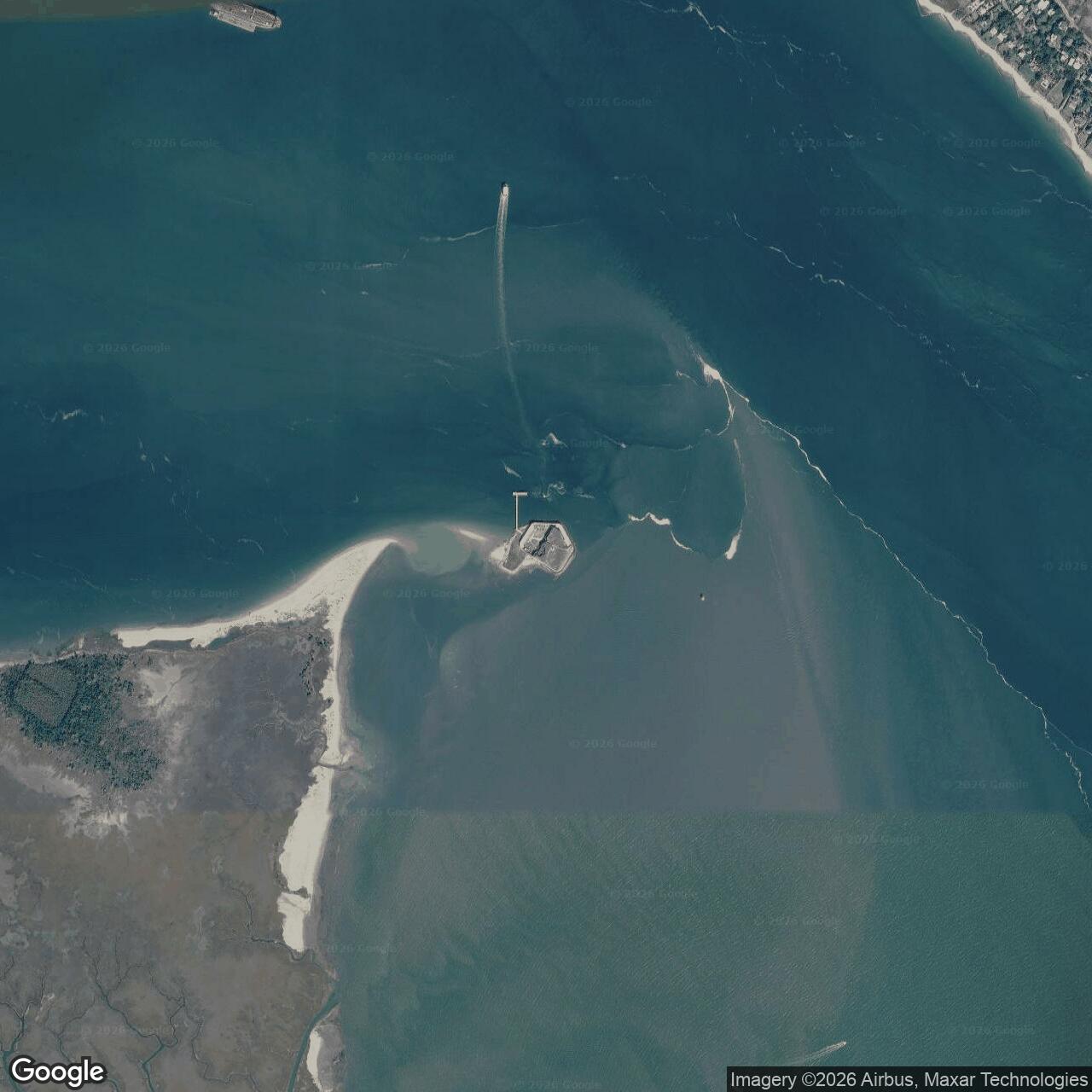
Fort Sumter Army Base, Charleston South Carolina

Longitude: -79.874693
Official Base Website: Fort Sumter Historic Site
Current Role: National Park Service ferry-access historic fort, museum
Fort Sumter stands on a small artificial island in the entrance channel of Charleston Harbor, between Charleston, Sullivan's Island, James Island, and Morris Island. Its position explains both its intended military purpose and its national historical significance. The U.S. Army and the Corps of Engineers planned the fort after the War of 1812 as part of the Third System of seacoast defense, a federal program meant to close the gaps that British operations had exposed in American coastal protection. In Charleston Harbor, the logic was especially clear. Fort Moultrie guarded Sullivan's Island, Castle Pinckney guarded an inner approach, and Fort Sumter was designed to sit in the channel itself, adding heavy masonry firepower at the place where vessels moving into Charleston would be most vulnerable.
Fort Sumter is no longer an active U.S. Army installation. Its final active military role ended after World War II; Battery Huger, the Endicott-era concrete battery built inside the old fort, was deactivated in 1947, and Congress authorized the Secretary of the Army to transfer Fort Sumter to the Secretary of the Interior in 1948. The site is now administered by the National Park Service as part of Fort Sumter and Fort Moultrie National Historical Park. In practical terms, the old Army post is now a ferry-access historic site, museum landscape, and national commemorative place rather than a functioning Coast Artillery or harbor-defense station.
Fort Sumter's identity is unusual because it was important before it was finished. Construction began in 1829, but the artificial island, ownership disputes, funding shortages, supply problems, tides, disease, and the difficulty of marine construction slowed the work for decades. The fort was still unfinished when Major Robert Anderson moved his small U.S. Army command there from Fort Moultrie on the night of December 26, 1860. That act transformed a not-yet-complete harbor-defense work into the most visible federal military position inside a seceded state. Less than four months later, Confederate batteries opened fire on Fort Sumter, beginning the American Civil War.
The fort therefore has two overlapping identities. It was a seacoast fortification, built to defend the United States against foreign naval attack. It was also the place where a domestic constitutional, political, and military crisis became open war. The first identity explains its form: a heavy masonry sea fort on an engineered island, intended to mount large numbers of guns. The second explains its place in national memory: a symbol of federal authority, secession, slavery, civil war, and reunification.
Site Design, Defenses, and Physical Plant
Fort Sumter was designed as a Third System masonry fort. The Third System was the most ambitious American coastal-fortification program of the early nineteenth century, and its forts were intended to be permanent, casemated, heavily armed works defending major ports. At Charleston, the chosen site was a shoal near the harbor entrance. Engineers began by creating an artificial island, placing roughly seventy thousand tons of rock and granite rubble from northern quarries to form a foundation on a two-and-one-half-acre base. Only after that marine foundation was secure could the brick fort itself rise above the water.
The planned fort was pentagonal, with massive brick and masonry walls roughly five feet thick and fifty feet high. Its design called for 135 heavy guns and a wartime garrison of about 650 officers and men. Four sides were lined with tiers of casemated gunrooms, while the gorge wall contained officers' quarters, administrative spaces, magazines, and service functions. The fort also contained enlisted barracks, a parade ground, a sally port, magazines, wharf facilities, and an esplanade. In its intended form, Fort Sumter was to be a powerful enclosed artillery platform whose guns could work in combination with Fort Moultrie and other Charleston Harbor defenses.
The work progressed slowly. Construction was halted in 1834 by a legal dispute over title to the shoal, resumed in 1841, and continued through the 1840s and 1850s under changing engineering supervision. The fort was still not complete in 1860. By the time Anderson occupied it, the exterior stood largely finished, but the interior was incomplete, barracks and quarters were unfinished in places, and only a fraction of the planned armament was mounted. Contemporary descriptions and later National Park Service summaries make clear that Sumter was an unfinished work hurriedly converted into a defensive refuge. In late December 1860, there were many guns present, but only a small number were mounted and immediately usable. The garrison and engineers had to mount guns, prepare ammunition, close openings, strengthen weak points, and convert a construction site into a defendable post under crisis conditions.
Civil War bombardments permanently changed the fort. The April 1861 attack burned buildings, damaged walls, and exposed how vulnerable masonry could be to sustained fire. The later 1863-1865 siege did far more damage. Union rifled artillery from Morris Island and naval bombardment battered the walls, destroyed casemates, reduced much of the structure to rubble, and forced the Confederate defenders to transform the remains into a low, earth-filled defensive work. By the time U.S. forces reentered Fort Sumter in February 1865, it no longer resembled the high-walled Third System fort planned before the war.
The postwar Army did not restore Fort Sumter to its original height. Instead, it stabilized and partly rebuilt the fort at a lower profile, reopened some lower-tier casemates, mounted a limited number of heavy guns, and preserved enough of the structure to keep it in the harbor-defense system. The most dramatic later change came in 1898-1899, when the Army built Battery Huger across the old parade ground. This large concrete Endicott Period battery mounted two 12-inch breechloading rifles, one on a disappearing carriage and one on a barbette mount. Battery Huger occupied about one third of the parade ground and visually dominated the old masonry fort. It represented a new era of seacoast defense: reinforced concrete, high-powered breechloading artillery, and earth cover replaced the older reliance on tall brick walls and dense casemates.
Mission Evolution
Fort Sumter's original mission was harbor defense. It was conceived as a seacoast artillery fort that would help deny enemy warships access to Charleston Harbor. In that role it belonged to the same broad national system as Fort Monroe, Fort Pulaski, Fort Jefferson, Fort Adams, and other large masonry works of the Third System. Its purpose was not to house a large mobile force or train field armies. It was a fixed artillery installation intended to dominate a maritime approach.
Before 1860 that intended mission was largely theoretical. The fort was under construction for decades and was not the principal garrison post in Charleston Harbor. Fort Moultrie, not Fort Sumter, housed the small Regular Army artillery command at Sullivan's Island. That changed after South Carolina seceded on December 20, 1860. Anderson judged Fort Moultrie too vulnerable to landward attack and too difficult to hold with his limited force. On December 26 he moved his command across the harbor to Fort Sumter, an act that made Sumter the central federal position in Charleston. Its mission immediately changed from future harbor-defense work to present crisis garrison: hold U.S. property, preserve federal authority, and avoid or withstand a direct assault.
The crisis deepened when attempts to supply or reinforce the garrison became political and military tests. The Star of the West incident in January 1861 showed that South Carolina forces were willing to fire on a vessel attempting to reach the fort. By April, President Abraham Lincoln's decision to send provisions to Fort Sumter forced the newly formed Confederate government to decide whether to tolerate a federal garrison in Charleston Harbor. Confederate authorities chose to demand evacuation and then to open fire.
During the Civil War, Fort Sumter's mission changed again. After Anderson's surrender, Confederate forces occupied the fort and made it part of the harbor-defense system protecting Charleston from U.S. naval and Army operations. From 1861 to 1865 it was no longer a U.S. Army post but a Confederate defensive position. Its role was to prevent federal ships from entering the harbor, support neighboring batteries and obstructions, and serve as a symbolic front-line post. During the long siege of Charleston, its artillery value declined as Union bombardment wrecked its guns and walls, but its military value did not disappear. Confederate engineers, soldiers, and enslaved laborers converted the ruins into an earthwork that absorbed shellfire and remained a barrier to Union control of the harbor.
After the war, Fort Sumter returned to U.S. control, but its mission never again had the decisive centrality it held in 1861. In the 1870s the Army reduced and repaired the fort, mounted a small number of heavy guns, and kept it as part of Charleston's defenses. From 1876 to 1897 it functioned mainly as an unmanned lighthouse station rather than as a vigorous artillery post. The Spanish-American War revived concern about seacoast defense, and Battery Huger gave Fort Sumter a modern Coast Artillery role. During World War I, a small garrison manned Battery Huger's rifles. In the interwar period the site was maintained by the Army but not used as a major military establishment. During World War II, the old 12-inch guns were removed, and 90 mm antiaircraft guns were installed and manned by Coast Artillery personnel.
The final mission change came in the 1940s. After World War II, Fort Sumter no longer had military value as a harbor-defense installation. Battery Huger was deactivated in 1947, and the following year Fort Sumter became a National Park Service national monument. The Army's purpose had ended; preservation, interpretation, and commemoration became the governing missions.
Operational Role
Fort Sumter's most consequential operational period began in December 1860. Major Robert Anderson, a career U.S. Army officer, commanded the small federal force in Charleston Harbor. His command included Regular Army artillerymen, officers, engineers, and support personnel. NPS accounts describe the broader harbor garrison at Fort Moultrie as a small First U.S. Artillery presence, and Anderson's later Fort Sumter force as roughly eighty soldiers, supported by engineers and laborers. The size of the garrison was far below what Fort Sumter had been designed to hold. A fort planned for 650 men was being defended by a tiny command trying to make usable a work that remained unfinished.
Anderson's move to Fort Sumter was operationally logical. Fort Moultrie had been built to face the sea and was vulnerable from the rear. Sand hills, nearby structures, and local militia activity made it difficult to defend with a small force. Fort Sumter, by contrast, stood in the harbor, surrounded by water, with heavier walls and a commanding position. The move also had strategic consequences that went far beyond engineering. It denied South Carolina immediate control of the strongest federal work in the harbor and forced both Washington and Charleston to confront the question of sovereignty directly.
Inside Fort Sumter, the garrison worked under pressure. Soldiers and engineers mounted guns, prepared ammunition, improved defenses, managed limited food supplies, and coped with uncertainty. Families, laborers, and workmen were also part of the fort's crowded wartime reality. The post was not simply a dramatic flagpole in the harbor. It was a half-finished military construction site occupied by a stressed, undersized, isolated Regular Army command.
The April 1861 battle began after Confederate authorities demanded evacuation and Anderson refused. At 4:30 a.m. on April 12, a Confederate mortar at Fort Johnson fired the signal shot. Within a short time, batteries around Charleston Harbor were firing on the fort. Anderson's men could respond with only a limited number of guns. The fort had more than four dozen usable guns by that point, but the garrison lacked manpower, cartridges, and safe access to the most exposed barbette weapons. Captain Abner Doubleday fired one of the first Union replies from the right gorge angle. For roughly thirty-four hours, the garrison endured bombardment, fire, smoke, falling masonry, and the growing danger that flames would reach the powder magazine.
The surrender was driven by practical military conditions. Fire consumed or threatened major interior spaces, the flagstaff was shot away, the magazine was endangered, and the garrison's provisions and ammunition situation had become untenable. Anderson accepted evacuation terms and left the fort on April 14, 1861, after a salute to the flag. The battle itself produced no deaths from enemy fire, but the surrender ceremony turned deadly when an accidental explosion during the salute killed Private Daniel Hough and fatally injured Private Edward Galloway. The operational result was Confederate control of the fort. The strategic result was the beginning of open civil war.
From 1861 to 1865, Fort Sumter operated as a Confederate harbor-defense position. Its Confederate garrison occupied a fort whose symbolic value was enormous but whose physical condition steadily worsened. The April 7, 1863 ironclad attack tested the harbor defenses when U.S. Navy ironclads attempted to force their way in. Fort Sumter and the surrounding Confederate works helped stop that naval attack. Later in 1863, Union land and naval operations shifted toward Morris Island. Once Union forces established batteries there, Fort Sumter became the target of sustained heavy bombardment. In the first major August-September 1863 bombardment, thousands of heavy rounds struck the fort. By late summer, its guns were largely silenced as offensive weapons, but Confederate troops refused to abandon the position.
The defense after 1863 was no longer a classic artillery duel from an intact fort. Confederate engineers and soldiers used rubble, sand, timber, and enslaved labor to transform the shattered masonry into an earthwork. The fort's role became one of endurance and denial. Even as a ruin, it anchored Confederate control of the harbor and forced Union forces to continue spending men, ships, shells, and time against Charleston's defenses. The siege continued until February 1865, when Confederate forces evacuated Charleston as Union operations under William T. Sherman made the city untenable. U.S. forces reoccupied Fort Sumter on February 18, 1865.
Fort Sumter's later operational life was less dramatic but still important. In the 1870s the Army rearmed portions of the lower casemates with heavy rifles, including 100-pounder Parrott guns. Those guns represented an effort to keep the battered fort in service, but the site was increasingly outdated. Battery Huger changed that. Built in 1898-1899, it placed modern concrete and two 12-inch rifles inside the old walls, tying Fort Sumter back into the Harbor Defenses of Charleston. Its weapons were intended to attack enemy surface vessels at long range, not to replay the close-range brick-and-mortar warfare of 1861.
During World War I, Battery Huger was manned by a small garrison. The fort then spent much of the interwar period in military custody but with little active use. During World War II, the Army removed Battery Huger's obsolete 12-inch guns and installed four 90 mm antiaircraft guns along the fort's right flank. These guns reflected a final change in threat perception: by the 1940s, harbor defense involved aircraft and modern naval systems, not only battleships moving under the fire of disappearing rifles. The 90 mm guns were removed in 1947, bringing Fort Sumter's active military role to an end.
Units, Organizations, and Systems
The most famous Army command associated with Fort Sumter was Major Robert Anderson's U.S. Army garrison in 1860-1861. Anderson had taken command of the federal forces in Charleston Harbor in November 1860. His small command was rooted in the Regular Army artillery presence at Fort Moultrie and included officers who later became prominent in the Civil War, including Abner Doubleday, Truman Seymour, John G. Foster, George W. Snyder, Samuel W. Crawford, and others. The fort's 1861 defense was not a militia episode. It was a Regular Army crisis operation carried out by professional soldiers and engineers in an incomplete federal fort.
The Confederate forces that attacked and then held Fort Sumter were not assigned as a single permanent organization in the same way across the entire war. The fort became part of the Confederate defenses of Charleston Harbor, under commanders including P. G. T. Beauregard and later other Confederate departmental and district commanders. Confederate artillery units, infantry detachments, engineers, labor details, and enslaved laborers all contributed to maintaining the fort. The Confederate garrison's work was often defensive engineering under fire: repairing damage, moving guns, building bombproofs, and keeping the position tenable in ruins.
In the postwar period, Fort Sumter was part of the U.S. Army's seacoast-defense system for Charleston. The late nineteenth-century and early twentieth-century Coast Artillery structure placed the fort within the Harbor Defenses of Charleston, especially after Battery Huger was constructed. The Coast Artillery mission linked Fort Sumter with Fort Moultrie and the Endicott batteries on Sullivan's Island. Battery Huger did not operate in isolation; it was one component in a harbor-wide system of long-range guns, observation, communications, mine control, and other defenses intended to prevent a hostile fleet from entering Charleston Harbor.
During World War II, Fort Sumter's last active role was tied to Coast Artillery antiaircraft defense. The four 90 mm guns installed after the removal of the Battery Huger rifles were part of a broader wartime harbor and air-defense posture. That final military use was short-lived, and the battery was deactivated in 1947.
The National Park Service became the defining organization after the Army era. Fort Sumter National Monument was established in 1948 after federal legislation directed the transfer of the fort from the Secretary of the Army to the Secretary of the Interior. Fort Moultrie was added to the NPS unit in 1960. In 2019, the unit was redesignated Fort Sumter and Fort Moultrie National Historical Park. That redesignation recognized that the site is not only a Civil War shrine but part of a larger Charleston Harbor defense story extending from the American Revolution through World War II.
Facilities and Physical Layout
Fort Sumter's physical layout is compact but layered. The original footprint was the artificial island and pentagonal masonry fort. The island itself was a military engineering achievement, because the fort had to be built up from a shoal before masonry work could proceed. The fort's planned arrangement included casemated gunrooms on multiple tiers, an internal parade, barracks, officers' quarters, magazines, storerooms, and a sally port. The wharf and boat access were essential because everything and everyone had to arrive by water.
The surviving fort is not the complete Third System work of 1861. Civil War damage, Confederate earthwork conversion, postwar reduction, and Battery Huger construction all changed the layout. Today the visitor sees remnants of brick casemates and walls, the parade ground, the sally port, officers' quarters ruins, enlisted barracks ruins, exposed artillery, the Union Garrison Monument, and the large concrete mass of Battery Huger. The contrast is historically important. Fort Sumter today is not a clean reconstruction of the original fort; it is a visible record of successive military alterations.
Battery Huger is the dominant later facility. Built from 1898 to 1899, it extends across much of the fort's interior and occupies about one third of the parade ground. Originally designed for two 12-inch rifles, it had gun platforms, magazines, service spaces, concrete protection, and access routes. It embodied the Endicott Period transformation of American coastal defense from masonry forts to dispersed concrete batteries. Today Battery Huger houses visitor facilities, museum space, restrooms, a bookstore, and an observation deck, turning a late nineteenth-century gun battery into the principal interpretive structure inside the preserved fort.
The location also imposes continuing physical constraints. Fort Sumter is exposed to saltwater, waves, storms, corrosion, and sea-level-related risk. It is accessible only by authorized ferry, and private vessels may not dock there. Maintenance is therefore not ordinary building upkeep. It involves masonry conservation, metal conservation, visitor safety, marine access, dock operations, erosion control, and interpretation within a small island site that was built for war rather than tourism.
Role in the Wider Military Network
Fort Sumter makes sense only as part of several larger systems. In its original conception, it was a node in the national Third System of seacoast defense. The United States built that system because the War of 1812 revealed serious coastal vulnerabilities. Fort Sumter's intended role was to strengthen Charleston Harbor by adding a powerful island fort to a network that already included older defenses. It was designed to work with other forts, not to defend Charleston alone.
In 1860-1861, Fort Sumter became part of a different system: the confrontation between federal authority and state secession. Its value was partly military, because it occupied a commanding position in the harbor, but it was also political and symbolic. Control of Fort Sumter represented control of federal property inside South Carolina. Anderson's move to the fort, the failed resupply effort by the Star of the West, Lincoln's decision to send provisions, and Beauregard's demand for evacuation all show that the fort had become a national decision point. It was a military installation whose existence forced political actors to choose between compromise, withdrawal, or war.
During the Civil War, Fort Sumter functioned within the Confederate Charleston Harbor defense system. That system included Fort Moultrie, Fort Johnson, batteries on Morris Island and Sullivan's Island, Cummings Point, harbor obstructions, mines or torpedoes, artillery positions, and mobile troops. Fort Sumter was the center of attention, but it was not the only point of defense. Its ability to help block naval movement depended on the combined fire and obstacles of the harbor network.
After the Civil War, Fort Sumter entered the Army's modern coast-defense system. Battery Huger placed the site in the Endicott-era network of reinforced-concrete batteries and centralized harbor-defense planning. By World War I and World War II, the old masonry fort mattered mainly because the island remained federal property in the harbor and because Battery Huger or its later antiaircraft replacements could still be integrated into a defensive system.
As an NPS site, Fort Sumter now belongs to another system: national historical preservation and public memory. It is interpreted alongside Fort Moultrie, the Sullivan's Island Life Saving Station Historic District, Liberty Square, and the broader Charleston landscape. That context matters because Fort Sumter is not just a battlefield. It is linked to slavery, secession, harbor defense, federal power, Reconstruction memory, national reconciliation narratives, civil rights-era interpretation, and the continuing public debate over how the Civil War should be remembered.
Chronology
- 1828 Engineers prepared plans for a casemated battery on the shoal opposite Fort Moultrie in Charleston Harbor.
- 1829 Construction began on the artificial island and fortification that became Fort Sumter.
- 1834 A legal dispute over ownership of the shoal halted construction.
- 1841 Construction resumed, with modified plans intended to strengthen the fortification.
- 1840s Work continued on the foundation, masonry walls, casemates, quarters, and interior structures.
- 1850s Work continued but slowed again because of funding, supply, and construction difficulties.
- 1860-12-20 South Carolina seceded from the United States.
- 1860-12-26 Major Robert Anderson moved his U.S. Army command from Fort Moultrie to the unfinished Fort Sumter under cover of darkness.
- 1860-12-27 The U.S. flag was raised over Fort Sumter.
- 1861-01-09 South Carolina batteries fired on the Star of the West as it attempted to reach Fort Sumter with men and supplies.
- 1861-04-11 Confederate representatives demanded that Anderson evacuate Fort Sumter; Anderson refused.
- 1861-04-12 At 4:30 a.m., a Confederate mortar at Fort Johnson fired the signal shot that began the bombardment of Fort Sumter and opened the Civil War.
- 1861-04-13 Fort Sumter burned and was severely damaged during the second day of bombardment; Anderson agreed to evacuation terms.
- 1861-04-14 Anderson's garrison evacuated Fort Sumter after a flag salute; an accidental explosion during the salute killed or mortally injured Union soldiers.
- 1861-04-15 Confederate forces occupied Fort Sumter after the U.S. garrison's departure.
- 1863-04-07 U.S. Navy ironclads attacked Charleston Harbor but were repulsed by Fort Sumter and the surrounding Confederate harbor defenses.
- 1863-07 U.S. Army and Navy operations against Morris Island began, setting the stage for sustained bombardment of Fort Sumter.
- 1863-08-17 The first major Union bombardment from Morris Island batteries and naval guns opened against Fort Sumter.
- 1863-09-02 By the end of the first major bombardment, Fort Sumter had been battered into a ruin.
- 1863-09-08 to 1863-09-09 A Union amphibious assault against Fort Sumter failed.
- 1863-12-11 A small-arms magazine explosion inside the damaged fort killed and wounded Confederate defenders.
- 1863-1865 Confederate soldiers, engineers, and enslaved laborers converted the ruined masonry fort into an earthwork and maintained it under continued bombardment.
- 1865-02-17 Confederate forces evacuated Charleston and its harbor defenses.
- 1865-02-18 U.S. forces reentered Fort Sumter and found the fort heavily ruined.
- 1865-04-14 Robert Anderson returned to Fort Sumter for a victory flag-raising ceremony, four years after the evacuation.
- 1870s The U.S. Army repaired and reduced the fort, restored some lower casemates, and mounted heavy guns.
- 1876-1897 Fort Sumter served largely as an unmanned lighthouse station.
- 1898-1899 The Army constructed Battery Huger inside Fort Sumter as an Endicott Period concrete coast-defense battery.
- 1899 Battery Huger was completed with two 12-inch breechloading rifles.
- 1917-1918 During World War I, a small garrison manned Battery Huger's rifles.
- 1932 The U.S. Government erected the Union Garrison Monument at Fort Sumter.
- 1941 Battery Huger's 12-inch rifles were removed from service.
- 1943 The Battery Huger rifles had been removed by about this year, and four 90 mm antiaircraft guns were installed at Fort Sumter during World War II.
- 1947 The 90 mm guns were removed and Battery Huger / Fort Sumter's active military role was deactivated.
- 1948-04-28 Congress authorized the transfer of Fort Sumter from the Secretary of the Army to the Secretary of the Interior and established Fort Sumter National Monument.
- 1959 National Park Service excavations reopened buried casemates and uncovered Parrott rifles that had been buried after Battery Huger was constructed.
- 1960 Fort Moultrie was added to the Fort Sumter National Monument unit.
- 1966-10-15 Fort Sumter was listed in the National Register of Historic Places as part of the early national historic preservation program.
- 2019-03-12 The John D. Dingell, Jr. Conservation, Management, and Recreation Act redesignated the unit as Fort Sumter and Fort Moultrie National Historical Park.
- Present Fort Sumter remains a closed former U.S. Army installation preserved by the National Park Service as a ferry-access historic fort, museum site, and national Civil War landmark.