Camp Wolters Army Base, Mineral Wells Texas
Longitude: -98.054013
Approximate Base Size: 23,747 acres
Current Role: Municipal airport
Camp Wolters was established in 1925 near Mineral Wells, Texas, as a Texas National Guard training camp and later became one of the most important U.S. Army training installations in Texas. Its first identity was not as a permanent federal fort but as a state-supported National Guard camp for horse-mounted cavalry units. Its later identities were much larger and more varied: World War II Infantry Replacement Training Center, prisoner-of-war compound, postwar separation and surplus installation, Wolters Air Force Base, U.S. Army Primary Helicopter School, Fort Wolters, U.S. Army Primary Helicopter Center/School, and finally a closed federal post whose land was divided among state military, municipal, educational, industrial, recreational, and private uses.
The installation is no longer an active federal U.S. Army post. The World War II Army training center was deactivated on January 19, 1946, and the later Fort Wolters federal installation was officially closed for military service on February 1, 1973. That closure did not erase all military use of the land. A reduced Fort Wolters training area remains associated with Texas Army National Guard use, and modern planning documents describe Fort Wolters as a small-arms and drop-zone training site. The larger former federal installation, however, is no longer a full Army base. Much of the old post became Wolters Industrial Park, Mineral Wells Regional Airport, educational and public facilities, private reuse, and related municipal or state uses. The Old Camp Wolters site is associated with the Mineral Wells High School campus and local historic interpretation.
The site mattered because of geography, land availability, and civic support. Mineral Wells lay west of the Dallas-Fort Worth area in the Cross Timbers country, close enough to Fort Worth, Dallas, rail lines, highways, and regional labor to support a large training plant, but far enough from dense urban congestion to offer open maneuver space, ranges, aviation approaches, and later helicopter training airspace. The community repeatedly supported the camp through donated, leased, purchased, and locally promoted land. That civic-military partnership explains why a modest National Guard camp could grow into a wartime replacement center, then be reactivated for Cold War aviation-engineer training, then become the Army's primary helicopter gateway during the Vietnam era.
The name honored Brigadier General Jacob F. Wolters, commander of the 56th Brigade of the Texas National Guard. That naming is important because it shows the installation's origin in Texas Guard cavalry rather than in the later federal Army aviation mission. Camp Wolters began as a seasonal camp for mounted Guard units. It became nationally important only when World War II mobilization and later Cold War aviation needs transformed the property into something much larger than its 1925 founders could have expected.
Location, Terrain, and Site Development
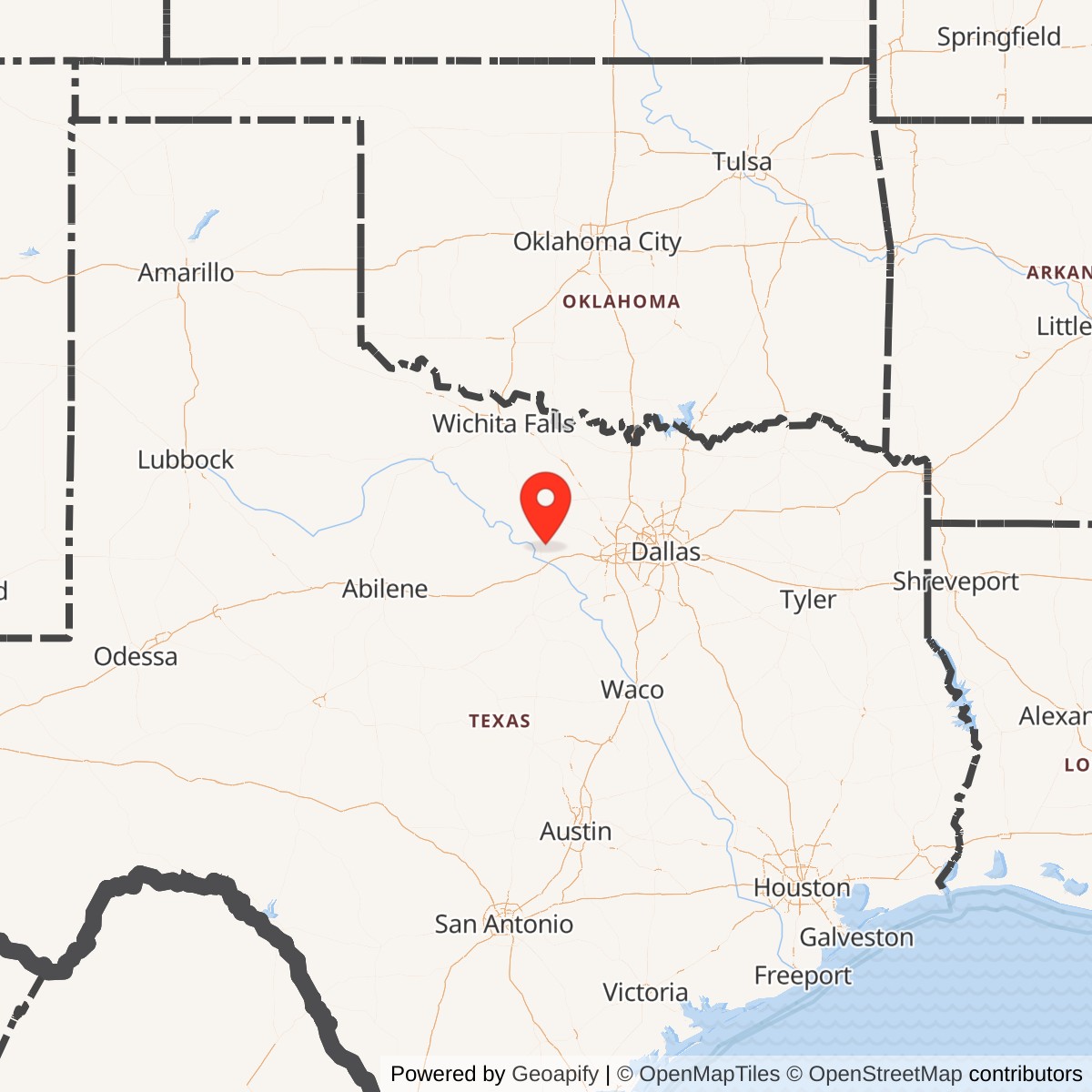
Camp Wolters occupied land east of Mineral Wells, extending across the Palo Pinto-Parker county line as the installation expanded. The original camp, later called Old Camp Wolters, was on the west side of the later military complex, near what is now the Mineral Wells High School campus. Mineral Wells donated roughly fifty acres for the first camp, while thousands of additional acres were leased for cavalry maneuvers. By 1927, about one thousand officers and enlisted men and roughly the same number of horses could be encamped there during National Guard training.The terrain was useful for mounted and later infantry training because it mixed open ground, rougher Cross Timbers country, roads, hills, and enough undeveloped space to support field problems. It was also close to Mineral Wells, which had hotels, services, utilities, and a civic leadership eager to support military activity. For the National Guard this meant a seasonal maneuver camp with headquarters, stables or horse areas, barracks, parade and drill spaces, and access to rural terrain. For the World War II Army it meant a community ready to assemble and lease the land needed for a much larger Infantry Replacement Training Center.
The World War II expansion created what local sources often call the "new" Camp Wolters farther east of Old Camp Wolters. The Texas Historical Commission marker states that the Army activated Camp Wolters as an infantry replacement center on October 13, 1940, and that additional lands bought or donated by local residents expanded the camp to more than 7,500 acres. The Historical Commission's Old Camp marker gives the troop capacity as 24,973, while the later Fort Wolters marker describes more than 30,000 soldiers per training cycle at peak. These figures describe different ways of counting capacity and throughput, but they point to the same fact: Camp Wolters was one of the great infantry replacement installations of the World War II Army.
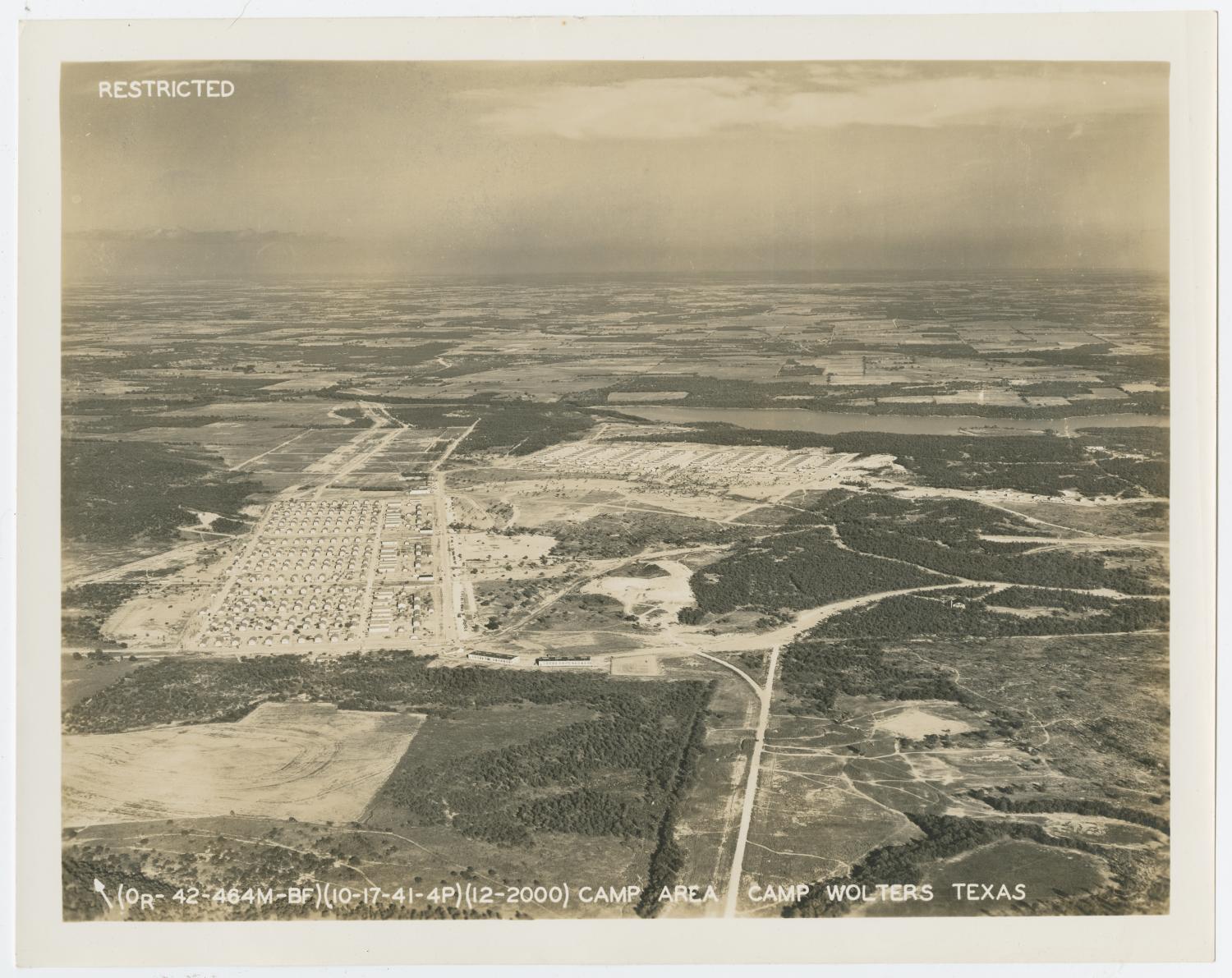
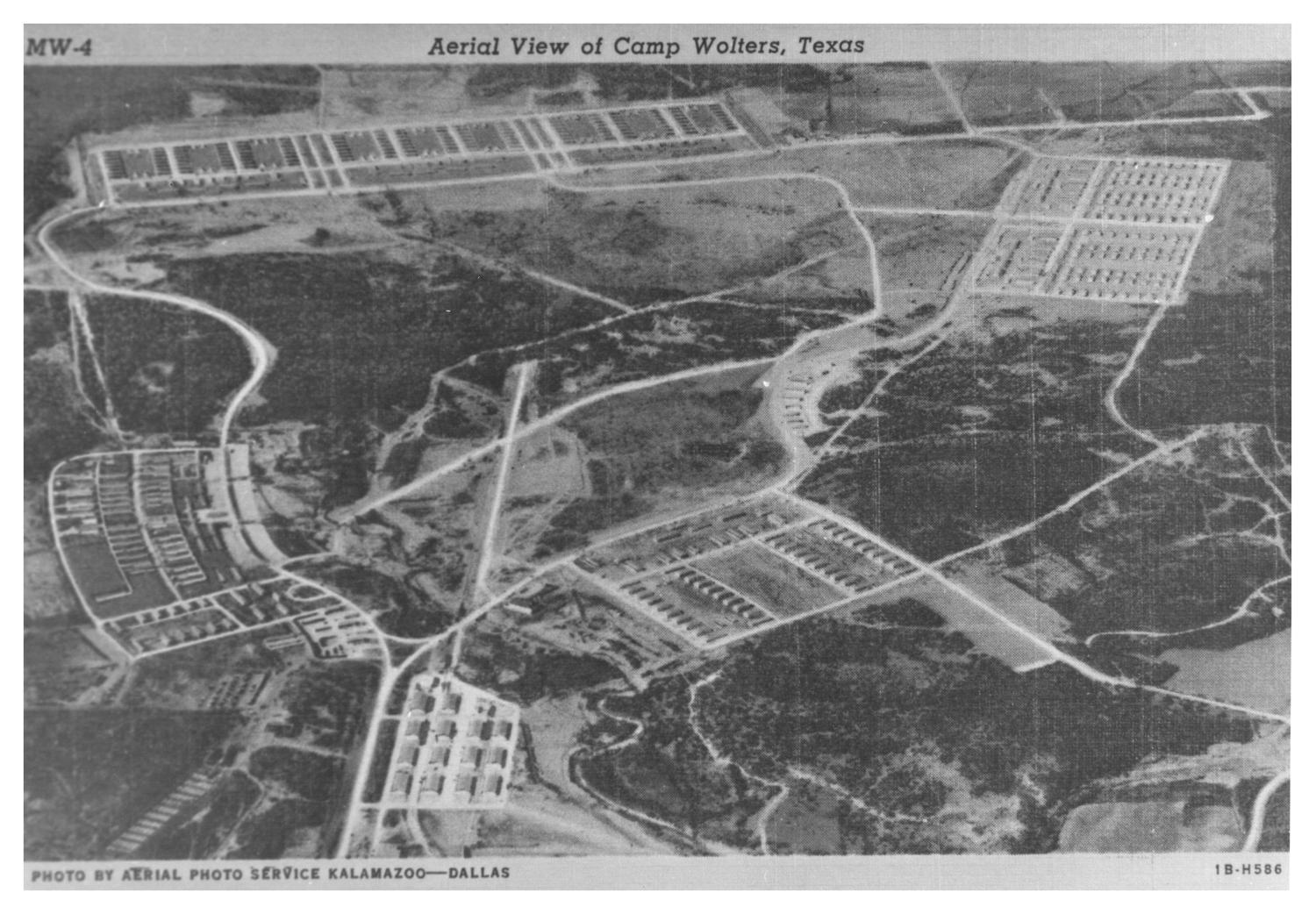
The physical plant grew quickly. The Fort Wolters historical marker states that more than 100 buildings were constructed in less than four months. Camp guides, postcards, photographs, and the Portal to Texas History collections show a large grid of barracks areas, service clubs, sports facilities, headquarters buildings, roads, utility lines, training grounds, and support structures. The old camp did not disappear; it was repurposed, most notably as a prisoner-of-war compound for German prisoners during the war. The new camp, meanwhile, became the main training plant for infantry replacements.
The later aviation era required a different landscape. Helicopter training could not be confined to the main cantonment. The U.S. Army Primary Helicopter School began with a main heliport and a small number of stage fields, then expanded to three heliports-Main, Downing, and Dempsey-and a network of stage fields spread through the surrounding region. By the Vietnam-era peak, sources describe the training system as using Fort Wolters proper, leased support land, extensive airspace, and nearly 722,000 acres of operating area for flight training purposes. The Portal to Texas History's Pictorial History of Fort Wolters describes the Primary Helicopter School as using about 1,350 square miles of airspace. The result was not just a post, but a regional aviation training system built around Mineral Wells.
Mission Evolution
Camp Wolters' first mission was National Guard cavalry training. The 56th Cavalry Brigade and related Texas Guard mounted units needed a summer training site where horse-mounted formations could drill, camp, maneuver, care for animals, and concentrate for annual field exercises. This was a pre-mechanized mission rooted in the interwar Army's continued reliance on cavalry and in the Texas National Guard's need for a central training place. The camp was seasonal, state-centered, and tied closely to Mineral Wells civic support.In 1933 a Civilian Conservation Corps company used the National Guard barracks and made improvements at the camp and in the city park. That episode was not the main military mission, but it mattered physically because CCC and related New Deal-era work helped improve parts of the camp landscape. The native stone entrances, walls, and camp improvements later became part of the site's visible historic memory.
The decisive federal transformation came with World War II mobilization. In 1940 and 1941 the Army selected and activated the site as an Infantry Replacement Training Center. This changed Camp Wolters from a periodic Guard camp into a full-time Army mobilization installation. Its mission was not to train one specific division from start to finish, but to receive individual soldiers, give them basic infantry preparation, classify and discipline them, teach the basic skills of ground combat, and send them onward to units or replacement streams. That made the camp a manpower-processing and training engine for the global war.
During World War II the camp also became a prisoner-of-war site. German prisoners from North Africa were held in the old camp area, where existing National Guard and early camp buildings could be adapted to compound use. The POW function placed Camp Wolters inside the national prisoner system supervised by the Army's Provost Marshal General. This meant the installation had to train U.S. infantrymen and simultaneously guard, house, feed, and administer enemy prisoners under wartime rules.
After the war the Army mission collapsed quickly. Camp Wolters served briefly in postwar separation and closing functions, then was deactivated in 1946. Local businessmen bought property and facilities for private reuse through Camp Wolters Enterprises. That private reuse period was brief because Cold War pressures soon returned the installation to federal service.
In 1951 the site reopened as Wolters Air Force Base. Its Cold War Air Force mission centered on the Aviation Engineer Force and special-category Army and Air Force personnel. This mission grew out of the problem created by the Army-Air Force split and by the Korean War: the Air Force needed airfields built, repaired, upgraded, and maintained in combat theaters, while many of the necessary construction troops and skills remained Army-derived. Wolters therefore trained aviation-engineer personnel for airfield construction and related support tasks rather than for infantry combat or helicopter flight.
In 1956 the installation returned to Army control and became the home of the U.S. Army Primary Helicopter School. This was the beginning of Fort Wolters' most historically famous Cold War mission. The Army needed a dedicated primary helicopter training base because rotary-wing aviation was becoming central to observation, liaison, medical evacuation, transport, and eventually airmobile warfare. Wolters provided the open airspace, heliport facilities, stage fields, contractor support, and weather conditions needed to train large numbers of new rotary-wing aviators.
The base was redesignated Fort Wolters in 1963, marking its status as a permanent Army installation. In March 1966 it was redesignated the U.S. Army Primary Helicopter Center/School, reflecting the scale of the Vietnam buildup. The Vietnam War transformed Wolters from an important specialty school into one of the main entry points into Army aviation. Army, Marine Corps, and later Air Force helicopter students trained there before continuing to more advanced or service-specific instruction. By January 1, 1973, about 40,000 students had completed the twenty-week training program, and other sources place the overall primary helicopter-school output at more than 41,000 students over the school's life.
Fort Wolters also had a Cold War air-defense role. A Nike Hercules missile installation, DF-70, was built on or adjacent to the Fort Wolters military landscape as part of the Dallas-Fort Worth Defense Area. The Dallas-Fort Worth Nike system defended aerospace plants, transportation infrastructure, Carswell Air Force Base, Naval Air Station Dallas, and the Fort Wolters helicopter training installation itself. That role was secondary to the helicopter school, but it linked Fort Wolters to the Army Air Defense Command's missile network.
The federal Fort Wolters mission ended in the early 1970s. Helicopter training was consolidated elsewhere, primarily in the Army aviation system at Fort Rucker, Alabama. Fort Wolters was officially closed for federal military service on February 1, 1973, although some references describe administrative and reuse processes continuing after that date. The closure reflected the drawdown after the Vietnam War, changing training requirements, and the Army's decision to consolidate aviation training. The post-closure mission became reuse: Texas Army National Guard training on part of the land, industrial redevelopment, airport use, education, municipal functions, historic preservation, and recreation.
Operational Role: World War II Infantry Replacement Training Center
Camp Wolters' World War II operational role was the production of infantry replacements. Replacement training centers were essential to the wartime Army because combat divisions constantly needed new riflemen, machine gunners, mortar crewmen, scouts, leaders, clerks, drivers, cooks, and support soldiers. Camp Wolters did not exist to preserve a stable home-station community; it existed to move large numbers of trainees through a hard schedule and send them into the Army's global replacement stream.A trainee arriving at Camp Wolters encountered a highly structured environment. The camp had reception and classification functions, barracks areas, mess halls, medical and dental services, drill grounds, training fields, roads, recreation facilities, service clubs, chapels, libraries, and athletic programs. Camp publications and photographs show that the Army paid attention to morale and recreation, but the central business was combat preparation. Soldiers learned marching, discipline, physical conditioning, rifle marksmanship, bayonet work, basic fieldcraft, camouflage, gas defense, first aid, map reading, range procedures, and small-unit tactics. They trained to become individual infantrymen who could be absorbed by units already in or moving toward combat.
Major General Bruce Magruder was one of the key command figures associated with the Infantry Replacement Training Center. He had been the first commander of the 1st Armored Division before being assigned to command the IRTC at Camp Wolters during World War II. Under leaders like Magruder, the camp had to balance speed and military quality. The Army needed replacement soldiers quickly, but a poorly trained replacement could become a liability to himself and his unit. The scale of the camp's throughput made Camp Wolters a major contributor to the U.S. infantry manpower system.
The camp's replacement role touched multiple theaters. Soldiers trained at Wolters could go to Europe, the Mediterranean, or the Pacific. The installation's historical memory includes famous individuals who passed through or were associated with the camp, including Audie Murphy and Jack Knight, both Medal of Honor recipients, and Eddie Slovik, whose grim wartime fame came from being the only U.S. soldier executed for desertion during World War II. These names should not obscure the larger story. Camp Wolters mattered because tens or hundreds of thousands of less famous infantry trainees passed through its barracks, ranges, and training fields before entering the war.
The camp also trained mounted units and had links to Texas cavalry heritage. The Old Camp marker refers to the internationally famous "F" Troop of World War II as one of the mounted units that trained there. Portal to Texas History descriptions also connect the local Texas National Guard cavalry lineage to Troop F, 124th Cavalry, which later gained fame in the China-Burma-India theater as part of the Mars Task Force and Burma Road campaign. This means Wolters' wartime history should be understood in both replacement-infantry and Texas cavalry terms.
Operational Role: Prisoner-of-War Camp
Camp Wolters also served as a prisoner-of-war camp for German prisoners captured in North Africa. The old National Guard camp buildings were converted to POW use, while the newer wartime cantonment carried the main infantry replacement mission. The Texas Historical Commission marker states that the prisoners came from North Africa and that the prison camp closed on August 15, 1946, as the last prisoners were returned to their homeland. The Portal to Texas History's Pictorial History volume on the POW camp places the Camp Wolters POW story within the wider system that brought large numbers of Axis prisoners to the United States after the North African campaign.This POW mission was part of a national logistics and security problem. Allied victories in North Africa produced far more prisoners than could safely or easily be held near active theaters. The United States therefore used domestic camps, often near existing military installations, to house and guard prisoners. Texas was useful because it had space, a climate that reduced some maintenance burdens, and many military posts where guards, medical care, administration, and work programs could be organized.
The Camp Wolters POW compound was not the same thing as the infantry trainee camp, but the two existed side by side within the same installation environment. The old camp's reuse illustrates one of Wolters' repeated patterns: facilities built for one mission were adapted for another. National Guard barracks became prisoner housing; later wartime facilities became Air Force and Army aviation infrastructure; later military land became industrial, educational, airport, Guard, and park-related property.
Operational Role: Wolters Air Force Base and Aviation Engineers
The 1951 reactivation as Wolters Air Force Base gave the installation a very different mission. The Air Force era was tied to the Korean War and to the need for aviation engineers. Airfield construction, repair, and improvement were critical military tasks in Korea and in Cold War planning more broadly. Runways, taxiways, fuel systems, hardstands, revetments, and supporting roads had to be built or repaired under field conditions. The workforce and doctrine for this mission crossed service boundaries because the Army had long provided many engineer skills while the Air Force required operational air bases.Wolters Air Force Base therefore trained and housed the newly formed Aviation Engineer Force and special-category Army and Air Force personnel. USACE archival findings identify training activity by engineer aviation battalions in the 1950s, including bivouac training, machine-gun pit and foxhole construction, airfield-construction exercises, ammunition storage, and other field-engineer functions. The 826th Engineer Aviation Battalion and 835th Engineer Aviation Battalion appear in those archival findings, showing that this was not a paper redesignation but a real engineer-training mission tied to airfield construction and defense.
This period kept the installation alive between World War II and the helicopter era. It preserved federal control, kept utilities and ranges in use, and reoriented the base toward aviation. It also created a bridge between old Camp Wolters and Fort Wolters. Without the Air Force reactivation, the later Army Primary Helicopter School would have had to start from a much weaker property base.
Operational Role: U.S. Army Primary Helicopter School and the Vietnam Era
The most important post-World War II mission at Wolters was primary helicopter pilot training. Camp Wolters returned to Army control on July 1, 1956. A contract with Southern Airways supported flight training, and the first Primary Helicopter School class reported on November 26, 1956. That class consisted of 34 warrant officer candidates and one chief warrant officer, and it graduated on April 27, 1957. The school started small compared with the later Vietnam-era machine, but its structure was already clear: teach new students the fundamentals of helicopter control before they moved on to advanced training.The early helicopter-school system used the Main Heliport and four stage fields. As the mission expanded, the training plant grew to three heliports and twenty-five stage fields. The named heliports included Main, Downing, and Dempsey. Stage fields included western-themed names such as Pinto, Ramrod, Mustang, Sundance, Bronco, Rawhide, and Wrangler, while later Vietnam-themed fields carried names such as An Khe, Vung Tau, Tuy Hoa, Cam Ranh, Hue, Chu Lai, Soc Trang, My Tho, Bien Hoa, and Vinh Long. The naming was not casual nostalgia. It linked training geography in Texas to the places where many students expected to serve.
Primary helicopter training was physically repetitive and technically demanding. Students had to learn hovering, pedal coordination, cyclic and collective control, takeoffs, landings, traffic patterns, emergency procedures, autorotations, navigation, formation basics, radio procedures, and safe operations in congested airspace. For many students, Wolters was the first place where they soloed a helicopter. The training had to be standardized because the Army could not afford inconsistent aviator production during the Vietnam buildup.
The scale increased dramatically after 1965. The Pictorial History of Fort Wolters records that in July 1965 the installation received instructions to prepare for an output of 290 students per month because of the buildup in Southeast Asia; before that construction was complete, the target rose to 375 students every four weeks. The Army added or expanded stage fields, modified dozens of existing buildings, constructed additional heliport capacity, and dedicated Downing Army Heliport in 1966. The Mineral Wells airport history notes that the airport added the Downing Hangar, two other buildings, and more than fifty-four acres of tarmac in 1966 to support Vietnam-era helicopter pilot training.
The aircraft fleet reflected changing training needs. Early training used Hiller OH-23 Raven helicopters; later training included OH-13 and TH-55 types. Sources describe more than 1,200 helicopters in use by 1970, and some aviation-history accounts describe a 1969 peak above 1,300 aircraft. Regardless of the exact count, Fort Wolters was among the world's largest helicopter training concentrations. The airspace around Mineral Wells became crowded with student traffic, instructor traffic, stage-field operations, emergency practice, and support flights.
The Vietnam War made Fort Wolters nationally consequential. Army helicopter doctrine expanded rapidly as airmobility, air assault, medical evacuation, armed helicopter support, and light observation became central to operations in Southeast Asia. Fort Wolters trained Army aviators and, as demand rose, also trained Marine Corps helicopter pilots beginning in 1968 and Air Force helicopter pilots beginning in 1970. By the time the school closed, about 40,000 students had completed its twenty-week program, with some sources placing total primary helicopter-school output at more than 41,000. The individual pilots then dispersed into the broader aviation system, many moving to Fort Rucker or onward to operational assignments. Fort Wolters was therefore a pipeline base: it changed individual civilians and soldiers into beginning military aviators at industrial scale.
Units, Organizations, and Systems
The earliest military organization tied to Camp Wolters was the Texas National Guard's mounted cavalry structure, especially the 56th Cavalry Brigade under Brigadier General Jacob F. Wolters. Local descriptions also connect the site to the 112th Cavalry Service Troop and Troop F, 124th Cavalry. This cavalry connection is essential because it predates the federal Army and aviation history that later overshadowed it.During World War II the central organization was the Infantry Replacement Training Center at Camp Wolters. Major General Bruce Magruder was the best-known commander associated with that mission. The IRTC was not a division, but a training establishment built to produce individual soldiers for the Army's replacement stream. Its subordinate battalions, companies, reception functions, range operations, medical facilities, service clubs, morale programs, and headquarters all existed to move trainees through the replacement-training cycle.
The prisoner-of-war compound operated under the broader Army POW system supervised by the Office of the Provost Marshal General. At Camp Wolters that meant the old camp buildings and guard structures were part of a national prisoner system, not merely a local jail. German prisoners from North Africa were the principal POW population identified in the site's public markers and local histories.
In the Air Force era, the Aviation Engineer Force and special-category Army and Air Force personnel defined the mission. USACE archival findings identify the 826th Engineer Aviation Battalion and the 835th Engineer Aviation Battalion in connection with training and construction exercises at Wolters Air Force Base. These units show the Korean War-era engineering mission in practice: field construction, airstrip work, defensive positions, ammunition storage, and engineer training tied to aviation support.
In the helicopter era, the U.S. Army Primary Helicopter School and later the U.S. Army Primary Helicopter Center/School were the central organizations. Southern Airways served as the flight-training contractor. Fort Wolters also hosted support organizations identified in the Handbook of Texas and post newspapers, including Beach Army Hospital, the 84th Military Police Detachment, the 328th U.S. Army Band, U.S. Army Reserve Detachment 20, 16th Weather Squadron, and, in a 1966 Fort Wolters Trumpet account, the 864th Engineer Battalion (Construction), the U.S. Army Hospital, the 303rd U.S. Army Security Agency Battalion, Battery D, 4th Missile Battalion (Nike-Hercules), 562nd Artillery, the 697th Engineer Company (Pipeline), and the U.S. Army Dental Detachment.
The Nike Hercules installation tied Wolters to the Dallas-Fort Worth Defense Area. The Missile Standard identifies DF-70 at Fort Wolters as one of four Nike Hercules sites guarding the region, along with sites near Denton, Terrell, and Alvarado. The Dallas-Fort Worth defense protected major aerospace plants, transportation nodes, Carswell Air Force Base, Naval Air Station Dallas, and Fort Wolters itself. Battery D, 4th Missile Battalion, 562nd Artillery is identified in Fort Wolters-related sources as the Nike unit at the post.
Facilities and Physical Layout
Camp Wolters had several distinct physical layers. The first was Old Camp Wolters, the original National Guard camp. It had the parade-ground and entrance features associated with the old cavalry camp, including stone entrance walls and camp buildings. The original site is now associated with Mineral Wells High School and local historic markers. The Texas Historical Commission marker for Old Camp Wolters is located at 3801 Ram Boulevard, on the Mineral Wells High School campus.The World War II layer was much larger. The new camp included organized barracks areas, roads, headquarters buildings, training areas, service clubs, athletic facilities, medical and dental support, ranges, and utility systems. Postcards, camp guides, and aerial views in the Portal to Texas History show the scale and order of the wartime cantonment: repeated barracks blocks, open training areas, service and recreation facilities, and a road network tying them together. The camp was built for throughput, not architectural permanence. Its structures were designed to support mass training under wartime deadlines.
The POW compound occupied the old camp structures, demonstrating how the Army reused existing plant. The old barracks and National Guard buildings could be enclosed, guarded, and repurposed for prisoners while the newer training center handled the large-scale infantry mission. The coexistence of POW and trainee functions meant the installation required guard posts, security procedures, prisoner administration, and separation between populations.
The Air Force and helicopter eras created a radically different layout. Wolters Air Force Base used ammunition storage areas, engineer training zones, ranges, and airfield-construction training areas. The Army helicopter period then produced a full rotary-wing training complex. Main Heliport was the core. Downing Army Heliport, built at Mineral Wells Airport, added capacity during the Vietnam buildup. Dempsey Army Heliport added another major training node. The school also depended on permanent and temporary stage fields scattered through the surrounding region.
The training system's physical scale far exceeded the cantonment. USACE archival findings state that the tempo of flight training required use of nearly 722,000 acres extending roughly from Jacksboro to Stephenville north-south and Weatherford to Breckenridge east-west. The same findings identify Main Heliport, Downing and Dempsey Army Heliports, and twenty-five stage fields. The Portal's Pictorial History volume describes the helicopter school as using about 1,350 square miles of airspace. That airspace was itself a facility: without it, the school could not safely launch, route, recover, and deconflict so many training helicopters.
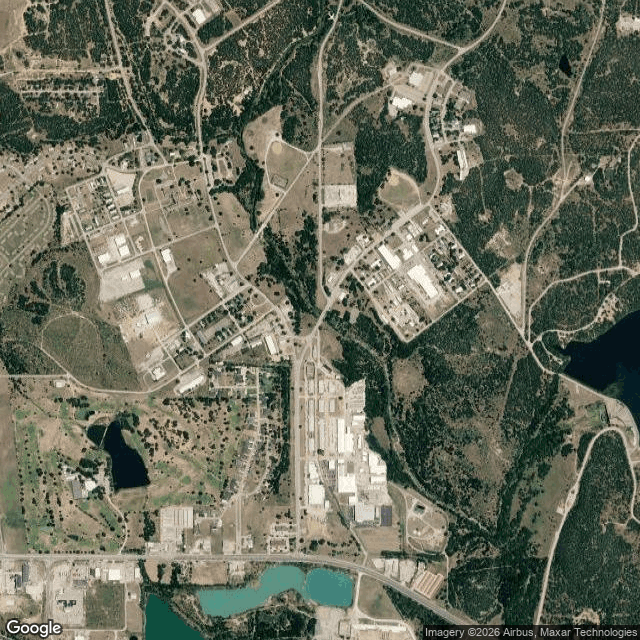
Current physical reuse reflects post-closure fragmentation. Wolters Industrial Park occupies a major portion of the former installation. Mineral Wells Regional Airport preserves part of the aviation footprint. Texas Army National Guard use continues on a reduced training area. Some land became or adjoins recreation and park-related landscapes, including Lake Mineral Wells State Park and Trailway. Other parcels passed to local institutions, private owners, education, and public facilities. The result is a scattered but still legible military landscape: historic markers, entrance remnants, industrial reuse, former aviation surfaces, Guard training areas, and surviving buildings all point back to the old camp and fort.
Summary
Camp Wolters belonged to several different military systems over time. In its first phase it was part of the Texas National Guard's interwar cavalry training system. Annual training camps were essential to Guard readiness because units that drilled locally needed a place to concentrate, camp, maneuver, and receive more intensive instruction. Camp Wolters gave Texas mounted units a physical center and linked Mineral Wells to the state military system.During World War II, Camp Wolters became part of the Army Ground Forces replacement-training system. That system was one of the least glamorous but most important structures in the wartime Army. Combat divisions could not survive prolonged operations without replacement soldiers. Camps like Wolters turned civilians and draftees into basic infantrymen and fed them into the personnel pipeline. This made Camp Wolters significant even though it was not itself a combat formation.
The POW function placed Camp Wolters in the national prisoner-of-war system. German and other Axis prisoners captured overseas were transported to the United States and distributed to camps near military posts, agricultural regions, and other areas where the Army could secure and maintain them. Camp Wolters' old camp compound was one piece of that larger wartime administrative and security system.
The Wolters Air Force Base period placed the installation inside the Korean War aviation-engineer system. The Air Force needed airfields and airfield-repair capacity; the Army retained many engineer skills; and special-category personnel arrangements attempted to bridge that gap. Wolters became one of the places where this interservice need was converted into trained construction and support personnel.
The helicopter-school era made Fort Wolters part of the Army Aviation system and, during Vietnam, part of the national war pipeline. Fort Wolters handled primary helicopter training; Fort Rucker and other aviation schools handled follow-on phases and broader aviation doctrine. Operational units in Vietnam depended on a constant flow of new pilots. Fort Wolters was where many of those pilots learned the basic skills that made later tactical training possible.
The Nike Hercules battery placed Fort Wolters inside the Army Air Defense Command and continental air-defense system. DF-70 was not built only for the post. It was part of the Dallas-Fort Worth Defense Area, protecting major aerospace and military-industrial targets. That meant Fort Wolters was both defended by and host to a broader Cold War missile network.
After closure, the site entered a different kind of system: state military training, local economic redevelopment, airport reuse, park and trail development, education, and historic preservation. The federal post closed, but the land continued to serve public and private purposes shaped by its military past.
Chronology
- 1921 The 56th Cavalry Brigade of the Texas National Guard was organized in Mineral Wells under Brigadier General Jacob F. Wolters.
- 1925 Camp Wolters was established near Mineral Wells as a National Guard training area named for Brigadier General Jacob F. Wolters.
- 1927 Roughly one thousand officers and enlisted men and about the same number of horses were encamped at the site during National Guard training.
- 1933 A Civilian Conservation Corps company used the National Guard barracks and made improvements at the camp and to Mineral Wells park facilities.
- 1940-10-13 The U.S. Army activated Camp Wolters as an infantry replacement center, according to the Texas Historical Commission Fort Wolters marker.
- 1940-10-30 Local historical accounts identify Mineral Wells as selected for the Infantry Replacement Training Center mission.
- 1941-03-22 Camp Wolters was formally turned over for Army Infantry Replacement Training Center use, according to local Camp Wolters historical accounts.
- 1941 The new Camp Wolters expansion grew rapidly east of Old Camp Wolters as the Army built the wartime training plant.
- 1942 Major General Bruce Magruder was assigned to command the Infantry Replacement Training Center at Camp Wolters.
- 1943 Mineral Wells Airport opened to support nearby Camp Wolters.
- 1943 The old camp area was used as a German prisoner-of-war camp for prisoners captured in North Africa.
- 1943-1945 Camp Wolters served as a major infantry replacement training center and German POW site during World War II.
- 1945 The war ended, and Camp Wolters shifted toward postwar separation, prisoner-return, and closure functions.
- 1946-01-19 The U.S. Army deactivated the Camp Wolters Infantry Replacement Training Center.
- 1946-08-15 The POW camp closed as the last German prisoners were returned home, according to the Fort Wolters historical marker.
- 1946 Local businessmen purchased land and facilities and organized private reuse through Camp Wolters Enterprises.
- 1951-02 The installation was reactivated and redesignated Wolters Air Force Base.
- 1951-1956 Wolters Air Force Base housed the Aviation Engineer Force and trained special-category Army and Air Force personnel.
- 1954-03-29 to 1954-03-31 The 826th Engineer Aviation Battalion conducted bivouac and defensive-position training northeast of the rifle range, according to USACE archival findings.
- 1954 The 835th Engineer Aviation Battalion conducted or planned airfield-construction training activity at Wolters Air Force Base, according to USACE archival findings.
- 1956-07-01 Camp Wolters returned to U.S. Army control.
- 1956-08 Southern Airways received the contract to conduct flight training for the U.S. Army Primary Helicopter School.
- 1956-09-26 The U.S. Army Primary Helicopter School was established at Camp Wolters.
- 1956-11-26 The first Primary Helicopter School class reported for training.
- 1957-04-27 The first Primary Helicopter School class graduated.
- 1958-11-30 Construction began on the Nike Hercules battery site at Camp Wolters, according to the Pictorial History of Fort Wolters.
- 1960-05 The Nike Hercules battery site was turned over to the Army.
- 1960-09 Nike site DF-70 at Fort Wolters began active service as part of the Dallas-Fort Worth Defense Area.
- 1963-06-01 The base was redesignated Fort Wolters.
- 1963-07-04 Dedication ceremonies were held for Fort Wolters as a permanent Army installation.
- 1965-07-18 Fort Wolters received instructions to prepare for an output of 290 helicopter students per month because of the buildup in Southeast Asia.
- 1965-11 Construction contracts were let to build and expand stage fields, aircraft parking, and training facilities for the Vietnam-era helicopter training expansion.
- 1966-03-15 Fort Wolters was redesignated the U.S. Army Primary Helicopter Center/School.
- 1966-09 Downing Army Heliport was dedicated at Mineral Wells Airport to support the expanded helicopter mission.
- 1966 A Fort Wolters newspaper account identified major post organizations including the 864th Engineer Battalion, U.S. Army Hospital, 303rd U.S. Army Security Agency Battalion, Battery D, 4th Missile Battalion, 562nd Artillery, 697th Engineer Company, and Dental Detachment.
- 1968 The Vietnam War demand expanded Fort Wolters' training role to include Marine Corps helicopter pilots.
- 1968-10 Nike site DF-70 was deactivated.
- 1969 Helicopter counts at Fort Wolters reached Vietnam-era peak levels in some aviation-history accounts.
- 1970 Fort Wolters began training Air Force helicopter pilots in addition to Army and Marine Corps students.
- 1970 Fort Wolters covered about 8,500 acres and leased additional land to support helicopter operations.
- 1973-01-01 About 40,000 students had completed the twenty-week helicopter training program.
- 1973-02-01 Fort Wolters was officially closed for federal military service.
- 1973 The helicopter school mission transferred to the U.S. Army Aviation School system at Fort Rucker, Alabama.
- 1975 Land from the former Fort Wolters closure process contributed to Lake Mineral Wells State Park and Trailway development.
- 1981 Lake Mineral Wells State Park opened to the public.
- 1997 The Texas Historical Commission marker for Old Camp Wolters was erected.
- 1999 The Texas Historical Commission marker for Fort Wolters was erected.
- 2012 Local restoration efforts at the old camp gate and historic marker area highlighted the surviving Old Camp Wolters landscape.
- 2024 NCTCOG planning documents described modern Fort Wolters as a primarily small-arms and drop-zone training site, with adjoining industrial-park redevelopment considerations.
- Present The federal Army post remains closed, while portions of the former military landscape serve Texas Army National Guard training, Wolters Industrial Park, Mineral Wells Regional Airport, educational, recreational, private, and historic uses.
![An illustration of the Service Club at Camp Wolters, which was located just outside Mineral Wells, Texas is shown here. Once the largest Infantry Replacement Training Center during World War II, Camp [later Fort] Wolters was re-opened during the Korean Conflict, and again during the Vietnam War. This portrait of the service club is probably a photograph taken from an old picture postcard.](/army_base/tx/images/metapth20463_xl_awo.0134p.jpg)