Mark 11 Reentry Vehicle for Minuteman Missile
Overview
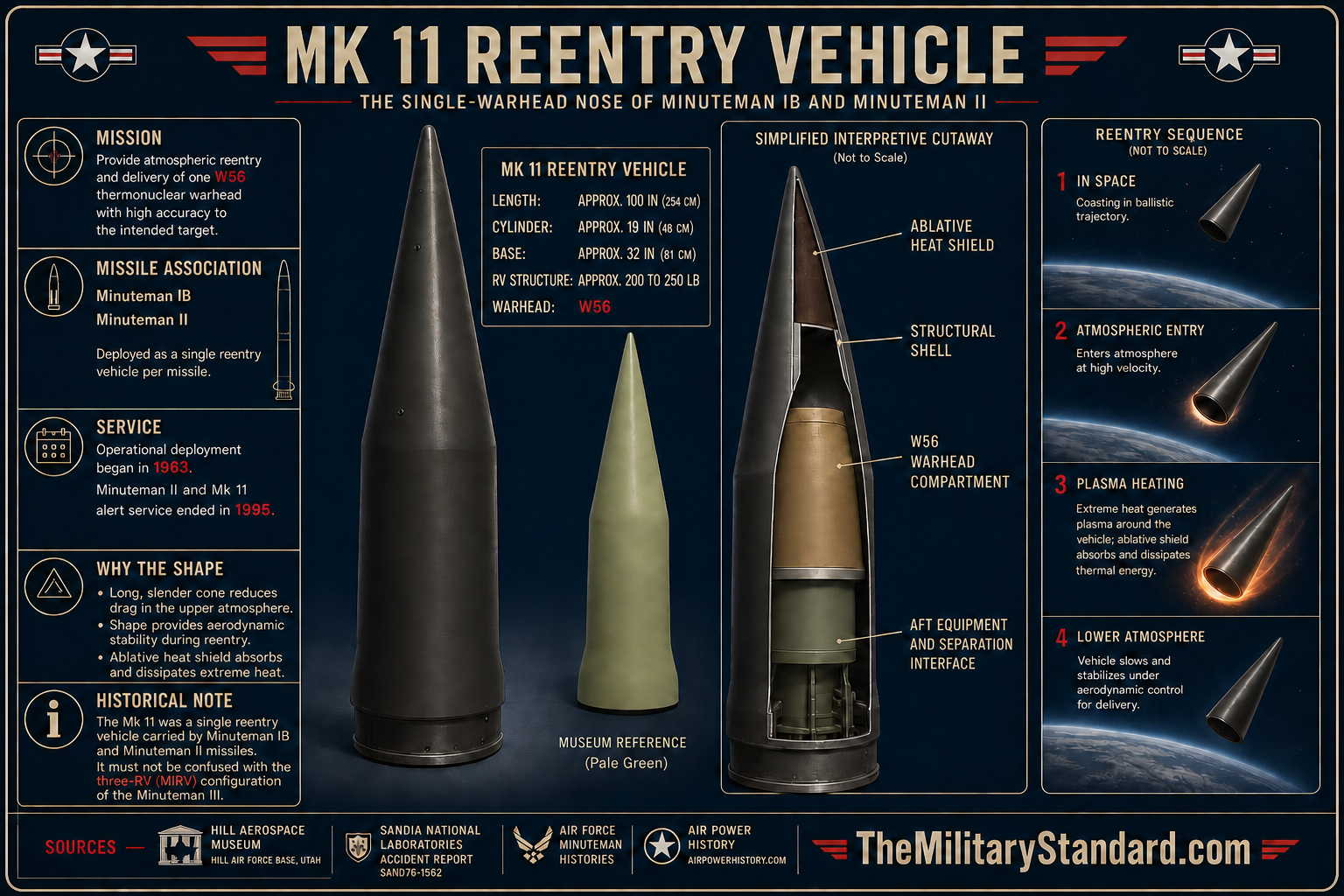
The Mk 11 was a family of United States Air Force ballistic-missile reentry vehicles developed for the Minuteman intercontinental ballistic missile. It carried a single nuclear warhead through space and protected it during the intense heating, deceleration, and aerodynamic loading of atmospheric reentry. The family included the original Mk 11 and the later Mk 11A, Mk 11B, and Mk 11C configurations.The Mk 11 must be distinguished from the W56 nuclear warhead installed inside it. The reentry vehicle was the aerodynamic, structural, thermal-protection, fuzing-support, and penetration package that delivered the warhead. The W56 supplied the nuclear explosive capability. Period photographs and captions sometimes call the combined assembly a W56/Mk 11, which can obscure that division of functions.
The designation also requires careful typography. Contemporary records use Mark 11, Mk 11, and MK 11, sometimes attaching a variant letter or a modification number. Those forms refer to the same reentry-vehicle family unless a source explicitly identifies a different configuration. This page uses Mk 11 for the family and preserves suffixes when evidence supports them.
Minuteman Requirements
Minuteman depended on three related technological advances: large solid-propellant rocket motors, a compact inertial guidance system, and a lightweight reentry vehicle that could carry a useful thermonuclear warhead across intercontinental range. Payload weight mattered directly because every pound devoted to the reentry system reduced range, penetration aids, or other missile performance margins. The three technologies consequently had to mature as one integrated weapon system.The earliest Minuteman IA missiles used the blunt Mk 5 reentry vehicle. As Minuteman development continued, the Air Force wanted a lighter, sharper, and less radar-visible vehicle for Minuteman IB and the improved Minuteman II. The Mk 11 emerged from that requirement and represented the mature form of the early Minuteman single-warhead reentry system.
Development
The Department of Defense and Atomic Energy Commission authorized advanced Minuteman warhead work in October 1960. The Air Force selected Avco to develop a new reentry vehicle capable of accepting the evolving warhead designs. The design had to survive launch vibration, vacuum, long ballistic flight, high-speed atmospheric heating, aerodynamic pressure, and the mechanical loads of deceleration.The Air Force also required a reduced radar cross-section during the exoatmospheric portion of the trajectory. A smaller or less conspicuous radar target complicated defensive tracking and engagement. This requirement influenced the vehicle's sharper profile, materials, surface treatment, and the later development of penetration-aid arrangements.
First Flight
On December 7, 1962, the Air Force successfully launched a Minuteman carrying a Mk 11 reentry vehicle on the first attempt. The missile flew approximately 3,500 miles from Cape Canaveral. The accomplishment demonstrated that the new vehicle could separate, maintain the intended trajectory, survive reentry, and reach the designated impact region.The launch did not end development. Flight testing continued through many Minuteman IB missions, instrumented evaluations, operational tests, and Atlas-launched research flights. Engineers studied separation, stability, thermal protection, radar signature, accuracy, warhead interfaces, fuzing support, and the behavior of test vehicles at impact.
Shape and Construction
The Mk 11 family was approximately 100 inches long, with a cylindrical section about 19 inches in diameter and a base diameter near 32 inches. It resembled the earlier Mk 5 in general proportions but had a visibly sharper nose. Flight-test vehicles sometimes carried external telemetry-antenna fairings that were not present on operational vehicles.The original Mk 11 weighed approximately 200 to 250 pounds as a reentry-vehicle structure. The Mk 11A, Mk 11B, and Mk 11C were approximately 25 percent heavier because of configuration changes and added capability. These figures describe the reentry vehicle rather than the complete warhead-equipped payload, whose weight was substantially greater.
Thermal Protection
Reentry converted enormous kinetic energy into heat. The Mk 11 used ablative thermal protection rather than attempting to absorb all heating in a massive heat-sink shell. Ablative material charred, decomposed, and eroded in a controlled manner, carrying heat away while insulating the structure and warhead inside.The nose incorporated Avcoite ceramic material in the region of greatest heating. The body used RaD-60, a molded silica-phenolic material containing chopped silica fibers. This thermal shell fitted over an airframe formed from magnesium ribs and a spin-formed magnesium skin in the cylindrical and flared sections.
Ablation allowed a lighter and sharper vehicle than the earlier heat-sink approach. The benefit was not merely lower weight. A slender shape improved ballistic performance and accuracy while the chosen materials protected the interior during a short but extraordinarily severe thermal pulse.
Stability and Separation
After Minuteman's powered stages completed their work, the reentry vehicle had to separate cleanly from the third stage. Any collision, unwanted rotation, or continuing radar association between the vehicle and spent stage could interfere with accuracy or make defensive tracking easier. Separation hardware therefore formed an important part of the complete reentry system.Later configurations used devices that tumbled or displaced the spent third stage after vehicle release. Small retro rockets applied randomized velocity so the stage would not remain an obvious radar reference near the reentry vehicle. These actions contributed to penetration without changing the vehicle into a maneuvering warhead.
The W56 Warhead
The Mk 11 family carried the W56 thermonuclear warhead in operational Minuteman service. The W56 was produced in successive modifications and entered the stockpile during the 1960s. It is commonly associated with an approximate yield of 1.2 megatons, though the reentry vehicle itself had no yield independent of the installed warhead.Warhead and vehicle were mechanically and electrically integrated but remained different program elements. The interface had to support the warhead through launch and reentry, transmit arming and fuzing functions, accommodate thermal expansion, and maintain safety until the proper flight conditions were satisfied. Reliability depended on the complete interface rather than either component alone.
Mk 11 Variants
The original Mk 11 entered service with Minuteman IB. The Mk 11A, Mk 11B, and Mk 11C followed as the Air Force refined range, hardness, accuracy, warhead integration, and penetration capability. Public summaries do not always use variant names consistently, especially when identifying training, test, or museum hardware.All four principal variants served with Minuteman II, while the original vehicle also appeared on Minuteman IB. The variants were outwardly similar enough that a photograph without a data plate, documented provenance, or known payload configuration may not support a precise suffix identification. Museum and archival captions therefore require careful source checking.
Penetration Aids
As Soviet antiballistic-missile radars and interceptors improved, simply delivering one visible reentry body became less satisfactory. The Air Force developed penetration aids intended to complicate detection, tracking, discrimination, and engagement. The Mk 11C became the principal Mk 11 configuration associated with a chaff-dispensing package.The dispenser released chaff in separated clouds along the trajectory. Defensive radars then faced multiple radar returns rather than one isolated target. The system did not make the reentry vehicle invisible; it attempted to consume defensive attention and make reliable discrimination more difficult within the available engagement time.
Weight was critical. The Mk 11C chaff dispenser used a lightweight beryllium spacer rather than aluminum because the complete configuration approached its payload limit. This illustrates how penetration features, structure, warhead weight, missile range, and reliability competed within a tightly controlled mass budget.
The final six Mk 11C development flights tested penetration-aid capability beginning on April 28, 1967. These tests evaluated more than dispenser release. They examined timing, cloud spacing, separation behavior, and whether the complete arrangement preserved the accuracy and reliability expected of the operational missile.
Minuteman IB Service
Minuteman IB introduced the Mk 11 into operational Strategic Air Command service in 1963. The new reentry vehicle replaced the earlier Mk 5 configuration in later Minuteman I deployments and provided the single-warhead payload for wings equipped with the improved missile. This deployment moved the design from flight development into continuous alert duty.Minuteman IB and Mk 11 remained a transitional combination. Minuteman II incorporated improved range, guidance, survivability, and penetration capability and gradually became the principal single-warhead Minuteman system. Minuteman IB service ended in 1973, while Mk 11 family service continued with Minuteman II.
Minuteman II Service
The LGM-30F Minuteman II carried one Mk 11 family reentry vehicle and W56 warhead. The first operationally configured Minuteman II was launched from an operational silo at Vandenberg Air Force Base in 1965. Deployment expanded through the late 1960s as Strategic Air Command converted and completed missile wings.Minuteman II improved its resistance to enemy defenses through electronic hardening, penetration aids, and better performance. The Mk 11 variants were integral to that mission. They delivered a high-yield single warhead rather than the multiple independently targetable vehicles later associated with Minuteman III.
Operational Testing
Strategic missile crews periodically removed selected missiles from alert, transported them to Vandenberg, and launched them toward the Pacific test range. These operational tests evaluated the complete chain from field maintenance and launch preparation through missile flight, guidance, reentry, and impact accuracy. Results provided evidence about the fielded force rather than development hardware alone.Test reentry vehicles substituted instrumentation or inert payloads for an operational nuclear warhead. Some were designed for recovery or detailed measurement, and their weight could differ from the combat configuration. Performance figures from a specific test vehicle therefore should not automatically be assigned to every operational Mk 11 variant.
Accuracy and Deterrence
The reentry vehicle could not independently correct an inaccurate ballistic trajectory. Minuteman's inertial guidance system and missile flight established the path, while the Mk 11 had to separate predictably and remain aerodynamically stable through reentry. Small errors in release, mass properties, or reentry behavior could translate into a significant miss distance.The completed weapon system combined rapid launch readiness, hardened dispersed silos, reliable solid-propellant motors, inertial guidance, a survivable reentry body, and the W56 warhead. Thousands of personnel in missile wings, depots, laboratories, contractors, test ranges, and command centers sustained that deterrent force. Mk 11 was one indispensable link within that larger operational chain.
Relationship to Mk 12
The Mk 11 was a single-warhead reentry vehicle. It should not be confused with the smaller Mk 12 vehicles deployed three at a time on Minuteman III. Mk 12 required a post-boost propulsion system capable of releasing separate reentry vehicles toward different aim points, creating the multiple independently targetable reentry vehicle configuration.Minuteman II and Mk 11 remained important even after Minuteman III entered service. Maintaining both systems distributed capabilities across the force and avoided immediate replacement of every missile. The Mk 11 thus overlapped with a newer generation of multiple-warhead technology for more than two decades.
Safety and Modernization
The W56/Mk 11 combination reflected the safety standards and engineering possibilities of its development era. Later nuclear systems incorporated more modern insensitive high explosives, fire-resistant pits, enhanced electrical isolation, and other design features. Public safety assessments consequently rated the aging Minuteman II warhead below newer designs in several categories.Those comparisons should not be misread as evidence that the reentry vehicle was casually handled or uncontrolled. Operational weapons were protected through procedural controls, physical security, coded command systems, maintenance standards, inspections, and the separation of authorized actions across trained organizations. Safety assessments nevertheless help explain why later systems received improved design features.
Retirement
The United States began retiring Minuteman II as arms-control obligations and force modernization reduced the single-warhead missile fleet. Operational Minuteman II service ended in the 1990s, and the Mk 11 family left alert service with it. The Air Force retained Minuteman III as the land-based intercontinental missile system.W56 warhead retirement and dismantlement followed separate Department of Energy processes. Reentry-vehicle shells, training shapes, test hardware, and museum exhibits did not necessarily contain nuclear components. A displayed Mk 11-shaped object must therefore be identified through provenance rather than appearance alone.
Preservation
Mk 11 examples and representative assemblies are displayed at several missile and aerospace museums, including collections associated with the Minuteman mission. Museum labels may identify an RV shell, complete training assembly, inert warhead section, instrumentation vehicle, or externally similar Emergency Rocket Communications System aeroshell. These categories should not be treated as interchangeable artifacts.The Hill Aerospace Museum has displayed a Minuteman Mk 11 reentry vehicle alongside a Minuteman II Emergency Rocket Communications System aeroshell. That comparison is useful because ERCS replaced the normal reentry vehicle with a communications payload while retaining a broadly similar external missile-envelope requirement. The paired display makes the different missions visually understandable.
Chronology
- 1960-10 The Department of Defense and Atomic Energy Commission authorized advanced Minuteman warhead development.
- 1961 Avco development of the Mk 11 reentry vehicle proceeded for the Minuteman program.
- 1962-07 Flight testing of the evolving W56 warhead and Mk 11 system was underway.
- 1962-12-07 The first Minuteman flight carrying a Mk 11 succeeded on a flight of approximately 3,500 miles.
- 1963-03-14 A Mk 11 Minuteman development vehicle launched from Cape Canaveral.
- 1963 Mk 11 and W56 equipment entered operational Minuteman service.
- 1963-08-28 Atlas-launched Mk 11 research flights began.
- 1964-02-12 The documented Atlas Mk 11 research-flight series concluded.
- 1965 The first operationally configured Minuteman II launched from an operational Vandenberg silo.
- 1966 The first complete 150-missile Minuteman II wing was turned over at Grand Forks Air Force Base.
- 1967-04-28 Final Mk 11C development flights began testing the penetration-aid configuration.
- 1967-12-08 The principal Minuteman IB Mk 11 flight-test series concluded.
- 1973 Minuteman IB and its operational Mk 11 phase left service.
- 1991 Strategic arms reductions began accelerating Minuteman II removal from alert.
- 1995 Minuteman II and the operational Mk 11 family completed their alert-service phase.