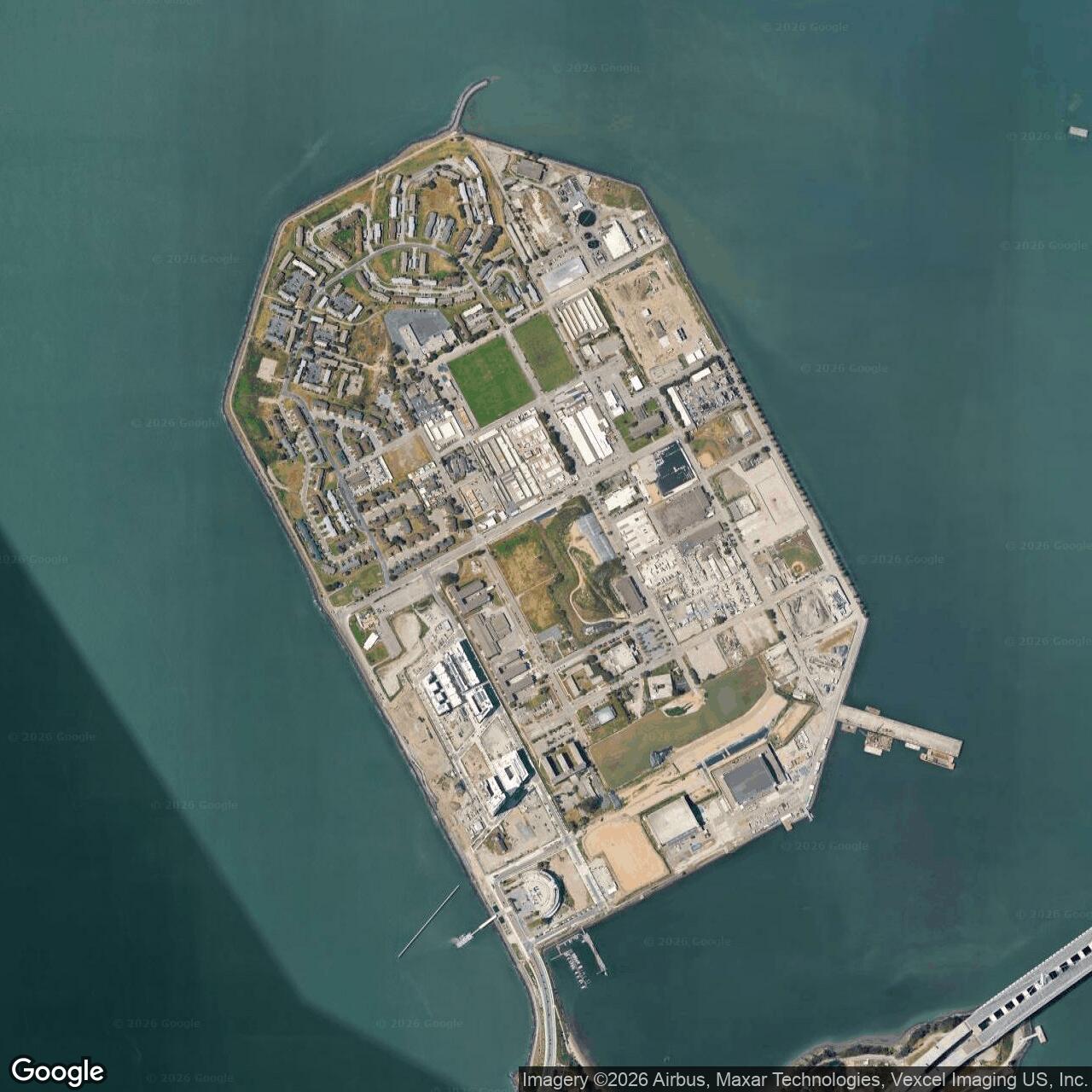
Naval Station Treasure Island, San Francisco California
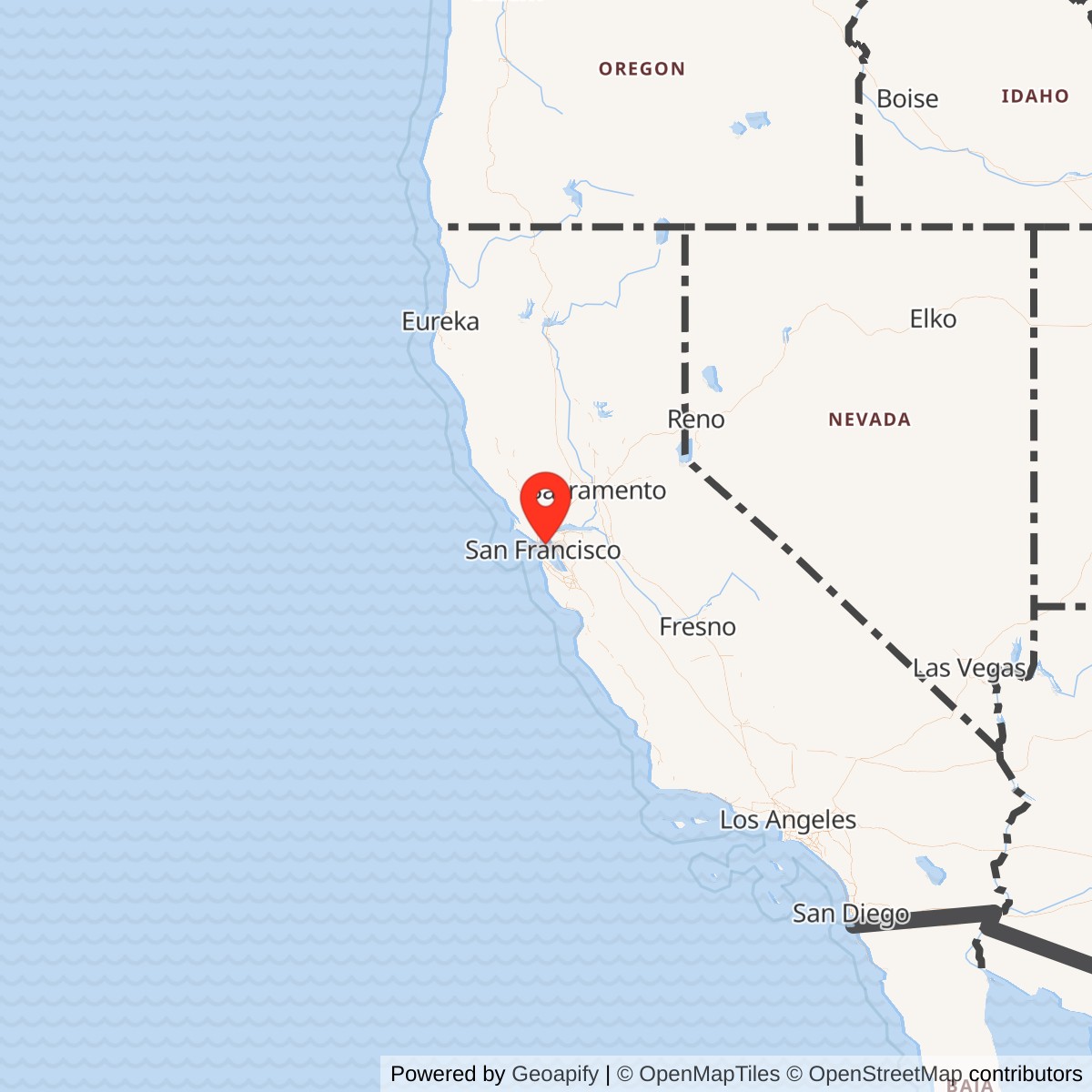
Longitude: -122.371
Current Role: Former naval training, distribution, receiving, hospital, and administrative station; now under phased Treasure Island/Yerba Buena Island redevelopment, public reuse, Job Corps/Coast Guard/FHWA parcels, and continuing Navy environmental cleanup/conveyance actions.
Treasure Island was built to sell San Francisco's future to the world, then almost immediately became one of the Navy's busiest gates to war. The island rose from Bay mud in 1936-1937 as an engineered fairground and proposed airport, a man-made stage for the 1939-1940 Golden Gate International Exposition. Its Art Moderne buildings, lagoon, hangars, broad avenues, and waterfront views were supposed to point toward peaceful transpacific travel. Within a few years, those same spaces were swallowing wartime traffic: sailors, Marines, WAVES, radio students, gunnery trainees, hospital patients, returning veterans, replacement crews, mail, supplies, and thousands of people moving every day between the United States and the Pacific war.
Naval Station Treasure Island occupied one of the strangest military landscapes in the United States. The main island was artificial, but the base's deeper military roots reached onto adjacent Yerba Buena Island, a natural island where federal and naval uses stretched back into the nineteenth century. The Navy operated an early West Coast naval training station on Yerba Buena Island until 1923 and continued receiving-station functions there afterward. When World War II overtook the Pacific, the Navy shifted major operations to nearby Treasure Island after leasing, occupying, and then acquiring the site through wartime condemnation. What had been a world's fair "Magic City" became a Navy training, distribution, receiving, medical, administrative, and support installation at the geographic center of San Francisco Bay.
The former naval station should be understood as a Navy processing and training city rather than a fleet base in the usual shipyard or homeport sense. Its wartime mission was movement: assemble sailors and Marines, train them quickly, house and feed them, treat them medically, move them toward ships and Pacific assignments, and receive them on the way back. Navy BRAC documentation states that Treasure Island processed approximately 12,000 military personnel per day for overseas service and return. Treasure Island Museum's wartime exhibit gives the larger cumulative number: about 4.5 million servicemen and servicewomen passed through Treasure Island from 1941 to 1945. Those numbers explain the installation's historical weight. Treasure Island did not win battles by launching warships from its piers. It helped win them by moving people through the naval war machine at extraordinary speed.
Mission Evolution
Treasure Island began as a civil-engineering and civic-imagination project. The Army Corps of Engineers built the 400-acre artificial island in 1936-1937 from sediment dredged from San Francisco Bay. Its original purpose was to host the Golden Gate International Exposition, which opened in 1939 and continued in 1940. The fair celebrated the Golden Gate and San Francisco-Oakland Bay bridges, California's Pacific-facing future, and the rise of transpacific air travel. The federal government paid for the island and for three permanent buildings intended to serve a future airport. Building One, the Administration Building, was designed as both exposition administration center and air terminal for Pan American Airways' China Clipper service.That planned airport future did not survive the war. California's Office of Historic Preservation records Treasure Island as the site of the 1939-1940 Golden Gate International Exposition and notes that from 1939 to 1944 the island was the landing site for China Clipper flights. But the Navy moved onto Treasure Island as the United States prepared for World War II, and the naval requirement consumed the airport vision. The transition was brutally practical: the island had hangars, open ground, water access, road access over the Bay Bridge, existing buildings, a sheltered lagoon, and a central Bay location near existing naval facilities at Yerba Buena Island, Mare Island, Alameda, Hunters Point, and San Francisco. Those advantages made it too valuable to remain a purely civic or commercial aviation project during wartime.
The Navy's early use was linked to training and distribution. Treasure Island Museum describes the World War II station as a major distribution and training site and the principal Pacific embarkation and debarkation point for sailors and Marines moving to and from the Pacific Theater. Navy BRAC history states that Yerba Buena Island continued as a naval receiving station until World War II, when naval operations were transferred to Treasure Island after the Navy acquired it by condemnation in 1942. The station's mission during the war combined receiving, training, administration, housing, medical care, and dispatch to the fleet.
After V-J Day, Treasure Island did not simply demobilize and disappear. The Navy continued to occupy and actively use the installation from 1946 through 1997. Its postwar mission kept many of the same functions but adjusted them to the Cold War: training schools, electronics and radar instruction, hull-maintenance and damage-control instruction, nuclear/biological/radiological/chemical warfare training, receiving and distribution work, regional administration, reserve readiness support, and embarkation/debarkation support during later wars. The Korean War, Vietnam War, and Gulf War all gave the station renewed importance as Pacific-facing naval activity surged and contracted.
The final transformation began with the 1993 Base Realignment and Closure decision. Naval Station Treasure Island closed on 30 September 1997 as a BRAC III major closure. The California Legislature created the Treasure Island Development Authority in 1997 as the local reuse authority, and the Navy began the long process of environmental cleanup, property transfer, and disposal. The post-Navy mission became urban reuse: housing, commercial development, public space, Job Corps, Coast Guard and Federal Highway Administration parcels, infrastructure reconstruction, and environmental restoration. The military base closed, but the site's transformation has been slow because cleanup, sea-level adaptation, seismic work, and phased conveyance all remain central to reuse.
World War II Role: Gateway to the Pacific
World War II was Treasure Island's defining military moment. The island's physical design had been theatrical during the fair; the Navy turned that theatrical landscape into a working military city. Exhibition halls became barracks, classrooms, shops, theaters, offices, and training spaces. Food and beverage exhibit areas became high-volume mess facilities. Treasure Island Museum notes that one converted mess hall eventually served more than 7,000 men an hour and could seat up to 3,000 at once. The Billy Rose Aquacade became one of the station's swimming pools. The Hall of Science and Federal Building became theaters. The fair's civic infrastructure was not erased; it was militarized.The station's wartime population moved at a tempo few shore installations could match. Treasure Island was responsible for feeding, housing, training, entertaining, medically supporting, and routing enormous numbers of naval personnel. Museum interpretation describes the station as a small town with its own post office, department store, chapel, gas station, restaurants, barbershops, tailor shops, hobby shops, theaters, and newspaper. The Masthead, the station newspaper, reportedly circulated 20,000 copies each Saturday. That civilian-sounding infrastructure was essential military infrastructure. A base that moved millions of people had to feed them, inform them, distract them, discipline them, and keep them healthy while orders, ship assignments, and transport schedules caught up.
Training at Treasure Island was broad and practical. Before sailors went to sea, they learned skills such as swimming, scuba diving, firefighting, communications, radio repair, gunnery, signaling, lookout recognition, navigation, aerial gunnery, and equipment operation. Training schools included a Gunnery School, Fire Fighting School, Fleet Operational Training School, Radio Materiel School, and Advanced Naval Training School. The Radio Materiel School alone occupied nine buildings and had produced more than 10,000 radio technicians by V-J Day. Four hundred students arrived for radio training each month, and one hundred graduates left weekly for sea duty. Treasure Island's training mission therefore linked directly to the electronics and communications demands of modern naval warfare.
The station also became an important place in the Navy's women's wartime history. The first eighteen WAVES assigned to Treasure Island arrived in 1942. As men moved to sea duty, WAVES filled critical administrative, communications, instructional, and operational-support roles. At the wartime peak, Treasure Island had 800 officers and enlisted women and six barracks dedicated to WAVES. Women were attached to fifteen different duties on the island, including the Communication Division, Operational Training School, and Gunnery School. They taught and performed duties in signaling, damage control, lookout recognition, navigation, and aerial gunnery. Their work helped keep the station's high-volume pipeline functioning.
The Naval Hospital was another major wartime component. The first sick bay opened in 1941 and provided medical and dental services. By 1945, Treasure Island had a hospital with more than 700 beds, an epidemiology unit, a blood bank, and a School of Tropical Medicine. Because Treasure Island was accessible by water and by road, it served both routine station needs and urgent-care functions for seriously ill or wounded personnel flown or transported from the South and Central Pacific and from around the Bay Area. The Red Cross blood bank and plasma collection work connected the hospital directly to battlefield survival in the Pacific. For many wounded or sick sailors and Marines, Treasure Island was one of the first American shore stations on the long trip home.
Postwar and Cold War Naval Station
After World War II, the Navy retained Treasure Island because the installation's value did not depend on one war alone. Its central Bay position, existing training plant, housing, administration buildings, and transportation access made it useful for a smaller but still global Navy. Treasure Island Museum summarizes the postwar period as one in which the Navy used the station for operations, training centers, distribution, and receiving. For nearly five decades after 1946, the installation hosted training schools and command functions while continuing to serve Pacific-oriented personnel movement and naval education.Training and electronics remained central. Postwar schools included U.S. Naval Schools Command, U.S. Naval School of Electronics, and schools for hull maintenance, radar, and nuclear/biological/radiological/chemical warfare. The electronics and radar mission is especially important because it tied the station to the Bay Area's broader technical culture. The museum's interpretation notes the interdependence between the military and the Bay Area and connects Treasure Island's electronics training to the region's emerging electronics and information-technology economy. Treasure Island's Cold War role was not merely to move sailors; it also helped train the technically skilled force required for radar, communications, damage control, and shipboard systems.
The Korean War revived the station's embarkation and debarkation role. Sailors and Marines again moved through Treasure Island on their way across the Pacific and on their return home. The station supported training and education while also serving as a family-visible point of reunion. Photographs and museum exhibits preserve images of Marines returning through the station in the early 1950s, a reminder that Treasure Island's mission touched the home front as well as the fleet.
Damage-control and radiological-safety training gave the Cold War station a darker but historically important dimension. In 1946 the Navy established radiological-safety training at Treasure Island as part of the Damage Control School. The logic reflected the new nuclear age: sailors needed to understand decontamination, radiological hazards, and shipboard survival after atomic attack or contamination. Around 1959, one training event staged a "Mock A-Bomb" exercise using conventional explosives, smoke grenades, and napalm to simulate a mass-casualty response. The USS Pandemonium, a full-scale mock ship assembled from salvaged parts, was used for decontamination and damage-control training. Later, the USS Buttercup provided realistic flooding and damage-control training during the 1980s and 1990s. These training systems were vivid, physical, and effective-but they also contributed to the environmental and radiological concerns that later complicated cleanup.
During the Vietnam War, Treasure Island again operated as a Pacific support station. The Twelfth Naval District relocated to Naval Station Treasure Island from San Francisco and remained there until disestablishment in 1977. The station supported communication electronics, firefighting, and training associated with coastal and river patrol operations, including "Brown Water Navy" activity. South Vietnamese sailors trained there in the early 1970s. In this period, the base's value lay in a mix of command administration, technical training, partner-force instruction, and continued receiving/distribution work.
Facilities and Physical Layout
Naval Station Treasure Island's layout was shaped first by exposition planning, then by wartime adaptation, then by Cold War training needs. The artificial island itself was roughly 400 acres, laid out with broad avenues, axial planning, large exhibition structures, hangars, waterfront space, Clipper Cove, and Building One as a visual and administrative anchor. The adjacent Navy landscape on Yerba Buena Island included older naval training and receiving-station facilities, officers' quarters, and support areas tied to the Bay Bridge approach.Building One is the clearest architectural survivor of the prewar vision. Built in 1938 as the Administration Building for the Golden Gate International Exposition and intended as an airport terminal, it later became a Navy headquarters and administrative building. Treasure Island Museum is located in its lobby and identifies it as historic Building One, historically found on older maps at One Avenue of the Palms and now addressed as 39 Treasure Island Road. Its survival is important because it connects every layer of the island's twentieth-century life: world's fair, Pan Am Clipper terminal, naval headquarters, Navy museum, and post-Navy public interpretation.
The large hangars and former fair buildings were equally important to wartime conversion. Their size allowed the Navy to house, feed, and train personnel at mass scale. Some fair facilities became mess halls, theaters, pools, shops, classrooms, and administrative space. The Navy did not need to build a completely new base from scratch. It inherited a purpose-built public spectacle and converted it into a military logistics machine. That is why Treasure Island's World War II landscape can feel so unusual: the geometry and architecture of a fairground were pressed into the tempo of war.
Postwar additions and specialized training facilities changed the site further. Radiological and damage-control training required mock ship structures, decontamination areas, fire training, and flooding trainers. The USS Pandemonium and USS Buttercup were not ships in the ordinary fleet sense; they were instructional machines used to teach sailors how to survive shipboard catastrophe. Their presence shows how a shore station could simulate maritime danger far from a combat zone.
Role in the Wider Military Network
Treasure Island was one node in the San Francisco Bay naval system, and that context matters. The Bay Area included Mare Island Naval Shipyard, Hunters Point Naval Shipyard, Alameda Naval Air Station, Yerba Buena Island, supply facilities, ship repair sites, training installations, and transport connections. Treasure Island's particular role was the human pipeline: receiving, training, processing, housing, hospital care, and distribution. It complemented shipyards and air stations by preparing and moving the people those other facilities needed.During World War II, the station sat inside the vast Pacific logistics system. Personnel arrived from across the country, passed through Treasure Island, and moved onward to ships, advanced bases, island campaigns, submarine service, aviation support, and amphibious operations. Returning personnel came back through the same Bay gateway. In that system, Treasure Island's significance was not just local or architectural. It was logistical and psychological. For many sailors and Marines, it was the last American shore before the Pacific and the first Bay Area landfall after war.
During the Cold War, the system role shifted toward training, administration, reserve support, and technical education. Radar, electronics, damage control, radiological safety, hull maintenance, and regional command functions kept the base relevant after the mass personnel pipeline of 1941-1945 declined. The station's activities during Korea, Vietnam, and the Gulf War demonstrate that Pacific crises repeatedly reactivated the old logic of Treasure Island: when the Navy needed to move, train, and manage people for Pacific operations, the island still made sense.
Closure, Cleanup, and Reuse
Naval Station Treasure Island was selected for closure under the 1993 BRAC round and closed on 30 September 1997. Navy BRAC documentation lists the former installation at 1,079 total acres and identifies the closure as a BRAC III major closure. The former base included Treasure Island, Yerba Buena Island, and associated property. After closure, the California Legislature created the Treasure Island Development Authority as the special reuse authority responsible for planning redevelopment and reuse.Property transfer has proceeded in phases. Navy BRAC documentation states that as of December 2020, TIDA had received approximately 866 acres of Treasure Island, Yerba Buena Island, and associated submerged property in support of redevelopment plans, with about 129 acres still to transfer as cleanup actions were completed. The Department of Labor received about 36 acres for Job Corps. The Coast Guard received property on Yerba Buena Island and associated submerged lands. The Federal Highway Administration acquired property related to the San Francisco-Oakland Bay Bridge and tunnel structures. This means the former naval station did not become a single simple redevelopment parcel. It became a multi-agency reuse landscape shaped by federal transfers, municipal planning, infrastructure, and environmental obligations.
The current reuse plan is ambitious. San Francisco Planning describes the Treasure Island and Yerba Buena Island development project as a new neighborhood with transportation infrastructure, jobs, parks and open space, community facilities, affordable housing, and sustainable systems designed to address climate challenges. The approved plan includes up to 8,000 homes, with approximately 27 percent designated as affordable or below-market-rate housing, plus commercial space, hotels, retail, restaurants, public art, and extensive parks/open space. The same planning context recognizes that redevelopment is implemented in major phases and requires continuing land transfers between the Navy, TIDA, and development entities.
Cleanup remains inseparable from redevelopment. Former Navy training and operational uses left hazardous and radiological concerns in parts of the former station. Navy BRAC pages continue to list environmental cleanup actions, Restoration Advisory Board meetings, and property transfer/conveyance status. The history of radiological-safety training, damage-control exercises, ship mockups, industrial uses, landfill construction, and wartime/postwar Navy activity all feed into the modern cleanup story. The former base is therefore not simply an urban development site. It is a former military installation whose reuse depends on environmental remediation, public oversight, engineering, and long-term land-management decisions.
Chronology
- 1866 Federal military activity on Yerba Buena Island predates Treasure Island; later Navy use of Yerba Buena Island forms part of the background to Naval Station Treasure Island.
- 1923 The Navy's first West Coast Naval Training Station on Yerba Buena Island was transferred to San Diego, though naval receiving-station activity continued.
- 1936-1937 The Army Corps of Engineers built Treasure Island from dredged San Francisco Bay sediments on the shoals near Yerba Buena Island.
- 1938 Building One / the Administration Building was completed as part of the exposition and planned airport complex.
- 1939-02-18 The Golden Gate International Exposition opened on Treasure Island.
- 1939-1940 Treasure Island hosted the Golden Gate International Exposition, celebrating San Francisco, California, the bridges, Pacific commerce, and transpacific aviation.
- 1939-1944 Treasure Island served as a landing site for Pan American Airways China Clipper flights.
- 1940 The Golden Gate International Exposition closed.
- 1941 The Navy moved onto Treasure Island as the United States prepared for World War II; the site began its major naval training and distribution role.
- 1941 The first sick bay opened on Treasure Island to provide medical and dental services.
- 1942 The Navy acquired Treasure Island by wartime condemnation and transformed the former fairground into a major naval training, distribution, receiving, hospital, and administrative station.
- 1942 The first WAVES arrived at Treasure Island.
- 1941-1945 About 4.5 million servicemen and servicewomen passed through Treasure Island during World War II.
- 1945 Treasure Island's hospital complex had more than 700 beds and supported acute care, epidemiology, blood bank work, and tropical-medicine training.
- 1945 By V-J Day, the Radio Materiel School had produced more than 10,000 radio technicians.
- 1946 The Navy continued active occupation of Treasure Island after World War II for operations, training, distribution, and receiving.
- 1946 Radiological-safety training was established at Treasure Island as part of Damage Control School activity.
- 1950-1953 During the Korean War, Treasure Island again served as a Pacific embarkation/debarkation and naval training center.
- 1950s Damage-control and radiological-response training expanded, including large-scale disaster exercises.
- 1957 The USS Pandemonium mock ship entered service for damage-control and radiological/decontamination training.
- 1959 A "Mock A-Bomb" disaster-response exercise was staged at Treasure Island using conventional explosives and smoke/napalm effects.
- 1966-1972 During the Vietnam War era, Treasure Island supported electronics, firefighting, and coastal/river patrol-related training; South Vietnamese sailors also trained there.
- 1975 The Navy/Marine Corps Museum was founded in Building One.
- 1977 The Twelfth Naval District, which had relocated to Naval Station Treasure Island during the Vietnam era, was disestablished.
- 1980s-1990s The USS Buttercup damage-control trainer operated at Treasure Island, teaching sailors emergency flooding and shipboard damage response.
- 1993 Naval Station Treasure Island was selected for closure under the BRAC III process.
- 1997-09-30 Naval Station Treasure Island closed.
- 1997 The California Legislature created the Treasure Island Development Authority as the local reuse authority.
- 2008 Treasure Island Museum resumed operation in Building One in space provided by the Treasure Island Development Authority.
- 2020-12 Navy BRAC documentation reported that TIDA had received approximately 866 acres of Treasure Island, Yerba Buena Island, and associated submerged property, with about 129 acres remaining to transfer after cleanup actions.
- Present Treasure Island and Yerba Buena Island are undergoing phased redevelopment and reuse while Navy environmental cleanup and property conveyance actions continue.