
AN/FPS-92 Clear BMEWS Tracking Radar
- Role
- Mechanically steered UHF missile and space-object tracker.
- Operational site
- Clear Air Force Station, Alaska, now Clear Space Force Station.
- Service
- 1966-2001; NORAD initial capability July 1, 1966 and full capability September 15, 1966.
- Antenna
- 84-foot parabolic dish with hydrostatic azimuth bearing.
Identity and significance
The AN/FPS-92 was the mechanically steered precision tracking radar added to Ballistic Missile Early Warning System (BMEWS) Site II at AN/FPS-50 detection radars. Instead, operators and computers directed its 84-foot dish toward a selected object to refine a missile track, check a detection, or gather orbital information. Clear was the only verified operational AN/FPS-92 installation. The radar was a modified member of the AN/FPS-49 tracker family, but its hydrostatic azimuth bearing made it a distinct engineering configuration rather than simply another AN/FPS-49 placed at an Alaskan site.
The distinction between the radar and the installation matters. Clear AFS began BMEWS detection operations in 1961, five years before the AN/FPS-92 tracker became operational. A history that assigns the whole station's 1961 opening date to the FPS-92 gives the equipment a false service life. Conversely, Clear Space Force Station remains active today, but that does not imply continued operation of the mechanical tracker. The AN/FPS-92 shut down during the 2000-2001 phased-array transition. The surviving institutional mission, later solid-state radar, and modern Long Range Discrimination Radar are parts of Clear's later history, not surviving FPS-92 hardware.
Strategic origins and the delayed tracker
BMEWS arose from concern that intercontinental ballistic missiles could cross the polar region and leave only minutes for assessment and national response. The original architecture used geographically separated stations in Greenland, Alaska, and Britain. At Clear, three immense fixed AN/FPS-50 antennas scanned broad northern sectors and generated initial detection and trajectory data. A precise steerable tracker was supposed to improve the accuracy and credibility of that picture. Cost and construction constraints removed the trackers from Clear's first building program, even though the site was designed with reinforced roofs capable of supporting them. This explains why the original detection network became operational before the equipment treated here existed.
NORAD later identified a low-angle warning gap between its Greenland and Alaska BMEWS stations. Its 1966 command history says the proposed Clear tracker was expected to help fill that gap, back up and validate detection-radar data, and provide information about satellites. The Department of Defense approved a Site II tracker in September 1963, bid requests went to industry in May 1964, and construction began in August 1965. The specified AN/FPS-92 was an improved AN/FPS-49, not a wholesale redesign of the BMEWS network. These planning records identify the requirement and approval path more securely than later summaries that describe the radar only as an afterthought to Clear's original fixed antennas.
The installation decision produced one tracker, not the two AN/FPS-49 units once contemplated for Clear. Building 102, the larger transmitter building, received the AN/FPS-92 on its reinforced roof. Building 101 also had a roof engineered for a heavy tracker, but the Historic American Engineering Record explicitly states that no tracker was ever installed there. This negative fact is important for reading old site plans and roof photographs. A second structurally prepared location must not be turned into a second operational AN/FPS-92 or a separate installation record.
Clear's geography shaped both the original station and the later tracker. The HAER study says the western BMEWS site covered possible launches from northeastern Asia, with its fixed detectors aimed into a defined northern sector. One detector could be assigned lower-angle coverage to address a narrower potential approach. The tracker did something different: once the detection network had generated a candidate track, its movable beam could pursue that object and improve the precision of the report. The distinction between a fixed broad warning fan and a selected precision track explains why both types of radar were retained despite the enormous cost of the new AN/FPS-92.
The project also belonged to a larger engineering plant. The three scanner buildings and the two transmitter buildings were joined by covered utilidors that carried people and waveguides through Alaska's winter conditions. Clear's separate power building contained three 7.5-megawatt generators and a coal-handling system; housing, dining, vehicle-maintenance, and warehouse areas supported the workforce. Those facilities were not components of the FPS-92 radar set, but they made continuous tracker operation possible at a remote site. In particular, a roof-mounted radar depended on the structural, electrical, heating, and access systems of Building 102 rather than an isolated tower in the tundra.
Engineering and physical arrangement
The AN/FPS-92's parabolic antenna measured 84 feet in diameter. The Historic American Engineering Record describes a central hub with 24 bolted radial sectors, each about 31 feet long, supported by a four-section steel axle and aluminum framing. The Air Force equipment handbook gives approximately 210,000 pounds, or 105 tons, for the moving portion. These figures describe the tracker mechanism, not the whole building or the surrounding protective dome. Its antenna could be directed in azimuth and elevation to follow a target; it was not a continuously rotating aircraft-search dish and did not substitute for the three AN/FPS-50 fixed detection arrays.
The defining mechanical difference from the AN/FPS-49 family was the azimuth bearing. The Air Force handbook explains that the AN/FPS-49 used a conventional ball-bearing race, whereas the AN/FPS-92 antenna floated on a high-pressure film of hydraulic fluid. A hydrostatic bearing supported the exceptionally heavy moving assembly during slow, smooth tracking. This mattered because missile and satellite tracking called for controlled motion and accurate pointing over time, not merely a fast traverse across the sky. The improvement also meant that hydraulics, fluid integrity, drive control, and the radar's safety interlocks became operationally significant parts of the system.
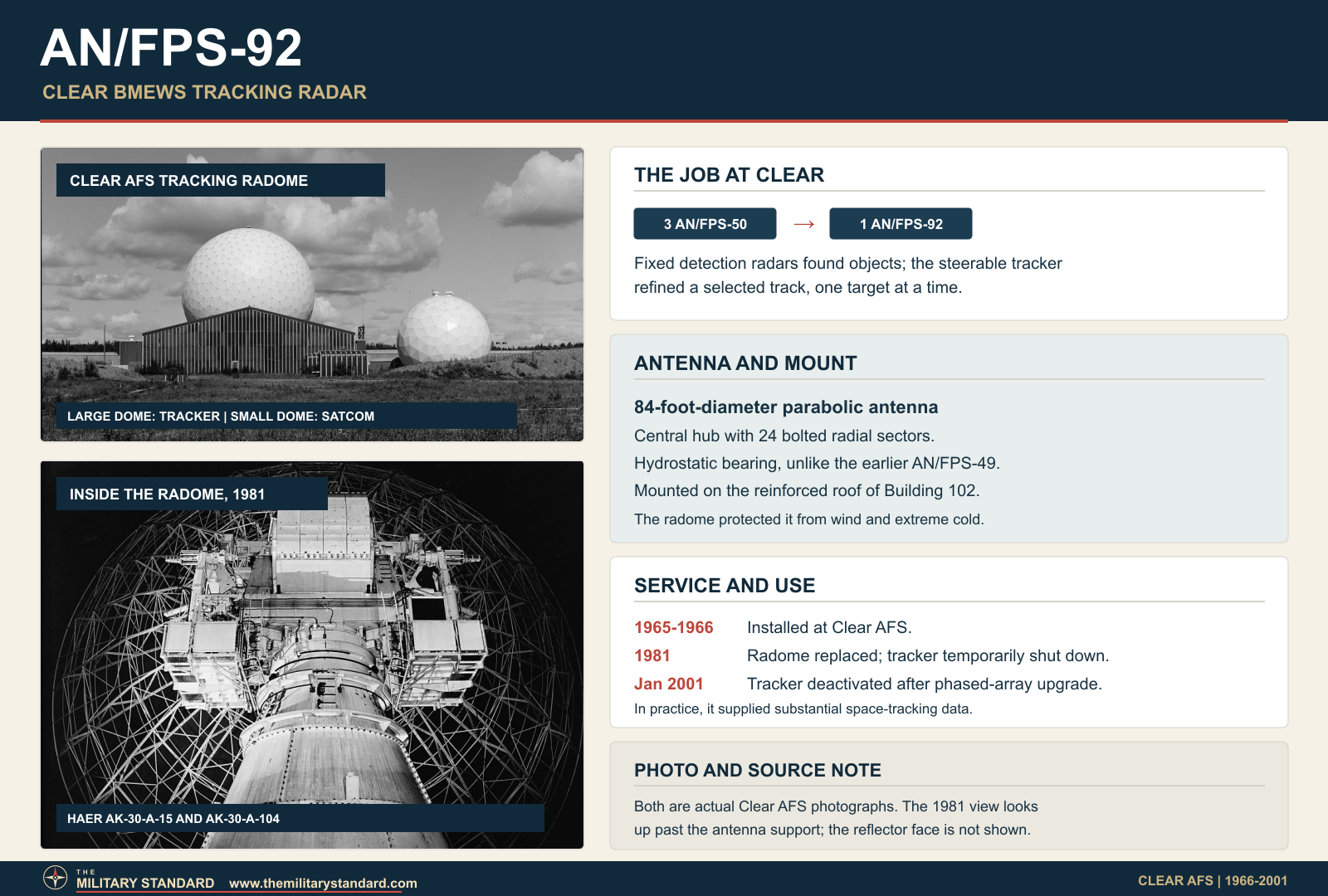
The tracker stood above Building 102 within a large radome. The HAER narrative gives a 104-foot radome dimension, while the Air Force handbook and a contemporary General Accounting Office report describe a 140-foot enclosure. The documents do not reconcile whether they measure different features, refer to different dome phases, or contain an error. This history therefore does not select one number as a settled external diameter. The 84-foot antenna dimension is independently consistent across the reviewed sources; the radome's published 104-foot and 140-foot figures remain explicitly disputed. The physical photographs show the correct relationship between the huge tracker dome and the much smaller satellite-communications dome nearby.
The original radome used cardboard honeycomb between fiberglass sheets with polyethylene covering. In 1981 the Air Force replaced it with a tedlar-panel, aluminum-frame structure after deterioration created a potential fire hazard. The FPS-92 was shut down in June 1981 for this work, interrupting its contribution of space-tracking data for several months. That sequence should not be mistaken for permanent equipment retirement. The radar returned to service inside the replacement enclosure and remained a component of Clear's BMEWS operations until the phased-array transition roughly two decades later.
The radome and the antenna must also be read correctly in photographs. An exterior photograph of the giant sphere shows the weather-protection structure, not the shape of the reflector inside it. A 1981 interior photograph used in the accompanying graphic looks upward along the support and rear assembly, so it likewise does not show a full frontal outline of the dish. The verified graphic deliberately states those limits. An unqualified modern rendering of a free-standing exposed antenna would create a false visual record for a machine whose operational appearance at Clear was overwhelmingly defined by its enclosing dome.
Transmitters, receivers, and processing
A late Air Force handbook describes three redundant transmitter units feeding the tracker antenna assembly with 8 megawatts of RF energy, divided as 4 megawatts in azimuth and 4 megawatts in elevation. The handbook does not label that 8-megawatt figure as peak RF output, average RF output, or station electrical demand. It would be wrong to place it without qualification in a generic peak-power column. The same handbook describes scan and track receiver sections, four monopulse signal channels, a tracker radar data-takeoff system (TRDTO), analog-to-digital conversion, and onward processing by the mission computer. This is a functional description of a computer-linked precision sensor, not a stand-alone dish feeding only a local operator display.
The Air Force historical study Searching the Skies places the AN/FPS-92 in the UHF band near 425 MHz and gives a tracking range greater than 3,000 miles. That is a historical capability statement, not a guaranteed range for every object. Radar detection and track quality depend on target size, reflectivity, trajectory, interference, and processing state. The reviewed direct AN/FPS-92 sources do not settle an exact production tuning band, average RF power, universal slew rate, or fixed altitude ceiling. This history leaves those model-specific values unresolved rather than borrowing AN/FPS-49 or AN/FPS-50 numbers. Likewise, the site's three 7.5-megawatt generators supplied a large installation; their aggregate capacity is not an FPS-92 equipment-input specification.
At the site level, radar data passed into Clear's mission computers and Missile Warning Operations Center, where the system compared detections and produced warning and impact-prediction information for command centers. The original IBM 7090 computers were replaced by Control Data Cyber 170/720 machines in 1982-1983, and the old computers were dismantled the following year. Thus the FPS-92's working environment changed during its lifetime even while its fundamental large mechanical antenna remained. A 1972 Air Defense Command chronology records acceptance of a pulse-compression modification specifically to improve FPS-92 accuracy in tracking space objects. Both developments show that the radar was maintained and upgraded as a live sensor, not frozen in its 1966 configuration.
The Air Force's attempt to modernize the entire Tactical Operations Room in 1980-1981 illustrates the difficulty of sustaining a 1960s warning system with later computing requirements. HAER reports that this program was abandoned because of software problems, after which the computer replacement proceeded by a more limited path. The tracker remained tied to operational data-takeoff and mission-processing systems throughout the change. It would be misleading to date the antenna's retirement to the end of its first computer generation. Equally, it would be misleading to treat later software or display modernization as a redesign of the antenna and hydrostatic mount.
Operational service: missile warning and space surveillance
NORAD's contemporary command history dates the AN/FPS-92's initial operational capability to July 1, 1966, and its full operational capability to September 15, 1966. The later HAER study calls its initial operating capacity June 1966. The best reconciliation is to keep the explicit NORAD day-level milestones for formal status while noting that the HAER narrative gives a preceding June date or a different interpretation of initial capacity. Neither source justifies moving the tracker back to Clear's 1961 detection-radar opening. RCA is named as the installer in NORAD's account, while equipment-hardware sources associate Goodyear Aircraft with the tracker pedestal and antenna subcontract work. These are different roles, not necessarily contradictory manufacturer claims.
In missile-warning service, the fixed detectors found candidate objects entering the coverage area and supplied the initial track geometry. The steerable FPS-92 could then pursue a selected target and refine the information available for warning, impact prediction, and attack assessment. HAER emphasizes a practical limitation: the Clear tracker could follow only one target at a time. It added confirmation and flexibility but could not replace the broad simultaneous coverage of three fixed detection radars. The same HAER study concludes that the radar's routine contribution eventually became predominantly space tracking, where precise observations of selected objects were especially valuable.
Space surveillance was not an incidental public-relations use. Once the number of satellites and debris objects increased, NORAD needed observations accurate enough to maintain a catalog and predict orbits. The AN/FPS-92's directed antenna, receiver channels, data-takeoff electronics, and computer connection made it useful for this task. Clear installed automated tracking equipment in December 1969, and the February 1972 pulse-compression acceptance specifically addressed space-object accuracy. The radar's long service illustrates how a missile-warning architecture acquired an enduring space-surveillance role without ceasing to support strategic warning.
HAER gives measurable evidence of this work. It reports that Clear successfully tracked 95 percent of the space objects assigned to it in early 1973 and attained a 100 percent assigned-object tracking rate in 1974. A 1975 computer change allowed automatic transfer of data to the Perimeter Acquisition Radar in North Dakota. Those are site-level performance and network statistics, not published intrinsic accuracy specifications for the FPS-92. The same preservation study notes that BMEWS supplied a much smaller fraction of overall national space-tracking data by 1985 as other sensors entered the network. The tracker could be locally successful while its share of the expanding national catalog declined.
Continuous readiness was essential because warning value disappears if a radar is unavailable at the moment of an attack. HAER records long stretches of Clear "green time," including more than 6,500 uninterrupted hours achieved by November 1970 and more than 19,500 by the end of that decade. These are BMEWS site readiness measures, not FPS-92 mean-time-between-failure figures. The distinction matters: a site could stay green through detector redundancy or operational procedures while a particular subsystem was under repair. Nonetheless, the statistics show the institutional priority placed on keeping the Clear warning plant, including its tracker, continuously useful.
The Arctic environment created more than ordinary weather problems. HAER discusses auroral interference and experiments in 1969-1970 intended to understand or reduce its effect on radar operation. It also records live electronic-countermeasure exercises with B-52 aircraft in 1974 and an EB-57 in 1977. These were tests of the Site II warning system, not proof of an AN/FPS-92-specific anti-jamming feature. They belong in this history because the precision tracker operated inside that contested signal environment. A radar's useful accuracy depended on the whole chain of detection, target assignment, electronic conditions, computer handling, and communication to command authorities.
The equipment also remained part of a larger warning system that evolved around it. BMEWS was never an interceptor or a missile-defense weapon; it provided detection and warning. Space-based sensors, other ground radars, command centers, and communications links altered the value of each BMEWS component over time. Clear continued to rely on the older fixed and mechanical radars even after newer phased-array technology became available elsewhere. That decision reflected cost, program priorities, and the fact that existing equipment still delivered useful warning and tracking data. It did not make the older radars technically equivalent to their eventual solid-state replacements.
The warning information had to leave Alaska reliably. HAER identifies redundant routes from Clear toward NORAD and Air Defense Command at Ent Air Force Base in Colorado. One followed microwave relay stations along the Alaska-Canada Highway; another used a mixture of microwave relay, White Alice troposcatter through Boswell Bay, a link through southeastern Alaska, commercial submarine cable, and telephone circuits. These communications paths were not part of the FPS-92 set, but the tracker could not contribute to national attack assessment if its refined data remained at Building 102. The relay network thus connected an unusually precise local observation to the distant command centers that could act on it.
The 1983 radiation accident and safety lessons
On September 14, 1983, six people working on or around the tracker antenna were exposed to radio-frequency radiation during maintenance at Clear. A General Accounting Office investigation found that four contractor employees and two federal employees received exposures substantially above applicable safety standards. The GAO examined technical-order compliance, radome access procedures, interlocks, contractor staffing and oversight, post-incident evaluation, and remedial actions. It did not claim authority to determine the medical outcome for each affected person. The incident belongs in the equipment history because it reveals how a high-power radar's maintenance system and human procedures were part of its operational safety, not an unrelated station anecdote.
The safety system used captive keys, waveguide switches, warning lights, and a klaxon to prevent personnel from entering the radome while transmitter power or antenna motion could endanger them. GAO found departures from prescribed procedures and recommended stricter compliance, interlock correction, better oversight, and a transmitter/waveguide configuration change. The later closure of GAO recommendations documents corrective action, but it does not erase the original accident or prove that every alleged injury was medically resolved. A careful account distinguishes confirmed RF exposure, documented process failures, and the limits of the public medical record.
Replacement and physical legacy
The Air Force installed a solid-state phased-array radar at Clear during 2000. HAER dates the AN/FPS-92 shutdown to January 2001, while some later summaries give February 1 for final mechanical BMEWS deactivation. The contemporary preservation account is the stronger located evidence for January; February should remain a source-qualified alternate until the exact operating log or acceptance document is reviewed. Clear's replacement is identified as AN/FPS-120, operational in 2001. The newer architecture electronically steered its beam rather than moving an 84-foot, 105-ton reflector inside a protective dome. It also displaced the three older AN/FPS-50 detection radars as the site moved beyond the original BMEWS plant.
No complete operational AN/FPS-92 is known to be preserved in a public collection. The strongest surviving visual record is the National Park Service and Library of Congress Historic American Engineering Record for Clear BMEWS Site II: 131 photographs, nine measured drawings, 81 data pages, and caption documentation. Those materials record the technical site, roof mount, radome, transmitter buildings, detection arrays, support systems, and the dismantling-era condition.
The 2001 HAER photography has an archival location label near 64.2471 N, 149.1600 W for the Clear BMEWS survey area. That is a site-level reference, not a surveyed point for the FPS-92 antenna center or the Clear property boundary. Equipment histories should not convert such a record into a fictitious radar-specific coordinate. Similarly, the old Clear land withdrawal and the station's later acreage refer to different periods and purposes; neither is an acreage figure for this single equipment set. The AN/FPS-92 was an installation component on Building 102, not a separately deeded base.
Clear Air Force Station was renamed Clear Space Force Station on June 15, 2021, and its missile-warning and space-domain-awareness missions continued under successor organizations. That continuity is a site and mission legacy, not proof that the FPS-92 survived. The value of this radar as a historical subject lies in its bridging role: it brought an improved precision tracker into an originally detector-only Alaskan BMEWS site, served both nuclear-warning and orbital-surveillance needs, and exposed the physical, computing, and safety demands of giant mechanically steered early-warning radars before phased arrays made that arrangement obsolete.
Technical summary and source limits
- Role
- mechanically steered UHF missile and space-object tracking radar at Clear BMEWS Site II.
- Verified installation
- Clear Air Force Station, Alaska, now Clear Space Force Station; one operational AN/FPS-92.
- Operational milestones
- NORAD IOC 1966-07-01; FOC 1966-09-15; deactivated in January 2001 per HAER.
- Antenna
- 84-foot parabolic reflector; 24 radial sectors; approximately 210,000-pound moving portion; hydrostatic azimuth bearing.
- Frequency
- UHF, approximately 425 MHz in an official Air Force historical study.
- Range
- greater than 3,000 miles in an Air Force historical survey; target-dependent, not a universal guarantee.
- RF power
- Air Force handbook states 8 MW supplied to antenna assembly; peak/average classification unresolved.
- Radome
- HAER gives 104 feet; Air Force handbook and GAO give 140 feet; dimensional conflict unresolved.
- Processing
- monopulse receiver channels, TRDTO, mission computers; pulse-compression modification accepted 1972-02-01.
- Successor
- AN/FPS-120 solid-state phased array at Clear.
Chronology
- 1958-01 Clear selected as BMEWS Site II after comparison with other Alaskan locations.
- 1958-07 Construction begins at the new Clear BMEWS station.
- 1961-09-30 Clear BMEWS detection-radar system reaches full operational capability without an FPS-92 tracker.
- 1963-09 Department of Defense approves a tracking radar for Clear after the low-angle gap study.
- 1964-05 AN/FPS-92 bid requests go to industry.
- 1965-08 Construction begins on the single Clear AN/FPS-92 tracker.
- 1966-06 HAER retrospectively describes initial operating capacity in June; this differs from NORAD's formal July IOC date.
- 1966-07-01 NORAD records initial operational capability for AN/FPS-92 at Clear.
- 1966-09-15 NORAD records full operational capability for the Clear tracker.
- 1967-01-01 The 13th Missile Warning Squadron assumes the Site II mission after Detachment 2 is disbanded.
- 1969-12 Automated tracking equipment is installed at Clear.
- 1972-02-01 Air Defense Command accepts a pulse-compression modification to improve FPS-92 space-object tracking accuracy.
- 1973 Clear successfully tracks 95 percent of the space objects assigned to Site II early in the year.
- 1974 Clear achieves a 100 percent assigned-object tracking rate and undergoes an electronic-countermeasure exercise with B-52 aircraft.
- 1975 A computer modification enables automatic data transfer from Clear to the Perimeter Acquisition Radar in North Dakota.
- 1977 Site II undergoes a further electronic-countermeasure exercise with an EB-57 aircraft.
- 1981-06 FPS-92 shuts down temporarily for replacement of its deteriorated radome.
- 1981 A tedlar-panel, aluminum-frame radome replaces the original enclosure and tracking service resumes.
- 1982-1983 Control Data Cyber 170/720 computers replace Clear's original IBM 7090 mission computers.
- 1983-09-14 Six maintenance personnel experience confirmed excessive RF exposure in the tracker-radome accident.
- 1985-11-07 GAO releases its investigation of the Clear accident and safety oversight.
- 2000-12 Clear's phased-array upgrade is installed during the transition away from mechanical BMEWS equipment.
- 2001-01 HAER records deactivation of the AN/FPS-92 tracker.
- 2001 AN/FPS-120 solid-state radar becomes the Clear successor system.
- 2021-06-15 Clear Air Force Station is renamed Clear Space Force Station; the AN/FPS-92 had been retired for two decades.
Historical photographs and graphic
The verified graphic combines two actual Clear BMEWS photographs from the federal Historic American Engineering Record. The interior view does not show the reflector face.
Exterior tracker-radome photograph and 1981 radome interior photograph.
Information sources (8)
- PDFNational Park Service, Historic American Engineering Record AK-30-A, Clear Air Force Station BMEWS Site II
Source for BMEWS site construction, physical layout, Building 102, antenna and radome design, 1981 replacement, operations, 2001 deactivation, and preserved record.
- PDFNorth American Aerospace Defense Command, 1966 NORAD-CONAD History
Source for the Site II low-angle gap requirement, September 1963 approval, 1964 bid request, RCA installation, 1966-07-01 IOC, and 1966-09-15 FOC.
- PDFAir Defense Command, A Chronology of Air Defense 1914-1972, Historical Study 19
Source for the 1972-02-01 acceptance of the FPS-92 pulse-compression modification for space tracking.
- PDFU.S. Air Force, Air Force Handbook, BMEWS radar-system description
Source for the 84-foot and 210,000-pound tracker antenna, hydrostatic bearing, transmitter and monopulse/TRDTO functional description, and 140-foot radome figure.
- WEBU.S. Air Force, Searching the Skies: The Legacy of the United States Cold War Defense Radar Program
Source for RCA attribution, UHF operation near 425 MHz, greater-than-3,000-mile historical range statement, and FPS-92 relationship to the AN/FPS-49.
- PDFU.S. General Accounting Office, Radiation Accident: Incident at Clear Air Force Station, Alaska, NSIAD-86-9
Source for the 1983 tracker maintenance accident, confirmed RF overexposures, interlock/technical-order issues, and documented remedial recommendations.
- PDFNational Park Service and Library of Congress, HAER AK-30-A photo captions
Source for photograph identification, archival coordinate labeling, and the distinction between tracker and nearby SATCOM dome.
- WEBUnited States Space Force, Clear Air Force Station Renamed as Clear Space Force Station
Source for the 2021-06-15 installation renaming and continuity of modern mission, not for survival of the AN/FPS-92.