
AN/TPS-59 Long-Range Three-Dimensional Radar
- Role
- Transportable 3-D aircraft surveillance and theater ballistic-missile surveillance
- Primary U.S. operator
- United States Marine Corps
- First fielded
- 1985, according to Marine aviation plans
- Documented modes
- About 300 nmi for air-breathing targets and 400 nmi for theater ballistic missiles in Marine planning literature; target- and mode-dependent
- Status
- Marine divestment began in 2019; final service date not verified
Identity and historical significance
The AN/TPS-59 was the United States Marine Corps' transportable, long-range, three-dimensional air-surveillance radar. It supplied the Marine Air-Ground Task Force with a much wider view than short-range tactical sensors could provide. Operators could use its tracks for air defense, ground-controlled intercepts, and en route aircraft control. An extensive 1990s modification gave the later AN/TPS-59(V)3 a theater ballistic-missile surveillance role as well. The radar thus crossed an important operational divide: it began as a long-range aircraft sensor and became a contributor to a joint air and missile defense picture. It was a Marine tactical system, not an Air Defense Command fixed radar station and not a missile-interceptor weapon.
The equipment's importance comes from its mission and long service rather than an enormous production run. A Marine aviation plan listed 11 U.S. sets in its mid-2010s distribution table, including operational squadron, training, test, and depot allocations. Lockheed Martin reported 16 AN/TPS-59(V)3 radars operating around the world in 2007. Those counts have different dates and populations; they should not be added together or treated as a present inventory. The radar saw use in the Persian Gulf, Operation Iraqi Freedom, Operation Enduring Freedom, later Southwest Asia deployments, Marine exercises, and an allied sale to Bahrain. Its development also illustrates the difficulty of keeping a complex expeditionary radar current as targets, digital networks, identification rules, and tactical requirements changed over several decades.
Names and variants require care. Marine program documents use AN/TPS-59, AN/TPS-59(V)3, and AN/TPS-59A(V)3 for different stages of the U.S. system. The 2015 and 2017 Marine Aviation Plans say the radar was fielded in 1985, gained theater ballistic-missile capability in 1998, and received the A(V)3 designation in 2011 following a control and signal processor shelter obsolescence upgrade. A 2007 company announcement identifies an AN/TPS-59(V)3B delivered to Bahrain. These variant labels do not justify assuming that every photograph, specification, or upgrade applies to every AN/TPS-59 at every date. This history uses the family designation in general passages and the precise suffix where a source identifies one.
Marine air-defense requirement and original fielding
The Marine Corps needed an expeditionary long-range sensor that could accompany a force ashore, assemble a regional air picture, and support the Tactical Air Operations Center (TAOC). The TAOC was the air-defense and airspace-control agency that converted radar observations, identification information, communications, and command decisions into useful control of aircraft and defensive weapons. A transportable radar extended the area the Marine force could see without requiring a permanent national-defense station. A long-range three-dimensional radar also supplied height information, a crucial distinction from a two-dimensional search radar that reports bearing and range but needs another source to establish altitude.
Marine aviation plans date the initial fielding to 1985. The AN/TPS-59 was described in subsequent official material as a solid-state L-band radar. Its tall, rectangular array and associated shelters formed a field-deployable system, but deployable does not mean a single self-contained trailer that could operate immediately after parking. A useful site needed prepared positions, power, interconnecting equipment, communications, identification support, operators, maintenance personnel, and an onward command-and-control path. The array's approximate 30-foot height appears in a 2012 Army depot account; that is a rounded system-height description, not a verified exact antenna-aperture dimension.
The 1980s system belonged to a broader Marine Air Command and Control System. Its long-range coverage supported anti-air warfare and the direction of friendly aircraft as well as warning of approaching hostile aircraft. It complemented, rather than replaced, other surveillance and traffic-control radars with different ranges, mobility, and roles. The Marine Corps' later antiair-warfare doctrine describes the TAOC as integrating organic radars, including the AN/TPS-59 and shorter-range AN/TPS-63, to conduct surveillance, identification, airspace management, intercept control, and support for surface-to-air weapons. The radar's historical record should therefore be read as part of an operating command system, not merely a list of transmitter and antenna specifications.
Persian Gulf operations and the missile-defense requirement
The radar was already part of Marine expeditionary air operations during the 1990-1991 Persian Gulf deployment. The official history of the 3d Marine Aircraft Wing describes Marine Air Control Squadron 2's TAOC move toward Ras Al Mishab and discusses anomalous propagation and weather ducting that interfered with AN/TPS-32 and AN/TPS-59 radars in the Gulf region. This is a valuable operational detail: long published range figures did not eliminate the effects of local atmospheric conditions on real surveillance. The source confirms use and environmental difficulty but does not, by itself, identify a unique radar set, serial number, or the precise site of every associated AN/TPS-59 antenna.
Iraqi Scud attacks during the war helped accelerate interest in theater ballistic-missile warning. A December 1992 Government Accountability Office procurement decision preserves unusually specific contemporary evidence of the Marine Corps' response. The solicitation, issued on February 18, 1992, sought design, fabrication, integration, installation, and test of modification kits. GAO described the pre-upgrade set as capable of detecting conventional fighter-sized aircraft to 300 miles and the modification requirement as extending detection to tactical ballistic missiles and other small targets at up to 400 miles. The decision uses miles, whereas later Marine program literature uses nautical miles; those units should not be silently merged. GAO said the contemplated output would reach the HAWK missile system through the Joint Tactical Information Distribution System, or JTIDS. It described the post-Desert Storm Scud threat as the procurement's context.
The 1992 contract record shows how large the upgrade really was. Radar performance depended on transmitter capability, receiver sensitivity, target-versus-clutter discrimination, waveform design, timing, processing, identification, interfaces, and shelter arrangement. GAO reported that the Marine Corps expected changes to roughly 12,000 of the system's 25,000 technical drawings. The solicitation also sought higher reliability, a shorter repair time, and improved mobility by eliminating one of two electronics shelters. Those were procurement objectives, not verified achieved field statistics. The contract was awarded to General Electric's Ocean and Radar Systems Division after a protest by Aydin; the GAO denied the protest. The GAO record is particularly useful because it documents a concrete program decision before later public summaries described the resulting radar simply as ballistic-missile capable.
Marine aviation plans date the theater ballistic-missile upgrade to 1998. The 2000 Marine Corps Concepts and Programs volume described the AN/TPS-59(V)3 as providing long-range surveillance, ground-control intercept support, and tactical ballistic-missile surveillance. It emphasized that the radar could be phased ashore in an amphibious operation, installed, and operated to extend Marine air defense over land. The document also linked its tracks to the Navy's Cooperative Engagement Capability and the developing common air picture. This was a change in the kind of information the radar was expected to furnish: a high-speed missile track needed timely identification, trajectory assessment, and reliable dissemination to distant decision makers, not just a long-range visual display for a local operator.
Technical capability and its limits
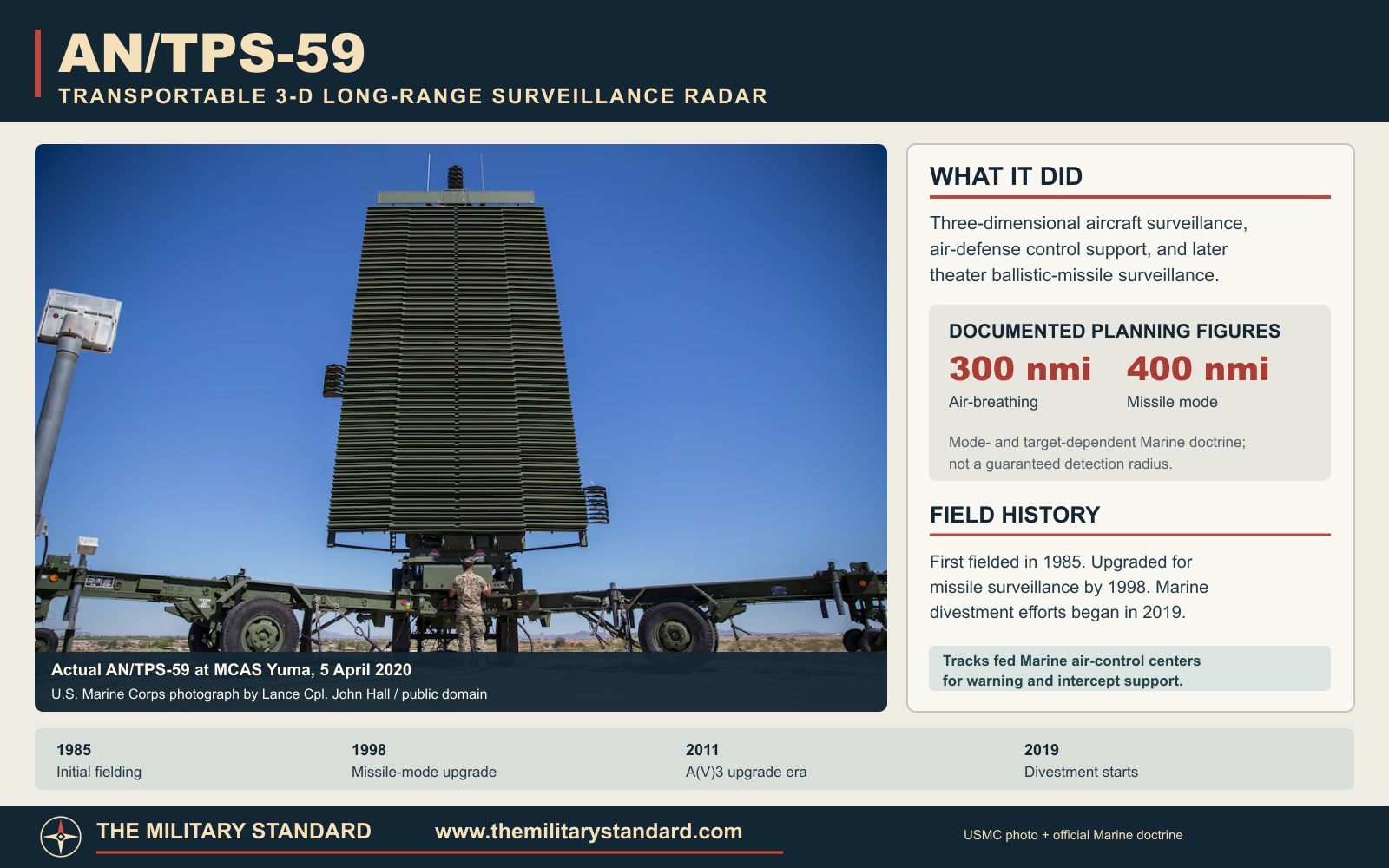
Marine doctrine distinguishes three operating contexts rather than publishing one universal range. In air-breathing-target mode, the AN/TPS-59 could track conventional aircraft and similar targets out to a stated 300 nautical miles and to about 100,000 feet. In theater ballistic-missile mode, the doctrinal description gives detection and tracking out to 400 nautical miles and above 500,000 feet, without external cueing. In combined mode, it provides simultaneous aircraft and missile surveillance, but the air-breathing-target altitude figure is lower than in the dedicated aircraft mode. These are mode- and target-dependent planning figures. They are not guarantees that every object of any size would be detected at exactly those distances, and they do not establish a single fixed maximum altitude for all configurations.
The public sources consistently identify the U.S. radar family as L-band. A Marine Corps Air Station Cherry Point antenna-system order lists 1215-1400 MHz for a local AN/TPS-59(V)3 entry. That is a documented installation/configuration listing, not proof that every historical version operated over the entire range simultaneously or that the same value belongs to every export variant. The same order calls the antenna parabolic, while later configuration material identifies an OE-340 phased-array antenna with an AN/TPS-59(V)3B entry.
The reviewed sources do not establish a defensible family-wide peak RF power, average RF power, rotation rate, exact antenna-aperture dimensions, equipment electrical load, or accuracy figure suitable for an unqualified master-table value. An official depot account describes a 30-foot-tall system, and a Marine logistics article describes multiple transmitter and receiver components, but neither gives the complete electrical specification or a dimensioned engineering drawing for each variant. It would be misleading to copy a number from another three-dimensional radar or treat a station antenna-safety table as an equipment data sheet.
Mobility was strategic as well as tactical. The Marine Corps Concepts and Programs account says the set could move by aircraft, helicopter, surface shipping, or organic landing-force vehicle transport. Each transport mode imposed its own packaging, lift, power, and reassembly demands. GAO's 1992 account explicitly records a desire to remove one electronics shelter to enhance tactical mobility. A radar that can be transported still needs time to make a site ready, align its parts, connect its generators and processing equipment, test communications, and verify that its air picture reaches the command network. The distinction helps explain why maintenance and shelter modernization remained important even after the core radar had already been fielded.
Track distribution and command networks
The AN/TPS-59 did not itself decide to fire an interceptor. It generated radar observations and tracks that entered a layered system of command and control. Marine Concepts and Programs 2009 calls the AN/TPS-59(V)3 the principal long-range three-dimensional air-surveillance radar for the Marine Air-Ground Task Force. It states that the radar could integrate with the AN/TYQ-23(V)4 Tactical Air Operations Module, or be configured with the AN/MSQ-124 Air Defense Communications Platform to send theater ballistic-missile track data into the JTIDS/Link 16 network. It also identifies the radar as a component in the Navy's Cooperative Engagement Capability and Composite Tracking Network. Those connections explain why software, interface, and processing upgrades had mission consequences beyond the antenna itself.
The 1992 GAO decision shows that interface requirements, communications, identification friend or foe, and built-in test equipment were explicit technical evaluation factors in the upgrade competition. That level of emphasis is not incidental. A radar could detect an approaching aircraft or missile and still be operationally less useful if a track was too slow, lacked adequate classification, or could not be transmitted in a form the next command node could use. The Marine Corps' later plans continued to list Link 16, IFF Mode 5, cyber/information assurance, receiver and exciter cabinets, and console/server refresh among the radar's sustainment concerns. The machine's service history is therefore also a history of software and network compatibility.
Deployment, training, and inventory
Marine Corps Concepts and Programs 2009 states that AN/TPS-59(V)3 sets deployed in support of Operation Iraqi Freedom and Operation Enduring Freedom. This confirms theater employment without identifying the radar's position for every year or authorizing a specific site coordinate. A 2013 official Marine photograph documents a more precise movement: an AN/TPS-59 was unloaded from a C-5 aircraft at an undisclosed Southwest Asia base on February 28 for use by Marines of Marine Air Control Squadron 1, Marine Air Control Group 38, 3d Marine Aircraft Wing, based at Yuma. The caption links the deployment to the U.S. Air Forces Central Command integrated air-defense and missile shield. Because the location was deliberately undisclosed, a history should not reverse-engineer or invent a named installation from that image.
The mid-2010s Marine Aviation Plan distribution table records two sets each for MACS-1, MACS-2, MACS-4, and MACS-24, one at Marine Corps Tactical Systems Support Activity at Camp Pendleton, one at Marine Corps Communications-Electronics School at Twentynine Palms, and one at Tobyhanna Army Depot, totaling 11. Squadron attribution is not a fixed antenna coordinate: squadrons deploy, detachments relocate, training sets change hands, and depot sets can be in overhaul. A Marine photograph dated March 13, 2017 independently shows Marines of the AN/TPS-59(V)3 Radar Repair Course setting up a set at Marine Corps Base Twentynine Palms. These records support named training and support relationships, not an enduring separate radar-station identity for every temporary erection point.
The Bahrain Defence Force received an AN/TPS-59(V)3B in 2007. Lockheed Martin reported that the system was built and tested at its Syracuse, New York facility, that Bahraini personnel trained there, and that site acceptance occurred during 2007. This illustrates international use, but it does not make the Bahrain equipment a U.S. installation. The company's same-year statement of 16 operating AN/TPS-59(V)3 systems worldwide is a dated global count, not a production total and not a substitute for the Marine Corps' own later allocation table.
Depot work and modernization
Keeping the radar useful required substantial maintenance capacity. A 2005 base realignment decision shifted AN/TPS-59 depot work from Marine Corps Logistics Base Barstow, California, to Tobyhanna Army Depot, Pennsylvania. Army reports describe construction of a 77-foot radome and testing facilities at Tobyhanna's Powder Smoke Ridge, followed by repair, overhaul, and fielding support. A 2012 Army article says technicians would repair radio-frequency equipment, transmitters, receivers, power supplies, motors, gearboxes, antennas, and antenna drives; it anticipated work on about two TPS-59 sets a year. A 2013 article documents an actual repaired set going to Marine Corps Air Station Cherry Point for final testing while two others were undergoing overhaul. These are maintenance-cycle and depot-location facts, not claims that Tobyhanna was a permanent operational early-warning station.
The Marine Aviation Plan records a 2011 redesignation to AN/TPS-59A(V)3 as the control and signal processor shelter was refreshed to address obsolescence. Its later planning list included identification upgrades for IFF Mode 5, antenna transmitter group changes, console and server replacement, information assurance, electronic-counter-countermeasure improvements, and ballistic-missile software changes. One plan directed sustainment to 2025; a later plan discussed sustainment to 2035. Those were planning horizons, not proof that every U.S. set remained operational through either date. The change in horizon itself demonstrates how lifecycle forecasts can move while force structure and replacement programs evolve.
Replacement and divestment
The AN/TPS-80 Ground/Air Task Oriented Radar, or G/ATOR, entered Marine modernization plans to cover multiple missions formerly handled by separate legacy radars. Early plan graphics put TPS-59 and TPS-73 in a present-day column and TPS-80 in a future column, but the eventual transition was more complicated than a one-for-one equipment swap. The Corps had to preserve long-range surveillance and integrated air-defense functions while reducing transport burden and improving survivability. The later G/ATOR Extended Range Mode program was specifically intended to provide extended range after the AN/TPS-59 sunset. The Fiscal Year 2026 Navy procurement justification scheduled four ERM kit installations in FY2025 and 16 in FY2026. That is a procurement plan, not evidence that the old radar was completely withdrawn on the first kit-installation date.
Marine Corps Systems Command stated in 2021 that AN/TPS-59 divestment efforts began in 2019 as part of Force Design 2030. The command cited a mismatch between the radar and the evolving pacing threat in a potential Indo-Pacific battlefield. This is an official explanation of a policy shift, not a complete set-by-set disposal ledger. The record located does not verify a final U.S. operational shutdown date, the exact date of the last training event, or the present disposition of each historic set. Accordingly, the radar should be described as a divesting legacy system with successor capabilities under fielding, not simply marked active forever or given a made-up retirement day.
The equipment's legacy is wider than its antenna silhouette. It made long-range three-dimensional surveillance available to Marine forces ashore, acquired a missile-tracking mission after the Gulf War, fed joint digital defense networks, and supported deployed operations for decades. Its successive rebuilds reveal the difference between fielding a radar and sustaining a usable surveillance system through changed threats and data standards. Its retirement planning likewise shows that a once valuable long-range set can become too demanding or exposed for a later expeditionary concept. The AN/TPS-59 remains an instructive bridge between Cold War-era transportable air-defense radar and networked modern integrated air and missile defense.
Technical summary
- Designation
- AN/TPS-59 family; U.S. AN/TPS-59(V)3 and AN/TPS-59A(V)3 variants; Bahrain AN/TPS-59(V)3B export variant.
- Primary U.S. operator
- United States Marine Corps.
- Original fielding
- 1985 according to Marine aviation plans.
- Primary roles
- three-dimensional long-range aircraft surveillance, air-defense and intercept support, en route traffic control, and later theater ballistic-missile surveillance.
- Frequency
- L-band; one Cherry Point antenna-system listing gives 1215-1400 MHz for a named local configuration.
- Air-breathing-target mode
- doctrinal planning figure of about 300 nautical miles and 100,000 feet, target and mode dependent.
- Theater ballistic-missile mode
- doctrinal planning figure of about 400 nautical miles and over 500,000 feet, target and mode dependent.
- Air-defense network
- TAOC, AN/TYQ-23(V)4, AN/MSQ-124, JTIDS/Link 16, CEC, and Composite Tracking Network in documented configurations.
- Measured physical and electrical data
- exact family-wide aperture dimensions, peak/average RF output, rotation rate, and generator load remain unverified in the reviewed sources.
- U.S. inventory context
- 11 sets in a mid-2010s Marine Aviation Plan allocation table, including operations, training, test, and depot positions.
- Status
- U.S. Marine Corps divestment began in 2019; exact final service date not verified; G/ATOR Extended Range Mode is the documented successor capability.
Chronology
- 1985 Marine aviation plans date the first AN/TPS-59 fielding.
- 1990-1991 Marine Persian Gulf operations employ AN/TPS-59; the official wing history records anomalous propagation and weather ducting affecting the radar.
- 1992-02-18 Marine Corps solicitation seeks an AN/TPS-59 modification for theater ballistic-missile detection and improved mobility and reliability.
- 1992-07-16 General Electric receives the modification contract after the source-selection process recorded in GAO's later protest decision.
- 1992-12-02 GAO denies Aydin's protest and publishes a detailed record of the upgrade requirements.
- 1998 Marine aviation plans date the theater ballistic-missile capability upgrade.
- 2000 Marine Corps Concepts and Programs describes the AN/TPS-59(V)3's aircraft, ground-control, and missile-surveillance roles.
- 2005 Base realignment decision directs transfer of AN/TPS-59 depot work from Barstow to Tobyhanna.
- 2007 Lockheed Martin delivers an AN/TPS-59(V)3B to Bahrain and reports 16 AN/TPS-59(V)3 radars operating worldwide at that time.
- 2009 Marine Corps Concepts and Programs documents AN/TPS-59(V)3 deployment support for Operations Iraqi Freedom and Enduring Freedom.
- 2011 Marine aviation plans date the A(V)3 designation and control/signal processor shelter obsolescence upgrade.
- 2011 Tobyhanna constructs the Powder Smoke Ridge radar test facility as AN/TPS-59 overhaul work moves to the depot.
- 2012 Tobyhanna reports repair and fielding-support work on the Marine radar.
- 2013-02-28 Official Marine photograph documents a MACS-1 AN/TPS-59 being unloaded from a C-5 in Southwest Asia.
- 2013 Tobyhanna finishes repair of a set sent to Marine Corps Air Station Cherry Point for final testing.
- 2015 Marine Aviation Plan table records 11 U.S. sets across four Marine air control squadrons, test and training organizations, and a depot.
- 2017-03-13 Official Marine photograph documents an AN/TPS-59(V)3 Radar Repair Course setup at Twentynine Palms.
- 2019 Marine Corps Systems Command begins AN/TPS-59 divestment efforts under the force-design changes it later describes publicly.
- 2021 Marine Corps Systems Command publicly explains the AN/TPS-59 divestment rationale.
- 2025-2026 Fiscal Year 2026 Navy budget schedules G/ATOR Extended Range Mode kit installations to support the post-AN/TPS-59 long-range mission.
Historical photographs
View the original 2020 Marine Corps photograph of the full array, credited to Lance Cpl. John Hall. Additional official views document a 2017 repair-course component close-up, 2013 transport to Southwest Asia, and Tobyhanna depot work. The close-up and transport images are not substitutes for an overall antenna reference.
Information sources (15)
- PDFUnited States Marine Corps, 2015 Marine Aviation Plan, AN/TPS-59 program section
SOURCE FOR 1985 fielding, 1998 and 2011 changes, the 11-set U.S. allocation table, sustainment concerns, and variant naming.
- WEBUnited States Marine Corps, 2017 Marine Aviation Plan, AN/TPS-59A(V)3 program section
SOURCE FOR continued variant and modernization chronology, IFF and electronics updates, and revised sustainment planning.
- PDFUnited States Marine Corps, Concepts and Programs 2000
SOURCE FOR the upgraded radar's MAGTF, amphibious, aircraft-control, missile-surveillance, and Navy CEC missions.
- PDFUnited States Marine Corps, Concepts and Programs 2009
SOURCE FOR L-band solid-state description, 300/400-nautical-mile figures, TAOM and ADCP interfaces, CEC/CTN connections, and OIF/OEF deployment.
- WEBUnited States Marine Corps, Antiair Warfare, MCTP 3-20C
SOURCE FOR the TAOC role and distinct aircraft, theater ballistic-missile, and combined radar modes and altitude statements.
- PDFUnited States Marine Corps History Division, The 3d Marine Aircraft Wing in Desert Shield and Desert Storm
SOURCE FOR Persian Gulf AN/TPS-59 use and the operational problem of anomalous propagation and weather ducting.
- WEBUnited States General Accounting Office, Aydin Computer and Monitor Division, B-249539, December 2, 1992
SOURCE FOR the 1992 upgrade procurement, target and range requirements, GE award, HAWK/JTIDS interface, drawing-change estimate, and proposed reliability and shelter changes.
- WEBUnited States Army, Tobyhanna begins new Marine Corps radar mission
SOURCE FOR physical height context, repair and test workload, supported components, and depot plans in 2012.
- WEBUnited States Army, Depot raises radome on Powder Smoke Ridge
SOURCE FOR the 2005 base realignment and Barstow-to-Tobyhanna transfer, test radome, and overhaul facilities.
- WEBUnited States Army, Marine Corps radar repairs complete, final testing under way
SOURCE FOR a documented repaired AN/TPS-59(V)3, Cherry Point final test, and additional depot overhauls in 2013.
- WEBLockheed Martin, Delivers AN/TPS-59 Ballistic Missile Defense Radar to Bahrain, October 2, 2007
SOURCE FOR the Bahrain (V)3B delivery and the company's dated 16-system worldwide operating figure.
- WEBUnited States Marine Corps Systems Command, Force Design 2030: Divesting to meet the future threat
SOURCE FOR the beginning of AN/TPS-59 divestment in 2019 and the Marine Corps' stated future-threat rationale.
- PDFDepartment of the Navy, Fiscal Year 2026 Procurement of Marine Corps Budget Justification, G/ATOR line
SOURCE FOR G/ATOR Extended Range Mode as the post-AN/TPS-59 long-range capability and FY2025-FY2026 kit-installation plan.
- PDFMarine Corps Air Station Cherry Point, Air Station Order 8000.1A antenna-system table
SOURCE FOR a local AN/TPS-59(V)3 frequency listing; antenna-description conflicts require variant-specific graphic verification.
- WEBU.S. Marine Corps, Radar Ready, photograph 200505-M-AS595-0038, by Lance Cpl. John Hall
SOURCE FOR: Verified full-array photograph at MCAS Yuma on April 5, 2020, public-domain status, and photographer credit.