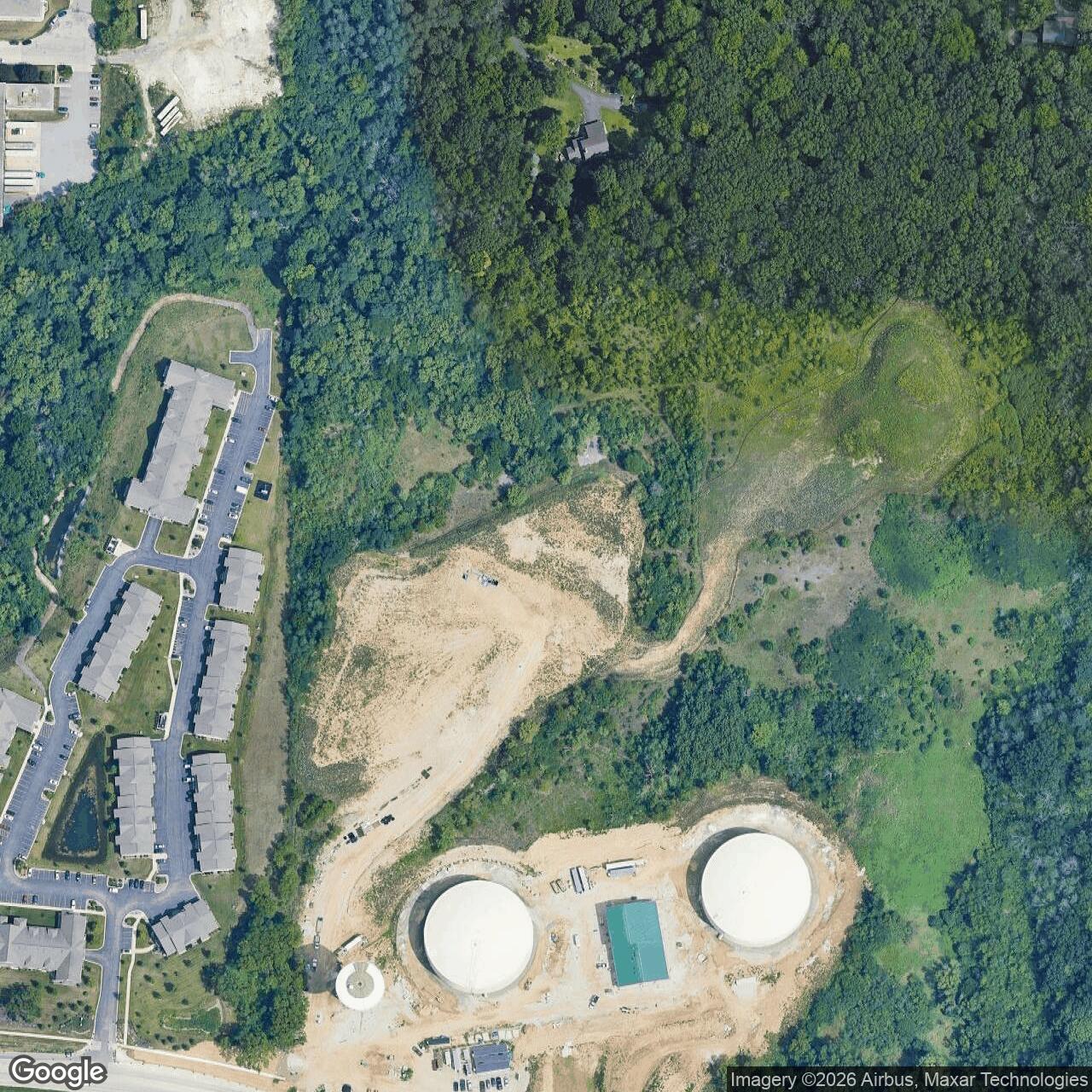
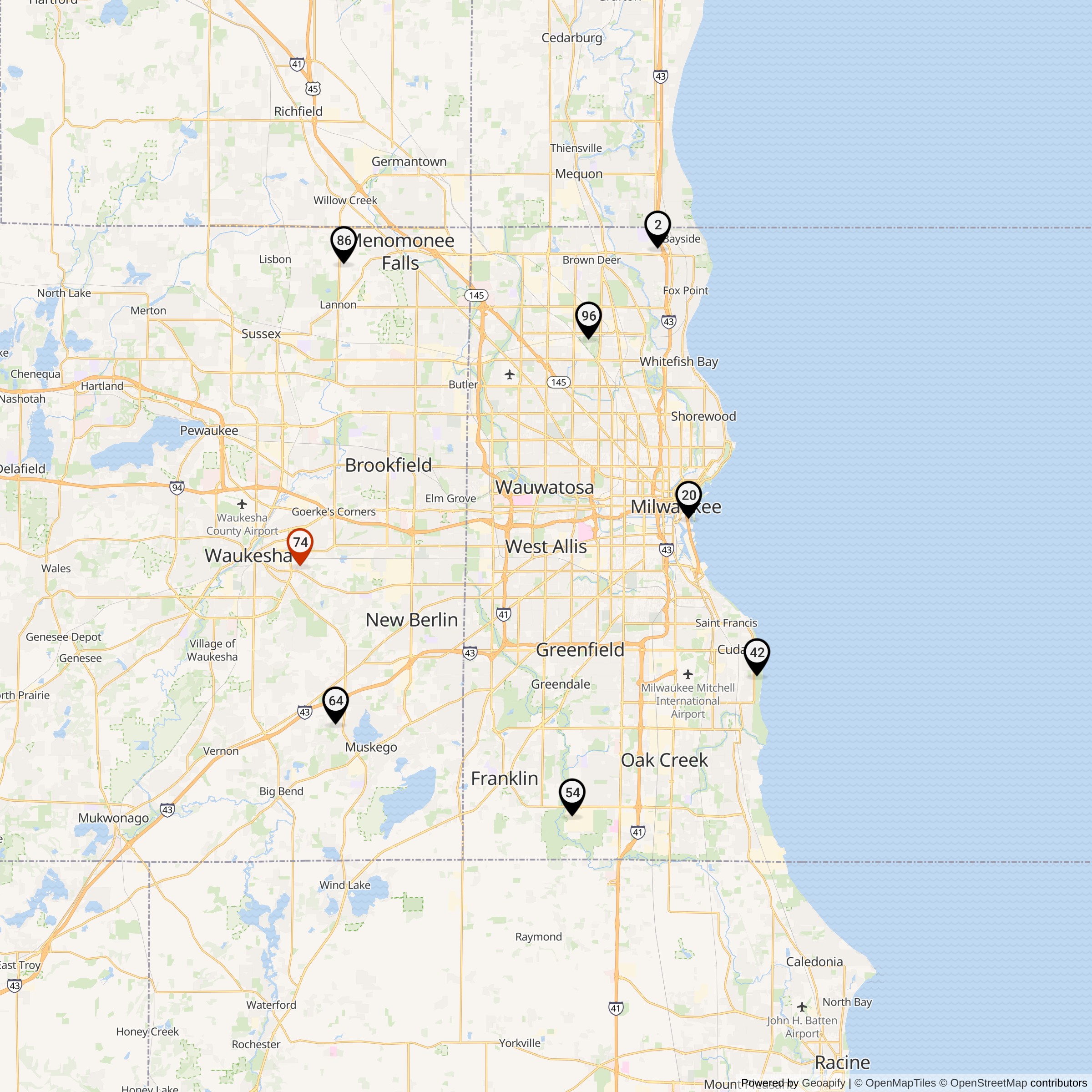
Nike Missile Site M-74 Launcher, Waukesha Wisconsin
Longitude: -88.19266116708090
This location was part of the Milwaukee Defense Area
Site ID: M-74
Missile / battery configuration: Nike 1B, 2C/18H, 30A/12L-U, (10L-H)
The missiles at this Launch Area were controlled by the Integrated Fire Control site located here.
Site Role: Launcher
A typical Nike air defense site consisted of two separate parcels of land. One area was known as the Integrated Fire Control (IFC) Area. This site contained the Nike system's ground-based radar and computer systems designed to detect and track hostile aircraft, and to guide the missiles to their targets.
The second parcel of land was known as the Launcher Area. At the launcher area, Nike missiles were stored horizontally within heavily constructed underground missile magazines. A large, missile elevator brought the Nikes to the surface of the site where they would be pushed across twin steel rails to one of four satellite launchers.
Elaboration on how Nike worked here.
Missile Type: Ajax/Hercules
The Nike Ajax was the first in the Army's family of guided missiles, and the world's first operational, guided, surface-to-air missile system. Nike Ajax had a burnout speed of Mach 2.3, a range of 25-30 miles, and a ceiling of 65,000 feet.
Designed to carry either nuclear and/or high-explosive warheads, the Nike Hercules missile could attack supersonic aircraft operating at altitudes in excess of 150,000 feet and at a range of more than 87 miles.
The Milwaukee Defense Area was created because Milwaukee was not merely a population center. In the 1950s it was a major industrial city, a Lake Michigan port, a railroad and highway hub, and part of the broader Great Lakes industrial belt. Its heavy manufacturing plants, machine shops, foundries, electrical-equipment firms, transportation links, harbor facilities, and proximity to Chicago made it part of a regional military-industrial target system. Local histories often describe Milwaukee in this period as the "Machine Shop of the World," and that description matters for the Nike story: the Army did not ring Milwaukee with missiles because of symbolism alone, but because the city and its surrounding industrial suburbs were considered useful wartime targets.
The immediate military problem was the Soviet long-range bomber threat. In the early 1950s, before intercontinental ballistic missiles dominated strategic planning, U.S. air-defense doctrine assumed that Soviet bombers might approach North America through northern routes, cross Canada or the Great Lakes region, and try to reach metropolitan and industrial targets. The Nike system was the U.S. Army's last-ditch point-defense layer within that larger continental air-defense system. Early-warning radars and interceptor aircraft were intended to detect and engage aircraft farther out. Nike batteries were positioned near the cities and installations that had to be protected if earlier layers failed.
Milwaukee received eight Nike batteries: M-02, M-20, M-42, M-54, M-64, M-74, M-86, and M-96. Headquarters facilities were in Milwaukee. The Chicago District of the U.S. Army Corps of Engineers oversaw land acquisition, design, and construction. The sites were first equipped with Nike Ajax missiles. Three batteries - M-02, M-20, and M-74 - were converted to Nike Hercules. The remaining five remained Ajax-only and closed earlier. The Milwaukee Defense Area was later merged with the Chicago-Gary defense system in 1968, after which Milwaukee's remaining defense was tied more closely to the larger Chicago-Milwaukee air-defense complex.
Nike Ajax and Nike Hercules were not intercontinental missiles. They were surface-to-air interceptors. Their mission was to shoot down hostile aircraft, not attack ground targets. The Ajax system used liquid-fueled missiles with conventional warheads. Hercules was larger, solid-fueled, longer-ranged, and capable of carrying either conventional or nuclear warheads. Hercules conversion therefore represented a significant change in the tactical reach, destructive power, and safety profile of a battery. For Milwaukee, that conversion was concentrated at the River Hills/Brown Deer, lakefront/Harbor Drive, and Waukesha batteries.
How a Nike Battery Worked
Each Milwaukee Nike battery was a split installation. The Integrated Fire Control area, or IFC, held the radar and command equipment. The launch area held the missiles, underground magazines, launchers, missile assembly/test functions, security facilities, utilities, and handling areas. The two parts could be separated by a mile or more because they performed different functions. The IFC needed clear radar coverage and suitable geometry for target tracking. The launch area needed enough land for magazines, elevators, launch rails, fueling or missile-handling procedures, roads, fencing, and support buildings.Nike Ajax was a command-guided system. It did not search for targets on its own. Ground radar detected and tracked the target. A second radar tracked the missile after launch. A computer compared the target and missile tracks and sent steering commands to the missile. The intercept was therefore a coordinated action by the whole battery: acquisition radar, target-tracking radar, missile-tracking radar, fire-control computer, communications equipment, launch crews, and missile handlers all had to function together.
This split-site arrangement is why every site history below treats the IFC and launcher as one installation even when they are mapped as separate points. The launcher could not fight without the IFC, and the IFC had no purpose without the launch area. The battery was the combined system.
Site-Specific History and Setting
M-74 was the Waukesha Nike battery, located west of Milwaukee. Its two-part layout placed the IFC on higher ground at what is now Hillcrest Park, with the launch area roughly a mile to the south near what the City of Waukesha now identifies as Missile Park / Nike Site M-74L. The site's location west of the city gave the Milwaukee Defense Area coverage of inland approaches and helped complete the missile ring beyond the immediate Milwaukee County industrial belt.M-74 entered service in 1956 with Nike Ajax missiles. It became one of the three Milwaukee batteries converted to Nike Hercules. Appendix D lists M-74 as a converted site, with Hercules construction from June 1958 to August 1959 and a Hercules operational date of December 2, 1959. Local M-74 research describes the conversion as taking place in 1959 and notes that all eight Milwaukee-area sites initially carried Ajax, while the five not converted to Hercules closed by the mid-1960s.
M-74 was operated first by active U.S. Army personnel and then by the Wisconsin National Guard. Local research states that active Army personnel operated the site from 1956 to 1964, that the Wisconsin National Guard took over in June 1964, and that the Guard manned it until closure in 1971. The same account notes that the M-74 Guard unit received recognition in August 1964 as one of two air-defense command firing batteries receiving a trophy for performance.
The site's layout is unusually legible today because Hillcrest Park preserved visible IFC-area remnants. The IFC contained radar and computer systems used to detect, track, and guide missiles against incoming aircraft. Hillcrest Park retains or has retained the radar tower, concrete pads, mess hall/barracks-related buildings, and other Cold War-era traces. Atlas Obscura describes the remaining radar tower as a 30-foot-tall structure with surviving concrete and metal remnants. The City of Waukesha's current Missile Park page identifies the launch-area site as Nike Site M-74L and describes planned park amenities such as picnic facilities, restrooms, parking, a playground, trails, and natural area.
The Waukesha site remained active until June 1971, making it one of Milwaukee's final Nike batteries. When it closed, Milwaukee lost its last local surface-to-air missile defense. The launch area was later cleared or substantially redeveloped, while the IFC became a rare publicly accessible Wisconsin Nike landscape.
Chronology
- 1956 M-74 became operational as a Nike Ajax battery.
- 1958-06 to 1959-08 M-74 Hercules conversion construction period.
- 1959-12-02 M-74 became operational with Nike Hercules missiles,
- 1956-1964 Local research identifies active U.S. Army operation of M-74 during this period.
- 1964-06 The Wisconsin National Guard took over operation of M-74.
- 1964-08 The M-74 Guard unit received air-defense command recognition for firing-battery performance in local accounts.
- 1968 The Milwaukee Defense Area was merged with the Chicago-Gary system.
- 1971-06 M-74 closed, ending one of Milwaukee's last Nike batteries.
- 2006 Local accounts identify late federal transfer/reuse activity at the former Waukesha Nike Hill IFC area.
- Present The former IFC is Hillcrest Park; the former launch area is identified by the City of Waukesha as Missile Park / Nike Site M-74L.
List of all Nike Installations in Wisconsin