
Galena Air Force Station / Galena Forward Operating Location, Alaska
At a Yukon River airfield, alert fighters stood ready to meet aircraft approaching Alaska while a nearby radar station supplied the warning and guidance.
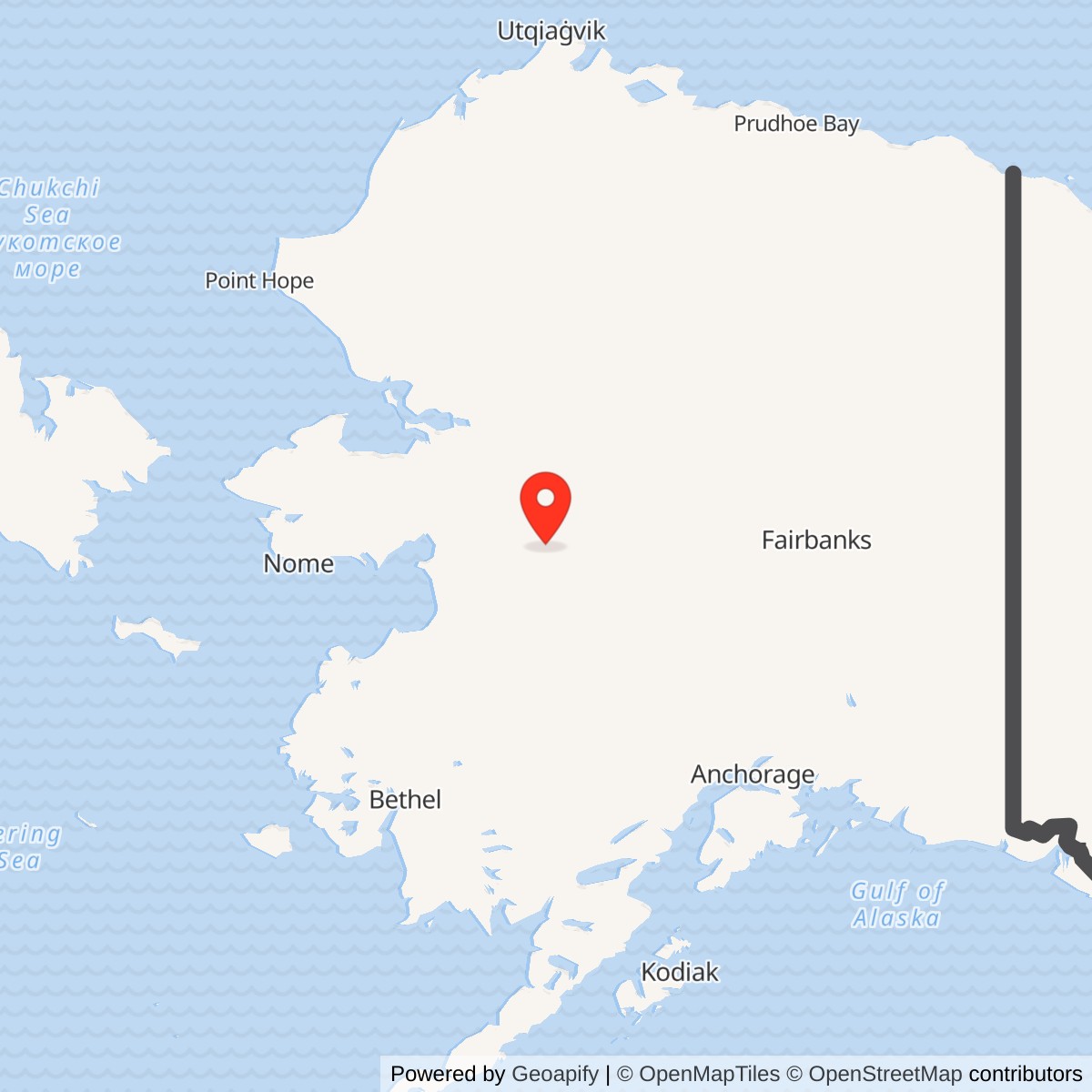
Longitude: -156.953333
Galena Air Force Station, also described as Galena Air Base or the Galena Forward Operating Location, was one of Alaska Air Command's two principal forward fighter-alert airfields. The Air Force began using the civilian airport in 1951. Its interceptors, supported first by the separate Campion Air Force Station, became part of Alaska's air-defense screen. A 1994 U.S. Army Corps of Engineers history records 198 Soviet-aircraft intercepts launched from Galena between 1961 and 1991. The resident fighter mission ended in 1993; the forward operating location subsequently closed under base realignment, while the state airport and portions of the former military complex found new uses. [1] [2] [4]
- Primary mission
- Forward fighter-interceptor alert and air-sovereignty defense.
- Military use
- 1951 to 1993 as a permanently staffed fighter location; caretaker period thereafter; former FOL closure by 2011.
- Fighter sequence
- F-94, F-89, F-102, F-106, F-4E and F-15A.
- Later radar
- AN/FPS-117 minimally attended radar at Galena Airport from the 1980s modernization; no longer active at Galena.
- Location
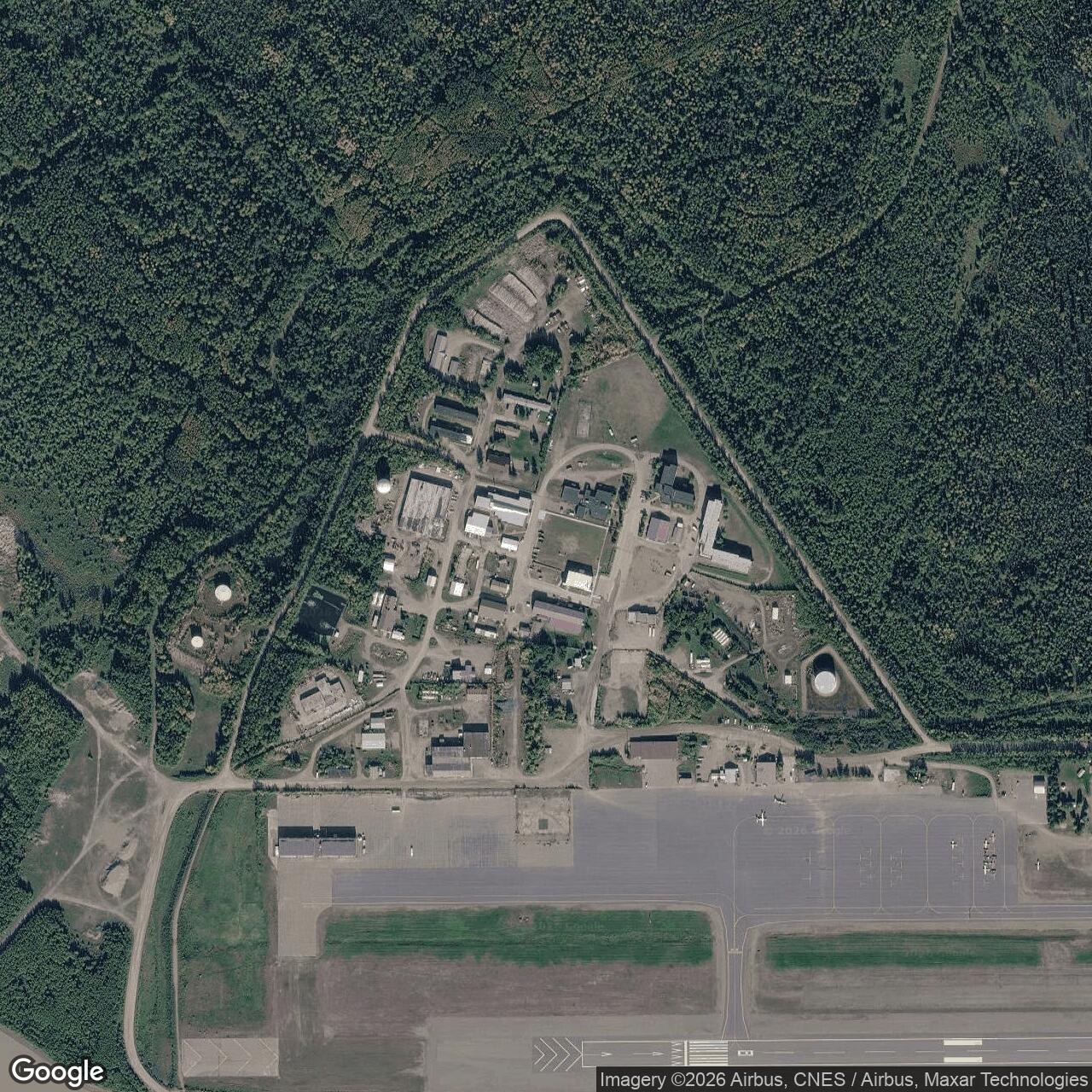
- Galena Airport on the north bank of the Yukon River, western interior Alaska.
- Distinct nearby station
- Campion AFS, formerly Galena II, stood about nine miles away.
From Wartime Field to Forward Base
The Civil Aeronautics Administration built the Galena airfield in 1941-1942 as part of Alaska's new aviation infrastructure. During World War II the Army expanded it into a staffed post on the Alaska-Siberia Lend-Lease route. Aircraft passed through Galena on the way toward Nome and Soviet receiving points. The Army added garrison quarters, fuel and maintenance facilities, and a large Birchwood hangar. After the war the airfield returned to civil administration. This wartime Army phase preceded the Air Force's Cold War station at the same airfield. [1] [2] [3] [5]
With Soviet long-range aviation now a concern, Alaska Air Command negotiated joint use of Galena Airport in early 1951. Galena replaced Marks Air Force Base near Nome in the command's forward-interceptor plan. Four F-94 Starfires from the 449th Fighter Interceptor Squadron arrived March 30, 1951. They were a detachment, not a permanently assigned full fighter squadron. The airfield's river location made it an important western staging point, but also required a substantial fuel, maintenance and supply system to keep alert aircraft ready. [1] [2] [3]
Fighter Alert on the Yukon
Galena's aircraft and facilities changed with the threat and the technology. In 1954 the runway was extended from about 6,500 to 7,250 feet and a Combat Alert Cell hangar was added for the F-89 Scorpion. F-102 Delta Daggers followed in the late 1950s, then F-106 Delta Darts, F-4E Phantoms and, in October 1982, F-15A Eagles. By 1989 two F-15s were normally stationed on alert. Crews could launch on short notice to identify and observe aircraft approaching U.S. airspace. The alert hangar, runway, aircraft servicing areas, fuel system, communications and housing all supported this mission. [1] [3]
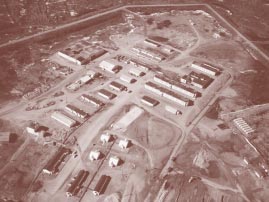
The Air Force developed Galena gradually rather than building a single standardized station. Major improvements from 1954 to 1959 upgraded the runway, lighting, fuel system and permanent support buildings. The base eventually contained more than 50 buildings, including quarters, shops and recreation spaces. About 200 to 300 military personnel served there during much of the Cold War. A later renovation campaign from 1979 to 1989 renewed older facilities and added 17 buildings. A 1989 Corps-cited mission statement identified the 5072nd Combat Support Squadron and 5099th Civil Engineering Squadron as key supporting units. [1] [2]
Isolation shaped the station's working life. Galena could not rely on a highway connection for bulk supplies, so the annual river-and-sea resupply program maintained roughly 13 months of stock. First called Mona Lisa and later Cool Barge, it brought fuel and other material through a coordinated military and contractor chain. Winter weather demanded ready aircraft shelters, reliable power and ground equipment that could function far from the command's main bases. [2]
Intercepts and Daily Operations
Radar stations reported unidentified tracks through the Alaska air-defense network. Controllers passed the information to Galena, where pilots scrambled to make visual contact and identify the aircraft. On December 5, 1961, two F-102s on alert at Galena intercepted two Soviet Tu-16 bombers off northwestern Alaska. The Air Force's historical booklet calls this the first recorded successful interception of a Soviet aircraft in the Alaskan theater. The same source records Galena F-102s intercepting an An-24 on May 19, 1968, and two Galena F-4s intercepting another An-24 on February 27, 1974, before that aircraft landed on St. Lawrence Island in bad weather. [2]
These episodes show why the forward airfield mattered. Alaska's long distances made an interceptor held near Galena more useful for western approaches than one launched only from Anchorage or Fairbanks. The Corps' total of 198 Galena-launched Soviet-aircraft intercepts from 1961 to 1991 describes repeated alert operations over three decades, not combat engagements. In 1989 the 21st Tactical Fighter Wing described Galena as an alert base whose aircraft maintained air sovereignty in peacetime and air defense in wartime. [1] [2]
Radar Modernization and Campion
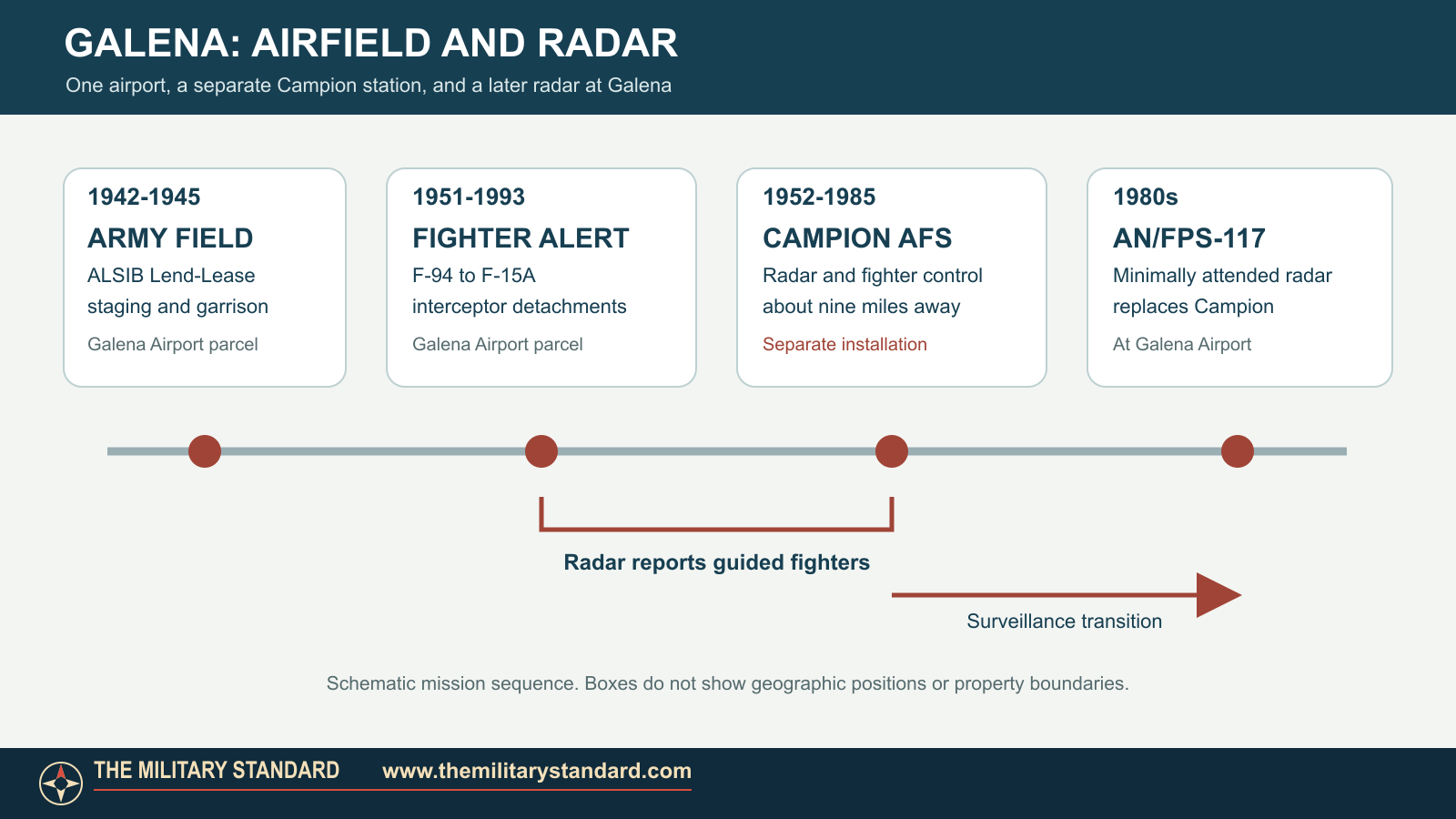
The fighter base and the original Galena-area radar station were different installations. The Air Force built the radar station known first as Galena II, later Campion AFS, about nine miles from the airport in 1951-1952. Campion's radar operators and controllers supplied the warning and guidance that made Galena's interceptors effective. Its staffed radar and control mission continued into the 1980s. During Alaska's radar modernization, the Air Force placed a minimally attended AN/FPS-117 long-range radar at Galena Airport instead of rebuilding the old Campion station. Campion closed in 1985 after the replacement system took over surveillance. [1] [2] [3]
The AN/FPS-117 at Galena is no longer active. Galena's radar mission ended during the post-Cold War drawdown, and the Washington Air National Guard's 215th Engineering Installation Squadron helped move radar equipment from Galena to Kokee Air Force Station on Kauai. By 1997, the Hawaii Air National Guard had dedicated an AN/FPS-117 at Kokee. [6] [7]
The End of the Resident Mission
In October 1993 the Air Force withdrew Galena's permanent military personnel and aircraft. Contractors maintained selected facilities in standby condition after the resident fighter-alert era ended. The 2005 Base Realignment and Closure process directed final closure of the former forward operating location, with military activities to end by September 2011. The Air Force released its leases and reserved land interests as facilities were demolished or conveyed. The state continues to operate Edward G. Pitka Sr. Airport, and refurbished former Air Force buildings now serve the Galena Interior Learning Academy and other local uses. [2] [4]
The station's legacy is clearest in the combination of its wartime airfield, decades of alert aircraft and the radar network that directed them. The remaining former military properties also carry an Air Force environmental-cleanup responsibility overseen by Alaska's Department of Environmental Conservation. That ongoing work is one part of the airfield's later history, separate from the Cold War fighter mission. [1] [4]
Chronology
- 1941-1942: The Civil Aeronautics Administration builds the Galena airfield. [2] [4]
- 1942-1945: The Army expands the airfield for the Alaska-Siberia Lend-Lease route and maintains a Galena post. [1] [5]
- March 30, 1951: Four F-94 fighters from the 449th Fighter Interceptor Squadron arrive for forward operations. [1]
- 1954: The runway is lengthened and a Combat Alert Cell hangar is built for the F-89 era. [1]
- December 5, 1961: Two Galena F-102s intercept Soviet Tu-16 bombers off northwestern Alaska. [2]
- May 19, 1968: Galena F-102s intercept a Soviet An-24 off western Alaska. [2]
- February 27, 1974: Galena F-4s intercept a Soviet An-24 that later lands on St. Lawrence Island. [2]
- October 1982: F-15 Eagles replace the F-4E on Galena forward alert. [1]
- 1984-1985: The new AN/FPS-117 radar at Galena replaces the surveillance role of separate Campion AFS. [2] [4]
- October 1993: The Air Force withdraws permanent military personnel and aircraft; caretaker support begins. [2] [4]
- By 1997: Radar equipment from Galena has been moved to Kokee, Hawaii, where the Air National Guard dedicates an AN/FPS-117. The Galena radar is no longer operating. [6] [7]
- 2005-2011: Base realignment directs the former forward operating location's final military closure and property transfer. [4]
Information sources (7)
- PDFU.S. Army Corps of Engineers, The Cold War in Alaska: A Management Plan for Cultural Resources, 1994, Galena Airport section, pp. 108-110
Source for the 1951 fighter detachment, aircraft sequence, construction, 198 intercepts, 1989 mission and personnel.
- PDFU.S. Air Force and Argonne National Laboratory, Defending Attack from the North: Alaska's Forward Operating Bases During the Cold War, 2001
Source for Galena's World War II and Cold War transitions, supply program, interceptor episodes, radar replacement and 1993 withdrawal.
- PDFU.S. Air Force, Former Galena Forward Operating Location, site-history report, 2012
Source for the airfield's fighter and support-facility sequence and the relationship between Galena and Campion.
- WEBAlaska Department of Environmental Conservation, Galena Air Force Station, site narrative, updated 2025
Source for the Army-era airfield, 1980s radar modernization, 2005 closure decision and later property reuse.
- PDFU.S. Army Corps of Engineers, World War II in Alaska Historic Resources Survey, 1987, Galena section, pp. 5-74 to 5-75
Source for the wartime Army garrison, Lend-Lease role, Birchwood hangar and physical airfield layout.
- WEBWashington Air National Guard, 215th Engineering Installation Squadron: A Legacy of Service, 2022
Source for moving radar equipment from Galena to Kokee Air Force Station.
- PDFHawaii Air National Guard, Pupukahi, January-March 1997
Source for dedication of Kokee's AN/FPS-117 radar.