
Campion Air Force Station, Alaska
Beyond the Galena airfield, a three-radome station watched the Yukon approaches and directed a changing network of northern Alaska radar sites.
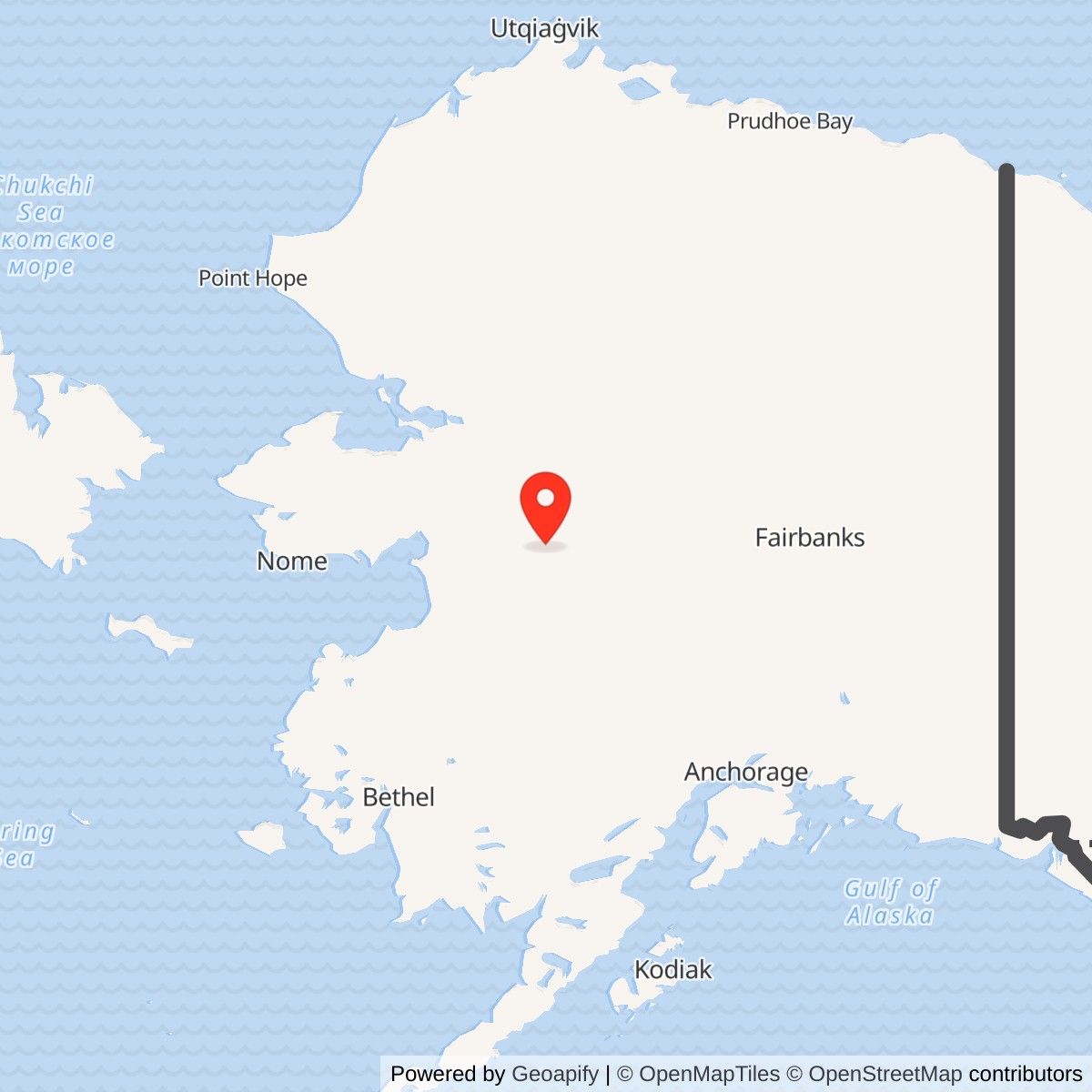
Longitude: -156.7289
Campion Air Force Station was a U.S. Air Force Aircraft Control and Warning station east of Galena on the Yukon River. First called Galena II, it began ground-controlled-interception operations in April 1952 and became fully operational that July. It grew from a local radar post into a direction center and then a NORAD control center. The 743rd Aircraft Control and Warning Squadron operated the station for most of its history. Campion closed on September 30, 1985, after a new minimally attended AN/FPS-117 radar near Galena took over the surveillance mission. [1] [2] [3]
- Station designation
- Campion AFS; originally Galena II; radar site F-08.
- Principal unit
- 743rd Aircraft Control and Warning Squadron.
- Military role
- Ground-controlled interception, air surveillance, direction-center and NORAD control-center operations.
- Operational period
- April 1952 to September 30, 1985; fully operational July 1, 1952.
- Radar sequence
- AN/FPS-3 search; AN/FPS-8 height finder; AN/FPS-20 search conversion; later AN/FPS-93A search and AN/FPS-90 height finder with AN/FYQ-9 data processing.
- Location
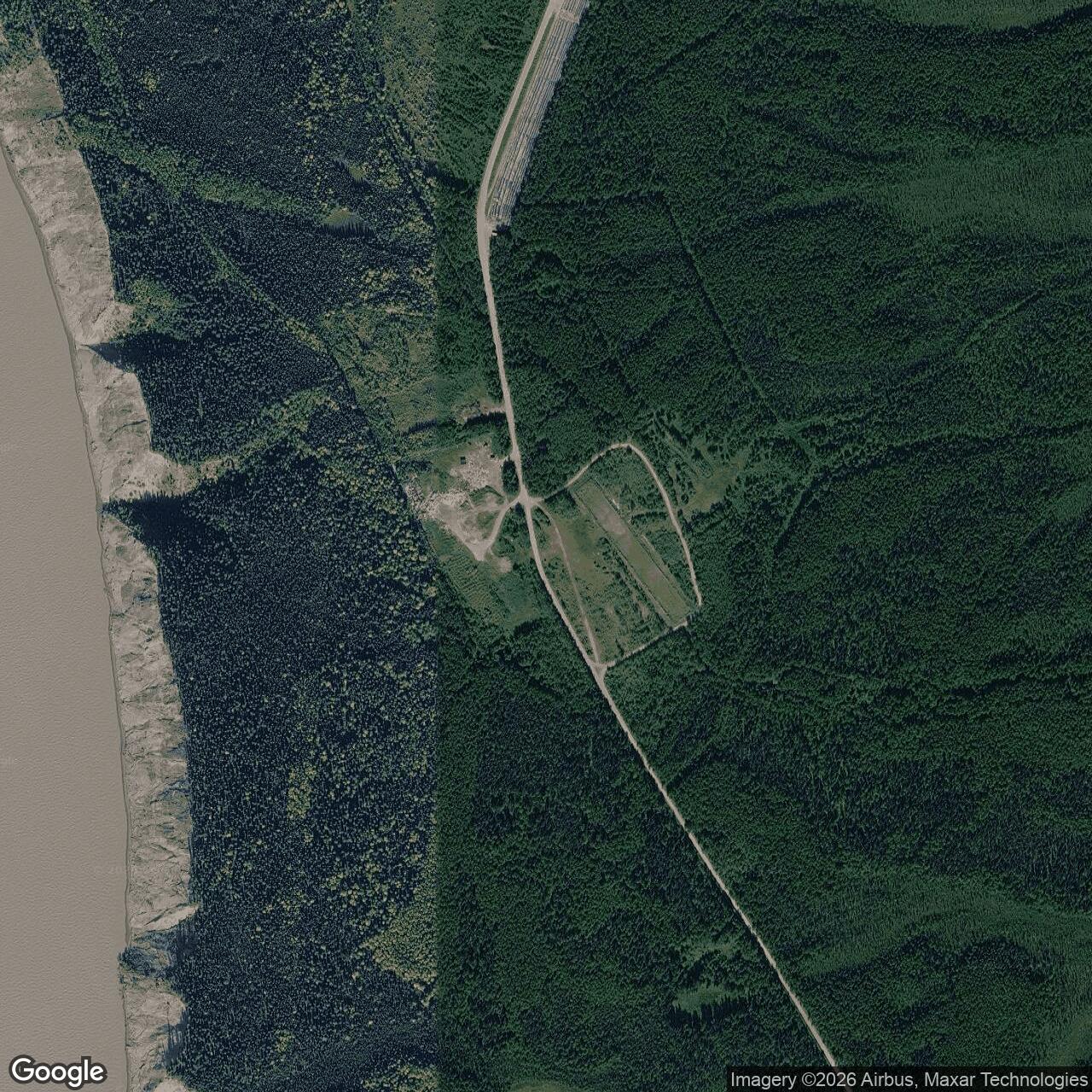
- About eight or nine miles east of Galena. This is a locality description, not a surveyed station-center coordinate.
Galena II and the Station's Name
The Korean War accelerated construction of Alaska's radar and fighter-interceptor defenses. Work on the radar station east of Galena began June 25, 1950; Morrison-Knudsen received the construction contract that May. The early name, Galena II, distinguished the radar site from the air base at Galena Airport, where interceptor aircraft could operate. The two installations worked together but occupied different locations. Supplies arrived at Galena by air or Yukon River barge and traveled onward to Campion by road. [1] [2] [3]
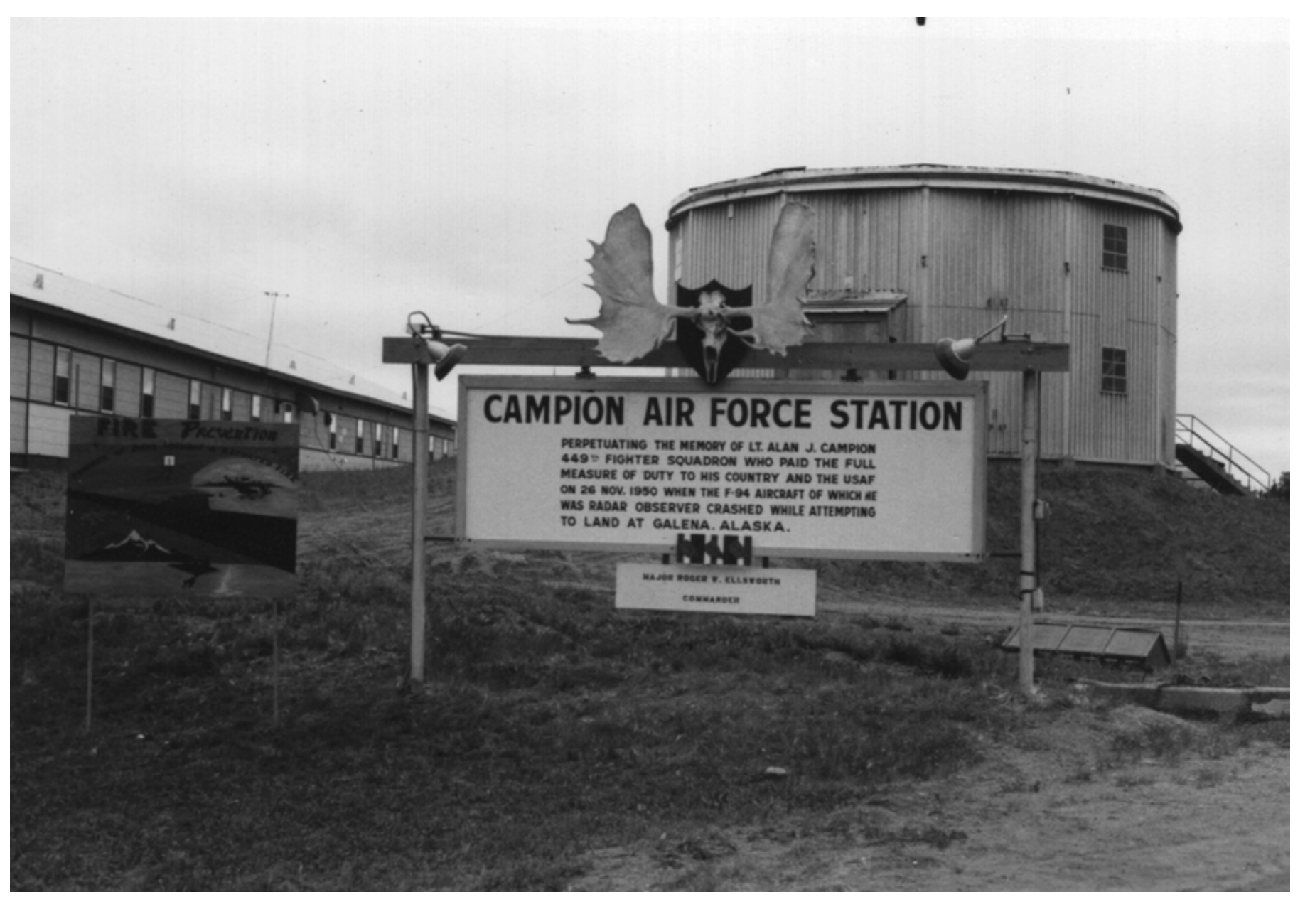
In April 1954 the Air Force named the station for First Lieutenant Alan J. Campion, a radar observer of the 449th Fighter Squadron who died when his F-94 crashed while attempting to land at Galena on November 26, 1950. A contemporary station welcome booklet and the photographed entrance sign record his name and the dedication. The renaming also ended confusion between the airfield and its nearby radar station. [3] [6]
Radar and Control Missions
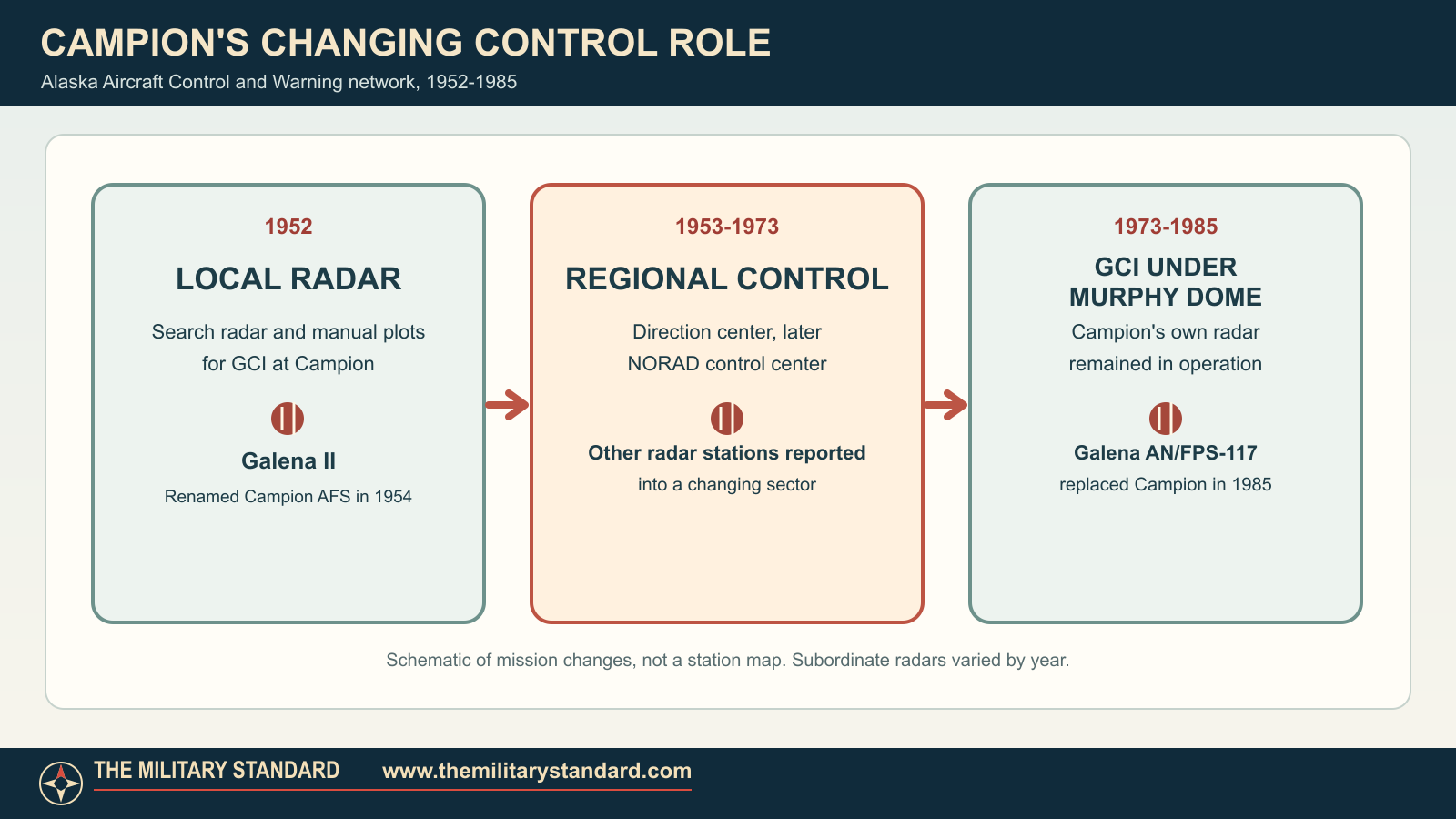
Campion began as a ground-controlled-interception station. Its AN/FPS-3 search radar detected aircraft and provided the bearing and distance information operators plotted by hand. An AN/FPS-8 height finder added a separate measurement of target altitude in 1955. A declassified NORAD history lists Campion among the stations operating the AN/FPS-20 conversion by the end of 1958. In the mid-1960s the site gained AN/FPS-93A search and AN/FPS-90 height-finding equipment together with the AN/FYQ-9 data-processing and display system. These were successive changes to Campion's own radar plant; the AN/FPS-117 belonged to its later Galena replacement. [1] [2] [4]
The station became an air-defense direction center in the first half of 1953. Its controllers combined radar tracks, identified aircraft and coordinated interception across a sector larger than the view of a single antenna. Campion later served as a NORAD control center. At different times its sector included Unalakleet and Northeast Cape. The network changed as stations opened or closed. A 743rd Squadron welcome booklet describes a later arrangement in which Campion directed Kotzebue, Cape Lisburne and Tin City. On June 13, 1973, Campion reverted to a ground-controlled-interception role under the Murphy Dome NORAD control center. [2] [3]
The Station on the Yukon
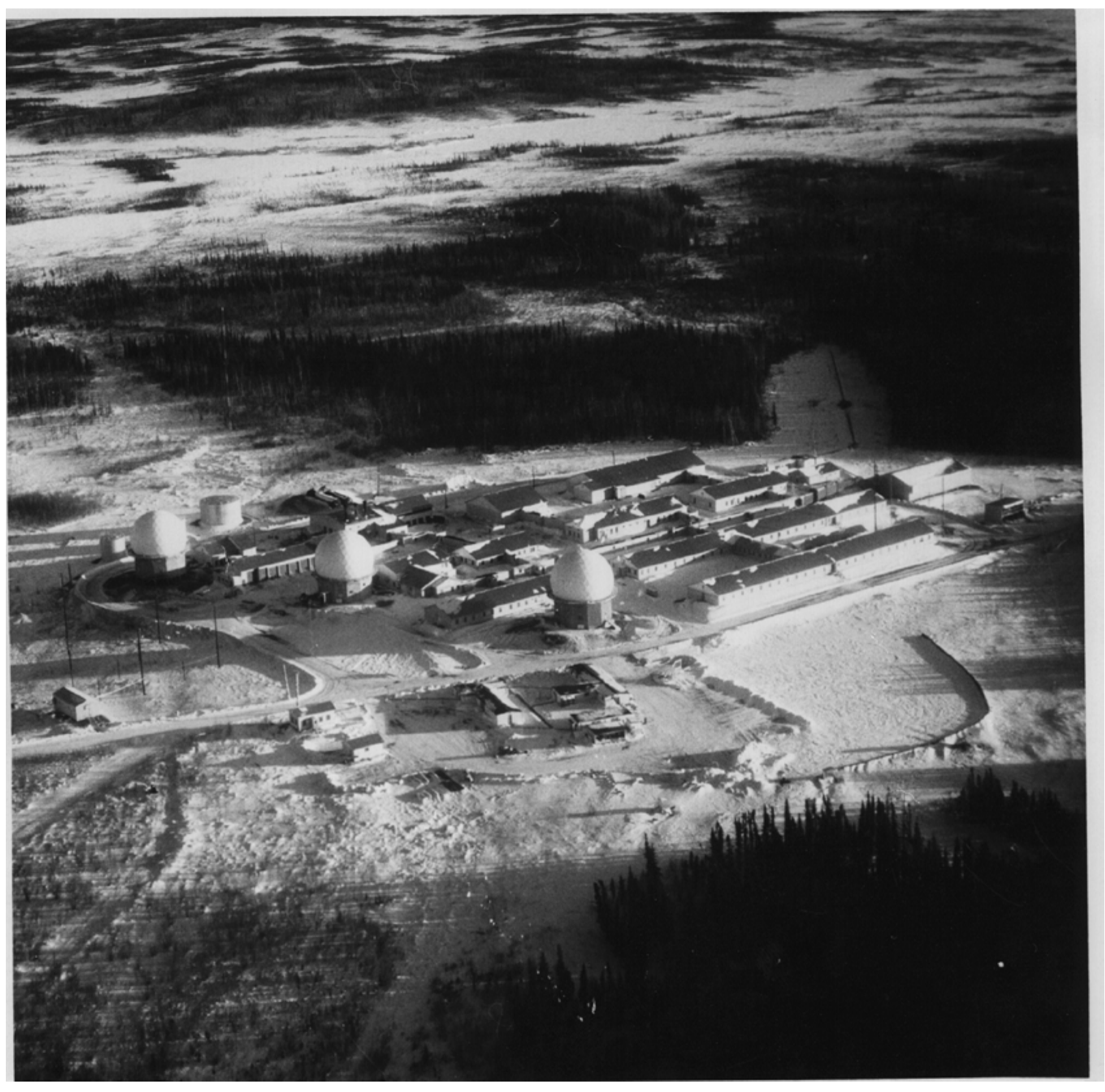
Campion was a single-camp installation on the Yukon floodplain, with its radar domes and living quarters in the same developed area. A Corps inventory described 21 wood-frame buildings joined by covered passageways, three radar domes and fuel storage. The aerial photograph below shows the three domes close to long rows of station buildings. The squadron's own booklet says nearly all buildings were connected by heated hallways, a practical answer to interior Alaska winters. [2] [3] [6]
The 743rd Squadron's authorized strength was 173 when it assumed operations in early 1953. Radar operators and controllers were supported by power, civil engineering, supply, food service, transportation and medical personnel. The station had quarters, a dining hall, a gym and bowling lanes, a library and a small dispensary. Detachment 1 of the 1930th Communications Squadron handled the message center, tactical teletype, ground-to-air radio and AUTODIN terminal. Most Air Force tours were 12 months, and the Yukon River's short navigation season made annual bulk resupply a major event. The barge program first called Mona Lisa was later known as Cool Barge. [1] [3]
Communications and the Galena Connection
Reliable communications were as important as the radars: Campion's controllers had to exchange tracks, orders and voice traffic with other stations and aircraft. In 1958 the White Alice Communications System connected Campion through the separate Kalakaket Creek Radio Relay Station south of Galena. After the White Alice link ended in 1978, Campion shifted to a nearby commercial Alascom satellite terminal. The Campion communications facilities were part of the radar installation; Kalakaket Creek was a separate White Alice relay site. [1] [2]
Galena Airport remained the region's forward operating airfield, and its later radar modernization decided Campion's fate. During the Air Force's Alaska Radar System transition, a minimally attended AN/FPS-117 radar was installed at Galena. That new radar was not placed on the former Campion parcel. Its remote-operation arrangement allowed surveillance to continue while the older staffed station was retired. [1] [2]
The Last Years
Campion's staffing had already changed before the final shutdown. In 1977 an Air Force contract with RCA Services transferred site-support work and removed 76 military positions. Regional radar control increasingly shifted away from large resident squadrons during the early 1980s. The Corps gives September 30, 1985 as Campion's closure date after the Galena minimally attended radar was placed in service. An over-the-horizon backscatter radar was later considered for the former Campion property, but the available land was too small. Between 1985 and 1990, the station's buildings and radar structures were demolished. [1] [2] [5]
Campion remains an important part of Alaska's air-defense history because it joined local radar surveillance to regional control of other northern stations. Alaska's Department of Environmental Conservation still lists the former property as an active cleanup site. That continuing land record concerns the former Campion station, not an operating radar mission. [2] [5]
Chronology
- May-June 1950: Morrison-Knudsen receives the construction contract; work begins June 25. [1] [3]
- November 26, 1950: Lieutenant Alan J. Campion dies in an F-94 crash near Galena. [3]
- April-July 1952: The GCI site begins operations in April and is fully operational by July 1. [1] [3]
- Early 1953: The 743rd Squadron assumes station operations; Campion becomes a direction center. [1] [2]
- April 1954: The Air Force names the former Galena II station for Lieutenant Campion. [3]
- 1955: An AN/FPS-8 height-finding radar is added. [1]
- 1958: Campion joins the White Alice network through Kalakaket Creek; a NORAD report lists its AN/FPS-20 conversion in operation by December. [1] [4]
- Mid-1960s: AN/FPS-93A and AN/FPS-90 radars and AN/FYQ-9 data processing enter the station's later equipment mix. [1]
- June 13, 1973: Campion reverts to a GCI role under Murphy Dome's control center. [2]
- 1977-1978: Contractor support reduces military staffing; Campion's White Alice connection gives way to commercial satellite communications. [1] [2]
- September 30, 1985: Campion closes after the Galena minimally attended radar takes over the mission. [2]
- 1985-1990: The former station's standing infrastructure is demolished. [5]
Information sources (6)
- PDFAlaska Office of History and Archaeology, History of the Aircraft Control and Warning System in Alaska, Campion section, pp. 41-43
Source for: construction and first operations, radar equipment, staffing and units, White Alice connection, supplies, and the 1985 radar replacement.
- PDFU.S. Army Corps of Engineers, The Cold War in Alaska: A Management Plan for Cultural Resources, 1994, Campion section
Source for: the direction-center and NORAD control-center history, subordinate radar relationships, physical station, and September 30, 1985 closure.
- PDF743rd Aircraft Control and Warning Squadron, Campion AFS Welcome Booklet, undated contemporary station publication
Source for: June 1950 construction start, July 1952 full-operation date, April 1954 naming, control mission, communications personnel, facilities, and daily life.
- PDFNorth American Air Defense Command, 1958 NORAD/CONAD History, July-December, declassified report
Source for: Campion's AN/FPS-20 conversion in operation by the end of 1958.
- WEBAlaska Department of Environmental Conservation, Campion AFS RRS Sitewide, hazard ID 560
Source for: removal of the former infrastructure between 1985 and 1990 and current environmental-site status.
- PDFEleventh Air Force archives, undated Campion entrance and aerial photographs reproduced in History of the Aircraft Control and Warning System in Alaska, pp. 41-42
Source for: actual Campion station appearance, entrance dedication sign, three radar domes, and connected building layout.