
AN/FPS-117 Long-Range Surveillance Radar
The AN/FPS-117 changed northern air defense by sending three-dimensional radar tracks from remote stations to regional controllers. Its solid-state array and remote operating system helped replace Alaska's large, continuously staffed radar outposts.
- Role
- Fixed, three-dimensional long-range air-surveillance radar.
- First Alaska service
- King Salmon prototype tested in 1982 and operated around the clock that December; regional control center entered service in 1983.
- Scan
- Mechanical rotation in azimuth; electronic beam steering in elevation.
- Frequency
- 1215 to 1400 MHz in Lockheed Martin's 2013 configuration.
- Manufacturer lineage
- General Electric Aerospace; later Martin Marietta and Lockheed Martin.
Overview
The AN/FPS-117 is a long-range radar that measures an aircraft's distance, direction and height in one surveillance system. General Electric Aerospace developed it for the Air Force's SEEK IGLOO modernization of Alaska's Aircraft Control and Warning network. At King Salmon Air Force Station, the prototype was tested in September 1982 and operated around the clock that December. Its radar tracks went by satellite to the Regional Operations Control Center at Elmendorf Air Force Base, which reached initial operational capability in June 1983. This arrangement allowed the Air Force to reduce permanent crews at outlying stations. [1] [10]
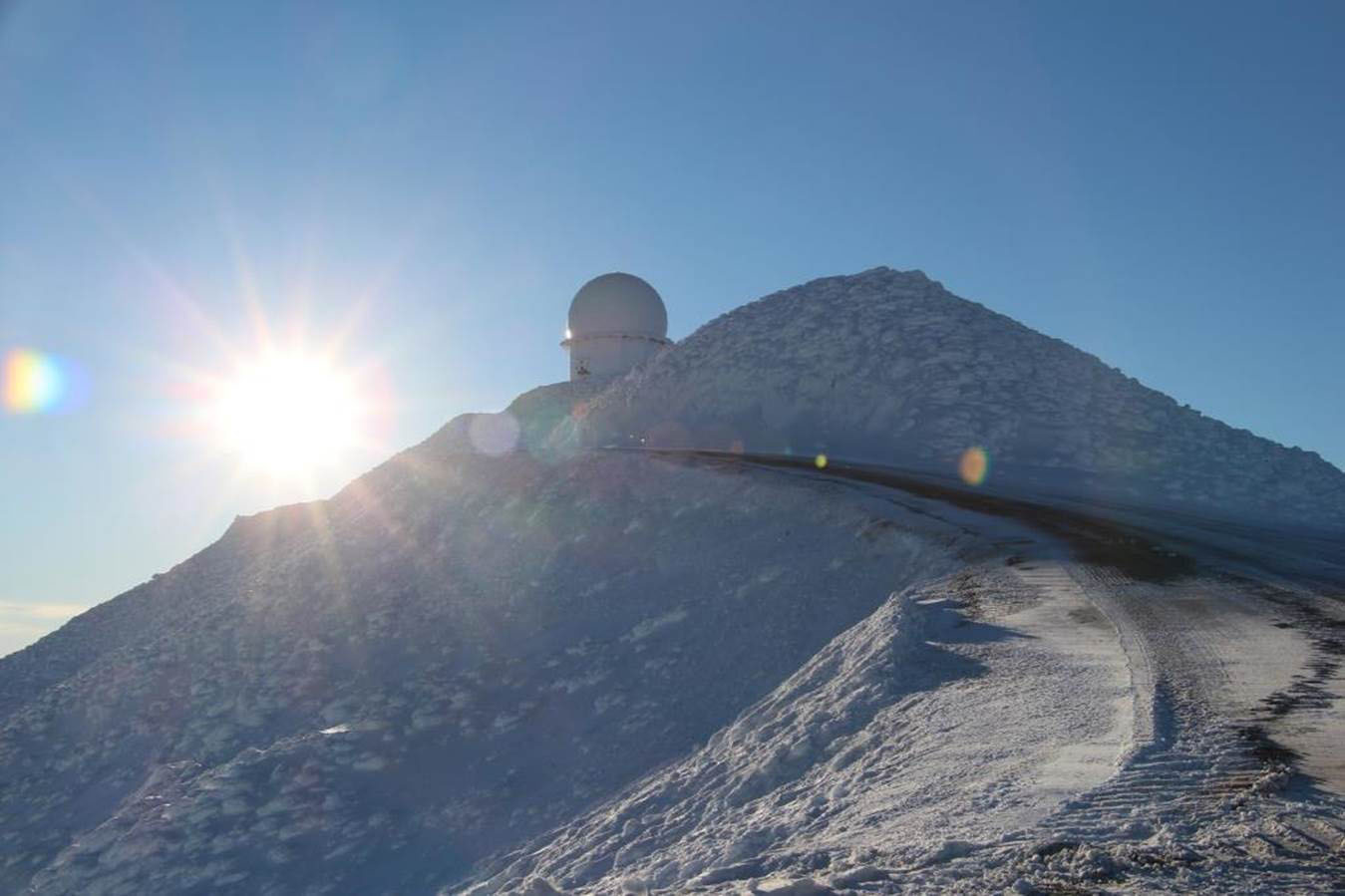
The radar subsequently served in the American and Canadian northern warning network and in other national air-defense systems. A fixed AN/FPS-117 site may show only a round radome from outside: the large, rotating planar antenna is enclosed to protect it from wind and ice. The radome is the protective shell, not the antenna itself. [3] [4]
The Northern Warning Problem
Alaska's Cold War radar stations watched approaches where roads were scarce, weather was severe and a repair trip could depend on an aircraft landing. Earlier radar systems needed substantial local crews to operate and maintain separate search, height-finding, power and communications equipment. The cost of keeping people and supplies at isolated stations made reliability and remote operation central requirements for a replacement. Contemporary Air Force reporting described General Electric's development effort as a 32-month contract for two minimally attended radar prototypes, with King Salmon chosen for the Alaska test installation. [2]
A useful replacement had to do more than extend range. Controllers needed dependable target height, radar tracks suitable for automated display, and a way to monitor and control equipment far from the regional center. A three-dimensional search radar could take over a task formerly shared between a broad-area search set and a separate height finder. Alaska's modernization joined that sensor change to satellite communications and a different way of staffing the warning network. [1] [2]
SEEK IGLOO and King Salmon
The first operational chapter belongs to General Electric, not to the later Lockheed Martin name on current product literature. General Electric Aerospace designed and produced the radar during SEEK IGLOO. Martin Marietta acquired GE Aerospace in 1993, and the 1995 Lockheed-Martin Marietta merger placed subsequent support under Lockheed Martin. Those corporate changes explain the different manufacturer names found in records of the same radar family. [2] [5]
Prototype testing began at King Salmon in September 1982, followed by 24-hour radar operation that December. The Elmendorf regional center reached initial operational capability on June 15, 1983, and the 705th Aircraft Control and Warning Squadron inactivated on November 1. The radar station continued with contractor maintenance and centrally used track data. [1] [10]
The Cold Bay Long Range Radar Site, A-08, which began operation in 1985 at a location separate from the earlier Cold Bay Air Force Station at Grant Point. [1] [6]
How the Radar Works
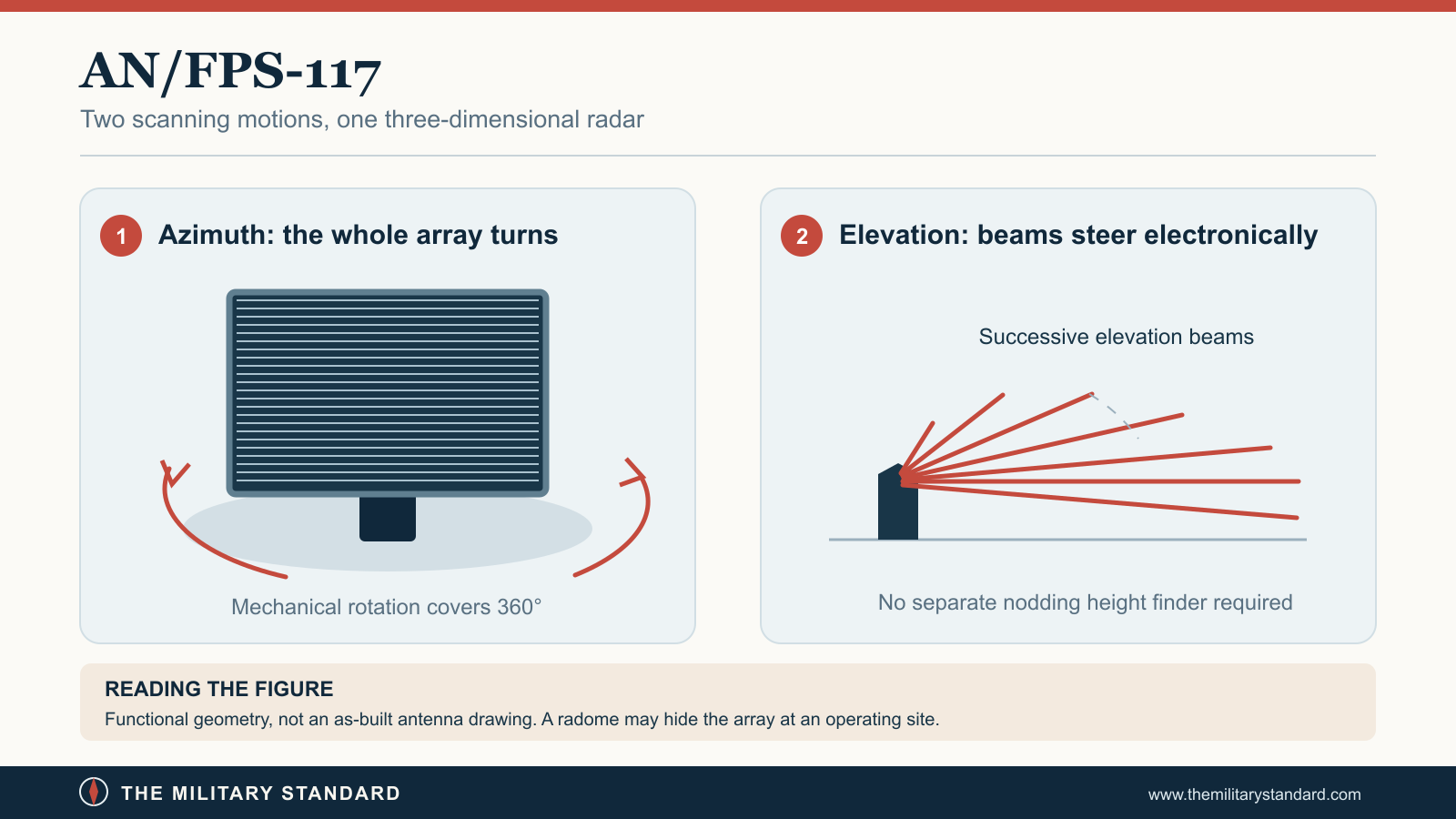
The AN/FPS-117 is three-dimensional because it derives range, azimuth and height from the same radar's observations. Its broad planar antenna rotates mechanically to look through every compass direction. Within each azimuth sector, the active array steers narrow beams electronically through elevation angles. This is an active electronically scanned elevation array on a rotating mount, not a stationary four-faced array. Lockheed Martin's published configuration has 44 active rows and an aperture of 52.6 square meters. [3]
Solid-state transmitter modules distribute radio-frequency power across the antenna. If a module fails, the radar can remain in service with reduced performance until it is repaired. Long coded pulses put useful energy on a distant target; pulse compression helps preserve range resolution when the echoes return. Digital processing separates aircraft returns from terrain and weather clutter and creates tracks for the air-defense system. These features work together: the system's useful reach cannot be inferred from transmitter peak power alone. [3] [4]
The radar also includes frequency-control and self-monitoring functions suited to a remote warning post. Lockheed Martin's 2013 fact sheet lists four frequency-agility modes and 100 center frequencies. Its five- or six-revolution-per-minute antenna rate means one complete azimuth sweep roughly every 10 to 12 seconds. Actual operation depends on the installed configuration and mission settings. [3]
Published Performance
The manufacturer's 2013 specification lists operation from 1215 to 1400 MHz, a combined RF power figure of 24.6 kilowatts, and 4.5 kilowatts average RF power. It defines an air-breathing-target coverage volume from 10 to 470 kilometers, or about 5 to 250 nautical miles, through 360 degrees of azimuth. The vertical volume reaches approximately 30.5 kilometers, or 100,000 feet, with elevation coverage from minus 6 to plus 20 degrees. These are published configuration figures, not an assertion that every installation retained identical equipment through every upgrade. [3]
The 250-nautical-mile coverage boundary is not a guaranteed detection range for every aircraft. The same fact sheet gives a more specific example: 80 percent probability of detection for a target with a one-square-meter radar cross section at 330 kilometers, or 180 nautical miles. A low-flying aircraft can be hidden by terrain or the earth's curvature long before either nominal range is reached. Target size and aspect, weather, clutter, propagation and processing settings also change the usable range. [3]
For its 2013 configuration, Lockheed Martin lists 99.5 percent system availability, critical mean time between failures above 2,000 hours, and mean time to repair below 45 minutes. The figures reflect the design emphasis on continued operation and quick replacement of failed units where access was difficult. [3]
Remote Sites and the North Warning System
Alaska's transition showed that a remote radar could feed an occupied control center without maintaining the old large station population beside it. The later North Warning System combined AN/FPS-117 long-range radars with AN/FPS-124 short-range radars across the northern approaches to North America. The two designations served complementary roles and should not be treated as interchangeable. Canada's defense department dates North Warning System construction and conversion to the later 1980s and early 1990s. [1] [7]
The radar served in markedly different Alaska settings. Cold Bay A-08 was built apart from an older installation; and King Salmon hosted the initial test. [1] [5] [6]
Modernization and Continuing Service
Long service required substantial renewal. In 1996, a Government Accountability Office procurement decision described a proposed reliability, maintainability and supportability upgrade for 34 AN/FPS-117 radars and four maintenance-control systems in Alaska, Canada, Iceland and California. That total was a multi-region procurement scope, not a count of Alaska sites. The Air Force later pursued an Essential Parts Replacement Program to address aging components. [8] [9]
The Air Force announced full operational capability for the replacement program in October 2015. It said four major radar subassemblies had been replaced, reducing the number of line-replaceable units by about 80 percent and preparing the radars for Mode 5 identification capability. The work kept the established surveillance architecture useful without claiming that a 1983 radar remained internally unchanged. [9]
In March 2020, Hill Air Force Base reported that its supported binational Atmospheric Early Warning System included 25 operational AN/FPS-117 and 36 AN/FPS-124 radars. Those radars stretched across the wider American-Canadian network. [4] [7]
Technical Summary
- Designation
- AN/FPS-117.
- Type
- Fixed long-range, three-dimensional air-surveillance radar.
- Original developer
- General Electric Aerospace.
- Published frequency
- 1215 to 1400 MHz.
- Array
- 52.6-square-meter active aperture; 44 active rows.
- Scanning
- Mechanical azimuth rotation at 5 or 6 rpm; active electronic elevation scanning.
- Published coverage volume
- 10 to 470 kilometers (approximately 5 to 250 nautical miles) and 0 to 30.5 kilometers in height, under the 2013 manufacturer's configuration.
- Example detection condition
- 330 kilometers (180 nautical miles) for an air-breathing target of 1 square meter radar cross section at 80 percent detection probability, per the same fact sheet.
- First documented Alaska operation
- King Salmon prototype, 24-hour operation in December 1982; regional system initial capability in June 1983.
Chronology
- 1981: Contemporary Air Force reporting describes General Electric's minimally attended radar prototypes and the planned King Salmon installation. [2]
- September 1982: Prototype testing begins at King Salmon. [10]
- December 1982: The King Salmon prototype begins 24-hour operation. [10]
- June 1983: The Elmendorf regional center reaches initial operational capability. [10]
- November 1983: The 705th Squadron inactivates; the radar site continues. [10]
- Late 1980s to early 1990s: The North Warning System installs long-range FPS-117 and short-range FPS-124 radars. [7]
- 1996: A federal procurement record documents a 34-radar, multi-region upgrade competition. [8]
- 2015: The Air Force announces full operational capability for the Essential Parts Replacement Program. [9]
- 2020: Hill Air Force Base reports 25 FPS-117 radars in the binational system it supports. [4]
Information sources (11)
- PDFAlaska Office of History and Archaeology, History of the Aircraft Control and Warning System in Alaska
Source for SEEK IGLOO, King Salmon's prototype and regional-control chronology, Alaska station operations, and the transition from staffed radar posts to minimally attended sites.
- PDFAir Force Magazine, The Air Force in Facts and Figures, July 1981
Source for the contemporary General Electric development program and planned King Salmon prototype installation.
- PDFLockheed Martin, FPS-117 Long-Range Radar System fact sheet, 2013
Source for the published array, scanning, frequency, power, coverage, detection-example, frequency-agility, and reliability specifications of the documented configuration.
- WEBHill Air Force Base, Unit at Hill AFB sustains radars, bolsters nation's homeland defense, March 4, 2020
Source for the binational radar-support context and the reported 25 AN/FPS-117 and 36 AN/FPS-124 operational radars.
- WEBLockheed Martin, FPS-117: At the Top of the World, 2020
Source for the manufacturer lineage and the radar's Alaska and northern-warning-system history.
- PDFU.S. Army Corps of Engineers, The Cold War in Alaska: A Management Plan for Cultural Resources, 1994
Source for Alaska radar-station modernization context and the distinction between the older Cold Bay station and later long-range radar site.
- WEBDepartment of National Defence Canada, North Warning System In-Service Support, January 2022
Source for the North Warning System's long-range and short-range radar roles and its late-1980s to early-1990s development.
- WEBU.S. Government Accountability Office, Sensis Corporation, B-265790.2, January 17, 1996
Source for the proposed reliability, maintainability, and supportability upgrade covering 34 AN/FPS-117 radars and four maintenance-control systems across several regions.
- WEBU.S. Air Force, Radar upgrades ensure situation awareness, October 21, 2015
Source for Essential Parts Replacement Program completion, major subassembly replacement, reduced line-replaceable-unit count, and Mode 5 preparation.
- PDF705th Aircraft Control and Warning Squadron history, Air Force Historical Research Agency material reproduced by USAF Unit History
Source for King Salmon prototype testing, December 1982 continuous operation, the Elmendorf regional center's June 1983 capability, and the squadron's November 1983 inactivation.
- WEBU.S. Air Force, AN/FPS-117 Alaska installation photograph, VIRIN 151021-F-FP939-002.JPG
Source for the actual Alaska radar image used in the CMS copy; the Air Force caption does not identify a specific station.