
Murphy Dome Air Force Station
From a staffed northern interception center to a White Alice junction and modern long-range radar, Murphy Dome tied together several generations of Alaska air defense.
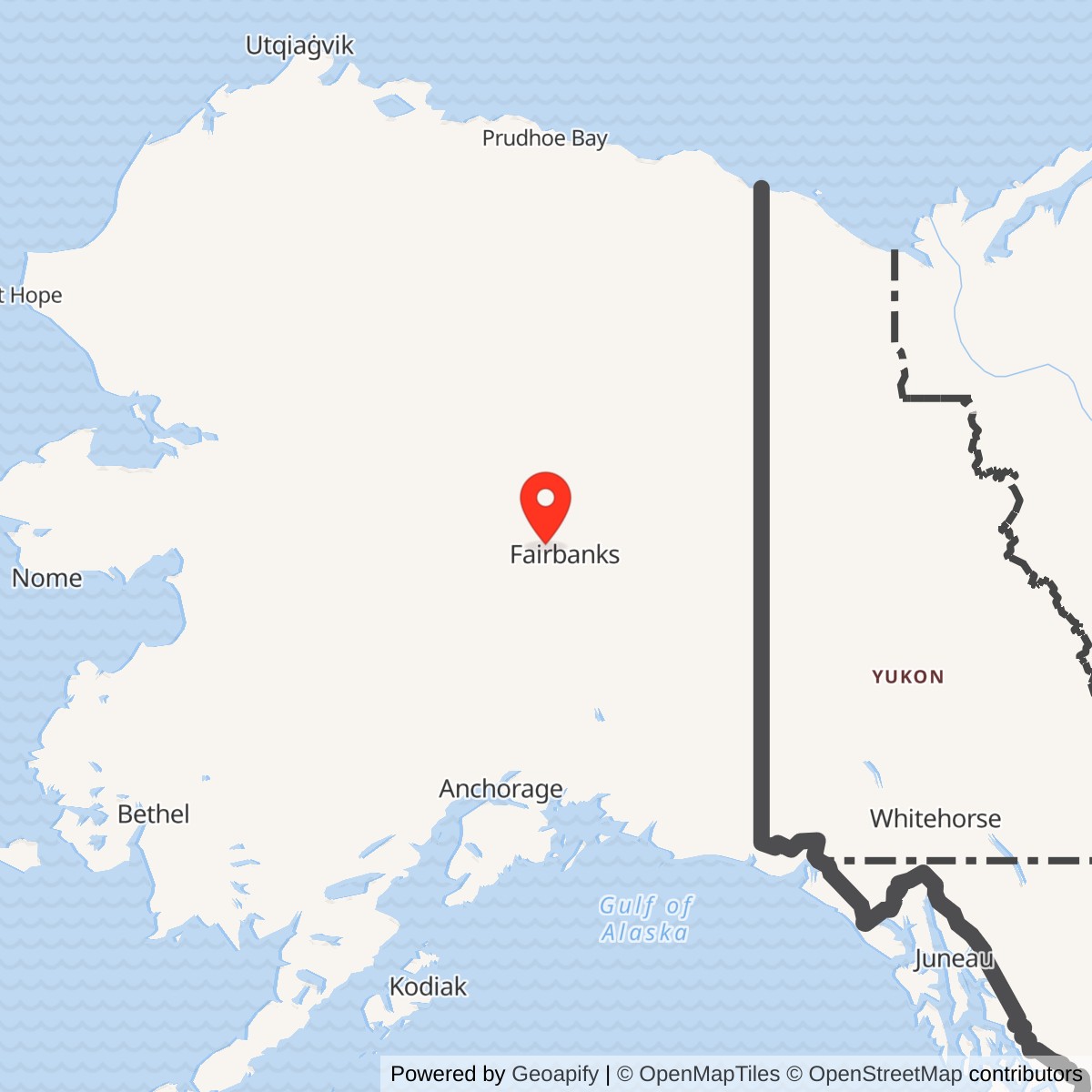
Longitude: -148.356838
Murphy Dome Air Force Station occupied a summit northwest of Fairbanks. It was one of Alaska's first permanent Aircraft Control and Warning (AC&W) installations and the northern master ground-controlled interception station. Radar operators detected and identified aircraft while controllers directed interceptors. A White Alice component later carried communications with other sites. Radar control and White Alice served different functions at the same installation. [1] [3]
- Military role
- Northern AC&W radar and interception control center; later long-range radar site.
- White Alice role
- Attended microwave terminal and repeater with links toward Pedro Dome and Clear.
- Principal radar eras
- AN/CPS-6B; later AN/FPS-6, AN/FPS-93A and AN/FPS-90; then AN/FPS-117.
- Location
- Murphy Dome, northwest of Fairbanks. The approximate map point is a state site-record location, not a surveyed installation boundary. [7]
- Key dates
- Partly operational in September 1951; full operation in spring 1952. White Alice service ended in May 1979; AN/FPS-117 became operational in 1992.
Northern Control Center
The Air Force began building Murphy Dome in June 1950 and completed the initial installation in July 1951. It became partly operational that September and fully operational in spring 1952. Along with Fire Island Air Force Station, the southern master station, Murphy Dome gave Alaska's developing radar network a place to assemble reports and direct fighter interceptions. A road from Fairbanks also allowed year-round resupply, unlike the more isolated coastal stations. [1] [3]
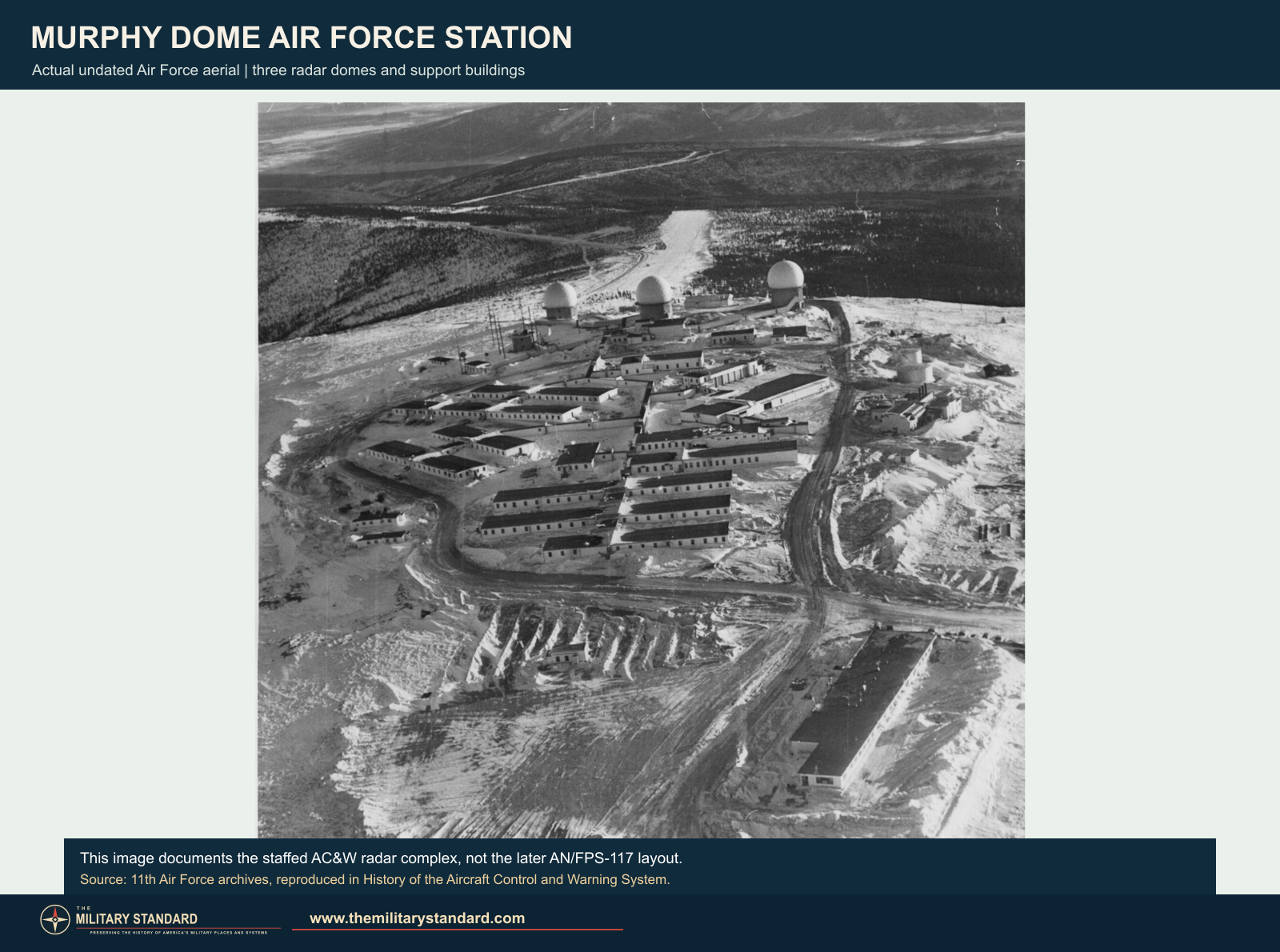
The 744th Aircraft Control and Warning Squadron was activated at Murphy Dome on 1 February 1953. The staffed complex grew around radar domes and an operations building, with barracks, administration, shops, warehouses and power facilities. The actual Air Force aerial below shows how substantial the installation became. [1] [4]
Radar and Interception
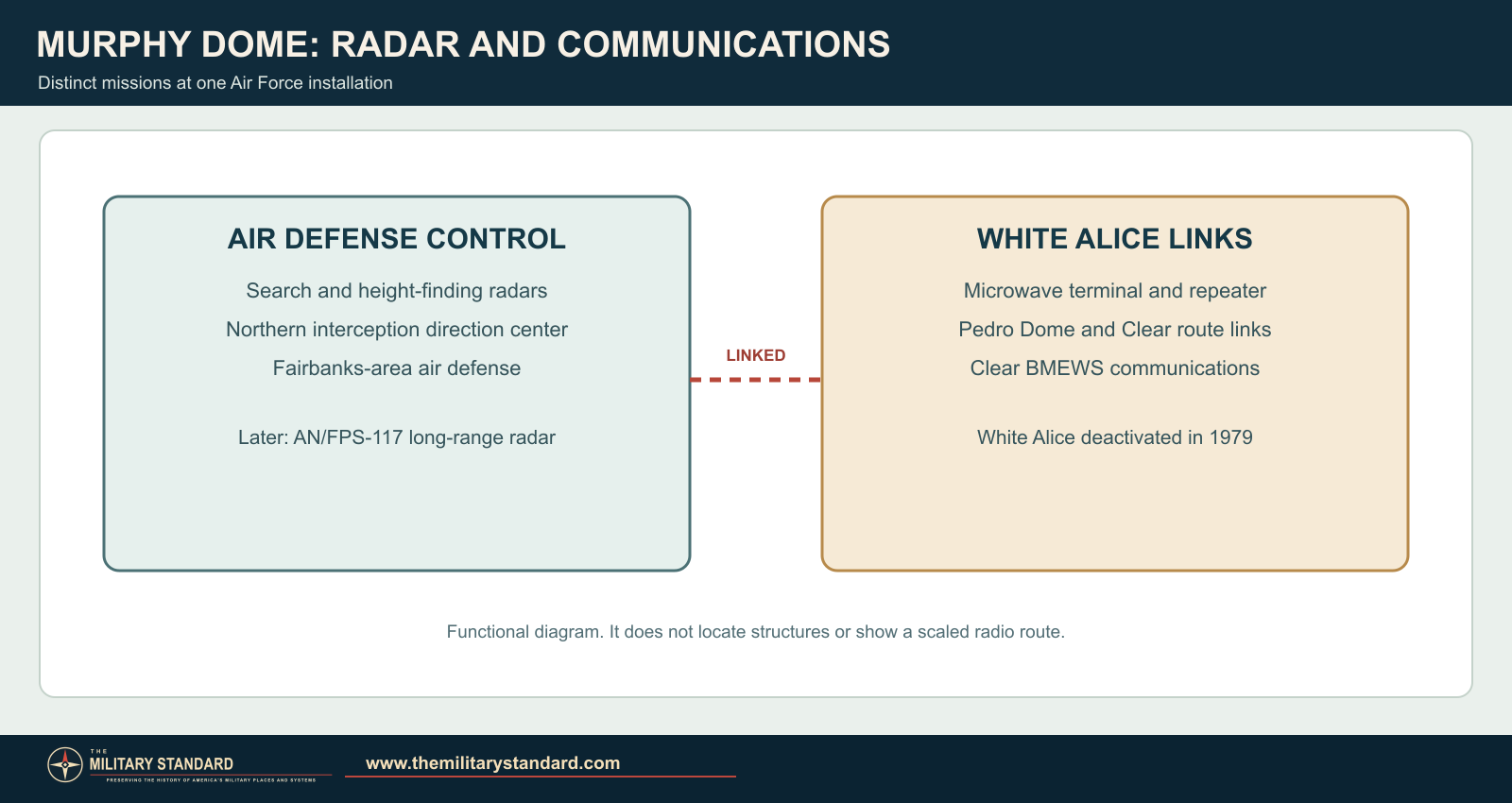
Murphy Dome began with an AN/CPS-6B search and height-finding radar. A later AN/FPS-6 provided height information, and subsequent configurations included AN/FPS-93A search and AN/FPS-90 height finding. Operators used the resulting air picture to help distinguish friendly and unknown tracks and to guide interceptors across the northern sector. The center also contributed to the joint air-defense system that supported the Army's Fairbanks-area Nike defenses. The missile batteries were separate Army sites, not launchers on Murphy Dome. [1] [3] [4]
Murphy Dome's controllers needed both radar information and reliable communications with other stations and aircraft. During the 1964 Alaska earthquake, a veteran recalled that White Alice microwave service failed and Military Affiliate Radio System traffic became the remaining outside link for a time. The event shows why a radar control center depended on more than its antennas. [1]
White Alice Communications
High-frequency radio initially served Murphy Dome but was unreliable. The White Alice Communications System provided a more dependable network. A detailed AC&W history dates activation of Murphy Dome's White Alice service to May 1957. An Air Force sale study later describes an attended microwave terminal and repeater linking Murphy Dome with Pedro Dome and Clear, including the Clear BMEWS communications route. The rearward-route network expanded in 1960-1961. [1] [2] [5]
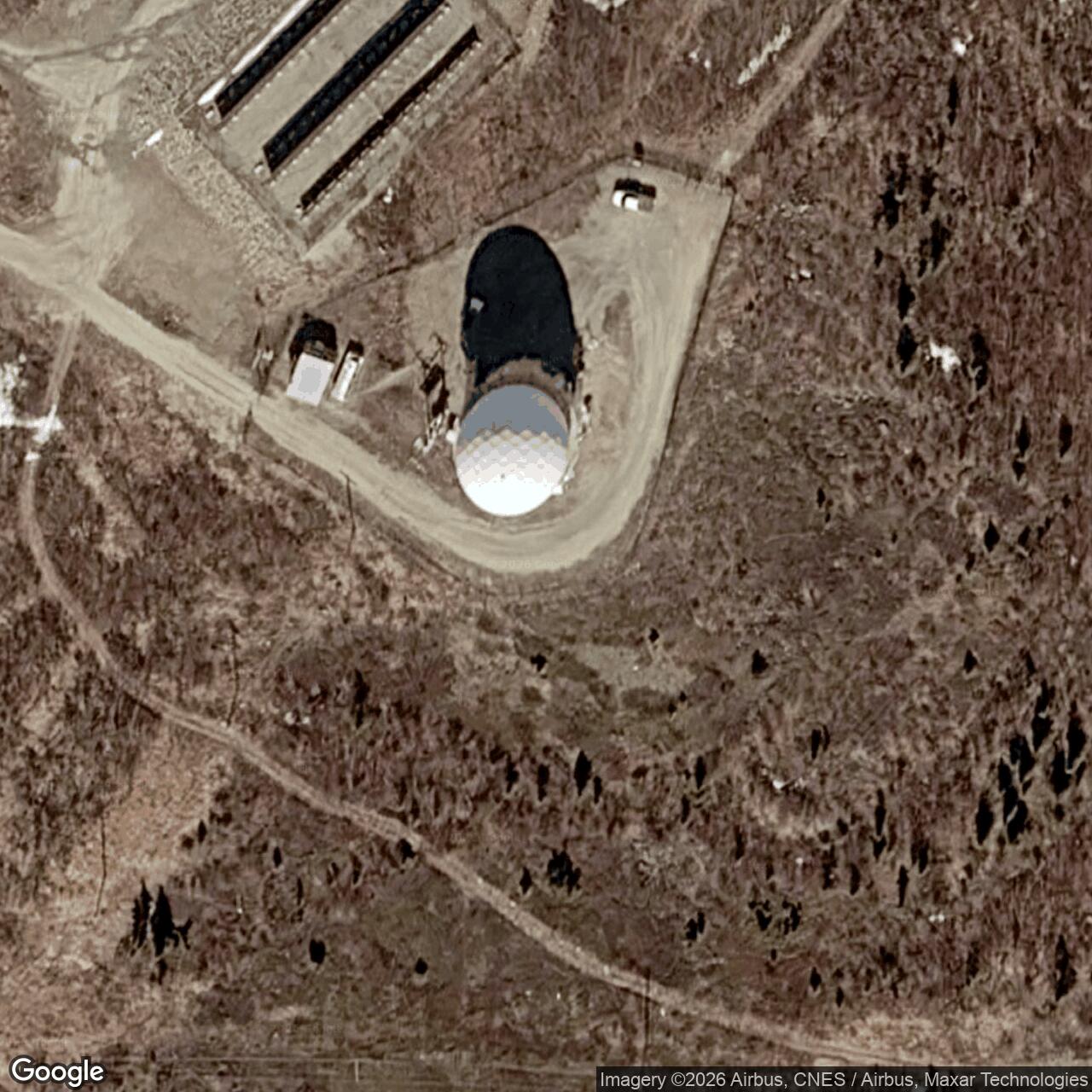
The White Alice component is associated with Building 1001 near the main radar area in an Alaska site record. White Alice service ended in May 1979, when a commercially owned satellite communications system replaced it. The radar mission continued after the microwave system was deactivated. [1] [6]
Modernization
The Air Force contracted more remote-site support and maintenance work to civilians in 1977. In September 1983 the Regional Operations Control Center at Elmendorf became fully operational, shifting air-defense direction work away from staffed remote control centers. Murphy Dome was redesignated as a long-range radar site. [1] [4]
Under SEEK IGLOO, an AN/FPS-117 minimally attended radar replaced the older search-and-height-finder arrangement. The site-specific AC&W history dates its operation at Murphy Dome to 1992. It continued as part of the Alaska Radar System, while most of the original staffed-era buildings were removed. The surviving radar mission therefore belongs to a different physical and operating era from the station in the historic aerial. [1]
Cold War Legacy
Murphy Dome continued to support long-range surveillance after the staffed control center and White Alice component closed. Its history connects the early AC&W radar network, fighter interception, missile-warning communications and the later Alaska Radar System at one summit. The historic photograph captures the first of those eras, while the AN/FPS-117 represents the later radar mission. [1] [3]
Chronology
- June 1950 Construction begins at Murphy Dome.
- July 1951 The initial AC&W installation is completed.
- September 1951 The station becomes partly operational.
- Spring 1952 Murphy Dome reaches full operation as the northern master interception center.
- 1 February 1953 The 744th Aircraft Control and Warning Squadron is activated at Murphy Dome.
- May 1957 The AC&W history dates activation of Murphy Dome White Alice service.
- 1960-1961 The Clear BMEWS rearward communications route is built and opened.
- 1964 The Alaska earthquake interrupts White Alice service; MARS radio carries outside traffic for a time.
- 1977 The Air Force contracts more remote-site support and maintenance work to civilians.
- May 1979 Murphy Dome White Alice service ends and commercial satellite communications replace it.
- September 1983 The Elmendorf Regional Operations Control Center becomes fully operational.
- 1992 The AN/FPS-117 minimally attended radar becomes operational at Murphy Dome.
Information sources (6)
- PDF[1] History of the Aircraft Control and Warning System in Alaska, Argonne National Laboratory / Alaska Office of History and Archaeology (2002, updated 2013)
Source for: site chronology, original radar and units, White Alice activation and deactivation, 1964 communication account, ROCC transition, SEEK IGLOO, and historic Air Force aerial. PDF pages 44-46, 95-96.
- PDF[2] A Special Study of the Sale of the White Alice Communications System, U.S. Air Force (1983)
Source for: attended Murphy Dome microwave terminal and repeater, links to Pedro Dome and Clear, and sale-period inventory description. PDF page 258.
- PDF[3] The Cold War in Alaska: A Management Plan for Cultural Resources, U.S. Army Corps of Engineers (1994)
Source for: northern control-center significance, 1950-1952 construction and operation, complex layout and later radar-site use. Printed pages 161-162.
- PDF[4] 744th Air Defense Squadron lineage and history, Air Force Historical Research Agency compilation
Source for: squadron activation, mission, and broad equipment sequence. Check equipment milestones against the more detailed AC&W study.
- PDF[5] Historical Overview and Inventory: White Alice Communications System, U.S. Army Corps of Engineers (1988)
Source for: network mission and 1960-1961 Clear BMEWS rearward-route development.
- WEB[6] Murphy Dome AFS - White Alice Station, Alaska Department of Environmental Conservation, hazard ID 786
Source for: White Alice component within Murphy Dome, Building 1001, approximate position and 1979 deactivation.