
Creech Air Force Base, Indian Springs Nevada
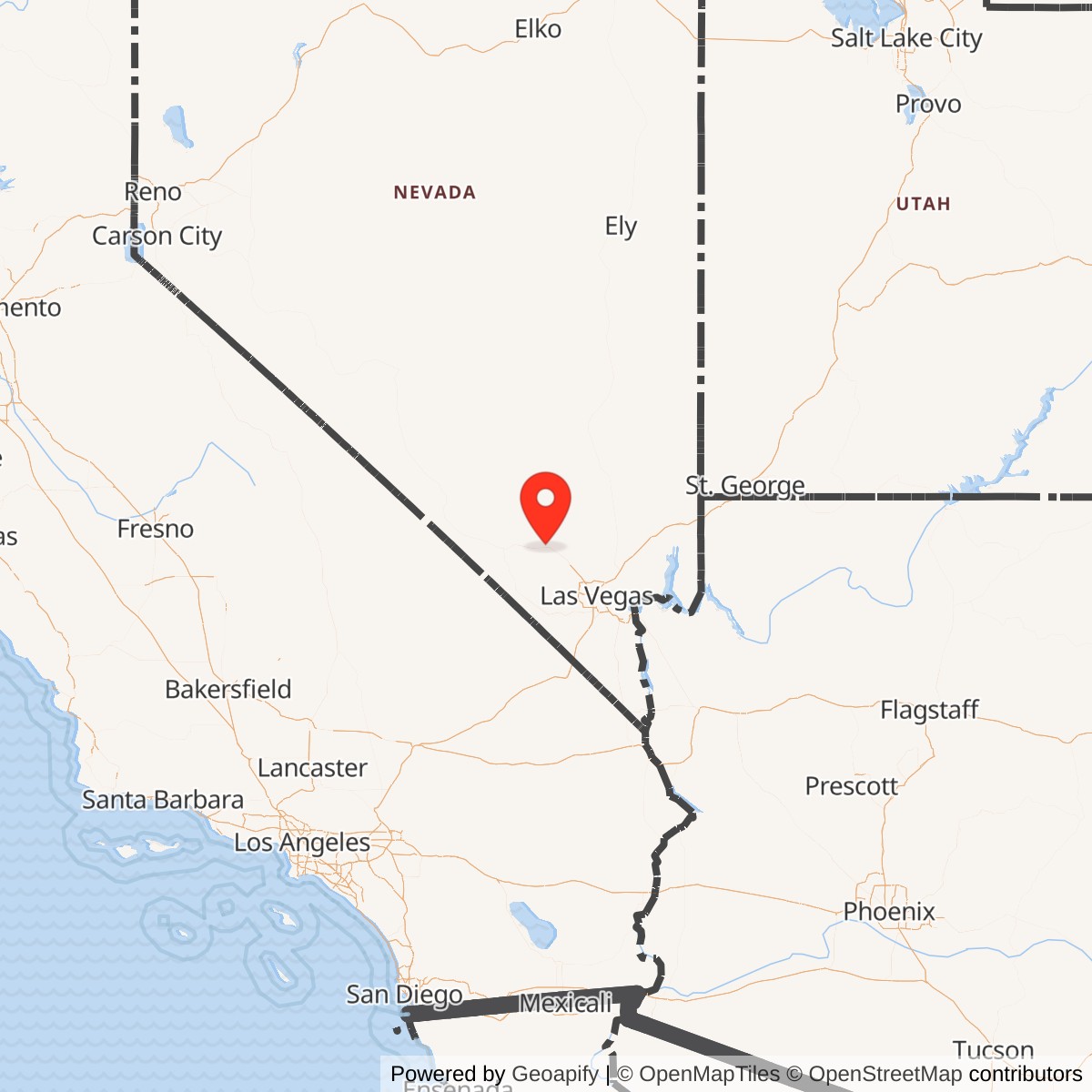
Longitude: -115.6773706
Official Base Website: Creech Air Force Base
Current Role: Creech Air Force Base, an active Air Combat Command installation supporting remotely piloted aircraft operations, testing, training, and range integration
Creech Air Force Base is one of the clearest examples of a small wartime airfield becoming more important with age. It began in the urgent aftermath of Pearl Harbor as Indian Springs Airport, a desert training and divert field built to support Las Vegas Army Air Field and the Army Air Forces training system. In the Cold War it became Indian Springs Air Force Base, then Indian Springs Air Force Auxiliary Field, a range-support, nuclear-test-support, field-training, and Thunderbird practice installation tied tightly to Nellis Air Force Base and the Nevada desert ranges. In the twenty-first century it became Creech Air Force Base, the home of the Air Force's remotely piloted aircraft enterprise and one of the most consequential operational nodes in modern airpower.
The site sits just north of Indian Springs in Clark County, Nevada, on the north side of U.S. Highway 95, with an additional Air Force-owned parcel south of the highway. AirNav lists Creech Air Force Base as FAA identifier INS and ICAO KINS, one mile north of Indian Springs. A 2026 Department of the Air Force environmental assessment describes Creech AFB as the main operating base of the 432d Wing and 432d Air Expeditionary Wing, located one mile northwest of Indian Springs and 35 miles northwest of Las Vegas. That same assessment gives the current land position as approximately 2,407 acres on the north side of U.S. 95, plus an additional 80 acres south of the highway.
It began as an Army Air Forces field, closed briefly with Las Vegas Army Air Field in January 1947, and then reopened in the independent U.S. Air Force era. It subsequently carried the names Indian Springs Air Force Base, Indian Springs Air Force Auxiliary Field, and Creech Air Force Base. That continuous Air Force identity and its active status make it different from World War II Army Air Forces fields that returned to civilian airport use.
Mission Evolution
The first mission was wartime training support. According to an Air Combat Command history article by the 432d Wing historian, Creech was first used as a military training camp on January 14, 1942, under the name Indian Springs Airport. The field rose quickly from a simple desert camp. The official Creech history states that by March 1942 three graded-earth landing strips with taxiways were in place, with plans for more permanent facilities and an auxiliary landing field for Las Vegas Army Air Field. By February 1943 the post was being used as a divert field and as an air-to-air gunnery training base. Later that year it supported a four-engine ground training school for B-17 copilots, with aircraft that included B-17s, TC-26s, and AT-61 trainers.That World War II mission was not glamorous, but it was essential. Indian Springs gave Las Vegas Army Air Field and the wider desert training complex a place where crews could divert, practice, and support gunnery training away from crowded urban airspace. The surrounding desert made the site useful for realistic aerial training, while the distance from Las Vegas reduced safety and congestion problems. Like many Army Air Forces fields in the West, its value was a combination of open space, clear weather, and proximity to a larger parent training base.
The end of World War II brought a sharp contraction. The official Creech history says the mission wound down in early 1945, the installation was in standby status by the end of that year, and Indian Springs Airport and Las Vegas Army Air Field were inactivated in January 1947. The closure was short-lived. Indian Springs reopened in January 1948 or January 1949, depending on the source chronology used, after the creation of the independent Air Force and the start of the Cold War. The Air Force assigned it to Air Training Command and redesignated it Indian Springs Air Force Base as it prepared for the arrival of its first permanently assigned Air Force unit in 1950.
The next phase tied Indian Springs to special weapons, the Nevada Test Site, and the Nellis range system. In July 1952 the base transferred to Air Research and Development Command and realigned under the Air Force Special Weapons Center at Kirtland Air Force Base. The official history describes Indian Springs as supporting the Continental Nuclear Test Program and as a staging base for delivery of testing materials to the Soviet Union for joint verification tests. This was the Cold War desert laboratory role: Indian Springs was not simply a runway, but an operating point between Nellis, the Nevada Test Site, and the massive restricted ranges north and west of Las Vegas.
The Thunderbird connection gave Indian Springs a public-facing mission that contrasted with the secrecy of nuclear and range support. After the 3600th Air Demonstration Team, the Thunderbirds, moved to Nellis Air Force Base, the Indian Springs airfield became their primary practice site. That practice mission lasted for decades and made the field familiar inside Air Force aviation culture. The base's location was ideal for high-performance demonstration training because it offered controlled airspace, desert visibility, and separation from the urban area.
In 1961 the installation shifted to Tactical Air Command. On April 13, 1964, the Air Force redesignated Indian Springs Air Force Base as Indian Springs Air Force Auxiliary Field and assigned it to Nellis Air Force Base. That name reflected its supporting role. The official Creech history states that during this era it had two enduring missions: range maintenance for parts of the Nellis Test and Training Range and recurring host-base support for deployments from multiple services that needed realistic field training. A UH-1N helicopter detachment in the 1970s and 1980s was the only aircraft unit assigned to the installation, but the base still mattered because it enabled the range and training system around Nellis.
The remotely piloted aircraft era transformed Indian Springs from support field to operational center. The official history dates the new era to December 13, 1996, when the first RQ-1 Predator remotely piloted aircraft flew at the airfield. In February 2001, on the Nellis range, a Predator conducted the first successful firing of a Hellfire missile. That moment changed the platform from an intelligence and surveillance aircraft into an armed system and helped transform Indian Springs into a global operational node. The Air Force renamed Indian Springs Air Force Auxiliary Field as Creech Air Force Base on June 20, 2005, honoring General Wilbur L. "Bill" Creech, former commander of Tactical Air Command and a figure closely associated with airpower modernization and the Thunderbirds.
The base then grew rapidly. The first MQ-9 Reaper arrived at Creech on March 13, 2007, and the Air Force activated the 432d Wing on May 1, 2007 as the first wing built around unmanned, later remotely piloted, aircraft systems. The 432d Air Expeditionary Wing activated on May 15, 2008. By 2017 the base had added the Persistent Attack and Reconnaissance Operations Center, and in 2019 the 432d Mission Support Group activated as part of the transition that gave the 432d Wing installation command authority at Creech. A 2026 Air Force biography for the wing commander describes the 432d Wing as the Air Force's first remotely piloted aircraft wing, equipped with MQ-9 Reaper and RQ-170 Sentinel aircraft, conducting 24/7 persistent attack and reconnaissance operations worldwide.
Operational Role
Creech's World War II role was to support training, gunnery, and divert operations. In practical terms, the installation gave student and operational aircrews a desert airfield where aircraft could land, stage, and support live training. The airfield's B-17 and trainer-era use placed it inside the Army Air Forces training pipeline that prepared crews for overseas war. Its value was not measured by a famous combat unit stationed there. It was measured by its ability to absorb dangerous flying activity, spread out training traffic, and support Las Vegas Army Air Field.During the early Cold War, the role changed from training support to range and test support. Indian Springs became a small but important base in the air and nuclear systems connected to Nellis and the Nevada Test Site. It handled people, aircraft, vehicles, and support functions for operations that were too remote or sensitive for ordinary airfields. The official history's reference to support for the Continental Nuclear Test Program is important because it places Indian Springs inside the wider national nuclear infrastructure, even though it was not itself the test site.
The base also supported airpower demonstration and safety training through the Thunderbirds. As the team's primary practice site, Indian Springs became a routine work area for one of the Air Force's most visible flying organizations. That role also brought tragedy. A 1984 U.S. General Accounting Office report documented that the January 18, 1982 Thunderbirds crash occurred during an aerial practice session at Indian Springs Air Force Auxiliary Field in Nevada, destroying all four aircraft and killing the pilots. The accident became one of the defining safety events in Thunderbirds history and is inseparable from the field's long practice-site role.
As Indian Springs Air Force Auxiliary Field, the installation functioned for decades as a support base for the Nellis Test and Training Range. Range maintenance, field training, helicopter support, transient aircraft support, and realistic deployment exercises were the daily substance of the mission. The name "auxiliary field" can make the base sound minor, but that would be misleading. A large test and training range needs runways, roads, equipment yards, maintainers, communications, security, and recovery points. Indian Springs supplied those functions for a desert range system that became central to modern tactical airpower.
The RPA mission changed the operational meaning of the base. Creech became a place where aircrews, sensor operators, intelligence personnel, maintainers, communications specialists, security forces, and mission-support Airmen could generate effects across the globe from a desert base in Nevada. The 432d Wing and 432d Air Expeditionary Wing connected Creech to overseas contingency operations, persistent attack and reconnaissance, intelligence collection, and precision strike. The MQ-9 Reaper fact sheet on the Creech website describes the aircraft as a medium-to-high altitude, long endurance remotely piloted aircraft system whose primary mission is persistent hunter-killer operations against emerging targets and whose alternate mission is intelligence, surveillance, and reconnaissance.
Creech's operational role is still changing. In September 2025, Air Combat Command redesignated the 25th Attack Group as the 25th Attack Wing. ACC described the new wing as a global MQ-9 organization operating 24/7/365 in support of four combatant commands, with intelligence, surveillance, reconnaissance, and precision-strike capability. In 2026, Creech reporting described the 11th Attack Squadron moving under the 25th Attack Wing and shifting from launch-and-recovery work to conventional MQ-9 combat operations. Those changes show that Creech's RPA mission is no longer an experimental niche. It is a mature combat enterprise that is still being reorganized as demand for MQ-9 and related systems changes.
The latest direction is collaborative combat aircraft. A 2026 Department of the Air Force environmental assessment evaluates a proposed Collaborative Combat Aircraft Experimental Operations Unit and Test and Training Unit One at Creech. The proposed action would add up to 52 aircraft and 554 personnel, with the units supporting experimentation, tactics development, testing, operator training, and deployable CCA assets. That proposal is historically significant because it continues the same pattern that has defined Creech since the 1990s: the base becomes important when new aviation concepts need open airspace, range access, secure infrastructure, and a workforce comfortable with remote, autonomous, or semi-autonomous airpower.
Units, Organizations, and Systems
The 432d Wing and 432d Air Expeditionary Wing are the core organizations in the modern Creech story. The 432d lineage reaches back to World War II reconnaissance, Vietnam-era combat operations in Southeast Asia, tactical drone testing in the 1970s, and later fighter operations before returning to active service at Creech in 2007. At Creech it became the Air Force's first unmanned, later remotely piloted, aircraft systems wing. The official wing history states that on May 1, 2007, the 432d Wing took charge of existing and rapidly expanding unmanned precision-attack and intelligence, surveillance, and reconnaissance combat missions in support of overseas contingency operations.The 432d Air Expeditionary Wing gave the enterprise an expeditionary combat framework. The official wing history states that the provisional 432d AEW activated at Creech on May 15, 2008 to provide the fullest possible spectrum of leadership while complementing the 432d Wing's organize, train, and equip role. Within a few years the Hunters dramatically increased MQ-1 Predator and MQ-9 Reaper combat lines and flight hours. The wing history describes a climb from 250,000 flight hours in mid-2007 to 500,000 in early 2009, one million in early 2011, and two million in late 2013. That rapid increase is one of the best measures of Creech's transformation into a combat operations center.
The 25th Attack Wing now forms another important part of the Creech-linked RPA system. Although headquartered at Shaw Air Force Base, the 25th Attack Wing inherited and reorganized key conventional MQ-9 operations that had grown from the 25th Attack Group under the 432d Wing. Creech-based aircraft, maintenance, and squadron transitions in 2025 and 2026 show that the base remains one of the places where the Air Force is restructuring how it generates MQ-9 combat power.
Other organizations have been important at different moments. The 556th Test and Evaluation Squadron is tied to unmanned aircraft testing and evaluation. The Nevada Air National Guard's 232d Operations Squadron and the Air Force Reserve's 726th Operations Group have been part of Creech's total-force RPA environment. The 99th Ground Combat Training Squadron and Silver Flag Alpha represented the base's field-training and security-force preparation role before that mission ended in 2015. The 432d Mission Support Group, activated in 2019, became especially important because it helped move Creech from dependence on Nellis support structures toward a more self-contained installation command arrangement.
The larger systems around Creech are just as important as the units. One system is the Nevada Test and Training Range, the huge airspace and range complex that gives Creech much of its military value. Another is Air Combat Command's remotely piloted aircraft enterprise, which connects crews, aircraft, sensors, satellite links, intelligence cells, and overseas combatant commands. A third is the emerging collaborative combat aircraft system, which could bring semi-autonomous aircraft operations to a base that already specializes in distributed aviation, range integration, and advanced tactics.
Facilities and Physical Layout
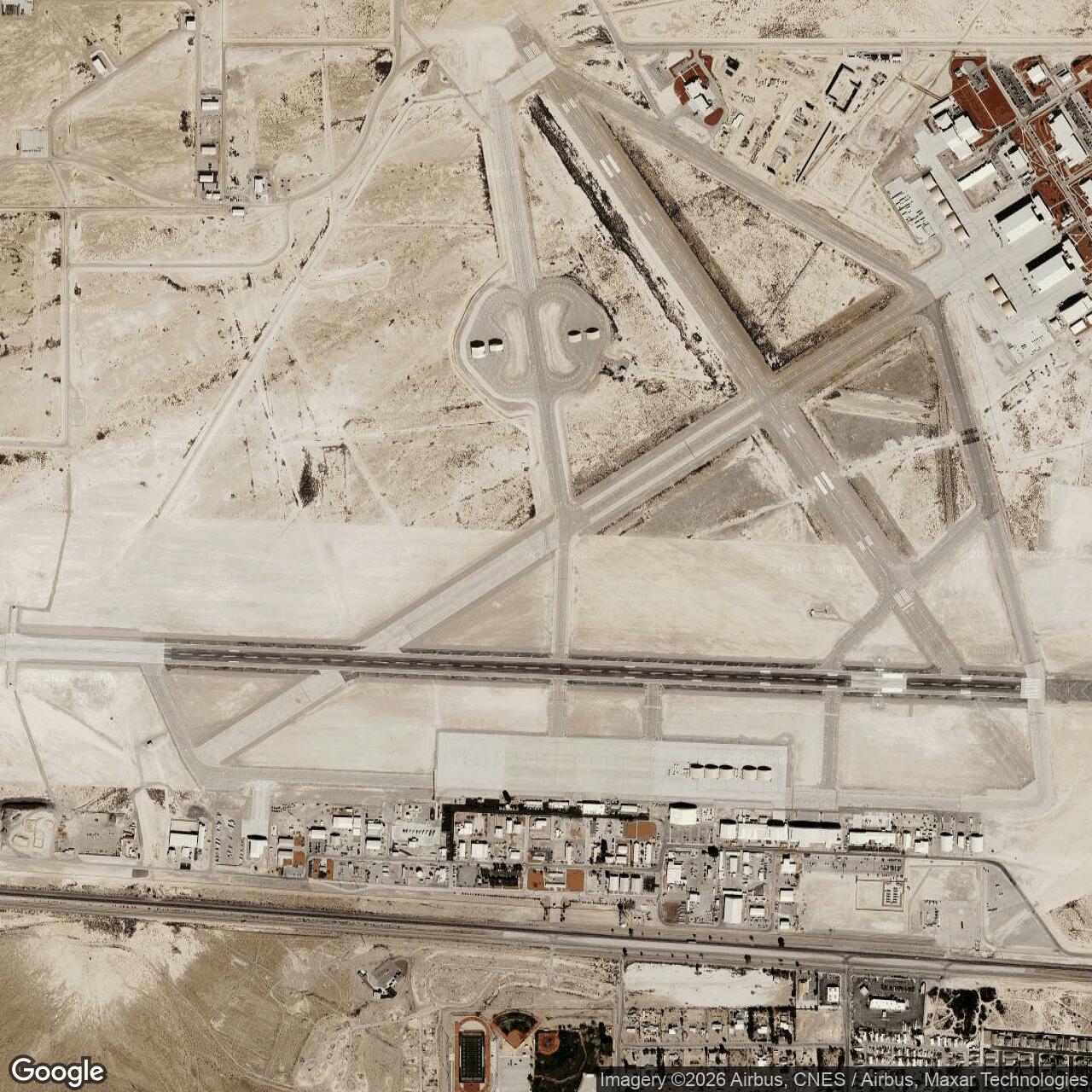
Creech's physical layout reflects its evolution from small desert airfield to active Air Force base. The core is the airfield north of Indian Springs. AirNav lists two asphalt runways: Runway 8/26 at 9,002 by 150 feet and Runway 13/31 at 5,476 by 100 feet. The field sits at an elevation of about 3,134 feet.The 2026 Department of the Air Force environmental assessment describes the base as largely developed for installation and airfield infrastructure or graded for bird-aircraft-strike-hazard management. The surrounding environment is the northeastern Mojave Desert, with dry playa, cold desert scrub, and Mojave warm desert habitats. That desert environment is part of the reason the base has been useful for so long. Sparse population, clear airspace, and direct access to restricted ranges made it suitable for activities that would be difficult near ordinary civilian airports.
The base's modern facilities are shaped by RPA operations. Creech is not only a runway with aircraft parking. It includes ground control stations, operations buildings, communications infrastructure, maintenance facilities, intelligence and mission-support spaces, training facilities, and security systems that make it possible to fly, control, recover, maintain, and support aircraft that may be operating in Nevada airspace or in overseas missions. The physical base and the digital network are inseparable. Without satellite links, secure communications, data processing, and mission-control spaces, the airfield alone would not explain Creech's importance.
The proposed collaborative combat aircraft beddown described in the 2026 environmental assessment illustrates the next layer of facilities. The Air Force's proposal included new or modified squadron operations, aircraft maintenance, supply, and airfield-support infrastructure needed to house up to 52 aircraft and 554 personnel. Whether or not every element proceeds exactly as proposed, the planning document shows that Creech remains an active growth installation rather than a static legacy base.
Role in the Wider Military Network
Creech has always mattered because it sits inside larger military networks. In World War II it supported the Las Vegas Army Air Field training system. During the Cold War it supported the Nevada Test Site, the Air Force Special Weapons Center, Nellis Air Force Base, and the Nellis range complex. As Indian Springs Air Force Auxiliary Field it supported range maintenance and realistic field training for multiple services. In the modern era it supports Air Combat Command, the 432d Wing and 432d Air Expeditionary Wing, the 25th Attack Wing's MQ-9 enterprise, the Nevada Test and Training Range, and combatant commanders using remotely piloted aircraft for persistent attack and reconnaissance.That network role explains why the base survived repeated changes in name and mission. Indian Springs was never simply a self-contained local airfield. It was a node that made other missions possible. It gave Las Vegas Army Air Field more depth. It gave nuclear-test and range programs an operating point. It gave the Thunderbirds practice space. It gave the RPA enterprise a home where crews could combine operational control, range training, and aircraft launch and recovery. Now it is being considered as a place where collaborative combat aircraft could be integrated into operational training and experimentation.
Creech also demonstrates a major shift in the geography of airpower. Older air bases projected power primarily through aircraft launched from their own runways. Creech projects power through aircraft, crews, sensors, data links, and command networks that may be separated by continents. An MQ-9 crew at Creech can participate in operations far from Nevada, while the aircraft, launch crews, and supported combatant command may be elsewhere. That separation between cockpit, aircraft, and battlefield is one reason Creech is historically important. It is a base built around the networked nature of modern air warfare.
Current Status
Creech Air Force Base remains an active U.S. Air Force installation in Clark County, Nevada. It is controlled by Air Combat Command and is currently associated with the 432d Wing and 432d Air Expeditionary Wing, with additional RPA enterprise organizations and mission partners that include 25th Attack Wing elements, test and evaluation activities, Air Reserve and Guard participation, and other support functions. The base's public-facing mission centers on remotely piloted aircraft, especially the MQ-9 Reaper, while its wider role includes persistent attack and reconnaissance, intelligence support, training, testing, tactics development, and range integration.Its current status is not merely "active." It is active and changing. The 2026 CCA environmental assessment identifies Creech as the proposed site for new collaborative combat aircraft experimentation and training units. Recent ACC and Creech reporting also shows continued restructuring of the MQ-9 enterprise, including 25th Attack Wing changes and Creech-based squadron transitions. The base that began as a small World War II desert training camp is still being used for the Air Force's next generation of airpower problems.
Chronology
- 1941-12-07 The attack on Pearl Harbor accelerates Army Air Forces training expansion in southern Nevada.
- 1942-01-14 Indian Springs Airport is first used as a military training camp.
- 1942-03 Three graded-earth landing strips with taxiways are in place, with plans for more permanent facilities and an auxiliary landing field for Las Vegas Army Air Field.
- 1942 The Army contracts for regular facilities at Indian Springs before the end of the year.
- 1943-02 Indian Springs is being used as a divert field and as a base for air-to-air gunnery training.
- 1943 The field supports a four-engine ground training school for B-17 copilots and operates with B-17s and training aircraft.
- 1945 World War II missions wind down, and the installation enters standby status by year's end.
- 1947-01 Indian Springs Airport and Las Vegas Army Air Field are inactivated during the postwar drawdown.
- 1948-01 / 1949-01 Indian Springs reopens in the early independent Air Force era. Sources differ between January 1948 and January 1949, but both place the reopening in the immediate post-USAF transition period.
- 1950 Indian Springs gains its first permanently assigned Air Force unit.
- 1951 The field is redesignated Indian Springs Air Force Base or placed in an Air Force Base/auxiliary status as Cold War operations expand.
- 1952-07 The base transfers to Air Research and Development Command and realigns under the Air Force Special Weapons Center.
- 1956-06 After the Thunderbirds move to Nellis AFB, Indian Springs becomes their primary air demonstration practice site.
- 1961 Control of Indian Springs shifts to Tactical Air Command.
- 1962-12-08 President John F. Kennedy arrives at Indian Springs AFB before continuing by helicopter to inspect the Nevada Test Site.
- 1964-04-13 The Air Force redesignates Indian Springs AFB as Indian Springs Air Force Auxiliary Field and assigns it to Nellis AFB.
- 1970s-1980s The base supports range maintenance, Nellis Test and Training Range operations, field training, and a UH-1N helicopter detachment.
- 1982-01-18 Four Thunderbirds aircraft crash during an aerial practice session at Indian Springs Air Force Auxiliary Field, killing all four pilots.
- 1992 After the inactivation of Tactical Air Command, Indian Springs AFAF falls under Air Combat Command.
- 1996-12-13 The first RQ-1 Predator flight at the airfield marks the beginning of the RPA era at Indian Springs.
- 2001-02 A Predator conducts the first successful Hellfire missile firing on the Nellis range.
- 2005-06-20 Indian Springs Air Force Auxiliary Field is redesignated Creech Air Force Base in honor of General Wilbur L. "Bill" Creech.
- 2007-03-13 The first MQ-9 Reaper arrives at Creech AFB.
- 2007-05-01 The 432d Wing activates at Creech as the Air Force's first unmanned, later remotely piloted, aircraft systems wing.
- 2008-05-15 The 432d Air Expeditionary Wing activates at Creech.
- 2012-08-30 The 799th Air Base Group stands up to improve operating support at the base.
- 2014-12-05 The Air Force Reserve's 726th Operations Group unfurls its flag at Creech.
- 2015-02-06 A final ceremony marks the end of the Silver Flag Alpha mission at Creech.
- 2015-04-01 The 99th Ground Combat Training Squadron inactivates after the end of the Silver Flag Alpha era.
- 2017-10 The Persistent Attack and Reconnaissance Operations Center activates at Creech.
- 2019-07 The 432d Mission Support Group activates, helping shift base-support stewardship to the 432d Wing.
- 2025-09-18 The 25th Attack Group is redesignated as the 25th Attack Wing, reflecting the growth and reorganization of conventional MQ-9 operations.
- 2025-12 The 11th Attack Squadron's re-patching ceremony at Creech marks its movement under the 25th Attack Wing.
- 2026-01 A Department of the Air Force environmental assessment evaluates beddown of a Collaborative Combat Aircraft Experimental Operations Unit and Test and Training Unit One at Creech.
- Present Creech AFB remains an active Air Combat Command installation and a major base for remotely piloted aircraft operations, testing, training, and future collaborative combat aircraft planning.
Sources & References
- WEB AirNav KINS - Creech Air Force Base
- WEB Creech Air Force Base History of Creech Air Force Base
- WEB Air Combat Command Creech Air Force Base marks 67th year
- WEB U.S. Air Force Indian Springs renamed Creech Air Force Base
- WEB Creech Air Force Base 432nd Wing, 432nd Air Expeditionary Wing
- WEB Creech Air Force Base About Us
- WEB MilitaryINSTALLATIONS Creech AFB In-Depth Overview
- PDF Department of the Air Force, Draft Environmental Assessment Collaborative Combat Aircraft Experimental Operations Unit and Test and Training Unit One, Creech Air Force Base, Clark County, Nevada, January 2026
- WEB Air Combat Command 25th Attack Wing becomes ACC's newest wing
- WEB Creech Air Force Base 11th ATKS officially becomes part of 25th ATKW
- WEB Creech Air Force Base ACC Commander explores Creech AFB's unique mission set
- WEB Creech Air Force Base Colonel Trevor T. Merrell
- PDF U.S. General Accounting Office Partial Videotape Erasure of 1982 Air Force Thunderbirds Crash, GAO/NSIAD-84-153