
Fort Gaines Army Base, Dauphin Island Alabama
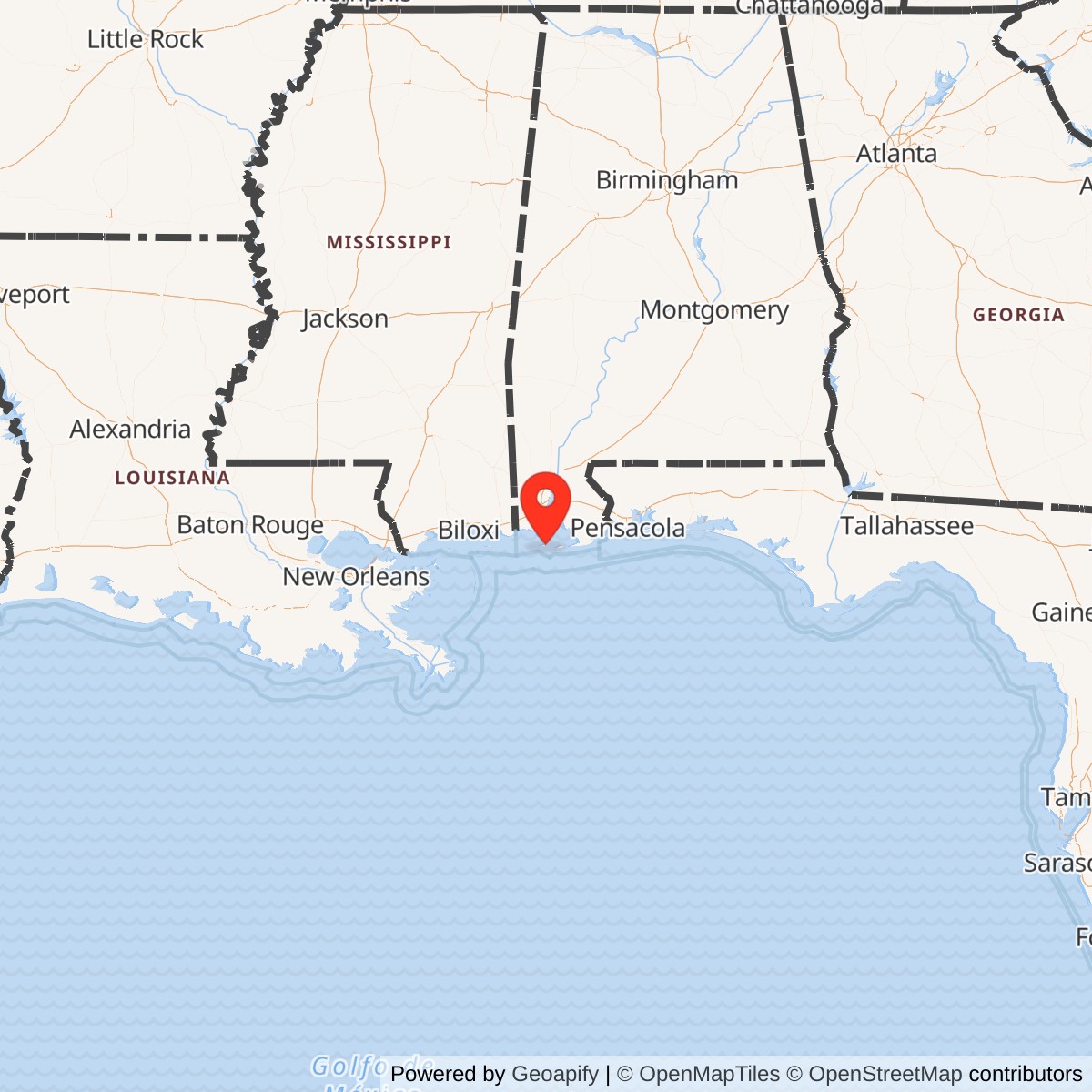
Longitude: -88.075999
Official Base Website: https://fort-gaines.com/
Current Role: Historic Fort Gaines: public museum, living-history, and preservation site managed by the Dauphin Island Park & Beach Board; threatened by shoreline erosion and coastal exposure.
Fort Gaines stands where Mobile Bay narrows into one of the Gulf Coast's most important harbor approaches. Its position at the eastern end of Dauphin Island made it the western member of the Mobile Bay harbor-defense pair, facing Fort Morgan across the entrance channel and looking over the waters that connected Mobile to the Gulf of Mexico, the Mississippi Sound, and the inland river-and-rail routes of the lower South. The fort's military importance came from that geography. Whoever controlled Dauphin Island could help guard, threaten, or deny one of the principal sea approaches to Mobile.
The fort was part of the United States' post-War of 1812 seacoast-defense program. After British operations along the Gulf Coast exposed the weakness of American harbor defenses, the Army and Congress moved toward a more systematic chain of masonry forts. Mobile Bay received two companion works: Fort Morgan on Mobile Point and Fort Gaines on Dauphin Island. Fort Morgan guarded the deep main ship channel from the east. Fort Gaines controlled the western side of the entrance, denied an enemy the use of Dauphin Island and Pelican Harbor, and offered defensive coverage for shallower-draft movement along the island side of the bay.
Fort Gaines is best known for the Civil War Battle of Mobile Bay, but its longer identity is more complex. It was conceived by U.S. military engineers after the War of 1812, delayed for decades by funding, engineering, flooding, and land-title problems, redesigned in the 1850s by Chief Engineer Joseph G. Totten, seized by Alabama militia in January 1861 before the United States Army completed it, finished under Confederate control, surrendered to Union forces in August 1864, repaired after the war, modernized with Endicott-period batteries, used as a Coast Artillery sub-post and training installation, sold out of War Department hands after World War I, briefly reused during World War II, and then converted into the public historic site that survives today.
Fort Gaines is closed as an Army coastal-defense installation. It remains open to the public as Historic Fort Gaines, a museum, living-history, and preservation site managed by the Dauphin Island Park & Beach Board. Its physical survival is unusually strong for a Gulf Coast masonry fort, but its setting is unusually fragile because the fort stands only feet from the Gulf and is exposed to shoreline erosion, storms, salt, and tidal change.
Mission Evolution
The first mission was strategic denial. U.S. planners wanted a fort on Dauphin Island because the island had already mattered in earlier imperial and wartime contests. French officials had recognized the value of the eastern point of the island in the early eighteenth century, and British use of the island during the War of 1812 reinforced the danger of leaving it open to an enemy. A fort there would prevent hostile forces from using the island as an anchorage, staging point, or base against Mobile.
The initial design phase began soon after the United States secured the region. French military engineer Simon Bernard and draftsman G. T. Poussin surveyed Mobile Bay in 1816. Bernard's concept placed a pair of similar masonry works on opposite sides of the bay entrance. Work on the Dauphin Island fort was contracted in 1819, but the project stalled by 1821. The site proved low and wet, the parade ground could flood, the original orientation and assumptions about the channel came into question, and Congress refused to continue funding. The half-finished or partially begun work then sat for decades while Mobile's commercial importance increased and American coastal-defense theory changed.
The mission revived in the 1840s and 1850s. Congress again appropriated money, Alabama cleared title to the land in 1853, and the fort was named for Edmund Pendleton Gaines, a Regular Army officer associated with the War of 1812 and later frontier and Indian War service. Chief Engineer Joseph G. Totten rejected the older Bernard-era layout and replaced it with a more modern design. The new Fort Gaines was no simple copy of Fort Morgan. It became a five-sided masonry-and-earth work arranged to concentrate defense across a broad arc toward the channel, with high brick scarp walls, bastions, tunnels, magazines, cisterns, ventilation and water systems, a dry moat, and protected communication routes.
The Civil War changed the mission before the U.S. Army finished the installation. Alabama militia seized Fort Gaines on January 5, 1861, shortly before Alabama seceded. Confederate engineers completed enough of the fort to put it into service as part of the lower Mobile Bay defense system. By 1864 it was one of three principal Confederate works at the bay entrance, along with Fort Morgan and Fort Powell. Its mission was to help keep Mobile open to blockade running and to deny Federal naval forces a secure entry into the bay.
After the Union captured Fort Gaines in August 1864, the mission reversed. The same fort that had formed part of the Confederate defensive perimeter became a Federal foothold on Dauphin Island. Its capture helped isolate Fort Morgan and eventually allowed Union forces to use the lower-bay forts as bases for later operations against Spanish Fort, Fort Blakeley, and Mobile. Fort Gaines therefore served both sides in the Civil War, but its strategic function remained constant: control Dauphin Island and shape access to Mobile Bay.
After the war, the Army repaired Fort Gaines, but the fort entered a long period of reduced importance. Masonry seacoast forts still mattered, but new naval artillery and changing coastal-defense doctrine were already making them vulnerable. The Endicott period gave Fort Gaines a second technical life when new concrete batteries and six-inch disappearing guns were added between 1901 and 1904. The fort's mission then became part of the modernized Harbor Defenses of Mobile, closely tied to Fort Morgan and the Coast Artillery system rather than to an independent garrison identity.
By World War I, even those improvements were aging. Fort Gaines and Fort Morgan served as Coast Artillery training bases, but the harbor-defense mission was being overtaken by longer-range naval guns and newer defensive systems. The Army deactivated the old Mobile Bay posts by the early 1920s, and Fort Gaines passed out of War Department ownership during the post-World War I disposal period. Its brief World War II reuse was limited compared with Fort Morgan's wartime role; Fort Gaines, already in deteriorated condition, was used by a Coast Guard unit involved in Gulf patrol duties against the German submarine threat. After that wartime use ended, the fort returned to historic-site and preservation functions.
Site Design and Physical Layout
Fort Gaines is a compact but sophisticated masonry seacoast fort. The surviving work occupies the 28.5-acre National Register property at the eastern end of Dauphin Island. The HABS and National Register documentation identifies it as a mid-nineteenth-century, French-influenced masonry fort with particularly strong brickwork and complex vaulting in the bastions. Its importance is architectural as well as military: it preserves a refined version of Third System coastal-defense thinking adapted to the difficult, low coastal ground of Dauphin Island.
The fort's original concept was a regular pentagonal bastioned work, much like Fort Morgan, but Totten's 1850s redesign produced a different geometry. The completed fort formed a five-sided work, roughly two-thirds of a hexagon, with the open portion closed by the gorge front. This allowed a broad defensive arc toward the channel and bay entrance. The main gate sat on the gorge front and was originally protected by a heavy wooden drawbridge. Outside the walls was a dry moat roughly thirty-five feet wide. The scarp rose more than twenty-two feet, and the earthen rampart climbed behind the masonry walls to the parapet and gun positions.
The internal design reveals how much engineering went into the fort. The bastions were not simply projecting corners. They held internal communication routes, ventilation, water systems, and vaulted spaces. Rainwater collection systems directed water through filters into underground cisterns. Tunnels and ramps linked the parade ground, magazines, and gun positions. Wide brick gun ramps allowed ammunition carts to reach the platforms above. Circular granite mounts and barbette-carriage positions helped guns traverse across their fields of fire. The fort's tide-flushed latrine system took advantage of the site's low elevation and the movement of water.
Fort Gaines also contained the normal structures of a working garrison post. The parade ground and interior buildings included officers' quarters, quartermaster space, kitchens, bakery and blacksmith functions, magazines, and support areas. The present historic site emphasizes many of these surviving features: tunnels, original cannons, blacksmith shop, bakery, latrine, quartermaster building, officers' quarters, museum, and interpretive exhibits. This gives Fort Gaines unusual interpretive value because the visitor can still understand both the fort's combat function and its daily garrison life.
The fort's low island setting was always both an advantage and a threat. It gave Fort Gaines a commanding view over the western approach to Mobile Bay, but it also placed masonry walls and foundations in a dynamic coastal environment. The same shoreline that made the fort tactically useful has become one of its greatest preservation risks. Storms, erosion, salt exposure, and shoreline retreat continue to shape preservation priorities at the site.
Civil War Service and the Battle of Mobile Bay
Fort Gaines entered the Civil War before it entered normal completed U.S. Army service. Alabama militia occupied the unfinished fort on January 5, 1861, and Confederate engineers continued the work. By the time of the Mobile Bay campaign, Fort Gaines was an important but imperfect Confederate position. Fort Morgan was the more powerful guardian of the deep channel, but Fort Gaines helped anchor the Dauphin Island side of the defense and supported the system of forts, torpedoes, obstructions, and Confederate naval vessels that protected Mobile.
Mobile's importance increased after New Orleans fell to Union forces in 1862. With New Orleans gone, Mobile became one of the Confederacy's most important remaining Gulf ports. Blockade runners carried cotton out and brought war materiel in through Mobile Bay. The Confederates strengthened the entrance with Fort Morgan, Fort Gaines, Fort Powell, pilings, and torpedo fields. The torpedoes narrowed the usable channel and forced Federal ships toward Fort Morgan's guns. Fort Gaines's guns were part of the larger defensive landscape, but the fort's location and limited armament meant it could not dominate the main deep-water channel in the same way Fort Morgan could.
The Union campaign began in early August 1864. Major General Gordon Granger landed roughly 1,500 troops on Dauphin Island on August 3 and laid siege to Fort Gaines from the land side. Rear Admiral David G. Farragut assembled an attacking fleet of monitors and wooden warships and ran past the bay defenses on August 5. The dramatic naval action is remembered through Farragut's famous torpedo-field order, but Fort Gaines's own battle was primarily a combined siege and bombardment. Federal land artillery and the Union monitors Chickasaw and Winnebago fired on the fort. The sand dunes west of the fort gave Union troops favorable ground, and higher buildings inside the fort, including officers' quarters and quartermaster structures, suffered damage.
Fort Gaines could do little to change the naval outcome. Later accounts emphasize that only one of its guns could reach the channel effectively and that the fort inflicted no significant damage on Farragut's fleet. The garrison's position became increasingly untenable after the fleet entered the bay. Fort Gaines could not save Fort Morgan, could not prevent Union control of Dauphin Island, and could not meaningfully threaten the Federal ships once they passed the entrance.
The internal crisis mattered as much as the bombardment. On August 6, many of the fort's officers petitioned Colonel Charles D. Anderson, declaring the position indefensible and asking that the fort be surrendered. Anderson faced bombardment, limited tactical usefulness, damaged exposed structures, and the prospect of disintegration among his officers. Fort Morgan's commander, Brigadier General Richard L. Page, objected sharply and regarded the surrender as dishonorable, but he could not reverse events. On August 8, 1864, Fort Gaines surrendered to Union forces. The garrison suffered forty-three casualties, including three fatalities, and the fort itself was damaged but repairable.
The surrender shaped the rest of the Mobile Bay campaign. With Fort Gaines in Union hands, Fort Morgan was isolated and exposed to siege. Federal forces then concentrated against Fort Morgan, which surrendered on August 23 after heavy bombardment. The capture of the lower-bay forts closed Mobile to open Gulf commerce even though the city itself did not fall until April 1865. In March 1865, Federal forces under Major General Edward R. S. Canby launched a major campaign from Forts Gaines, Morgan, and Barrancas against Spanish Fort, Fort Blakeley, and Mobile. Fort Gaines therefore became part of the Union staging geography for the final Mobile campaign.
Units, Commands, and Military Communities
Fort Gaines's unit history is less continuous than that of large permanent Army posts because the fort was often unfinished, lightly garrisoned, or treated as a supporting post of the broader Mobile Bay defenses. Its most important organizational identity was as part of the harbor-defense system rather than as a standalone troop base. U.S. Army engineers, especially under the influence of Bernard's post-1812 planning and Totten's later redesign, shaped the physical fort. The Corps of Engineers was therefore central to Fort Gaines long before major line units occupied it.
During the Civil War, Alabama militia first seized the fort, and Confederate engineers and artillerymen completed and manned it. By 1864 the Fort Gaines garrison was under Colonel Charles D. Anderson. Army Historical Foundation material describes an 800-man garrison that included a battalion of cadets from Pelham Military Academy in Mobile. Other summaries describe earlier Confederate garrison strength as smaller. The key point is that Fort Gaines was held by a mixed Confederate defensive force responsible for a fixed seacoast work at a moment when Mobile was a major blockade-running port.
Union forces involved in the capture included Major General Gordon Granger's land component and Rear Admiral Farragut's naval force. The land side made Fort Gaines vulnerable through siege pressure from Dauphin Island. The naval side made the fort strategically irrelevant once the fleet successfully entered the bay. This combination of Army siege pressure and Navy passage through the defenses illustrates why Fort Gaines belongs in both Army coastal-defense history and the wider joint history of the Mobile Bay campaign.
In the late nineteenth and early twentieth centuries, Fort Gaines belonged to the Coast Artillery world. It functioned in relation to Fort Morgan and the Harbor Defenses of Mobile. Army Historical Foundation material describes Fort Gaines as a sub-post of Fort Morgan in the early twentieth century, which helps explain why some older guns remained in place there while obsolete Fort Morgan pieces were more actively destroyed or removed. During World War I, coast artillery units manned or trained at the Mobile Bay forts. During World War II, Fort Gaines's better-documented military reuse was Coast Guard rather than Regular Army: the old fort was used by a Coast Guard unit associated with Gulf patrol duties during the German U-boat threat.
Role in the Wider Military Network
Fort Gaines only makes full sense as one node in the Mobile Bay defense network. It was never intended to fight alone. Its purpose was to work with Fort Morgan, Fort Powell, bay obstructions, mines or torpedoes, shore artillery, and naval forces to control the entrance to Mobile Bay. Its value came from position, not size. On Dauphin Island it denied an enemy easy use of Pelican Harbor and the western approach, while Fort Morgan, across the channel, covered the deeper waterway that large ships needed.
In the national system, Fort Gaines was a Third System seacoast fort. It belonged to the generation of masonry works built after the War of 1812 to protect strategic harbors from naval attack. Like other Third System forts, it reflected a belief that permanent masonry, heavy artillery, protected magazines, and carefully engineered bastions could make American ports defensible against foreign fleets. Its long, interrupted construction history also shows the limits of that system: federal funding, engineering assumptions, site conditions, and political priorities could delay even strategically important forts for decades.
During the Civil War, Fort Gaines became part of the Confederate logistics defense system. Mobile was not just a local port. It was a blockade-running gateway connected to cotton exports, imported weapons, gunpowder, salt, cloth, river systems, and rail routes into the Confederate interior. The lower-bay forts existed to keep that gateway open. When Fort Gaines and Fort Morgan fell, Mobile remained a city, but its open maritime supply function was effectively broken.
In the Endicott era, Fort Gaines moved into a different system. The masonry fort was not abandoned, but new concrete batteries and disappearing guns were added to fit the Army's modern Coast Artillery doctrine. Its relationship with Fort Morgan and the Harbor Defenses of Mobile became even more important because modern harbor defense depended on coordinated fire, mines, observation, command, and support rather than on one isolated masonry fort.
In the preservation era, Fort Gaines entered yet another network: historic sites, coastal preservation, tourism, and public memory. The fort is linked interpretively to Fort Morgan, Mobile Bay Battlefield, the Civil War naval war, the story of blockade running, the Gulf Coast's colonial and territorial history, and the survival of nineteenth-century American coastal fortifications. Its listing on preservation-endangered registers reflects a modern strategic problem of a different kind: how to keep a coastal military landmark standing in an environment shaped by erosion, storms, and sea-level pressure.
Post-Civil War, Endicott, and Twentieth-Century Service
After the Civil War, U.S. engineers repaired Fort Gaines, but the fort did not regain the importance that wartime events might suggest. Like many masonry forts, it remained in federal hands but waited for a doctrine and funding environment that would justify new investment. The Endicott Board era supplied that investment. Between 1901 and 1904, Fort Gaines received two modern batteries with six guns, complementing the more extensive modernization at Fort Morgan. These batteries reflected a new world of breech-loading rifled artillery, disappearing carriages, reinforced concrete, and coordinated harbor defense.
Fort Gaines's Endicott modernization was limited compared with Fort Morgan's. Fort Morgan remained the stronger active post and received more extensive batteries, while Fort Gaines served in a supporting role. That hierarchy persisted into the early twentieth century. The Army Historical Foundation notes that Fort Gaines's relative inaccessibility helped preserve some of its older Civil War-era guns, because ordnance personnel did not remove and destroy them with the same urgency that they applied to Fort Morgan's obsolete weapons. As a result, Fort Gaines retained a significant physical link to its Civil War armament.
During World War I, the Mobile Bay forts served training and Coast Artillery purposes, but their strategic value had declined. By the early 1920s the War Department deactivated the forts as active coastal-defense posts. Fort Gaines was then sold out of federal military ownership during the post-World War I disposal period. Later accounts vary in how they describe the receiving public body, with references to the state of Alabama and the City of Mobile, but the essential point is that the fort left the Army's permanent post structure before World War II.
World War II brought a brief return to military use because the Gulf of Mexico faced a real German submarine threat. Fort Morgan was reactivated more substantially to help protect Mobile's shipbuilding and port activity. Fort Gaines, in worse condition and less useful as a modern artillery post, had a more limited role. It was used by a Coast Guard unit involved in Gulf patrol duties. By 1946 the wartime reuse had ended, and Fort Gaines remained inactive as a military installation.
Current Status
Fort Gaines is now Historic Fort Gaines, a public historic site at the eastern end of Dauphin Island. It is managed by the Dauphin Island Park & Beach Board and interpreted for visitors through self-guided tours, museum exhibits, preserved fort spaces, cannons, tunnels, living-history demonstrations, blacksmithing, and special events. The Town of Dauphin Island identifies the site at 51 Bienville Boulevard and describes its original cannons, blacksmith shop, bakery, latrine, quartermaster building, officers' quarters, museum, gift shop, and Battle of Mobile Bay interpretation.
The site is listed in the National Register of Historic Places under NRIS number 76000348. National Register documentation gives the nominated property as 28.5 acres and identifies the fort as a nationally significant masonry work with outstanding brickwork, complex bastion vaulting, and advanced systems of communication, ventilation, and water management. The Library of Congress HABS record also preserves early twentieth-century photographs and the 1854 plan-and-profile drawing associated with Totten's redesign.
Chronology
- 1713 French Governor LaMothe-Cadillac recognized the strategic value of fortifying the eastern point of Dauphin Island.
- 1814 U.S. control of the Mobile Bay area made American harbor-defense planning possible after the War of 1812.
- 1816 Simon Bernard and G. T. Poussin surveyed Mobile Bay for the United States and shaped the paired-fort concept for the bay entrance.
- 1818-1819 U.S. plans called for companion fortifications at Mobile Point and Dauphin Island as part of the post-War of 1812 coastal-defense system.
- 1819 Work was contracted for the Dauphin Island fort.
- 1821 Work on the Dauphin Island fort stopped after Congress refused further funding amid doubts about the site, channel, and expense.
- 1845-1846 Congress again appropriated funds for the Dauphin Island fort, reopening the project in principle.
- 1853 Alabama cleared title to the land, and the fort was named for Edmund Pendleton Gaines.
- 1854 Chief Engineer Joseph G. Totten supplied revised plans for a more modern five-sided masonry fort.
- 1857 Construction resumed under the later design after the long period of delay.
- 1861-01-05 Alabama militia seized the unfinished Fort Gaines shortly before Alabama seceded from the Union.
- 1861-1862 Confederate engineers completed enough of the fort to put it into operational service as part of the lower Mobile Bay defenses.
- 1864-08-03 Major General Gordon Granger landed Union troops on Dauphin Island and began investing Fort Gaines from the land side.
- 1864-08-05 Farragut's fleet ran past the Mobile Bay defenses; Federal land and naval pressure turned directly against Fort Gaines.
- 1864-08-06 Many Fort Gaines officers petitioned Colonel Charles D. Anderson to surrender the fort as indefensible.
- 1864-08-08 Fort Gaines surrendered unconditionally to Union forces.
- 1864-08-23 Fort Morgan surrendered after a heavier siege, completing Union control of the lower Mobile Bay forts.
- 1865-03 Federal forces used Forts Gaines, Morgan, and Barrancas as staging points for the campaign against Spanish Fort, Fort Blakeley, and Mobile.
- 1865-04-12 Mobile fell to Union forces after the final Mobile campaign.
- 1867 U.S. engineers had repaired the Mobile Bay masonry forts after Civil War damage.
- 1895 The Endicott modernization era brought new attention to the Mobile Bay harbor defenses.
- 1901-1904 Two modern batteries with six guns were constructed at Fort Gaines.
- World War I era Fort Gaines and Fort Morgan served as Coast Artillery training bases, although their guns were increasingly obsolete.
- 1923 The Army deactivated the old Mobile Bay coastal-defense posts by this period.
- 1926 Fort Gaines passed out of federal military ownership during the post-World War I disposal period, with later histories describing transfer or sale to public/state/local ownership.
- 1940s Fort Gaines was briefly reused during World War II, chiefly in association with Coast Guard Gulf patrol activity.
- 1946 The World War II-era military reuse ended, and the fort remained inactive as a military installation.
- 1955 Fort Gaines opened to the public as a state park / historic site.
- 1976 Fort Gaines was listed in the National Register of Historic Places, NRIS 76000348, with a nominated acreage of 28.5 acres.
- 2011 The National Trust for Historic Preservation listed Fort Gaines among America's 11 Most Endangered Historic Places because of preservation threats, including erosion.
- Present Fort Gaines is a public historic site and museum managed by the Dauphin Island Park & Beach Board, while preservationists continue to address erosion, storm, masonry, and coastal-exposure threats.
- Visual and Reference Resources
- The Library of Congress HABS record is the best compact source for historic images, survey metadata, and architectural documentation. It includes eight photographs, data pages, caption pages, and a plan-and-profile drawing associated with the 1854 Totten design. The NPGallery / National Register file is the best single source for nominated acreage, architectural description, and the preservation-era statement of significance. The Encyclopedia of Alabama and Army Historical Foundation article are the best narrative sources for placing Fort Gaines beside Fort Morgan in the Mobile Bay defense system. The Town of Dauphin Island and official Fort Gaines pages are the best current visitor/status sources.
