
Santa Maria Army Air Field, California
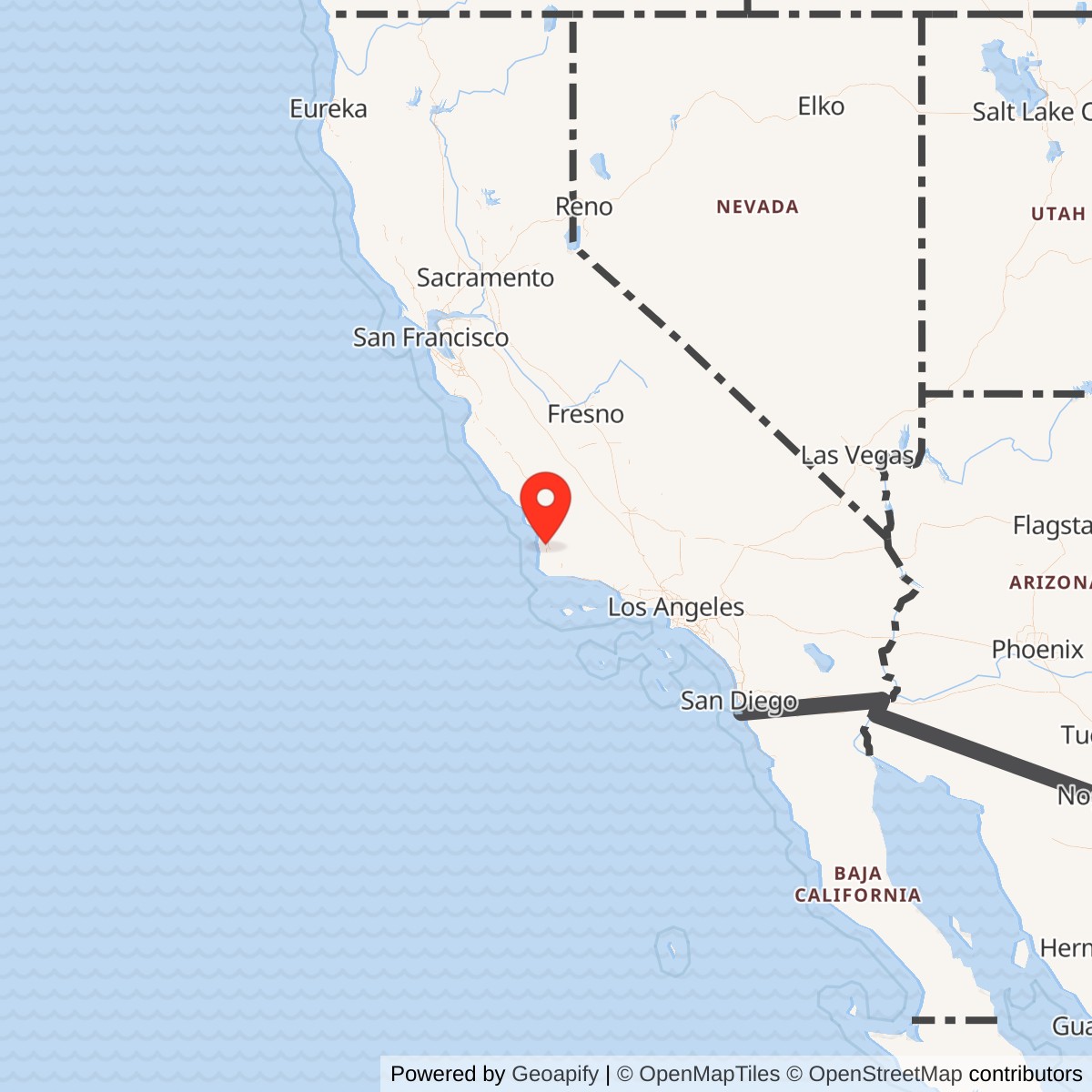
Longitude: -120.4580833
Airport ICAO ID: KSMX
Official Base Website: Santa Maria Army Air Field
Current Role: Santa Maria Public Airport / Capt. G. Allan Hancock Field, an active Santa Maria Public Airport District airport with general aviation, limited commercial service, aviation businesses, firefighting/air tanker use, museum/heritage activity, and surrounding industrial/commercial reuse; portions of the former Army airfield remain in environmental cleanup/regulatory records.
Santa Maria Army Air Field was a World War II Army Air Forces training and support installation on California's central coast. It occupied the ground now used by Santa Maria Public Airport / Capt. G. Allan Hancock Field, but its wartime footprint was larger than the present civil airport. State Water Board records describe the former Army airfield as an approximately 3,085-acre property owned by the U.S. government from 1942 to 1949, while the present airport district reports that today's airport encompasses about 2,598 acres with two active runways. Those figures capture the site's basic historical arc: the Army built a very large wartime aviation installation, then the property was gradually narrowed, transferred, and reused as a regional public airport and aviation-industrial landscape.
The field's location mattered. Santa Maria sat far enough from the most crowded Los Angeles basin to offer room for runways, barracks, hangars, shops, ammunition and fuel support, and flying approaches, but it was still tied to California's wartime aviation network by highway, rail, coastal geography, and proximity to other military installations. Camp Cooke, later Vandenberg Space Force Base, lay to the southwest. Other Army Air Forces fields and auxiliary strips spread across the Central Coast, the San Joaquin Valley, the Mojave, and Southern California. Santa Maria therefore became one part of a large wartime air-training system rather than an isolated local airport.
The installation is best understood as a World War II Army Air Forces fighter and crew-training base, with a late-war jet-transition and experimental-training layer. It was not simply a municipal airport taken over for wartime use. The U.S. Army Corps of Engineers built what the local airport district describes as Santa Maria Army Base in the early 1940s to provide training facilities for B-25 crews. After the initial bomber-training phase ended, the base became a training field for P-38 Lightning pilots and ground crews. By 1945, it also had a more unusual role in the first generation of U.S. jet-fighter operations, when Bell P-59 Airacomet activity associated with the 412th Fighter Group and related Army Air Forces base-unit training appeared at Santa Maria.
That combination gives Santa Maria a stronger military history than a simple "former World War II airfield" label suggests. It was a product of rapid wartime construction, a base that adapted from bomber training to fighter replacement training, a place where P-38 pilots prepared for overseas service, a node in the Fourth Air Force fighter-training network, and one of the California fields associated with the Army Air Forces' first jet-fighter community. Its postwar life as Santa Maria Public Airport preserved the aviation use of the land even though the Army installation itself closed.
Mission Evolution
Santa Maria's military mission began with the emergency expansion of the Army Air Forces during World War II. The official airport history states that, in the early 1940s, the U.S. Army Corps of Engineers constructed the facility then known as Santa Maria Army Base to provide training facilities for crews of B-25 aircraft. That first mission reflected the scale of America's bomber-training problem in 1942. The Army needed airfields where crews could learn to operate complex twin-engine aircraft, practice procedures, and move through the training pipeline fast enough to support global war.
The B-25 phase did not last as the field's defining mission. A few years later, the B-25 groups departed and Santa Maria became a training field for P-38 pilots and ground crews. The Lockheed P-38 Lightning was one of the Army Air Forces' most distinctive fighters: twin-engine, high-performance, long-legged, and technically demanding. A P-38 training base needed more than a runway. It needed maintenance capacity, hangars, parts supply, fueling, crash/fire support, instrument and communications support, instructors, classrooms, and enough airspace and nearby auxiliary fields to let pilots build proficiency before being assigned to operational units.
That shift from B-25 crews to P-38 fighters reflected the Army Air Forces' ability to reassign fields as wartime requirements changed. Santa Maria's training mission was not fixed by the original construction plan. The base adapted to the Fourth Air Force and IV Fighter Command system, which defended the West Coast, trained fighter organizations, prepared replacement pilots, and moved units toward deployment. Santa Maria's Central Coast position, clear flying country, and comparatively large site made it well suited to that work.
By 1944 and 1945, Santa Maria's significance broadened again. Environmental and historical records associated with the former airfield identify it as a place connected to both P-38 fighter-pilot training and the early Bell P-59 Airacomet jet-fighter program. The 412th Fighter Group, the Army Air Forces' pioneering jet-fighter organization, moved through several California stations and by July 1945 was stationed at Santa Maria Army Air Field before moving to March Field later that year. The presence of P-59 operations did not transform Santa Maria into the Army Air Forces' main experimental test center; that role belonged especially to Muroc and related desert test facilities. But it did make Santa Maria part of the operational training and familiarization network through which America's first jet fighters entered military use.
The Army mission ended after the war. The airport district history states that, in 1946, following the war's end, Santa Barbara County acquired the property by means of an interim permit from the War Assets Administration. The County retained control until 1949, when the City of Santa Maria obtained an undivided one-half interest. In March 1964, management and ownership moved to the newly formed Santa Maria Public Airport District. The former Army airfield therefore passed through a familiar postwar process: federal disposal, county and city control, and eventual creation of a special airport district to manage aviation reuse.
World War II Operations
What happened at Santa Maria during World War II was the daily work of training, maintaining, housing, and supporting military aviation. The field's original B-25 mission required medium-bomber crew facilities. Even if that phase was brief, it would have demanded runways long enough for twin-engine bomber training, aircraft parking and servicing areas, crew instruction space, maintenance shops, and the administrative systems needed to track students, aircraft, flying hours, and incidents. The base was part of the larger wartime pattern in which new Army airfields were built quickly, then re-tasked as training demands changed.
The P-38 phase gave the airfield its strongest wartime identity. P-38 training was specialized because the Lightning was not an ordinary single-engine trainer. Pilots had to master twin-engine handling, high speed, turbo-supercharged engines, complex systems, gunnery, formation work, emergency procedures, and long-range fighter tactics. Ground crews had to maintain a demanding aircraft with two Allison engines, intercoolers, electrical systems, hydraulics, armament, and high-performance airframe requirements. Santa Maria's mission therefore included both pilot training and ground-crew training. The official airport history specifically names both pilots and ground crews, which is important because aircraft readiness depended as much on the maintenance system as on the pilots in the cockpit.
Santa Maria's P-38 mission also connected it to the fighter pipeline that moved airmen from training bases to combat theaters. A pilot who trained at Santa Maria did not fight a battle there. The field's contribution was preparatory: to turn partially trained aviators into men ready for assignment to fighter groups, replacement pools, or advanced training. Local and secondary aviation-history sources record that hundreds of P-38 pilots graduated from Santa Maria before the training mission wound down in 1945. Even where exact counts vary by source and counting method, the military significance is clear. Santa Maria existed to produce usable fighter manpower for a global air war.
The field also hosted or supported fighter-group activity tied to operational deployment. The 479th Fighter Group, equipped with P-38s, trained in California before deploying to England, and Santa Maria Army Air Field appears in the group's station history for a brief period in April 1944. That short stay should not be overread as the whole story of Santa Maria, but it illustrates how the field fit into the movement of fighter units through California staging and training locations. The Army Air Forces did not use every field in a static way. Groups, squadrons, base units, instructors, aircraft, and detachments moved as training needs, deployment schedules, and airfield capacity required.
Santa Maria's late-war jet connection adds another layer. The Bell P-59 Airacomet was not a successful combat fighter, but it was historically important because it introduced American military pilots and maintainers to jet propulsion, different engine handling, different maintenance requirements, and different tactical possibilities. The 412th Fighter Group, formed as the first American jet-fighter group, operated P-59s and later worked with early P-80 Shooting Star activity. By mid-1945, records place the 412th system and a lesser-known 440th Army Air Forces Base Unit training function at Santa Maria. The significance of that presence lies not in combat output but in transition. Santa Maria became one of the places where the Army Air Forces moved from piston-engine fighter training into the jet age.
The operational environment would also have included aircraft maintenance, fuel handling, solvent use, storage tanks, vehicle maintenance, barracks operations, heating systems, and waste-management practices typical of a large World War II airfield. Later State Water Board records describe the former airfield as having approximately 100 wartime buildings, including barracks, officer quarters, aircraft maintenance facilities, warehouses, aircraft hangars, administrative buildings, a theater, a chapel, and other support buildings. Those same records describe more than 200 underground storage tanks originally constructed or installed at the approximately 3,085-acre airfield, many associated with heating oil, gasoline, or lubrication oil. That environmental record is not a side issue; it helps reconstruct the scale and physical complexity of the wartime installation.
Units, Organizations, and Systems
Santa Maria Army Air Field's unit history is best described through systems rather than through one single permanently stationed combat group. The first system was the Army Air Forces training establishment. The field was built for B-25 crew training, then used for P-38 pilot and ground-crew training. That placed it in the same broad family as other California training fields that existed to feed the Army Air Forces with pilots, crews, mechanics, and operational units.
Fourth Air Force and IV Fighter Command form the most important command context. Fourth Air Force controlled much of the fighter-training and air-defense activity on the West Coast. In the early war period, the West Coast faced real concern about Japanese attack, submarine activity, and the need to defend aircraft factories, ports, oil facilities, and coastal cities. As the war progressed, the command's training and replacement functions became increasingly important. Santa Maria's P-38 mission belongs to that Fourth Air Force fighter-training world.
The P-38 training organization at Santa Maria included both flying and ground elements. The 483d Army Air Forces Base Unit, and that kind of base unit structure was typical of Army Air Forces station administration in 1944-1945. Base units handled the local mission: instruction, maintenance, operations, administration, supply, medical support, military police, and the other functions required to keep an airfield operating. Even when combat groups moved through or were briefly stationed at a field, the base-unit system provided continuity.
The 479th Fighter Group is part of the Santa Maria story because it links the field to an operational P-38 fighter organization that later fought in Europe. The group was activated in California in 1943, trained with P-38s, and deployed to England in 1944. Its connection to Santa Maria was brief, but it shows that the field was used in the broader California fighter-training and deployment network rather than merely for local familiarization flights.
The 412th Fighter Group gives Santa Maria its most unusual late-war association. The group was the Army Air Forces' first jet-fighter group and operated Bell P-59 Airacomets as part of the early American jet program. Its station history places it at Santa Maria Army Air Field in 1945 before it moved to March Field. Related records also note the presence of the 440th Army Air Forces Base Unit, described as a training squadron in connection with P-59 activity at Santa Maria by late June 1945. Those organizations connect Santa Maria to the transition from propeller-driven fighter aviation to jet propulsion.
Santa Maria also had a relationship with auxiliary and support fields. Fighter training required dispersal and practice areas, and secondary fields helped spread traffic, support night flying, relieve congestion, and provide emergency or specialized training locations. The Estrella field near Paso Robles, for example, is described by aviation-history sources as a backup or auxiliary training field for squadrons stationed at Santa Maria and as a place used for night-flying training with P-38s. That relationship illustrates a larger truth about Army airfields: the named main base was often only the visible center of a wider flying network.
Facilities and Physical Layout
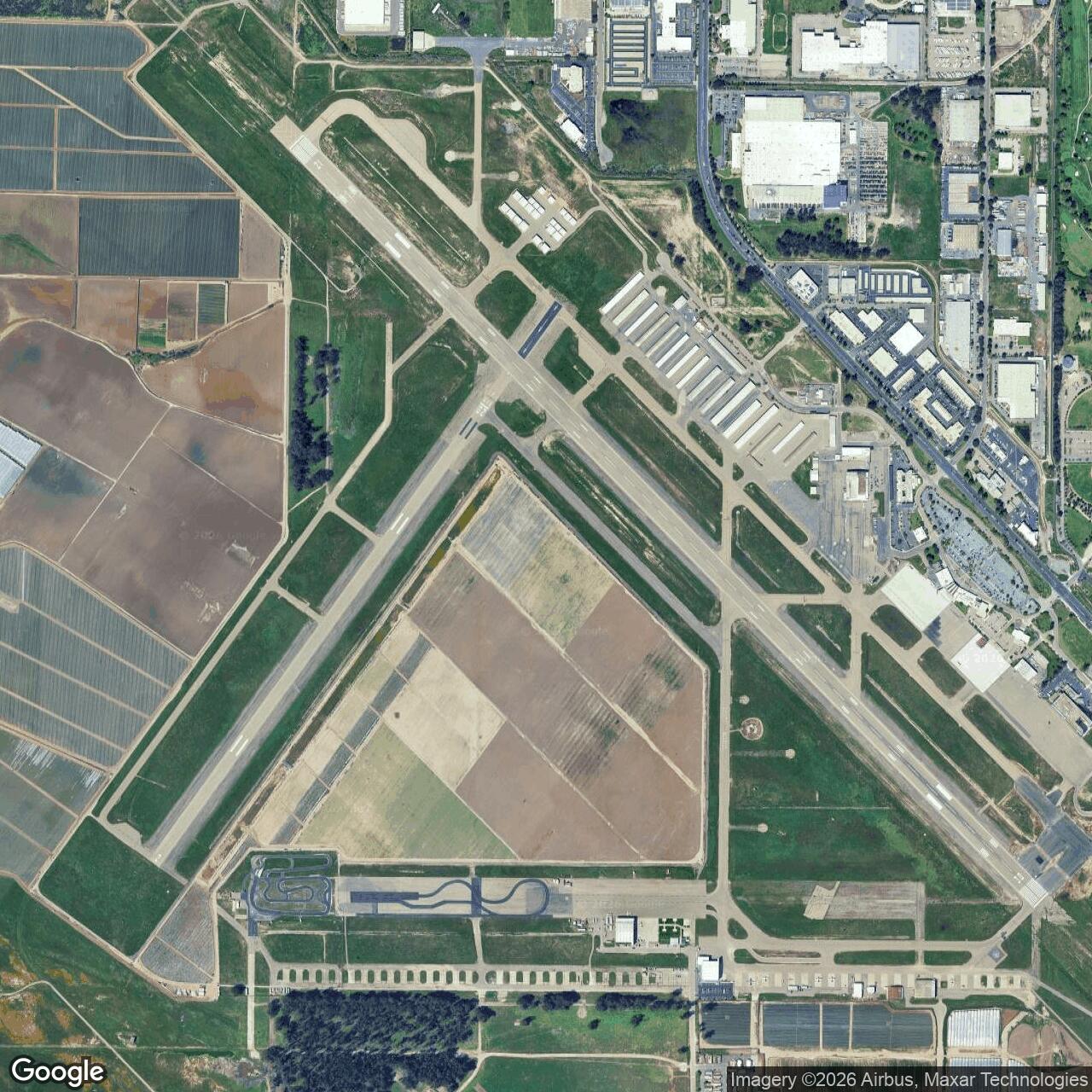
The former Santa Maria Army Air Field was physically large. State Water Board records describe it as about 3,085 acres, and the present airport district reports that the current airport occupies about 2,598 acres. The difference reflects postwar disposal, reuse, and boundary changes, but both numbers show that the wartime field was more than a runway. It was a complete aviation installation with flying surfaces, hangars, shops, living areas, utilities, fuel systems, roads, and training support facilities.
The modern airport's runway pattern preserves the aviation logic of the site. Current airport information lists two active runways: Runway 12/30, now 8,004 by 150 feet, and Runway 2/20, about 5,199 by 75 feet. These present dimensions are not identical to the wartime configuration in every detail, especially after later runway extension and civil-airport development, but they show why the site remained useful for aviation. A large, open, south-of-town airfield could accept long runways, instrument facilities, maintenance areas, and supporting aviation industry.
The wartime built environment was extensive. The State Water Board record states that, in 1942, approximately 100 buildings were constructed, including barracks, officer quarters, aircraft maintenance facilities, warehouses, aircraft hangars, administrative buildings, a theater, a chapel, and other support buildings. That list is a compact description of a temporary Army airfield city. Personnel needed housing, food, recreation, training rooms, medical care, offices, and shops. Aircraft needed hangars, hardstands, maintenance docks, parts storage, fuel, oil, fire protection, and specialized work areas. The field was therefore organized around both people and machines.
Maintenance facilities were especially important. A P-38 training base generated heavy demand for engine work, airframe repairs, armament maintenance, hydraulic and electrical troubleshooting, tire and brake service, sheet-metal repair, and engine-cleaning operations. Later environmental maps and cleanup records identify former air-base features such as a P-38 hangar dock, engine cleaning room, and lube-oil pump house in the industrial portion of the former base. Those remnants point to the practical infrastructure behind the flying mission. Pilots trained only because mechanics, supply crews, fuel handlers, and shop personnel kept aircraft airworthy.
The fuel and utilities system left a strong environmental footprint. State records describe more than 200 underground storage tanks originally constructed and installed at the former airfield. Many smaller tanks stored heating oil for buildings, while larger tanks stored gasoline or lubrication oil. A wartime base of this size also needed water, sewage, power, roads, storm drainage, fire protection, and vehicle support. The postwar cleanup record makes clear that these systems were not incidental. They were part of the installation's material life, and their remnants continued to affect later property owners and regulators long after the Army mission ended.
Santa Maria's layout also interacted with postwar airport and industrial development. Former military buildings, parcels, shops, and utility corridors became part of the airport district, aviation businesses, industrial properties, and surrounding commercial uses. The airport terminal, industrial park, hangar areas, air traffic control tower, crash/fire/rescue facilities, and owner-built hangar areas mentioned in the airport district history are postwar developments layered onto a former Army field. The current landscape is therefore a palimpsest: a working public airport and business district built over a World War II training base.
Role in the Wider Military Network
Santa Maria Army Air Field belonged to a wartime military network that stretched across California. That network included major Army Air Forces bases, contract flying schools, municipal airports under military control, desert training fields, coastal defense areas, and auxiliary strips. California offered weather, space, existing aviation industry, and long-distance routes, but it also required careful distribution of training to avoid overloading airspace and fields. Santa Maria's value came from its ability to absorb one piece of that load.
During the B-25 phase, the base formed part of the Army Air Forces' bomber-training expansion. Medium-bomber crews needed fields that could handle twin-engine aircraft and support crew coordination. Even though Santa Maria did not remain primarily a B-25 base, its original purpose shows how quickly the Army was building air infrastructure in 1942. The field was one of many wartime facilities created before the Army could know exactly which aircraft and units would need it most.
During the P-38 phase, Santa Maria fit into the Fourth Air Force fighter-training and West Coast air-defense system. P-38s were valuable for interception, long-range escort, and fighter-bomber work, but they required specialized training. Santa Maria helped prepare pilots and crews within a larger system that included other California fighter bases, gunnery fields, auxiliary strips, depots, and replacement organizations. The connection to Daggett, Estrella, and other fields shows that Santa Maria was a hub in a distributed training geography rather than a self-contained school.
The late-war P-59 layer placed Santa Maria in an even wider technological network. Early jet operations in the United States involved Muroc, Palmdale, Bakersfield, Santa Maria, March Field, contractor facilities, and Army Air Forces technical commands. The Airacomet was not a combat success, but the process of learning to operate jets mattered enormously. Jet operations required different maintenance habits, different pilot handling, different safety procedures, and new training concepts. Santa Maria's association with the 412th Fighter Group and P-59 training means the field had a small but real place in the Army Air Forces' transition toward the postwar jet age.
The field also sat near Camp Cooke and the central coast military corridor. That geography mattered during and after the war. Camp Cooke trained ground troops and later became a missile and space launch installation as Vandenberg. Santa Maria remained a civil airport but continued to serve a region shaped by military aviation, missile testing, aerospace operations, and emergency response. The former Army field did not become a postwar Air Force base like some other wartime installations, yet its aviation function survived in a region where military and civil aerospace remained closely intertwined.
Postwar Reuse, Environmental Record, and Current Status
The Army airfield closed as a military installation after World War II, but the property did not go dark. In 1946, Santa Barbara County acquired the field under a War Assets Administration interim permit. In 1949, the City of Santa Maria obtained an undivided one-half interest. In March 1964, ownership and management were transferred to the newly created Santa Maria Public Airport District. That sequence turned a federal wartime base into a public airport and gave the region a permanent aviation asset.
The present Santa Maria Public Airport / Capt. G. Allan Hancock Field remains active. It is publicly owned by the Santa Maria Public Airport District and serves general aviation, commercial passenger service, aviation businesses, aircraft maintenance, and public-safety aviation functions. The airport district lists two active runways and more than 200 based general aviation aircraft. Current airport data identifies the field as SMX / KSMX, about three miles south of Santa Maria, with the main runway long enough to support larger aircraft than many regional airports.
The airport has also become a firefighting aviation site. Santa Maria's location on the Central Coast, runway length, and open ramp capacity make it useful for aerial firefighting operations. That current emergency-response role is not the same as the Army Air Forces mission, but it preserves a public-service version of the field's wartime logic: aircraft, trained crews, fuel, maintenance, and dispatch capability concentrated at a strategically useful regional airfield.
The postwar landscape includes heritage uses as well. The Santa Maria Museum of Flight and newer aviation-preservation efforts connect the present airport to the military and civilian aviation stories of the region. The Capt. G. Allan Hancock name also ties the current airport to the earlier Hancock aviation tradition in Santa Maria, which predated the World War II Army field but became intertwined with it after the war.
The environmental record is an important part of the current status. State Water Board records identify portions of the former Army airfield in relation to cleanup and abatement proceedings for industrial property on or near the former base. The record describes former Army airfield operations, underground storage tanks, petroleum products, volatile organic compounds, and possible solvent-related issues in groundwater, soil, and soil gas. The existence of cleanup activity does not mean every problem can be attributed neatly to the Army period, because later private industrial operations also affected parts of the property. It does mean that the former Army airfield remains a regulatory and environmental geography as well as an airport history.
Chronology
- 1927 Capt. G. Allan Hancock established the earlier Hancock Field at a different Santa Maria location, beginning the local Hancock aviation tradition that later became associated with the present airport.
- Early 1940s The U.S. Army Corps of Engineers constructed what the airport district describes as Santa Maria Army Base to provide training facilities for B-25 aircraft crews.
- 1942 State Water Board records identify 1942 as the beginning of U.S. government ownership of the former Santa Maria Army Airfield property and note that approximately 100 buildings were constructed that year.
- 1942 The wartime building program included barracks, officer quarters, aircraft maintenance facilities, warehouses, hangars, administrative buildings, a theater, a chapel, and other support buildings.
- 1942-1949 State Water Board records describe the U.S. government as owning the former Santa Maria Army Airfield during this period.
- 1943 The airfield's mission shifted from the initial B-25 crew-training purpose toward P-38 pilot and ground-crew training.
- 1944-04 The 479th Fighter Group, a P-38 fighter organization, was briefly stationed at Santa Maria Army Air Field during its California training period before deployment overseas.
- 1944-1945 Santa Maria functioned as a P-38 training field for Army Air Forces pilots and ground crews.
- 1945 The field became associated with early Bell P-59 Airacomet jet activity and the 412th Fighter Group system.
- 1945-06 Records associated with the P-59 program note that the 440th Army Air Forces Base Unit, described as a training squadron, was operating at Santa Maria by late June 1945.
- 1945-07 The Santa Maria Army Airfield Basic Layout Plan and Building Schedule was dated July 1945, providing later cleanup records with a key map reference for former buildings and tanks.
- 1945-07-10 The 412th Fighter Group station history places the group at Santa Maria Army Air Field beginning around this date.
- 1945-11 The 412th Fighter Group moved from Santa Maria to March Field, part of the postwar transition of early jet-fighter activity.
- 1946 Following the war, Santa Barbara County acquired the property by interim permit from the War Assets Administration.
- 1946 Santa Maria Army Air Field effectively ended its Army Air Forces installation role as the property moved into postwar disposal and civil-airport reuse.
- 1947-06 Current FAA airport data lists June 1947 as the civil airport activation date for SMX.
- 1949 The City of Santa Maria obtained an undivided one-half interest in the airport, creating joint city-county control.
- 1964-03 Ownership and management transferred to the newly formed Santa Maria Public Airport District.
- 2012-05-03 A runway extension project lengthened Runway 12/30 to 8,004 feet, reinforcing the airport's regional aviation role.
- 2023 State Water Board cleanup and abatement records again placed portions of the former Santa Maria Army Airfield into the public regulatory record, including discussion of wartime buildings, storage tanks, and later industrial-site contamination issues.
- Present Santa Maria Army Air Field is closed as an Army installation, while the site remains active as Santa Maria Public Airport / Capt. G. Allan Hancock Field under the Santa Maria Public Airport District.
Information sources (11)
- WEBSanta Maria Public Airport District
History
- WEBSanta Maria Public Airport District
Pilot Information
- WEBAirNav
KSMX Santa Maria Public Airport / Capt G Allan Hancock Field
- PDFCalifornia Regional Water Quality Control Board / State Water Resources Control Board
Cleanup and Abatement Order No. R3-2023-0070 materials, including former Santa Maria Army Airfield discussion
- WEBState Water Resources Control Board
GeoTracker program information
- WEBPacific Wrecks
Santa Maria Army Air Field (Santa Maria Public Airport)
- WEBEdwards Air Force Base
412th Test Wing
- PDFUSAF Unit History PDF
440th AAF Base Unit
- PDFSanta Maria Public Airport
District meeting packet / historical discussion material
- WEBEstrella Warbird Museum
Why P-38?
- WEBCalifornia Environmental Quality Act database
Airport Surveillance Radar, Model 11 to Serve Santa Maria Public Airport