
Atlas F Site 577-1 Missile Silo, Lone Wolf / Lugert area Oklahoma
Longitude: -99.25971458674624
Site Type: Atlas F vertical silo launch facility
Missile Type: SM-65F Atlas
Missile Assigned to this Silo: GD mfg 43F; GD serial 61-2529; AF tail 529; accepted 1962-01-31; delivered 1962-03-06; not launched / salvaged as scrap.
Number of Launchers/Missiles: 1
Parent Base: Altus AFB
Missile Wing: 11th Bombardment Wing; 11th Strategic Aerospace Wing after 1962-04-01
Missile Squadron: 577th Strategic Missile Squadron
Current Site Use: Former Atlas F silo complex in agricultural/private-property setting; visible surface/near-surface remains documented by 2003 aerial and later imagery, but current use is not publicly verified beyond private ownership.
Site Ownership: Private/non-federal ownership after surplus disposal; individual owner not verified.
Accessible: No public access / private property.
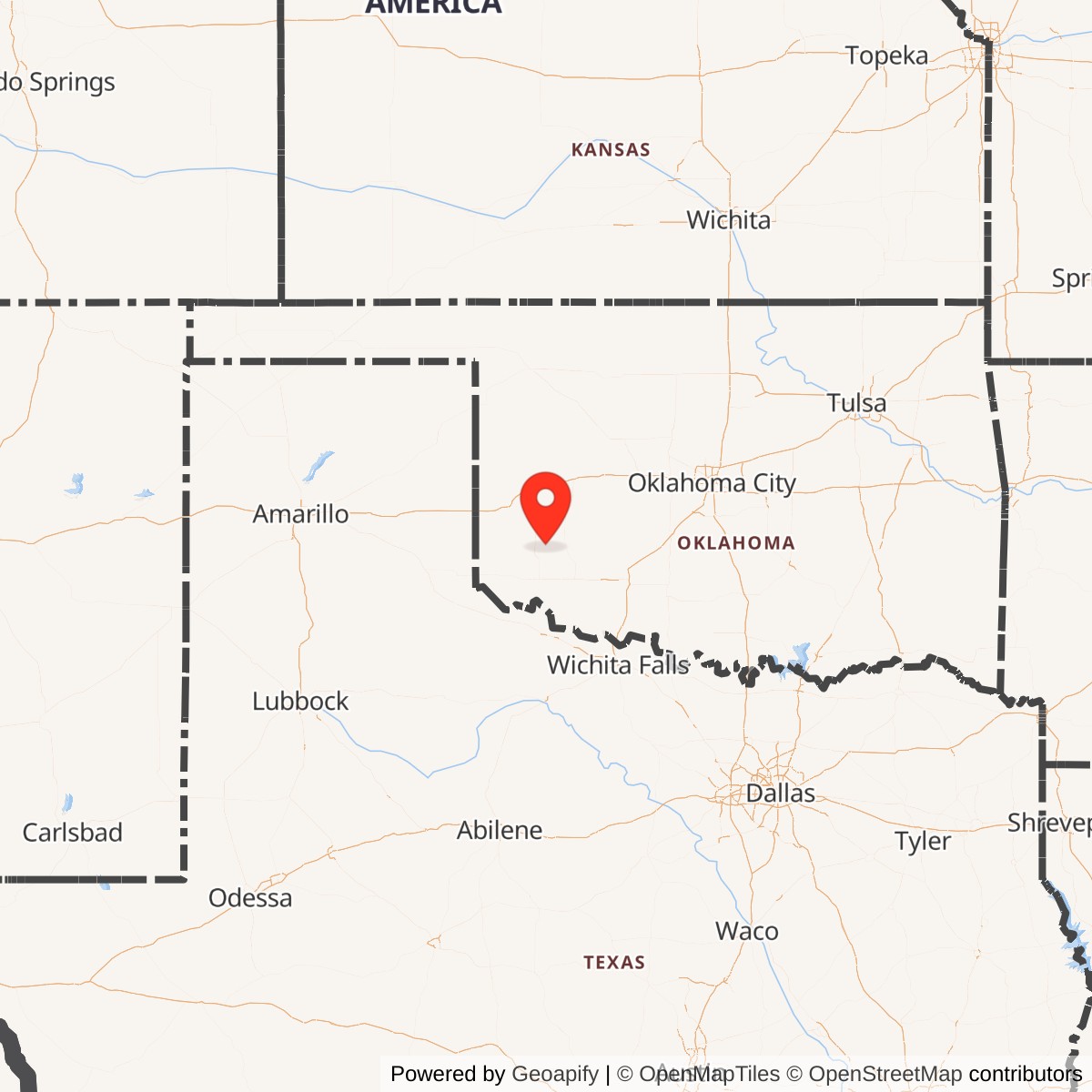
Atlas F Site 577-1 was one of the twelve SM-65F Atlas intercontinental ballistic missile launch complexes assigned to the 577th Strategic Missile Squadron at Altus Air Force Base, Oklahoma. The site was the squadron's Site 1, located in Kiowa County in southwestern Oklahoma near Lone Wolf and the Lugert area.
The site belonged to the 11th Bombardment Wing, which became the 11th Strategic Aerospace Wing on 1962-04-01, and to the 577th Strategic Missile Squadron, the Altus Atlas F unit. Atlas F launch complexes were self-contained complexes with their own underground launch control center and silo rather than Minuteman-style unmanned launch facilities controlled from a remote LCC.
Site 577-1 is inactive and decommissioned. The site was constructed beginning in 1960, turned over to the Air Force on 1961-09-06, and operated as part of the Altus Atlas F force until the 577th Strategic Missile Squadron was inactivated on 1965-03-25. Its assigned operational missile was General Dynamics Atlas missile 43F, Air Force tail number 529, serial number 61-2529. That missile was accepted on 1962-01-31, delivered on 1962-03-06, was not launched, and was ultimately salvaged as scrap. The former launch complex is now non-federal private property, with no public access.
Location, Landscape, and Site Description
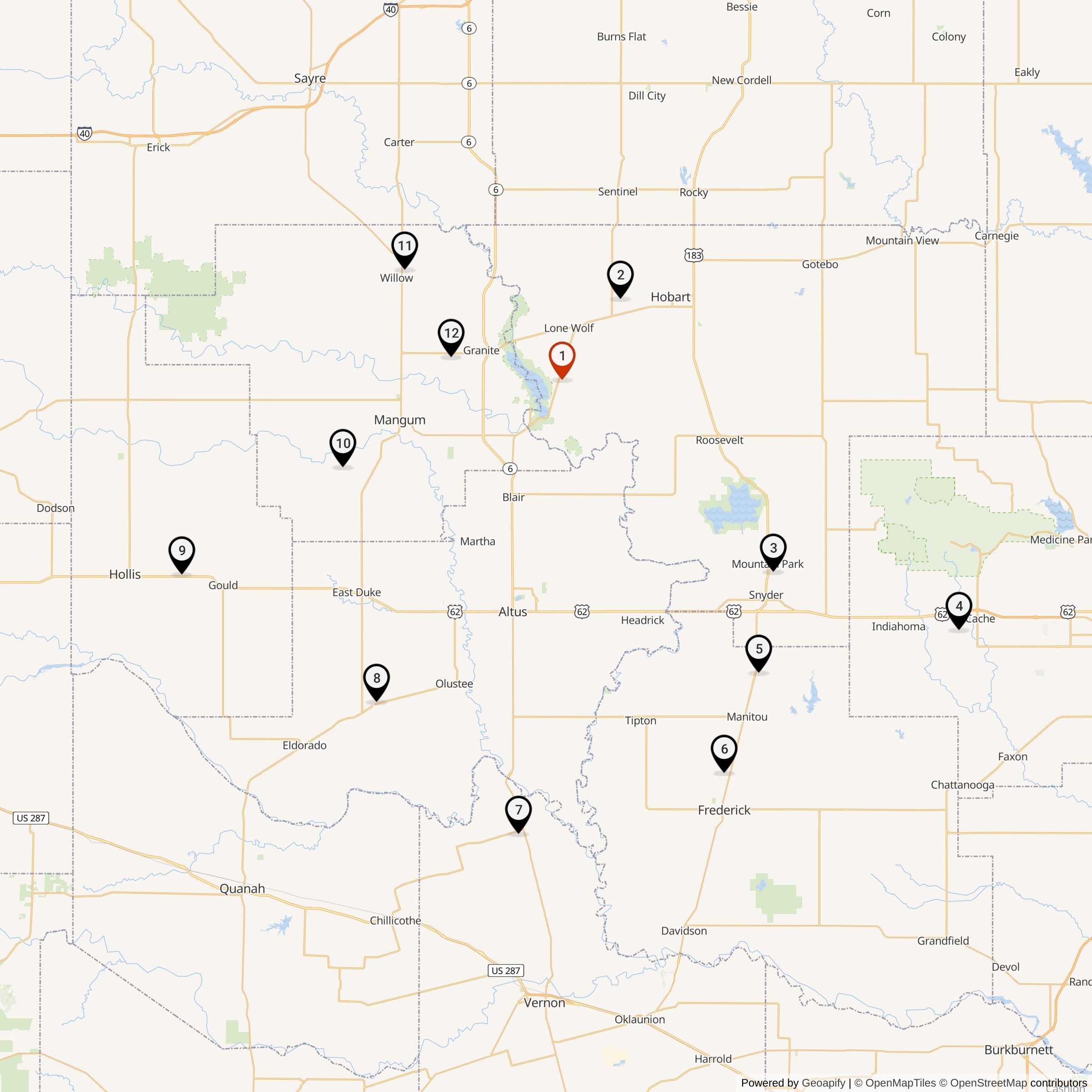
Site 577-1 was placed in the open agricultural landscape of Kiowa County, west-northwest of the Altus AFB support base and near the small communities of Lone Wolf and Lugert. This part of southwestern Oklahoma offered the Air Force the wide dispersal, road access, and low-density land use needed for first-generation ICBM basing. The site was one of twelve launch complexes arranged in a broad ring around Altus AFB, with eleven in Oklahoma and one near Fargo, Texas. The dispersal pattern reduced the chance that a single enemy weapon could destroy the entire missile force and also gave each missile complex its own physical security perimeter, power, support systems, and launch-control facilities.
The Atlas F site type was a vertical silo launch complex. Unlike the earlier Atlas D and Atlas E configurations, which stored the missile horizontally and raised it before launch, the Atlas F missile remained upright in a hardened underground silo. The complex included the deep launch silo, a below-grade launch control center, an access portal, connecting tunnel or utility passage, propellant and support systems, surface access roads, fencing, and hardened or semi-hardened structures associated with the elevator-launcher and crew operations. Public descriptions of Atlas F complexes identify the silo as roughly 176 to 180 feet deep and paired with an underground launch control center. At launch, the missile would be brought to the surface by the silo elevator after liquid-oxygen loading was completed.
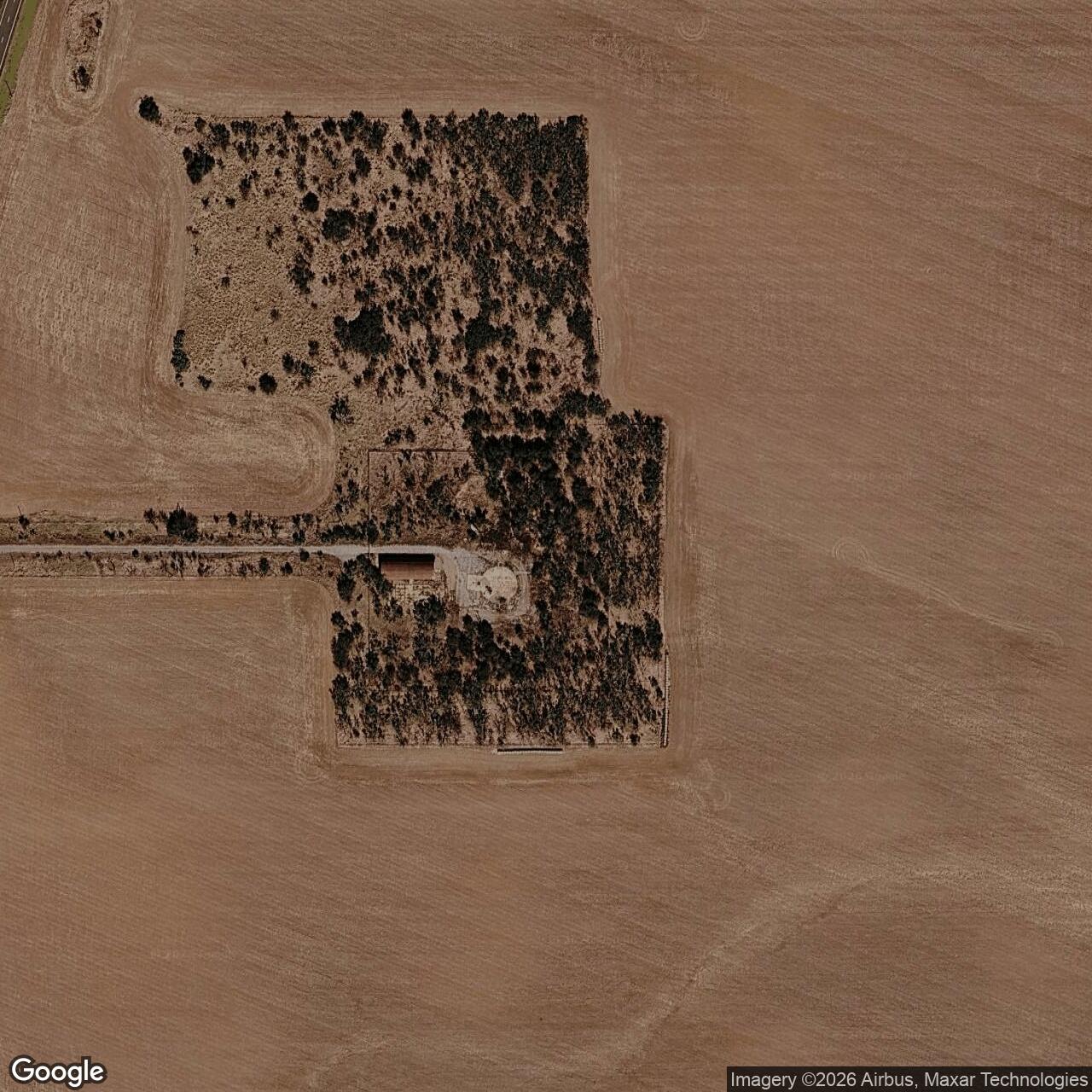
Aerial photographs show the surviving Site 1 footprint in an agricultural setting. The surface remains visible as a distinct cleared and disturbed complex surrounded by trees and cultivated fields. Visible features include the access road, the main surface entry area, the apparent silo/headworks area, and support or cover structures.
Strategic and Cold War Context
Site 577-1 existed because the United States rushed to deploy a survivable intercontinental ballistic missile force during the early Cold War. The Atlas family was America's first operational ICBM system. Its deployment came at a time when Strategic Air Command still relied heavily on bomber alert forces, but national policy and military planning increasingly required land-based missiles that could reach Soviet targets from the continental United States.The Atlas F was the final operational Atlas ICBM variant. It represented an effort to make the liquid-fueled Atlas more survivable and faster to launch than earlier Atlas basing modes. Earlier Atlas launchers were vulnerable aboveground or in coffin-style structures, and they involved a sequence in which the missile had to be raised, serviced, and fueled. Atlas F improved survivability by placing each missile vertically in a hardened underground silo with an adjoining control center. The missile still used RP-1 kerosene and liquid oxygen, so it could not match the quick reaction and reduced maintenance burden of later solid-fueled Minuteman missiles. But it could sit on alert with RP-1 aboard, receive liquid oxygen at the start of the countdown, and then be raised on its elevator to the surface for firing.
This made the Altus Atlas F field an important transitional system. It was more hardened and dispersed than the earliest Atlas deployments, yet it still carried the operational complexity of large liquid-fueled missiles. Site 577-1 therefore illustrates the narrow window between the first deployment of operational ICBMs and the rapid move to solid-fueled, more maintainable missile systems.
Construction and Activation
The Altus Atlas F program was announced publicly in early 1960. In April 1960 the U.S. Army Corps of Engineers, Tulsa District awarded the basic construction contract for the Altus Atlas F launch complexes to Morrison-Knudsen and Hardeman and Associates, whose combined bid was just over $20.9 million. The overall Altus missile project required land acquisition across six counties. The Real Estate Division of the Tulsa District filed condemnation suits against hundreds of landowners to acquire the needed property for the twelve dispersed launch complexes.Site 577-1's construction began on 1960-05-09. It was the Corps of Engineers construction Site Number 1 and the Air Force operational Site Number 1. Site construction took place in the same challenging environment that affected other first-generation missile projects. The Atlas missile was still evolving while construction was underway, which meant that design changes, engineering revisions, and equipment-interface changes had to be incorporated into facilities already being built. Corps accounts of the Altus program describe paperwork and design changes moving through a priority system, while overall missile-construction management shifted in late 1960 to the Corps of Engineers Ballistic Missile Construction Office.
The construction effort involved heavy excavation, deep concrete work, propellant systems, command-control infrastructure, and integration of contractor, Air Force, Corps, and Convair/General Dynamics personnel. The Altus sites also faced the usual first-generation missile construction problems: high water tables at some locations, difficult coordination among multiple organizations, construction fires, work stoppages, and the technical challenges of installing clean and reliable propellant loading systems. Although those problems were not all specific to Site 577-1, they shaped the field in which Site 1 was built.
Site 577-1 was turned over to the Air Force on 1961-09-06. Its assigned missile, General Dynamics manufacturing number 43F, was accepted on 1962-01-31 and delivered on 1962-03-06. Official sources differ slightly on the date when the Altus Atlas F sites became fully operational: a USAF unit-history compilation lists turnover to SAC and operational status on 1962-10-09, while the official Altus AFB chronology and the Oklahoma Historical Society state that the missile silos became operational on 1962-10-10. The safest interpretation is that Site 577-1 became part of the operational Altus Atlas F force in early October 1962, immediately before or during the opening phase of the Cuban Missile Crisis.
Missile System and Technical Role
Site 577-1 housed the SM-65F Atlas, later commonly identified as HGM-16F in post-1962 missile-designation terminology. The Atlas F was a liquid-fueled, one-and-one-half-stage ICBM built by Convair/General Dynamics. It used RP-1 kerosene and liquid oxygen, with a booster-sustainer engine arrangement rather than the later multi-stage solid-fuel design of Minuteman. The Atlas F was stored vertically on an elevator inside its underground silo. During launch preparation, the missile received liquid oxygen, the silo doors opened, and the missile and launcher were raised to the surface before firing.The Association of Air Force Missileers describes Atlas F as an SM-65F/HGM-16F system housed in a vertical silo with an adjoining control center, hardened to 100 psi overpressure, using inertial guidance. This was a significant improvement over radio-guided Atlas D sites and contributed to the Atlas F role as the most advanced of the Atlas ICBM deployments. The missile nevertheless remained a liquid-fueled weapon that demanded intensive maintenance and careful propellant handling.
Site 577-1's assigned missile was Atlas 43F, Air Force tail number 529, serial number 61-2529, and its payload was the W-38 thermonuclear warhead. The National Air and Space Museum identifies the Mark 4 reentry vehicle as used on Titan I and Atlas E/F missiles and states that it carried a W-38 nuclear warhead with a yield of about 3.75 megatons. Public W-38 summaries identify the reentry vehicle as the Avco Mark 4 ablative RV. No site-specific launch occurred from 577-1; the assigned missile was not launched and was later salvaged as scrap.
Operational History
The 577th Strategic Missile Squadron was organized at Altus AFB on 1961-06-01 and assigned to the 11th Bombardment Wing, later the 11th Strategic Aerospace Wing. Official Altus AFB chronology states that the squadron operated a complex of twelve Atlas F missile sites within a forty-mile radius of Altus. The Oklahoma Historical Society similarly describes twelve Atlas F sites activated in June 1961, with the missiles in underground silos and the launch facilities manned around the clock.Operational duty at Site 577-1 was unlike later Minuteman launch-facility duty. A Minuteman launch facility was normally unmanned and remotely controlled from a separate launch control center; an Atlas F complex, by contrast, included its own underground launch control center and required launch crews and support personnel to operate within or immediately around the complex. Personnel monitored missile status, communications, power, environmental controls, propellant systems, and security conditions. Maintenance crews and contractor specialists worked on the missile, silo, elevator, propellant systems, and command-control equipment. Security personnel protected the isolated facility and controlled access to the fenced complex.
The 577th SMS reached a crucial operational moment in 1962. USAF unit-history material states that the first Series F Atlas ICBM was placed on alert at the 577th SMS at Altus early in August 1962. By October 1962, all twelve Altus missiles were on alert in the context of the Cuban Missile Crisis. This made Site 577-1 part of one of the most intense alert periods in Strategic Air Command history. Although available sources do not identify a separate Site 1 incident during the crisis, the whole squadron was part of the U.S. nuclear alert posture while Soviet missiles in Cuba created the most dangerous direct nuclear confrontation of the Cold War.
Routine operations after the crisis involved the demanding daily work of a first-generation liquid-fueled missile force. The Atlas F system had improved basing and inertial guidance, but it still required extensive inspection, testing, and maintenance. Liquid oxygen handling, propellant-system cleanliness, missile pressurization, elevator readiness, and launch-control reliability all mattered. The operational burden of these systems was one reason the Atlas program had such a short active life once solid-fueled Minuteman missiles became available in increasing numbers.
Deactivation and Disposal
The Atlas F force had a very short operational life. By late 1964 and early 1965, the Department of Defense was phasing out the remaining Atlas ICBMs. USAF unit-history material records the first 577th SMS ICBM off alert on 1964-12-30, the last ICBM off alert on 1965-02-04, and the last ICBM shipped on 1965-02-10. The 577th Strategic Missile Squadron was inactivated on 1965-03-25.As with other Atlas F sites, decommissioning would have involved removal of the missile, removal or abandonment of specialized equipment, termination of active alert operations, and disposal or transfer of the real property. Available public sources do not provide a site-specific, step-by-step disposal record for Site 577-1 showing exactly which structures were sealed, removed, filled, or left in place. A 2009 Oklahoma business article on another Altus Atlas F silo reported that government personnel had helped seal off some former silos by filling them with concrete and welding doors shut, but that statement was not specific to Site 577-1 and should not be treated as a confirmed Site 1 condition.
The former Site 1 also appears in environmental records. The U.S. Army Corps of Engineers Formerly Used Defense Sites inventory lists LONEWOLF, Kiowa County, ATLAS MISSILE NO. 1, property number K06OK0401, site number 01, with an HTRW category. A U.S. General Accounting Office Oklahoma FUDS table also lists ATLAS MISSILE NO. 1, K06OK0401, Kiowa County, as eligible and hazardous, with three eligible projects and cleanup cost figures recorded in thousands of dollars. ProPublica's DERP-based Bombs in Our Backyard dataset lists ATLAS MISSILE NO. 1 at Lonewolf, Kiowa County, with one hazardous site and a highest-risk status of Response Complete. These sources indicate that the former launch complex entered the former-defense-site environmental system and that the response is recorded as complete, but they do not provide a detailed remediation narrative for the physical silo structure.
Current Status and Site Use
Site 577-1 is no longer an active military installation. It is a decommissioned former Atlas F launch complex on private property in Kiowa County. Modern imagery and historical aerial photographs show the former complex remains visible in the agricultural landscape, with a distinguishable access road, tree-covered site footprint, and surviving surface or near-surface features. The silo and launch-control structures should be assumed to remain hazardous or inaccessible unless a current owner and lawful access arrangement states otherwise.Current ownership is non-federal/private, but the individual owner was not verified in public sources. A 2009 Journal Record article on the restoration of the Hobart Atlas F silo reported that several other Altus-area sites, including Lone Wolf, were also in private hands, though the article could not confirm individual owners. The site should be treated as private property with no public access.
Chronology
- 1960-01 Public officials announced plans for an Atlas F missile facility associated with Altus AFB.
- 1960-04 The Corps of Engineers, Tulsa District awarded the Altus Atlas F construction contract to Morrison-Knudsen and Hardeman and Associates.
- 1960-05-01 Official Altus AFB chronology states that construction began on the first of twelve Atlas F missile sites around Altus.
- 1960-05-09 Construction began at Atlas F Site 577-1 near Lone Wolf, Oklahoma.
- 1960-10 The Tulsa District Real Estate Division filed condemnation suits for land needed for the Altus Atlas F field.
- 1960-11 Construction management responsibility shifted to the Corps of Engineers Ballistic Missile Construction Office.
- 1961-06-01 The 577th Strategic Missile Squadron was organized at Altus AFB.
- 1961-09-06 Site 577-1 was turned over to the Air Force.
- 1962-01-31 Atlas missile 43F / tail number 529 was accepted.
- 1962-03-06 Atlas missile 43F / tail number 529 was delivered for the Altus operational ICBM mission.
- 1962-04-01 The 11th Bombardment Wing was redesignated the 11th Strategic Aerospace Wing.
- 1962-08 The first Series F Atlas ICBM at the 577th SMS was placed on alert.
- 1962-10-09 USAF unit-history material lists SAC turnover and operational status for the 577th SMS missile force.
- 1962-10-10 Official Altus AFB and Oklahoma Historical Society chronologies state that the Atlas F missile silos became operational.
- 1962-10 The 577th SMS Atlas F sites were on alert during the Cuban Missile Crisis.
- 1964-05-14 A propellant-loading explosion destroyed squadron launch complex 577-6 near Frederick, Oklahoma; this did not occur at Site 577-1.
- 1964-12-30 USAF unit-history material records the first 577th SMS ICBM removed from alert.
- 1965-02-04 USAF unit-history material records the last 577th SMS ICBM removed from alert.
- 1965-02-10 USAF unit-history material records the last 577th SMS ICBM shipped out.
- 1965-03-25 Site 577-1 was decommissioned and the 577th Strategic Missile Squadron was inactivated.
- 2015-09-30 The USACE FUDS Oklahoma inventory listed LONEWOLF, ATLAS MISSILE NO. 1, K06OK0401, site 01, as an HTRW entry.
- 2017 ProPublica's DERP-based Bombs in Our Backyard dataset listed ATLAS MISSILE NO. 1 at Lonewolf, Kiowa County, with Response Complete status.
Read about the Atlas at Altus AFB
All Atlas Missile Silo Locations