
Atlas F Site 577-7 Missile Silo, Fargo Texas
Longitude: -99.3244834258309
Site Type: Atlas F vertical silo launch facility
Missile Type: SM-65F Atlas
Missile Assigned to this Silo: GD mfg 41F; GD serial 61-2527; AF tail 527; accepted 1961-12-29; delivered 1962-02-13; not launched / salvaged as scrap.
Number of Launchers/Missiles: 1
Parent Base: Altus AFB
Missile Wing: 11th Bombardment Wing; 11th Strategic Aerospace Wing after 1962-04-01
Missile Squadron: 577th Strategic Missile Squadron
Approximate Base Size: Approx. 8-acre FUDS property (ESI; original acquisition acreage not verified)
Current Site Use: Former Atlas F silo complex / Northside School Farm property; Northside ISD considered sale in 2023; current post-sale status not verified.
Site Ownership: Northside Independent School District No. 905 documented after 1967 conveyance and in 2023 board agenda; final current owner after proposed sale not verified.
Accessible: No public access / non-public school-district or private property; observe only from public roads unless owner grants permission.
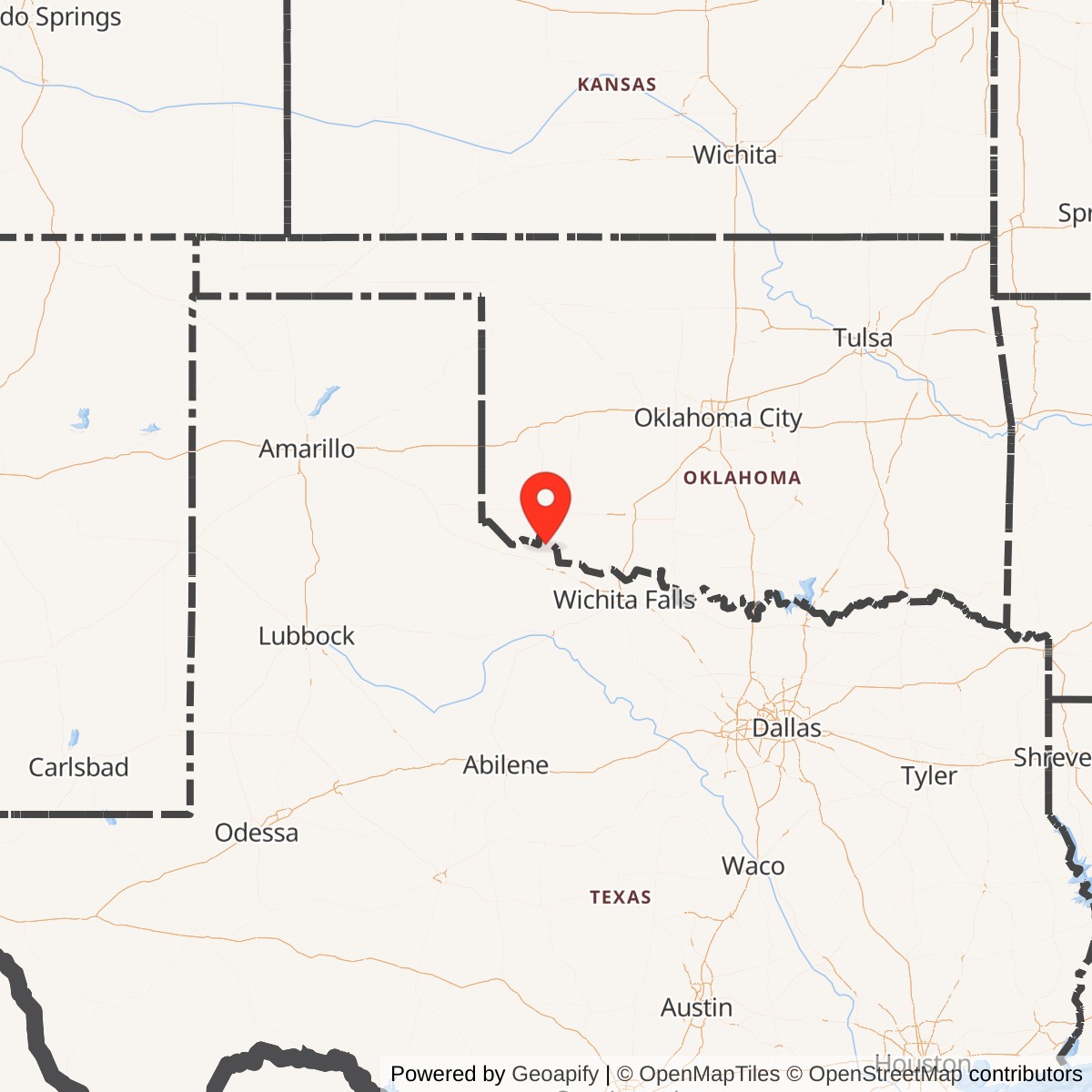
Atlas F Site 577-7 was one of the twelve SM-65F Atlas intercontinental ballistic missile launch complexes assigned to the 577th Strategic Missile Squadron at Altus Air Force Base, Oklahoma. The site was the squadron's Site 7, located in Wilbarger County, Texas, near Fargo and southeast of Ranchland, with the federal environmental record also identifying it by Vernon, Texas.
The site belonged to the 11th Bombardment Wing, which was redesignated the 11th Strategic Aerospace Wing on 1962-04-01, and to the 577th Strategic Missile Squadron, the Atlas F missile unit assigned to Altus AFB. Because Atlas F launch complexes were self-contained vertical-silo sites with an underground launch-control center at the complex itself, rather than Minuteman-style unmanned launch facilities controlled from a separate remote launch control center.
Site 577-7 is inactive and decommissioned as a military missile installation. Construction at the site began on 1960-05-24, the site was turned over to the Air Force on 1961-11-08, and the Altus Atlas F missile force became operational in October 1962. The site remained part of the operational 577th Strategic Missile Squadron until the Atlas F weapon system was removed from service in 1965. Site 577-7 was decommissioned on 1965-03-25, the same date on which the 577th Strategic Missile Squadron was inactivated.
Its assigned operational missile was General Dynamics Atlas missile 41F, serial number 61-2527, Air Force tail number 527. The missile was accepted on 1961-12-29 and delivered on 1962-02-13. Unlike some former Atlas F missiles that later flew as space-launch or test vehicles, the Site 577-7 missile is listed as not launched and salvaged as scrap.
The former missile property later entered the Formerly Used Defense Sites environmental record as ATLAS MISSILE NO. 7 / K06TX0063, also cross-referenced in public records as K06OK0407. Searchable portions of the 2001 Expanded Site Investigation for Former Atlas Missile Site No. 7 state that the FUDS property covers approximately 8 acres in farmland. The investigation also indicates that the property was conveyed to Northside Independent School District No. 905 of Vernon, Texas, in 1967, and later public school-board records identify the property as the Northside School Farm and describe it as the former Atlas Missile Site #7 located about one-half mile west of U.S. Highway 283 and south of FM 91. A 2023 Northside ISD board agenda considered authorizing sale of the Northside School Farm; final post-sale ownership was not verified. The site should be treated as a decommissioned former missile complex with no public access.
Location, Landscape, and Site Description
Site 577-7 is in the rolling agricultural country of Wilbarger County in north Texas, close to the Oklahoma border and within the operational radius of Altus Air Force Base. Although missile listings commonly use Fargo, Texas, as the nearest town, environmental and school-district records often use Vernon, the larger local community and administrative reference point. The site sat within the same dispersed Altus missile field as the eleven Oklahoma launch complexes, but it was the one 577th SMS site located in Texas.The location was chosen for the same basic reasons as the other Altus Atlas F sites: distance, dispersal, road access, and operational support. Official Altus AFB history states that the 577th Missile Squadron activated in 1961 to operate twelve Atlas F missile sites within a forty-mile radius of Altus. Dispersal reduced the chance that a single enemy strike could destroy the entire force, while the sites remained close enough to the parent base for maintenance, supply, security response, communications, crew support, and wing administration.
Site 577-7 was not a simple surface launch pad. It was a major underground missile complex built around a reinforced-concrete vertical silo, an elevator-launcher, heavy overhead doors, an underground launch-control center, equipment and utility areas, propellant and liquid-oxygen handling systems, communications equipment, power systems, environmental-control equipment, security fencing, and a surface compound. In an Atlas F complex, the missile stood vertically inside the silo on its launcher. During alert the missile could be protected below grade, but it still had to be raised to the surface before launch.
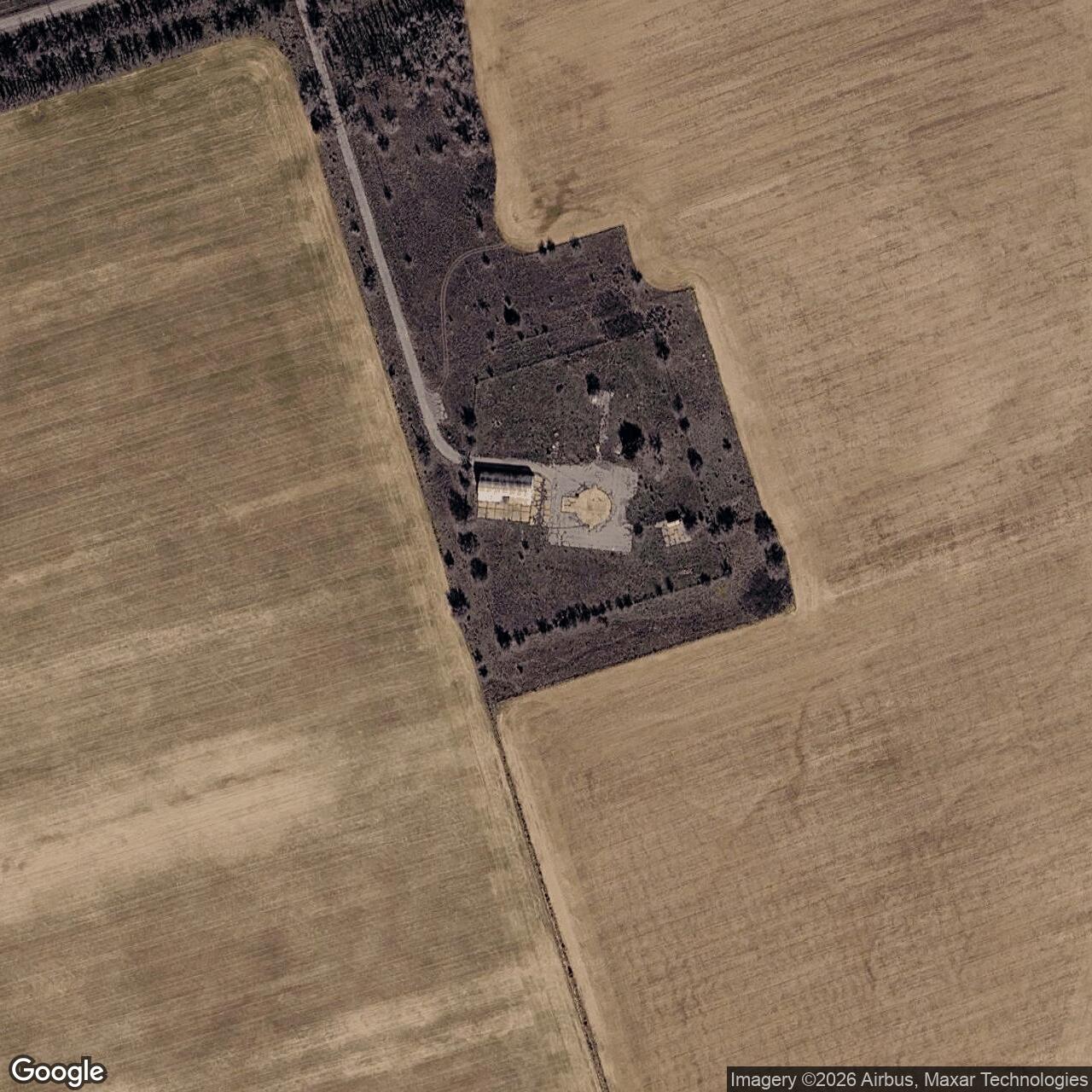
Satellite imagery (see below) shows the site as a recognizable former Atlas F compound in farmland.
Strategic and Cold War Context
Site 577-7 existed because the United States was rapidly constructing a hardened land-based nuclear deterrent during the most intense years of the early Cold War. Atlas was the first operational American intercontinental ballistic missile. The system was developed when Strategic Air Command still depended heavily on bomber aircraft but needed missiles that could be kept on alert and could reach intercontinental targets from bases in the United States.The National Park Service identifies Atlas F as the most advanced operational Atlas version and describes it as held in a blast-proof silo-lift configuration, with 72 Atlas F missiles deployed at six bases: Schilling, Lincoln, Altus, Dyess, Walker, and Plattsburgh. The F model was important because it placed the missile in a vertical underground silo rather than in the more exposed arrangements used by earlier Atlas models. That improved survivability, but it did not make Atlas F a modern solid-fuel missile. Atlas F was still a liquid-propellant system, using RP-1 fuel and liquid oxygen oxidizer. The missile could keep RP-1 aboard while on alert, but liquid oxygen had to be loaded during the countdown. The missile then had to be elevated from the silo before launch.
The Altus Atlas F field became operational at a historically significant moment. USAF unit-history material lists Strategic Air Command turnover and operational status on 1962-10-09, while official Altus AFB chronology gives 1962-10-10 for the missile silos becoming operational. Either date places the field's entry into active missile service immediately before the Cuban Missile Crisis reached its most dangerous phase. During that crisis, the 577th SMS Atlas F sites formed part of the United States' strategic alert posture.
Site 577-7's position in Texas also illustrates the practical geography of missile-field design. The field was centered on Altus AFB in Oklahoma, but missile dispersal followed operational distance and available land rather than state lines. The Texas site remained part of the Altus-based 577th SMS and 11th Strategic Aerospace Wing system, not a Dyess AFB site. It was the Texas outlier of an Altus-operated missile field.
Construction and Activation
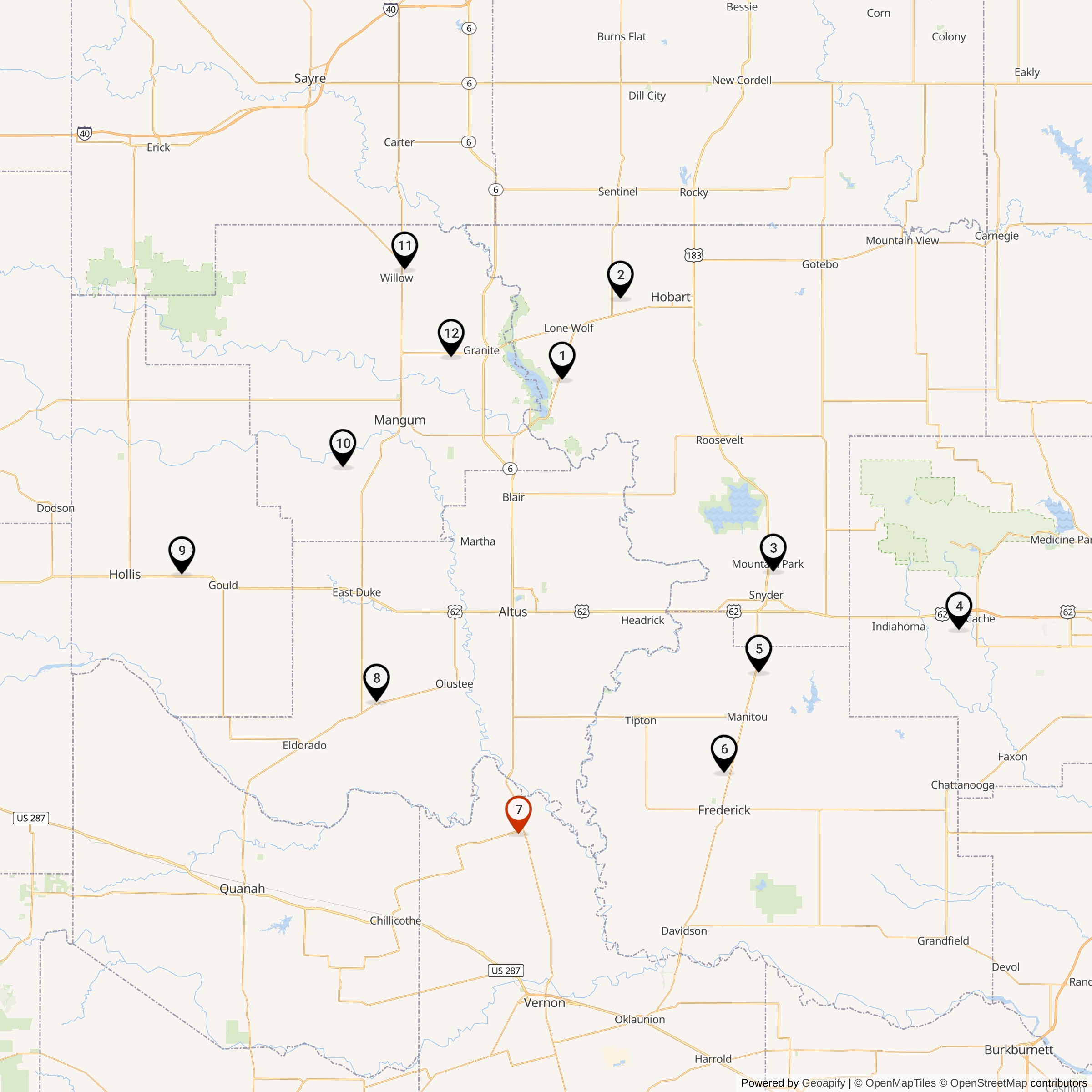
Construction of the Altus Atlas F missile field began as part of the national program to deploy hardened ICBM launchers at dispersed inland locations. Official Altus AFB chronology states that construction began on the first of the twelve Atlas F sites around Altus on 1960-05-01. USAF unit-history material records that the Corps of Engineers, Tulsa District awarded the basic construction contract to Morrison-Knudsen and Hardeman and Associates, whose combined bid was just over $20.9 million. The same summary states that the twelve launcher locations included Lone Wolf, Hobart, Snyder, Cache, Manitou, Frederick, Creta, Hollis, Russell, Willow, and Fargo, Texas, and that land acquisition for the missile field involved condemnation suits against 477 landowners in six counties surrounding Altus to acquire 12,879 acres.Construction at the Texas site began on 1960-05-24. Work at an Atlas F complex required excavation of the deep silo, construction of reinforced-concrete underground structures, installation of the elevator-launcher, construction of the underground launch-control and equipment areas, installation of electrical, communications, propellant, liquid-oxygen, ventilation, power, and security systems, and integration of the site with the missile and Strategic Air Command operating procedures.
The Altus construction program faced the broader first-generation ICBM construction problem known as concurrency. The missile, launch equipment, and operational procedures were still changing while the sites were being built. USAF unit-history material describes the Tulsa District's efforts to manage changing requirements and notes that responsibility for ballistic-missile construction was transferred to the Corps of Engineers Ballistic Missile Construction Office in November 1960. The same material records that the Altus project experienced coordination difficulties among the Corps of Engineers, the contractor, the Site Activation Task Force, and Convair/General Dynamics integration personnel, along with high water tables at some sites, underground cavities at one site, short work stoppages, project-related fatalities, fires, and difficult propellant-loading-system installation and testing.
Site 577-7 was turned over to the Air Force on 1961-11-08. Turnover meant that the facility had reached a stage suitable for Air Force acceptance and activation work; it did not by itself mean that the site was on nuclear alert. That transition required site checkout, missile acceptance and delivery, crew and maintenance certification, propellant-system readiness, communications integration, security procedures, and SAC acceptance. The assigned missile, Atlas 41F / serial number 61-2527 / tail number 527, was accepted on 1961-12-29 and delivered on 1962-02-13. The 577th SMS missile force then reached operational status in October 1962.
Missile System and Technical Role
Site 577-7 was an SM-65F Atlas launch complex. Atlas F was the final operational Atlas ICBM variant and the vertical-silo member of the Atlas family. The missile used a one-and-one-half-stage design with liquid propulsion, RP-1 fuel, liquid oxygen oxidizer, inertial guidance, and a silo-lift launch arrangement. The Air Force's F.E. Warren Atlas fact sheet describes the Atlas as Strategic Air Command's first intercontinental ballistic missile and explains the basic silo-elevator concept: because Atlas could not be launched from inside its underground silo, an elevator raised it to ground level for launch.The Site 577-7 missile was stored vertically in the silo on an elevator-launcher. During a launch sequence the complex would open its heavy silo doors, load liquid oxygen, raise the missile and launcher to the surface, complete final countdown functions, and launch the missile from above grade. Atlas F reduced reaction time compared with earlier Atlas configurations, but the launch sequence remained more complicated than that of later solid-fueled ICBMs. The missile had to be attended by a trained crew and supported by maintenance, propellant, security, communications, and power systems.
The public technical sources identify the Atlas F weapon system as armed with the Mark 4 reentry vehicle carrying the W-38 nuclear warhead. The Smithsonian National Air and Space Museum describes the Mark 4 reentry vehicle as used on U.S. Air Force Atlas E/F and Titan I ICBMs in the early 1960s, carrying a W-38 warhead with a yield of about 3.75 megatons.
Site 577-7's assigned missile was General Dynamics Manufacturing Number 41F, serial number 61-2527, Air Force tail number 527. The missile was accepted on 1961-12-29, delivered on 1962-02-13, was not launched, and was later salvaged as scrap. That history contrasts with other former Atlas missiles that were converted to space-launch or test roles after ICBM retirement.
Operational History
Site 577-7's operational history was short, intense, and typical of the first generation of American ICBM basing. The 577th Strategic Missile Squadron was organized at Altus AFB on 1961-06-01 under the 11th Bombardment Wing, later the 11th Strategic Aerospace Wing. Its mission was to operate twelve dispersed Atlas F missiles around Altus. The official Altus AFB fact sheet states that the missiles sat inside underground silos with launch facilities that were manned around the clock, and that the Altus missile silos became operational on 1962-10-10.Each Atlas F complex was a crewed operational site, not simply a remotely monitored unmanned silo. Launch crews, security personnel, maintenance teams, propellant specialists, communications personnel, and wing-support functions were required to keep the site ready. The crew at a site such as 577-7 lived with the practical demands of an early liquid-fueled ICBM: propellant-system maintenance, environmental control, power generation, communications checks, security routines, launch-readiness inspections, and repeated operational testing. The site was part of Strategic Air Command's alert force, and its value came from being ready at a moment of crisis rather than from any peacetime launch.
The Cuban Missile Crisis came almost immediately after the Altus Atlas F force became operational. SAC history and later squadron summaries record that the 577th SMS had its Atlas F missiles on heightened alert during the crisis. The 577th missile field, including Site 577-7, was part of the U.S. strategic posture during the confrontation with Soviet missiles in Cuba. The site's Texas location did not change its operational chain of command; it remained an Altus-based Atlas F launch complex.
The site did not experience the kind of known catastrophic accident that destroyed Site 577-6 near Frederick in May 1964. That accident was a 577th SMS event and heavily affected the squadron and the national view of Atlas F safety, but it did not occur at Site 577-7. Nevertheless, the accident helps explain the operational environment in which all Altus Atlas F sites functioned. Atlas F required liquid oxygen loading and complex propellant equipment, and the system's operational burden was substantial. The short service life of Site 577-7 reflects both the speed with which Atlas F was fielded and the speed with which solid-fueled Minuteman made it obsolete.
By late 1964 the Atlas program was nearing the end of its ICBM role. SAC Missile Chronology records that on 1964-11-19 Secretary of Defense Robert S. McNamara announced that all remaining first-generation ICBMs, including Atlas F, would be phased out by the end of June 1965. USAF unit-history material records that the first 577th SMS ICBM came off alert on 1964-12-30, the last came off alert on 1965-02-04, and the last missile was shipped on 1965-02-10. The 577th Strategic Missile Squadron was inactivated on 1965-03-25.
Deactivation and Disposal
Site 577-7 left active missile service as part of the rapid retirement of the first-generation Atlas ICBM force. The Atlas F system had entered operational service only in the early 1960s, but by 1964 and 1965 it was already being displaced by newer solid-fueled missile systems, especially Minuteman. Secretary of Defense McNamara's 1964 announcement accelerated the phaseout of Atlas D, Atlas E, Atlas F, and Titan I ICBMs. For the 577th SMS, missiles began coming off alert in late 1964, with the last 577th SMS missile off alert by 1965-02-04 and the last missile shipped by 1965-02-10. The squadron was inactivated on 1965-03-25.The assigned Site 577-7 missile, Atlas 41F / tail number 527, did not later fly as a space-launch vehicle, it was salvaged as scrap. The site itself was not a later arms-control treaty demolition case. It was retired before the START-era procedures that required standardized silo elimination, inspection, and treaty verification. Its afterlife was therefore shaped by surplus property disposal, local ownership, environmental investigation, and the physical persistence of the underground facility rather than by formal arms-control demolition.
Searchable portions of the Former Atlas Missile Site No. 7 Expanded Site Investigation state that the FUDS property covers approximately 8 acres in farmland and that the Department of Defense removed underground storage tanks before conveyance of the property to Northside Independent School District No. 905 in 1967. Later environmental documentation and public datasets identify the site as a FUDS property. The USACE Texas FUDS inventory lists ATLAS MISSILE NO. 7 (K06OK0407), property number K06TX0063, at Vernon in Wilbarger County, with three project categories: BD/DR, HTRW, and CON/HTRW. ProPublica's DERP-derived Bombs in Your Backyard dataset lists ATLAS MISSILE NO. 7 (K06OK0407), Vernon, Wilbarger County, as Medium Risk.
Current Status and Site Use
Site 577-7 is a decommissioned former Atlas F launch complex in Wilbarger County, Texas. It is not an active military installation and no public museum or authorized visitor program was found for the site. The best documented post-military use is Northside School Farm, associated with Northside Independent School District. Public board records from 2023 identify the former Atlas Missile Site #7 as being located about one-half mile west of U.S. Highway 283 and south of FM 91 and show that the district considered authorizing sale of the property. Final current ownership after that proposed sale was not verified.The site should be treated as non-public property with no public access. The underground areas of former Atlas F complexes can be hazardous because of confined spaces, water, structural deterioration, old utilities, environmental contamination, and fall hazards. No condition assessment suitable for public-access guidance was found. Viewing should be limited to lawful observation from public roads unless the current owner gives explicit permission.
Chronology
- 1960-01 Public announcements identified Altus AFB as the future hub for twelve Atlas F missile sites in southwestern Oklahoma and nearby Texas.
- 1960-05-01 Official Altus AFB chronology states that construction began on the first of twelve Atlas F missile sites around Altus AFB.
- 1960-05-24 Construction began at Atlas F Site 577-7 near Fargo, Texas.
- 1961-06-01 The 577th Missile Squadron activated at Altus AFB to operate twelve Atlas F launch sites.
- 1961-11-08 Site 577-7 was turned over to the Air Force.
- 1961-12-29 Atlas missile 41F / serial number 61-2527 / tail number 527 was accepted.
- 1962-02-13 Atlas missile 41F was delivered for the Altus operational ICBM mission.
- 1962-04-01 The 11th Bombardment Wing was redesignated the 11th Strategic Aerospace Wing.
- 1962-08 USAF unit-history material records the first Series F Atlas ICBM at the 577th SMS placed on alert early in the month.
- 1962-10-09 USAF unit-history material lists SAC turnover and operational status for the 577th SMS missile force.
- 1962-10-10 Official Altus AFB chronology states that the Atlas F missile silos became operational.
- 1962-10 The 577th SMS Atlas F sites were on heightened alert during the Cuban Missile Crisis.
- 1964-05-14 A propellant-loading explosion destroyed squadron Site 577-6 near Frederick, Oklahoma; this did not occur at Site 577-7.
- 1964-11-19 Secretary of Defense Robert S. McNamara announced the planned phaseout of Atlas D, Atlas E, Atlas F, and Titan I missiles by the end of June 1965.
- 1964-12-30 USAF unit-history material records the first 577th SMS ICBM removed from alert.
- 1965-02-04 USAF unit-history material records the last 577th SMS ICBM removed from alert.
- 1965-02-10 USAF unit-history material records the last 577th SMS ICBM shipped.
- 1965-03-25 Site 577-7 was decommissioned and the 577th Strategic Missile Squadron was inactivated.
- 1967 The former Site 577-7 property was conveyed to Northside Independent School District No. 905 of Vernon, Texas, according to environmental-report excerpts.
- 2001 An Expanded Site Investigation was completed for Former Atlas Missile Site No. 7, Vernon, Texas.
- 2002 A Remedial Investigation Report was prepared for Former Atlas Missile Site No. 7, Vernon, Texas.
- 2015-09-30 The USACE FUDS Texas inventory listed VERNON, ATLAS MISSILE NO. 7 (K06OK0407), K06TX0063, with BD/DR, HTRW, and CON/HTRW entries.
- 2017 ProPublica's DERP-based Bombs in Your Backyard dataset listed ATLAS MISSILE NO. 7 at Vernon, Wilbarger County, Texas, as Medium Risk.
- 2023-10-16 Northside ISD's public board agenda considered a resolution authorizing sale of the Northside School Farm, identified as the former Atlas Missile Site #7.
Read about the Atlas at Altus AFB
All Atlas Missile Silo Locations