
Atlas F Site 577-3 Missile Silo, Snyder Oklahoma
Longitude: -98.9410942957014
Site Type: Atlas F vertical silo launch facility
Missile Type: SM-65F Atlas
Missile Assigned to this Silo: GD mfg 42F; GD serial 61-2528; AF tail 528; accepted 1962-01-31; delivered 1962-03-02; not launched / salvaged as scrap.
Number of Launchers/Missiles: 1
Parent Base: Altus AFB
Missile Wing: 11th Bombardment Wing; 11th Strategic Aerospace Wing after 1962-04-01
Missile Squadron: 577th Strategic Missile Squadron
Current Site Use: Former Atlas F silo complex in agricultural/private-property setting near Snyder; visible surface compound in public imagery; no documented public reuse or public-access program found.
Site Ownership: Private/non-federal ownership after surplus disposal; individual owner not verified.
Accessible: No public access / private property.
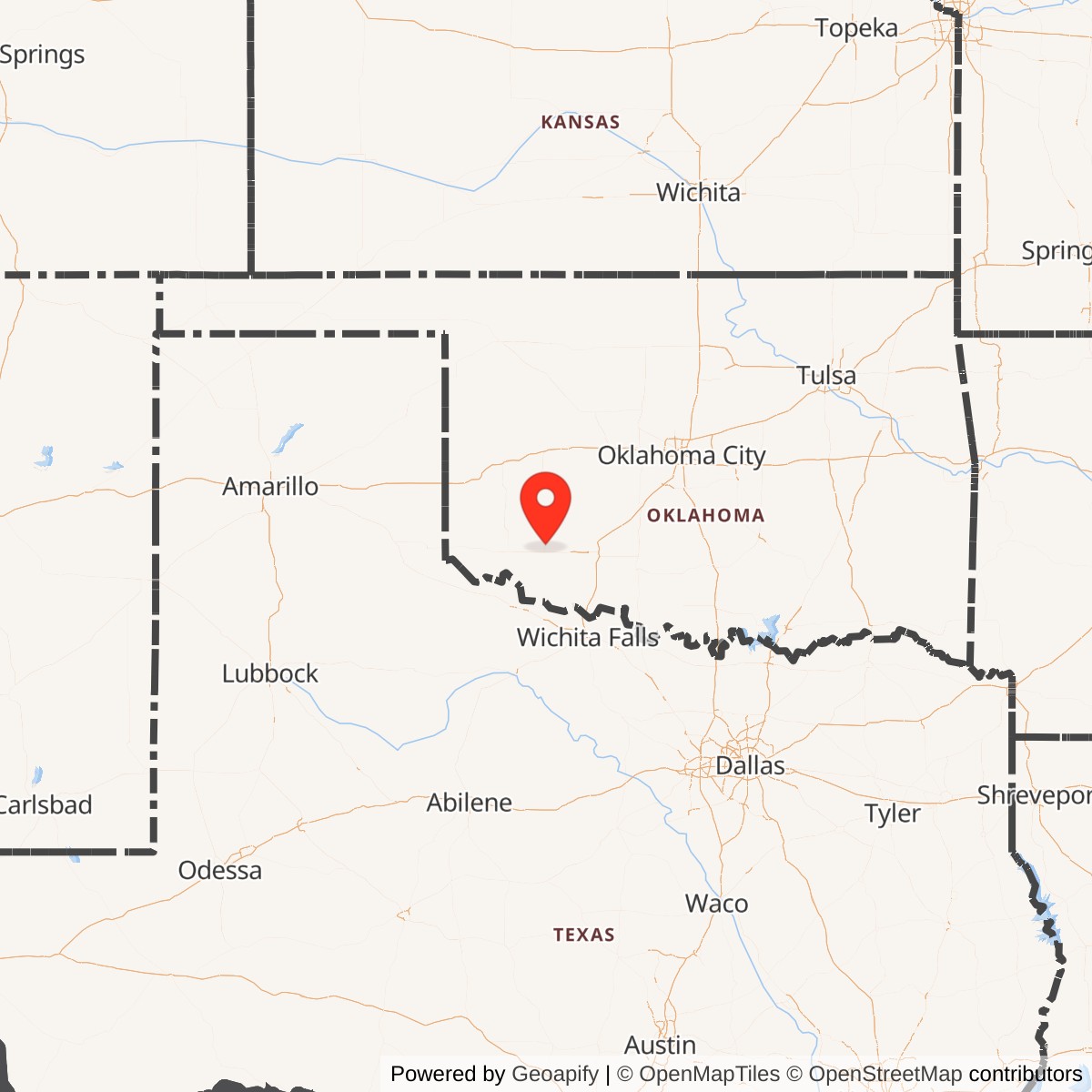
Atlas F Site 577-3 was one of the twelve SM-65F Atlas intercontinental ballistic missile launch complexes assigned to the 577th Strategic Missile Squadron at Altus Air Force Base, Oklahoma. The site was the squadron's Site 3, located in Kiowa County near Snyder in southwestern Oklahoma.
The site belonged to the 11th Bombardment Wing, which was redesignated the 11th Strategic Aerospace Wing on 1962-04-01, and to the 577th Strategic Missile Squadron, the Altus Atlas F missile unit. Atlas F launch complexes were self-contained vertical silo sites with their own underground launch-control center rather than Minuteman-style unmanned launch facilities controlled from a separate remote LCC.
Site 577-3 is inactive and decommissioned as a military installation. Construction at the site began on 1960-05-09, the site was turned over to the Air Force on 1961-08-01, and the Altus Atlas F missile force became operational in early October 1962. The site remained part of the operational 577th Strategic Missile Squadron until the Atlas F weapon system was removed from service in 1965. Site 577-3 was decommissioned on 1965-03-25, the same date on which the 577th Strategic Missile Squadron was inactivated.
Its assigned operational missile was General Dynamics Atlas missile 42F, serial number 61-2528, Air Force tail number 528. The missile was accepted on 1962-01-31 and delivered on 1962-03-02. Unlike some surplus Atlas missiles that were later reused for test or space-launch missions, Atlas 42F is listed as not launched and salvaged as scrap.
The former launch complex is now non-federal, private property. No public reuse, museum operation, or authorized visitor program was found for Site 577-3. The site should therefore be treated as a decommissioned former missile complex on private land with no public access.
Location, Landscape, and Site Description
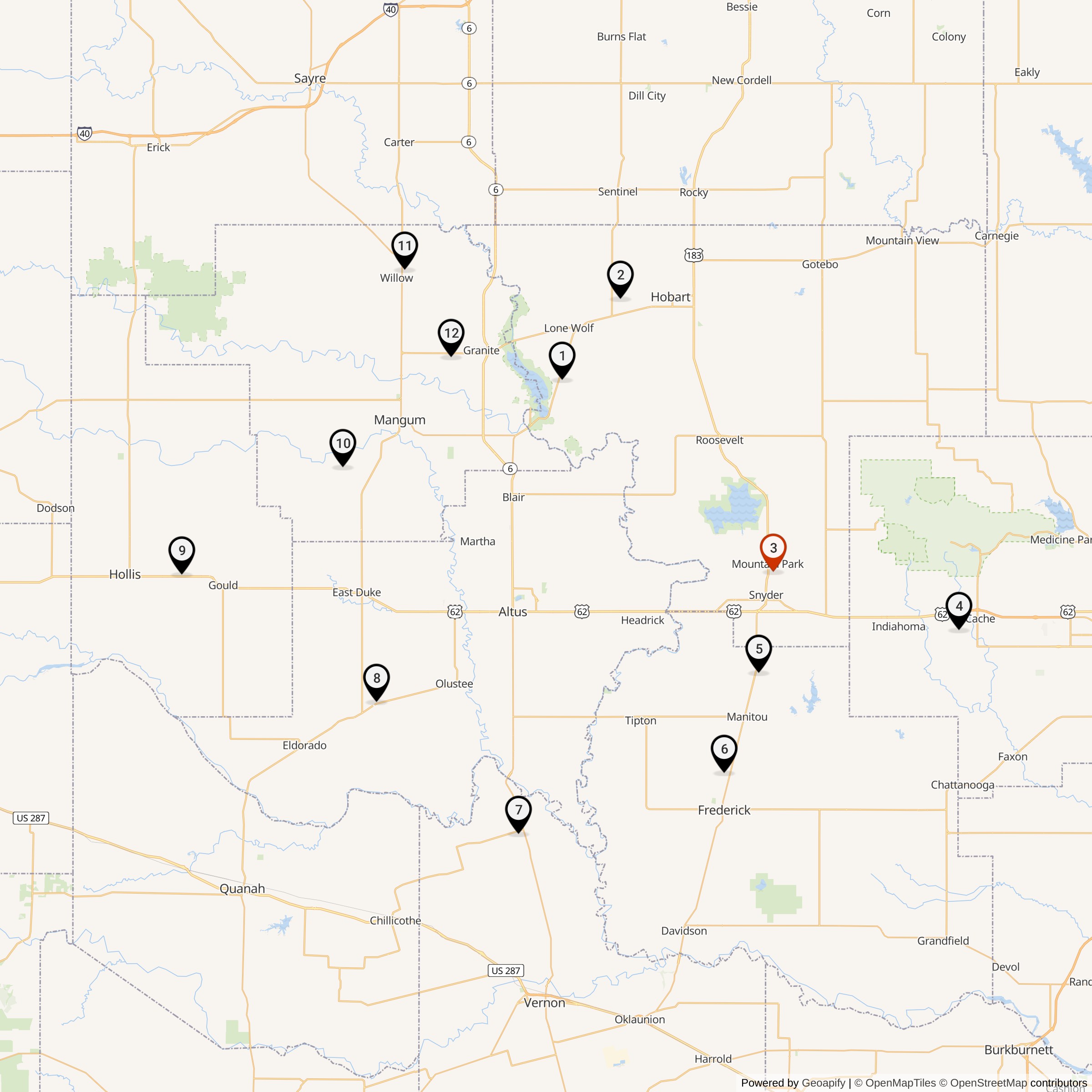
Site 577-3 occupies a rural agricultural setting in Kiowa County, Oklahoma, near Snyder and in the broader Mountain Park/Snyder area. The site was one of the twelve Altus Atlas F launch complexes placed in a broad ring around Altus Air Force Base. Official Altus AFB history states that the 577th Missile Squadron activated in 1961 to operate twelve Atlas F missile sites within a forty-mile radius of the base. That dispersal pattern was a central element of first-generation ICBM basing. It separated the launch complexes so that one attacking weapon could not destroy the entire missile force, while keeping the sites close enough to Altus for logistics, security response, maintenance, communications, and command administration.The Snyder area provided the Air Force with the kind of landscape it needed for an Atlas F site: open plains, agricultural land, low surrounding population density, road access, and enough separation from the parent base and the other launch complexes to support a dispersed nuclear-alert posture. The site was not simply a marker on a map or a small surface pad. Atlas F launch complexes were large engineered underground facilities that required deep excavation, reinforced concrete, silo doors, an elevator-launcher, utility systems, propellant systems, crew facilities, communications, fencing, and surface support structures.
Atlas F was the vertical-silo member of the operational Atlas family. A typical Atlas F complex included a deep cylindrical silo, a large elevator-launcher, two heavy silo doors, a below-grade launch-control center, tunnel or connecting passageways, environmental-control equipment, power generation and distribution equipment, propellant and liquid-oxygen support systems, antenna and communications equipment, access roads, fencing, and a controlled surface compound. The Western Oklahoma Historical Society describes the Altus-area Atlas F silos as deep, heavily reinforced concrete structures with a connected launch-control center where five-person crews served around the clock. The Association of Air Force Missileers describes the Atlas F as housed in a vertical silo with an adjoining control center, hardened to 100 psi overpressure, and raised to ground level by a large silo elevator before launch.
Strategic and Cold War Context
Site 577-3 existed because the United States was rapidly building a credible land-based nuclear deterrent during the early Cold War. The Atlas missile family was the first operational American intercontinental ballistic missile system. Atlas was developed in an era when Strategic Air Command still relied heavily on bomber aircraft, but national strategy increasingly required missiles that could reach intercontinental targets from the United States, remain on alert, and complicate Soviet attack planning.The Atlas F represented the most survivable operational Atlas basing concept. Atlas D used launch complexes with exposed gantry-type arrangements, and Atlas E stored the missile horizontally in a semi-hardened coffin launcher. Atlas F placed the missile upright in an underground silo. It still used liquid propulsion and therefore retained operational limitations that later solid-fueled missiles avoided, but the hardened silo made the missile more survivable and reduced its exposure before launch.
The missile used RP-1 kerosene fuel and liquid oxygen oxidizer. RP-1 could remain aboard the missile while it sat on alert, but liquid oxygen had to be loaded during the launch countdown. The missile would then be raised on the silo elevator before launch. This was more complex and slower than the near-instant readiness of later Minuteman missiles, but in 1962 the Atlas F force was a major step toward hardened, dispersed, land-based deterrence.
The Altus missile field became operational at a historically significant moment. Official Altus AFB chronology states that the 577th Missile Squadron's Atlas F sites became operational on 1962-10-10, immediately before the Cuban Missile Crisis reached its most dangerous phase. During that crisis, the operational Altus Atlas F force formed part of the United States' strategic nuclear-alert posture.
Construction and Activation
Construction of the Altus Atlas F missile field began under the larger national program to field hardened ICBM sites in the central United States. Official Altus AFB chronology states that construction began on the first of twelve Atlas F missile sites in the area around Altus AFB on 1960-05-01. The Western Oklahoma Historical Society places the ceremonial groundbreaking for the Altus-area missile sites on 1960-05-20 at Altus AFB. These events marked the beginning of a fast, large, and technically demanding construction program spread across southwestern Oklahoma and one nearby Texas site.Construction at Site 577-3 began on 1960-05-09. That makes the Snyder site one of the early construction starts in the Altus field. The site was listed as Corps of Engineers Construction Site Number 2 and Air Force Operational Site Number 3. Building an Atlas F complex required excavation of the silo shaft, placement of heavily reinforced concrete, installation of the steel launch-support structure, construction of the adjoining underground control center and tunnel, installation of mechanical and electrical systems, installation of propellant-support systems, construction of surface support features, and integration of the launch equipment with the Atlas missile and Strategic Air Command procedures.
The site was turned over to the Air Force on 1961-08-01. Turnover did not necessarily mean that the site immediately stood nuclear alert. It meant the facility had reached the stage at which Air Force and contractor organizations could continue with equipment checkout, missile acceptance, training, certification, and operational readiness. The site's assigned missile, Atlas 42F, was accepted on 1962-01-31 and delivered on 1962-03-02. The Altus Atlas F force then reached operational status in October 1962, just as the Cuban Missile Crisis placed Strategic Air Command on heightened alert.
The speed of the construction program reflected the strategic urgency of the time. The Atlas F sites were built before the United States had fully transitioned to solid-fueled ICBMs. They were expensive, complex, and labor-intensive, but they gave Strategic Air Command a hardened and dispersed missile capability during the narrow period between early experimental ICBM deployment and the more durable Minuteman era.
Missile System and Technical Role
Site 577-3 housed the SM-65F Atlas, later commonly identified as HGM-16F after the 1962 missile-designation changes. The Atlas F was a one-and-one-half-stage, liquid-fueled ICBM built by Convair/General Dynamics. It used a booster-and-sustainer arrangement and burned RP-1 fuel with liquid oxygen. The Atlas airframe depended on internal pressurization, a design feature inherited from the missile's earlier development history, so ground handling and alert operations required careful control of pressure, propellants, and support systems.The technical role of Site 577-3 was to keep one Atlas F missile on strategic alert as part of the 577th Strategic Missile Squadron. The missile itself stood vertically underground in the silo. A combat crew served at the launch complex, not at a distant Minuteman-style missile alert facility. The Association of Air Force Missileers describes Atlas F combat crews as including two officers and three enlisted members: a combat crew commander, deputy combat crew commander, missile facilities technician, ballistic missile analyst technician, and electric power production technician. The crew arrangement reflected the complexity of liquid-fueled Atlas operations, which required direct monitoring of missile, facility, power, communications, and support systems.
The launch sequence was more involved than that of later solid-fueled missiles. Public Atlas F descriptions explain that RP-1 fuel was kept aboard the missile, liquid oxygen was loaded during the countdown, and the missile was raised by the silo elevator to ground level before launch. The heavy silo doors then opened above the missile. This reduced the missile's exposure compared with earlier Atlas basing systems, but the missile still had to emerge from the silo before launch. That design explains why Atlas F was an important advance but also why it was quickly superseded by Minuteman.
Public museum sources identify the Mark 4 reentry vehicle as used on Atlas E/F and Titan I missiles in the early 1960s. The National Air and Space Museum states that the Mark 4 carried the W-38 nuclear warhead with a yield of about 3.75 megatons.
Operational History
The 577th Strategic Missile Squadron was activated at Altus AFB on 1961-06-01 to operate the twelve Atlas F launch complexes around the base. The squadron was assigned to the 11th Bombardment Wing and then the 11th Strategic Aerospace Wing after the wing's 1962 redesignation. Site 577-3 was one of the individual launch complexes that gave the squadron its dispersed field structure. The site was not an isolated symbolic installation; it was one operational node in a ring of armed ICBM sites intended to make the Altus missile force harder to destroy in a single attack.Operational Atlas F duty was demanding. The missile was a liquid-fueled weapon, the launch complex was mechanically complex, and crews had to monitor not only command and control but also power, environmental systems, propellant systems, and missile condition. Maintenance and contractor support were significant because the Atlas F system required continuous technical attention. Security forces protected the complex, controlled access, and responded to alarms, while missile maintenance teams traveled from the base or support locations to inspect, repair, and test systems.
Site 577-3's operational service coincided with the most dangerous part of the Cold War. The Altus Atlas F force became operational in October 1962. The Cuban Missile Crisis began the same month, and public histories of the 577th SMS state that the operational Altus Atlas F sites were placed at a high level of alert during the crisis. The Snyder site therefore belonged to a missile field that was not merely theoretical. Its first operational period came as the United States and Soviet Union faced the possibility of nuclear war.
The site's assigned missile, Atlas 42F, did not have a later test-launch career, it was not launched, and instead salvaged as scrap. This distinguishes Site 577-3 from some other Atlas F sites whose missiles were later reused in research, space-launch, or test programs after the operational ICBM mission ended. In this case, the missile's post-alert afterlife appears to have been disposal rather than reuse.
The 577th SMS did experience a major squadron-level accident during its operational period, but not at Site 577-3. On 1964-05-14, a propellant-loading explosion destroyed Site 577-6 near Frederick, Oklahoma, during a maintenance and modification sequence. That event is relevant to the squadron and the Atlas F system because it illustrates the hazards of liquid-fueled missile operations, but it should not be attributed to the Snyder site.
Deactivation and Disposal
Atlas F was a transitional weapon system. It gave Strategic Air Command a hardened vertical-silo ICBM capability, but it was expensive to operate and technically demanding. By the mid-1960s, solid-fueled Minuteman missiles offered faster reaction, lower operating complexity, and a more sustainable alert posture. Secretary of Defense Robert McNamara announced the phaseout of the remaining Atlas ICBMs in 1964, and the Altus Atlas F force was removed from service the following year.Site 577-3 was decommissioned on 1965-03-25. That date is also the inactivation date for the 577th Strategic Missile Squadron. Decommissioning meant the site no longer served as an operational ICBM launch complex. The missile was removed from strategic-alert status, the squadron was inactivated, and the property entered the broader pattern of surplus former Atlas F sites that were later transferred out of active Air Force use.
Site 577-3's closure occurred before the later Strategic Arms Reduction Treaty inspection and silo-elimination regimes that affected many Minuteman and Peacekeeper launch facilities. Atlas F sites such as 577-3 were retired as part of an early Cold War weapons-system phaseout rather than as START-era treaty-demolition cases. As a result, the site's later physical condition depended on surplus disposal, private reuse, environmental cleanup, and local land use rather than on the later standardized treaty procedures for destroying modern ICBM silos.
The former site did enter the federal environmental-restoration record. The USACE FUDS inventory lists SNYDER, ATLAS MISSILE NO. 3, K06OK0403, with both HTRW and BD/DR project entries. The U.S. General Accounting Office's 2001 Oklahoma FUDS table lists ATLAS MISSILE NO. 3, K06OK0403, Kiowa County, as eligible with hazards and eligible cleanup projects. ProPublica's DERP-derived Bombs in Your Backyard dataset lists ATLAS MISSILE NO. 3 at Snyder, Kiowa County, with two sites and Response Complete status. These records show that the former missile property remained part of the long afterlife of Cold War infrastructure after its operational mission ended.
Current Status and Site Use
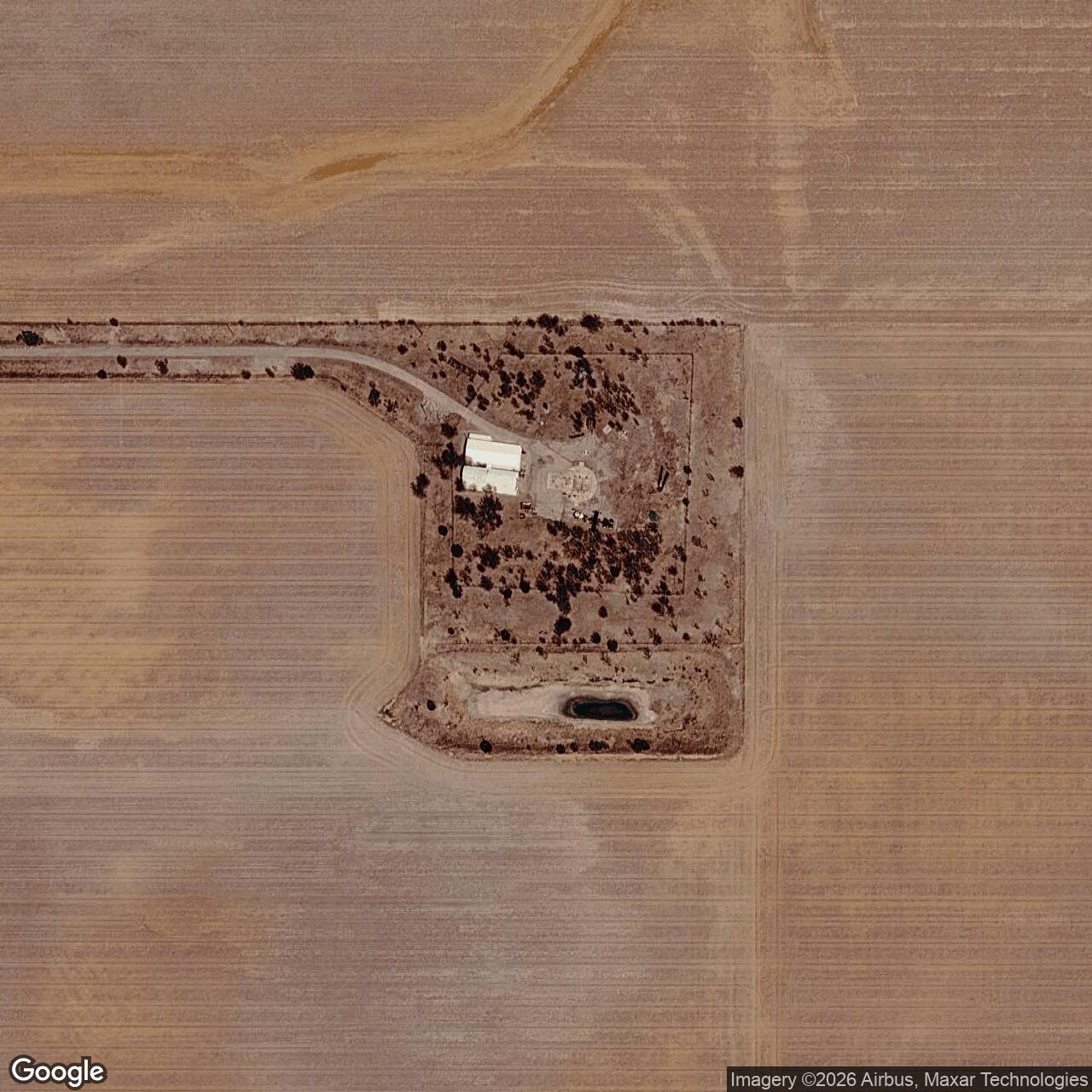
Site 577-3 is a decommissioned former Atlas F launch complex on private property near Snyder, Oklahoma. It is not an active military installation and no public museum, public tour operation, or official interpretive program was found for the site. The site should be treated as private property with no public access unless an owner or lawful authority explicitly grants permission.Public aerial imagery shows the former compound in agricultural land. The site appears to retain a recognizable launch-complex footprint, including the former access and surface compound area.
Chronology
- 1960-01 Public announcements identified Altus AFB as the future hub for twelve Atlas F missile sites in southwestern Oklahoma and nearby Texas.
- 1960-05-01 Official Altus AFB chronology states that construction began on the first of twelve Atlas F missile sites around Altus AFB.
- 1960-05-09 Construction began at Atlas F Site 577-3 near Snyder, Oklahoma.
- 1960-05-20 A ceremonial groundbreaking for the Altus-area Atlas missile sites was held at Altus AFB.
- 1961-06-01 The 577th Missile Squadron activated at Altus AFB to operate twelve Atlas F launch sites.
- 1961-08-01 Site 577-3 was turned over to the Air Force.
- 1962-01-31 Atlas missile 42F / serial number 61-2528 / tail number 528 was accepted.
- 1962-03-02 Atlas missile 42F was delivered for the Altus operational ICBM mission.
- 1962-04-01 The 11th Bombardment Wing was redesignated the 11th Strategic Aerospace Wing.
- 1962-08 USAF unit-history material records the first Series F Atlas ICBM at the 577th SMS placed on alert early in the month.
- 1962-10-09 USAF unit-history material lists SAC turnover and operational status for the 577th SMS missile force.
- 1962-10-10 Official Altus AFB and Oklahoma Historical Society chronologies state that the Atlas F missile silos became operational.
- 1962-10 The 577th SMS Atlas F sites were on heightened alert during the Cuban Missile Crisis.
- 1964-05-14 A propellant-loading explosion destroyed squadron Site 577-6 near Frederick, Oklahoma; this did not occur at Site 577-3.
- 1965-03-25 Site 577-3 was decommissioned and the 577th Strategic Missile Squadron was inactivated.
- 2001 GAO listed ATLAS MISSILE NO. 3, K06OK0403, Kiowa County, as eligible for potential inclusion in the FUDS cleanup program with hazards and eligible projects.
- 2015-09-30 The USACE FUDS Oklahoma inventory listed SNYDER, ATLAS MISSILE NO. 3, K06OK0403, with HTRW and BD/DR entries.
- 2017 ProPublica's DERP-based Bombs in Your Backyard dataset listed ATLAS MISSILE NO. 3 at Snyder, Kiowa County, with Response Complete status.
Read about the Atlas at Altus AFB
All Atlas Missile Silo Locations