
Atlas F Site 577-2 Missile Silo, Hobart Oklahoma
Longitude: -99.17056055119474
Site Type: Atlas F vertical silo launch facility
Missile Type: SM-65F Atlas
Missile Assigned to this Silo: GD mfg 69F; GD serial 61-2555; AF tail 555; accepted 1962-05-11; delivered 1962-05-16; launched 1974-07-14 from Vandenberg SLC-3W with TIMATION 3 / NTS-1; successful.
Number of Launchers/Missiles: 1
Parent Base: Altus AFB
Missile Wing: 11th Bombardment Wing; 11th Strategic Aerospace Wing after 1962-04-01
Missile Squadron: 577th Strategic Missile Squadron
Current Site Use: Former Atlas F silo complex reused as Missile Silo BNB.
Site Ownership: Private/non-federal ownership after surplus disposal
Accessible: Limited by appointment or paid reservation only; private property, no unscheduled public access.
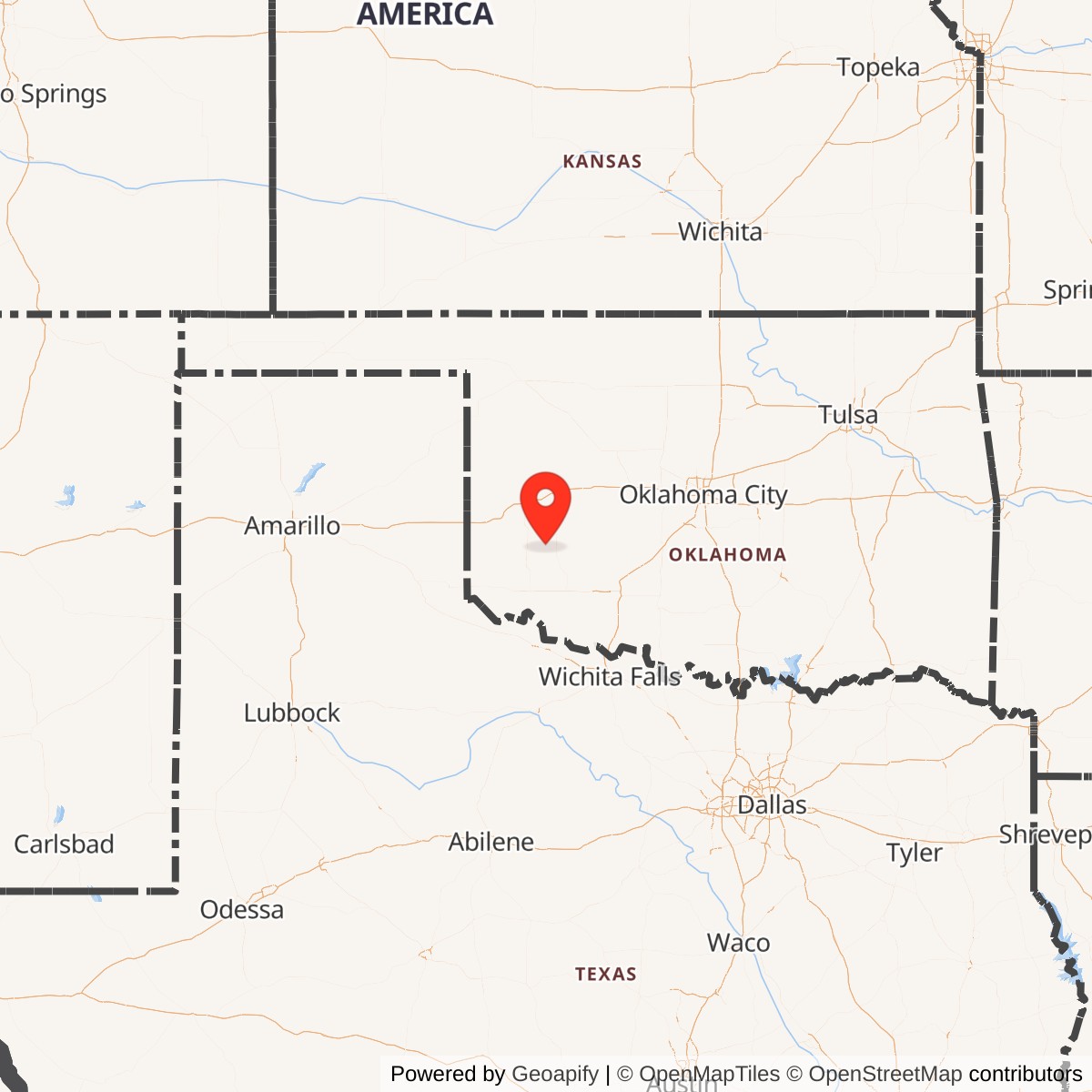
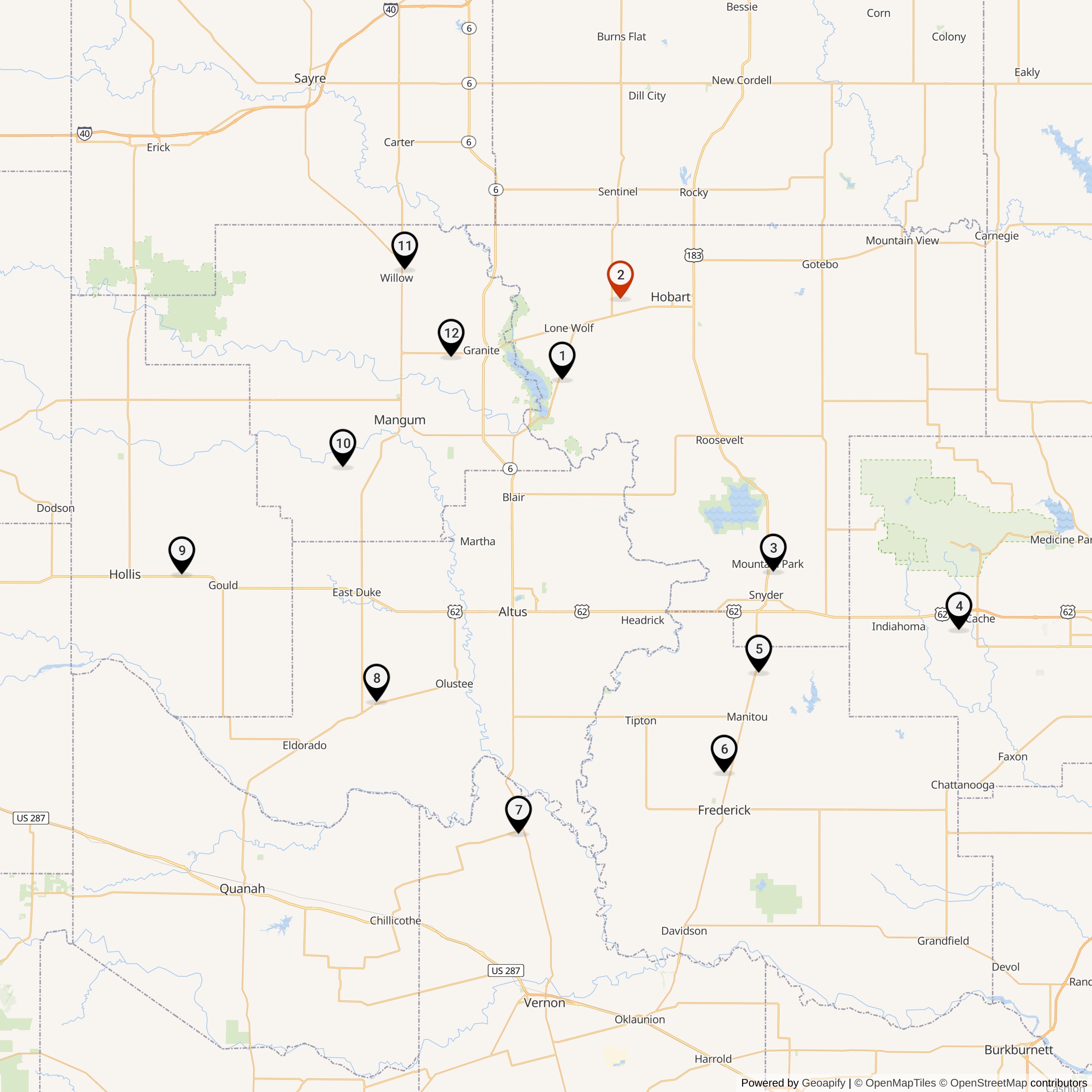
Atlas F Site 577-2 was one of the twelve SM-65F Atlas intercontinental ballistic missile launch complexes assigned to the 577th Strategic Missile Squadron at Altus Air Force Base, Oklahoma. The site was the squadron's Site 2, located in Kiowa County near Hobart in southwestern Oklahoma.
The site belonged to the 11th Bombardment Wing, which was redesignated the 11th Strategic Aerospace Wing on 1962-04-01, and to the 577th Strategic Missile Squadron, the Altus Atlas F unit. Atlas F launch complexes were self-contained vertical silo sites with their own underground launch control center, and not Minuteman-style unmanned launch facilities controlled from a separate remote LCC.
Site 577-2 is inactive and decommissioned as a military installation. Construction at the site began on 1960-07-28, the site was turned over to the Air Force on 1961-11-01, and the Altus Atlas F missile force became operational in early October 1962. The site remained part of the operational 577th Strategic Missile Squadron until the squadron and the Atlas F weapon system were removed from service in 1965. Site 577-2 was decommissioned on 1965-03-25. Its assigned operational missile was General Dynamics Atlas missile 69F, Air Force tail number 555, serial number 61-2555. That missile was accepted on 1962-05-11, delivered on 1962-05-16, later removed from the site after deactivation, and eventually launched successfully from Vandenberg AFB on 1974-07-13 carrying the prototype GPS satellite NTS-1.
The former launch complex is now private property. Unlike many Atlas sites that are completely closed to the public, Site 577-2 has a documented adaptive reuse as the Missile Silo BNB, a private overnight-stay and tour operation at a former Atlas F ICBM silo complex near Hobart. Public access is still limited and controlled: the property should not be treated as an open public historic site, and visits require a reservation, appointment, or owner permission.
Location, Landscape, and Site Description
Site 577-2 occupies a rural agricultural setting near Hobart, Oklahoma, in the open plains landscape of Kiowa County. The site was one of the twelve Altus Atlas F launch complexes placed in a broad ring around Altus Air Force Base. Official Altus AFB history states that the 577th Missile Squadron activated in 1961 to operate twelve Atlas F missile sites within a forty-mile radius of the base, while the Oklahoma Historical Society likewise describes twelve Atlas F sites within roughly that radius. That dispersal pattern was a central element of first-generation ICBM basing. It separated the individual launch complexes so that one attacking weapon could not destroy the entire missile force, while keeping the sites close enough to Altus for support, security, maintenance, and command administration.The area around Hobart provided the kind of setting the Air Force wanted for Atlas F deployment: low population density, accessible roads, agricultural land that could be acquired or encumbered, and sufficient separation from the parent base and other launch complexes. The rural setting also helped minimize surface obstructions and allowed the Air Force to build a hardened underground facility with a distinct security perimeter, access road, and support infrastructure.
Atlas F was the vertical-silo member of the operational Atlas family. Unlike Atlas D launch complexes, which used aboveground gantries, and Atlas E sites, which stored the missile horizontally in a coffin-type launcher, Atlas F stored the missile upright in an underground silo. A typical Atlas F complex included the deep cylindrical silo, a large elevator-launcher, two heavy silo doors, a below-grade launch control center, access tunnel or passageways, power and environmental-control systems, propellant and oxidizer support equipment, communications equipment, fencing, road access, and surface structures or covers associated with the underground facility.
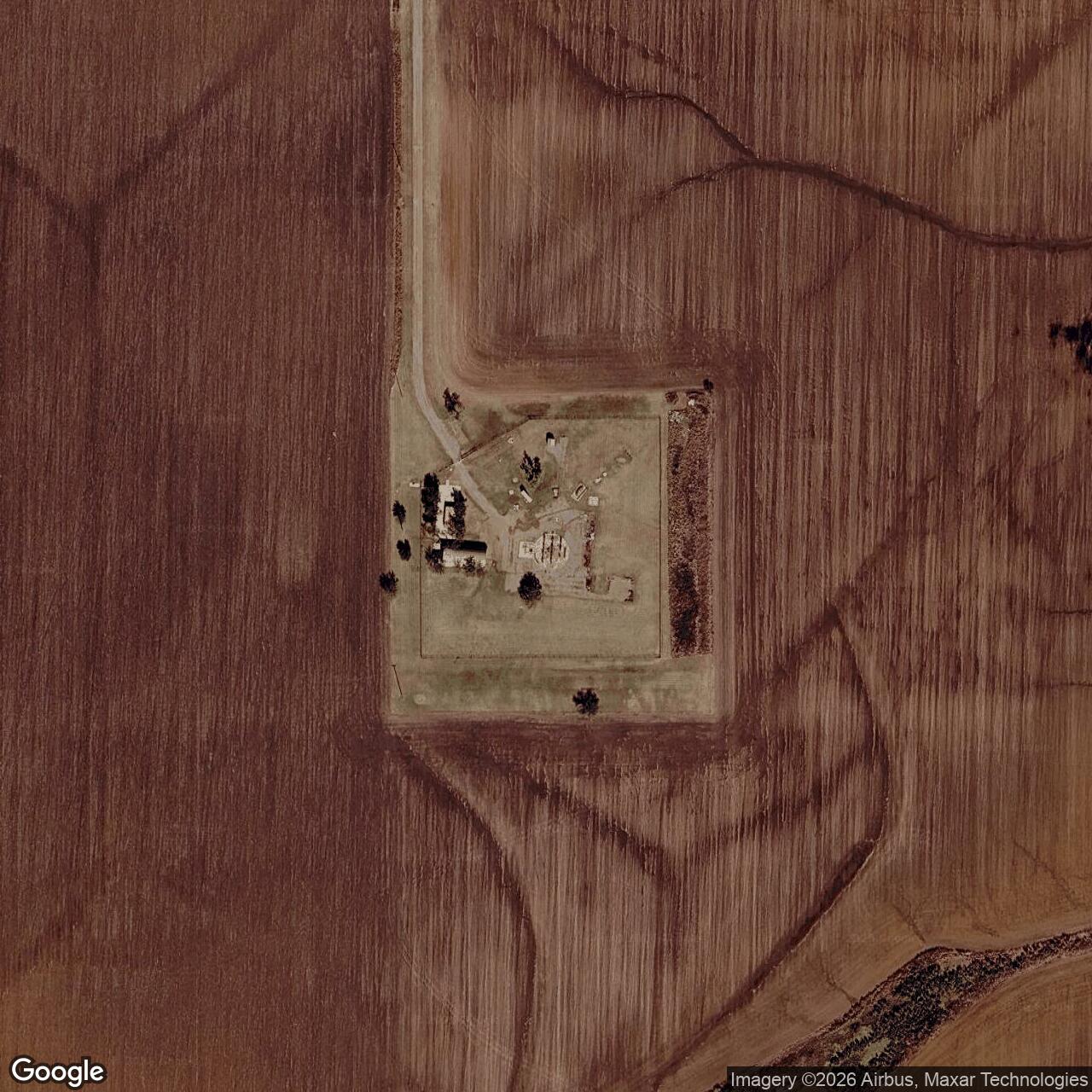
Site 577-2's visible layout is especially well documented because the property later became the Missile Silo BNB.
Strategic and Cold War Context
Site 577-2 existed because the United States was racing to field a credible land-based nuclear deterrent during the early 1960s. The Atlas family was the first operational American intercontinental ballistic missile system. It emerged from the same strategic environment that had made Strategic Air Command's bomber force central to U.S. nuclear policy, but it answered a different problem: how to hold targets at intercontinental range from fixed U.S. bases with a weapon that could be dispersed, kept on alert, and launched without sending bombers through air defenses.The Atlas F variant was the last operational Atlas ICBM model and represented the most survivable form of the Atlas basing concept. Its hardened vertical silo was a major advance over earlier exposed or semi-hardened Atlas launchers. The missile remained a large liquid-fueled weapon, using RP-1 kerosene and liquid oxygen rather than the solid propellant used by the later Minuteman force. RP-1 could be kept aboard the missile during alert, but liquid oxygen had to be loaded during the countdown. The missile was then raised from the silo on its elevator before launch. That operating sequence was more complex and slower than later solid-fueled systems, but the vertical silo gave Atlas F a higher degree of protection and allowed it to maintain alert as a serious early-1960s deterrent system.
The Altus missile field became operational at a historically significant moment. Altus AFB's official chronology states that the 577th Missile Squadron's Atlas F sites became operational on 1962-10-10. USAF unit-history material gives an adjacent operational date of 1962-10-09. In either case, the field reached operational status just before or during the opening phase of the Cuban Missile Crisis. The Missile Silo BNB historical summary, drawing on the site's Atlas history, notes that many of the Altus sites were just coming online during that crisis and that the 577th SMS sites were kept at a high level of alert.
Construction and Activation
Construction of the Altus Atlas F field began as part of a large national missile-construction program managed through the U.S. Army Corps of Engineers and Air Force ballistic missile organizations. The official Altus AFB chronology states that construction began on the first of the twelve Atlas F sites around Altus on 1960-05-01. The Altus missile field required heavy construction across dispersed rural sites and involved excavation, concrete, steel, power systems, liquid-oxygen and fuel systems, environmental controls, communications, crew facilities, security infrastructure, and integration with Convair/General Dynamics missile equipment.Construction at the site began on 1960-07-28. This timing reflects the staggered construction sequence typical of the Atlas F fields: even though the overall Altus program began earlier, individual launch complexes started and turned over on different dates depending on land acquisition, design status, contractor schedule, local construction conditions, and equipment availability.
The site was turned over to the Air Force on 1961-11-01. Turnover did not mean the site was immediately fully operational as a nuclear-alert launcher. It meant the basic facility had reached the point at which Air Force and contractor organizations could proceed through equipment installation, checkout, missile acceptance, training, and operational certification. Site 577-2's assigned missile, Atlas 69F, was accepted on 1962-05-11 and delivered on 1962-05-16. Official Altus AFB history states that the twelve Atlas F sites became operational on 1962-10-10; USAF unit-history material gives 1962-10-09 as the SAC turnover and operational date for the missile force.
The construction and activation period placed Site 577-2 in the first generation of U.S. silo-based ICBM operations. The site came online after the Atlas D and E deployments had shown both the strategic value and operational limits of liquid-fueled ICBMs. The Altus Atlas F field therefore represented both a technological advance and a temporary solution: hardened vertical silos gave the missile force better protection, but the labor and complexity of Atlas operations were already being overtaken by solid-fueled Minuteman.
Missile System and Technical Role
Site 577-2 housed the SM-65F Atlas, later commonly identified as HGM-16F in the post-1962 designation system. The Atlas F was a one-and-one-half-stage, liquid-fueled ICBM built by Convair/General Dynamics. It used two booster engines and a sustainer engine, with the booster engines jettisoned during flight while the sustainer continued. In its operational Atlas F configuration, the missile used RP-1 kerosene and liquid oxygen. RP-1 fuel could remain aboard the alert missile, while liquid oxygen was loaded during the launch countdown.The Atlas F launch complex was both a launch site and a crewed operational facility. Unlike later Minuteman launch facilities, which were normally unmanned and controlled from remote launch control centers, an Atlas F complex included its own underground launch control center. Missile crews and support personnel occupied the site on alert, while security, maintenance, communications, and technical teams sustained the facility as part of the larger squadron system. The Missile Silo BNB site, describing its former Atlas F complex, notes that these sites were manned continuously during the squadron's active period.
The launch sequence reflected the transitional nature of Atlas F technology. To launch, the silo doors opened and the missile was elevated from the underground silo. The Missile Silo BNB historical summary describes two 75-ton overhead doors and the raising of the missile from the silo before launch. The missile was then prepared with liquid oxygen and fired from the surface position. The vertical silo protected the missile while it was stored on alert, but the need to raise and fuel it before firing remained a major operational burden compared with later solid-fueled ICBMs.
Site 577-2's assigned missile was Atlas 69F, serial number 61-2555, Air Force tail number 555. The same missile later launched from Vandenberg AFB's SLC-3W on 1974-07-13 with the prototype GPS satellite NTS-1 / STP-73-3 payload, with a successful outcome.
For public-source capability context, the Atlas F used the Mark 4 reentry vehicle and W-38 thermonuclear warhead. The National Air and Space Museum identifies the Mark 4 RV as used on Titan I and Atlas E/F ICBMs and states that it carried a W-38 nuclear warhead with a yield of about 3.75 megatons.
Operational History
Site 577-2's operational history was short but intense. It was part of a strategic missile force that existed for only a few years, yet those years included the Cuban Missile Crisis and the rapid transition from first-generation liquid-fueled ICBMs to newer solid-fueled missiles. The site was not a stand-alone base; it was one of twelve dispersed launch complexes operated by the 577th Strategic Missile Squadron from Altus AFB under the 11th Bombardment Wing / 11th Strategic Aerospace Wing.The 577th Strategic Missile Squadron was activated at Altus on 1961-06-01 to operate the twelve Atlas F sites. The Air Force Historical Research Agency lists the 577th Strategic Missile Squadron as an operational component of the 11th Wing from 1961-06-01 to 1965-03-25. Altus AFB history states that the missile silos became operational on 1962-10-10 and that the activation was short-lived because the Atlas F was phased out by April 1965.
During active service, Site 577-2 supported the standard Atlas F alert mission. Missile crews occupied the underground control center and sustained alert status. Security personnel controlled access to the fenced compound. Maintenance teams serviced the missile, elevator-launcher, environmental systems, communications, oxidizer and fuel infrastructure, power systems, and support equipment. The site also had to remain connected to squadron command, the parent base, and Strategic Air Command command-and-control channels.
The Cuban Missile Crisis gave the newly activated Altus Atlas F field its most important strategic context. During the crisis all 577th SMS sites were at a high level of alert and were ready to launch if necessary. This should be understood as a squadron- and field-level statement rather than a uniquely documented Site 577-2 event, but it is directly relevant because Site 577-2 was one of the twelve 577th SMS Atlas F sites.
Operational service also involved the practical hazards of liquid-fueled ICBM work. Atlas F required propellant handling, liquid-oxygen loading equipment, elevator operations, explosive ordnance safety, and careful maintenance of complex underground systems. The best-known 577th SMS accident occurred at Site 577-6 near Frederick on 1964-05-14, when a propellant-loading exercise ended in an explosion that destroyed that launch complex. That incident did not occur at Site 577-2, but it illustrates the risks present in the same squadron's Atlas F operations.
Site 577-2 has a distinctive post-operational history because it became one of the better-known private Atlas sites. The Missile Silo BNB page describes the site as a former Atlas F ICBM missile silo complex near Hobart that offers an underground guest room and tours of the former missile base. This adaptive reuse gives Site 577-2 a public historical profile that many otherwise inaccessible Atlas F complexes do not have.
Deactivation and Disposal
Site 577-2 left active missile service during the rapid retirement of the Atlas ICBM force. By late 1964 the Department of Defense had decided to phase out the remaining Atlas D, E, and F missiles as newer solid-fueled Minuteman missiles and other strategic forces came online. The Atlas F sites had been designed to improve survivability, but the missile's liquid-oxygen requirements, large maintenance burden, and aboveground launch position after elevator rise made the system less attractive than more modern weapons.The 577th Strategic Missile Squadron was inactivated on 1965-03-25. Air Force historical sources also place the 577th Strategic Missile Squadron under the 11th Wing from 1961-06-01 to 1965-03-25. Altus AFB's public chronology states that by April 1965 the 577th Missile Squadron had been inactivated after the Department of Defense phased out the Atlas F missile. The Oklahoma Historical Society similarly states that by April 1965 the Atlas missile was outdated and phased out of the national strategic defense plan.
The deactivation process should be understood as several distinct actions rather than a single event. The missile force was removed from alert, missiles were removed or shipped out, reusable equipment was recovered where useful, hazardous materials and military property were addressed, the squadron was inactivated, and the property eventually passed out of active Air Force missile use. For Site 577-2, the assigned missile's later launch in 1974 confirms that at least that missile hardware was removed from the site and repurposed rather than destroyed in place. The silo and underground structures remained as part of the real property.
Environmental and disposal history is reflected in FUDS and related public records. The U.S. Army Corps of Engineers 2015 FUDS inventory lists Hobart, Kiowa County, ATLAS MISSILE NO. 2, property number K06OK0402, site 01, in the HTRW category. The U.S. General Accounting Office's 2001 Oklahoma FUDS table lists ATLAS MISSILE NO. 2, K06OK0402, Kiowa County, as eligible with hazards and eligible cleanup projects. ProPublica's DERP-derived Bombs in Your Backyard dataset lists ATLAS MISSILE NO. 2 at Hobart, Kiowa County, with one hazardous site and Response Complete status. These records show that the former launch complex entered the federal environmental-restoration record after military disposal, even though the site is now privately reused.
Because Atlas F retirement occurred before the later Strategic Arms Reduction Treaty inspection and demolition regimes that affected Minuteman and Peacekeeper sites, Site 577-2's disposal was not a START-era silo-demolition case. The site survived as a privately reused former Atlas F complex rather than being eliminated under later treaty verification procedures.
Current Status and Site Use
Site 577-2 is a decommissioned former Atlas F launch complex on private property near Hobart, Oklahoma. It is not an active military installation. It is not an unrestricted public museum. Its best documented current use is as the Missile Silo BNB and tour site. The Missile Silo BNB homepage describes the property as a former Atlas F ICBM missile silo complex near Hobart with a B&B guest room 37 feet underground, access through the original missile-base entryway and stairwell, and tours of the underground parts of the complex included with reservations. Its tours page separately describes scheduled tours by appointment.The site is therefore accessible only under controlled private terms, such as a paid stay, scheduled tour, or explicit owner permission. The fact that the site offers tours does not make the grounds open for casual visitation. Unscheduled visits, trespassing, or entering the property without authorization should be avoided.
The physical remains appear substantial. Public photographs show a preserved surface compound, access road, support buildings, the silo-headworks area, and underground access. The B&B description confirms that parts of the underground complex are accessible to guests and that the former launch control center levels are part of the interpreted space. This makes Site 577-2 one of the more visible and publicly interpreted examples of an Atlas F complex, even though it remains private.
Chronology
- 1960-01 Public announcements identified Altus AFB as the future base for an Atlas F missile field.
- 1960-05-01 Official Altus AFB chronology states that construction began on the first of twelve Atlas F missile sites around Altus.
- 1960-07-28 Construction began at Atlas F Site 577-2 near Hobart, Oklahoma.
- 1961-06-01 The 577th Missile Squadron activated at Altus AFB to operate twelve Atlas F launch sites.
- 1961-11-01 Site 577-2 was turned over to the Air Force.
- 1962-04-01 The 11th Bombardment Wing was redesignated the 11th Strategic Aerospace Wing.
- 1962-05-11 Atlas missile 69F / serial number 61-2555 / tail number 555 was accepted.
- 1962-05-16 Atlas missile 69F was delivered for the Altus operational ICBM mission.
- 1962-08 USAF unit-history material records the first Series F Atlas ICBM at the 577th SMS placed on alert early in the month.
- 1962-10-09 USAF unit-history material lists SAC turnover and operational status for the 577th SMS missile force.
- 1962-10-10 Official Altus AFB and Oklahoma Historical Society chronologies state that the Atlas F missile silos became operational.
- 1962-10 The 577th SMS Atlas F sites were on alert during the Cuban Missile Crisis.
- 1964-05-14 A propellant-loading explosion destroyed squadron launch complex 577-6 near Frederick, Oklahoma; this did not occur at Site 577-2.
- 1965-03-25 Site 577-2 was decommissioned and the 577th Strategic Missile Squadron was inactivated.
- 1974-07-13 Former Site 577-2 missile Atlas 69F was launched successfully from Vandenberg AFB SLC-3W carrying the prototype GPS satellite NTS-1 / STP-73-3.
- 2001 GAO listed ATLAS MISSILE NO. 2, K06OK0402, Kiowa County, as eligible for potential inclusion in the FUDS cleanup program with hazards.
- 2015-09-30 The USACE FUDS Oklahoma inventory listed HOBART, ATLAS MISSILE NO. 2, K06OK0402, site 01, as an HTRW entry.
- 2017 ProPublica's DERP-based Bombs in Our Backyard dataset listed ATLAS MISSILE NO. 2 at Hobart, Kiowa County, with Response Complete status.
Read about the Atlas at Altus AFB
All Atlas Missile Silo Locations