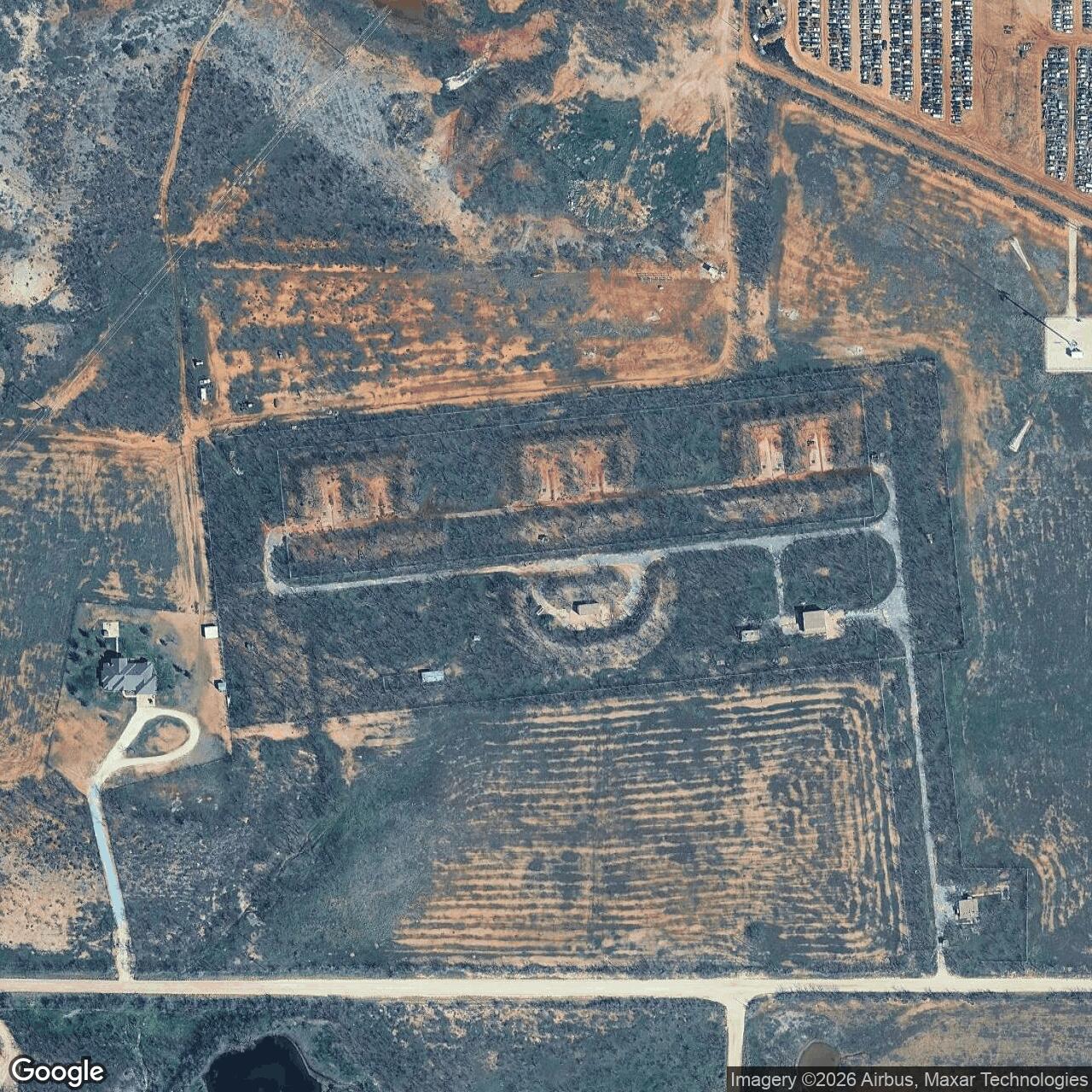
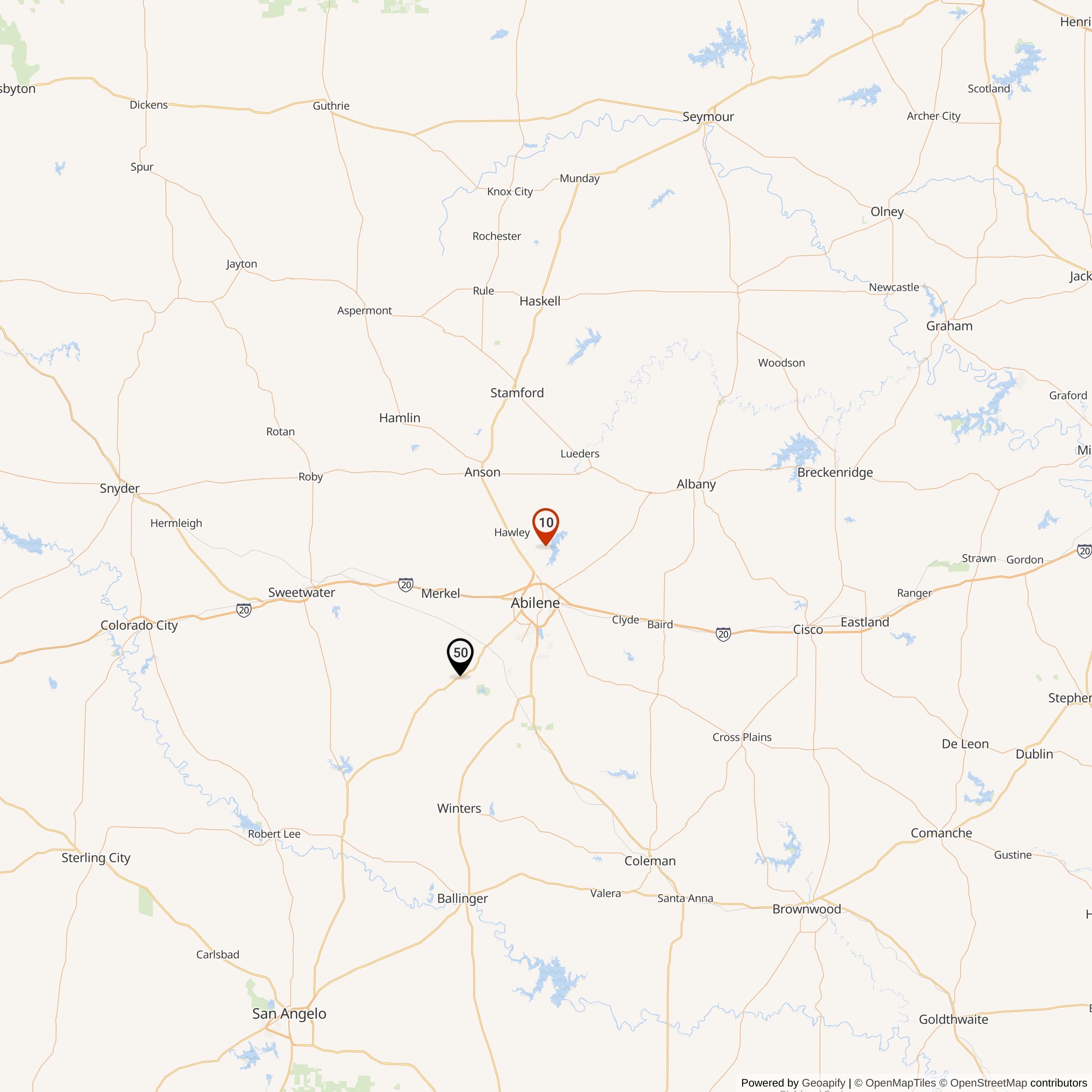
Nike Missile Site DY-10 Launcher, Fort Phantom Hill Texas
Longitude: -99.7176049684275
This location was part of the Dyess Defense Area
Site ID: DY-10
The missiles at this Launch Area were controlled by the Integrated Fire Control site located here.
Site Role: Launcher
A typical Nike air defense site consisted of two separate parcels of land. One area was known as the Integrated Fire Control (IFC) Area. This site contained the Nike system's ground-based radar and computer systems designed to detect and track hostile aircraft, and to guide the missiles to their targets.
The second parcel of land was known as the Launcher Area. At the launcher area, Nike missiles were stored horizontally within heavily constructed underground missile magazines. A large, missile elevator brought the Nikes to the surface of the site where they would be pushed across twin steel rails to one of four satellite launchers.
Elaboration on how Nike worked here.
Missile Type: Hercules
The Nike Ajax was the first in the Army's family of guided missiles, and the world's first operational, guided, surface-to-air missile system. Nike Ajax had a burnout speed of Mach 2.3, a range of 25-30 miles, and a ceiling of 65,000 feet.
Designed to carry either nuclear and/or high-explosive warheads, the Nike Hercules missile could attack supersonic aircraft operating at altitudes in excess of 150,000 feet and at a range of more than 87 miles.
Battery Type: single
Current site status: demolished
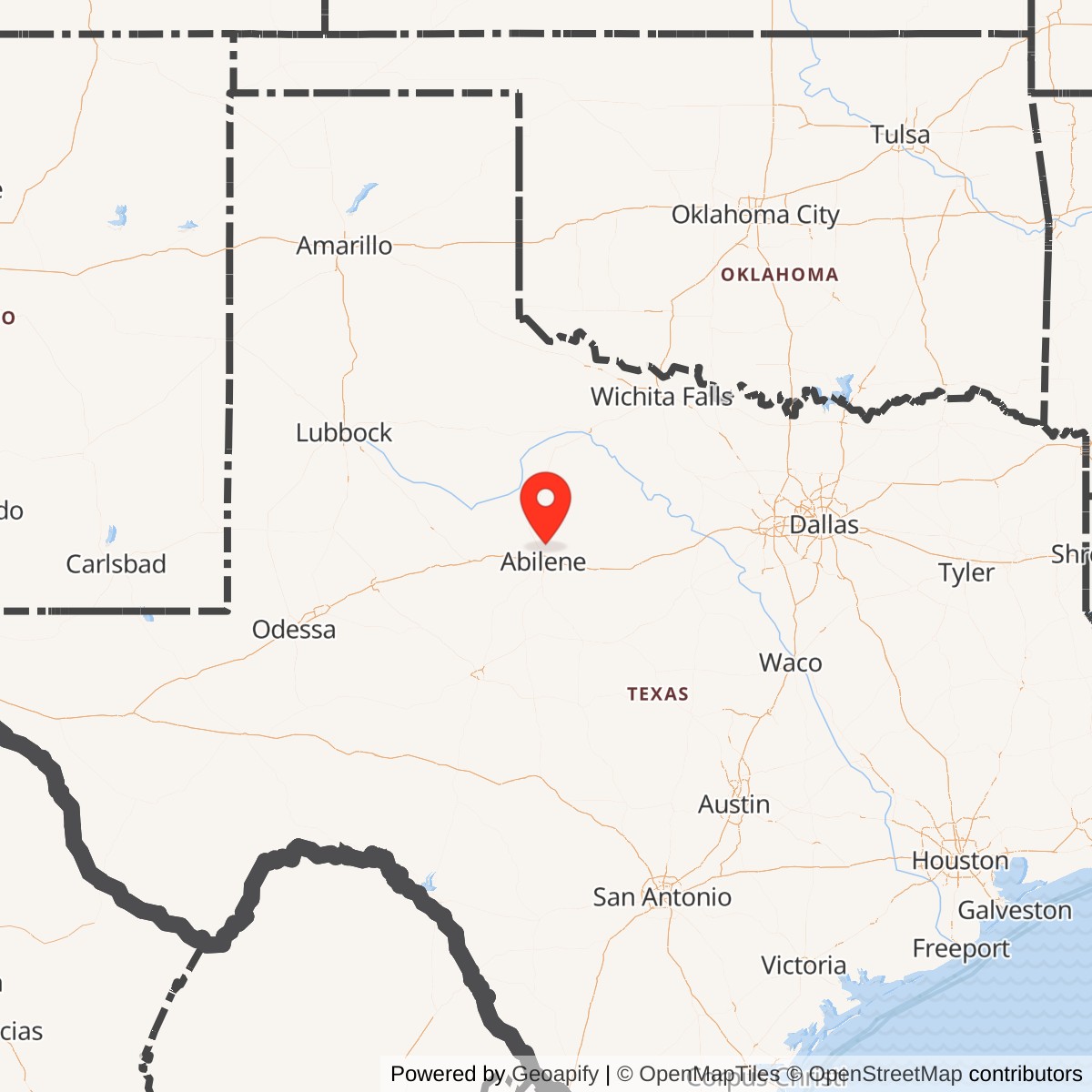
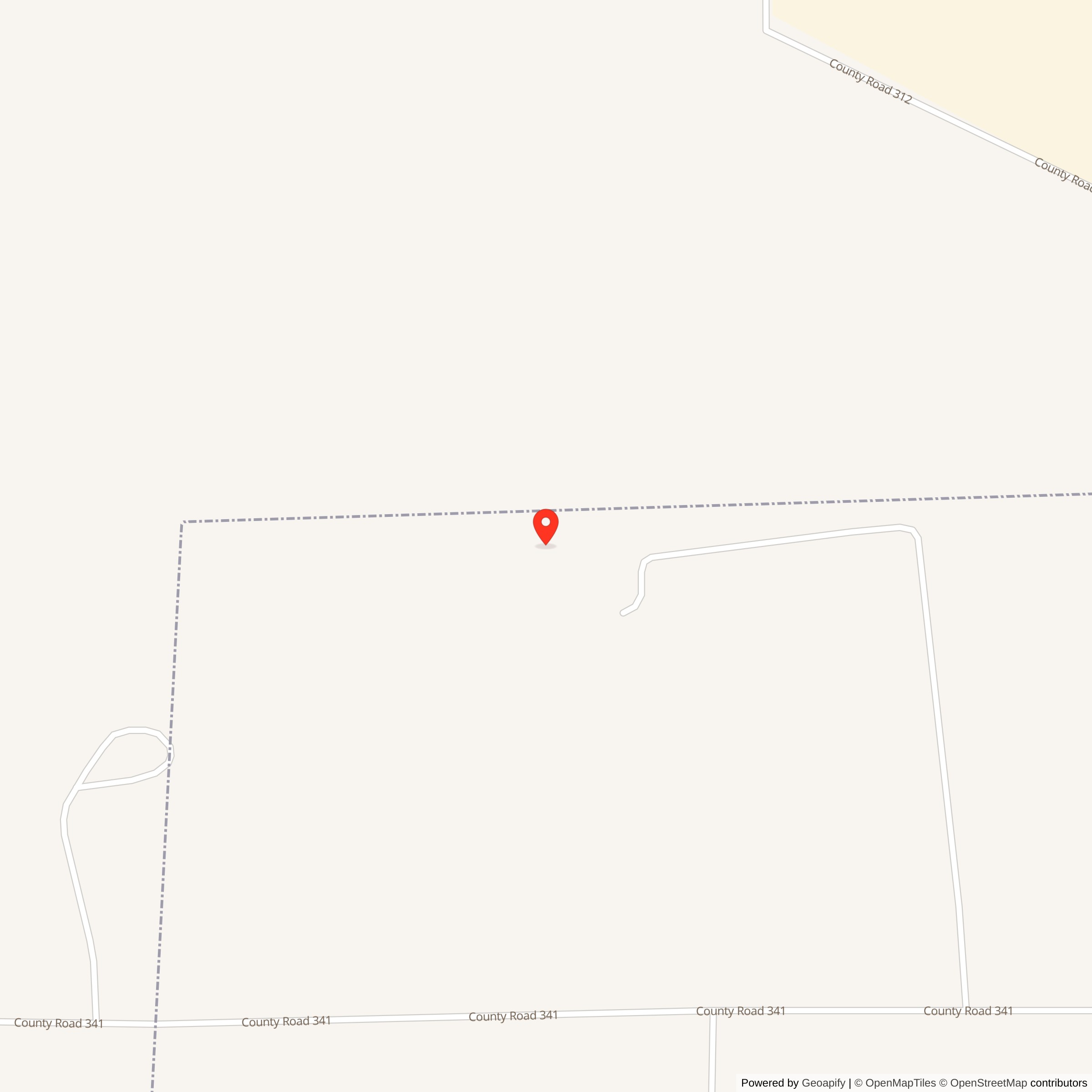
Nike Missile Site DY-10 was a U.S. Army Nike Hercules air-defense battery in the Dyess Defense Area north of Abilene, Texas, near Fort Phantom Hill and Fort Phantom Hill Lake. It was not an independent Air Force missile installation, and it was not an Atlas intercontinental ballistic missile site. It was an Army Air Defense Command Nike Hercules surface-to-air missile site, administratively and logistically tied to Dyess Air Force Base because its mission was to protect Dyess AFB, Strategic Air Command bomber operations, and the Atlas F missile field around Abilene.
It operated from October 1960 to June 1966 and was then abandoned by the Army. The later federal site inventory recorded the control / integrated fire control area as intact and associated with the Abilene Independent School District, and the launch area as intact and privately owned. Later public property listings identify the former control site at 8249 West Lake Road as the original DY-10 Nike Missile Control Site and describe multiple concrete buildings on a fenced 12-acre property.
Location, Terrain, and Military Purpose
DY-10 sat north of Abilene in the open rolling country around Fort Phantom Hill Lake. This was not an urban-defense Nike ring like the batteries around New York, Chicago, Philadelphia, Los Angeles, or San Francisco. It was part of a smaller Strategic Air Command base defense system. Its purpose was to provide last-line air defense for one of the Air Force's high-value nuclear strike installations in West Texas.Dyess Air Force Base became a major Strategic Air Command installation during the Cold War. In the period relevant to DY-10, Dyess was associated with SAC bomber operations and with the 578th Strategic Missile Squadron's Atlas F ICBM silos dispersed around the region. The federal Cold War missile history and the official Dyess AFB history both identify the Dyess Nike Hercules defenses as being installed to defend SAC bombers and Atlas F missile silos stationed at and around Dyess AFB. That mission explains the placement of only two Nike Hercules batteries rather than a broad city ring: DY-10 north of Abilene near Fort Phantom Hill, and DY-50 southwest of Abilene.
The terrain around DY-10 helped the Nike mission. Nike batteries required separation between the control/radar site and the launch site, with radar visibility between the two and a clear view of the airspace to be defended. The open land north of Abilene offered relatively unobstructed radar fields, room for above-ground launch positions and safety buffers, and enough distance from the main base to form a defended perimeter rather than placing the launchers directly on the airfield. The Fort Phantom Hill location also placed DY-10 near older military geography. The nearby nineteenth-century Fort Phantom Hill had originally been part of the U.S. Army's frontier-defense system, and the Cold War Nike site reused the same general landscape for a very different kind of military frontier: defense against long-range Soviet bomber attack.
History
The Dyess Defense Area belonged to the later Nike Hercules phase rather than the earlier Nike Ajax phase. Many early Nike defenses around cities began with underground Ajax batteries in the mid-1950s and were later converted to Nike Hercules. DY-10 was different. It was one of the "new defense sites" built for Nike Hercules from the start as part of the SAC-base defense program. Appendix D of the Nike Hercules history lists DY-10 and DY-50 under SAC base sites, records DY-10's construction period as August 1959 to June 1960, and gives an operational date with Hercules missiles of October 15, 1960. Later site summaries round that service period to October 1960 through June 1966.The strategic logic was straightforward. By the late 1950s, SAC bases and ICBM fields were among the most important American military targets. Dyess had bombers, tankers, and later Atlas F missile silos distributed across the surrounding countryside. A Soviet bomber attack on Dyess could threaten aircraft, nuclear weapons infrastructure, command facilities, and the Atlas field. Nike Hercules batteries gave the Army the ability to engage high-altitude aircraft before they reached those targets. The Hercules missile could carry a conventional or nuclear warhead. In the SAC-base role, the significance of the nuclear option was that one detonation could destroy or disrupt a formation of attacking bombers, making it a practical defense against massed aircraft rather than single targets only.
DY-10 and DY-50 were controlled through a Battery Integration and Radar Display Equipment system, commonly called BIRDIE, installed at Sweetwater Air Force Station. BIRDIE was used in smaller defense areas that did not need the larger Missile Master command-and-control installation found in major metropolitan defense areas. The official Dyess history and To Defend and Deter both describe the Dyess Nike batteries as controlled by a BIRDIE system at Sweetwater AFS. This made the Dyess Defense Area part of the larger continental air-defense network while still being scaled to a two-battery SAC-base defense mission.
Physical Layout and Facilities
Like other Nike sites, DY-10 was divided into two separated components: the Integrated Fire Control area and the Launch area.The Integrated Fire Control site, or IFC/control area, was the radar and command portion of the battery. This area contained the radar equipment, battery-control equipment, and support buildings necessary to detect, identify, track, and engage incoming aircraft. In a Nike Hercules battery, the control area normally included acquisition radar, target-tracking radar, missile-tracking radar, target-ranging radar where applicable, radar-control vans, battery-control equipment, communications, generator support, administrative buildings, barracks or ready spaces, roads, fences, and utility systems. The Portal to Texas History preserves a period aerial photograph of the DY-10 control site showing buildings, vehicles, and equipment in a field. The Portal description specifically identifies it as the control site for Nike-Hercules battery DY-10 north of Abilene and notes that it served the launch battery nearby.
DY-10's missile-type code in federal and site inventories is Nike 3AG/12H/12L-H. The "AG" portion indicates an above-ground Nike Hercules launch configuration, different from the underground magazine-and-elevator arrangements used at many earlier Ajax or Ajax/Hercules urban sites. Appendix D of the History of the Nike Hercules Weapon System also notes that the SAC-base sites were above-ground installations. Above-ground Nike Hercules sites stored and handled missiles in protected surface launch areas rather than in deep underground magazines. The launcher area would have included launch pads or rails, bermed missile positions, missile shelters or storage areas, missile assembly and handling areas, ready/support buildings, generators, security fencing, access roads, sentry facilities, and safety clear zones. Later aerial imagery reproduced by The Military Standard shows the launcher area as an above-ground, bermed Nike Hercules site rather than a buried magazine site.
Operational History
Construction of DY-10 began in the broader Dyess Nike buildup that started in 1959. On November 19, 1959, the Army conducted groundbreaking ceremonies at Dyess AFB for the battalion headquarters of the 5th Missile Battalion, 517th Artillery, U.S. Army Air Defense Command. The battalion was the Army unit responsible for the Dyess Nike Hercules defense. Appendix D places DY-10's construction period from August 1959 to June 1960 and gives the Hercules operational date as October 15, 1960. The federal site inventory and later site summaries give the active-service period as October 1960 to June 1966.Once operational, DY-10 formed the northern battery of the Dyess Defense Area. DY-50, southwest of Abilene, formed the other half of the local Nike shield. Together the two batteries protected Dyess AFB and the surrounding Atlas F field by placing Nike Hercules launch capability on opposite sides of the defended area. The batteries were not intended to replace fighter-interceptor aircraft or the national radar network. They were the point-defense layer: the local missile defense available if Soviet bombers penetrated the outer air-defense system and approached the high-value base area.
A Nike Hercules engagement depended on the integrated work of the IFC and launch areas. The IFC searched for targets, interrogated aircraft to help separate friend from foe, tracked the target, tracked the missile after launch, and generated guidance commands. The launcher area maintained the missiles and launchers in a ready state. If the battery was ordered to fire, the missile was launched from the surface launch area, tracked by the missile-tracking radar, and guided toward the intercept point by command signals from the control site. For DY-10, the presence of BIRDIE control at Sweetwater AFS meant that the battery did not operate in isolation. It was integrated with DY-50 and with regional air-defense command-and-control, allowing the two batteries to coordinate engagements rather than duplicate targets.
The men who served at DY-10 worked in a joint-service environment even though the site itself was an Army battery. The Portal to Texas History specifically notes that the unit operating the battery was U.S. Army but based with the Air Force at Dyess AFB several miles away, and that the earlier title "Aerial View of Airbase" was incorrect because the site was not physically part of Dyess AFB. That distinction matters. DY-10 was attached to Dyess for mission and administration, but its radar and launcher components were separate field installations north of Abilene.
Site Life and Daily Function
A Nike Hercules battery required constant technical readiness. Radar equipment, missile electronics, generators, communications circuits, launchers, warhead handling systems, hydraulic systems, and security systems all had to be maintained. Unlike an Atlas F silo, a Nike site did not sit with a single missile hidden underground waiting for a strategic launch order. It was an air-defense installation built for rapid response to aircraft. The daily rhythm involved watchstanding, radar checks, communications checks, maintenance, training drills, launcher inspections, security patrols, and periodic evaluations.DY-10's above-ground launcher layout also shaped daily operations. Above-ground Hercules sites required careful weather protection, handling procedures, and security of exposed surface launch areas. The open terrain made radar coverage easier but also left the launcher area visible and exposed to the West Texas environment. The battery's crews had to keep complex electronics and missile hardware operational in heat, wind, dust, storms, and seasonal temperature swings. The remoteness of the site north of town also meant that, although the battery was tied to Dyess AFB, the men working at the site spent much of their duty time at a small isolated missile facility rather than on the main base.
Closure and Post-Military Use
DY-10 was deactivated in June 1966. Its closure fits the larger mid-1960s reduction of selected Nike defenses as the perceived threat shifted from Soviet manned bombers toward ballistic missiles, as air-defense budgets tightened, and as the United States carried the rising cost of the Vietnam War. SAC-base Nike sites such as the Dyess batteries had been built for a specific bomber-defense problem. By the mid-1960s, the Atlas F missiles at Dyess had also been removed from service, reducing part of the target set that DY-10 and DY-50 had been built to defend.The Portal to Texas History notes that DY-10 was in operation between October 1960 and June 1966 and was then abandoned by the Army. The federal inventory later recorded the control site as intact and in Abilene Independent School District ownership, and the launch site as intact and privately owned. A 1997 field visit report by Scott D. Murdock described the DY-10 control site as being used by the Abilene Independent School District, with most buildings appearing in good condition; the same report described the launcher site as gated and locked. Later property listings for 8249 West Lake Road identify that property as the former Nike Missile Control Site DY-10, describe multiple concrete buildings and a tennis court on 12.13 acres, and show that the property was marketed for sale in the 2020s. Because real-estate listings can lag or differ across platforms, this history treats that as evidence of post-military disposition rather than a definitive current ownership statement.
The launcher site's post-closure condition is less thoroughly documented in official sources. The federal inventory says intact/private ownership. The Military Standard and later derivative summaries describe the launch area as an above-ground Nike Hercules site with bermed positions, apparently abandoned and overgrown. Because the launch site was an above-ground installation, its surviving evidence is likely to consist of roads, berms, pads, shelters, utility remnants, perimeter alignments, and building foundations or standing support buildings rather than underground elevator doors and deep magazines.
List of all Nike Installations in the Dyess Defense AreaList of all Nike Installations in Texas