
AN/FPS-80 Blue Moon / Blue Fox Tracking Radar
- Role
- Fixed precision missile and space tracker
- Manufacturer
- General Electric
- Operational site
- Shemya Air Force Station, Alaska
- Documented service
- 1962 to July 1977
- Original configuration
- 60-foot mechanically steered UHF monopulse antenna; later Blue Fox configuration details are source-qualified
Designation and Identity
The AN/FPS-80 was a one-site American precision tracking radar built for one of the most geographically demanding intelligence missions of the Cold War. From Shemya Island at the western end of Alaska's Aleutian chain, it watched the approaches to the Soviet Far East and converted detections of missile and satellite activity into accurate tracks. Aerospace Defense Command's 1973 equipment list described the FPS-80 simply as a "Long range radar sensor." Its SPACETRACK table was more revealing: Shemya was listed with an FPS-80(M) tracking radar paired with an AN/FPS-17(XW3) detection radar. Those two entries establish the equipment's essential identity. The AN/FPS-80 was not a general air-defense search set and was not a routine ground-controlled-intercept radar. It was the steerable precision element of a specialized missile and space surveillance complex.
The radar emerged from a sequence of projects whose code names can easily be confused. Historical technical literature identifies the original Shemya tracker as Blue Moon and says it entered operation in 1962. The later Blue Fox program modified the Shemya tracker, and Aerospace Defense Command records the resulting system as FPS-80(M). A separate code-name listing describes Blue Pearl as a modernized version of the AN/FPS-80 built by General Electric, but no primary document located establishes whether Blue Pearl was a distinct engineering phase, a contracting label, or another name for part of the Blue Fox modernization.
The equipment was built by General Electric and used a large mechanically steered parabolic antenna rather than a fixed detection fence or phased array. Declassified National Security Agency history describes a sixty-foot antenna FPS-80 at Shemya, while an Aerospace America technical-history article likewise identifies Blue Moon as a sixty-foot dish on a pedestal. The same article describes the original configuration as a UHF monopulse tracker using a 2.5-degree pencil beam. Specialist radar references later describe the Blue Fox modification as a conversion to L-band. Because an equipment-level technical order or engineering handbook for the modified configuration was not located, the original UHF description and the source-qualified L-band modification are kept separate rather than collapsed into one frequency statement.
Only one operational AN/FPS-80 site has been verified: Shemya, Alaska. That fact is as important as any technical specification. The Air Force did not buy a widespread fleet of FPS-80s. The system was developed around the geometry of Soviet missile tests whose trajectories and impact areas could be observed from the Aleutians. Every major modification therefore affected the one radar that carried the designation in operational service. The configuration that existed in 1962 was not necessarily identical to the configuration accepted after Project Blue Fox in 1965, nor was the 1972 computer environment necessarily the same as the system's early data-processing arrangement.
Strategic Need and Shemya's Geography
Shemya became valuable because geography placed American sensors close to Soviet missile test activity without requiring access to Soviet territory. The island lies near the western end of the Aleutian chain, more than a thousand miles from mainland Alaska and much closer to the Soviet Far East than most American bases. Soviet long-range missile tests fired toward Kamchatka and the Pacific created trajectories that could be observed from this remote American position. When Soviet rocket testing accelerated in the late 1950s, the Air Force revived and expanded Shemya after an earlier period of reduced postwar activity. The isolated airfield and wartime infrastructure became the base for a new electronic intelligence mission whose importance far exceeded the size of the island.
The first major sensor was the AN/FPS-17(XW3), a fixed-beam high-power detection radar. Air Force civil-engineering history says the Shemya FPS-17 went into operation in 1960, while declassified intelligence history says the equipment had been installed in 1959. Its task was to detect Soviet missile and space events, particularly activity associated with missile impacts on Kamchatka, firings into the Pacific Ocean, and satellite launches. The fixed-beam concept was powerful for detection because a missile or spacecraft crossing the designed beam geometry produced measurable observations, but the antenna could not turn to follow a target across the sky. Detection alone therefore left analysts with only part of the desired technical picture.
The AN/FPS-80 addressed that limitation. Once the FPS-17 or other intelligence information indicated that an event was occurring, a steerable tracking radar could be pointed toward the expected target region, acquire the object, and follow it through a longer arc. Repeated measurements of range and angular position gave analysts a richer data stream from which to derive trajectory, velocity, orbital elements, impact points, and aspects of missile or booster performance. The pairing transformed Shemya from a fixed warning fence into a more capable measurement complex. The AN/FPS-17 found or cued the event. The AN/FPS-80 then became the precision instrument used to exploit it.
Shemya's location imposed severe operating costs. The island was distant from major logistics centers, exposed to persistent wind, salt air, fog, precipitation, and seismic activity, and dependent on air and maritime supply. A precision mechanical tracker needed a stable pedestal, accurate alignment, reliable power, climate-controlled electronics spaces, spares, and technicians able to keep complex servo and radio-frequency systems functioning despite that environment. The radome seen in period photographs was therefore more than a visual landmark. It protected the large steerable antenna from weather loads that otherwise would have limited operation or increased mechanical error.
Development Background
The AN/FPS-80 belongs to the transition from early missile detection to integrated missile and space tracking. Sputnik's launch in October 1957 made the space-surveillance problem visible to the public, but Air Force and intelligence organizations already understood that Soviet missile development demanded better measurement. Fixed-beam systems could show that a launch or reentry had occurred and could provide useful timing and trajectory clues. Precision tracking could do more. It could follow individual objects, refine trajectory solutions, support orbit determination, and produce scientific and technical intelligence that revealed what the Soviet system itself was capable of doing.
The Air Force Spacetrack system developed as a network rather than a single radar program. It incorporated optical cameras, research radars, missile-warning sensors, and specialized tracking equipment. The early network suffered from uneven ownership, different data formats, limited communications, and sensors that had been built for missions other than systematic space surveillance. By the middle of the 1960s, Aerospace Defense Command had acquired a more direct operational role over important sensors at Shemya and Diyarbakir. The AN/FPS-80 became one of the radars through which the command could obtain fast, accurate tracking data on Soviet spacecraft and missile events.
Blue Moon appears in historical technical literature as the developmental and operational identity of the original Shemya tracker. An Aerospace America history describes examples of the new spacecraft tracking radars as sixty-foot dishes on pedestals and states that Blue Moon entered operation at Shemya on 1962-04-01 as the FPS-80. It describes a 2.5-degree monopulse pencil beam operating in the UHF range. That account is consistent with the radar's functional requirement: a relatively narrow, steerable beam capable of measuring target angular error and maintaining track rather than continuously scanning all azimuths like a conventional air-surveillance radar.
Aerospace Defense Command's later SPACETRACK table gives February 1962 as the operational date for the Shemya site. The difference between February and 1962-04-01 should not be treated as a simple contradiction. Large radar systems normally pass through construction completion, equipment turn-on, contractor checkout, preliminary mission use, military testing, acceptance, and full operational status. ADC's table can reasonably preserve one program milestone while the Blue Moon history preserves another. Because the exact milestone labels behind the February entry have not been recovered, both dates remain in the record. February 1962 is retained as ADC's table date, while 1962-04-01 is retained as the reported Blue Moon operational milestone.
Manufacturer and Program Organizations
General Electric was the principal manufacturer associated with AN/FPS-80. The company had become one of the major American builders of very-high-power radar and space-tracking equipment during the 1950s and 1960s. Its Heavy Military Electronics work at Syracuse is repeatedly associated with large Air Force radar systems, including the AN/FPS-17 family and later precision trackers. The continuity was valuable at Shemya because the tracker had to interact with an already unusual detection installation rather than with a standard continental radar site. General Electric could bring experience in large antennas, high-power radio-frequency systems, tracking servos, data handling, and the special requirements of missile and space measurement.
The government side was more complicated. Air Force Security Service initially operated the Shemya intelligence radars while NORAD tasked them. A declassified history of foreign missile and space telemetry and technical-intelligence collection states that the responsibility for operating the FPS-17 and FPS-80 at Shemya transferred from USAF Security Service to Air Defense Command, part of NORAD, in 1962. This distinction matters because the physical radar remained in place while the operational chain changed. The mission moved from a primarily intelligence-service operating arrangement toward integration with ADC's expanding space-detection and tracking architecture.
Air Defense Command did not work in isolation. Foreign Technology Division and related Air Force technical-intelligence organizations needed the radar measurements to analyze Soviet weapons and launch systems. NORAD and SPACETRACK needed timely metric observations to maintain warning and space catalogs. Electronics Systems Division and other acquisition organizations managed modifications and contractor support. Later, the 16th Surveillance Squadron became the unit most closely identified with the Shemya radar mission, while the 73rd Aerospace Surveillance Wing and Fourteenth Aerospace Force provided higher-level space-surveillance command relationships during different periods. The AN/FPS-80 therefore sat at the intersection of intelligence collection, operational space surveillance, acquisition, engineering, and continental aerospace defense.
Purpose and Operational Role
The radar's primary operational purpose was precision tracking after detection. That sounds simple, but it defined a different type of radar from the search systems that dominated continental air defense. A search radar repeatedly rotates or scans through a large volume of airspace and accepts relatively coarse measurements in exchange for broad coverage. The AN/FPS-80 could not watch the entire sky in that manner. Its large dish had to be directed toward a selected target or predicted acquisition box. Once the target entered the beam and the tracker achieved lock, the radar could devote its energy and measurement process to that object and generate a high-quality track.
This division of labor made the AN/FPS-17 and AN/FPS-80 complementary rather than redundant. The fixed-beam AN/FPS-17 provided wide-angle event detection along known Soviet test geometry. It could indicate that an object had crossed one or more beams and supply timing and coarse path information. Operators or computers could then use that information, along with known launch geometry and intelligence cues, to point the AN/FPS-80. The tracker could acquire the object and follow it as the pedestal moved in azimuth and elevation. In the ideal sequence, detection led to acquisition, acquisition led to track, and track led to an intelligence or space-surveillance solution.
Official Air Force history gives a concrete measure of the result. By 1965 the ADC Spacetrack Operations Center was receiving data from assigned detection and tracking radars at Shemya and Diyarbakir. The Air Force history says the new Shemya FPS-80 could detect Soviet satellites launched from Kapustin Yar within minutes and provide highly accurate satellite positioning data to a distance of 2,500 miles. That figure is best treated as a documented performance distance for the space-surveillance mission, not as a universal instrumented range against every possible target. Radar range depends on target radar cross section, geometry, transmitter and receiver configuration, integration time, frequency, and the specific mission mode.
The intelligence mission was equally important. A declassified National Security Agency history states that intelligence from the radar systems, initially operated by USAF Security Service and tasked by NORAD, gave NORAD essential information on foreign missile and space activity and also supported Defense scientific and technical intelligence analysis during missile tests. At Shemya the FPS-17 and FPS-80 covered missile impacts on Kamchatka, firings into the Pacific, and launches of satellites from Soviet ranges. The tracker therefore supported both operational awareness and the deeper technical task of reconstructing what foreign missiles and launch vehicles were doing.
Original Blue Moon Technical Configuration
The best-supported public baseline for the original AN/FPS-80 is deliberately narrower than many later internet summaries. Historical technical literature identifies a sixty-foot parabolic dish mounted on a pedestal, a 2.5-degree monopulse pencil beam, and UHF operation. The antenna was mechanically steered rather than continuously rotated. No source-controlled antenna revolutions-per-minute figure is applicable because the system was a tracker, not a rotating search set. The pedestal moved in azimuth and elevation to keep the beam centered on a selected object.
Monopulse tracking was well suited to the mission because it could derive angular-error information from a single radar pulse or pulse group rather than depending on a slower conical-scan process. In simplified terms, the antenna/feed system compared received signal energy in different portions of the beam and determined whether the target lay above, below, left, or right of boresight. The servo system then moved the antenna to reduce that error. Repeated range and angle measurements allowed the radar to maintain a smooth track and provide data to downstream processing. The exact comparator, receiver-channel arrangement, and waveform details of the AN/FPS-80 have not been located.
The sixty-foot dish provided substantial antenna gain, but dish diameter alone does not define the radar's performance. Transmitter power, pulse shape, pulse repetition frequency, receiver noise characteristics, signal processing, target cross section, tracking filters, and pointing accuracy all matter. Publicly accessible material reviewed did not provide a sufficiently authoritative AN/FPS-80-specific peak RF power, average RF power, pulse width, or PRF. In particular, the very high power figures associated with the nearby AN/FPS-17 cannot be transferred to the FPS-80 merely because the two radars worked together.
The original frequency is likewise kept at the band level. The Aerospace America technical-history article identifies the Blue Moon FPS-80 as UHF. No primary source located gives a reliable exact original center frequency or tuning range. Specialist secondary references say the later Blue Fox modification converted the radar to L-band. That claim is plausible in the context of the era's precision-tracking development, but without an equipment technical order it is recorded as source-qualified rather than treated as an exact engineering specification. No unsupported MHz figure is supplied.
Antenna, Pedestal, and Radome
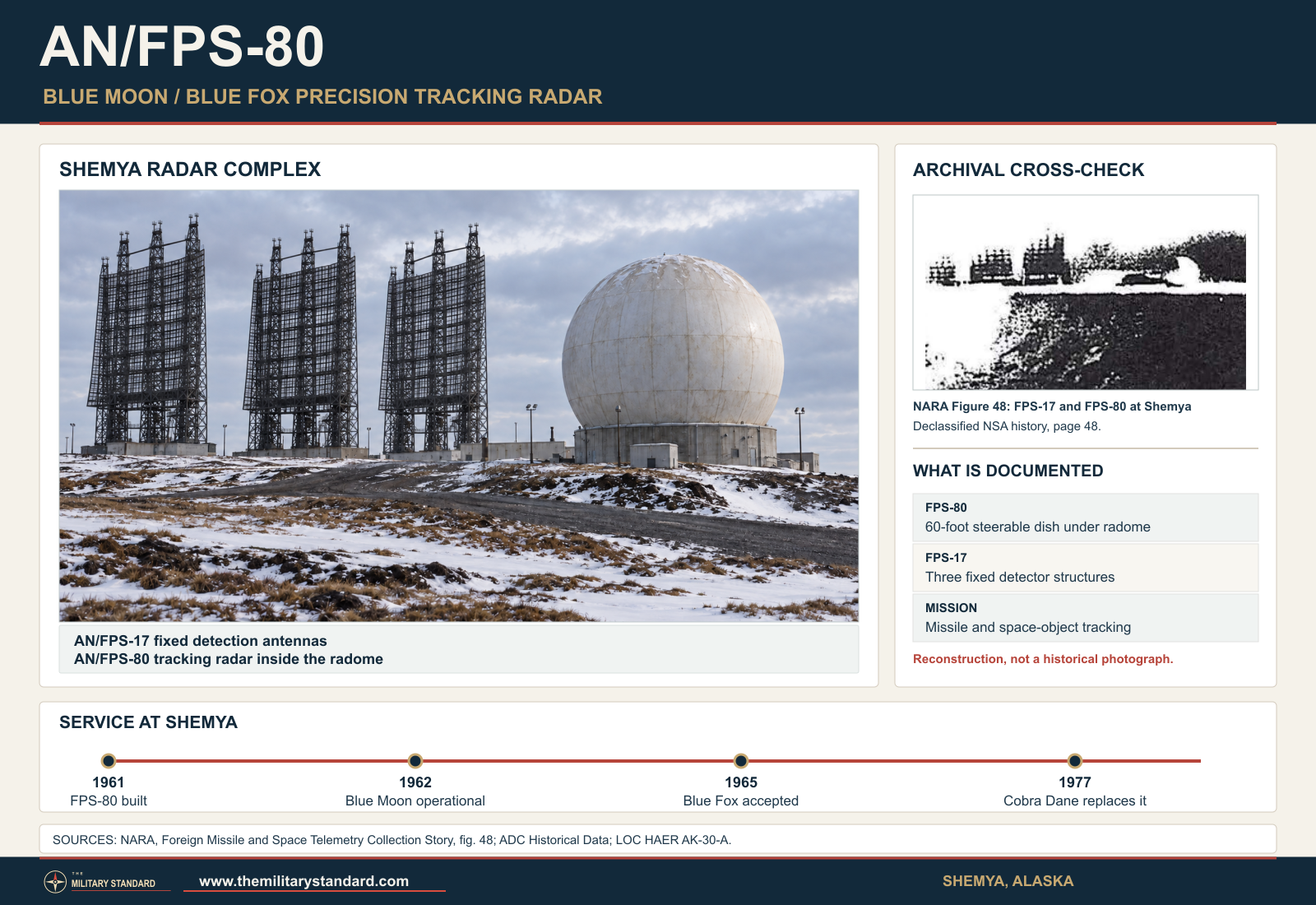
The AN/FPS-80's most visible feature was the large dish inside its radome. Period photographs from Shemya in 1965-1966 show the FPS-80 radome near the massive FPS-17 structures, and a later photograph from about 1971 likewise shows the two systems together. The enclosure allowed the tracking antenna to operate in Aleutian weather without carrying full wind loads on the exposed dish. For a tracker whose usefulness depended on precise pointing, reducing wind-induced disturbance was particularly important.
The pedestal had to perform a demanding mechanical task. A sixty-foot antenna has significant mass and rotational inertia, yet a tracker must move quickly enough to acquire a predicted target and accurately enough to keep a narrow beam centered as the target changes angular position. Unlike a search radar that can accept a fixed rotational schedule, the AN/FPS-80's movement depended on target geometry. The drive system accelerated, decelerated, reversed, and followed commanded azimuth and elevation rates. Public documentation reviewed here does not provide authoritative maximum slew rates, acceleration limits, travel stops, or pointing accuracy, so those values are intentionally left open.
The radome also created radio-frequency engineering requirements. Any protective enclosure introduces attenuation, reflection, and possible boresight error, and those effects have to be controlled in a precision tracking system. The Shemya installation therefore represented more than a dish under a weather cover. It was a calibrated measurement instrument whose antenna, pedestal, enclosure, alignment references, servo electronics, transmitter, receiver, timing, and data-processing chain all had to work together. The surviving photographs are valuable because they show the scale and physical relationship of the tracker to the surrounding missile-surveillance complex even where detailed facility drawings remain difficult to obtain.
How the AN/FPS-80 Worked
An AN/FPS-80 engagement began before the tracker itself necessarily saw the target. A Soviet missile launch might be detected by the AN/FPS-17 fixed beams, predicted from known test activity, or reported through intelligence channels. The detection data defined an approximate trajectory and time. That information gave operators or automated aids an acquisition point. The AN/FPS-80 pedestal then slewed the dish toward the expected line of sight so that the target could enter the radar's relatively narrow tracking beam.
Once echoes appeared in the acquisition volume, the radar had to separate the desired object from noise, clutter, and possibly multiple objects produced by staging or breakup. The monopulse angle channels provided directional error, while the range channel measured time delay between transmission and return. The tracking loops continuously adjusted antenna pointing and range gates as the target moved. Those measurements, stamped against accurate time, formed the raw metric record. For a ballistic missile, the resulting track could help determine trajectory and impact behavior. For a satellite, the measurements could be combined with orbital models to refine an ephemeris and predict later passes.
The tracker was especially valuable when a missile test produced more than one object. Boosters, payloads, reentry vehicles, debris, or failed stages could separate and create a complicated scene. A fixed detection fan might observe several crossings but could not follow each object continuously. A steerable tracker could be assigned to the object judged most important. That capability did not make the AN/FPS-80 a multi-target phased array. It remained a mechanically steered instrument with finite acquisition and tracking capacity. Later interfaces and processing improvements sought to make better use of the radar in increasingly complex events.
Data left the radar site as part of a larger processing chain. Early SPACETRACK depended on communications links that moved observations from remote sensors to central centers where tracks and catalogs were maintained. By the mid-1960s the Space Defense Center at Cheyenne Mountain became a principal operational node. As computing improved, more processing could occur at the sensor site and better cues could be sent back to the tracker. The AN/FPS-80's history is therefore inseparable from computers and communications even though public sources reveal less about its internal electronic architecture than about its operational milestones.
Blue Fox and the AN/FPS-80(M)
Project Blue Fox was the major documented modification of the Shemya tracker. A code-name reference describes Blue Fox as the modification of AN/FPS-80 to AN/FPS-80(M) at Shemya in 1964. The ADC chronology then provides the stronger operational milestones. Category II testing on the FPS-80 at Shemya began on 1965-03-18 under Project Blue Fox, and ADC accepted the FPS-80 tracking radar on 1965-04-08. These dates fit a program that began or was contracted in 1964 and reached military test and acceptance in the spring of 1965.
The suffix or parenthetical notation needs careful handling. ADC's 1973 SPACETRACK table prints FPS-80(M), while the chronology often says simply FPS-80 even when discussing Blue Fox. A specialist code-name listing explicitly states that Blue Fox modified AN/FPS-80 to AN/FPS-80(M). Without the governing JETDS technical order, it is safer to treat "(M)" as the documented ADC modified configuration notation rather than assert that it functioned exactly like a standard letter-suffix redesignation.
Specialist radar references say Blue Fox upgraded the original UHF radar to L-band. That change would have affected antenna-feed behavior, transmitter and receiver hardware, tracking precision, and perhaps the data-processing chain. However, the exact operating frequency, peak power, pulse width, PRF, receiver noise figure, and antenna-beam parameters of the modified configuration have not been recovered from primary engineering documentation.
A separate code-name source identifies Blue Pearl as a modernized AN/FPS-80 built by General Electric for the Air Force. No ADC chronology entry located ties Blue Pearl to a date at Shemya, and no technical document establishes whether it preceded, followed, or overlapped Blue Fox. It is possible that the term refers to a related modernization package or acquisition activity.
Computers and Data Processing
Computing became increasingly important as the radar moved from simple tracking toward integrated space surveillance and technical intelligence. Secondary histories associate both Blue Fox and the related Blue Nine effort with General Electric M236 computers. That claim is repeated often enough to be useful as a research lead, but it has not been elevated to a lifetime equipment specification because an authoritative AN/FPS-80 computer equipment list has not yet been located. The radar almost certainly experienced multiple computing configurations across fifteen years of service.
Official Air Force history shows the broader direction of change. During the 1960s SPACETRACK moved toward faster on-site processing and more integrated command-center operations. In October 1967 the Office of the Secretary of Defense financed modifications to the FPS-80 so it could be tied to an electronic-intelligence sensor at Shemya for more positive target identification. That investment recognized that radar metric data alone did not always reveal what a tracked object represented. Correlating radar tracks with electronic intelligence could increase confidence in target identity and event interpretation.
The resulting dual-track, dual-slave capability is recorded clearly in the ADC chronology. On 1969-10-16 ADC accepted an interface known as ANDERS installed in the ADC FPS-80 and the USAF Security Service ELINT tracker at Shemya. The wording is important because it demonstrates active cooperation between an ADC radar and a separate USAFSS intelligence sensor. The interface allowed the two systems to work in a more coordinated manner, linking precise radar tracking with electronic-intelligence collection rather than leaving analysts to correlate the data only after the fact.
Modernization continued into the 1970s. ADC records that SPACETRACK computer modification F-2021 began at Shemya on 1972-05-29. The chronology does not identify the FPS-80 by name in that entry, so the modification is best described as a Shemya SPACETRACK computer modernization that supported the radar complex rather than as proof of a particular computer cabinet inside the FPS-80.
Operators, Units, and Command Relationships
The earliest Shemya missile-intelligence radar operations belonged to an intelligence-service environment. The declassified NSA history says USAF Security Service initially operated the radars while NORAD tasked them. In 1962 responsibility for operating the FPS-17 and FPS-80 transferred to Air Defense Command. This transition should not be mistaken for the activation date of every later surveillance unit. It was a mission and command handoff involving equipment that was already being brought into operation.
The 16th Surveillance Squadron became the principal ADC unit associated with Shemya's radar mission later in the decade. Official and Air Force-derived lineage material places the squadron's activation in 1966, with assignment to Shemya and a mission centered on Soviet missile surveillance and space tracking. In January 1967 the broader 73rd Aerospace Surveillance Wing began controlling space-surveillance operations, and later command reorganizations placed the mission under Fourteenth Aerospace Force. The exact effective dates and naming sequence should be verified against an AFHRA lineage card before being used as a unit-level master chronology, but the broad organizational pattern is clear.
Shemya itself supported many other missions at the same time. The base had host support organizations, communications, weather, airfield operations, intelligence detachments, and Strategic Air Command activity in addition to the radar complex. That environment matters because AN/FPS-80 personnel depended on the base for housing, power, transportation, food, medical support, communications, and logistics. The radar mission could be national in significance while the people operating it still depended on a small remote installation where weather and supply affected daily life.
No authoritative AN/FPS-80 crew count was located. It would be misleading to copy a staffing number from another large tracker or to treat the strength of the 16th Surveillance Squadron as the number of people required at one console. The radar needed operators, maintenance technicians, electronics specialists, servo and mechanical maintenance, computer and communications support, power and environmental-control personnel, engineering assistance, and contractor support. These functions may have been distributed across different units and contractors rather than forming a single standardized radar crew.
SPACETRACK and SPADATS Integration
The AN/FPS-80 became important because it was connected to a network. Early American space surveillance grew from disparate sensors whose primary missions ranged from missile warning to astronomical observation. SPACETRACK organized their observations into a system able to detect, identify, track, and catalog man-made objects in space. NORAD's growing concern was not merely knowing that satellites existed. The command needed accurate orbital predictions so it could distinguish routine objects from new launches and identify objects that might threaten or confuse aerospace defense operations.
By 1965 the ADC Spacetrack Operations Center at Ent Air Force Base was receiving observations from Shemya and Diyarbakir. The Shemya pair of AN/FPS-17 and AN/FPS-80 offered a particularly useful combination because the Soviet launch geometry that made the site valuable for technical intelligence also made it valuable for rapid recognition of new space objects. Official Air Force history emphasizes that the FPS-80 could observe Soviet satellites launched from Kapustin Yar within minutes and provide accurate positioning data out to 2,500 miles. That early observation shortened the time between launch and a usable orbit solution.
SPADATS, the Space Detection and Tracking System, was the larger operational structure that combined sensor observations with central processing and display. The 1965 activation of the Space Defense Center at Cheyenne Mountain and the continuing consolidation of sensor management moved space surveillance from an experimental collection network toward an operational aerospace-defense mission. The AN/FPS-80 contributed metric observations that central computers could combine with data from other radar and optical sensors. Its value therefore depended not only on its own beam but on the timing, communications, processing, and tasking systems around it.
The same integration explains why a one-site radar could remain important even as the number of satellites increased rapidly. A sensor at Shemya did not need to see every orbiting object. It needed to cover the geometries for which its location was uniquely valuable and provide high-quality measurements when tasked. Other radars and optical stations covered different portions of the sky. Together they formed a global network in which geographic diversity was as important as raw transmitter power.
Operational Tracking of Soviet Missile and Space Events
The best evidence of AN/FPS-80's operational value is not a specification table but a declassified event report. NORAD's Weekly Intelligence Review for 1965-12-24 described a Soviet experimental space vehicle failure launched from Tyuratam on 1965-12-16. The vehicle entered a ballistic trajectory, then an apparent powered-flight attempt over Kamchatka resulted in an explosion and multiple reentering objects. The report states that the FPS-17 and FPS-80 at Shemya tracked associated objects and that processed data indicated an impact point. Visual observations from an airborne intelligence platform and a commercial pilot were then compared with the radar information.
That event demonstrates the complete collection chain. The Shemya radars detected and tracked objects from a Soviet launch. Processing converted measurements into a geographic impact solution. Other sensors observed the reentry visually. Analysts then compared independent reports to interpret what had happened. The AN/FPS-80 therefore contributed to an intelligence process that could reconstruct a failed or unusual Soviet test without any American observer being near the launch site.
The radar also supported routine satellite surveillance. Air Force history credits it with rapidly detecting satellites launched from Kapustin Yar and providing precise position data. A newly launched spacecraft was especially important because its orbit might not yet be cataloged. Early observations allowed central processors to estimate an orbit, predict future passes, and determine whether the object was behaving like a known class of Soviet satellite. The quality of those early measurements could determine how quickly the new object became part of the operational space catalog.
Missile tracking and satellite tracking overlapped because the same launch vehicle could present different intelligence questions at different moments. During boost and ballistic flight, analysts cared about propulsion, staging, velocity, and impact geometry. If a payload entered orbit, the mission shifted toward ephemeris determination, orbital behavior, and mission identification. A steerable tracker at Shemya could contribute to both phases when geometry allowed. This dual use is why official histories often describe the site as a foreign missile and space intelligence facility rather than force it into either a pure missile-warning or pure satellite-tracking category.
Range, Coverage, and Performance
Range figures for large Cold War radars are among the easiest specifications to misuse. The strongest AN/FPS-80-specific public statement located here is the Air Force history's description of highly accurate satellite positioning data to 2,500 miles. That statement does not say the radar could never detect or track any object beyond that distance. It describes demonstrated useful performance in a specific space-surveillance context.
A separate FY1968 Air Force history observed that the existing SPACETRACK radars of that era had ranges under 4,000 nautical miles. That is a network-level comparison made while the Air Force was evaluating future space-surveillance needs. It does not isolate AN/FPS-80 performance and cannot safely be converted into a model rating. Secondary internet summaries sometimes attach other large range numbers to FPS-80, but those often originate in discussions of FPS-79 or other tracking radars.
Altitude coverage is equally unsuitable for a conventional ceiling. AN/FPS-80 tracked ballistic missiles and orbiting spacecraft, so its useful vertical envelope extended well above aircraft-defense altitudes. Its actual ability to track an object at a given altitude depended on slant range, target radar cross section, geometry, frequency, antenna pointing, and whether the target could be cued into the beam.
The radar's field of regard was governed by the mechanical pedestal, local horizon, radome, and site geometry. Exact azimuth and elevation travel limits have not been located. A sixty-foot mechanically steered dish could not instantaneously jump between widely separated targets, and its one-beam architecture imposed scheduling limits that later phased arrays would overcome. Those limitations became increasingly important as missile tests produced multiple objects and the number of satellites in orbit grew.
Transmitter and Receiver Architecture
Public evidence does not yet support a responsible tube-by-tube or waveform-by-waveform description of AN/FPS-80. The original radar is identified as UHF and monopulse, which implies multiple receiver comparison channels or equivalent angle-error processing, but no reviewed primary document specifies the exact RF source, modulator, pulse width, PRF, receiver intermediate-frequency architecture, noise figure, or transmitted waveform.
The Blue Fox modification further complicates the picture. If the specialist secondary description of conversion to L-band is correct, the transmitter, receiver, feed, and perhaps radome electrical design had to change materially. A frequency-band change is not a minor calibration adjustment. It affects antenna illumination, waveguide dimensions, component choices, propagation behavior, and receiver design. Until a Blue Fox engineering document or technical order is found, later configuration details should not be reconstructed by borrowing specifications from AN/FPS-79, AN/FPS-49, or Cobra Dane.
Average RF power is therefore also unresolved. The project standard requires published average power to come from a source or, if it is calculated, to be clearly labeled CALCULATED from source-controlled pulse width, PRF, and peak power. Because those three inputs have not been established for AN/FPS-80, no calculated average is presented. This is a deliberate restraint rather than a missing research step disguised by a borrowed number.
Electrical and Site Support Requirements
No model-specific AN/FPS-80 total electrical load was located in public documentation. The radar clearly required substantial power for transmitter equipment, antenna drives, computers, cooling, environmental control, communications, and the supporting radome facility. Shemya's remote location made reliable generation and distribution particularly important. However, a base power-plant capacity figure would not equal radar load, and a power requirement from another General Electric tracker would not be valid evidence for FPS-80.
Cooling and environmental control were likewise integral to operations. High-power electronic equipment produces heat, precision receivers are sensitive to temperature, and computer equipment of the 1960s demanded controlled spaces. Mechanical tracking systems also required maintenance in an environment where salt and weather could accelerate corrosion. The exact equipment list is not known, but the installation necessarily included far more than the antenna visible outside. Transmitter, receiver, servo, timing, computer, communications, maintenance, and utility spaces formed the hidden portion of the radar system.
The radar depended on Shemya's airfield and supply chain. Replacement electronic modules, heavy mechanical components, test equipment, food, fuel, and personnel had to reach an island where weather could delay transportation. The logistical burden helps explain why contractor engineering and depot-level support were important to specialized radar sites. It also helps explain the strategic appeal of Cobra Dane. A newer phased array promised not merely better radar performance but a more integrated architecture replacing two aging major sensors and their specialized support chains.
Integration with USAFSS ELINT and ANDERS
One of the most significant later changes to the AN/FPS-80 was its integration with electronic intelligence. Radar could tell analysts where an object was and how it moved, but an ELINT sensor could capture emissions associated with a missile, reentry vehicle, telemetry system, or supporting equipment. Bringing the two data streams together made it easier to correlate the physical track with the emitting target or event.
The FY1968 Air Force space history records that in October 1967 the Office of the Secretary of Defense financed modifications to the FPS-80 so it could be tied to an electronic-intelligence sensor at Shemya for more positive target identification. This statement provides the strategic rationale. The project was not simply a local wiring change. It was an effort to increase confidence in what the radar was tracking by combining independent measurement disciplines at the same geographically valuable site.
ADC's chronology records the operational result on 1969-10-16. It says a dual-track, dual-slave capability known as the ANDERS interface, installed in the ADC FPS-80 and the USAFSS ELINT tracker at Shemya, was accepted. The phrase "dual track-dual slave" indicates a coordinated relationship between the sensors rather than a one-way data handoff after the event. The exact technical interface, timing method, command logic, and computer hardware remain to be recovered from project documentation.
ANDERS is important in the larger history of measurement and signature intelligence. Modern technical intelligence routinely combines radar metric data, electronic emissions, optical observations, and other signatures. Shemya was doing an early version of that integration during the Cold War. The AN/FPS-80 provided an accurate geometric track, while the adjacent intelligence system contributed information from a different portion of the electromagnetic spectrum. Together they made the Soviet test event more intelligible than either sensor could alone.
Relationship to AN/FPS-79
AN/FPS-17 detection radars. Both supported missile and space technical intelligence and SPACETRACK. Both evolved through computer and processing modernization. That functional similarity is why histories of early space surveillance often discuss them together.
The designs nevertheless differed. The original FPS-80 is documented as a sixty-foot UHF tracker, while mature official evidence for FPS-79 identifies a larger roughly eighty-four-foot dish and sources disagree over its frequency/configuration history. The Blue Nine program produced FPS-79 after Blue Moon, and one historical account explicitly calls it a modified version of the Blue Moon concept.
The distinction is particularly important because internet summaries often mix the two. The famous 35-foot antenna and 24,000-mile range descriptions belong to technical literature discussing FPS-79, not the Shemya FPS-80. Likewise, the 1975 antenna and pedestal replacement documented for Diyarbakir should not be applied automatically to Shemya. The AN/FPS-80 history therefore uses only model-specific evidence and treats the AN/FPS-79 page as a cross-reference for network context rather than a specification source.
Role in the Wider Military Network
The AN/FPS-80 occupied a rare point where strategic intelligence, aerospace defense, and space surveillance overlapped. At the sensor level it worked with AN/FPS-17(XW3). At the installation level it depended on Shemya's communications, power, airfield, and support organizations. At the command level it passed through USAF Security Service, Air Defense Command, Aerospace Defense Command, and the space-surveillance organizations that connected remote sensors to central processing. At the national level its data contributed to understanding Soviet missile and space capabilities.
Within SPACETRACK and SPADATS, Shemya complemented sensors at Diyarbakir, Moorestown, Eglin, Trinidad Air Station, BMEWS sites, optical stations, and other contributing locations. A 1963 NORAD summary identifies the AN/FPS-44 radar at Trinidad as a part-time SPADATS contributor and discusses delayed transfer of its operational control; Trinidad should not be treated as an ADC-operated FPS-80 installation. No single sensor could observe every orbit or missile trajectory. Shemya's unique value came from geometry against Soviet Far Eastern test activity and from the ability to acquire some launches early in their flight or orbital history. The FPS-80's precision measurements could then be combined with observations from other locations to improve a track or orbit solution.
The radar also sat within NORAD's broader transformation from air defense to aerospace defense. By the 1960s the command had to consider bombers, ballistic missiles, satellites, nuclear detonations, and the possibility that space objects could affect warning or attack assessment. ADC was redesignated Aerospace Defense Command in 1968, reflecting that expanded domain. AN/FPS-80 was a physical expression of the change because its primary targets were not ordinary aircraft but missiles and spacecraft moving far above traditional air-defense altitudes.
Shemya itself became a larger technical-intelligence node. Radar, electronic intelligence, airborne reconnaissance, communications, and later Cobra Dane all exploited the island's proximity to Soviet test areas. The ANDERS interface demonstrated direct cooperation between ADC and USAFSS sensors. Later Cobra Ball aircraft and Cobra Dane continued the same underlying mission of measuring foreign missile tests. The AN/FPS-80 therefore belongs to a continuing Shemya intelligence lineage rather than to a closed chapter isolated from what followed.
Modernization in the Early 1970s
By the early 1970s, the AN/FPS-80 was still useful but aging. Its basic architecture dated from the beginning of the 1960s, while the number and complexity of tracked objects had increased dramatically. Space surveillance increasingly favored sensors with larger fields of regard, faster data processing, better discrimination, and the ability to track multiple objects. The single mechanically steered dish at Shemya could still produce high-quality tracks, but every second spent slewing or following one object was time unavailable for another.
ADC's 1972 F-2021 computer modification at Shemya reflects the attempt to improve the existing network while a replacement was being developed. Better computer support could improve cueing, track processing, data formatting, and communications even if the antenna itself remained mechanical. The exact hardware content and completion date of F-2021 at Shemya remain unresolved, but the program shows that the Air Force continued investing in the old site rather than simply waiting for Cobra Dane.
At the same time, strategic arms limitation gave missile-test measurement a new policy dimension. The 1972 SALT I agreements formalized the importance of national technical means of verification. Shemya already had years of experience collecting metric and signature data on Soviet tests. The next radar would be built in part to make that capability more powerful, integrated, and durable. The transition from FPS-17/FPS-80 to Cobra Dane therefore reflected both technological aging and a strategic requirement for better treaty-monitoring intelligence.
Replacement by AN/FPS-108 Cobra Dane
In July 1973 Raytheon won the contract to build Cobra Dane at Shemya. Contemporary electronics-industry reporting described the new phased-array radar as a replacement for the FPS-17 detection and FPS-80 tracking radars. The AN/FPS-108 combined functions that previously required separate fixed detection and mechanical tracking systems. Its phased array could steer beams electronically, track multiple objects, collect detailed metric and signature data, and respond more quickly than a large dish that had to move physically.
The architectural change was profound. AN/FPS-80's sixty-foot dish concentrated energy into one mechanically directed tracking beam. Cobra Dane used a large fixed phased-array face containing many radiating elements and changed beam direction electronically. That allowed rapid movement among targets and supported a far greater multi-object workload. For the missile-test mission, where one launch could produce boosters, payloads, decoys, reentry vehicles, and debris, that capability was a major advantage.
Alaska's official Cold War history states that both AN/FPS-17 and AN/FPS-80 were deactivated when Cobra Dane was completed in July 1977. A later official Space Force history gives Cobra Dane initial operational capability by July 1977, while several other sources use 1977-08-01 as the declared operational date. These are compatible transition milestones rather than necessarily competing dates.
Replacement did not mean that the mission disappeared. Cobra Dane continued foreign ballistic-missile intelligence collection, treaty monitoring, and space surveillance from the same island. Current Space Force descriptions still emphasize collection of radar metric and signature data on foreign missile events, observation of selected space launches, and tracking of satellites. The continuity shows that the AN/FPS-80's strategic role was sound. What became obsolete was the mechanical and processing architecture used to perform it.
Preservation and Surviving Evidence
No complete preserved AN/FPS-80 has been verified. The Shemya tracker was superseded at an active national-security site, not retired into a museum environment. The radar's large antenna, pedestal, radome, electronics, and support plant were functionally obsolete once Cobra Dane took over. Public documentation reviewed here does not provide a detailed disposal inventory establishing which components were scrapped, reused, buried, or removed. The equipment is therefore listed as having no verified complete preserved example.
Documentary preservation is much stronger. The National Archives and declassified NSA history preserve an important photograph of the AN/FPS-17 and AN/FPS-80 at Shemya. Private Shemya photo collections show the FPS-80 radome in 1965-1966, and later photographs show the radar complex around 1971. ADC historical tables and chronology preserve equipment designations, program milestones, and operational integration. Official Air Force histories preserve the system's role in SPACETRACK and its demonstrated 2,500-mile precision tracking. Together these sources allow the radar to be reconstructed historically even without surviving hardware.
The site itself remains militarily significant. Shemya was later renamed Eareckson Air Station, and Cobra Dane continues operating there. That continuity gives the AN/FPS-80 an unusual kind of physical legacy. The exact tracker may be gone, but the radar mission still occupies the same island and still exploits the same strategic geography. A visitor cannot tour a preserved FPS-80, but modern satellite imagery, official photographs of Cobra Dane, historic Shemya photographs, and site documentation reveal how the old tracker fit into the continuing sensor landscape.
Technical Uncertainties and Source Conflicts
Several important specifications remain unresolved by design. No source-controlled exact original frequency in MHz has been established. The original system is reliably described as UHF. Specialist sources describe Blue Fox as an L-band conversion, but the exact modified frequency or tuning band remains open. No reliable equipment-specific peak RF power or average RF power has been found. No calculation is offered because source-controlled peak power, pulse width, and PRF have not all been established for the same configuration.
The service-date record also needs layered interpretation. ADC's historical table gives February 1962. Historical technical literature gives 1962-04-01 for Blue Moon operational status. Blue Fox is associated with 1964 in code-name sources, while ADC records Category II tests beginning 1965-03-18 and acceptance on 1965-04-08. The most defensible chronology therefore distinguishes initial site operation from the later modernization and acceptance sequence rather than replacing all dates with a single one.
The modified designation is another open issue. ADC clearly prints FPS-80(M), but no governing nomenclature technical order was located. The parenthetical M may have been an operational modified-system convention rather than a standard JETDS suffix in the same sense as AN/FPS-80A would have been. The record uses the exact ADC notation and does not invent an A suffix. Blue Pearl is preserved only as a research lead because its relationship to Blue Fox remains unclear.
The computer history also remains incomplete. Secondary literature associates General Electric M236 computers with Blue Fox, while ADC later documents the F-2021 SPACETRACK computer modification at Shemya. These facts show that computer support changed, but they do not yet establish a complete cabinet-by-cabinet configuration timeline.
Legacy
The AN/FPS-80 helped establish the operational pattern that still defines strategic missile and space surveillance: detect an event, acquire selected objects, generate precise metric data, correlate those measurements with other intelligence, and distribute the resulting track to national command and analysis organizations. Its hardware was mechanical and its computing primitive by modern standards, but the information problem it solved remains familiar. Missile trajectories, reentry objects, satellite launches, and space debris still have to be detected, tracked, identified, and interpreted.
The radar also illustrates how intelligence requirements can produce equipment that never exists in large numbers yet still deserves a full equipment history. AN/FPS-80's importance cannot be measured by procurement quantity. One radar at Shemya filled a geographic and technical niche that few other sensors could match. It observed Soviet activity from a strategically placed American island, supplied precise tracking to SPACETRACK and NORAD, supported technical intelligence, and eventually integrated with electronic-intelligence collection through ANDERS.
Its replacement by Cobra Dane makes the continuity especially clear. The newer phased array inherited the same broad mission while solving the older system's limitations in beam agility, multiple-object tracking, integration, and maintainability. Current Space Force descriptions of Cobra Dane still emphasize foreign ballistic-missile metric and signature collection, treaty monitoring, space launch observation, and satellite tracking. Those missions are direct descendants of the work performed by the FPS-17/FPS-80 complex.
The AN/FPS-80 therefore belongs among the foundational sensors of the American space-surveillance and foreign-missile intelligence system. It was not simply a large dish on a remote island. It was a precision measurement instrument linked to detection radar, computers, communications, intelligence organizations, and central aerospace-defense centers. From Blue Moon through Blue Fox and ANDERS to its replacement by Cobra Dane, its history traces the development of a national technical-intelligence architecture from isolated radar observations toward integrated multi-sensor surveillance.
Chronology
- 1957-10-04 The Soviet Union launched Sputnik 1, sharply increasing the urgency of American space detection, tracking, and identification.
- 1958 The Air Force revived Shemya for renewed strategic use as Soviet missile tests toward Kamchatka increased the island's intelligence value.
- 1959 Declassified intelligence history records installation of the AN/FPS-17 detection radar at Shemya.
- 1960-05 Official Air Force base history records the Shemya AN/FPS-17 as operational, providing the detection capability later paired with AN/FPS-80.
- 1961-02-01 NORAD assumed operational command of the Navy Space Surveillance fence and data-processing facility, part of the broader consolidation of American space-surveillance operations.
- 1961 Official Air Force history records construction of an AN/FPS-80 tracking radar near the Shemya AN/FPS-17.
- 1962-02 ADC's later SPACETRACK table gives February 1962 as the Shemya FPS-80(M) site date; the specific operational milestone represented by this table entry has not been established.
- 1962-04-01 Historical technical literature identifies Blue Moon, designated FPS-80, as becoming operational at Shemya.
- 1962 A declassified NSA history states that responsibility for operating the Shemya FPS-17 and FPS-80 transferred from USAF Security Service to Air Defense Command, part of NORAD.
- 1964 Code-name references associate Project Blue Fox with modification of AN/FPS-80 to the FPS-80(M) configuration at Shemya.
- 1965-03-11 ADC submitted a requirement for satellite classification and mission assessment capability, illustrating the expanding space-defense mission into which Shemya fed data.
- 1965-03-18 ADC began Category II testing on the Shemya FPS-80 under Project Blue Fox.
- 1965-04-08 Aerospace Defense Command accepted the FPS-80 tracking radar at Shemya after the Blue Fox test period.
- 1965 Air Force historical analysis records that the Shemya FPS-80 could rapidly detect Soviet satellites launched from Kapustin Yar and provide highly accurate position data to 2,500 miles.
- 1965-09-03 The Space Defense Center was activated at Colorado Springs, strengthening centralized operational use of observations from sensors such as Shemya.
- 1965-12-16 The Shemya FPS-17 and FPS-80 tracked objects from a failed Soviet experimental-space-vehicle operation launched from Tyuratam. Processed radar data produced an impact point near Kamchatka.
- 1966 The 16th Surveillance Squadron was activated at Shemya in the ADC space-surveillance mission.
- 1967-01-01 Space-surveillance operations came under the 73rd Aerospace Surveillance Wing, providing higher-level organization for assigned radar and optical sensors.
- 1967-10 Official Air Force history records OSD financing modifications to tie the FPS-80 to a Shemya electronic-intelligence sensor for improved target identification.
- 1968-01-15 Air Defense Command was redesignated Aerospace Defense Command, reflecting the command's air, missile, and space responsibilities.
- 1968-06-21 Shemya Air Force Station was redesignated Shemya Air Force Base.
- 1968-07-01 Fourteenth Aerospace Force replaced the 9th Aerospace Defense Division as a major ADC space organization.
- 1969-10-16 ADC accepted the ANDERS dual-track, dual-slave interface connecting the ADC FPS-80 with the USAFSS ELINT tracker at Shemya.
- 1972-05-26 The United States and Soviet Union signed the SALT I agreements, increasing the policy importance of national technical means used to observe strategic missile activity.
- 1972-05-29 ADC began SPACETRACK computer modification F-2021 at Shemya.
- 1973-07 Raytheon won the contract to build Cobra Dane at Shemya, a phased-array radar intended to replace the FPS-17 detection and FPS-80 tracking systems.
- 1976 Cobra Dane installation and technical-assistance work reached completion stages at Shemya.
- 1977-07 Alaska Cold War history records the AN/FPS-17 and AN/FPS-80 as deactivated upon completion of Cobra Dane.
- 1977-08-01 Multiple histories use this date for Cobra Dane operational status, completing the transition from the FPS-17/FPS-80 complex to AN/FPS-108.
- 1993-04-06 Shemya Air Force Base was renamed Eareckson Air Station, preserving the continuing radar and intelligence mission at the former FPS-80 location.
- 2004 Cobra Dane received major missile-defense upgrades while retaining foreign-missile intelligence and space-surveillance roles inherited from the earlier Shemya complex.
- 2009-02 Control of the upgraded Cobra Dane system returned from the Missile Defense Agency to the Air Force, while the sensor retained intelligence and space-tracking missions.
- 2020-10 The U.S. Space Force fact sheet continued to describe Cobra Dane's missions as foreign ballistic-missile metric/signature collection, treaty monitoring, selected space-launch observation, and space surveillance.
- 2026 The AN/FPS-80 remains retired. Cobra Dane continues the Shemya foreign-missile and space-tracking mission at Eareckson Air Station; this is mission continuity, not survival of FPS-80 hardware.
Information sources (21)
- PDFHistorical Data of the Aerospace Defense Command, 1946-1973
SOURCE FOR: Primary ADC source for the exact AN/FPS-80 description, FPS-80(M) notation, Shemya SPACETRACK installation, 16th Surveillance Squadron association, February 1962 table date, and AN/FPS-17(XW3) pairing.
- PDFADC Historical Study No. 19, A Chronology of Air Defense, 1914-1972
SOURCE FOR: Primary ADC chronology for 1965-03-18 Blue Fox Category II testing, 1965-04-08 acceptance, 1969-10-16 ANDERS acceptance, and 1972-05-29 F-2021 computer modernization at Shemya.
- PDFNational Security Agency / National Archives, The Foreign Missile and Space Telemetry Collection Story, The First 50 Years, Part One
SOURCE FOR: Declassified intelligence history documenting the sixty-foot FPS-80 at Shemya, missile and satellite coverage, USAFSS operation, 1962 transfer to ADC, and a period photograph of FPS-17/FPS-80.
- PDFNORAD Weekly Intelligence Review, WIR 52/65, 24 December 1965
SOURCE FOR: Declassified operational intelligence report documenting FPS-17/FPS-80 tracking of objects from a failed Soviet experimental-space-vehicle launch on 1965-12-16 and the resulting impact-point solution.
- PDFBeyond Horizons: A Half Century of Air Force Space Leadership
SOURCE FOR: Official Air Force historical study describing growth of SPACETRACK and stating that the Shemya FPS-80 could rapidly detect Kapustin Yar satellite launches and provide highly accurate positioning data to 2,500 miles.
- PDFThe Air Force in Space, Fiscal Year 1968
SOURCE FOR: Official Air Force history for the primary SPACETRACK network, limits of contemporary sensor coverage, Shemya radar role, and October 1967 funding to integrate FPS-80 with an electronic-intelligence sensor.
- PDFAFCEC, "A Look Back: A Brief Military History of Shemya Island"
SOURCE FOR: Official Air Force installation history documenting Soviet-test-driven reactivation, AN/FPS-17 operation in 1960, AN/FPS-80 construction in 1961, and later replacement by Cobra Dane.
- PDFAlaska Office of History and Archaeology, The Coldest Front
SOURCE FOR: State historical study documenting Shemya's Cold War intelligence role and stating that AN/FPS-17 and AN/FPS-80 were deactivated when Cobra Dane was completed in July 1977.
- PDFAerospace America, Pesavento, "Declassifying..."
SOURCE FOR: Historical technical source identifying Blue Moon as FPS-80, a sixty-foot pedestal-mounted tracker operational 1962-04-01 with a 2.5-degree monopulse UHF pencil beam, and describing the relationship to later Blue Nine development.
- WEBDesignation-Systems.net, Code Name Listing - B
SOURCE FOR: Specialist code-name reference identifying Blue Fox as the 1964 modification of AN/FPS-80 to FPS-80(M), Blue Nine as the AN/FPS-79 program, and Blue Pearl as a modernized FPS-80 requiring further source reconciliation.
- WEBSearching the Skies: The Legacy of the United States Cold War Defense Radar Program
SOURCE FOR: Historical defense-radar study documenting Cobra Dane's replacement of the Shemya AN/FPS-17 and AN/FPS-80 and the continuity of missile-test and SPACETRACK missions.
- WEBU.S. Space Force, COBRA DANE Radar fact sheet
SOURCE FOR: Current official source describing the successor radar's foreign-missile metric/signature intelligence, treaty-monitoring, selected launch observation, and space-surveillance missions at Eareckson Air Station.
- WEBPeterson-Schriever Space Force Base, "COBRA DANE: A piece of history transitions to AFSPC"
SOURCE FOR: Official historical article documenting the 1973 contract period, 1976 fielding, July 1977 initial operational capability, and continuing Shemya radar mission.
- WEBRadomes.org, Eareckson AFS, Shemya, Alaska
SOURCE FOR: Specialist radar-site archive providing site coordinates, equipment sequence, photographs, documents, and aerial imagery for the Shemya radar complex.
- WEBShemya Photos, Page 1
SOURCE FOR: Historical photograph collection providing a 1965-1966 view from the FPS-17 toward the FPS-80 radome and broader visual context for the remote installation.
- WEBFlickr, AN/FPS-17 and AN/FPS-80, Shemya
SOURCE FOR: Photograph landing page for a circa-1971 view of the Shemya detection and tracking radar complex.
- PDFAir & Space Forces Magazine, contemporary 1973 Cobra Dane contract reporting
SOURCE FOR: Contemporary industry reporting that the new Cobra Dane system at Shemya would replace the FPS-17 detection and FPS-80 tracking radars.
- WEBGlobalSecurity, Eareckson / Shemya background
SOURCE FOR: Secondary facility reference for the Shemya missile-surveillance mission, AN/FPS-17 and AN/FPS-80 sequence, and Cobra Dane replacement context.
- WEBU.S. Space Force, Mission Delta 4 fact sheet
SOURCE FOR: Current organizational source showing continued Space Force support to Cobra Dane at Eareckson and the modern missile-warning and space-domain-awareness network that inherited the earlier Shemya mission.
- PDFNORAD Historical Summary, July-December 1963
SOURCE FOR: Trinidad AN/FPS-44 radar was a part-time SPADATS contributor in 1963; operational-control transfer was still delayed. Trinidad was a related network site, not an AN/FPS-80 site.
- PDFNaval Aeronautical Organization, January 1967
SOURCE FOR: Period Navy directory distinguishes U.S. Air Force Trinidad Air Station, under Air Force Eastern Test Range operational control, from supporting Naval Station Trinidad.