
AN/FPS-87 and AN/FPS-87A Long-Range Search Radar
- Role
- Two-dimensional long-range aircraft search with receiver-side electronic-counter-countermeasures
- Documented configuration
- AN/FPS-20A plus OA-4381 receiver group equals AN/FPS-87A
- Published AN/FPS-87A characteristics
- 1,250-1,350 MHz; 2 MW peak RF; listed 230 nmi range; 3.3-10 rpm
- Early photographed site
- Hopedale Air Station, Labrador, by June 1963
- Later designation
- AN/FPS-93/93A after MK-747/FPS conversion
Designation and Identity
The AN/FPS-87 family was one of the less conspicuous but technically important branches of the Bendix OA-4381 receiver group. Later military handbook material confirms that both AN/FPS-87 and AN/FPS-87A existed as valid radar sets and that they were the immediate predecessors of AN/FPS-93 and AN/FPS-93A respectively.
The authoritative ADC compilation, Historical Data of the Aerospace Defense Command, 1946-1973, lists "FPS-87A" and describes it exactly as "FPS-20A with OA-4381." That wording is retained because it is direct command-level evidence and because it prevents the AN/FPS-87A from being confused with other FPS-20-family electronic-counter-countermeasures modifications such as the GPA-102 and GPA-103 conversions. ADC does not separately define plain AN/FPS-87 on its principal radar-description page. MIL-HDBK-162A, however, explicitly distinguishes Radar Set AN/FPS-87 from Radar Set AN/FPS-87A when describing their conversion by Modification Kit MK-747/FPS into AN/FPS-93 and AN/FPS-93A. Its printed description on the first page of that entry says AN/FPS-98A once; this is a handbook typographical error, not a separate conversion. The entry heading, second-page type line, component footnotes, and cited nomenclature cards all identify AN/FPS-93A. The most defensible family map is therefore that AN/FPS-87 and AN/FPS-87A were separate suffix variants within the same receiver-modernized FPS-20 family, not alternate spellings for one system.
A second nomenclature problem appears in secondary histories. Several later modification trees call the receiver package "OA-4831." That number conflicts with both ADC and federal supply-system evidence. ADC gives OA-4381, while logistics records identify the receiver group itself as OA-4381/FPS-87 and link it to technical-order literature for AN/FPS-87 and AN/FPS-93. The repeated OA-4831 form is therefore treated as a likely transposition in secondary literature rather than as a second receiver group.
The family was built around a Bendix radar foundation. The official Air Force Cold War radar study Searching the Skies identifies AN/FPS-87A as a Bendix-built long-range L-band search radar based on AN/FPS-20. MIL-HDBK-162A also identifies Bendix Corporation, Baltimore, Maryland, as manufacturer of AN/FPS-87 or AN/FPS-87A when describing the later AN/FPS-93 conversion.
Development Background
The AN/FPS-87 family emerged from the technical problem facing the North American air-defense radar network at the end of the 1950s. The permanent radar system had been built around large fixed search radars such as AN/FPS-20 and AN/FPS-20A. Those sets provided the range and azimuth coverage needed to detect approaching aircraft and feed manual or SAGE direction centers. Their basic pulse-radar architecture, however, had been conceived before electronic attack became a central design concern. As Soviet bomber forces matured and electronic warfare became an expected part of any strategic attack, Air Defense Command could not treat jamming resistance as an optional refinement. Existing stations had to be made harder to blind without replacing the entire radar plant.
The AN/FPS-20 itself was a Bendix long-range search radar operating in the 1.25 to 1.35 GHz portion of L-band. Federal radar-characteristics compilations give a representative parent-family baseline of 2 megawatts peak RF power, 4.32 kilowatts average RF power, a nominal 230-nautical-mile range, 360 pulses per second, a six-microsecond pulse, and antenna rotation selectable across approximately 3.3 to 10 rpm. Those figures describe the basic search-radar family and are useful for understanding the physical and electromagnetic platform into which the OA-4381 was inserted. The AN/FPS-87A is separately tabulated in the same federal compilation with those same model values. Plain AN/FPS-87 is not separately tabulated there, so those model-specific numbers are not silently assigned to the unsuffixed variant without qualification.
The wider FPS-20 modernization program produced several designation branches. The GPA-102 modification led to AN/FPS-64 from FPS-20 and AN/FPS-66 from FPS-20A. The GPA-103 led to AN/FPS-65 and AN/FPS-67. The OA-4381 receiver branch produced AN/FPS-87 and AN/FPS-87A. Later antenna and ECCM modernization through MK-747/FPS converted the 87 family into AN/FPS-93 and AN/FPS-93A. That sequence is historically significant because it shows that the Air Force did not pursue one universal upgrade. It experimented with and fielded several packages that attacked the vulnerability problem at different points in the signal chain.
The AN/FPS-87 branch emphasized reception and signal discrimination. A stronger transmitter alone could not solve every jamming problem. If an adversary injected enough energy into the radar's receiver passband, or if clutter and interference overwhelmed the display, increased transmitted power might improve some aspects of signal return while leaving the receiver vulnerable. Improving the receiving chain offered another path. Better filtering, gain control, signal handling, and resistance to interference could preserve useful target information in conditions where the unmodified receiver was less effective. The OA-4381 therefore represented a shift in emphasis from brute-force radiated power toward better use of the returning signal.
The OA-4381/FPS-87 Receiver Group
Federal supply records are unusually helpful in confirming the identity of OA-4381. Receiver Group MM9200 is cross-referenced to JETDS type number OA-4381/FPS-87. Associated records identify the end application as AN/FPS-93. Other component records tie power supplies, intermediate-frequency amplifiers, waveguide assemblies, attenuators, mixer stages, and receiver subassemblies to the same receiver group. These records are not a substitute for a complete technical manual, but they independently confirm that OA-4381 was a real receiver-group designation physically integrated into the FPS-20 lineage.
One especially useful component record identifies a 30 MHz intermediate-frequency amplifier used with receiver group OA-4527/FPS-87 and references the same AN/FPS-20 technical-order family. The reviewed records therefore show that the FPS-87 receiver modernization was not a single box casually attached to the radar. It was a receiver-system change with multiple interconnected components. The exact boundary between OA-4381 as the receiver-group designation and subordinate assemblies such as OA-4527 is not fully reconstructed here, and it should not be flattened into one item. The important point is that the designation change corresponded to a real receiver architecture rather than to a paperwork-only renaming.
The receiver-centered nature of the modification also explains why many outward photographs of an AN/FPS-87A site look very much like photographs of an AN/FPS-20A site. The major rotating search antenna, tower, radome, transmitter building, and site infrastructure could remain recognizable. The operational improvement occurred largely inside the electronics plant. This is a recurring problem in radar identification. A photograph can establish that a station had a familiar FPS-20-family antenna, but it often cannot establish whether the cabinets beneath it represented FPS-20A, FPS-87A, or a later configuration. Hopedale is especially valuable because surviving 1963 photographs are captioned specifically as FPS-87A cabinets and show an airman at the FPS-87A klystron cabinet. Those captions tie visible equipment to a known designation and date.
AN/FPS-87 Versus AN/FPS-87A
The suffix boundary must be preserved. ADC directly defines AN/FPS-87A as OA-4381. MIL-HDBK-162A later says that AN/FPS-87 and AN/FPS-87A, when modified with MK-747/FPS, became AN/FPS-93 and AN/FPS-93A respectively. This establishes that an unsuffixed AN/FPS-87 was not simply a shortened way of writing AN/FPS-87A. It was a distinct starting configuration in the same family.
The most plausible and widely repeated modification tree maps AN/FPS-20 plus OA-4381 to AN/FPS-87 and AN/FPS-20A plus OA-4381 to AN/FPS-87A. That mapping fits ADC's direct description of the A variant and the later handbook's paired 87-to-93 and 87A-to-93A conversions. It also fits the known FPS-20 versus FPS-20A distinction within the parent family. The parent sets differed in modulator arrangement, with technical literature distinguishing dual-modulator and single-modulator configurations. Because the primary OA-4381 installation order has not been located, the plain AN/FPS-87 mapping is presented as a strongly supported family reconstruction rather than as a verbatim ADC statement.
This distinction helps explain why some field histories are inconsistent. A site could begin with FPS-20A, receive OA-4381 and become FPS-87A, then receive MK-747/FPS and become FPS-93A. Another site with a different FPS-20 starting configuration could follow the unsuffixed branch. If a later station summary simply lists "FPS-87" without the suffix, that notation should not automatically be normalized to 87A.
Technical Characteristics and Source Control
The best model-specific technical baseline located for AN/FPS-87A comes from a federal radar-characteristics compilation. It lists 1250 to 1350 MHz, 2,000,000 watts peak RF power, 4,320 watts average RF power, 230 nautical miles range, 360 pulses per second, six-microsecond pulse width, antenna rotation from approximately 3.3 to 10 rpm, and a nominal beamwidth of 1.3 degrees horizontal by 5.0 degrees vertical. These values are internally consistent. At 360 pulses per second and six microseconds per pulse, the duty factor is 0.00216. Multiplying 2,000,000 watts by 0.00216 yields 4,320 watts, exactly matching the published average-power figure. Because the federal table itself publishes the average value, it is recorded as a published figure, not merely as a calculated estimate.
Those values should not be interpreted as proof that every FPS-87-family site always operated identically. The 1250 to 1350 MHz figure is a tuning range, not evidence that the radar transmitted across the entire band simultaneously. The 230-nautical-mile number is an instrumented or published characteristic, not a guarantee that every aircraft target was detected at that distance under every propagation, altitude, target-cross-section, clutter, antenna-tilt, or jamming condition. Likewise, selectable antenna speed means operators could trade scan revisit rate against dwell and local operating requirements. Radar performance was an interaction among the equipment, the target, the site, the atmosphere, maintenance condition, and the tactical environment.
The technical evidence is much stronger for AN/FPS-87A than for plain AN/FPS-87. The federal table has a direct 87A line but not a separate unsuffixed 87 line. The parent AN/FPS-20 line shows the same 1250 to 1350 MHz, 2-megawatt peak, 4.32-kilowatt average, 230-nautical-mile, 360-pps, six-microsecond baseline. That commonality is consistent with a receiver-group conversion that retained the parent transmitter and antenna system. It is still important to label the inference correctly.
The radar was a two-dimensional long-range search sensor. It measured range from pulse travel time and azimuth from antenna position. It did not independently provide the precise target altitude required for interception. In the classic ADC station architecture, a separate height finder such as AN/FPS-6B or AN/FPS-90 supplied elevation information. The search radar provided the broad surveillance picture, the height finder refined altitude, identification equipment helped distinguish friendly traffic, and communications or automated data-processing equipment moved the track toward a control center. The AN/FPS-87 therefore should not be described as a self-contained three-dimensional radar simply because it was a powerful long-range set.
Antenna, Rotation, Transmitter, Receiver, and Power
The AN/FPS-87 family retained the basic mechanical-search architecture of the FPS-20 line. A large rotating reflector swept the horizon in azimuth, creating a repeated surveillance picture over 360 degrees. The federal 87A characteristics give a 1.3-degree horizontal by 5.0-degree vertical beam and rotation from 3.3 to 10 rpm. That beam geometry is characteristic of a long-range two-dimensional search function. The narrow horizontal beam improved azimuth resolution, while the broader vertical beam allowed coverage across a useful elevation volume without mechanically nodding a height-finder antenna.
The sources located do not provide a clean model-specific dimensional drawing for the pre-MK-747 AN/FPS-87 antenna. It is therefore safer to identify it as the retained FPS-20-family rotating reflector rather than import the later Raytheon MK-747 antenna dimensions from AN/FPS-93. That distinction is important because the MK-747 conversion was specifically a later modernization that changed the antenna and associated high-power rotary-joint and filtering arrangements. Using a later FPS-93 reflector measurement for an earlier FPS-87 would erase the very equipment transition the designation sequence is meant to document.
The transmitter remained in the high-power FPS-20 family. Technical material for that family describes a klystron-based high-power transmitter operating in the 1250 to 1350 MHz band, with six-microsecond pulses at 360 pps and a minimum peak output of approximately 2 megawatts. The 87A federal characteristics are consistent with that parent architecture. The original FPS-20 modernization history also distinguishes transmitter/modulator arrangements between suffix configurations. Those differences matter to lineage but do not justify an unsupported claim that OA-4381 itself changed peak power.
The receiver was where the family's identity lay. OA-4381/FPS-87 gave the radar a revised receiving group designed for improved performance in the interference and jamming environment faced by the Permanent Radar Network. Component-level evidence confirms intermediate-frequency amplification, mixing, attenuation, waveguide, and power-supply elements within the receiver lineage. Parent FPS-20 technical literature also describes video enhancement, anti-chaff, and interference-reduction features appearing through the broader modernization program.
Parent-family electrical evidence gives 120/206-volt, 60-Hz, three-phase input for major radar equipment. The exact complete installation power demand of an AN/FPS-87 or AN/FPS-87A site was not located. A radar station also required far more than transmitter input power. Antenna drive, receiver cabinets, cooling, environmental control, radome services, communications, identification equipment, displays, data-processing interfaces, lighting, standby generation, and support buildings all added to the site electrical burden. For remote Pinetree and Alaska stations, power reliability was itself a mission requirement. A radar with sophisticated ECCM electronics was useless if a generator failure stopped the antenna or chilled electronics failed.
How the Radar Worked
In basic operation, the transmitter generated short L-band pulses and sent them through the antenna feed to the rotating search antenna. Each pulse traveled outward at essentially the speed of light. When the pulse encountered an aircraft or other reflecting object, a minute fraction of the energy returned to the antenna. The radar receiver amplified and processed the returning signal. The elapsed time between transmission and reception yielded range. The antenna's azimuth at the time of reception yielded bearing. Successive sweeps allowed controllers and automatic systems to build and maintain tracks.
The problem was that the receiver did not see only desired target echoes. Ground clutter, weather, other radars, internal noise, deliberate jamming, chaff, and spurious signals all competed for attention. In a strategic air-defense system, an adversary could exploit those weaknesses deliberately. If the screen filled with false energy or the receiver saturated, the radar's nominal peak power and instrumented range mattered little. The purpose of ECCM modernization was to preserve usable target information when the electromagnetic environment became hostile.
The OA-4381 receiver group should therefore be understood as part of a contest between radar engineering and electronic attack. A receiver could be made more selective, more stable, and less vulnerable to overload or unwanted signals. Intermediate-frequency stages, attenuation, gain management, filtering, and signal-processing improvements could allow useful echoes to remain visible where an earlier receiving chain performed poorly. The surviving public component records do not reconstruct every circuit and operator control, so the exact anti-jam mechanism is not overstated. The designation itself, its placement in ADC's ECCM modernization context, and its later replacement by the more extensive MK-747 conversion establish the operational intent.
Once detected, a target report did not remain local. At manual stations, operators plotted and passed track information by voice and teletype. At SAGE-connected stations, radar data passed through processing equipment into the automated air-defense network. Alaska developed a somewhat different but related semiautomatic architecture. At King Salmon, the AN/FYQ-9 Semiautomatic Data Processing and Display System became operational alongside the mid-1960s radar modernization. The result was less dependence on slow manual reporting and a faster path from radar return to a usable regional air picture.
ECCM Role and the Bomber Threat
The AN/FPS-87 family belongs to the period when Continental Air Defense had to assume that a Soviet bomber raid would include electronic support. Long-range bombers could carry or be accompanied by jammers, and the Soviet Union had ample incentive to interfere with the radars that would cue interceptors and missile defenses. The U.S. response was layered. Some radars gained frequency-diversity features. Others received higher-power transmitters, velocity filters, improved receivers, lower-sidelobe antennas, polarization changes, or new signal-processing equipment. The AN/FPS-87 family occupied the improved-receiver branch of that larger effort.
This modernization was economical as well as tactical. The Air Force had already invested heavily in remote radar stations, towers, radomes, power plants, communications, housing, and supply systems. Replacing all of that with entirely new radar types would have been expensive and slow. Converting an existing FPS-20 or FPS-20A allowed ADC to retain much of the station plant while improving the radar's resistance to interference. The designation changed because the military needed configuration control. Maintainers, supply organizations, technical orders, depots, and operators had to know which receiver group, drawings, replacement parts, and procedures belonged at a particular site.
The next step, MK-747/FPS, illustrates both the value and limits of the receiver modernization. MIL-HDBK-162A states that AN/FPS-87 and AN/FPS-87A modified with MK-747/FPS became AN/FPS-93 and AN/FPS-93A. Specialist modification histories associate MK-747 with a Raytheon antenna, bandpass filtering, and dual high-power rotary-joint changes. ADC separately describes OA-3424 as a high-gain antenna providing more effective ECCM capability. In other words, the later modernization attacked the problem not only in the receiver but also in the antenna and RF path. AN/FPS-87 was an important evolutionary step, but it was not the end state of FPS-20-family counter-countermeasures.
Pinetree Line and Labrador Service
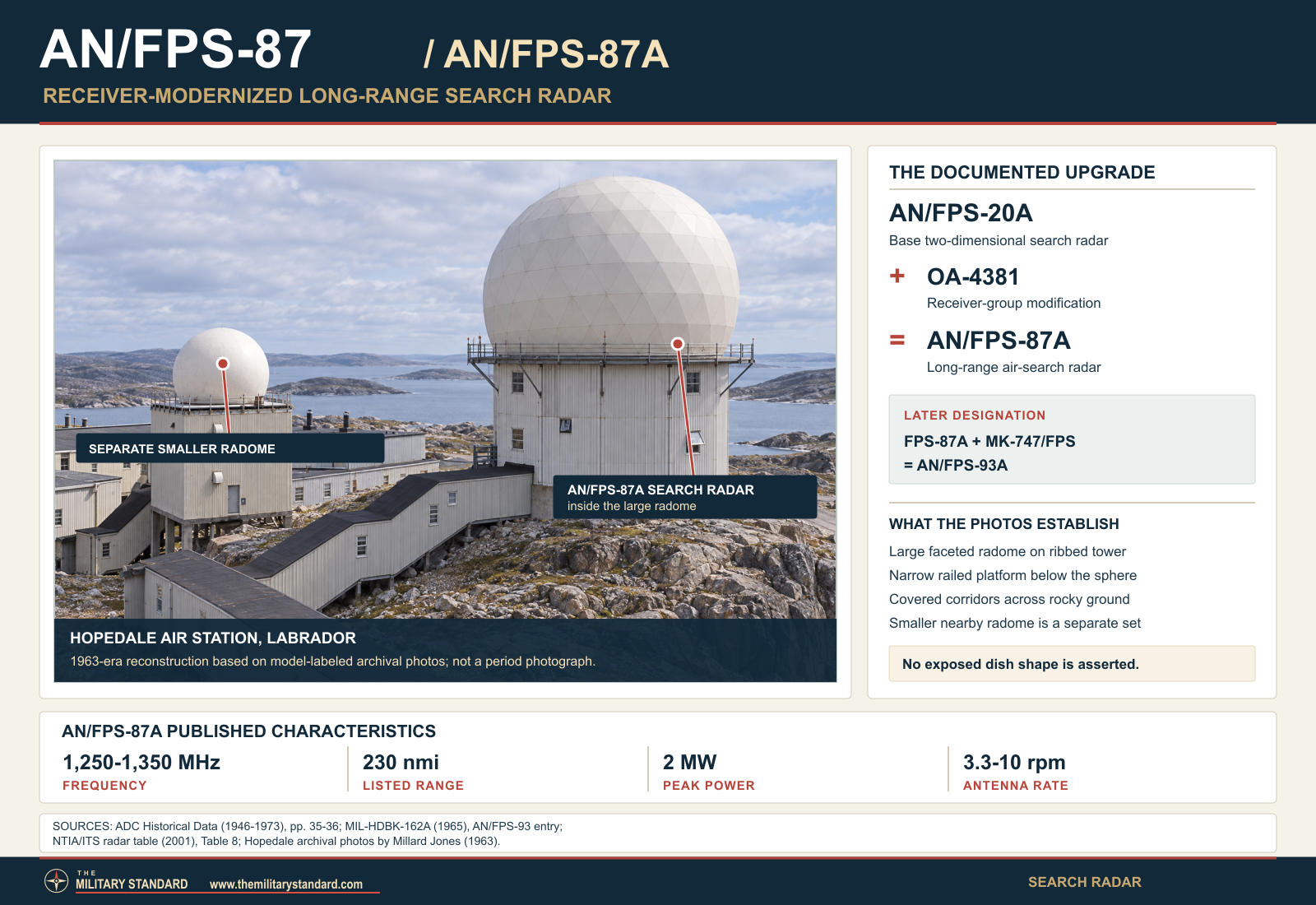
The clearest early photographic evidence for AN/FPS-87A comes from Hopedale Air Station in Labrador. A surviving photo collection labels FPS-87A cabinets in December 1963, shows an airman at the FPS-87A klystron cabinet, and identifies the FPS-87A search-radar radome in photographs from June and July 1963. Those images provide unusually strong evidence because they connect the designation to both interior electronics and the exterior radar installation at a known station and date. The July photograph shows the large faceted search-radar radome on a ribbed cylindrical tower with a narrow perimeter platform and enclosed passage. A smaller nearby radome is separately identified as no longer in use; June captions identify smaller radomes left from earlier FPS-502 and TPS-502 equipment. This exterior evidence supports the accompanying labeled reconstruction, but it does not reveal the shape of the antenna hidden inside the large radome.
Hopedale belonged to the northern radar network built to extend warning coverage toward the approaches from the Arctic and North Atlantic. Remote Labrador stations operated in severe weather, depended on long logistics chains, and were tied into continental command arrangements that changed over time. Installing an ECCM-improved search radar at Hopedale was therefore not merely a technical exercise. It strengthened one of the forward sensors that would provide warning before a bomber force reached the more densely populated portions of Canada and the United States.
Cartwright Air Station provides ADC documentary evidence for the same family. The ADC overseas radar-network tables show Cartwright's equipment progression from FPS-3/FPS-502/TPS-502 through FPS-20A and later FPS-87A, followed by FPS-93A. The station's 922d Aircraft Control and Warning Squadron operated a ground-control-intercept and warning mission. That sequence is almost a textbook example of the modernization chain. An older search radar was replaced by FPS-20A, the receiver-modernized FPS-87A appeared, and the more extensive FPS-93A modernization followed before the station closed in 1968.
Other Newfoundland and Labrador station summaries show similar equipment evolution, but dates and suffixes are not always consistent between OCR tables, retrospective station lists, and photo captions. The responsible approach is therefore site-specific. Where ADC provides a clear 87A entry, it can be normalized as evidence. Where only a degraded OCR line appears, it should be cross-checked against unit histories or photographs. The value of the Pinetree evidence is not the number of stations that can be made to fit a neat list. It is the way those stations demonstrate the 87A as a fielded intermediate stage between FPS-20A and FPS-93A.
Alaska Air Command and NORAD Service
Alaska offered another demanding environment for the AN/FPS-87A. The state's radar sites looked across approaches used by Soviet reconnaissance aircraft and, in wartime, potential bomber routes. They were remote, expensive to supply, and exposed to severe cold, wind, icing, and isolation. Search-radar reliability and resistance to interference were therefore strategically important. The Alaska Department of Natural Resources' official history of the Aircraft Control and Warning System documents the mid-1960s installation of AN/FPS-87A at King Salmon, describing it directly as a modified FPS-20.
King Salmon is especially valuable because its operational context is unusually well documented. The station originally used AN/FPS-3 and AN/FPS-6, then received AN/FYQ-9 semiautomatic data processing. The site therefore combined search-radar modernization, height-finder modernization, and faster data handling. The 705th Aircraft Control and Warning Squadron operated the facility until 1977, after which contract maintenance took over.
That sequence shows what the designation meant operationally. The radar did not exist by itself. An aircraft entered the surveillance volume, the search radar established range and azimuth, the height finder refined altitude, identification and communications systems helped characterize the track, and the FYQ-9 reduced the burden of manual reporting. The resulting information fed the Alaska NORAD Region's warning and control system. If the contact were hostile, that network could support decisions involving interceptors or wider warning actions.
AN/FPS-117 modernization in 1984. Kotzebue's 748th also used FPS-87A within a sequence that later ended in FPS-93 and FPS-117. These sites reinforce the role of the 87A as a transitional but operationally important step in the modernization of northern long-range surveillance.
The replacement history also shows that retirement was not a single fleetwide event. Some 87A sets were converted to 93/93A. Other stations retained older configurations until a later site modernization. Alaska's eventual AN/FPS-117 program changed the operating model again, replacing large manned Cold War radar plants with modern solid-state minimally attended long-range radars. The physical radomes and buildings of the earlier era often remained long enough to document the technological layers even after the electronics changed.
Kamloops and Canadian Service
Kamloops Air Station in British Columbia provides evidence for notably long AN/FPS-87A service. Station histories list FPS-3A, FPS-20, and FPS-87A among the search radars and show FPS-87A as part of the final equipment configuration with a Canadian FPS-507 height finder. The station transferred from U.S. Air Force manning to the Royal Canadian Air Force on 1 April 1962. Canadian veteran memorial evidence says radar operations ceased in April 1988 and the station formally closed on 1 August 1988. The exact date at which its final 87A configuration was established needs primary Canadian technical records. Its 87A service must not automatically be assigned to the preceding USAF-manned period. The station nevertheless shows that the radar family was not confined to a short early-1960s conversion window.
That longevity fits the system's origins. The OA-4381 modernization appears repeatedly in sources as a Canadian-associated ECCM solution applied to the American Bendix FPS-20 lineage. Pinetree itself was a binational defense system, and the radar network crossed service and national boundaries. A U.S. JETDS designation did not imply that every engineering contribution or installation was purely American. Canadian stations, Canadian organizations, U.S. Air Force squadrons, and later RCAF operators all participated in the life of these systems.
The record also cautions against a single retirement date. If Kamloops indeed retained AN/FPS-87A until station closure in 1988, then the family remained operational long after many U.S. ADC examples had been converted to AN/FPS-93/93A. FAA Order 1380.40C, dated 1992, still includes FPS-87 among Class B long-range radar facilities for maintenance staffing purposes. The order is an equipment-type listing, not a site inventory or proof that an AN/FPS-87 set was still operating in 1992. It shows continuing recognition of the designation in federal maintenance planning, while the last site-specific operation verified is Kamloops in April 1988.
Operators, Maintenance, and Support
AN/FPS-87-family operation depended on the people and infrastructure of a radar station. Aircraft Control and Warning squadrons provided radar operators, maintenance technicians, communications personnel, power-production specialists, administrative staff, security, cooks, vehicle maintainers, and other support functions. The radar operators watched the surveillance presentation, recognized tracks and anomalies, coordinated with height-finder and identification functions, and passed data into the regional control system. Maintenance personnel kept the high-voltage transmitter, receiver, antenna drive, waveguide, cooling, and display equipment within tolerance.
The OA-4381 conversion added maintenance consequences. New receiver cabinets and subassemblies meant new technical orders, spare parts, test points, alignment procedures, and troubleshooting requirements. A station could not gain useful ECCM capability merely by installing hardware. Technicians had to understand the new system well enough to keep it calibrated. Remote sites magnified the burden because a failed specialized component might have to arrive by air or sea. Supply identification and illustrated-parts breakdowns therefore mattered operationally. The federal supply records that survive today are the documentary residue of that maintenance system.
Cold-weather and coastal sites added environmental stresses. Radomes protected antennas from wind and ice but introduced their own attenuation and maintenance demands. Heating and ventilation protected electronics from condensation and temperature extremes. Diesel generation and redundant power systems kept radars on the air when commercial utility service was unavailable. Communications sites and troposcatter links moved track information out of locations that had no convenient terrestrial network. The radar set was the central sensor, but the military installation surrounding it was a machine for keeping that sensor available.
Operational Events and Strategic Context
No single battle is uniquely associated with AN/FPS-87 in the way a weapon may be associated with a particular campaign. Its operational significance came from continuous warning duty during the Cold War. The radar family stood watch during a period that included the Berlin crises, the Cuban Missile Crisis, repeated Soviet long-range aviation activity, and the continuing possibility of a nuclear bomber attack across northern approaches. A long-range radar's value in that setting was measured in hours and days of uneventful readiness punctuated by the occasional unidentified or Soviet contact that had to be classified quickly.
King Salmon's documented observation of a Soviet reconnaissance aircraft in 1958 predates installation of AN/FPS-87A there, but it explains the operational environment into which the later radar was introduced. The threat was not hypothetical. Soviet aircraft approached Alaskan airspace, and the sites existed to ensure those movements were detected and reported. The receiver modernization improved a surveillance architecture already performing real strategic-warning work.
The 87A also operated during the period when SAGE and related regional automation transformed air defense. Rather than viewing each radar station as an isolated lookout, the Air Force increasingly treated it as a sensor feeding a larger information system. The tactical importance of an ECCM receiver therefore extended beyond the local scope. If a jammer degraded one radar, the effect could propagate into the tracking picture used by control centers. Improving the sensor's ability to deliver usable data strengthened the network as a whole.
Transition to AN/FPS-93 and AN/FPS-93A
The clearest endpoint of the AN/FPS-87 lineage was MK-747/FPS. MIL-HDBK-162A states that incorporation of Modification Kit, Electronic Equipment MK-747/FPS changed AN/FPS-87 into AN/FPS-93 and AN/FPS-87A into AN/FPS-93A. The handbook's principal-components table lists the appropriate 87-series radar plus one MK-747 kit for the corresponding 93-series result. It also identifies Raytheon Company, Lexington, Massachusetts, with the MK-747 modification and Bendix with the underlying AN/FPS-87/87A.
The later configuration improved long-range tracking in range, azimuth, and search. ADC describes OA-3424 as a high-gain antenna providing more effective ECCM capability. Specialist histories associate the MK-747 package with the Raytheon antenna, bandpass filtering, and modifications to handle the high-power RF path. This was a more visible change than OA-4381. It altered major external and RF components, not only the receiver electronics.
That lineage is useful for identifying photographs and station records. A site whose equipment list says FPS-87A in 1963 and FPS-93A a few years later may represent the same underlying radar plant moving through a controlled modification program rather than two complete radars being removed and replaced. The exact physical work varied by site and should be verified before claiming a particular construction sequence, but the nomenclature relationship is explicit. The AN/FPS-87 family was therefore both an operational radar and a technological bridge to the more capable AN/FPS-93 family.
FAA Service and Long-Term Survivability
As the Soviet manned-bomber threat declined relative to ballistic missiles and as the Federal Aviation Administration assumed greater responsibility for long-range domestic air surveillance, many former military radar facilities entered joint-use or FAA service. Older FPS-20-family radars were attractive because they already occupied useful locations and could be modernized rather than discarded immediately. FAA maintenance documentation from 1992 still categorized FPS-87 among Class B long-range radar facilities, alongside FPS-20, FPS-37, FPS-60-series, FPS-90-series, and FPS-117 equipment.
That late administrative evidence should be read carefully. It does not prove that a large fleet of untouched AN/FPS-87 radars remained operational in 1992. It does show that the FAA still considered the type relevant enough to include in staffing and maintenance classification. Some radars may have carried additional local modifications, and some station records may have used legacy nomenclature for equipment that had changed internally. Site-level technical logs would be needed to establish the exact late configuration of each surviving set.
The longevity of the basic architecture is nevertheless significant. The FPS-20 family began as a late-1950s long-range air-defense radar, yet its derivatives remained useful for decades because antennas, towers, transmitters, receivers, and processing could be modified incrementally. AN/FPS-87 was one stage in that process. Its history demonstrates how Cold War air defense depended as much on controlled modernization of installed assets as on spectacular new radar programs.
Preservation and Surviving Evidence
No complete AN/FPS-87 or AN/FPS-87A museum installation has been confirmed in the reviewed public record. Preservation instead survives in fragments and sites. Remote radar stations retain towers, radome foundations, equipment buildings, power plants, roads, or abandoned support structures. Some active Long-Range Radar Sites preserve the geography of the original station even though AN/FPS-117 or later equipment replaced the 87 family decades ago.
Photographic preservation is particularly strong. The Canadian Air Defence Sector Museum archive contains dated Hopedale photographs showing FPS-87A cabinets, a klystron cabinet, the search-radar radome, barracks, and the wider 923d Aircraft Control and Warning Squadron complex. Radomes.org preserves site pages, photographs, rosters, and equipment histories for Cape Newenham, Cape Romanzof, Kotzebue, Kamloops, Cartwright, and many other radar stations. These images are essential because radar electronics are often removed long before buildings disappear.
Technical-document preservation is equally important. MIL-HDBK-162A preserves the later 87-to-93 conversion relationship and manufacturer attribution. ADC's Historical Data preserves the command's exact equipment wording and site tables. Federal radar-characteristics compilations preserve numerical parameters for AN/FPS-87A. Supply-system records preserve the OA-4381/FPS-87 receiver designation and links to technical-order families. Together these sources allow a system that left few museum artifacts to be reconstructed with unusual precision.
Role in the Wider Military Network
AN/FPS-87 and AN/FPS-87A were nodes in the North American air-defense network, not stand-alone weapons. Their job was to produce reliable long-range range-and-azimuth information that could be combined with height data, identification, communications, and command-and-control systems. In the continental United States and Canada, that information supported Air Defense Command and NORAD. At SAGE-connected locations it contributed to automated direction-center processing. In Alaska, semiautomatic systems such as AN/FYQ-9 helped move tracks into regional command channels. Interceptor aircraft and surface-to-air missile defenses depended on the warning picture generated by those sensors.
The family also occupied a specific place in the technology network. It inherited the core search function of OA-4381 receiver modernization, and then served as the starting point for AN/FPS-93/93A through MK-747/FPS. That chain connected receiver engineering, antenna design, jamming resistance, radar-site operations, SAGE data processing, and later FAA surveillance. The designation is therefore more meaningful when read as a point in a system evolution than as an isolated model number.
Its geography reinforces that interpretation. Hopedale and Cartwright watched the northeastern approaches. King Salmon, Cape Newenham, Cape Romanzof, and Kotzebue watched Alaska and the Bering approaches. Kamloops served the Canadian continental network. The same family moved across USAF, NORAD, RCAF, and later FAA contexts. That dispersion was not accidental. The radar's value lay in keeping a broad surveillance network functioning under the threat of electronic attack while allowing existing sites to be modernized economically.
Legacy
The AN/FPS-87 family's legacy is the history of incremental modernization. It did not introduce a revolutionary new antenna or a visually dramatic phased array. Its importance lay in improving the receiving end of an already widespread long-range radar and extending the usefulness of the FPS-20 infrastructure in a more difficult electronic environment. This kind of engineering is easy to overlook because the exterior appearance of a radar site may change little while the operational capability changes substantially.
The family also illustrates why suffixes and modification-kit designations matter. AN/FPS-87 and AN/FPS-87A were not interchangeable labels. OA-4381 and the commonly repeated OA-4831 form are not equally supported. AN/FPS-93 and AN/FPS-93A were not merely later names for the same radar but the products of a specific MK-747 modernization applied to corresponding 87-series starting sets. Preserving those relationships prevents the history of the FPS-20 family from collapsing into one undifferentiated list of model numbers.
Finally, AN/FPS-87 shows the durability of the Cold War ground-radar network. Some stations progressed from FPS-3 to FPS-20A to FPS-87A to FPS-93A and finally to AN/FPS-117. Others retained an 87-series configuration much longer. FAA documentation still acknowledged FPS-87 in 1992. The radar's story therefore spans the transition from manually plotted aircraft tracks to automated air-defense networks and from a bomber-centered threat to a joint military-civil surveillance system. It was a technical bridge, an operational sensor, and a reminder that much of air defense was built not by replacing yesterday's equipment all at once, but by making it harder to defeat tomorrow.
Chronology
- 1950s Bendix AN/FPS-20 and AN/FPS-20A long-range search radars become major elements of the permanent North American radar network.
- 1958 AN/FPS-20A becomes the prime search radar at King Salmon, Alaska, establishing the parent configuration later modernized there to AN/FPS-87A.
- 1958-03 King Salmon radar operators record a Soviet reconnaissance aircraft off Alaska's coast, illustrating the operational environment in which later ECCM upgrades would serve.
- 1959 ADC begins a broad period of FPS-20-family ECCM modernization in response to growing electronic-warfare requirements.
- Early 1960s OA-4381 receiver modernization enters the FPS-20 family, producing AN/FPS-87 / AN/FPS-87A configurations according to combined ADC, handbook, and lineage evidence.
- 1961 ADC overseas-network tables show FPS-20A entering service at several Newfoundland and Labrador stations that later received 87A/93A modernization.
- 1963-06 Hopedale photographs identify the FPS-87A search radar at the 923d Aircraft Control and Warning Squadron station.
- 1963-07 Hopedale photographs again identify the FPS-87A radome, providing dated visual evidence of operational fielding.
- 1963-09-13 Nomenclature cards later cited by MIL-HDBK-162A are dated for AN/FPS-93 and AN/FPS-93A, confirming the formal follow-on conversion lineage from the 87 series.
- 1963-12 Hopedale photographs show FPS-87A cabinets and an airman at the FPS-87A klystron cabinet.
- 1964 FPS-87A/93A transitions appear in northern radar-station equipment histories as ADC modernizes Pinetree and related sites.
- Mid-1960s King Salmon receives AN/FPS-87A, AN/FPS-90, and AN/FYQ-9 semiautomatic data processing.
- Mid-1960s Cape Newenham, Cape Romanzof, Kotzebue, and other Alaska radar sites use AN/FPS-87A within their search-radar modernization sequences.
- 1965 King Salmon's AN/FYQ-9 modernization becomes operational in the same general period as the AN/FPS-87A upgrade, reducing manual track-reporting burden.
- 1965-03-01 MIL-HDBK-162A equipment data date for AN/FPS-93/93A records AN/FPS-87 and AN/FPS-87A as the respective radar sets modified by MK-747/FPS.
- 1965-12-15 MIL-HDBK-162A edition preserves Bendix manufacturer attribution for AN/FPS-87/87A and Raytheon attribution for MK-747/FPS.
- 1966 ADC and station histories show additional transitions from FPS-87A to FPS-93A in northern radar networks.
- 1968-06-18 Cartwright's USAF operation ends after a sequence that included FPS-20A, FPS-87A, and FPS-93A.
- 1970s Many remaining FPS-20-family sites continue conversion, transfer, or closure as the manned-bomber defense network contracts and FAA joint-use arrangements expand.
- 1977 The 705th Aircraft Control and Warning Squadron ceases direct operation of King Salmon as contract maintenance assumes the site mission.
- Early 1980s Alaska modernization begins replacing older search radars with AN/FPS-117 minimally attended radars.
- 1984 AN/FPS-117 is installed at Cape Newenham and Cape Romanzof, ending the operational line that had included FPS-87A/93 variants there.
- 1988-04 Kamloops radar operations cease after decades of Pinetree Line service; the precise FPS-87A installation date remains unverified.
- 1988-08-01 Canadian Forces Station Kamloops formally closes, according to the Canadian veterans memorial inscription.
- 1992-12-21 FAA Order 1380.40C lists FPS-87 as a Class B long-range radar facility type for maintenance staffing; this does not establish a 1992 operational site.
- 2026 No complete preserved AN/FPS-87 installation is confirmed in the reviewed record; manuals, dated photographs, station remains, and archives preserve evidence of the radar family.
Historical Photographs and Drawings
The Hopedale 1963 photo collection identifies FPS-87A cabinets, a klystron cabinet, and the large search-radar radome. The images are linked for research; they are not reproduced here. The illustration above is a labeled reconstruction.
The 1965 MIL-HDBK-162A entry depicts the later AN/FPS-93-family reflector. It is not proof of the pre-conversion AN/FPS-87 antenna shape.
Information sources (17)
- PDFHistorical Data of the Aerospace Defense Command, 1946-1973
SOURCE FOR: Primary ADC source for exact radar description wording, station equipment tables, Pinetree/overseas network context, and chronology.
- PDFMIL-HDBK-162A / TM 11-487C-1, Military Standardization Handbook, Radar Sets
SOURCE FOR: Primary federal handbook source confirming AN/FPS-87 and AN/FPS-87A as separate valid radar sets and their conversion through MK-747/FPS to AN/FPS-93 and AN/FPS-93A; also supports Bendix and Raytheon contractor roles.
- PDFMIL-HDBK-162A alternate digital copy
SOURCE FOR: Independent mirror of the federal handbook used to cross-check OCR and conversion wording.
- PDFFederal Radar Characteristics Compilation, PB2001107556
SOURCE FOR: Source for model-specific AN/FPS-87A frequency, peak and average power, range, PRF, pulse width, rotation, and beamwidth values.
- PDFDavid F. Winkler, Searching the Skies: The Legacy of the United States Cold War Defense Radar Program
SOURCE FOR: Official U.S. Air Force Air Combat Command history identifying AN/FPS-87A as a Bendix long-range L-band search radar based on AN/FPS-20 and providing broader Cold War radar-system context.
- WEBSearching the Skies, HTML edition
SOURCE FOR: Searchable version of the official Air Force Cold War radar history used for equipment and network context.
- PDFAlaska Department of Natural Resources, History of the Aircraft Control and Warning System in Alaska
SOURCE FOR: Official Alaska historic study documenting King Salmon's AN/FPS-20A to AN/FPS-87A transition, AN/FPS-90, AN/FYQ-9, Soviet reconnaissance context, and station operations.
- WEBCanadian Air Defence Sector Museum, Hopedale Labrador Photographs
SOURCE FOR: Dated photographic evidence identifying FPS-87A cabinets, klystron cabinet, radome, and the 923d AC&W Squadron station in 1963.
- WEBRadomes.org, AN/FPS-3 Modification History Tree
SOURCE FOR: Secondary specialist source for the FPS-20 family modification tree, including AN/FPS-87/87A and later AN/FPS-93/93A conversion relationships; OA-4831 spelling retained only as a noted conflict against stronger OA-4381 evidence.
- WEBRadomes.org, Radar Equipment Index
SOURCE FOR: Secondary specialist equipment index identifying AN/FPS-87A as a Bendix L-band search radar based on AN/FPS-20.
- WEBRadomes.org, Cape Newenham AFS
SOURCE FOR: Station-level source for 794th AC&W Squadron site identity, FPS-20A/FPS-87A/FPS-93/FPS-117 lineage, and surviving photographic/document resources.
- WEBRadomes.org, Cape Romanzof AFS
SOURCE FOR: Station-level source for 795th AC&W Squadron site identity, FPS-20A/FPS-87A/FPS-93A/FPS-117 lineage, and surviving photographs/documents.
- PDF794th Aircraft Control and Warning Squadron Unit History
SOURCE FOR: Air Force Historical Research Agency-derived unit compilation supporting Cape Newenham equipment lineage, site history, and AN/FYQ-9 context.
- PDF795th Aircraft Control and Warning Squadron Unit History
SOURCE FOR: Air Force Historical Research Agency-derived unit compilation supporting Cape Romanzof equipment lineage and Alaska AC&W organization context.
- PDFFederal Aviation Administration Order 1380.40C
SOURCE FOR: Federal maintenance-management source showing FPS-87 remained an identified Class B long-range radar facility type in 1992.
- WEBAeroBase Group, Receiver Group MM9200 / OA-4381/FPS-87
SOURCE FOR: Secondary presentation of federal supply data confirming JETDS type number OA-4381/FPS-87 and supporting receiver-group nomenclature.
- WEBVeterans Affairs Canada, Canadian Forces Station Kamloops Memorial
SOURCE FOR: USAF initial manning and 825th Radar Squadron; RCAF handover on 1 April 1962; radar operations ended April 1988 and station formally closed 1 August 1988. The published coordinate is for the memorial, not the former radar site.