
AN/FPS-88 Long-Range Search Radar
- Role
- Two-dimensional long-range aircraft search and early warning
- Lineage
- General Electric AN/FPS-8 modernization
- Defining receiver
- OA-4923/FPS-88(V), with a parametric amplifier
- Documented service
- Allied field conversions by 1963; site-specific retirement through at least 2001
- U.S. operational site
- None verified in the reviewed records
Overview
The AN/FPS-88 was an American-designed, General Electric fixed ground search radar created by substantially modernizing the AN/FPS-8 family. It was a two-dimensional air-surveillance sensor: the radar measured target range and azimuth, while an associated height finder supplied elevation or altitude. The documented modernization improved detection performance, receiver sensitivity, operational reliability, and resistance to hostile or accidental interference. It retained major elements of the AN/FPS-8 architecture but introduced a new receiver group built around a parametric amplifier, and at some installations it received a much larger antenna, a larger tower, and multichannel operating capability.
AN/FPS-88 has often been reduced to one sentence in radar lists: an updated AN/FPS-8 operating in L-band. That description is directionally correct but historically incomplete. Air Force technical-order difference sheets identify the Power Supply-Receiver Group OA-4923/FPS-88(V) as the defining modification. The new group included Receiver RF Unit OA-4924/FPS-88(V), Amplifier Group OA-4925/FPS-88(V), Parametric Amplifier AM-3742/FPS-88(V), IF Preamplifier AM-3743/FPS-88(V), Voltage Regulator CN-962/FPS-88(V), Control Panel C-4868/FPS-88(V), and an updated PP-862A/FPS-8 receiver power supply. The received echo passed through a transmit-receive tube, parametric amplifier, filter-mixer, and IF preamplifier before entering the normal and moving-target-indication receiver channels.
The equipment's clearest operational history is outside the continental United States. Denmark, Norway, Portugal, Italy, and Turkey all have documentary connections to AN/FPS-88. Danish and Norwegian histories show conversion of existing FPS-8 stations during the 1960s, followed in several cases by AN/FPS-110 modernization in the 1970s. Portugal's air force describes its Paos de Ferreira installation as an FPS-8 converted in 1966 into a more capable, multichannel FPS-88 with anti-jamming circuits. Italian government inquiry records place the radar at Licola and Marsala in 1980, and other Italian station histories extend the type's service into the late 1990s and 2001. Turkey's Ministry of National Defence still listed depot-level AN/FPS-88 maintenance capability in 2020, although that notice alone does not prove that an operational radar remained on alert.
No continental United States operational installation has been confirmed. The user-supplied Aerospace Defense Command historical volume contains no AN/FPS-88 entry, and the official Department of Defense Legacy study describes the model without identifying a United States site. The radar was a United States Joint Electronics Type Designation System item, was developed from the General Electric AN/FPS-8, was documented in a United States Air Force technical order, and formed part of allied NATO air-defense systems built around American equipment.
The earliest verified field history also corrects a common dating problem. The Department of Defense Legacy study says General Electric produced the updated version in the late 1960s, but Norway records an FPS-8-to-FPS-88 modification completed at Gråkallen in October 1963, Denmark records FPS-88 service at Skagen from 1964 and Skrydstrup from 1965, and Portugal dates its conversion to 1966. The safest introduction statement is therefore that field conversions existed by 1963, with wider allied modernization continuing through the 1960s. The phrase late 1960s is retained as a published general description, not used as the first-service date.
System Identity And Nomenclature
AN/FPS-88 identifies a fixed ground radar set under the Joint Electronics Type Designation System. In the contemporary designation pattern, F denotes fixed, P denotes radar, and S denotes a detecting or search function. The suffix (V) appearing in technical documentation indicates a variable configuration or family in which approved combinations of components could differ. A federal technical table lists AN/FPS-88(V)1 and AN/FPS-88(V)2 together, but the exact component differences between those two variants have not been recovered from a configuration-control document.
The system was not a separate successor conceived on a clean sheet. The 1968 technical-order difference section states that the general description and operating procedures for AN/FPS-8 and AN/MPS-11 sets equipped with OA-4923/FPS-88(V) are the same as for the basic set except where differences are specifically stated. That language establishes an upgrade relationship at the equipment level. An FPS-8 could become an FPS-88 through modification and component replacement, a process described explicitly by Portuguese, Danish, and Norwegian operators.
At the same time, AN/FPS-88 should not be treated as nothing more than an FPS-8 receiver cabinet. National station histories document physical changes that could be extensive. Skrydstrup received an antenna reported to have three to four times the area of the earlier FPS-8 antenna, requiring a new large radar tower and radome. Gråkallen's conversion involved removal of the old rigid radome, enlargement of the platform, and installation of a 55-foot rigid radome. The exact exterior configuration could therefore vary with site, variant, climate protection, and modernization package.
AN/FPS-88 must also remain distinct from AN/FPS-89 and AN/FPS-90. AN/FPS-88 was a rotating plan-position or search radar that produced range and azimuth. AN/FPS-89 and AN/FPS-90 were height-finding radars derived from the AN/FPS-6 family. Italian records sometimes list FPS-88 search, FPS-89 height, and a Marconi S-269 height finder at one station. The numbers are adjacent, but the systems performed different functions and had visibly different antennas.
AN/FPS-110 was a later modernization or replacement at multiple Scandinavian sites. Denmark replaced the FPS-88 at Skagen and Skrydstrup with FPS-110 equipment in 1977. Norway's historical account says FPS-88 sets at Kongsvinger, Gråkallen, Vardø, and Kautokeino were further upgraded to FPS-110 with national funding in the NADGE era. The relationship was evolutionary at some sites, but FPS-110 should not be used as a synonym for every FPS-88 configuration.
The AN/FPS-8 Foundation
General Electric developed the AN/FPS-8 as a 1950s L-band air-surveillance radar for aircraft control and early warning. The basic set was widely deployed at military installations and civil-military sites, and related configurations included the fixed AN/MPS-11. This broad family gave allied operators a common technical foundation, established training and spares, and a radar that could be improved without rebuilding an entire air-defense system at once.
The original FPS-8 used a mechanically rotating antenna and pulsed transmitter to measure slant range and azimuth. A timing system triggered the transmitter, the duplexer connected the antenna alternately to the transmitter and receiver, and the receiver converted weak echoes to an intermediate frequency suitable for detection and display. Normal-video and moving-target-indication paths helped operators separate aircraft from stationary terrain returns. Associated IFF equipment assisted identification, and a separate height finder supplied the third coordinate needed for interception.
By the early 1960s, the original receiver and single-channel arrangements were increasingly limiting. The radar environment contained more stations, more interference, and a growing electronic-warfare threat. NATO countries also needed higher readiness from geographically exposed sites. Better low-noise amplification could improve the usable signal-to-noise ratio without replacing every transmitter, display, and facility component. More than one operating channel could reduce downtime and provide flexibility when interference or equipment failure affected one path.
The AN/FPS-88 solution therefore combined continuity with selective replacement. It preserved the basic FPS-8 operating concept while concentrating new technology in the receiver and related assemblies. This was financially and logistically attractive for countries that already possessed FPS-8 infrastructure. The conversion could extend useful service, improve detection, and strengthen anti-jamming performance while deferring the purchase of an entirely new radar generation.
Why The Modernization Mattered
Air defense in the 1960s demanded more than raw peak transmitter power. A search radar had to detect weak targets against receiver noise, weather, ground clutter, mutual interference, and deliberate jamming. It also had to remain available through tube failures, maintenance, and channel conflicts. Improvements in receiver noise figure and selectivity could yield operational gains that were not visible in a simple power comparison.
The Portuguese Air Force provides an unusually clear operator description. At Paços de Ferreira, modification and replacement of components changed the FPS-8 into FPS-88 in 1966. The resulting radar had greater detection capacity, contained anti-jamming circuits, and was no longer single-channel. Portugal specifically connects the multichannel design with greater reliability and consequently higher operational availability. This is stronger evidence than later generic claims because it comes from the service that operated the converted station.
Danish history adds the physical side of the improvement. Skrydstrup described the conversion as supplementing the FPS-8 with additional equipment until it resembled a double FPS-8. A new antenna with three to four times the earlier antenna's area was an important part of the work. Larger effective aperture can produce more gain and a narrower beam when frequency and efficiency are comparable, consistent with the compiled FPS-88 values of 35.4 dB gain and 1.3-degree beamwidth versus 30.3 dB and 2.5 degrees for AN/GPS-3 in the same federal table.
The phrase electronic countermeasures capability in the Department of Defense Legacy study can be misunderstood. AN/FPS-88 was not an offensive jammer. In operational terms, the improvement was electronic counter-countermeasures or anti-jamming capability: measures that helped the radar continue detecting targets in the presence of interference. The Portuguese description of anti-jamming circuits and the Norwegian emphasis on improved jamming protection support that interpretation.
The OA-4923/FPS-88(V) Receiver Group
The most securely documented model-specific hardware is Power Supply-Receiver Group OA-4923/FPS-88(V). The technical order states that this group replaced Radar Receiver R-524/FPS-8 and Receiver RF Group OA-417/FPS-8. Its cabinet measured approximately 51 by 34 by 27 inches and weighed about 477 pounds. These dimensions describe the receiver group, not the complete radar or its building.
Receiver RF Unit OA-4924/FPS-88(V) and Amplifier Group OA-4925/FPS-88(V) formed major subassemblies. The amplifier group contained the transmit-receive tube, parametric amplifier, filter-mixer, and IF preamplifier. The technical order gives OA-4925/FPS-88(V) dimensions of approximately 34 by 34 by 10 inches and a weight of about 165 pounds. Model-specific cabinet photographs in the manual show dense rack-mounted electronics, meters, control panels, waveguide or coaxial connections, and maintenance access.
The echo path began at the duplexer and passed through the transmit-receive tube. The tube protected the sensitive receiver during the transmitted pulse and admitted returning energy during the listening interval. From there, the target signal entered Parametric Amplifier AM-3742/FPS-88(V), then the filter-mixer, then IF Preamplifier AM-3743/FPS-88(V). The amplified intermediate-frequency signal continued to the normal and moving-target-indication receiver paths used by the existing radar system.
The difference data replace older references to an RF amplifier with references to the parametric amplifier. They also replace the original T-R cavity terminology with a T-R tube and substitute Power Supply PP-862A/FPS-8 for PP-862/FPS-8. Other retained FPS-8 components listed in the difference section include Duplexer CU-321/FPS-8, Keep-Alive Power Supply PP-863/FPS-8, Coherent-Oscillator Coupler CN-196/FPS-8, Stable Local Oscillator O-171/FPS-8, Coherent-Oscillator AFC Preamplifier AM-734/FPS-8, Frequency Mixer CV-252/FPS-8, Receiver Control C-1092/FPS-8, and RF Monitor ID-340/FPS-8.
This mixture of new FPS-88(V) assemblies and retained FPS-8 components is the clearest proof of the system's evolutionary identity. It also warns against using a single serial or cabinet photograph to represent every installation. An upgrade could contain new receiver hardware inside an older operations building, while another nation could combine the receiver package with a new antenna, new tower, redundant channel, or locally supplied display and data equipment.
Parametric Amplifier Technology
A parametric amplifier uses a time-varying circuit parameter, commonly capacitance in a nonlinear element, and pump energy to amplify a weak radio-frequency signal. In the era before low-noise solid-state microwave amplifiers became routine, parametric devices could deliver a substantially lower receiver noise figure than many conventional front ends. Lower noise allowed the receiver to distinguish weaker echoes from its own internal background and improved the practical value of the existing transmitter and antenna.
For AN/FPS-88, the parametric amplifier sat close to the beginning of the receive chain, where noise performance mattered most. Loss or noise introduced before the first effective amplification could not be repaired later in the chain. The T-R tube, amplifier, filter-mixer, and IF preamplifier therefore had to operate as a carefully adjusted group. Pump settings, bias, tuning, temperature, local-oscillator stability, and component health would all affect performance.
Parametric technology also imposed maintenance demands. A highly sensitive front end was not a maintenance-free black box. Technicians needed test equipment, alignment procedures, spares, and training to diagnose degraded gain or increased noise. The component photographs and extensive difference instructions in the technical order show why depot and site support remained important. Turkey's 2020 maintenance notice, although much later, specifically places transmitter-receiver stages, display equipment, circuit boards, and on-site troubleshooting within its radar-support mission.
Transmitter, Timing, And Waveform
The reviewed FPS-88 difference sheets do not describe a completely new transmitter. Their system block diagram retains the established sequence of trigger circuits, trigger amplifier, modulator, transmitter, duplexer, and antenna. This supports the conclusion that the receiver modernization worked with much of the FPS-8 transmitter architecture, although site-specific packages or later variants may have included further changes.
A United States government compilation lists AN/FPS-88(V)1 and (V)2 at 1280 to 1350 megahertz, 1.2 megawatts peak power, 1,080 watts average power, 360 pulses per second, and a 3-microsecond pulse. The figures are model-specific in the table but are not a substitute for the original acceptance specification.
The same table lists a 220-nautical-mile range. That is a nominal or reference range, not a promise that every aircraft at every altitude would be detected at 220 nautical miles. Radar horizon, target size, target aspect, antenna height, terrain, atmospheric refraction, receiver condition, interference, display thresholds, and operator procedures all affected real detection. Low-flying aircraft could remain below line of sight even when high-altitude targets were visible much farther away.
The Department of Defense Legacy study publishes a broader 1280-to-1380-megahertz band. The narrower federal table gives 1280 to 1350 megahertz for FPS-88(V)1 and (V)2. Both are retained as a source conflict. The narrower value is used for the confirmed model-specific operating field, while 1380 megahertz is described as a broader published family or tuning limit requiring confirmation from the FPS-88 nomenclature card or complete technical specification.
Antenna, Beam, And Scan
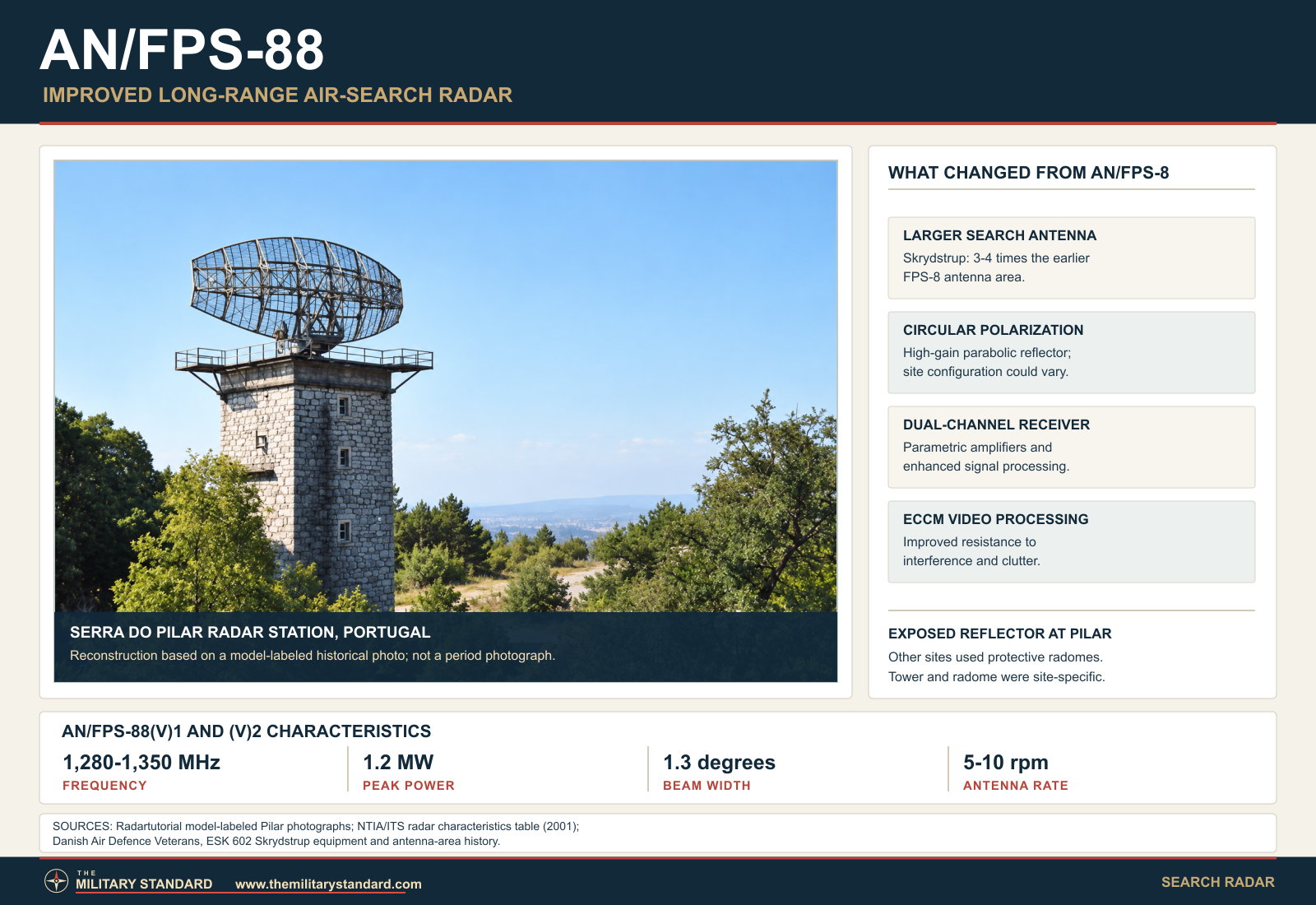
The government characteristics table gives a 5-to-10-rpm scan rate, 35.4-dB antenna gain, and 1.3-degree beamwidth for AN/FPS-88(V)1 and (V)2. Those values are internally consistent with a high-gain rotating search antenna. At five revolutions per minute, an antenna completes one scan every twelve seconds; at ten revolutions per minute, one scan takes six seconds. Faster scanning refreshes the air picture more often but gives fewer pulses on a target during each sweep.
No single verified dimension can yet be assigned to every FPS-88 antenna. Skrydstrup's historical account describes antenna area relative to the earlier FPS-8 and records a new large tower and radome. Gråkallen records a 55-foot rigid radome but does not state the reflector dimensions inside it. Photographs on specialist sites show that FPS-8-family exterior arrangements varied, and some images labeled by family do not provide enough detail to prove an exact FPS-88 variant.
The Skrydstrup conversion therefore establishes a larger-antenna configuration without making it universal. It also provides an important installation sequence. Tower construction began late in 1964. The new FPS-88 arrived on five railway cars on 23 August 1965. A radome assembled from fiberglass triangular panels required about forty hours to erect. The history demonstrates that a conversion could be a major civil-engineering and logistics project, not merely a rack change inside an existing building.
At Gråkallen, work began on 2 September 1963 and finished on 26 October. The old rigid radome was removed, the platform enlarged, and a 55-foot rigid radome installed. This is the earliest precise conversion interval recovered. It suggests that national packages and construction methods differed, and it moves verified FPS-88 field history earlier than the broad late-1960s label.
Any future artwork must be tied to a named site and date. A generic FPS-8 antenna, a Danish large-antenna FPS-88, and a Norwegian radome-covered FPS-88 are not visually interchangeable. A reconstruction must verify reflector curvature, aperture proportions, feed, rear bracing, elevation or fixed-tilt arrangement, rotation platform, tower, radome, and nearby structures from authenticated photographs or drawings. The separately labeled Serra do Pilar reconstruction is based on a historical photograph specifically identified as AN/FPS-88 at that Portuguese station. It is an illustration, not a period photograph, and it is not offered as the universal FPS-88 antenna configuration.
Normal Video, Mti, And Clutter Control
The technical-order block diagram sends the IF preamplifier output toward both normal and moving-target-indication receivers. Normal video displays all sufficiently strong echoes, including aircraft, terrain, buildings, weather, and other clutter. MTI compares pulse-to-pulse phase behavior to suppress returns that remain stationary and emphasize moving targets. The coherent oscillator, stable local oscillator, AFC circuitry, and frequency mixer were therefore essential to the radar's clutter-rejection function.
MTI improved the usefulness of a search radar but did not eliminate every unwanted return. Moving weather, wind-driven objects, anomalous propagation, pulse repetition blind speeds, and imperfect coherence could create residual clutter or suppress real targets. Operators needed to compare normal and MTI presentations, understand local terrain, and adjust controls without erasing weak aircraft. The FPS-88 receiver improvement made more signal available, but good display interpretation remained a human and procedural task.
Anti-jamming measures could include channel choice, receiver tuning, gain control, filtering, video comparison, and operating procedures. The recovered public sources do not enumerate every FPS-88 countermeasure or prove that all variants had identical circuits. The history therefore avoids a fictional checklist. Portugal's official statement proves some anti-jamming circuits and multichannel capability at its converted set, while Norway's history confirms improved interference protection as a NADGE-era priority.
Two-dimensional Search And Height Finding
AN/FPS-88 was a planimetric or two-dimensional search radar. Its rotating beam measured range from echo delay and azimuth from antenna bearing. It did not itself supply the accurate target height needed by an interceptor controller. A separate nodding or tilting height finder acquired a selected target and measured elevation, which could be converted to altitude with range and site geometry.
Denmark paired FPS-88 operations with AN/FPS-6A and AN/FPS-6B height finders, with some FPS-6B equipment later modified to AN/FPS-89 and Marconi S-269 height finders alongside the FPS-88 search function at Marsala. These pairings reflect national inventories and modernization dates. They should not be converted into a claim that a specific height finder was an inseparable component of every FPS-88 set.
Identification friend or foe was another associated function rather than part of the primary radar echo path. An interrogator transmitted coded challenges and received replies from cooperating transponders. Primary radar could detect a reflecting object whether or not it replied; IFF helped determine identity and status. Display integration could place the primary and secondary information together for an operator, but the exact interrogator and display configuration varied by country and period.
Operations And Crew Work
A fixed FPS-88 station required operators, radar maintenance technicians, communications personnel, power and environmental-control specialists, security, administration, and command staff. The radar antenna could scan continuously, but the useful product was a maintained air picture. Operators initiated tracks, correlated IFF, requested height, passed reports, and supported interception or warning procedures. Maintenance teams monitored transmitter output, receiver gain and noise, timing, antenna drive, cooling, power quality, and display performance.
Shift work was central to readiness. Air-defense stations normally operated around the clock or maintained prescribed alert periods, and remote high sites imposed additional burdens. Weather could block access, ice could affect radomes or structures, and power interruption could remove a large region from coverage. No-break generating equipment installed during the Gråkallen modernization illustrates how power continuity formed part of radar capability.
Calibration and alignment were operational work, not merely workshop activity. Receiver sensitivity, local-oscillator stability, MTI coherence, antenna bearing, range timing, IFF alignment, and communication circuits all had to remain within tolerance. A radar that illuminated the screen but produced biased range or azimuth could damage the common air picture. Technical logs and periodic checks were therefore as important as dramatic interceptions.
The system's analog and early electronic equipment also placed judgment close to the sensor. Operators saw raw or lightly processed presentations that demanded familiarity with local clutter and traffic patterns. Later automated networks could extract plots and combine many sensors centrally. FPS-88 lived through that transition, serving first in national voice-reporting and manual-control arrangements and later feeding semi-automated or NADGE systems at some sites.
Facilities And Site Support
An FPS-88 installation was more than an antenna. It required a stable tower or platform, radome where climate or protection demanded one, transmitter and receiver spaces, an operations room, cooling and ventilation, electrical distribution, emergency power, grounding and lightning protection, maintenance shops, spares storage, communications, access roads, and security. Existing FPS-8 facilities could be reused, but larger antennas or new data systems forced construction.
Skrydstrup demonstrates the scale of those changes. The antenna enlargement required a new tower, and later NADGE work required further alterations to the operations area. A serious fire on 29 January 1965 destroyed the operations bunker, forcing the unit to operate under primitive conditions from tents and trailers in Bæk Skov until May 1966. The radar modernization and bunker reconstruction overlapped, showing that equipment history cannot be separated from site resilience.
At Paços de Ferreira, the technical installation stood on the Serra do Pilar while barracks and support facilities developed in the town. The official history records workshops, quarters, administration, medical support, roads, microwave communications, and a remote station at São Pedro Velho. These were installation functions rather than components of FPS-88, but they sustained the personnel and communication network that made the radar operational.
Denmark
Denmark's two best documented FPS-88 stations were Skagen and Skrydstrup. Skagen began with AN/FPS-8 in 1956, changed to AN/FPS-88 in 1964, and replaced it with AN/FPS-110 in 1977. The station's call sign was BLUELIGHT. It became the first operational NADGE station in Europe on 17 June 1971, placing the FPS-88 within a modernizing NATO reporting and control environment during the latter part of its service.
Skrydstrup began FPS-8 service in 1955 and operated FPS-88 from 1965 until 10 January 1977. Its call sign was CLIPPER. The unit controlled increasingly fast interceptors, including the F-104G, which made timely and reliable radar information important for fuel management, interception, and recovery. Denmark introduced the DANSEMIK semi-automatic intercept-control system as an interim improvement before full NADGE integration.
The Danish record is important because it documents both technical and organizational transition. FPS-88 increased sensor performance, but faster aircraft and growing traffic also required better computation and data handling. A stronger radar feeding an obsolete control room would not solve the full problem. Denmark therefore improved the antenna and receiver while also rebuilding operations, training controllers, and connecting the stations to NATO systems.
The precise Danish configuration should not be assumed for every operator. The new antenna at Skrydstrup may represent a specific national package or FPS-88 variant. Skagen's history confirms modification to FPS-88 but does not provide the same construction detail. Until engineering drawings and serial records are recovered, the two Danish sites are verified deployments with related but not necessarily identical physical arrangements.
Norway
Norway placed radar stations along a long, mountainous coastline facing strategically important northern approaches. Its historical warning chain combined different radar origins and had to address terrain masking, low-altitude gaps, communications, physical protection, and electronic vulnerability. Existing FPS-8 stations offered a base for modernization before full NADGE-era replacement.
The Norwegian control-and-warning history states that most FPS-8 stations in the early-warning chain had been upgraded to FPS-88. It names Kongsvinger, Gråkallen, Vardø, and Kautokeino as stations later upgraded further to FPS-110 with national funds. These four are therefore confirmed FPS-88 locations at the level needed for the equipment roster, although their exact conversion and retirement dates are not equally documented.
Kautokeino began with TPS-1D and TPS-10D equipment, received FPS-8 in 1958 and FPS-6 in 1962, and was upgraded nationally to FPS-88. The radar was moved to Rassegavarre in 1972 and further upgraded to FPS-110 in 1977. This sequence shows that designation, site location, and physical equipment can evolve together. The FPS-88 phase should be associated with the Kautokeino system and its later Rassegavarre position only where dates and maps support that distinction.
Gråkallen offers the most precise Norwegian conversion evidence. Work began on 2 September 1963 and ended on 26 October 1963. The old rigid radome was removed, the platform enlarged, and a 55-foot rigid radome erected. A video-link building and no-break power equipment were also constructed during the wider modernization period. These changes connected sensor improvement to communications and continuity of operations.
Norway's later FPS-110 conversion reflects the limits of incremental modernization. As NADGE demanded improved automation, interference resistance, standardized reporting, and integration, the FPS-88 could be extended but not indefinitely. The national decision to upgrade rather than immediately replace every site nevertheless prolonged the value of expensive towers, shelters, trained personnel, and communications.
Portugal
The Portuguese Air Force provides the strongest official national statement on what the FPS-88 conversion achieved. At Estação de Radar N.º 2 on Serra do Pilar near Paços de Ferreira, operational radar activity began on 15 September 1958. The original planimetric set was AN/FPS-8, accompanied initially by an AN/TPS-10D height finder. The height finder changed to AN/FPS-6A in 1961.
Five years later, in 1966, component modification and replacement transformed the planimetric FPS-8 into FPS-88. The official history attributes greater detection capacity, anti-jamming circuitry, and a change from single-channel operation to the new configuration. It directly connects this change to reliability and operational availability. Those details make Paços de Ferreira a key source for understanding the purpose of the upgrade.
The FPS-88 remained part of a wider Portuguese detection, interception-control, communications, and support system. A microwave station at São Pedro Velho and the command relationships of EDCI 12 connected the radar to the national air-defense picture. The radar did not operate as an isolated local airfield sensor. Its tracks supported a chain of reporting and control linked to Portugal's NATO obligations.
By 1990 the older system had become obsolete, difficult to sustain, and inadequate for new air-defense requirements. Portugal began implementing the SICCAP command-and-control system, and a new three-dimensional long-range radar entered operation at the site in 1996 through the NATO Radars for the Southern Region and Portugal program. The official history does not give a single FPS-88 shutdown date.
Italy
Italian parliamentary and judicial inquiry records provide unusually detailed evidence for the type in operational service in 1980. Testimony before a parliamentary commission identified Licola as a manual voice-reporting radar center equipped with AN/FPS-88. The same discussion distinguished Licola from automated or semi-automated NADGE stations in the central and southern Italian network. This shows that sensor model and automation level were separate questions.
An official inquiry record describes Marsala as an air-defense radar center controlling the central and lower Tyrrhenian region and the Sicilian Channel. It was integrated into NADGE, carried the code name Moro and NATO site identifier Alpha Juliet, and was linked with Licola, Poggio Ballone, Siracusa, and the sector operations center at Martina Franca. For 1980 the record lists AN/FPS-88 search radar, S-269 height radar, and AN/FPS-89 height radar, with a theoretical range of 220 nautical miles.
The Marsala evidence demonstrates how FPS-88 could function within a semi-automated network while Licola still used voice-manual procedures. It also confirms that the 220-nautical-mile figure appeared in an operational historical record, not only a technical characteristics compilation. The figure remains theoretical and should not be mistaken for guaranteed low-altitude coverage across terrain and curvature.
Specialist Italian histories also identify long service at Mortara, Potenza Picena, and Monte Scinauz, with the Monte Scinauz FPS-8 reportedly modernized to FPS-88 and shut down on 18 July 2001. These locations are credible but unconfirmed research leads.
Italy eventually replaced older two-dimensional search and separate-height-finder arrangements with modern three-dimensional radars such as AN/FPS-117 and RAT-31DL. At Licola, specialist reporting says AN/FPS-117 replaced AN/FPS-88 in 1995. The broader Italian modernization reduced local manning, centralized control, and allowed remote sensors to feed a common recognized air picture.
Turkey
Turkey's Ministry of National Defence listed AN/FPS-88 among systems supported by the 3rd Air Maintenance Factory Directorate in a notice dated 10 May 2020. The organization performed depot-level maintenance, repair, renovation, calibration, and mobile-team troubleshooting for radar, navigation, communications, IFF, and air-defense equipment. The notice specifically includes work on transmitter-receiver stages, display devices, and circuit boards.
This official support listing demonstrates that Turkey retained institutional maintenance responsibility or capability for AN/FPS-88 long after many European operators had replaced it. It does not identify active sites, serial numbers, quantities, readiness status, or the date of final operational retirement. A depot can preserve technical capacity for reserve, training, stored, or declining equipment after front-line use has ended.
United States Service Boundary
AN/FPS-88 was American in design lineage and designation, and its technical instructions were incorporated into a United States Air Force technical order. General Electric's role is supported by the Department of Defense Legacy study and specialist equipment records. Those facts justify its inclusion in a United States defense radar equipment catalog even if the principal field users were allies.
No reviewed source confirms an operational AN/FPS-88 at a continental United States Aerospace Defense Command station. Searching the Skies describes the radar but does not connect it to a domestic site. The much larger domestic FPS-8 roster cannot be relabeled as FPS-88 without site-level conversion evidence.
The absence of a confirmed domestic deployment is a present evidence boundary, not proof that no American test, training, acceptance, or temporary installation ever existed. General Electric and Air Force test facilities may have handled prototype or production equipment. Technical-order preparation also implies access to representative hardware.
Nato Network Integration
FPS-88 served during the transition from national radar chains and voice reporting to the NATO Air Defence Ground Environment. NADGE linked radar stations, reporting centers, communications, and command facilities across allied territory. A radar's range and sensitivity mattered, but its data also had to be extracted, formatted, communicated, correlated, and presented to controllers.
Denmark's Skagen station was ready as the first NADGE station in Europe in June 1971 while still using FPS-88. Norway upgraded FPS-88 stations in the context of NADGE planning before converting them to FPS-110. Marsala used FPS-88 within a semi-automated Italian NADGE site in 1980. These examples show that the older sensor could feed newer command systems when local interfaces and communications were added.
The radar did not become three-dimensional simply because its plots entered an automated network. Height still came from a separate sensor unless external tracks supplied it. Nor did network integration guarantee identical configuration. Each nation combined United States equipment, national communications, local displays, height finders, IFF, and NATO interfaces according to its modernization schedule.
The network context explains the FPS-88's long utility. Replacing a radar involved not only a new antenna and transmitter but interfaces, buildings, radomes, power, training, spares, and acceptance testing. Incremental modernization kept coverage available while larger NATO programs proceeded. The cost was continued dependence on aging hardware and skilled maintenance.
Replacement And Retirement
There is no single worldwide retirement date. Denmark ended FPS-88 operations at Skrydstrup in January 1977 and lists the 1977 transition at Skagen. Norway converted named sites to FPS-110 during the 1970s, with Kautokeino documented in 1977. Portugal moved to its SICCAP-era three-dimensional system by 1996. Italian equipment remained in service at some sites through the 1990s and possibly until Monte Scinauz closed in 2001.
Replacement types also varied. AN/FPS-110 extended the earlier family at Danish and Norwegian sites. AN/FPS-117 replaced older equipment at Italian locations. Portugal adopted a long-range three-dimensional radar through the RSRP program. Modern phased-array systems combined range, azimuth, and height and supported remote operation, reducing the need for a separate height-finder crew.
Turkey's 2020 maintenance notice prevents a simple statement that the type disappeared everywhere by 2001. It proves support capability, not necessarily continuous alert duty. A future official Turkish inventory or disposal record may narrow the final service date.
Preservation And Surviving Fabric
No complete, publicly authenticated AN/FPS-88 set has been confirmed in a museum or preserved at an operating site. Radar stations may retain towers, radomes, foundations, operations buildings, cable routes, or individual cabinets after the active set is removed. Those remains document a site but should not be described as a preserved radar unless the surviving components are identified.
Photographs of former stations require date control. A radome visible today may cover a successor AN/FPS-110, AN/TPS-77, AN/FPS-117, RAT-31, or civil radar rather than the earlier FPS-88. Likewise, a period station photograph may show an FPS-8 before conversion or an FPS-110 afterward. Caption, date, viewpoint, and antenna features must agree before an image is used as model evidence.
Receiver cabinets may be more likely to survive than complete antennas, but no accession record for OA-4923/FPS-88(V), OA-4924/FPS-88(V), OA-4925/FPS-88(V), or AM-3742/FPS-88(V) has been located. National technical museums, former radar schools, depot collections, and veteran associations remain promising research targets. Serial plates and nomenclature tags would be essential for separating FPS-88 hardware from visually similar FPS-8 components.
Technical Summary
- Designation
- AN/FPS-88; technical documentation also uses AN/FPS-88(V), with (V)1 and (V)2 listed in a federal characteristics table
- Equipment UID
- MBH-EQP-0086
- Country and lineage
- United States design and Joint Electronics Type Designation System item derived from General Electric AN/FPS-8
- Primary role
- Fixed two-dimensional long-range air-surveillance search, reporting range and azimuth
- Height information
- Supplied by associated height finders such as AN/FPS-6A, AN/FPS-6B, AN/FPS-89, AN/FPS-90, or national equivalents depending on site
- Frequency
- 1280 to 1350 megahertz in the model-specific federal table; 1280 to 1380 megahertz in the Department of Defense Legacy study
- Peak power
- 1.2 megawatts in the federal table
- Average power
- 1,080 watts in the federal table
- Pulse repetition frequency
- 360 pulses per second
- Pulse width
- 3 microseconds
- Nominal range
- 220 nautical miles, target and geometry dependent
- Scan rate
- 5 to 10 revolutions per minute
- Antenna gain
- 35.4 dB in the federal table
- Beamwidth
- 1.3 degrees in the federal table
- Defining receiver group
- OA-4923/FPS-88(V)
- Key receiver technology
- AM-3742/FPS-88(V) parametric amplifier with filter-mixer and AM-3743/FPS-88(V) IF preamplifier
- Confirmed operational countries
- Denmark, Norway, Portugal, Italy; Turkish support responsibility documented in 2020
- Confirmed United States operational sites
- None located in reviewed sources
- Earliest precise conversion recovered
- Gråkallen, Norway, 2 September to 26 October 1963
- Retirement
- Site-specific; 1977 in documented Danish cases, later in Portugal and Italy, and Turkish maintenance support listed in 2020
- Direct predecessor
- AN/FPS-8
- Successors
- AN/FPS-110, AN/FPS-117, RAT-31 family, and national three-dimensional systems, site-specific
- Preservation
- No complete authenticated example confirmed
Chronology
- Early 1950s General Electric developed the AN/FPS-8 L-band fixed search radar for aircraft control and early warning.
- 1954 to 1958 AN/FPS-8 family equipment entered broad United States and allied service, creating the technical and facility base later used for FPS-88 conversions.
- 1955 Skrydstrup, Denmark, began AN/FPS-8 search-radar service.
- 1956 Skagen, Denmark, began AN/FPS-8 service as part of the developing Danish control and warning system.
- 1958 Paços de Ferreira, Portugal, began operational radar activity with AN/FPS-8 planimetric search equipment and AN/TPS-10D height finding.
- 1958 Kautokeino, Norway, received AN/FPS-8 after earlier TPS-1D operations.
- 1961 Portugal replaced the AN/TPS-10D height finder at Paços de Ferreira with AN/FPS-6A.
- 1962 Kautokeino received AN/FPS-6 height-finding equipment.
- 2 September 1963 Modification of the Gråkallen FPS-8 to FPS-88 began.
- 26 October 1963 The Gråkallen conversion was completed after platform enlargement and installation of a 55-foot rigid radome.
- 1963 to 1964 Norway added associated video-link and no-break power improvements at Gråkallen.
- 1964 Skagen's FPS-8 was modified to FPS-88.
- 1964 Denmark decided to supplement or replace Skrydstrup FPS-8 equipment with the larger FPS-88 arrangement.
- Late 1964 Construction of a new large FPS-88 tower began at Skrydstrup.
- 29 January 1965 Fire destroyed Skrydstrup's operations bunker, forcing temporary operation from tents and trailers.
- 23 August 1965 New FPS-88 equipment arrived at Skrydstrup on five railway cars.
- 1965 The Skrydstrup FPS-88 entered its documented service period with a larger antenna and radome.
- 1966 Paços de Ferreira converted AN/FPS-8 to multichannel AN/FPS-88 with improved detection and anti-jamming circuitry.
- 1960s Norway upgraded most FPS-8 stations in its early-warning chain to FPS-88.
- 1960s Kongsvinger, Gråkallen, Vardø, and Kautokeino became documented Norwegian FPS-88 locations.
- May 1966 Skrydstrup returned to its rebuilt bunker after the 1965 fire.
- Late 1960s The Department of Defense Legacy study's broad chronology places General Electric's updated FPS-88 production in this period, although field conversions are documented earlier.
- 30 November 1968 The technical-order FPS-88(V) difference section carried this change date and documented the OA-4923 receiver installation.
- 1969 Denmark began NADGE training and conversion work while FPS-88 remained in service.
- Early 1970s FPS-88 stations increasingly fed semi-automatic or NADGE reporting systems while still relying on separate height finders.
- 17 June 1971 Skagen became the first NADGE station in Europe while operating FPS-88.
- November 1971 Denmark completed broader NADGE development affecting the operational environment of its radar stations.
- 1972 Norway moved the modernized Kautokeino radar to Rassegavarre.
- 10 January 1977 Skrydstrup stopped FPS-88 operations and transitioned to AN/FPS-110.
- 1977 Skagen's listed FPS-88 service period ended with AN/FPS-110 replacement.
- 1977 Kautokeino's FPS-88 was further upgraded to FPS-110.
- 1980 Italian parliamentary testimony identified Licola as a voice-manual radar center equipped with AN/FPS-88.
- 1980 Italian inquiry records listed AN/FPS-88 search, AN/FPS-89 height, and S-269 height equipment at semi-automated Marsala.
- 1980s FPS-88 continued serving in parts of the Italian air-defense network while newer three-dimensional systems entered service elsewhere.
- Around 1990 Portugal began implementing SICCAP because its older radar system had become obsolete and difficult to sustain.
- 1995 Specialist Italian reporting places AN/FPS-117 replacement of AN/FPS-88 at Licola.
- 1996 A new Portuguese three-dimensional long-range system became operational at Paços de Ferreira through the RSRP program.
- September 1998 Specialist station history places the end of FPS-88 operation at Potenza Picena, Italy.
- 18 July 2001 Specialist Italian history records shutdown of the FPS-88-modernized radar at Monte Scinauz.
- 10 May 2020 Turkey's Ministry of National Defence listed depot-level maintenance and repair capability for AN/FPS-88.
Historical photographs and drawings
Radartutorial identifies a historical Serra do Pilar AN/FPS-88 photograph. The photograph is used as a geometry reference, not republished here. Skrydstrup station history documents a larger antenna and radome at that separate Danish installation.
The U.S. Air Force technical-order difference sheets show FPS-88(V) receiver assemblies and a block diagram, not a universal exterior antenna.
Information sources (18)
- PDFT.O. 31P6-2FPS8-1, Operation, Radar Sets AN/FPS-8 and AN/MPS-11, Including FPS-88(V) Difference Data
SOURCE FOR: FPS-88(V) receiver-group component identities, signal path, replacement of FPS-8 assemblies, and difference-sheet dates.
- WEBSearching the Skies: The Legacy of the United States Cold War Defense Radar Program
SOURCE FOR: Department of Defense synthesis of the FPS-8 modernization and its broader published frequency and production chronology.
- PDFIVHS Roadway Environment
SOURCE FOR: Federal AN/FPS-88(V)1 and (V)2 characteristics table; frequency, power, pulse, range, scan, gain, and beamwidth values.
- WEBEstação de Radar N.º 2
SOURCE FOR: Portuguese Air Force primary station chronology, 1966 FPS-8-to-FPS-88 conversion, multichannel reliability, anti-jamming circuits, and 1996 replacement.
- WEBESK 601, Radarhoved Skagen
SOURCE FOR: Skagen AN/FPS-88 operating period, NADGE conversion, and AN/FPS-110 successor.
- WEBESK 602, Radarhoved Skrydstrup
SOURCE FOR: Skrydstrup equipment periods, larger antenna, new tower, radome, fire, delivery, and 1977 successor.
- PDFFra ASTA til SKYLIGHT og GOTHAM
SOURCE FOR: Danish command-and-warning system context, station chronology, and NATO integration.
- PDFDet norske kontroll- og varslingssystemets historie 1945-2000
SOURCE FOR: Norwegian FPS-8-to-FPS-88 conversions, Gråkallen work dates and radome, NADGE, and FPS-110 transition.
- PDFParliamentary Commission Hearing, 11 October 1989
SOURCE FOR: Italian government testimony identifying AN/FPS-88 at Licola.
- PDFUstica Inquiry Record, Marsala Radar Center Description
SOURCE FOR: Italian inquiry description of Marsala search radar, height finders, and semi-automated control environment.
- WEBMaintenance and Repair Activities for Air Defence, Navigation and Communication Systems
SOURCE FOR: Turkish Ministry of National Defence AN/FPS-88 maintenance responsibility in 2020; not proof of active alert operation.
- WEBAN/FPS-88 Equipment Page
SOURCE FOR: Specialist cross-check and photograph discovery; not treated as primary proof for all configurations.
- WEBAN/FPS-8 Family Equipment Page
SOURCE FOR: FPS-8 family distinction and specialist visual leads requiring date and model checks.
- WEBAN/FPS-88 Overview
SOURCE FOR: Secondary comparison of receiver, multichannel, and ECCM descriptions.
- WEBGreek Air Control and Radar Historical Review
SOURCE FOR: Secondary context for two-dimensional search radar and separate height-finder practice.
- WEBItalian Radar and Cold War Historical Review
SOURCE FOR: Secondary lead for later Italian service; precise dates require national archive confirmation.
- WEBNational Archives Catalog Search for AN/FPS-88
SOURCE FOR: Discovery route for future model-specific cards, photographs, and contracts; not evidence of a specific deployment.
- WEBAN/FPS-88, Radartutorial equipment page
SOURCE FOR: Model-labeled historical photograph of the exposed AN/FPS-88 antenna and tower at Serra do Pilar, Portugal; used as a reconstruction geometry reference, not republished.