
Long-Range Height-Finder Radar AN/FPS-6 Air Defense Radar
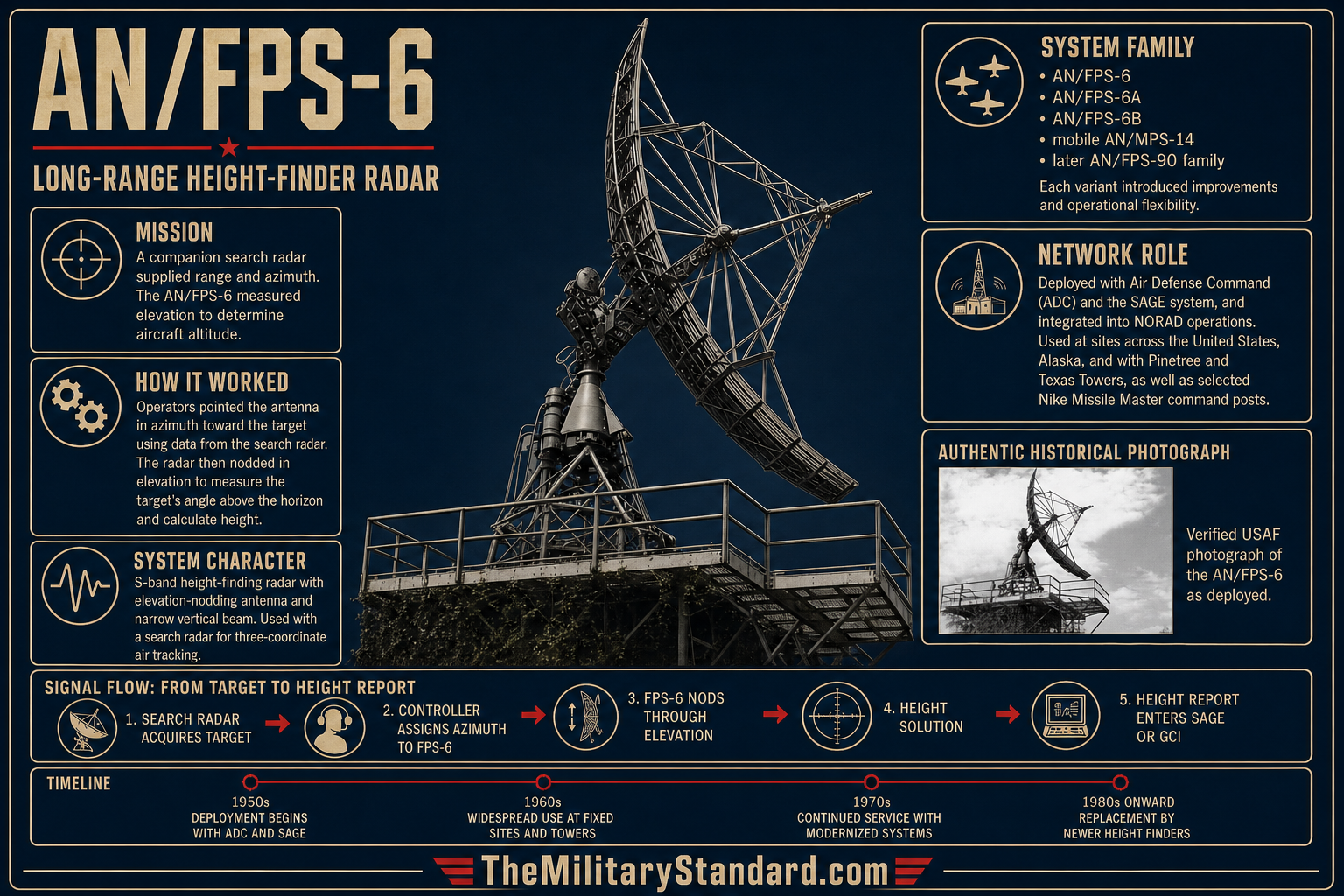
Common Name: Long-Range Height-Finder Radar
System Family: Permanent Radar Network; SAGE; Mobile Radar Program; Alaska AC&W; Pinetree; Texas Towers; joint Nike Missile Master
Equipment Category: Fixed high-power S-band height-finding radar
Frequency Band: S-band
Frequency MHz: 2700-2900 MHz
Peak Power: 5 MW peak
Average Power: No official average RF rating located; nominal duty-cycle calculation approximately 3-6 kW RF from handbook pulse/PRR limits
Radar Manufacturer: General Electric Company, Heavy Military Electronics Department, Syracuse, New York
Primary Role: Determine aircraft altitude by vertically scanning targets acquired by an associated long-range search radar and supplying height data to GCI/SAGE and joint air-defense control systems
Detection Range: AN/FPS-6 baseline 200 nmi; AN/FPS-6A and 6B 300 nmi maximum slant range
Altitude Coverage: Baseline vertical coverage approx. -5,000 to +60,000 ft and -2 to +32 deg; FPS-6A functional description up to 100,000 ft; FPS-6B documented indicator scales to 75,000 ft
Antenna Type & Dimensions: Vertically oriented truncated semi-parabolic reflector; base Reflector AT-374/FPS-6; FPS-6B preserved example AT-873/FPS-6B; approx. 30 ft high x 6 ft wide in specialist references
Antenna Rotation Rate: 360-degree azimuth pointing; baseline 180-degree pointscan average slewing rate approx. 7.5 rpm; vertical nod 20 or 30 cycles/min
Transmitter & Receiver: 5-MW magnetron transmitter; 2-3 microsecond pulses; 300-400 pps; RHI presentation; OA-929/FPS-6A indicator on 6A/6B; 6B variable-nod feature; related AN/FST-2/SAGE integration
Power Requirements: 120/208 VAC, 3-phase, 60 Hz, 4-wire; approx. 50 kVA for FPS-6B; normally shared station power source with associated search radar
Resolution and accuracy: The handbook lists approximately 3.2 degrees azimuth resolution, about 0.90 degree elevation resolution, range accuracy of approximately plus or minus 1 percent, and elevation or height accuracy on the order of 1,000 feet. The exact operational quality depended on calibration, target strength, operator interpretation, propagation conditions, and equipment configuration.
Beam: Approximately 3.2 degrees horizontal beam width. The handbook's FPS-6B entry lists a receiver-bandwidth value of 0.85 degree in the extracted table where the layout suggests a vertical-beam characteristic.
Antenna: A vertically oriented truncated semi-parabolic reflector with waveguide feed. The baseline service manual identifies Reflector AT-374/FPS-6, while the preserved Sioux Lookout FPS-6B reflector is marked AT-873/FPS-6B. Specialist historical references commonly describe the distinctive reflector as roughly 30 feet high and about 6 feet wide.
Indicators: The original radar used the OA-270/FPS-6 radar-set group. AN/FPS-6A and 6B used Indicator Group OA-929/FPS-6A, which the handbook credits with increased height findings, accuracy, and reliability. The operator presentation was a range-height indicator rather than the map-like plan-position display associated with general-search radar.
Site separation: The handbook specifies an absolute minimum separation of about 100 feet between FPS-6-family height-finder equipment and associated or other radar equipment in the relevant installation note. Temperate Tower AB-258/FPS-6 required a level area approximately 30 feet in diameter. Arctic Tower AB-259/FPS-6 required a substantially larger level area, approximately 70 feet in diameter.
Introduced: Production 1953-1960; field deployment documented by 1954-1955
Retired: No single national retirement date; progressively replaced/reconfigured from early 1960s onward, with related Canadian service surviving to 1987 and derivative families later
Replaced: AN/CPS-4; AN/FPS-4; AN/FPS-5; AN/TPS-10 and other earlier height finders depending on site
Replaced By: AN/FPS-26/26A, AN/FPS-90 family, later AN/FPS-89 and AN/FPS-116, and eventually 3-D search radars eliminating separate height-finder requirement
Associated Systems: AN/MPS-14; AN/FPS-6A; AN/FPS-6B; AN/FPS-90; FPS-507; AN/FST-2; SAGE; AN/FSG-1 Missile Master; FPS-3/FPS-20/FPS-7/FPS-24/FPS-35/FPS-66/FPS-67 search radars
Preserved Examples: Preserved AT-873/FPS-6B reflector at Sioux Lookout Memorial, Ontario. Numerous former radar towers, foundations and station buildings survive without original FPS-6 electronics.
The AN/FPS-6 was the principal long-range radar height finder of the United States continental air-defense system during a large part of the Cold War. General Electric produced the fixed-site AN/FPS-6 family for the Air Force, while the closely related AN/MPS-14 provided a transportable version for mobile and interim radar stations. The principal fixed variants were AN/FPS-6, AN/FPS-6A, and AN/FPS-6B. Later derivative or reworked configurations included AN/FPS-90 and other modernization paths, but those later designations should not be treated as merely interchangeable names for every FPS-6 installation.
The equipment's identity is clearer in the technical manuals than in one of Air Defense Command's own retrospective tables. ADC's 1973 "Radar Equipment Designations" page labels FPS-6, FPS-6A, and FPS-6B as "Long Range Search." A later radar-description table in the same ADC volume labels them "Long Range Height," which matches the Air Force technical manuals, unit equipment records, SAGE histories, and the system's actual operating role. The service manual is explicit: the AN/FPS-6 was a high-power fixed-station radar "designed to operate as the height-finding facility for a suitable search radar installation." The contradictory ADC page-35 label is therefore preserved as an original-source anomaly, not adopted as the equipment's operational classification.
Equipment type
The AN/FPS-6 was a fixed, high-power, S-band height-finding radar. It did not normally conduct the continuous 360-degree general-surveillance search performed by radars such as the AN/FPS-3, AN/FPS-7, AN/FPS-20, AN/FPS-24, or AN/FPS-35. Instead, a search radar detected and tracked an aircraft in range and azimuth, after which the FPS-6 was pointed toward that contact and scanned vertically through it. The operator used the resulting range-height display to determine target altitude.
This division of labor was fundamental to 1950s and 1960s air-defense radar architecture. Search radar gave the horizontal picture. Height-finding radar supplied the vertical dimension needed to turn that picture into a three-dimensional intercept solution. A fighter controller could not efficiently place an interceptor against a target merely by knowing that an aircraft was 140 miles away on a given bearing. The controller also needed altitude. That requirement made the FPS-6 family an essential companion to successive generations of long-range search radar and made it one of the most widely distributed specialized radars in the Air Defense Command network.
Manufacturer
General Electric Company manufactured the AN/FPS-6 family. The service manual identifies General Electric's Heavy Military Electronics Department on Court Street in Syracuse, New York, as the manufacturer of Radar Set AN/FPS-6. General Electric advertising and surviving production photographs likewise connect the system to the company's Syracuse radar work. A photograph dated 20 October 1954 shows AN/MPS-14 equipment in the foreground and an AN/FPS-6 in the background at the General Electric facility, providing unusually direct visual evidence of the family during its early production period.
The scale of production was substantial. The Air Force historic-context study Searching the Skies states that approximately 450 AN/FPS-6 and mobile AN/MPS-14 sets were produced between 1953 and 1960. That figure explains why the FPS-6 became so visually characteristic of Cold War radar stations. The narrow, vertically oriented reflector appeared at permanent continental sites, mobile-program stations, Pinetree locations in Canada, Alaskan sites, Texas Towers, and several joint Army-Air Force command posts associated with Nike missile defense.
Development and service dates
The AN/FPS-6 emerged during the rapid modernization that followed construction of the first permanent postwar radar network. Early permanent stations commonly used AN/CPS-4, AN/FPS-4, or AN/FPS-5 height-finding equipment. These systems provided the altitude data required by ground-controlled-intercept operations, but the Air Force needed greater range, higher altitude coverage, improved accuracy, better reliability, and equipment that could integrate with the increasingly sophisticated command-and-control environment being built for continental defense.
Production of the FPS-6/MPS-14 family was underway by 1953, and General Electric imagery documents the equipment in Syracuse by October 1954. A February 1960 General Electric advertisement called the FPS-6 a "6-year-old radar" and described it as the principal height finder for air defense. Although advertising language must be treated as promotional rather than independent historical authority, the date is consistent with the production record and with station histories showing FPS-6 installation during the mid-1950s.
Deployment accelerated as Air Defense Command modernized permanent and mobile radar sites. Cambria, California, for example, had an FPS-6 operating with an FPS-3 search radar by 1955 according to ADC equipment tables. Selfridge added an FPS-6 in 1957. Highlands Air Force Station received one in 1958. Mobile-program sites in the West and Southwest operated FPS-6, FPS-6A, and FPS-6B sets alongside FPS-3, FPS-20, FPS-7, and other search radars. By the end of the decade the FPS-6 family was standard height-finding equipment across much of the continental network.
Service did not end on one national date. During the early 1960s, some FPS-6-family sets were replaced by newer AN/FPS-26 or AN/FPS-26A height finders. Other equipment was redesignated or modified into AN/FPS-90 configurations, and still later modernization programs extended the basic family. Some U.S. stations continued operating FPS-6-series equipment into the later 1960s, while Canadian stations retained examples much longer. CFS Sioux Lookout's preserved FPS-6B reflector was removed from the station in May 1987 immediately before that Canadian station closed in June.
Purpose and operational role
The FPS-6 answered a simple but strategically critical question: how high was the target? Air-defense search radars could detect aircraft at long range and establish their horizontal position, but early two-dimensional search systems did not independently provide precise altitude. Height mattered because an interceptor needed a climb profile, the controller needed to distinguish high-altitude bomber tracks from lower traffic, and a missile-defense command post needed three-dimensional target information to determine which weapon battery should receive an engagement.
In a typical operating sequence, the search radar found a target and developed a track. The FPS-6 antenna then slewed to the target's azimuth. Instead of continuously rotating through all bearings like a search radar, the height-finder antenna nodded rapidly upward and downward through a vertical sector while remaining pointed generally toward the target. Returned echoes appeared on a range-height indicator. The display showed distance horizontally and height or elevation vertically, allowing the operator to select the target return and determine altitude.
This function became more important as Soviet aircraft performance improved. A bomber approaching at 40,000 feet presented a different interception problem from a reconnaissance aircraft or bomber above 60,000 feet. The Air Force therefore continuously improved the FPS-6 family. The 6A introduced the OA-929/FPS-6A indicator group and increased height-finding performance, accuracy, and reliability. The 6B retained that indicator approach while adding improved components and a variable-nod feature to the antenna system. These changes were operational improvements, not merely changes in nomenclature.
How the system worked
The FPS-6 depended on another radar to tell it where to look. A long-range search radar swept the sky and detected a contact. Once the contact's range and azimuth were known, the height-finder's antenna was rotated toward the target bearing. The tall reflector then nodded in elevation, sweeping its narrow vertical beam upward and downward across the target. Every time the beam crossed the aircraft, the radar received a return at a particular range and elevation.
The operator viewed those returns on an RHI, or range-height indicator. Unlike a plan-position indicator, which resembles a map viewed from above, an RHI resembles a vertical cross-section through the sky. One axis represents distance from the station and the other represents height or elevation. A target therefore appears at a location corresponding to both its range and vertical position. Once the correct return was identified, altitude could be read or calculated and passed to the controller.
The radar's 5-MW peak transmitter provided the energy needed for long-range returns, while the narrow vertical beam and mechanical nodding motion provided altitude discrimination. Accuracy depended on precise antenna positioning and calibration. The system therefore included extensive antenna-control, transmitter, receiver, indicator, synchronization, blanking, calibration, and monitoring equipment. It was not simply a dish connected to a display. A failure in antenna drive, transmitter timing, range calibration, receiver sensitivity, or indicator alignment could directly degrade the altitude information used for an interception.
Later improvements focused heavily on operator workload and reliability. General Electric's 1960 advertisement listed full-time trace-height-line display, automatic indicator calibration, sector scan, performance monitoring, azimuth blanking, variable nod angle, a ferrite isolator, and improved receiver noise figure among the improvements made during the system's first years. Because that list comes from a manufacturer advertisement, it is best treated as evidence of GE's own modernization claims, while the military handbook independently confirms important changes such as OA-929 indicators and the FPS-6B variable-nod feature.
Typical installation and physical layout
A fixed FPS-6 installation normally consisted of a radar tower containing the antenna and tower-mounted electronics, associated equipment in the operations building, power and utility support, and cable or waveguide connections linking the components. The service manual makes clear that the FPS-6 did not function as a self-contained isolated station. Its control equipment was intended to be housed in the operations building of the associated search-radar installation.
The most visible feature was the height-finder tower. Temperate installations used structures such as AB-258/FPS-6, while arctic installations used AB-259/FPS-6 or comparable protected configurations. The antenna group sat at the top and had to rotate in azimuth while nodding in elevation. Because the reflector was tall and narrow, an FPS-6 could often be distinguished in historical photographs from the broad horizontal search-radar antennas nearby.
In the operations building, the range-height indicators stood close enough to the control and plotting functions for height information to be passed quickly. Search operators and controllers first established the target track. The height-finder operator then selected the proper contact and supplied altitude. At SAGE-era sites, the radar became part of an increasingly automated information chain even though human operation remained essential to height measurement, calibration, maintenance, and target discrimination.
The radar compound also required a stable electrical system, heating and cooling, maintenance benches, spare parts, test equipment, communications, and trained technicians. A large height finder could not be treated as an appliance that simply ran until failure. Magnetrons, high-voltage components, waveguides, motors, gearboxes, bearings, servo systems, indicators, and receivers all demanded scheduled maintenance. At isolated sites, the ability to keep the radar working through weather and supply delays was as important as nominal laboratory performance.
At joint Army-Air Force installations, additional towers could stand beside the Air Force equipment. Selfridge, and Lockport are examples where Air Force SAGE or surveillance radars occupied the same larger defense complex as Army Nike command-and-control facilities. Specialist site histories document Army-operated FPS-6A height finders alongside Missile Master installations. The result could be a dense radar skyline containing separate search, Air Force height-finding, and Army height-finding equipment serving related but distinct command systems.
Integration with other systems
The FPS-6 was normally paired with a search radar of comparable range. Early combinations included FPS-3 and FPS-6. Later combinations included FPS-20, FPS-20A, FPS-7, FPS-24, FPS-35, FPS-66, and FPS-67 search radars. ADC's station tables repeatedly show these pairings and, at many sites, show two height finders operating simultaneously. The second set improved capacity and redundancy, particularly at stations handling heavy traffic or multiple simultaneous intercepts.
The radar family became closely associated with SAGE. The 1965 handbook lists AN/FST-2 among related equipment for FPS-6B, and station histories show FPS-6-series sets operating at sites that fed SAGE direction centers. SAGE automated the larger surveillance picture, but altitude still had to enter the track. Height-finding radar therefore remained an important bridge between mechanically scanned sensors and computerized command-and-control.
The FPS-6 also connected to the Army Nike air-defense system at joint direction centers. CONAD pursued collocation of Army Missile Master facilities and Air Force radar sites because interceptor aircraft and surface-to-air missiles were defending the same airspace. At Highlands, Lockport, Selfridge, and other joint sites, Army and Air Force radars could occupy the same property while supporting different but integrated command chains. The Army used FPS-6A-family height finders in conjunction with Missile Master to help develop the three-dimensional target picture used for Nike defense.
In Alaska, the need for more than one height finder at key control locations was explicitly tied to simultaneous control responsibilities. NORAD's 1959 history discussed collocation and the need for sufficient radar capacity where direction centers might control both interceptor aircraft and ground-to-air missiles. That requirement illustrates why the height finder was a system-capacity issue rather than merely an accessory to a search radar.
Variants and upgrades
AN/FPS-6 was the baseline fixed set. MIL-HDBK-162A gives 200 nautical miles range and vertical coverage to approximately 60,000 feet for the basic configuration. It used the earlier OA-270/FPS-6 radar-set group and lacked the FPS-6B variable-nod feature.
AN/FPS-6A improved the operator and performance side of the system. The military handbook identifies Indicator Group OA-929/FPS-6A as the major distinguishing feature, replacing OA-270/FPS-6 and improving height findings, accuracy, and reliability. The 6A functional description gives a maximum slant range of 300 nautical miles and height-finding capability to 100,000 feet for targets within the -2 to +32 degree elevation envelope.
AN/FPS-6B retained the OA-929 indicator system, added improved components, and incorporated a variable-nod feature into the antenna system. The 6B technical entry gives 300 nautical miles range. Its documented indicator scales extend to 75,000 feet, but that display scale should not automatically be interpreted as the absolute physical limit of every 6B configuration.
AN/MPS-14 was the mobile version. It used closely related and substantially interchangeable components packaged for transport to prepared sites. Air Defense Command employed MPS-14 sets during mobile radar programs, at overseas locations, and where the permanent fixed installation was unavailable or not justified.
AN/FPS-90 was closely related to the FPS-6 family, but its exact relationship should be described carefully. The Air Force service manual states that the FPS-90 nomenclature was assigned to certain FPS-6-family sets after removal of the mechanical variable-nod mechanism, while later historic summaries describe FPS-90 as a higher-power or improved FPS-6 derivative. The safest treatment is to regard FPS-90 as a formal derivative/reconfiguration within the FPS-6 technical family, not as a casual synonym for any upgraded FPS-6.
FPS-507 was a Canadian adaptation associated with the same family. The military handbook describes it as performing the same basic function as the FPS-6B while using Canadian components, including a Canadian Marconi magnetron in documented configurations. Some Canadian FPS-6B equipment was modified to FPS-507 standards.
The family continued to generate later modernizations such as FPS-116. That long afterlife is evidence of the basic design's usefulness. The Cold War air-defense system changed from manual plotting to SAGE and from bomber defense toward mixed aerospace warning, but a reliable mechanical height finder could remain useful if its electronics and control systems were updated.
Systems it replaced / systems that replaced it
The FPS-6 replaced or supplemented earlier height finders such as AN/CPS-4, AN/FPS-4, AN/FPS-5, AN/TPS-10, and related equipment depending on the station. ADC permanent-network tables show these substitutions site by site. At Cambria, an FPS-6 appeared alongside the existing FPS-3 in the mid-1950s. At other stations, FPS-6-family equipment replaced FPS-4 or FPS-5 during the modernization that preceded or accompanied SAGE.
There was no single universal successor. AN/FPS-26 and AN/FPS-26A C-band height finders replaced FPS-6-family equipment at many SAGE sites. AN/FPS-90 served as a family derivative or reconfiguration at others. Searching the Skies identifies AN/FPS-89 and AN/FPS-116 as later General Electric height-finder developments related to the role. Eventually, three-dimensional search radars made a separate mechanical height finder unnecessary at many installations because one radar could produce range, azimuth, and elevation together.
This replacement process occurred over decades rather than one modernization year. ADC's 1963 tables often show FPS-6 or FPS-6A operating beside newer FPS-26, FPS-26A, or FPS-90 equipment. That overlap is important. New radars did not instantly erase old ones from the network. Installations needed redundancy, construction schedules varied, equipment availability differed by sector, and a working FPS-6 could continue to provide useful height data while a newer system was installed or tested.
Known U.S. military locations using it
The AN/FPS-6 family was widely deployed, some of the stations included:
- Cambria Air Force Station, California - ADC tables record FPS-6 service with FPS-3 and later FPS-20-family search radar during the permanent-network modernization period.
- Klamath Air Force Station, California - FPS-6 and later FPS-6B height-finding equipment operated with FPS-20A and later FPS-66-family search radar.
- Blaine Air Force Station, Washington - ADC records FPS-6 and FPS-6A during the late 1950s and early 1960s, later replaced by FPS-26A-family height finding.
- Hutchinson Air Force Station, Kansas - ADC records FPS-6 and FPS-6A/6B in successive configurations with FPS-20 and FPS-66 search radars.
- Watertown Air Force Station, New York - FPS-6 height finders replaced earlier FPS-5 equipment and later gave way to FPS-26A.
- Saratoga Air Force Station, New York - FPS-6 height-finding equipment supported the station after its early FPS-5 period and before later FPS-26A modernization.
- Selfridge Air Force Base radar station, Michigan - an Air Force FPS-6 arrived in 1957; FPS-6 and FPS-6A equipment later operated with the SAGE mission. The property was also shared with the Army Nike command system.
- Highlands Air Force Station, New Jersey - an Air Force FPS-6 became operational in 1958 and an FPS-6B was added in 1960. The Army also installed two FPS-6A height finders for the Nike Missile Master mission.
- Lockport Air Force Station, New York - two Air Force FPS-6 height finders supported the SAGE station around 1960. The Army also operated two FPS-6A height finders associated with the Niagara-Buffalo Nike direction center.
- Dickinson radar site, North Dakota - ADC's Mobile Radar Program records FPS-6A operating with FPS-3/FPS-3A and later FPS-66.
- Lewistown Air Force Station, Montana - ADC records FPS-6A and FPS-6B height finders during the transition from FPS-3A to later search radar equipment.
- Keno Air Force Station, Oregon - ADC records two FPS-6A sets, later FPS-6A/FPS-6B combinations, supporting FPS-20A and FPS-67 search radar.
- Luke Range radar site, Arizona - ADC records FPS-6/FPS-6A service with FPS-20A and later FPS-7C and FPS-26 equipment.
- Pyote Air Force Station, Texas - ADC records FPS-6 with FPS-3 and FPS-3A during the late 1950s and early 1960s.
- Ozona Air Force Station, Texas - ADC records FPS-6 with FPS-3 during the Mobile Radar Program.
- Zapata Air Force Station, Texas - ADC records FPS-6 supporting FPS-3/FPS-3A search radar.
- Port Isabel Air Force Station, Texas - ADC records FPS-6 with FPS-3A during the Mobile Radar Program.
- Lake Charles radar site, Louisiana - ADC records FPS-6-family use during the mobile and southern-defense radar period.
- Texas Tower No. 3, Nantucket Shoal - ADC records two FPS-6 height finders with FPS-20/FPS-20A/FPS-67 search-radar configurations.
- Texas Tower No. 4, Unnamed Shoal - the offshore station operated two FPS-6A height finders with its FPS-20A search radar. Both height finders were lost with the platform when the tower collapsed on 15 January 1961.
- Alaskan Aircraft Control and Warning network - NORAD records show extensive FPS-6 deployment and planning for multiple height finders at important direction centers. The family was particularly valuable in the northern network because altitude information was essential to long-range interception and missile-defense coordination.
Operational history
The FPS-6 reached operational maturity at the same time the United States was transforming air defense from a collection of manual radar stations into a continental computerized network. Its service history therefore tracks several major Cold War transitions. It first appeared as the improved height-finding companion to early permanent-system search radars. It then became standard equipment at many SAGE stations. It also served in Alaska, Canada, mobile radar units, offshore Texas Towers, and Army-Air Force joint defense centers.
Daily operation was labor intensive. Search operators first had to acquire the target. The height-finder operator then had to point the FPS-6 to the correct azimuth, scan vertically, distinguish the desired target from other returns, read or derive altitude, and pass the result into the control system. Calibration had to remain accurate because a systematic height error could send an interceptor above or below its target. Maintenance personnel kept the high-voltage transmitter, magnetron, antenna drives, servo systems, receiver, cooling, and indicators working continuously.
SAGE changed the information environment but did not eliminate the need for height finding. Direction centers could correlate tracks from multiple radars and automate parts of interception control, yet the air picture still required altitude. FPS-6-series radars therefore remained operational at SAGE sites even as their associated search radars changed from FPS-3 to FPS-20, FPS-7, FPS-24, FPS-35, and other types.
The system also participated in joint Army-Air Force defense. CONAD sought to integrate Army Nike missile command posts with Air Force surveillance and SAGE because the same hostile track could become a fighter-interceptor target, a Nike target, or both. At Highlands, Selfridge, Lockport, and other collocated locations, FPS-6-family height finders contributed to this common three-dimensional air picture. Some Army Missile Master installations had their own FPS-6A equipment in addition to the Air Force height finders already at the radar station.
This joint mission is a reminder that the FPS-6 was not tied to one weapon system. It supported fighter control, Bomarc and Nike-era air defense, surveillance evaluation, identification, and sector command-and-control. Its data helped determine whether a track was climbing, descending, or maintaining altitude and whether an interceptor or missile battery could engage it effectively.
One of the most dramatic events involving FPS-6 equipment occurred offshore. Texas Tower No. 4 operated an FPS-20A search radar and two FPS-6A height finders. The tower entered SAGE service in 1960 but suffered severe structural problems unrelated to the radar itself. On 15 January 1961 it collapsed during a winter storm, killing twenty-eight men. The FPS-6A sets went down with the platform. The event was an installation and engineering disaster rather than a radar failure, but it forms part of the equipment's deployment history because it shows how far Air Defense Command was willing to place major radar systems beyond the coastline in pursuit of additional warning time.
The FPS-6 also illustrates the intense pace of Cold War electronics improvement. General Electric's 1960 advertisement emphasized that a six-year-old design had already accumulated a series of changes in display, calibration, scanning, monitoring, isolation, and receiver performance. The military handbook confirms that later FPS-6A and FPS-6B configurations improved indicators, components, range, height-finding capability, and antenna scanning. In this sense the designation represents a moving technical family rather than a single frozen 1954 configuration.
By the 1960s the radar faced competition from C-band height finders and later three-dimensional systems. AN/FPS-26 and FPS-26A replacements appeared at many stations. FPS-90 derivatives continued the family at others. Eventually the rise of radars that produced elevation as part of their normal search function made a separate nodding height finder less necessary. The FPS-6 disappeared gradually because its function was absorbed into newer sensor architectures, not because altitude ceased to matter.
Preserved examples / surviving equipment
The strongest publicly documented preserved FPS-6 artifact identified is at Sioux Lookout, Ontario. Veterans Affairs Canada records a memorial incorporating an FPS-6 height-finding antenna donated by Canadian Forces Station Sioux Lookout. The antenna was moved from the station in May 1987, shortly before the station closed in June. Its inscription identifies the reflector as AT-873/FPS-6B, serial number 13 FML 186, manufactured in 1959 under contract CD-765400 by Canadian General Electric.
That memorial is particularly valuable because it preserves the defining physical feature of the radar, the tall narrow height-finder reflector, with its identity plate information. Many American FPS-6 sites retain towers, foundations, operations buildings, generator facilities, or roads but no radar hardware. Once the antenna and electronics were removed, an empty tower or concrete pad could be difficult to interpret without photographs and technical drawings.
Chronology
- 1953 Production of the AN/FPS-6 and mobile AN/MPS-14 family is underway during the expansion of Cold War air-defense radar.
- 1954-10-20 General Electric imagery documents AN/MPS-14 and AN/FPS-6 equipment at the Syracuse radar facility.
- 1955 ADC permanent-network tables show AN/FPS-6 entering service at stations such as Cambria, California, as older height finders are replaced.
- 1956 FPS-6 deployments expand across permanent and mobile radar programs.
- 1957 Selfridge receives an AN/FPS-6 height finder as the Detroit-area radar network moves toward SAGE and joint missile-defense integration.
- 1958 Highlands Air Force Station begins operating an AN/FPS-6 height finder and enters the SAGE era.
- 1958 ADC tables show FPS-6-family height finders at numerous permanent and mobile radar locations.
- 1959 NORAD planning emphasizes adequate height-finder capacity at key control sites responsible for both interceptor and ground-to-air missile missions.
- 1959 Multiple Mobile Radar Program stations operate FPS-6 or FPS-6A equipment with FPS-3, FPS-20, and other search radars.
- 1959-04 Texas Tower No. 4 begins documented radar operation with an FPS-20A search radar and two FPS-6A height finders.
- 1960 General Electric advertises the FPS-6 as a six-year operational veteran and principal air-defense height finder while promoting a series of reliability and performance improvements.
- 1960 AN/FPS-6A and FPS-6B variants are increasingly visible in ADC station equipment tables.
- 1960 Highlands combines Air Force FPS-6/FPS-6B height-finding equipment with Army FPS-6A sets supporting Nike Missile Master operations.
- 1960 Lockport Air Force Station operates Air Force FPS-6 height finders while Army FPS-6A equipment supports the Niagara-Buffalo Nike direction center.
- 1960 Selfridge operates FPS-6/FPS-6A height finders within a joint Air Force-Army radar and missile-defense installation.
- 1960-04 Texas Tower No. 4 enters SAGE operation with its two FPS-6A height finders.
- 1961-01-15 Texas Tower No. 4 collapses during a winter storm, destroying the offshore radar installation and killing twenty-eight military and civilian personnel.
- 1961 The Air Force service manual documents FPS-6 as a high-power fixed height finder manufactured by General Electric's Heavy Military Electronics Department in Syracuse.
- 1962-1963 Many SAGE stations begin replacing one or more FPS-6-family sets with FPS-26/FPS-26A or FPS-90-family height finders while retaining other FPS-6 equipment during transition.
- 1963 ADC permanent-network tables still show widespread FPS-6, FPS-6A, and FPS-6B use beside newer height finders and search radars.
- 1965-12-15 MIL-HDBK-162A codifies detailed technical descriptions for AN/FPS-6, AN/FPS-6A, and AN/FPS-6B.
- 1967-11-01 The FPS-6-family service manual incorporates later changes covering AN/FPS-6, FPS-6A, FPS-6B, FPS-90, and MPS-14 equipment.
- Late 1960s to 1970s Basic FPS-6-family equipment is progressively replaced, reconfigured, or superseded as FPS-26, FPS-90, FPS-116, and later three-dimensional radars take over height-reporting functions.
- 1987-05 The FPS-6B reflector at CFS Sioux Lookout is moved from the station for preservation shortly before closure.
- 1987-06 CFS Sioux Lookout closes; its preserved FPS-6B reflector remains as a public memorial artifact.
- Present Surviving FPS-6-family evidence consists of preserved antennas such as Sioux Lookout, photographs, technical manuals, specialist collections, radar towers and foundations, and former station buildings across North America.
Information sources (11)
- PDFT.O. 31P3-2FPS6-2-1, Service Instructions for Radar Sets AN/FPS-6, AN/FPS-6A, AN/FPS-6B, AN/FPS-90, and AN/MPS-14
Source for the radar's formal height-finding function, General Electric manufacturer identity, equipment architecture, component nomenclature, and variant family.
- PDFMIL-HDBK-162A / TM 11-487C-1, Military Standardization Handbook, United States Radar Equipment (36.9 MB)
Source for frequency, 5-MW peak power, pulse data, baseline 200-nmi range, 6A/6B 300-nmi range, angular coverage, height capability, scan rates, power requirements, indicators, towers, and related systems.
- PDFAerospace Defense Command, Historical Data of the Aerospace Defense Command, 1946-1973
Source for ADC's contradictory equipment classification, later correct height-finder description, permanent/mobile site equipment histories, Texas Tower use, and the official AN/FPS-6 photograph listing.
- PDFDavid F. Winkler, Searching the Skies: The Legacy of the United States Cold War Defense Radar Program
Source for General Electric manufacture, production of approximately 450 FPS-6/MPS-14 sets from 1953 to 1960, SAGE-compatible height-finder context, and successor-system history.
- WEBCanadian Air Defence Museum, FPS-6 Height Finder
Source for Pinetree-line operating context, technical cross-checks, and historical imagery.
- WEBVeterans Affairs Canada, Sioux Lookout Memorial
Source for the surviving FPS-6B reflector, its 1987 preservation, AT-873/FPS-6B designation, serial number, 1959 manufacture, and Canadian General Electric inscription.
- PDFGeneral Electric, "How a 6-Year-Old Radar Stays Young," Air Force Magazine, February 1960
Period manufacturer source for the claimed six-year operating history and contemporary improvement program. Used as advertising evidence, not as an independent technical authority.
- PDFNORAD/CONAD History, January-June 1959
Source for collocation of Army Missile Master and Air Force radar facilities and the broader integrated missile/interceptor defense context.
- PDF661st Radar Squadron (SAGE) unit history compilation
Source for Selfridge FPS-6/FPS-6A equipment and joint Army Nike missile-defense use.
- WEBRadomes.org, Highlands Air Force Station
Specialist source for Air Force FPS-6/FPS-6B and Army FPS-6A deployment at the New York Defense Area Missile Master/SAGE joint site.
- WEBRadomes.org, Lockport Air Force Station
Specialist source for Air Force FPS-6 and Army FPS-6A height-finder deployment at the Niagara-Buffalo joint radar and Nike command post.