
Durban Island FOX-E DEW Line Station, Canada
Four people kept this small radar and radio station running on a cliff-top island with no airstrip.
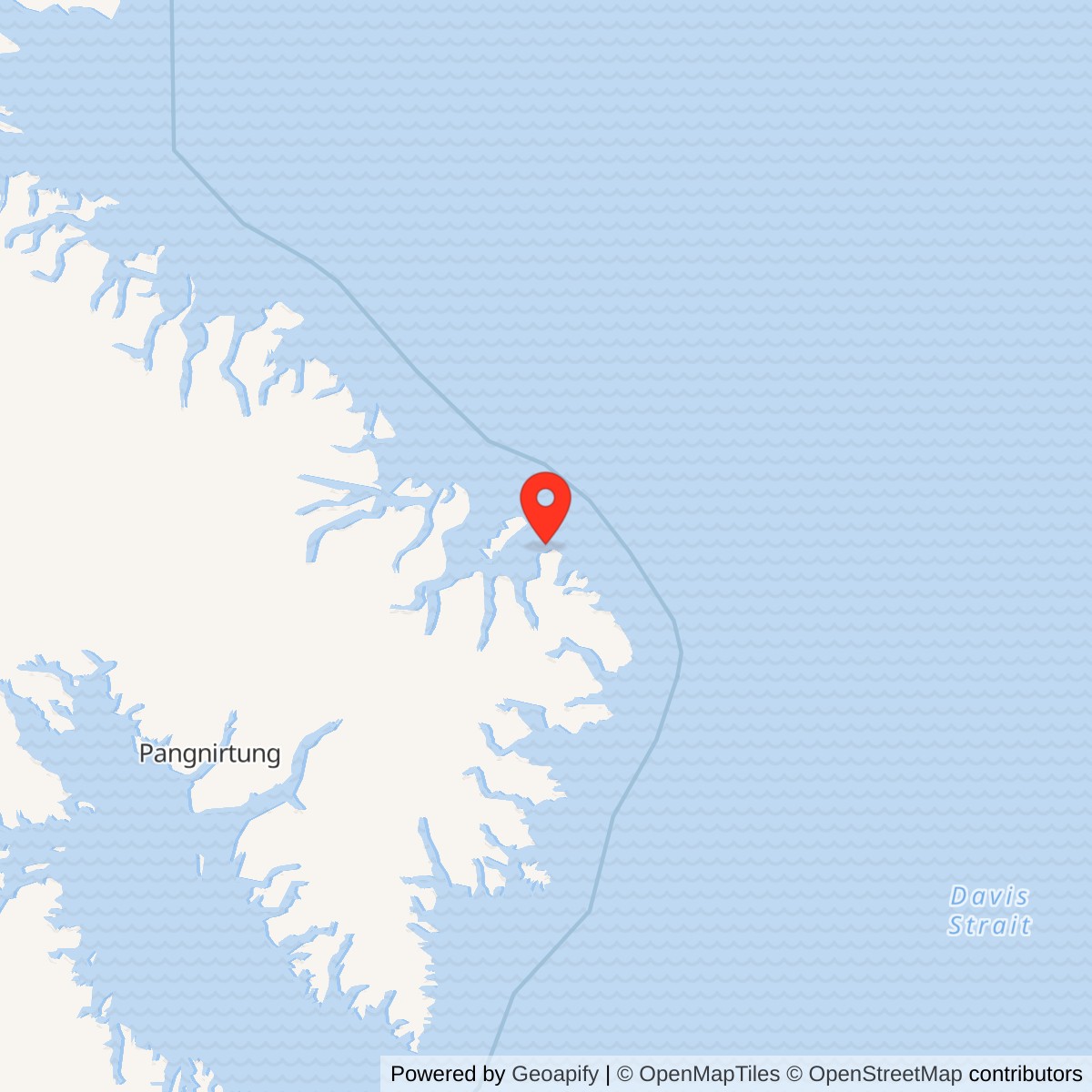
Longitude: -62.182765
Site Number: FOX-E
Current Role: Former DEW Line property; Canadian government assumed responsibility in 1965.
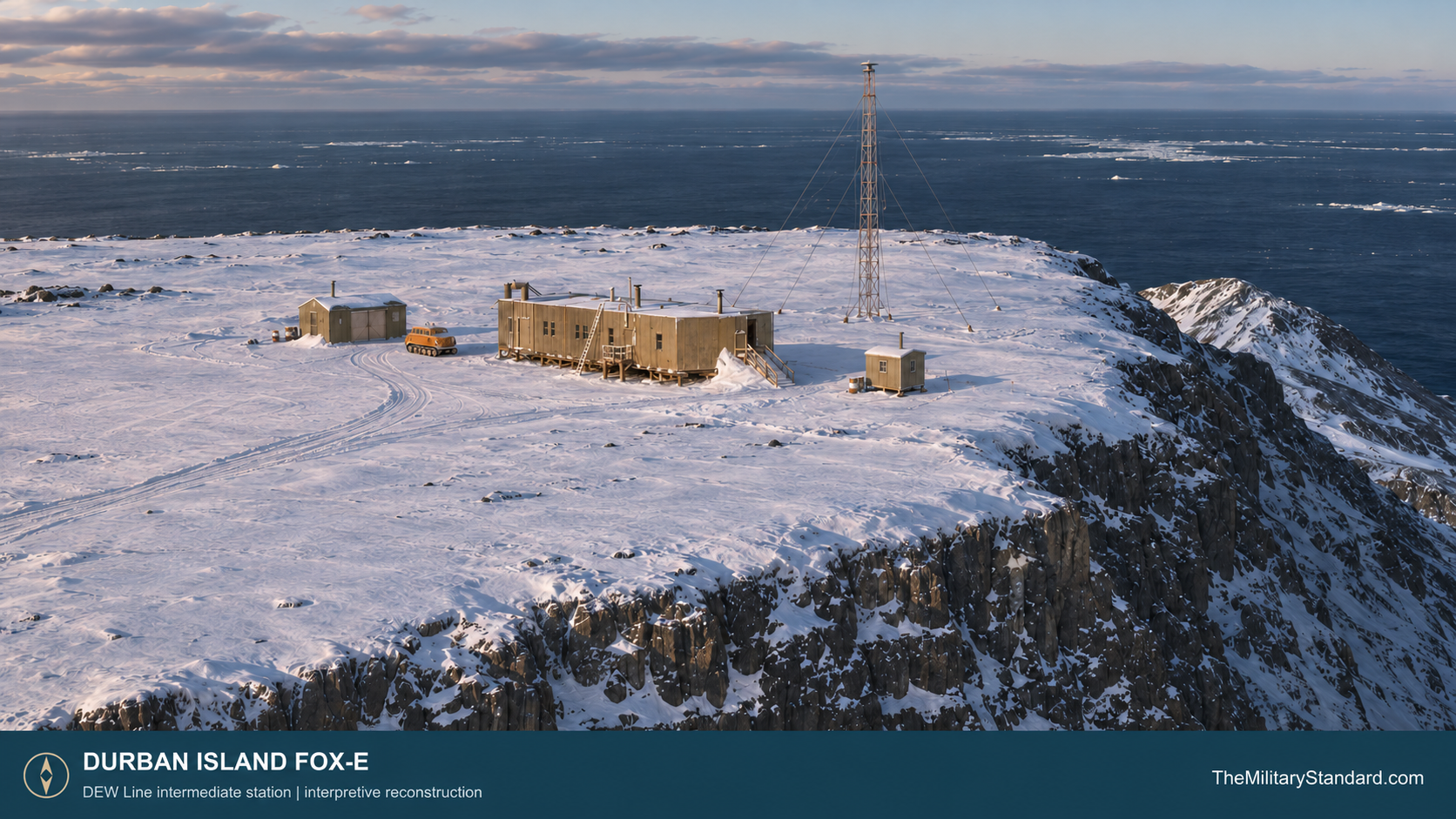
Durban Island, code FOX-E, was a small intermediate station in the eastern sector of the Distant Early Warning Line. It stood on a flat-topped island above Davis Strait, between the larger radar stations at Kivitoo FOX-D and Broughton Island FOX-5. The site added a low-altitude warning point to the chain that reported aircraft movements across the Arctic approaches to North America. [1] [2] [5]
- DEW Line code
- FOX-E
- Station role
- Intermediate radar station
- Radar equipment
- AN/FPS-23
- Resident crew
- Four people
- Air access
- Helicopter only
- Operating period
- August 1957 to July 21, 1963
- Location
- Durban Island, Nunavut
A Watch Post Above Davis Strait
The station occupied the island's high ground off the coast of Baffin Island, about 95 kilometres southeast of Qikiqtarjuaq. Steep shorelines and the limited plateau gave the crew a broad view but left no space for an airstrip. Helicopters supplied the station from Cape Dyer, and the crew also depended on seasonal surface deliveries. [2] [3] [4] [6]
Building FOX-E
Construction began in 1956 during the final push to establish the Canadian DEW Line. The 1956 aerial photograph shows a compact work site near the rim of the island rather than an extensive base. Workers erected the slender lattice tower, set the prefabricated modules on supports and assembled a separate garage and storage area. The station became part of the operating line in 1957. [1] [2] [4] [5]
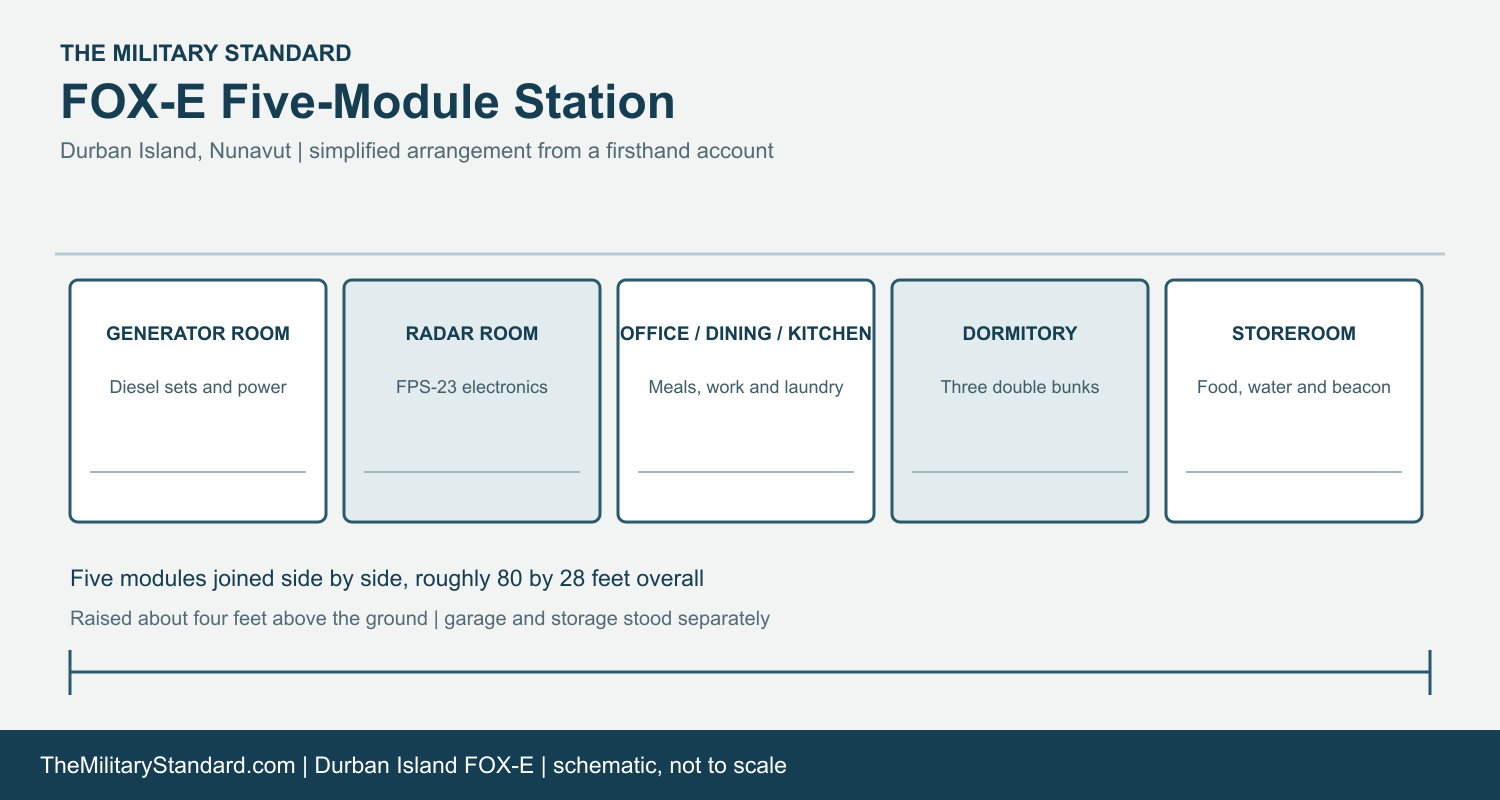
Five prefabricated modules, each about 16 by 28 feet, were joined side by side into a building about 80 by 28 feet. The building stood roughly four feet above the ground on stilts. Its rooms ran from generator room and radar room through the shared office, dining and kitchen area to the dormitory and store room. The compact arrangement kept the essential equipment and living space within one heated enclosure. [3] [4]
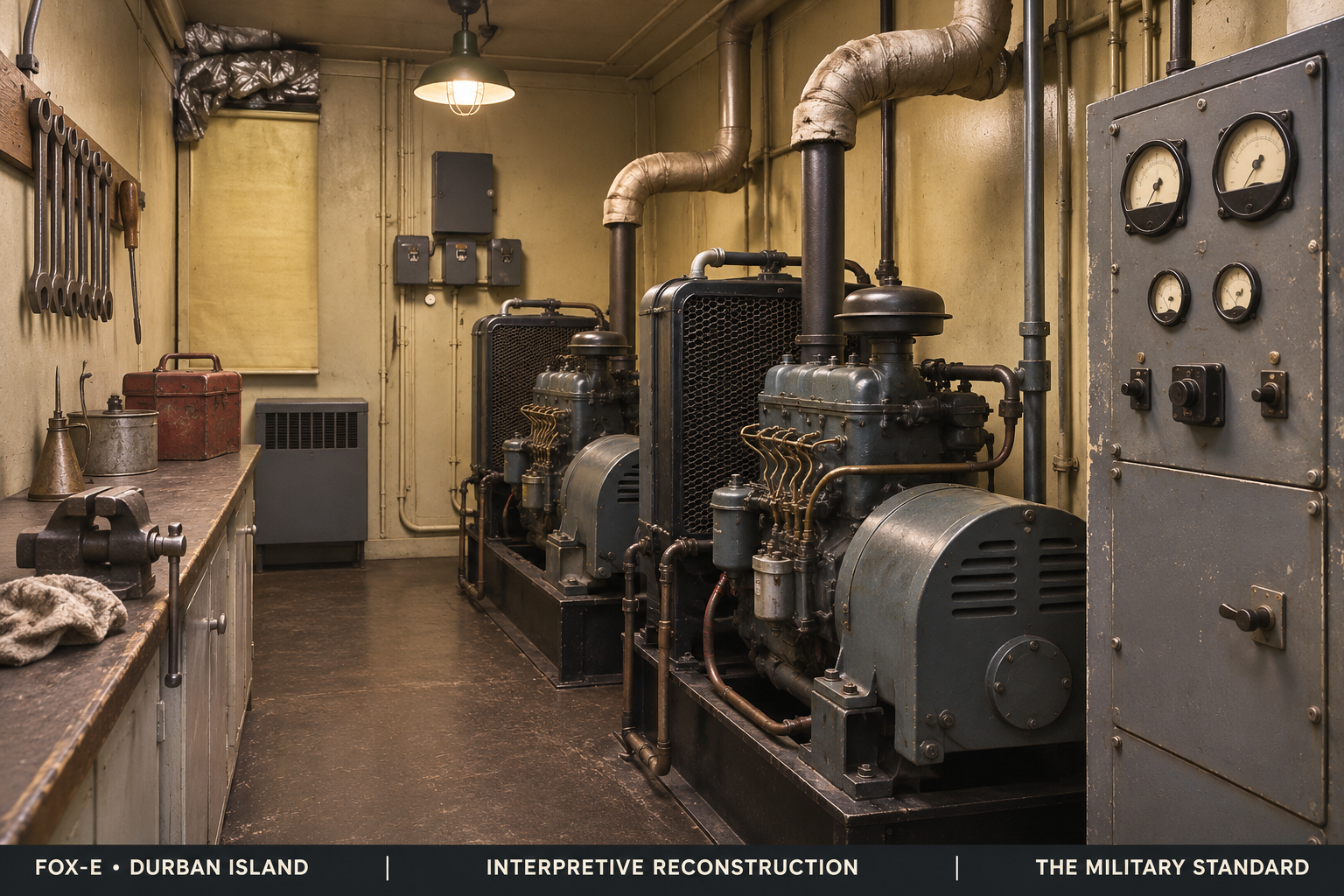
The generator room held two diesel sets that supplied heat and power for the station. The radar room contained transmitter cabinets and a technician's workbench. Elsewhere the building had a shower, lavatory, laundry space, bunks, food storage, a water tank and a low-frequency beacon transmitter. A separate garage protected vehicles and supplies; lifelines led between structures when blowing snow made even a short walk hazardous. [3]
Radar and Communications
FOX-E began manual operation in August 1957 with AN/FPS-23 equipment. This Doppler radar helped detect aircraft moving through low-altitude gaps in the warning line. FOX-E did not have the large rotating search antenna and radome of a main or auxiliary station. Its narrow tower and compact electronics building reflected the more specialized intermediate-station mission. [1] [3] [5]
A radar alarm required human judgment and a working communications path. The resident radician maintained the electronic equipment, while the station chief handled operations and reporting. The site's radio equipment connected its watch with neighboring DEW stations, and its beacon supported aircraft approaching the isolated island. [3] [5]
The tall lattice tower carried the station's radio and Doppler equipment. Its exposed antennas needed attention during icing and storms. The roof mast supplied wind speed and direction information, which mattered for helicopter arrivals. Inside the radar room, motor-generator equipment produced the 400-hertz power needed by parts of the electronic system. [3] [4]
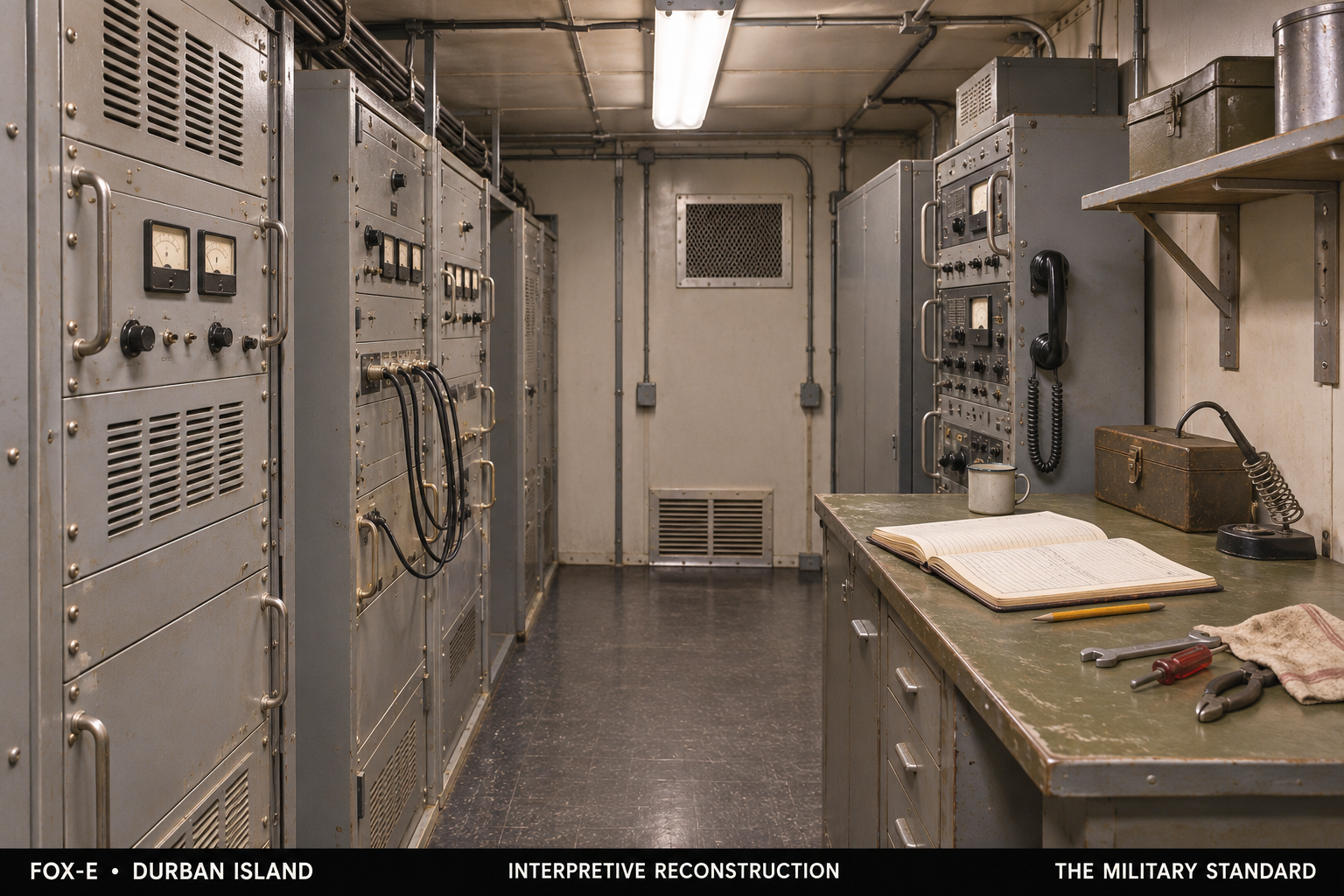
The power plant was modernized in summer 1960 when the original pair of 10-kilowatt diesel generators was replaced with two 20-kilowatt units. That change increased the station's electrical margin for its radar, radio, heating and domestic loads. Continuous power was central to the warning mission and to life in the five-module building. [3]
Four People on an Island
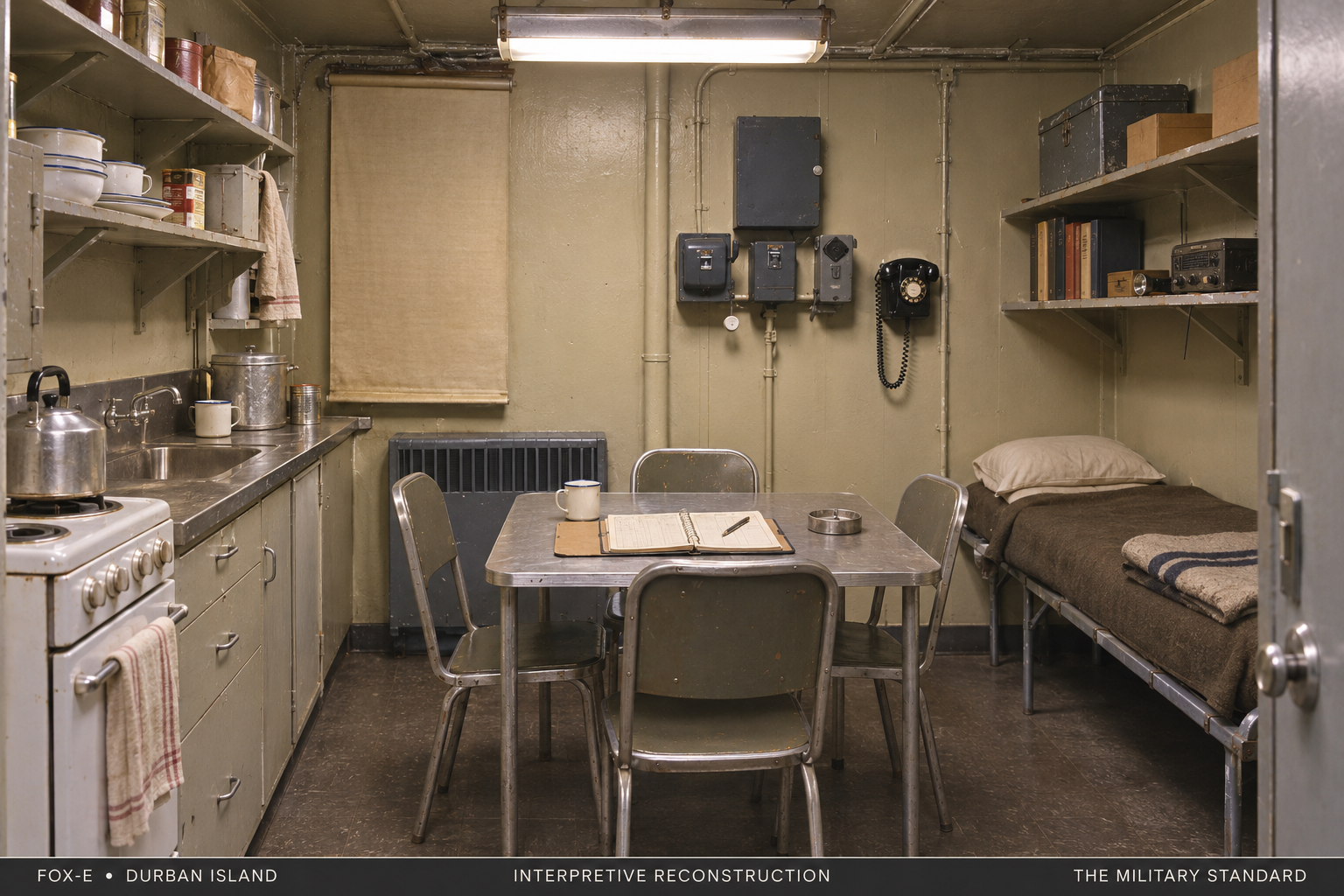
FOX-E normally had four year-round residents: a station chief, a radician, a mechanic and a cook. The dormitory held three double bunks for the mechanic, cook and visitors, while the chief and radician slept in the shared office and dining module. Summer workers could expand the population during supply and maintenance periods. [3]
With no runway, personnel and urgent parts arrived by helicopter, often from Cape Dyer. In good weather the flight took roughly an hour. Weather could interrupt that schedule for many days, leaving the crew to rely on stored food, fuel, spare parts and their own repair skills. Winter flights followed the sea ice; summer approaches crossed the mountainous coast. [3]
The small crew shared work, meals and off-duty time at close quarters. Movies, recorded music, mail and a small game table helped fill the hours between watches and maintenance jobs. Storms and blowing snow could confine everyone to the building, but the radar and generators still needed regular checks. A working station depended as much on the mechanic and cook as on the electronics specialists. [3]
The End of the FOX-E Watch
Aerospace Defense Command records give July 21, 1963 as the inactivation date for FOX-E. A Canadian government account likewise places its operation between 1956 and 1963. Canada took responsibility for the former station in 1965. The remaining buildings, tower and fuel facilities became part of the physical record of this brief but demanding military watch. [1] [2]
Chronology
- 1956 Construction of the intermediate station begins on Durban Island.
- August 1957 FOX-E begins manual operation with AN/FPS-23 equipment.
- Summer 1960 Two 20-kilowatt diesel generators replace the original 10-kilowatt units.
- July 21, 1963 FOX-E is inactivated.
- 1965 Canada assumes responsibility for the former station.
Related Sites
Information sources (6)
- PDF[1] Aerospace Defense Command, Historical Data, 1946-1973, DEW Line station table
Records FOX-E manual operation in August 1957, its AN/FPS-23 equipment and July 21, 1963 inactivation.
- PDF[2] Aboriginal Affairs and Northern Development Canada, The Big Picture: Contaminated Sites in Nunavut, FOX-E profile
Identifies Durban Island as an intermediate DEW station, the 1956 to 1963 operating span, Qikiqtarjuaq proximity and 1965 federal transfer.
- WEB[3] Martin Allinson, Nineteen Months in Retrospect, The DEWLine Memories
Firsthand account of the four-person crew, five-module building, radar and power rooms, helicopter access, weather and daily life.
- WEB[4] The DEWLine, Durban Island FOX-E station photographs
Period views of the communications tower, modular building and island setting.
- PDF[5] U.S. Air Defense Command, A History of the DEW Line, 1946-1964
Historical framework for intermediate stations, Doppler gap-filler warning and the DEW Line reporting network.
- PDF[6] Defence Research and Development Canada, Canadian Arctic site coordinates, 2012
Publishes the FOX-E Durban Island station-area coordinate.