
Kivitoo FOX-D DEW Line Station, Canada
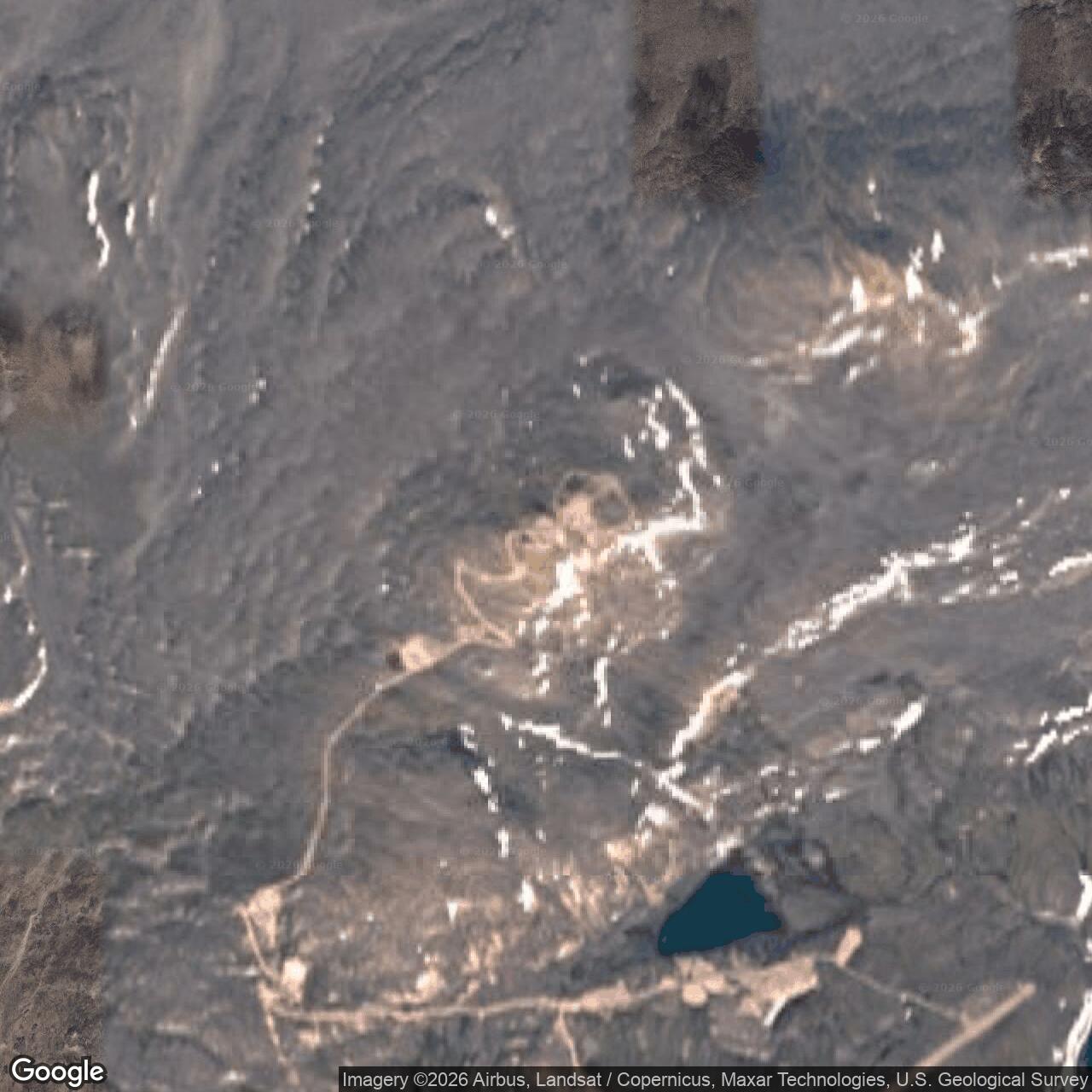
A compact Doppler watch post above Davis Strait, linked by radio to Cape Hooper and Broughton Island and by a steep road to its coastal landing strip.
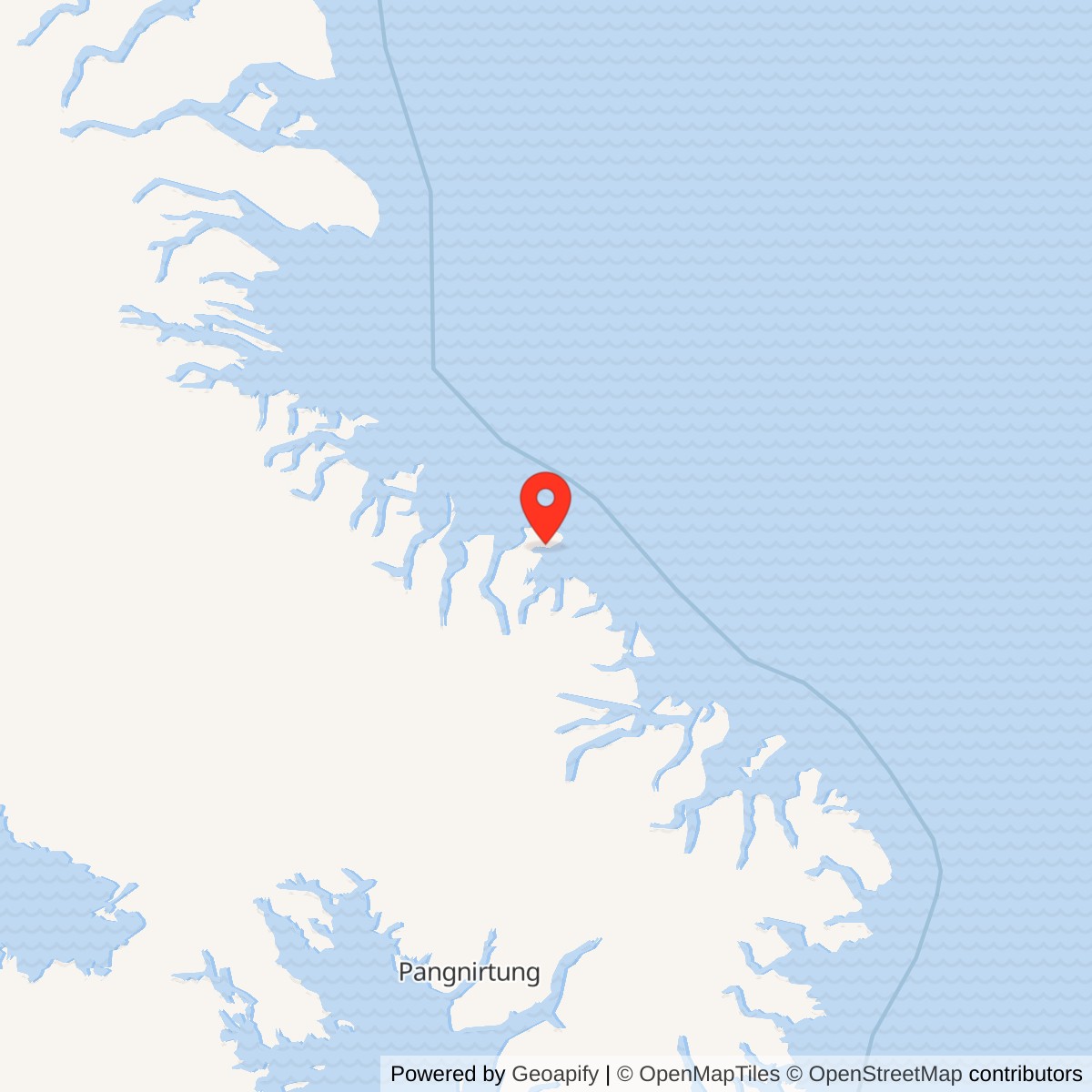
Longitude: -64.909917
Site Number: FOX-D
Current Role: Former DEW Line station; later site condition described in Canadian federal records.
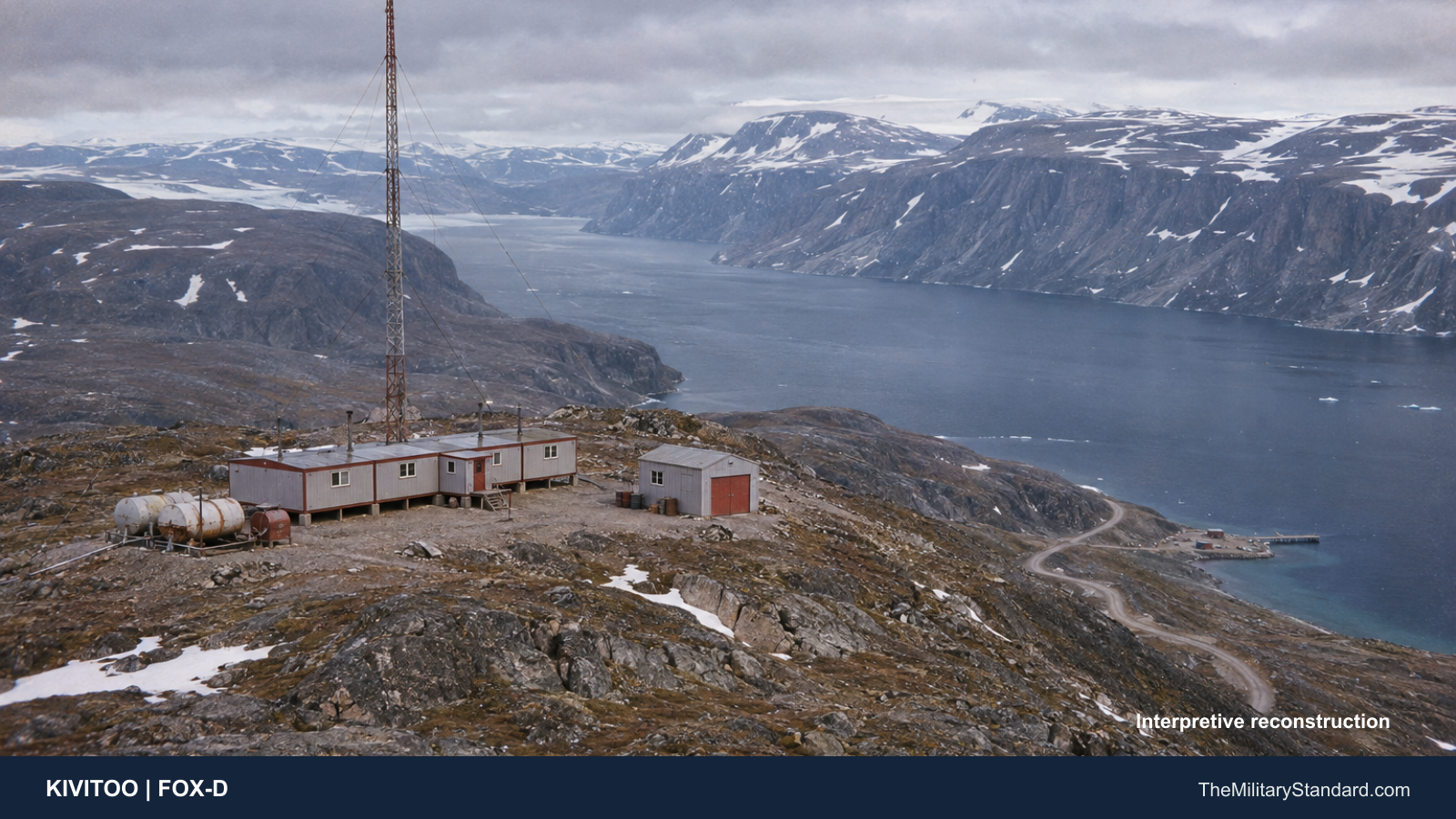
Kivitoo FOX-D was an intermediate Distant Early Warning Line station on the east coast of Baffin Island, in present-day Nunavut. From a rocky height above the abandoned settlement of Kivitoo, its crew watched a gap between Cape Hooper FOX-4 and Broughton Island FOX-5. The station carried AN/FPS-23 Doppler equipment for low-altitude aircraft warning. It was a smaller installation than the neighboring auxiliary stations and did not have their large rotating search-radar radomes. [1] [2] [3] [6]
- DEW Line code
- FOX-D
- Role
- Intermediate Doppler station
- Radar
- AN/FPS-23
- Operation
- August 1957 to 1963
- Location
- Above Kivitoo, eastern Baffin Island, Nunavut
A Watch Post Above Davis Strait
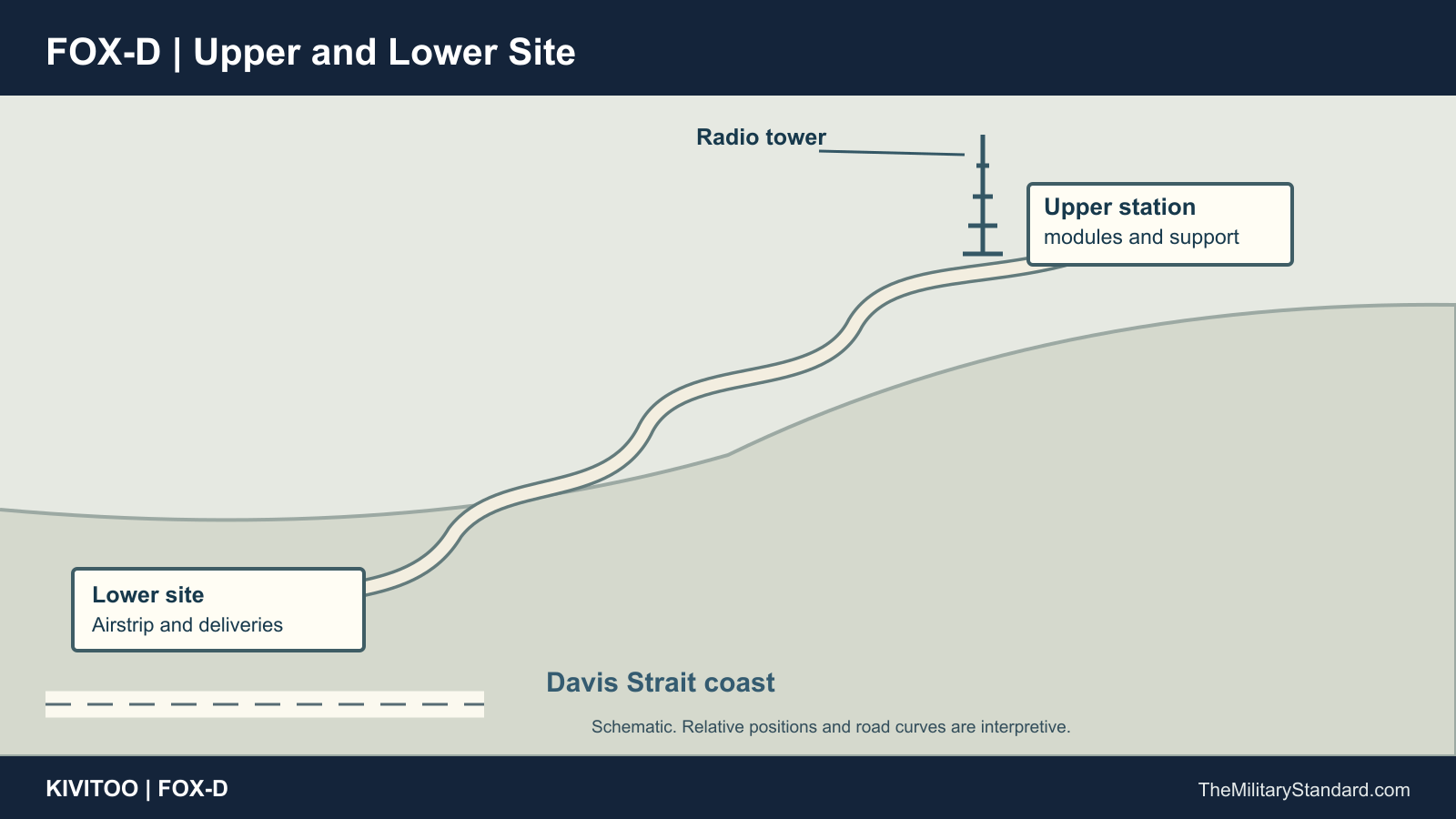
The station occupied two connected areas. The operating compound stood high above the coast, while the lower area provided an airstrip, landing and fuel facilities. A road of about five miles climbed from the shore to the summit. The elevated position served the warning and radio paths, but put the crew, equipment and access road directly in the way of Baffin Island weather. [3] [4]
Construction and Opening
The DEW Line building campaign brought prefabricated modules, fuel, radio equipment and heavy supplies to isolated Arctic coasts in the mid-1950s. At Kivitoo, the contractor developed a coastal landing and airstrip, then built the road to the upper site. The compact hilltop compound contained the joined operating and living modules, a garage, a warehouse, two large fuel tanks and a tall antenna tower. The lower station area supported aircraft and shore deliveries. [2] [3] [4]
A Canadian Marconi worker recalled being assigned to FOX-D in 1957. His account describes moving equipment and personnel between the shore and the hill in a Bombardier tracked vehicle. That journey was part of the station's daily reality: the radar watch was at the summit, but the arriving freight and aircraft were down by the coast. [3] [5]
Aerospace Defense Command recorded manual operation beginning in August 1957. FOX-D entered the operational chain that linked the eastern Arctic warning sites during the first summer of DEW Line service. [1] [2]
Radar and Communications
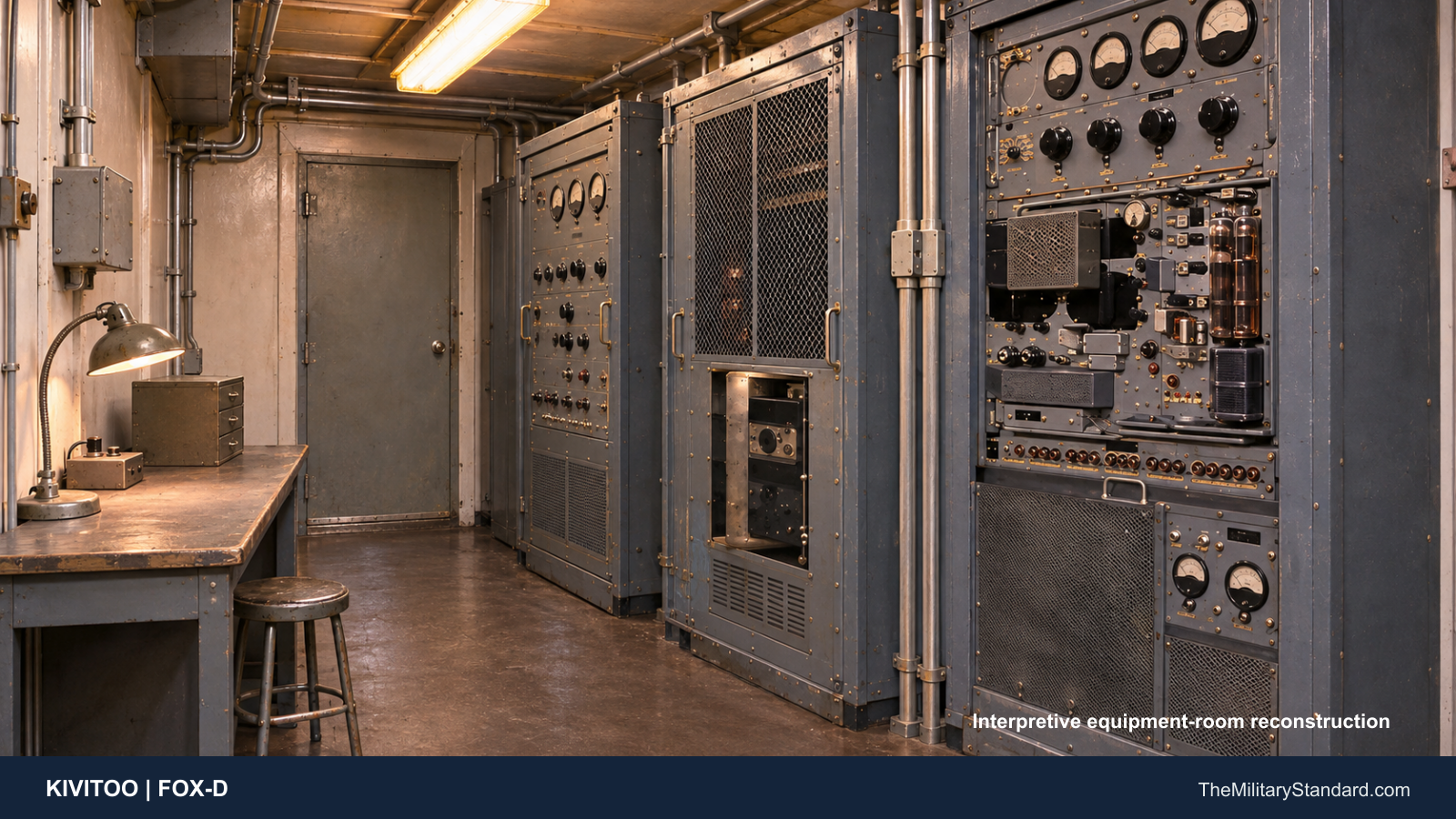
The AN/FPS-23 was a fixed-path Doppler warning system. Its transmitters and receivers monitored radio paths for changes caused by an aircraft crossing the beam. It supplied a warning where an aircraft flying low might pass beneath or between the coverage of the larger search radars. A reported alarm had to reach adjacent stations and the wider warning network so that operators could assess and relay it. [1] [2] [6]
FOX-D's antenna tower was central to that connection. Martin Allinson, who served at the station, described a roughly 100-foot tower used for the interstation radio link. One path reached Cape Hooper FOX-4 across difficult terrain; the other ran toward Broughton Island FOX-5 across water. On a clear night, crew members could see the lights of FOX-5 across the strait. Radio maintenance was therefore as essential to the warning mission as maintenance of the Doppler equipment itself. [3]
The equipment depended on diesel generation, a protected indoor operating space and stored fuel. Watch crews had to keep radar, communications, power and heat functioning together. The compact module train placed operating rooms close to sleeping and service spaces, while the garage and warehouse supported repairs and supplies. [2] [3] [4]
Working and Living at FOX-D
Kivitoo's crew lived at the upper station, separated from the landing strip by the steep access road. An emergency hut stood about halfway up the route. That refuge mattered when a vehicle trip was interrupted by weather or mechanical trouble. The route also meant that unloading an aircraft or a coastal delivery was only the first step in getting supplies to the operators. [3]
The airstrip could take a lightly loaded DC-3, according to Allinson's account. Heavy freight generally arrived by sealift or by airdrop onto the frozen fjord in winter. Fuel and other bulky stores had to be moved from the lower site to the hill. A small resident workforce had to handle both technical watches and the practical labor needed to keep a remote station supplied. [3] [4]
Weather could differ sharply between the summit and the strip. Fog at the lower landing area was not always visible from the hilltop, so weather observations were made at the runway. Wind, snow and icing also complicated road travel and outdoor maintenance. Life at FOX-D meant living in the same compact building group where the warning watch continued around the clock. [3] [4]
Inactivation and the Former Station
Aerospace Defense Command listed FOX-D as inactivated on July 21, 1963. Canadian federal accounts likewise place the end of the original station's operation in 1963. The short-lived post had served the first generation of the eastern DEW Line, connecting low-altitude warning and interstation communications between the larger auxiliary stations. [1] [4]
The upper module train later burned. The former station and its lower support area remained as physical traces of the original line, and the Canadian government subsequently addressed the abandoned facilities and materials. The hill road, coastal access and isolated summit setting still explain why this small watch post required such a substantial support system. [3] [4]
Chronology
- Mid-1950s Construction develops the lower landing area, hill road and upper station.
- 1957 Canadian Marconi personnel arrive at the station.
- August 1957 Manual AN/FPS-23 operation begins.
- July 21, 1963 Aerospace Defense Command records FOX-D as inactivated.
- After 1963 The former station enters its abandoned-site period; the upper module train is later destroyed by fire.
Related Sites
Information sources (6)
- PDF[1] Aerospace Defense Command, Historical Data, 1946-1973, DEW Line station table
Station code, AN/FPS-23 equipment, August 1957 manual operation and July 21, 1963 inactivation.
- PDF[2] U.S. Air Defense Command, A History of the DEW Line, 1946-1964
The DEW Line mission, intermediate stations, construction and operating arrangements.
- WEB[3] The DEWLine, Kivitoo FOX-D station account and photographs
Martin Allinson's firsthand account of the hilltop station, radio tower, road, airstrip, weather, aircraft and supply movements.
- PDF[4] Aboriginal Affairs and Northern Development Canada, The Big Picture: Contaminated Sites in Nunavut, FOX-D profile
Federal description of the upper station, lower support area, 1957 to 1963 operation and later site condition.
- WEB[5] The DEWLine, War Stories 3
Canadian Marconi staff recollection of assignment to FOX-D in 1957 and vehicle travel between the shore and the hill.
- WEB[6] The DEWLine, A Brief Introduction
Explains the main, auxiliary and intermediate station roles and the original DEW Line design.