Nellis Air Force Base, Nevada
Longitude: -115.0343
Origin of current name: Named in honor of 1st Lt William Harris Nellis (1916-1944). Lieutenant Nellis was killed on 27 Dec 1944, during his 70th mission, while flying his P-47 on a ground support mission near Bastogne, Belgium.
Date current name was assigned to base: 30 Apr 1950
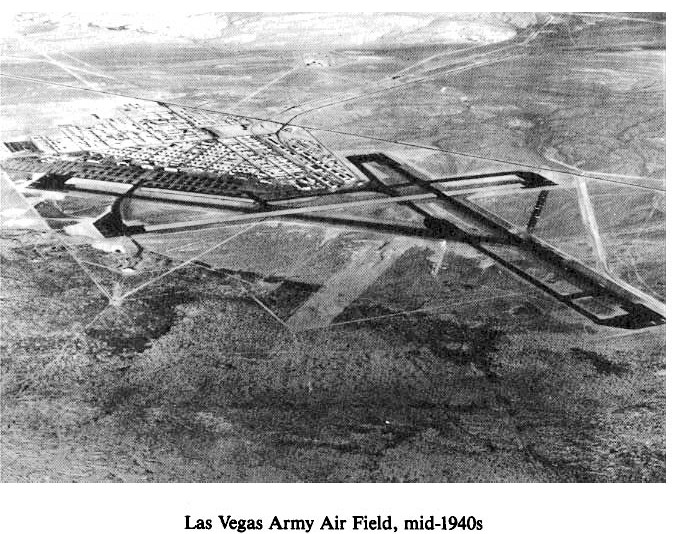
Previous Names: Las Vegas Air Field, 15 Sep 1941; Las Vegas Army Gunnery School, 1942; Las Vegas Army Air Field, 8 Apr 1943; Las Vegas Air Force Base, 13 Jan 1948
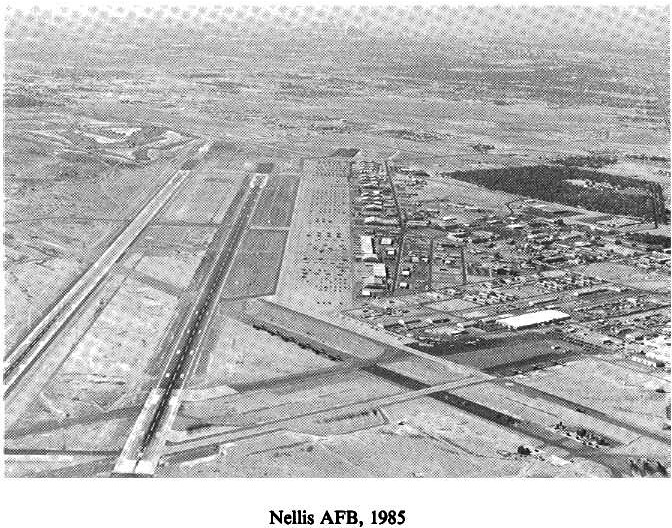
Changes in Capability: Trained AAF gunners 1941-1945; additional buildings, range facilities, housing, and 50-bed hospital added to field's basic structures mid-1941,; the installation had a training and housing capacity for 800 students by 7 Dec 1941; B-29 gunnery training during Mar-May 1945; additional construction for USAF Aircraft Gunnery School (later, USAF Fighter Weapons School) completed May 1950; Wherry housing project constructed 1951 and 1954 (acquired from contractor 1958); expansion of runways and taxiway, construction of additional hangars late 1954; base hosted Thunderbird aerobatic team upon its move from Luke AFB 1 Jun 1956; Capehart housing project completed 12 Feb 1960; Nellis land area (over 3 million acres) exceeded that of any other USAF base by 1962; major rehabilitation project of concrete operational areas 1964-1966, medical facility dedicated 22 May 1965 (supplemented by an addition in mid-1971); USAF Tactical Fighter Weapons Center organized 1 Sep 1966; airman dormitory project completed mid-1970; 300-unit family housing unit completed mid-1971; Red Flag exercises, providing realistic combat crew training, began late 1975, brought about construction of dormitories and other facilities for rotationally-deployed units at the base.
Major Changes in Status: Caretaker status, 28 Aug 1946; inactivated, 31 Dec 1946; subbase of Mather Fld, CA, 30 Aug 1947-31 Mar 1948; activated, 1 Apr 1948; subbase of Williams AAFld, AZ, 1 Apr 1948-1 Oct 1950.
Official Base Website: nellis.af.mil
Mission
Nellis Air Force Base provides advanced combat training for composite strike forces, which includes every type of aircraft in the Air Force inventory. Training is commonly conducted in conjunction with air and grounds units of the Army, Navy, Marine Corps and allied forces from throughout the world. Nellis also conducts operational testing and develops tactics. The base also supports combat search and rescue and remotely piloted aircraft operations worldwide.
Overview
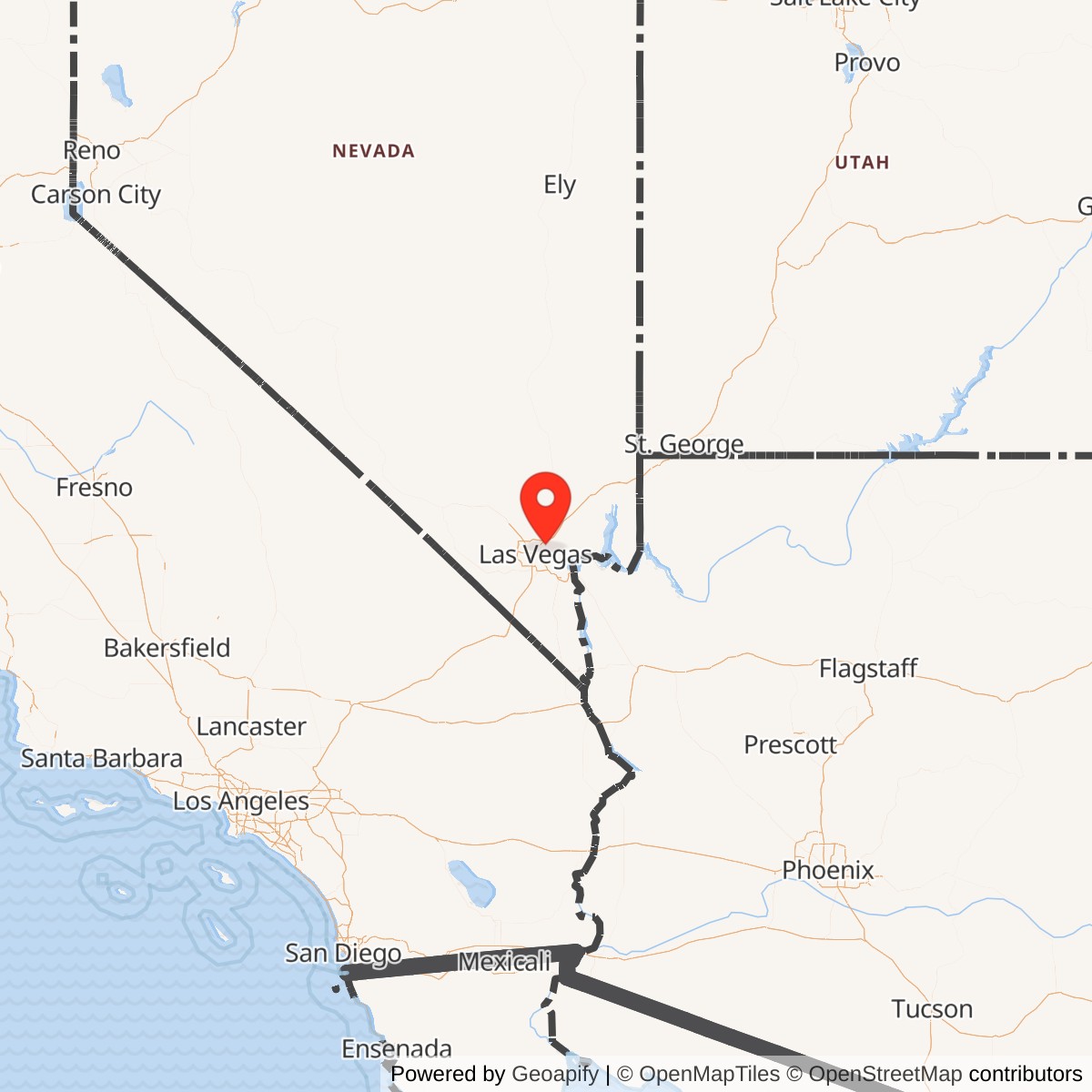
Nellis, an integral part of the United States Air Force's Air Combat Command, is known as the Home of the Fighter Pilot. It is the pinnacle of advanced air combat aviation training. The base's all-encompassing mission is accomplished through an array of aircraft: A-10; F-15C; F-15E; F-22A; F-16; RQ-1A and MQ-1 Predator remotely piloted aircraft; and HH-60G helicopters. Nellis' work force of approximately 12,000 military and civilian people makes it one of the largest single employers in southern Nevada.The base is located approximately eight miles northeast of downtown Las Vegas and covers more than 14,000 acres, while the total land area occupied by Nellis and the restricted Nevada Test and Training Range is more than 4,800 square miles. An additional 10,000 square miles of airspace north and east of the restricted range are also available for military flight operations.
Nellis Area I
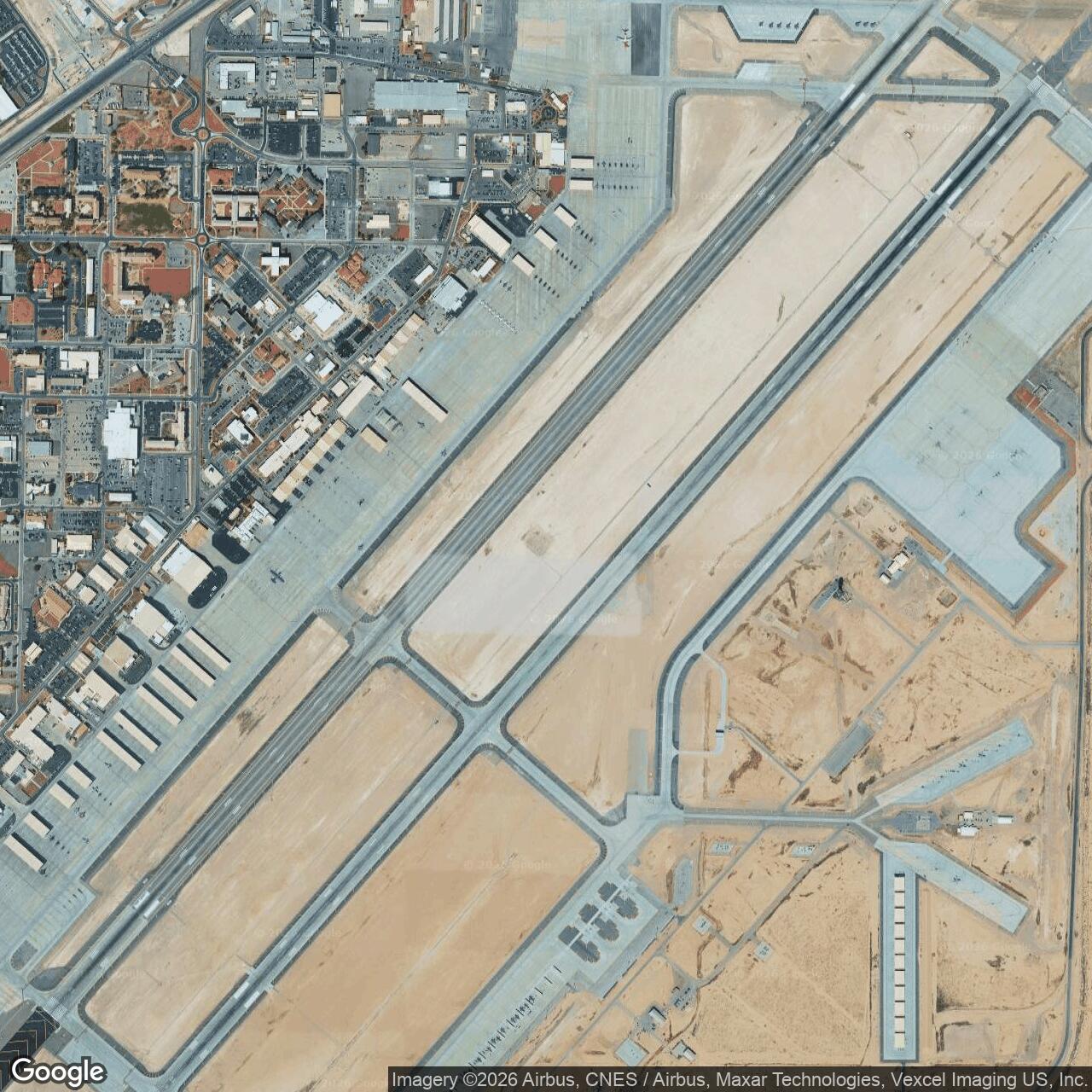
Nellis' primary operations are located east of Las Vegas Blvd. Area I consists of industrial and administration facilities, two runways with ramp space for up to 300 aircraft, recreation and shopping facilities, single housing and some family housing.
Nellis Area II
Nellis' Area II is located at the northeast edge of the main base. It is home to the 820th RED HORSE Squadron, 896th Munitions Squadron and the largest above ground weapons storage complex in the United States.
Nellis Area III
Nellis' Area III is located west of the main base. More family housing, administration and industrial areas are located here, as well as the Mike O'Callaghan Federal Hospital.
Nevada Test Site
The Department of Energy installation is located in Nye County, approximately 65 miles northwest of Las Vegas with support and administrative headquarters at Mercury, Nev. The installation is operated by the DOE, Nevada Operations Office in North Las Vegas, which is charged with the management of all the nation's nuclear weapon programs.The NTS covers approximately 1,350 square miles. It includes Yucca and Frenchman Flats, Paiute and Rainer Mesas and the former Camp Desert Rock area, which was used by the Sixth Army in the 1950s to house troops participating in atmospheric tests at the test site. Yucca Flat, a valley roughly 10 miles wide by 20 miles long, and Paiute Mesa, a rugged 7,500-foot-high area of 166 square miles at the northwest corner of the site, were the main underground test areas.
Frenchman Flat is the first dry lake basin north of the hills beyond Mercury. It was used for all blasts in the Nevada test series in 1951, but since then has been used primarily for DOE weapons development tests and Department of Defense military effects tests.
Approximately 5,000 people are employed at the NTS, including 50 military, with an additional 2,000 people in test site-related employment in Las Vegas. The Department of Energy also operates the Remote Sensing Laboratory on Nellis AFB.
History
A Western Air Express dirt runway, a water well and a small operations shack eight miles north of Las Vegas was the setting of the original site of today's Nellis Air Force Base.In October 1940, Maj. David Schlatter, of the U.S. Army Air Corps, surveyed several areas in Utah, Arizona and Nevada looking for a site to locate the first American flexible aerial gunnery school. Major Schlatter was particularly interested in the Nevada site since about 90 percent of the area north, northwest and northeast of Las Vegas was desert wasteland. On Jan. 25, 1941, Las Vegas Mayor John L. Russell signed over the property to the U.S. Army Quartermaster Corps for the development of the flexible gunnery school. The mission of the new school, the Las Vegas Army Air Corps Gunnery School (located on the new Las Vegas Army Air Field), was defined as "training of aerial gunners to the degree of proficiency that will qualify them for combat duty."
A detachment of five officers took up residence in a small basement post office in the Las Vegas federal building in May 1941.They were staff officers of the 79th Air Base Group, commanded by Lt. Col. Martinus Stenseth. A month later, the military population of LVAAF more than doubled with the arrival of five administrative non-commissioned officers and other support personnel. During those first few months, there were no services or facilities at the new base. Enlisted men were quartered in the Work Project Administration barracks in town. Its initial motor pool consisted of six vintage trucks and a semi-trailer often found parked by the barracks. Supply and logistics had not yet been organized, and mechanics had to borrow nuts, bolts and old parts from service stations in Las Vegas. Gasoline and oil were borrowed from the Civilian Conservation Corps.
The reasons were many for locating the school near the town of Las Vegas, which had a population of 9,000: flying weather was ideal year-round; more than 90 percent of the area to the north was unpopulated public domain and available at $1 per acre; the inland strategic location was excellent; rocky hills, approximately six miles from the base afforded a natural backdrop for cannon and machine-gun firing; and dry lake beds were available for emergency landings.
Construction of permanent base facilities began in earnest in mid-1941 for barracks to house 3,000 people. By December 1941, there were 10 AT-6 Texan trainers and 17 B-10 Martin bombers.
From this humble beginning, LVAAF grew rapidly. The first B-17s arrived in 1942, giving students their first chance to train in the gun turret of an actual combat plane and providing aircraft to train co-pilots in ground and transition school. At the height of World War II, 600 gunnery students and 215 co-pilots graduated from LVAAF every five weeks.
In March 1945, the base converted from B-17s to the B-29 Gunnery School. The base population peaked in early 1945 with nearly 11,000 officers and enlisted people logged on unit morning reports. Of these, more than 4,700 were students.
As World War II ended, the base converted to the role of separating military men and women from the service. During 1945 and 1946, thousands of soldiers received their separation physicals and final pay at LVAAF on their return to civilian life.
Activities at LVAAF continued to wind down until Jan. 31, 1947, when it was inactivated. In 1948, the base was reactivated as Las Vegas Air Force Base and hosted a pilot training wing. With the onset of the Korean War, the mission of LVAFB changed from an advanced single-engine school to one of training jet fighter pilots for the then Far East Air Forces.
In 1950, LVAFB was renamed in honor of 1st Lt. William Harrell Nellis, the young man from southern Nevada killed-in-action over Luxembourg Dec. 27, 1944. Virtually every fighter pilot and every ace who staked claim to a corner of Korean air space called "MiG Alley", establishing a kill ratio of 14 to 1, received final combat training at Nellis.