
Davis Air Force Base, Alaska
From the Army's wartime airfield to all-weather fighters, the 1950 Navy transfer and civilian airport reuse.
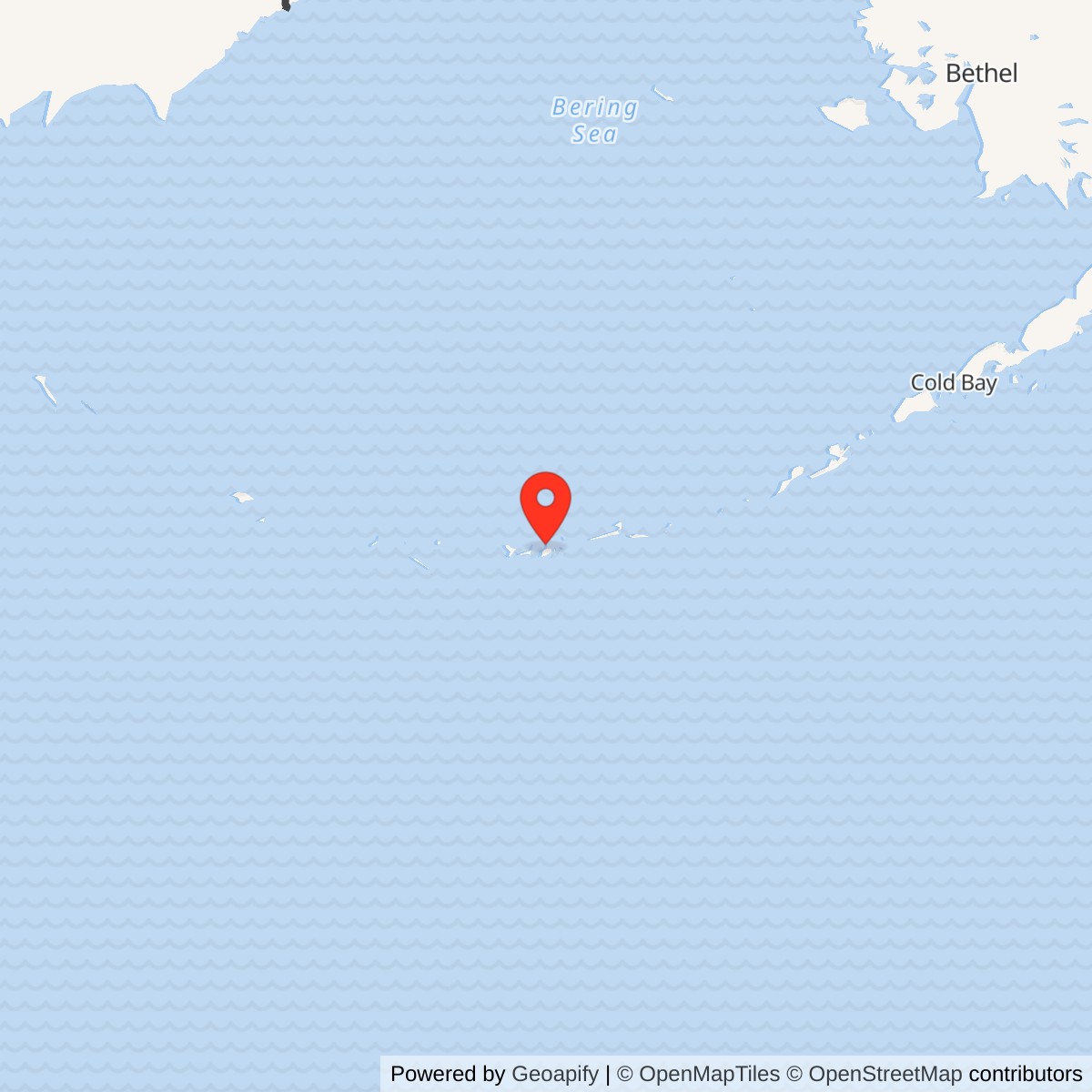
Longitude: -176.6425
Official Base Website: Adak Airport / former Naval Air Facility Adak
Current Role: Former Davis Air Force Base airfield became part of Naval Air Facility Adak; Adak Airport now uses the airfield.
- Installation
- Davis Air Force Base at Adak; predecessor Army field and later Navy base share the airfield landscape
- Air Force period
- 1947-1950 service phase; Navy transfer July 1, 1950
- Principal fighter units
- 415th Night Fighter Squadron, May-September 1947; 449th Fighter Squadron, September 1947-March 1949
- Primary fighter equipment
- Northrop P-61 Black Widow; North American F-82 Twin Mustang transition
- Later aircraft location
- 449th transferred to Ladd Air Force Base on March 28, 1949
- Namesake
- Colonel Everett S. Davis; Air Force historian dates field naming to January 4, 1945
- Historic facilities
- Crossing runways, hangars, camps, maintenance, supply and nearby Sweeper Cove depot/harbor
- Property area
- Davis-only acreage unresolved; later Navy reservation and NHL areas have different scopes
- Present airfield
- Adak Airport, ADK / PADK; runway 05-23 active, former north-south strip closed in late-2026 FAA diagram
- Location
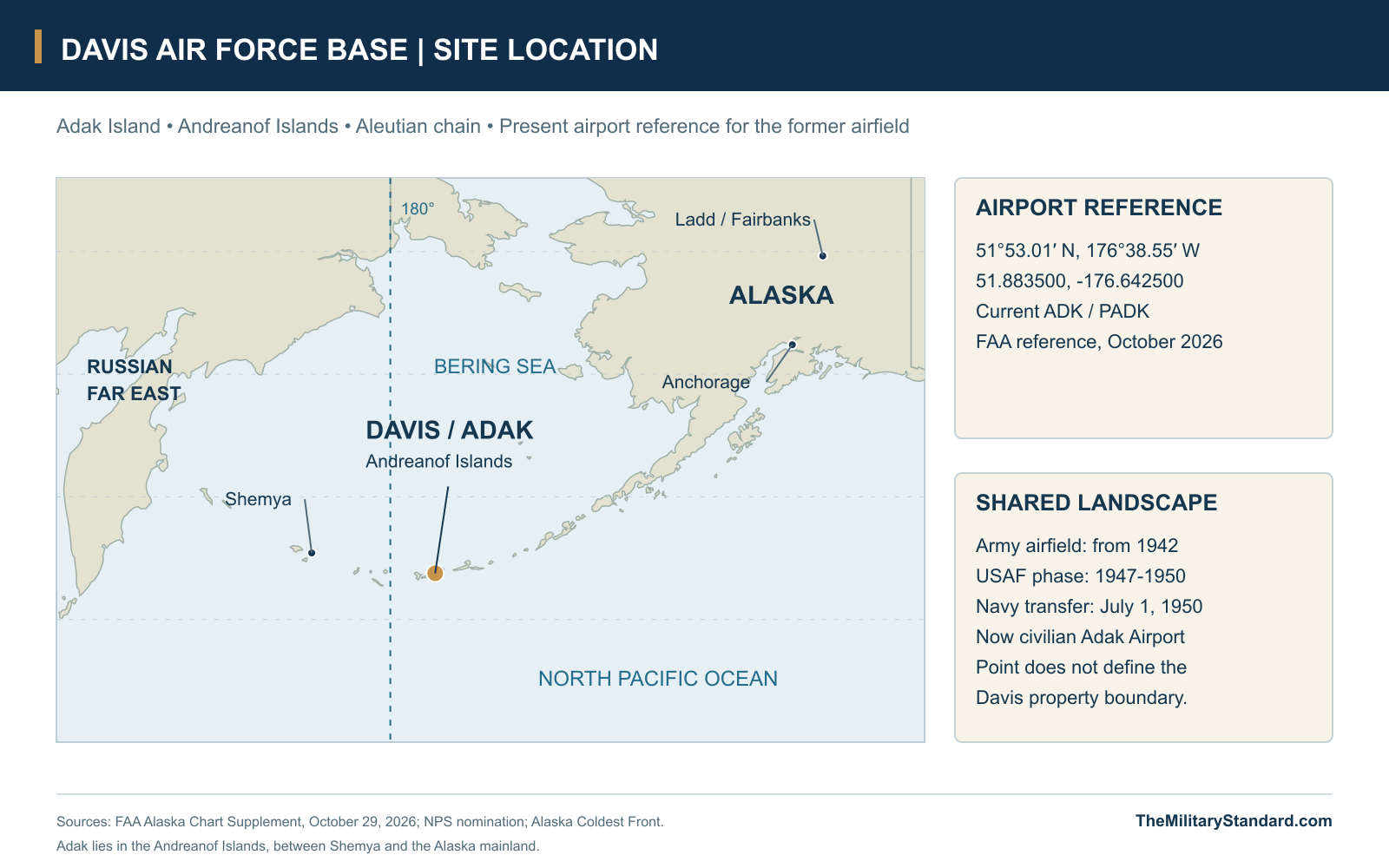
- Northeastern Adak Island, Andreanof Islands, Aleutians West Census Area, Alaska
An Air Force Base Between Two Eras
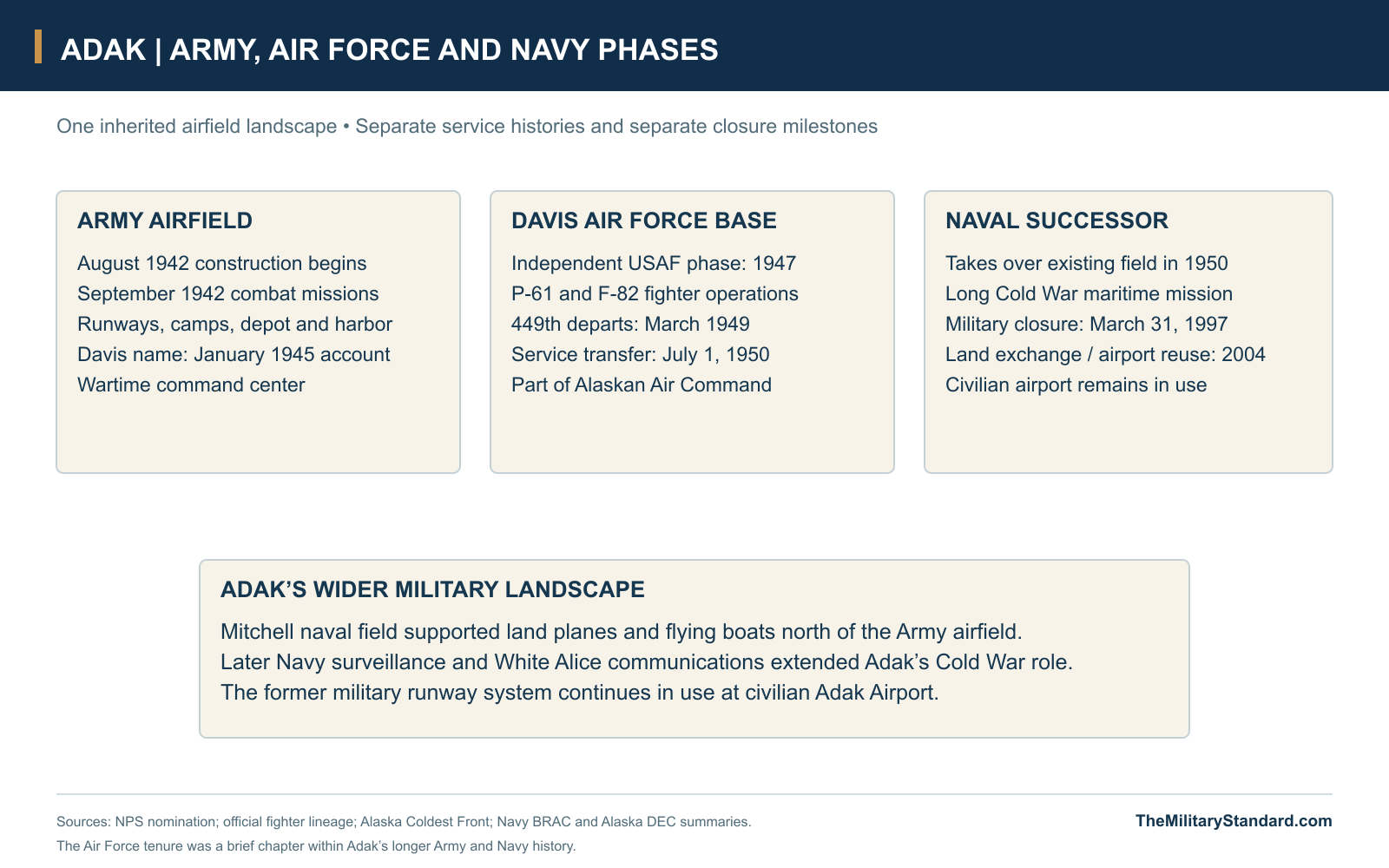
Davis Air Force Base was the brief postwar Air Force phase of the principal military airfield on Adak Island. The Army had built the field during the Aleutian campaign in 1942; the new United States Air Force inherited it after the war and used it for an all-weather fighter mission. The Navy assumed the installation on July 1, 1950. Davis therefore belongs to a longer Adak military landscape, but its Air Force period should be distinguished from both the wartime Army base and the much longer naval establishment that followed. [1] [3] [4] [5]
The field lies on the northeastern side of Adak, one of the Andreanof Islands, where relatively level ground, Kuluk Bay and Sweeper Cove brought an airfield and sea supply route close together. Mountains, wetlands, strong winds and frequent poor visibility shaped construction and flying from the beginning. The location reference used here is the present FAA Adak Airport point, 51.883500 degrees north, 176.642500 degrees west. It identifies the inherited airfield landscape rather than a surveyed Davis-era boundary or headquarters building. [1] [10] [11]
Adak's history extends beyond the military occupation. Archaeological evidence and the wider Unangaxé history of the Aleutians predate the wartime installations, and the island's refuge status also preceded the base. Military development transformed tidal flats, hillsides and shorelines into a network of runways, camps, depots and communications sites. Those changes created the infrastructure inherited by Davis, while leaving a much broader landscape than the small portion needed to park and launch its postwar fighters. [1] [2] [15]
Building the Adak Airfield
Japanese attacks on Dutch Harbor and occupation of Attu and Kiska in June 1942 exposed the difficulty of conducting an air campaign from bases far to the east. Adak offered a forward position from which bombers could reach Kiska with fighter support, together with a sheltered anchorage valuable to the Navy. American forces landed on August 30, 1942, and the 807th Engineer Aviation Battalion began turning a tidal basin into an airfield. A dike and drainage system controlled the water so the underlying surface could support aircraft. [1] [2] [10]
Engineers created a usable strip while the rest of the base was still emerging from tents, temporary roads and improvised services. On September 14, bombers and fighters operating from Adak attacked Kiska, establishing the new field's immediate value to the campaign. Construction continued after that first operational milestone. A more durable Runway A was built beside the initial strip, and the crossing Runway B followed; steel matting, subsequent paving and repeated improvements changed both the surfaces and their usable dimensions over time. [1] [2]
Adak soon developed into more than a launch point for raids. Maintenance, supply and transport work supported the movement of the campaign toward Amchitka, Attu and Shemya, while the island served as a staging and anchorage area for larger operations. Its reserve depot and waterfront facilities could hold and move the materials needed by forces operating farther west. The result was a substantial logistical base whose runway, shops and harbor connections remained useful after the immediate combat front had moved away. [1] [2] [18]
The Airfield, Camps and Harbor
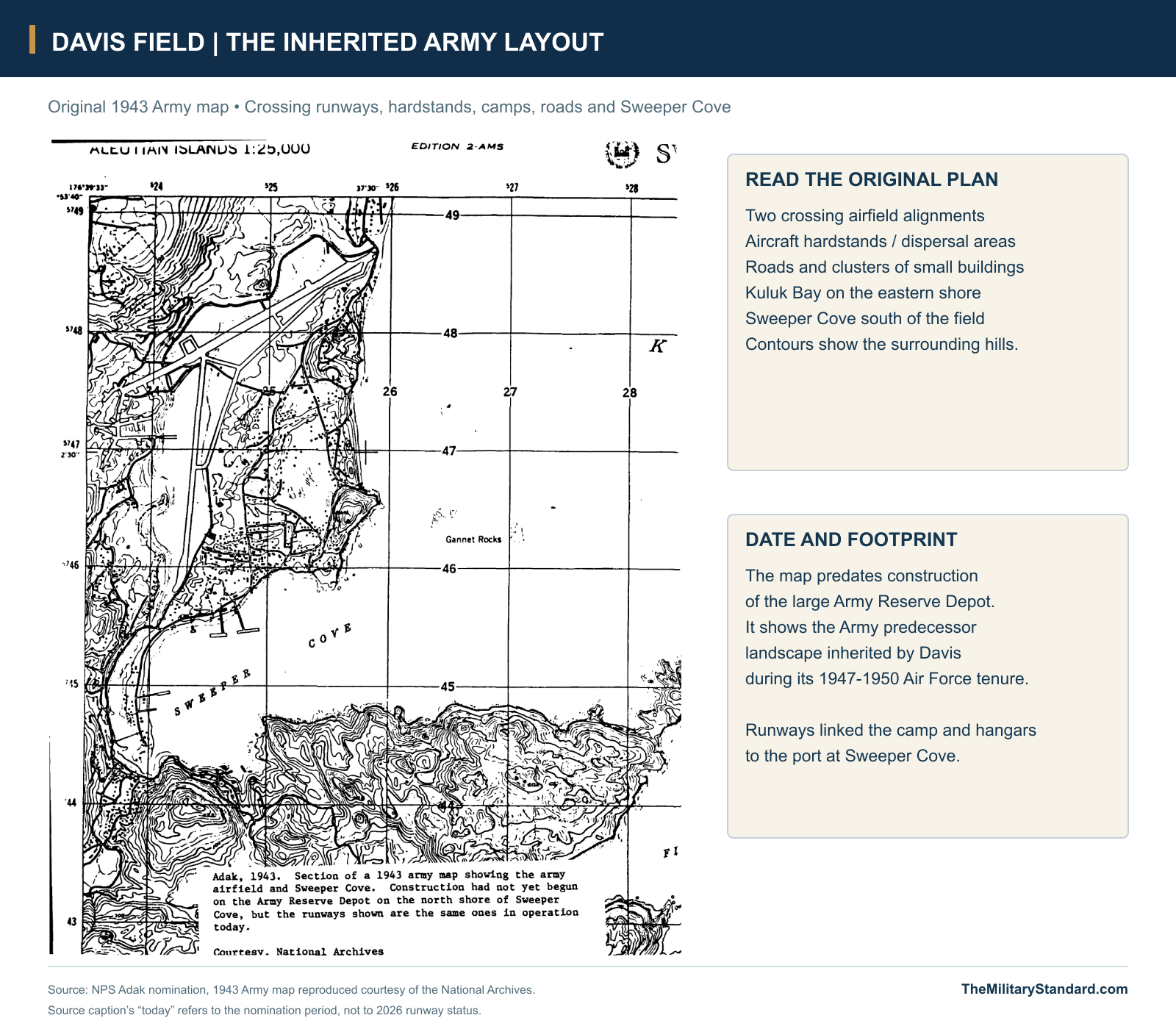
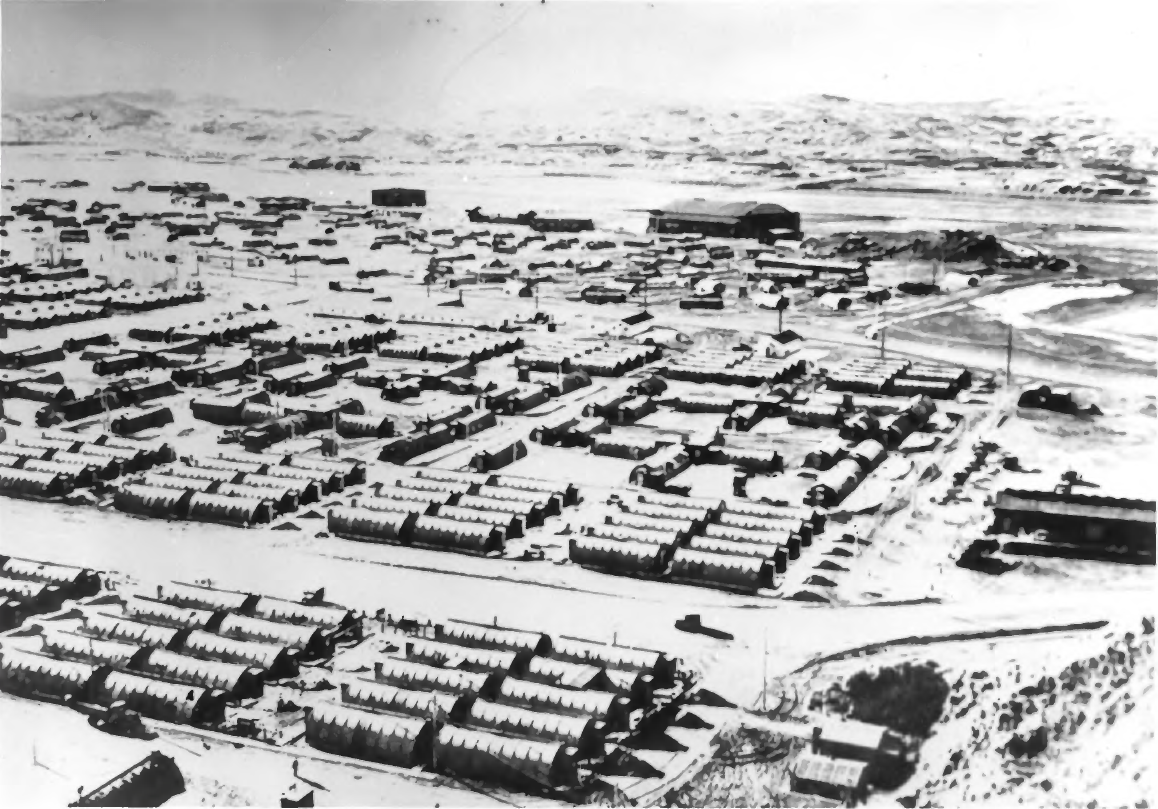
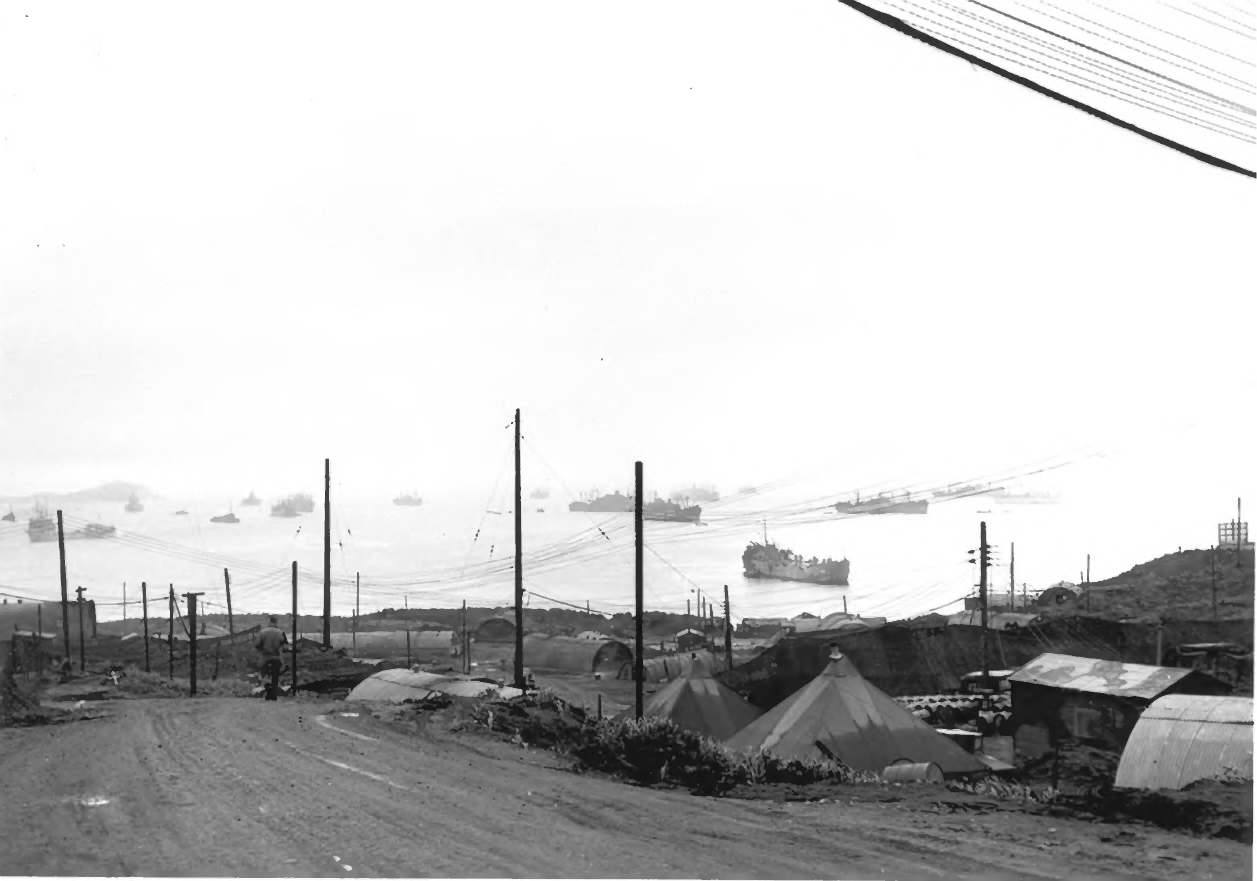
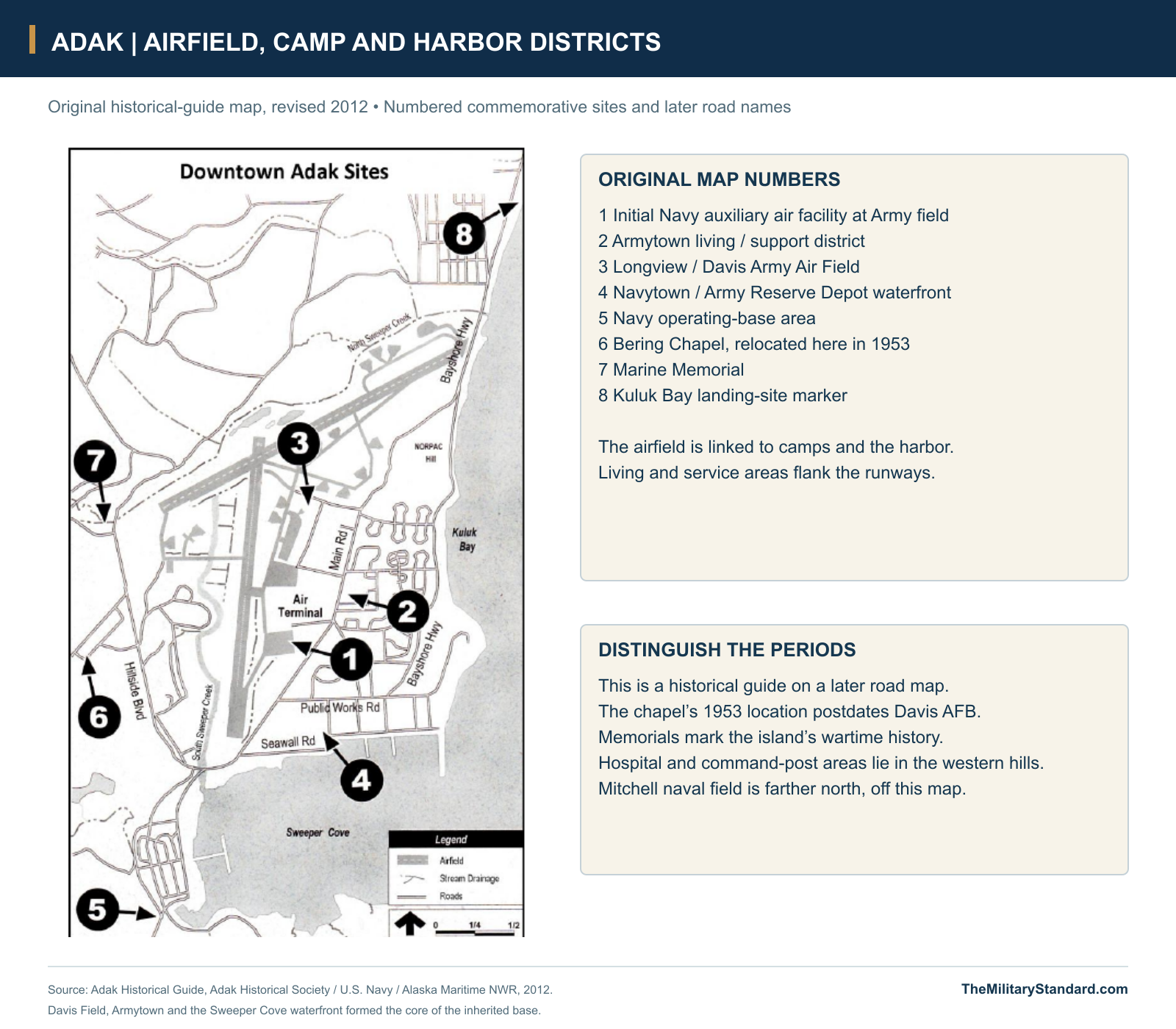
The inherited Army airfield stood in the main developed area between Kuluk Bay and Sweeper Cove. Runways, taxiways, aircraft hardstands and hangars occupied the flattest ground; quarters and support buildings spread along roads and into adjoining terrain. Armytown's rows of huts housed the workforce needed to operate and enlarge the installation. A wartime map and the 1943 encampment photograph show this relationship clearly, although neither records every later alteration made during the Davis Air Force period. [1] [2] [13]
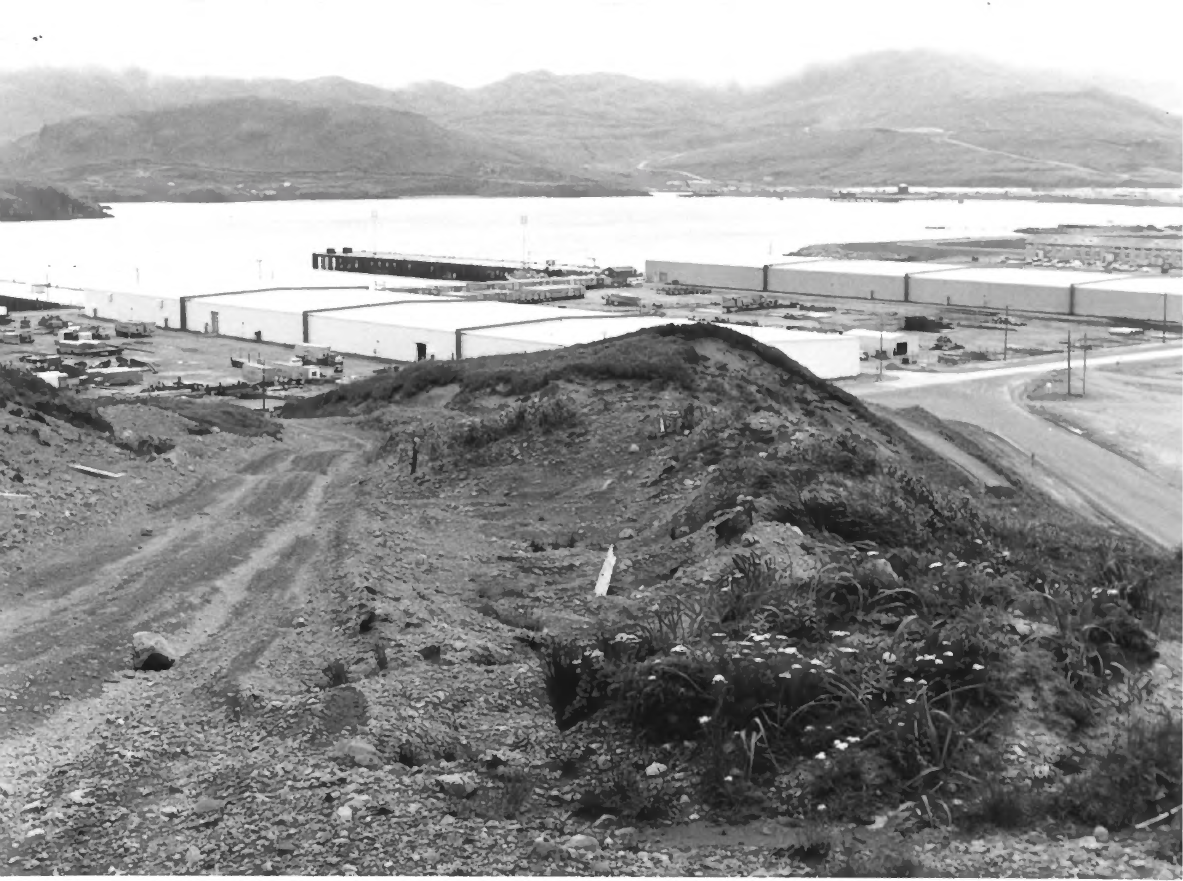
The sea supply system lay immediately south of the airfield. At Sweeper Cove the Army Reserve Depot included immense transit warehouses, piers and a breakwater, linking arriving ships to the island's stores and operating units. The three major warehouses were built for a much larger wartime contingency than Davis's later fighter mission. Their continued use and adaptation illustrate how the postwar establishment could draw on infrastructure already in place rather than constructing an entirely new base for a short Air Force tenure. [1] [13]
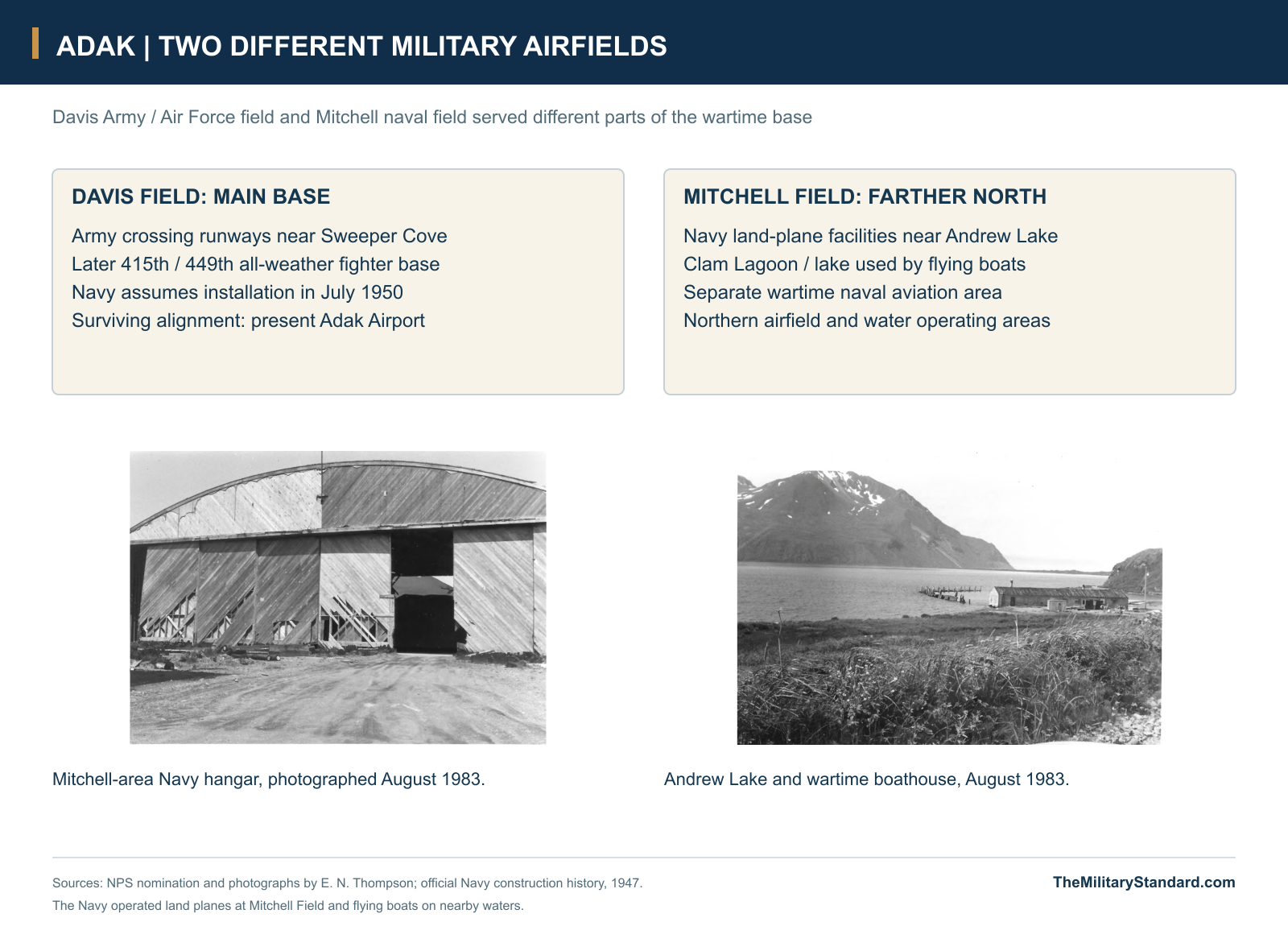
The Navy's original Adak air station was a different airfield farther north, around Andrew Lake and Clam Lagoon. It included land runways at Albert E. Mitchell Field and water operating areas for flying boats, together with hangars and naval support facilities. Early Navy aircraft had also used facilities beside the Army field before moving north. These locations explain why a photograph labeled Adak Naval Air Station does not necessarily depict Davis Field, and why the Navy's 1950 takeover was a consolidation of facilities on an island where both services had already worked. [1] [2] [18]
Davis's Name and the Postwar Command
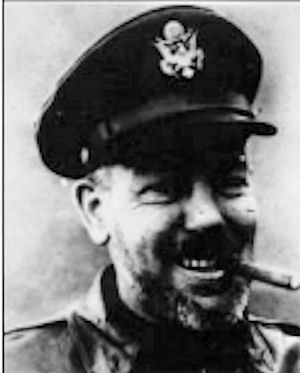
The airfield's name honored Colonel Everett S. Davis, an early commander and later chief of staff of the air organization that became Eleventh Air Force. His transport disappeared on November 28, 1942, while flying from Naknek toward Elmendorf in severe weather; the wreckage was found near Lake Iliamna the following year. The 3rd Wing historian dates the naming of Adak's airfield in his honor to January 4, 1945. The commemorative name thus preceded the independent Air Force and survived successive changes in the installation's control. [8]
Eleventh Air Force headquarters moved to Adak in August 1943, making the island a command center as well as an operating and supply base. In December 1945 the wartime command was redesignated Alaskan Air Command as the military reduced its forces and reorganized for peacetime responsibilities. Headquarters returned to Elmendorf on October 1, 1946. That move did not immediately end Adak's flying mission, but it placed the principal air command nearer the mainland installations that would become increasingly important in the emerging defense of Alaska. [4] [9]
Davis's Air Force operating phase is generally dated from the 1947 service transition through the Navy transfer in 1950. During those years it remained a real installation, with aircraft, maintenance and base administration, rather than merely an old name attached to an abandoned runway. Permanent construction in 1947-48 improved parts of the inherited plant even as wider defense planning began to favor mainland bases. The tension between investment in existing facilities and a changing strategic requirement helps explain the short life of Davis as an Air Force base. [3] [4] [5] [19]
Black Widows and Twin Mustangs
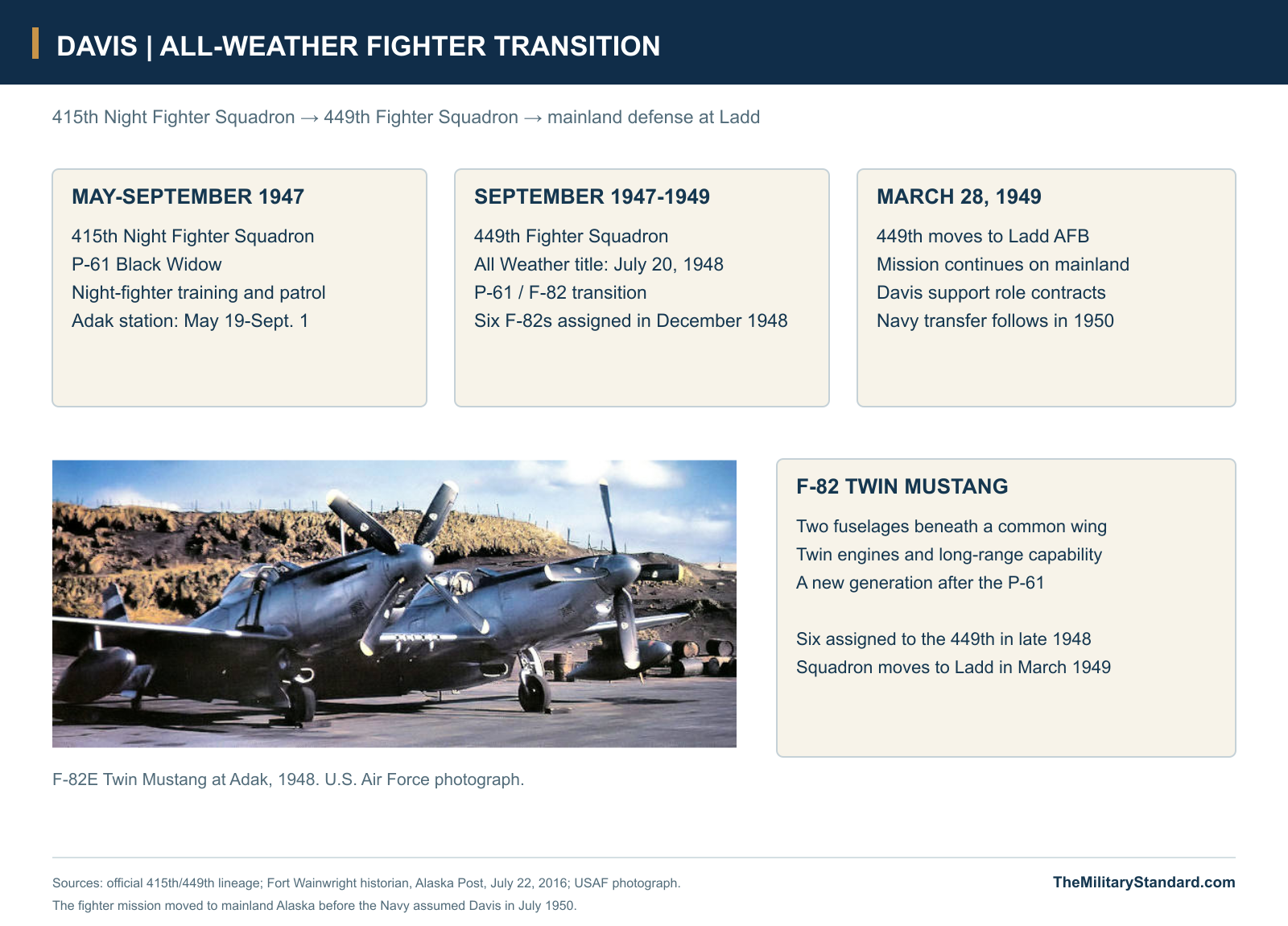
The 415th Night Fighter Squadron brought the P-61 Black Widow to Adak in May 1947. Its official station record runs from May 19 to September 1, when the squadron inactivated. The aircraft embodied a different requirement from the wartime bombing offensive: a crew needed to find and intercept aircraft when darkness or weather made visual search inadequate. Radar, instrument flying, navigation and coordination between the pilot and other crew members were central to maintaining a useful night-fighter capability in the Aleutian environment. [5] [6] [10]
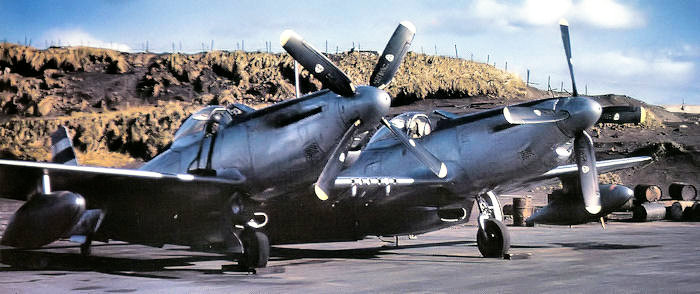
The 449th Fighter Squadron activated at Adak on September 1, 1947, continuing the local fighter mission after the 415th's inactivation. It belonged to Alaskan Air Command and was redesignated the 449th Fighter Squadron, All Weather, on July 20, 1948. Its official aircraft chronology includes P-61s from 1947 to 1949 and F-82 Twin Mustangs beginning in 1948. These dates describe a transition rather than an instantaneous replacement of every aircraft on the flight line. [5]
The Twin Mustang joined two fuselages under a common wing and provided a long-range, twin-engine platform for the all-weather mission. A Fort Wainwright installation historian records six F-82s assigned to the 449th at Davis in December 1948, shortly before the unit's move to Ladd. A surviving Air Force photograph shows an F-82E at Adak in 1948. The squadron's operational all-weather aircraft are associated with the F-82H. Together, the unit record and period photograph illustrate the arrival of a new generation of fighters as the P-61 era drew to a close. [5] [7] [21]
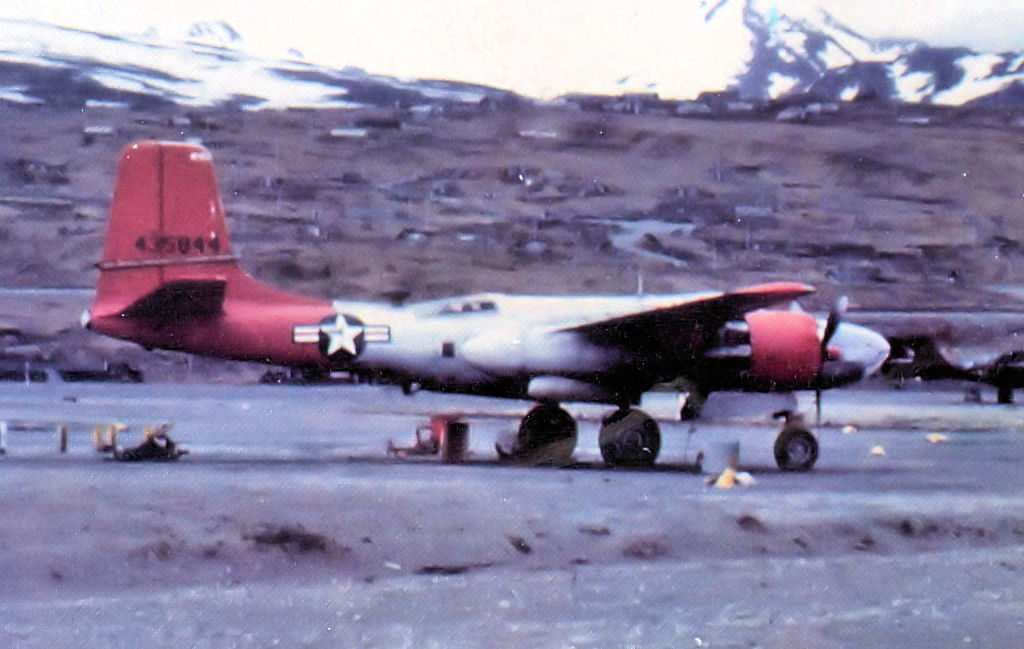
Davis also handled aircraft beyond the permanent fighter unit. A federal photograph identifies a B-26C Invader at the base in 1948, showing another Air Force type on the Adak flight line. Transient and support flying required the same runway services, weather information, navigation aids, fuel and maintenance coordination that sustained the fighters. The airfield's usefulness therefore exceeded the number of combat aircraft permanently stationed there at any one moment. [10] [22]
Maintaining an Isolated Air Base
A serviceable fighter on Adak depended on work that was much less conspicuous than a patrol or interception. Engines, airframes, radar equipment, radios and instruments needed attention, while stores, power, heating and transport kept the flight-line organization functioning. Wind, damp, salt exposure and rapidly changing visibility complicated tasks that would have been easier at a sheltered mainland field. The inherited hangars and workshops were important because maintenance had to continue when conditions limited flying or delayed the arrival of replacement parts. [2] [6] [10]
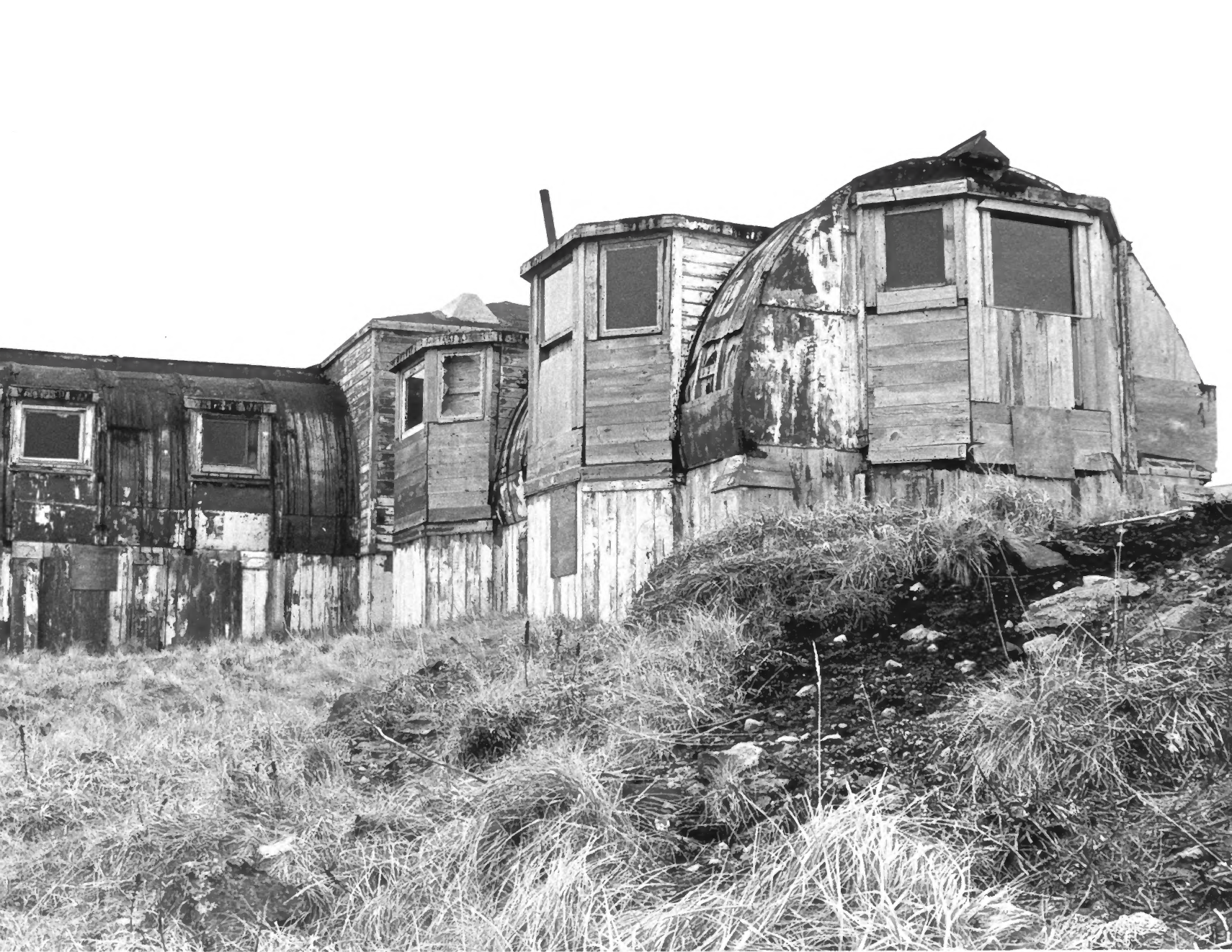
The base's physical arrangements reflected both wartime haste and the attempt to improve postwar living conditions. Dispersed huts, temporary construction, hillside support areas and the waterfront supply system survived alongside new permanent facilities. The Corps of Engineers records permanent work during 1947 and 1948, but later naval housing and community buildings should not all be attributed to that Air Force construction program. Photographs of the former Army hospital area and depot show the scale and variety of the earlier plant that the smaller postwar establishment inherited. [1] [3] [13]
Administration accompanied the flying mission. The December 1948 Judge Advocate Journal lists Davis AFB at Adak among the Alaskan installations receiving legal support and discusses the assignment of personnel to the post. That contemporary record is a reminder that Davis required the ordinary machinery of an operating base: personnel administration, military law, supply accountability and coordination with its parent command. The 1950 census metadata likewise identifies Davis Air Force Base as its own enumeration district, distinct from the Navy installation elsewhere on Adak. [14] [19]
Withdrawal and the Navy Transfer
By the late 1940s, the Air Force's view of Alaska's strategic geography had changed. The wartime offensive had progressed westward through the Aleutians toward Japanese territory; concern about Soviet bomber routes instead drew attention toward northern and interior Alaska. Maintaining a remote fighter base at Adak competed with the needs of Ladd, Elmendorf and the developing mainland air-defense system. Budget and personnel pressures reinforced the move to concentrate forces where they could better serve that new requirement. [3] [4]
The 449th's official station record places its move from Adak to Ladd Air Force Base on March 28, 1949. The transfer took the continuing all-weather fighter mission to Fairbanks rather than ending the squadron or discarding its aircraft. Davis then moved toward a reduced support and transfer role, with the airfield and its facilities still available as assets. The departure of the fighter squadron and the later change in the installation's service ownership were separate stages in this contraction. [3] [5] [7]
On July 1, 1950, the installation passed to the Navy. This ended Davis's short period as an Air Force base but preserved the airfield within an enduring North Pacific naval station. Navy patrol aviation, maritime surveillance and support requirements gave Adak a role that its location could continue to serve even after mainland bases became preferable for much of Alaska's fighter defense. The later Navy closure in 1997 is consequently a different event from the end of the Davis Air Force phase in 1950. [3] [4] [15]
Role in the Wider Military Network
Davis's clearest postwar operational connection was with Ladd. The same 449th unit that flew from Adak continued its mission at the Fairbanks base, carrying personnel, experience and the transition to newer all-weather fighters into the mainland defense system. Elmendorf had already become Alaskan Air Command's headquarters in 1946. Together these moves show that the Air Force was redistributing command and combat capability within Alaska, rather than simply withdrawing from the region when it left the Aleutian base. [4] [5] [7] [9]
Adak's later communications and intelligence installations belonged to subsequent phases of that wider military network. The White Alice terminal developed for Project Bluegrass connected Adak with Shemya and the Alaskan communications system well after Davis's fighter era, while Navy surveillance and cryptologic activities occupied other parts of the island. Those later installations extended Adak's military role beyond the airfield, drawing on the island's transport, power and communications infrastructure for Cold War missions. [4] [20]
The Naval Successor and Civilian Airport
The Navy used the inherited airfield throughout the Cold War and repeatedly changed the surrounding installation. A 1959 land withdrawal set aside a broad area for naval use, commonly reported as about 79,200 acres; that later reservation was much larger than the runway and does not establish the acreage of the earlier Davis base. Patrol aircraft, waterfront facilities, housing, communications and other support functions made Adak a substantial naval community. Its physical plant consequently continued to evolve long after the Air Force had departed. [4] [15]
After the Cold War the naval establishment contracted, and its military mission ended on March 31, 1997. Closure did not immediately resolve the disposition of every building, road, utility or contaminated area. A later land exchange transferred developed property to The Aleut Corporation, while the airport passed to the Alaska Department of Transportation and Public Facilities for operation and maintenance. The state's summary dates the land exchange to March 2004 and distinguishes it from the earlier operational closure. [15] [16]
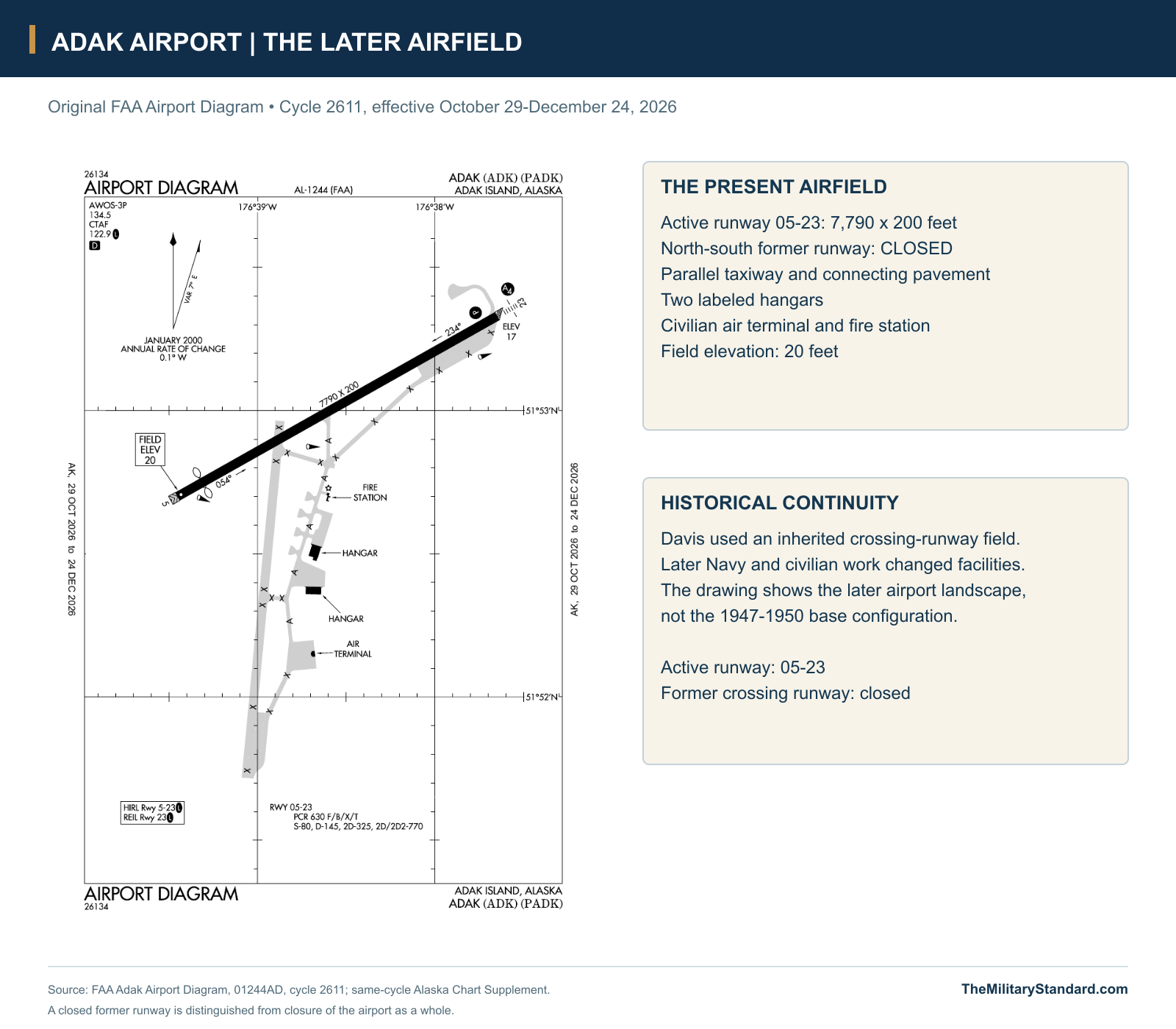
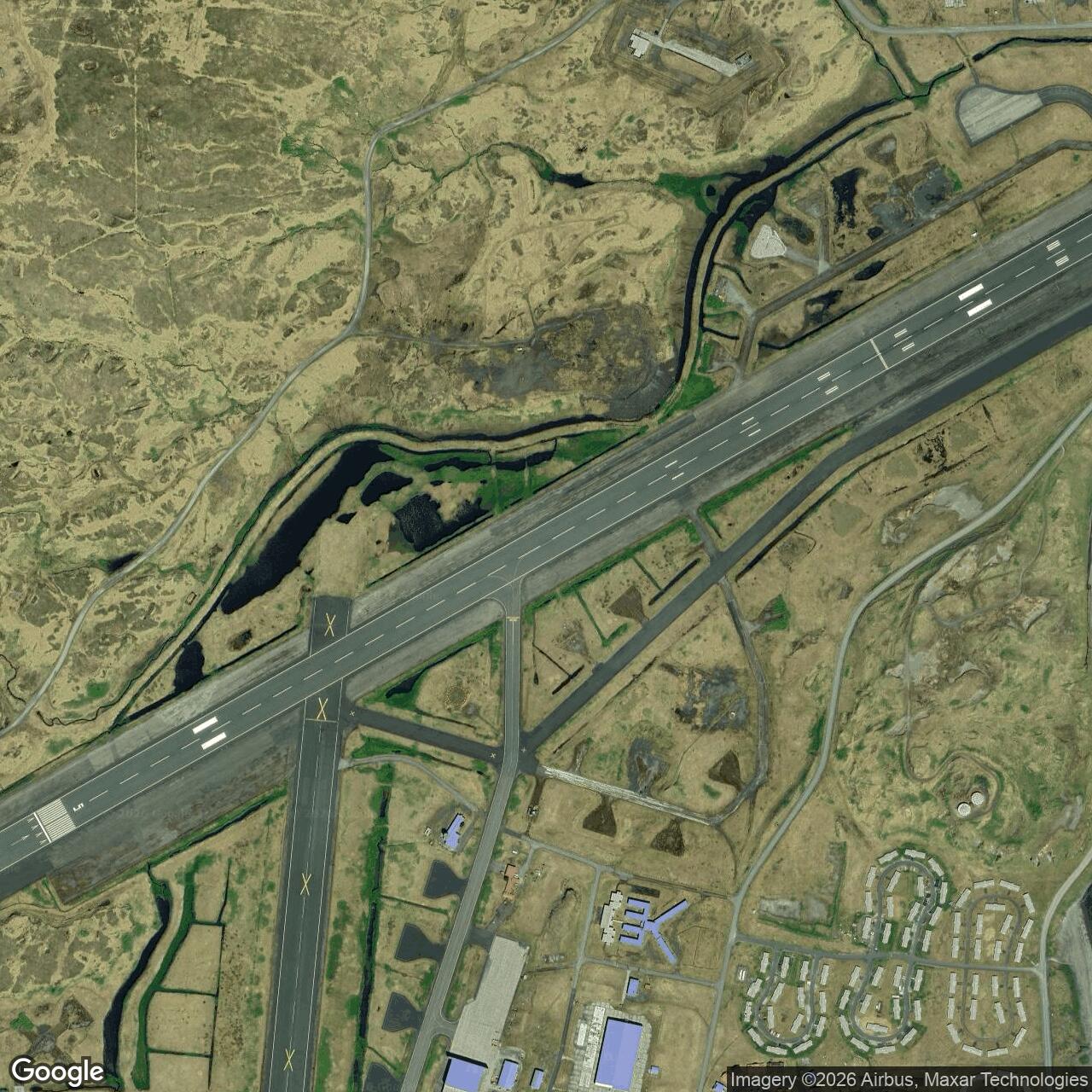
The present airport preserves the clearest large-scale continuity with Davis Field. The FAA's late-2026 diagram shows active Runway 05-23, 7,790 feet long and 200 feet wide, with taxiways, hangars, a terminal and a fire station. The old north-south runway is marked closed. Modern surfaces, buildings and operational restrictions belong to the civilian airport's own period, but the crossing-runway landscape still makes the relationship between the wartime Army field, the Air Force base and its naval successor legible. [11] [12]
Reading the Surviving Landscape
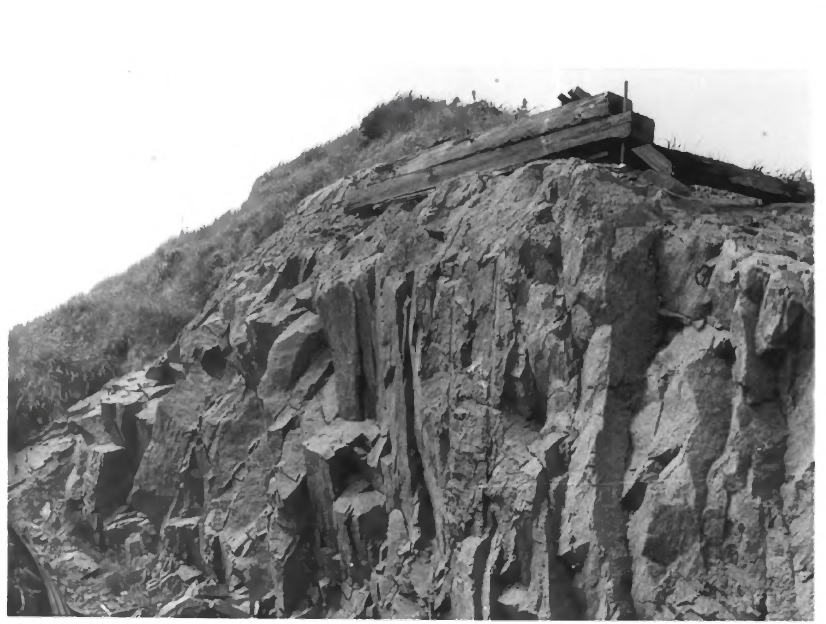
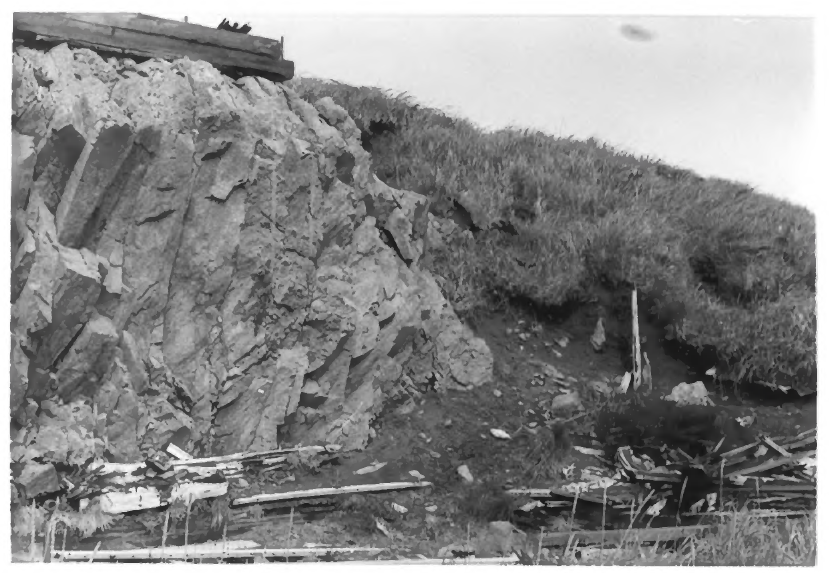
Adak's historical importance rests on the connected landscape as well as individual structures. The National Historic Landmark nomination identifies runways, harbor areas, the reserve depot, command-post remains, a hospital-area hut and selected coastal defenses as evidence of the wartime system. Its 1983 photographs and later supplements record conditions at the time of documentation, including changes and deterioration that had already occurred. The photographs document the physical legacy of the island's successive Army, Air Force and Navy occupations. [1] [13] [25]
The combined Army and Navy landmark was designated on February 27, 1987. Its nomination's 46,700-acre area, the later Navy reservation and the 2004 land-exchange acreage describe different administrative purposes. The acreage of Davis during its Air Force tenure remains undocumented. For the Air Force story, the most useful surviving relationship is the physical chain from runway and hangars through the living and service districts to the depot and harbor, supported by maps and dated photographs. [1] [15] [16] [25]
Environmental restoration and land-use controls remain part of Adak's postmilitary history. State and federal records address fuel, other contamination and munitions in specific areas, while civilian airport and community use continue on portions of the former base. Those obligations do not erase the military sequence: Davis was one short phase in a site repeatedly adapted to new requirements. Its significance lies in the transition from the Aleutian wartime offensive to early Cold War all-weather air defense, followed by the Navy's longer maritime mission. [4] [16] [17]
Chronology
- August 30, 1942 American forces occupy Adak and begin developing the Army airfield. [1] [2]
- September 14, 1942 Bombers and fighters operate from the new field against Kiska. [1]
- 1943-44 Crossing runways, camps, depot and harbor infrastructure develop; separate Mitchell naval airfield built farther north. [1] [2] [18]
- August 1943 Eleventh Air Force headquarters moves to Adak. [9]
- January 4, 1945 3rd Wing historian dates naming of the Adak field for Colonel Everett Davis. [8]
- December 1945 Eleventh Air Force redesignated Alaskan Air Command. [9]
- October 1, 1946 Alaskan Air Command headquarters returns to Elmendorf. [4] [9]
- May 19, 1947 415th Night Fighter Squadron station record begins at Adak. [6]
- September 1, 1947 415th inactivates and the 449th Fighter Squadron activates at Adak. [5] [6]
- 1947 The new independent United States Air Force inherits the Adak installation. [3] [4]
- 1947-48 Permanent construction improves parts of the inherited base. [3]
- July 20, 1948 449th redesignated Fighter Squadron, All Weather. [5]
- December 1948 Six F-82s assigned to the 449th at Davis in the Army installation historian's account. [7]
- March 28, 1949 449th moves from Adak to Ladd Air Force Base. [5]
- 1950 Census Davis AFB listed as enumeration district 3-8, separately from the Adak naval installation. [14]
- July 1, 1950 Davis installation transferred to the Navy; Air Force phase ends. [3] [4]
- 1959 Broad Navy land withdrawal follows the service transfer. [15]
- 1960s Later Adak White Alice / Project Bluegrass communications belong to a separate installation phase. [20]
- February 27, 1987 Combined Army and Navy wartime landscape designated a National Historic Landmark. [25]
- March 31, 1997 Successor Navy military mission ends at Adak. [15] [16]
- March 2004 Land exchange and civilian property transfers reshape former base use. [16]
- November 2026 Civilian Adak Airport remains in use; current FAA diagram marks the north-south former runway closed. [11] [12]
Related Sites
Information sources (25)
- WEBErwin N. Thompson, National Park Service, Adak Army Base and Adak Naval Operating Base nomination, 1984 and supplements
Military-landscape history covering airfield construction, runways, depot, hospital, command post, coast defenses and Mitchell naval airfield, with a 1943 Army map and later nomination maps.
- WEBAdak Historical Society / U.S. Navy / Alaska Maritime National Wildlife Refuge, Adak Historical Guide, revised 2012
Historical district map and numbered sites around Davis Field, Armytown and Sweeper Cove, with accounts of construction, logistics and community development.
- PDFD. Colt Denfeld, U.S. Army Corps of Engineers, The Cold War in Alaska, August 1994
Early postwar air defense, the Davis P-61 mission, permanent construction in 1947-48 and the July 1, 1950 Navy transfer.
- PDFAlaska Office of History and Archaeology, The Coldest Front: Cold War Military Properties in Alaska
Adak service transitions, the July 1, 1950 handover, postwar strategic context, later Navy development and preservation.
- PDFMaurer Maurer, Combat Squadrons of the Air Force, World War II, 1969 / 1982 reprint
Official 449th Fighter Squadron entry, printed pages 555-556: activation September 1, 1947; July 20, 1948 all-weather designation; move to Ladd March 28, 1949; aircraft succession. 415th entry provides the preceding Adak station period.
- WEBAir Education and Training Command, 415th Special Operations Squadron lineage and honors
Official lineage, aircraft, assignments and inactivation of the 415th Night Fighter Squadron, including its Adak station dates of May 19-September 1, 1947.
- PDFL. Amber Phillippe, Fort Wainwright DPW, History Snapshot: F-82s at Ladd, Alaska Post, July 22, 2016
Six Twin Mustangs assigned to the 449th at Davis in December 1948 and the squadron's 1949 transfer to Ladd.
- WEBDoug Beckstead, 3rd Wing historian, Elmendorf Army Air Base's first commander, December 2, 2008
Biography of Colonel Everett Davis, the November 28, 1942 transport loss, recovery near Lake Iliamna and January 4, 1945 naming of the Adak airfield.
- PDFOffice of Air Force History, Air Force Combat Units of World War II
Eleventh Air Force and Alaskan Air Command lineage and stations: Adak headquarters from August 1943, December 1945 redesignation and October 1, 1946 return to Elmendorf.
- PDFFederal Aviation Administration, Aircraft Navigation in the Aleutian Air War
Aleutian airfield engineering, radio navigation, flying conditions and the movement of wartime operations westward through Adak.
- PDFFederal Aviation Administration, Alaska Chart Supplement, October 29, 2026
Adak Airport reference N51 degrees 53.01 minutes, W176 degrees 38.55 minutes, ADK/PADK identifiers and the 7,790-by-200-foot active runway.
- PDFFederal Aviation Administration, Adak Airport Diagram, cycle 2611
Airport layout effective October 29-December 24, 2026: active runway 05-23, closed former north-south runway, taxiways, hangars, terminal and fire station.
- WEBNational Park Service, Adak landmark photographic documentation
Fourteen photographs of the 1943 encampment and convoy, 1983 depot and naval/coastal-defense remains, and 1985-86 warehouse and hospital-area structures, with original caption sheets.
- WEBNational Archives, 1950 Census Alaska enumeration-district metadata
Contemporary listing of Davis Air Force Base as Third Judicial Division enumeration district 3-8 and the Adak naval installation as a separate district.
- WEBDepartment of the Navy, Former Naval Air Facility Adak BRAC summary
Successor Navy installation, the later 79,200-acre withdrawal, March 31, 1997 mission closure and postclosure property disposition.
- WEBAlaska DEC, Adak Former Naval Air Facility site summary
Navy closure, the March 2004 land exchange and 47,271-acre transfer, airport transfer to Alaska DOT&PF, and environmental restoration.
- PDFAgency for Toxic Substances and Disease Registry, Naval Air Facility Adak public health assessment
Federal assessment of contamination, munitions, institutional controls and civilian reuse at the former naval installation.
- WEBBureau of Yards and Docks, Building the Navy's Bases in World War II, Volume II, 1947
Official naval construction history, Chapter 23: Army airfield co-use, Mitchell Field, seaplane facilities, docks, shops, power and base support.
- PDFThe Judge Advocate Journal, Bulletin No. 1, December 1948
Contemporary listings of Davis AFB among Alaskan posts with judge-advocate support, including personnel assignments.
- PDFU.S. Army Corps of Engineers, Historical Overview and Inventory: White Alice Communication System, 1988
History and original drawings of the later Adak Project Bluegrass communications terminal.
- WEBUnited States Air Force, F-82E at Adak, 1948, archival photograph
U.S. Air Force photograph of an F-82E at Adak in 1948, reproduced through Wings magazine, October 2003, and Wikimedia Commons.
- WEBUnited States Air Force, B-26C 44-35844 at Davis AFB, 1948, archival photograph
U.S. Air Force photograph of B-26C 44-35844 at Davis AFB in 1948, reproduced through David W. Menard's USAF Plus Fifteen and Wikimedia Commons.
- WEBUnited States Army Air Forces, Colonel Everett S. Davis portrait, 1942
U.S. Army Air Forces portrait of Colonel Everett S. Davis, 1942, reproduced through John Haile Cloe's Top Cover for America and Wikimedia Commons.
- WEBNatural Earth, public-domain map data
Public-domain 1:50m country and coastline geometry for the regional location map.
- WEBNational Park Service, Adak Army Base and Adak Naval Operating Base National Historic Landmark
National Historic Landmark designation of February 27, 1987, and the significance of the combined Army and Navy wartime landscape.