Hammer Army Airfield, Fresno California
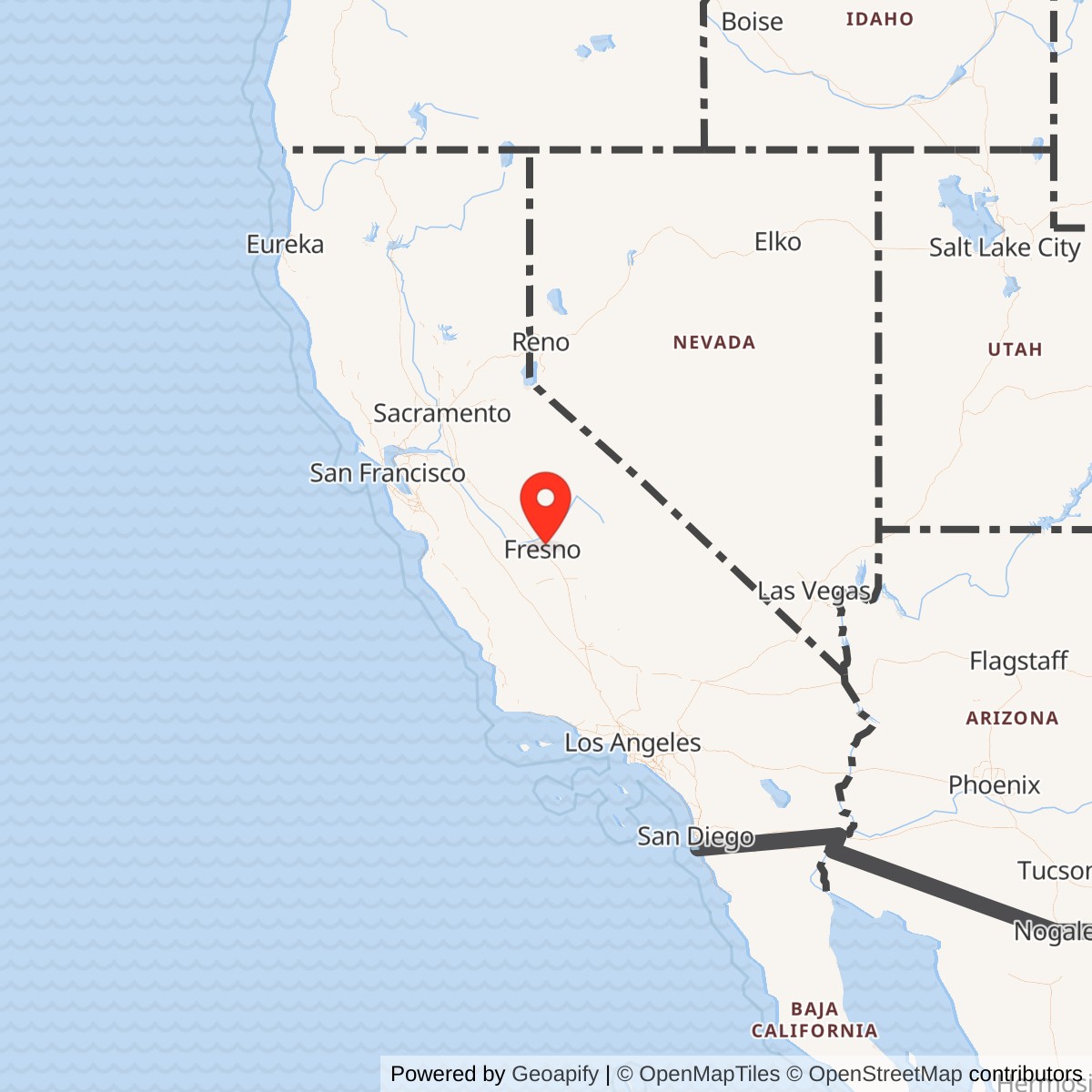
Longitude: -119.7188333
Airport ICAO ID: KFAT
Official Base Website: Fresno Yosemite International Airport
Current Role: Fresno Yosemite International Airport; Fresno Air National Guard Base / 144th Fighter Wing; California Army National Guard AVCRAD; public safety, firefighting, law-enforcement, medical, and civil aviation operations
Before Fresno Yosemite International Airport became the Central Valley's front door to Yosemite, Sequoia, Kings Canyon, commercial travel, firefighting aircraft, National Guard fighters, and public-safety aviation, it was a wartime field built in a hurry on farmland northeast of Fresno. In 1941 the Army Air Corps needed space that Chandler Field, Fresno's older municipal airport, could not provide. By the end of that year, concrete and asphalt had replaced fields east of the city; within months the new Fresno Army Air Base had become Hammer Field, a Fourth Air Force installation where bombers, replacement personnel, night-fighter crews, WACs, nurses, hospital staff, and thousands of young airmen passed through the machinery of World War II aviation.
Hammer Field was not famous because a single battle happened there. Its importance was quieter and more systemic. It helped turn the San Joaquin Valley into a wartime aviation landscape and gave the Army Air Forces a large West Coast base with room for training, processing, hospital care, bomb storage, support squadrons, and the specialized night-fighter program that the AAF moved to California in 1944. At night, when the field was doing its most distinctive work, pilots and radar operators learned to find targets they could barely see, using instruments, ground controllers, airborne radar, and trust in a crewmate's voice. That made Hammer Field part of the transition from daylight air power to all-weather, radar-directed air defense.
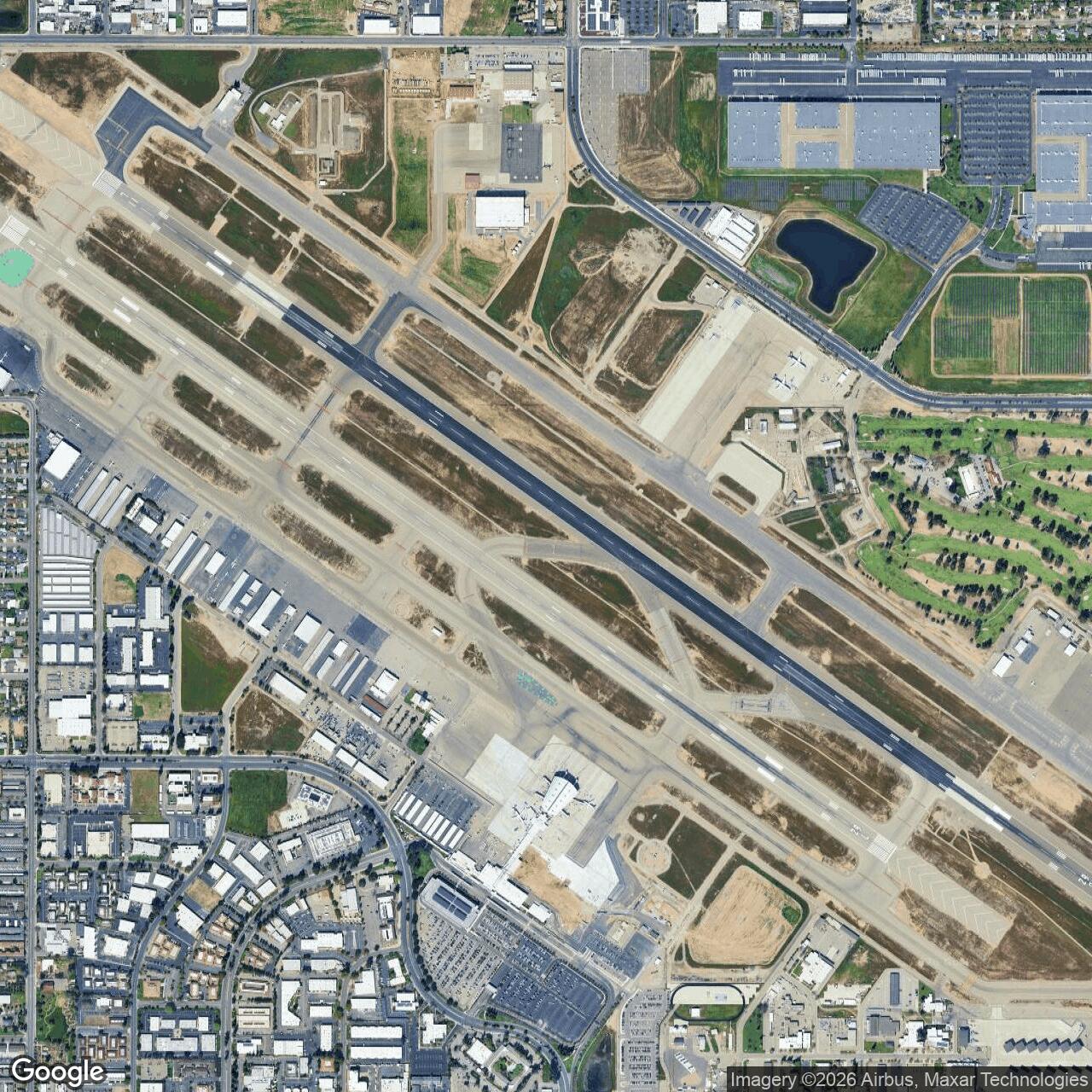
The installation occupied the site of today's Fresno Yosemite International Airport, about five miles northeast of central Fresno. Modern FAA and airport data place the airport reference point at 36 degrees 46 minutes 35.6 seconds north, 119 degrees 43 minutes 7.8 seconds west. The modern airport is a public civil airport owned by the City of Fresno, while the southeast portion of the airfield supports the Fresno Air National Guard Base and the 144th Fighter Wing. The airport also hosts California Army National Guard aviation maintenance activity, firefighting, law-enforcement, medical, and other government aviation operations. The World War II Army airfield closed as a U.S. Army Air Forces installation after the war, but the aviation use of the site never ended.
Mission Evolution
The field's origin lay in the pre-Pearl Harbor defense buildup. In early 1941 the War Department concluded that Chandler Field, the existing Fresno municipal airport west of downtown, was too small for the air base the Army needed. Fresno civic leaders acquired and leased a larger site east of the city to the Army Air Corps by March 14, 1941. Construction of runways, hangars, administration buildings, service buildings, and barracks began almost immediately. The field was originally known as Fresno Army Air Base and was officially opened on April 3, 1941, when Lieutenant Colonel Lotha A. Smith assumed command. The runways were completed in November 1941, and the field was turned over to the Army Air Corps on December 1, 1941, only days before the Japanese attack on Pearl Harbor changed the pace and urgency of every American military installation.
The base was renamed Hammer Field in January 1942 and formally dedicated in May 1942. It honored First Lieutenant Earl M. Hammer, a San Francisco aviator and University of California graduate who became the first California airman killed in action in World War I. The name therefore tied a new World War II installation to the earlier generation of American military aviation. What had begun as a Fresno Army Air Base quickly became a named Army Air Forces field with a growing wartime identity.
At first, Hammer Field supported bomber and air-base functions. Early units associated with the field included the 15th Bombardment Group, the 47th Light Bombardment Group, and the 49th Air Base Group. On December 7, 1941, known units included the 84th, 85th, 86th, and 97th Bombardment Squadrons (Light), headquarters and support elements of the 49th Air Base Group, signal, weather, communications, chemical, quartermaster, ordnance, and material support elements. The field's early role reflected a West Coast defense logic: large training and support bases had to be placed inland but close enough to move aircraft, crews, and support personnel rapidly through the Pacific war system.
In August 1942 the Fourth Air Force Replacement Depot arrived at Hammer Field. That mission made the base more than a flying field. It became a personnel-processing and preparation center for airmen and aviation technicians moving toward overseas assignments. The depot received filler replacements and prepared them to fill assignments in the Air Force. That work was routine, repetitive, and essential: men arrived, were processed, trained, sorted, and moved onward. The field's base newspaper, the Hammer Field Night Hawk, later reported that about 60,000 troops had been trained at Hammer Field during its five years of wartime existence.
The installation also developed a large medical role. One of Hammer Field's most important facilities was its Army Air Forces regional hospital, a complex of 85 buildings containing 932 beds, with a total authorized capacity of 1,112. The hospital could serve surrounding Army bases as well as Hammer itself. Its scale reflected the Army Air Forces' regional medical system: a field with thousands of flying and ground personnel, plus satellite and auxiliary activities, required more than a small station infirmary. The hospital was a regional support institution in its own right.
By 1943 the base mission had widened again. In June 1943 Hammer Field's first WAAC personnel arrived, initially as the 794th Women's Army Auxiliary Corps, later reorganized through the transition from WAAC to the Women's Army Corps. In December 1943 Hammer Field was also designated an Army Air Forces Training Center for nurses. These functions placed the field within the broader wartime manpower transformation of the Army: women in uniform and military nursing institutions were not auxiliary decoration, but part of the operating system that allowed massive air bases to function.
Hammer Field's most distinctive mission arrived in 1944, when the Army Air Forces moved its night-fighter training program to California. The Air Staff ordered the entire night-fighter training program to California in January 1944, headquartered at Hammer Field near Fresno. Under Fourth Air Force supervision and the 481st Night Fighter Operational Training Group, crews entered a three-phase pipeline. Phase One familiarization occurred at Bakersfield Municipal Airport. Phase Two, meant to weld pilots and radar operators into teams and teach day and night interception, was conducted at Hammer Field. Phase Three advanced night flying took place at Salinas Field. After additional organizational training, squadrons were ready for transfer overseas. In May 1944 the 319th Wing under Colonel Ralph A. Snavely replaced the 481st, and the 450th and related Army Air Forces Base Units carried on the training and replacement mission.
Operational Role
The physical work of Hammer Field began with construction speed. The Army needed runways, utilities, aircraft servicing areas, barracks, hospital buildings, storage, administrative space, roads, ranges, and support shops before the United States had fully entered the war. Once Pearl Harbor occurred, the field's tempo intensified. Its runways and service areas supported bombers and training aircraft; its barracks and support buildings absorbed replacement personnel; its hospital treated patients from a larger air-base network; and its support squadrons kept aircraft, communications, weather, ordnance, transportation, and supply functions operating.
The field was a Fourth Air Force base, and Fourth Air Force's wartime role on the West Coast was both defensive and preparatory. It had to support the air defense of the western United States while also preparing pilots, crews, and units for overseas theaters. Hammer Field therefore functioned as a rear-area installation with front-line consequences. Aircraft and crews trained in California later operated over Europe, the Mediterranean, China-Burma-India, the Philippines, New Guinea, the Marianas, and other combat theaters. The field's mission was to produce and process people capable of operating in those theaters, not to become a combat theater itself.
The night-fighter mission made Hammer Field especially significant. Early in World War II, night fighting required a mixture of flying skill, radar technology, ground-control discipline, crew coordination, and a temperament different from ordinary daylight pursuit. The pilot had to fly in darkness, often alone or with little external reference. The radar operator had to interpret the airborne radar picture and talk the pilot toward a target. Ground-control radar personnel had to vector the crew into position. The whole system required trust and practice. Hammer Field became one of the places where that system was taught and refined.
The AAF night-fighter program at Hammer had direct combat relevance. The 481st Night Fighter Operational Training Group graduated units shortly before D-Day, including the 423d Night Fighter Squadron in March 1944 and the 425th and 426th Night Fighter Squadrons in May. Under the 319th Wing, additional squadrons were completed, including the 427th, 547th, 548th, 549th, and 550th Night Fighter Squadrons. Some trained with P-70 versions of the A-20 Havoc, while the Northrop P-61 Black Widow became the standard U.S. purpose-built night fighter as production improved. The training system associated with Hammer, Bakersfield, Salinas, Delano, Visalia, Meadows Field, and other auxiliary locations helped prepare squadrons for the specialized demands of nighttime interception in the European, Mediterranean, China-Burma-India, and Pacific theaters.
Night-fighter training was dangerous. The Air Force historical study Conquering the Night notes that the AAF did not consider the accident rate alarming, but admitted it was serious enough to demand constant attention. That is unsurprising. The program asked young crews to fly complex aircraft at night, interpret unfamiliar technology, coordinate with controllers, and simulate combat conditions before many aviation systems had matured. Hammer Field's night-fighter mission should therefore be understood as a combat-preparation mission with real risk even before the crews reached a war zone.
Hammer Field also supported ordnance and storage functions. Historical summaries note bomb storage, rifle ranges, a high-tower shotgun range, chemical-warfare storage, and an underground concrete igloo magazine for arms storage. The Army also acquired Bakersfield's Chandler Field Municipal Airport in 1942 for use as an auxiliary field to Hammer, with bomb storage and training among its main functions. These support activities remind us that wartime airfields were not just runways. They were hazardous industrial and training landscapes with explosives, chemicals, firing ranges, fuel, aircraft maintenance, vehicle maintenance, and medical support all operating in parallel.
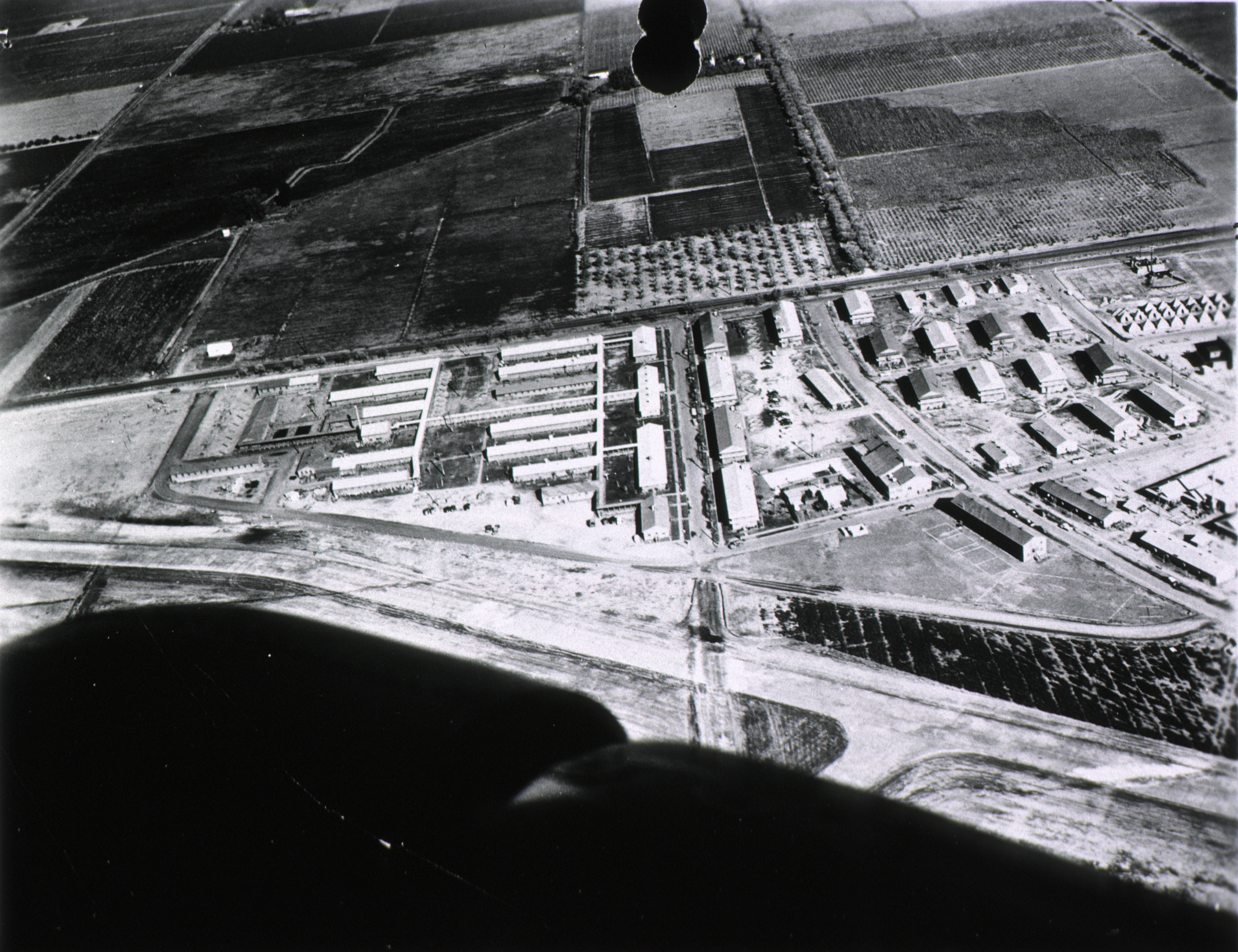
The regional hospital formed another operational center. The National Library of Medicine preserves a 1945 aerial view (photo 1 below) of the U.S. Army Air Forces Regional Hospital at Hammer Field. The image shows that the hospital was not a small appendage on the edge of a flying base, but a full medical campus with rows of ward and support structures. The hospital's ability to serve other bases made Hammer part of the broader health and recovery system of wartime aviation, where training accidents, illness, flight stress, and ordinary medical needs all had to be managed without interrupting the movement of personnel and units to the war.
Units, Organizations, and Systems
Hammer Field's early units reflected the Army Air Corps / Army Air Forces transition from a smaller prewar arm into a wartime air force. The 15th Bombardment Group, 47th Light Bombardment Group, and 49th Air Base Group were central to the early field identity. The units known to be present on December 7, 1941 included bombardment squadrons, headquarters and air-base elements, material, air-base, communications, weather, chemical, ordnance, quartermaster, signal, and other support organizations. This was the structure of an air base learning to operate at wartime scale.
The Fourth Air Force Replacement Depot gave the field a personnel-system role. Replacement depots were not glamorous, but they were critical to the AAF's global expansion. They ensured that individual officers, enlisted men, aviation specialists, and support personnel moved through the correct administrative and training channels before assignment. Hammer's replacement function meant that the base handled the human logistics of air war, not only aircraft operations.
The 481st Night Fighter Operational Training Group and later the 319th Wing / 450th Army Air Forces Base Unit defined Hammer Field's best-known specialized training role. The 481st moved from Florida to Hammer Field in early 1944, and the night-fighter training system was reorganized around California fields. Hammer Field served as the headquarters and Phase Two training center where pilots and radar operators were paired and taught day and night interception. The 450th AAF Base Unit then carried the night-fighter replacement training mission forward under the 319th Wing.
The squadrons tied to this training system included the 423d, 425th, 426th, 427th, 547th, 548th, 549th, and 550th Night Fighter Squadrons. The precise training paths varied, because different phases occurred at different fields, and squadrons often moved among Hammer, Bakersfield/Meadows Field, Delano, Visalia, Salinas, and other locations. The important point is that Hammer was the headquarters and training center of a regional system rather than a solitary airfield. It coordinated a network that trained crews for a new kind of air combat.
Women's Army Auxiliary Corps and Women's Army Corps personnel formed part of the field's support system beginning in 1943. Nurses and nurse trainees also belonged to the field's medical mission. These women served in a base environment where administrative, medical, communications, support, and personnel work were mission-essential. Their presence at Hammer Field reflects the larger wartime expansion of women's uniformed roles across the Army and Army Air Forces.
After World War II, new organizations inherited the ground. The City of Fresno took over the airport section under War Assets Administration authority in December 1946, and Hammer Field became the foundation of Fresno's civil air terminal. The California Air National Guard's 144th Fighter Wing later made Fresno Air National Guard Base its home; official 144th Fighter Wing history states that the site has been used for military aviation since World War II, when it was known as Hammer Field. Today the airport also hosts California Army National Guard aviation maintenance activity, specifically an Aviation Classification Repair Activity Depot, alongside civil, law-enforcement, firefighting, and medical aviation users.
Facilities and Physical Layout
Hammer Field's wartime landscape was a dispersed air-base complex. The runway system began with a major northwest-southeast runway. Modern Fresno Yosemite International Airport's runway 11L/29R follows that historical orientation and has grown beyond the wartime dimensions. The Army built hangars, administration and service buildings, barracks, shops, storage areas, range facilities, medical buildings, roads, and supporting utilities. The field was planned for aircraft operations, but it also had to operate as a self-contained military community.
The original airfield site was roughly 1,600 acres according to local historical accounts. The modern Fresno Yosemite International Airport covers approximately 1,728 acres, reflecting later civil-airport development and changes in land use. During the war the base also depended on auxiliary and associated fields. Chandler Field was used briefly while Hammer was under construction and later served auxiliary functions. Night-fighter training brought a wider regional network into the Hammer system, with Bakersfield/Meadows Field, Delano, Visalia, Salinas, and other California fields tied to different phases of the program.
The hospital was one of the most visible large facilities. With 85 buildings and nearly a thousand beds, it was a campus-scale medical complex. A 1945 aerial photograph shows the hospital as an ordered grid of long ward buildings and support structures in the agricultural landscape near the airfield. This facility's size makes sense only when Hammer Field is understood not just as a runway but as a regional Army Air Forces support base.
Other physical components included bomb-storage and ammunition facilities, an underground concrete igloo magazine, chemical-warfare storage areas, rifle ranges, a high-tower shotgun range, motor pool areas, cold storage, fire station, school buildings, and various training and service areas. These elements gave the field the ability to train, house, heal, equip, and move personnel while also handling hazardous materials. They also help explain later environmental and reuse complexity at former military airfield properties.
Closure and Postwar Reuse
By the autumn of 1945 the war had ended and Hammer Field's military requirement was collapsing. On October 25, 1945, the War Department announced that Hammer Field would be deactivated. Brigadier General Lotha A. Smith, the field's first commander, returned in November 1945 as the final commander. The 450th Army Air Forces Base Unit's night-fighter training role ended by March 1946, marking the close of the field's principal AAF training mission.
On December 5, 1946, the City of Fresno agreed to assume operation of the airport section of Hammer Field under an interim license from the War Assets Administration. In September 1948 the War Assets Administration canceled leases on behalf of the federal government and quitclaimed additional land and buildings to the City of Fresno. The airfield became Fresno Air Terminal, and commercial aviation shifted from Chandler Field because the older airport was too small for postwar aircraft. In 1956 the City Commission changed the name from Hammer Field to Fresno Air Terminal; in 1996 the airport became Fresno Yosemite International Airport.
Postwar reuse did not erase military aviation. The California Air National Guard's 144th Fighter Wing history records the unit's relocation to Fresno in the mid-1950s and states that the site has been used for military aviation since World War II. The 144th evolved through P-51/F-51, F-86, F-102, F-106, F-4, F-16, and F-15 eras, and the Fresno Air National Guard Base remains part of the airport complex. That later Air National Guard history is separate from the World War II Army Air Forces installation, but it demonstrates the continuity of military aviation on the Hammer Field site.
Current Status
The former Hammer Army Airfield is now Fresno Yosemite International Airport, a joint civil and military aviation site serving the San Joaquin Valley and the national parks of the Sierra Nevada. Its FAA identifier is FAT. The airport remains open to the public, with two paved runways, commercial passenger service, cargo activity, general aviation, and a growing regional transportation role.
Military and government aviation remain present. The Fresno Air National Guard Base on the airport's southeast side is home to the 144th Fighter Wing of the California Air National Guard. The airport also lists a California Army National Guard Aviation Classification Repair Activity Depot, U.S. Forest Service, CAL FIRE, California Highway Patrol, Fresno County Sheriff, Fresno Police Department, air ambulance, and other aviation users. This mix gives the former Army airfield an unusually broad modern identity: civil airport, Air National Guard fighter base, Army Guard aviation maintenance site, firefighting platform, public-safety aviation base, and regional passenger gateway.
Little of the wartime base reads to the casual traveler as "Hammer Field," but the name survives in local memory, archival collections, and military use. Fresno's airport code, FAT, preserves the Fresno Air Terminal era that followed the Army. The California Army National Guard still uses the Hammer Field name for its armory identity in the area, and local historical accounts continue to connect the airport to Lieutenant Earl Hammer and the Army Air Forces base that once occupied the ground.
Chronology
- 1940-12 Army Air Corps leaders and local officials considered Fresno-area options for a large West Coast air base as the United States accelerated prewar mobilization.
- 1941-03-14 Fresno civic authorities had acquired and leased the new east-Fresno airfield site to the Army Air Corps.
- 1941-04-03 Fresno Army Air Base officially opened when Lieutenant Colonel Lotha A. Smith assumed command.
- 1941-04 Construction of runways, hangars, administrative buildings, service buildings, and barracks was underway.
- 1941-04-22 The first of the expected bomber aircraft associated with the new base arrived in Fresno, landing at Chandler Field because the new Hammer runways were still under construction.
- 1941-11 Runways at the new field were completed.
- 1941-12-01 The field was turned over to the Army Air Corps.
- 1941-12-07 Units recorded at the field included light bombardment squadrons, air-base group elements, material, communications, weather, chemical, ordnance, quartermaster, and signal support organizations.
- 1942-01 Fresno Army Air Base became Hammer Field, named for First Lieutenant Earl M. Hammer.
- 1942-05 Hammer Field was dedicated under its new name.
- 1942-08 The Fourth Air Force Replacement Depot arrived at Hammer Field.
- 1942 Chandler Field was acquired for use as an auxiliary field to Hammer Field, with bomb storage and training among its functions.
- 1943-06 The first WAAC personnel at Hammer Field arrived, including the 794th Women's Army Auxiliary Corps.
- 1943-12 Hammer Field was designated as an Army Air Forces Training Center for nurses.
- 1944-01 The AAF ordered its night-fighter training program moved to California, headquartered at Hammer Field.
- 1944-03 Night-fighter training missions began at Hammer Field.
- 1944-03 The 481st Night Fighter Operational Training Group graduated the 423d Night Fighter Squadron shortly before D-Day.
- 1944-05 The 425th and 426th Night Fighter Squadrons graduated; the 319th Wing under Colonel Ralph A. Snavely replaced the 481st in the night-fighter training system.
- 1944 The 319th Wing completed training for additional night-fighter squadrons including the 427th, 547th, 548th, 549th, and 550th.
- 1945-09-06 The U.S. Army Air Forces Regional Hospital at Hammer Field was photographed from the air, documenting the hospital complex near the end of the war.
- 1945-10-25 The War Department announced that Hammer Field would be deactivated.
- 1945-11 Brigadier General Lotha A. Smith, the first base commander, returned as the final commander.
- 1946-03-15 The 450th Army Air Forces Base Unit / night-fighter training function ended, marking the close of the main Army Air Forces training mission.
- 1946-12-05 The City of Fresno agreed to assume operation of the airport section of Hammer Field under an interim War Assets Administration license.
- 1948-09-29 The War Assets Administration canceled leases and quitclaimed additional land and buildings to the City of Fresno.
- 1954 The 194th Fighter Interceptor Squadron relocated to Fresno.
- 1956-12-26 The City Commission changed the name of Hammer Field to Fresno Air Terminal.
- 1957 The 144th Fighter Interceptor Wing followed the 194th to Fresno.
- 1996 Fresno Air Terminal was renamed Fresno Yosemite International Airport.
- Present The former Hammer Field site operates as Fresno Yosemite International Airport, with the Fresno Air National Guard Base / 144th Fighter Wing, California Army National Guard aviation maintenance activity, firefighting, law-enforcement, medical, and civil aviation operations on the successor airport property.