
Visalia Army Air Field - Camp Visalia, Visalia California
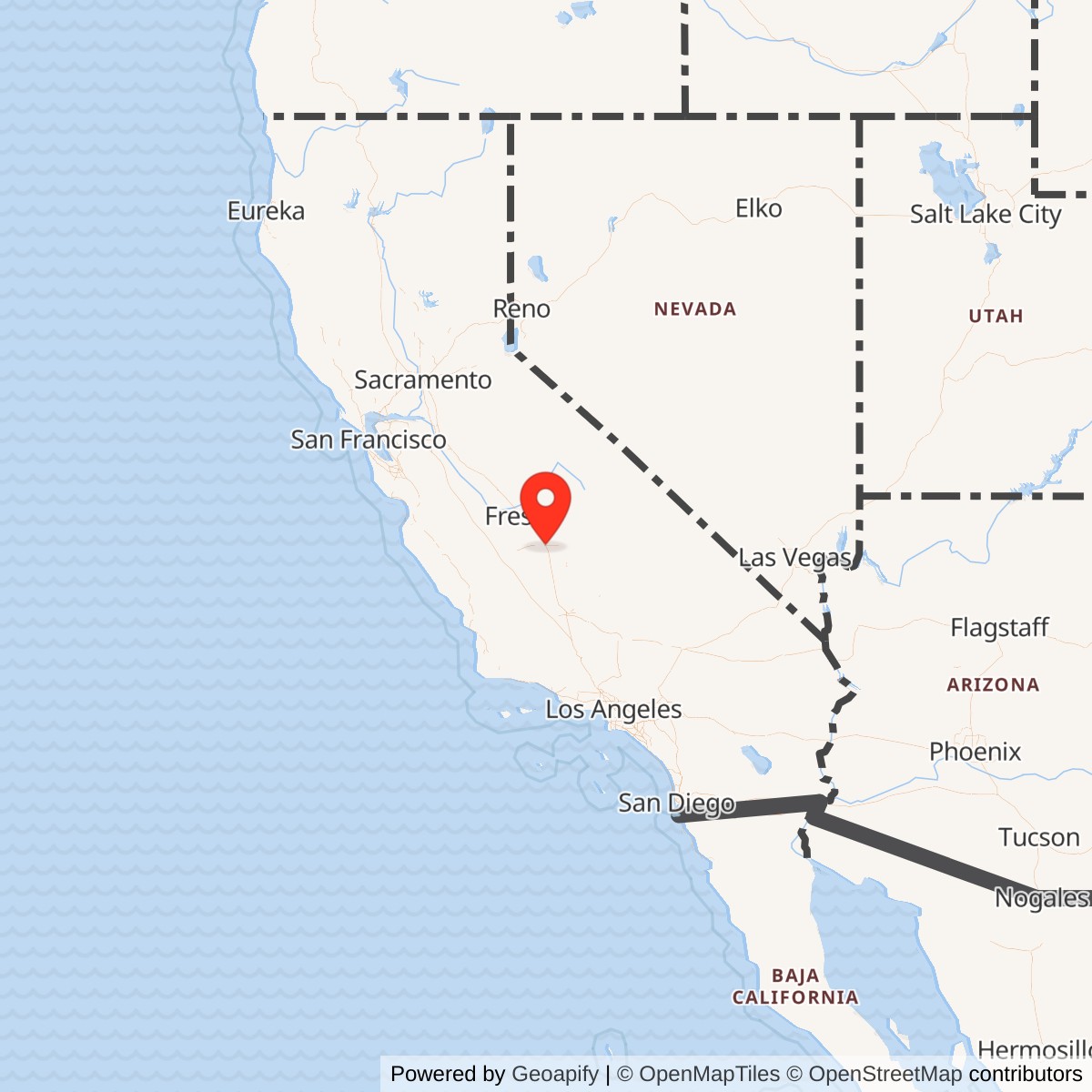
Longitude: -119.3928610
Airport ICAO ID: KVIS
Official Base Website: Visalia Municipal Airport
Current Role: Visalia Municipal Airport, KVIS, an active City-owned public general-aviation airport with business, training, maintenance, emergency, instrument, and occasional military operations
Long before the Army arrived, Visalia's airport was a pasture where a broken water line forced two local aviators to land. Fifteen years later, the same ground was sending anti-submarine bombers over the California coast and training radar-equipped night fighters for war in Europe. That transformation from improvised local airstrip to military operating field captures the rapid expansion of American aviation during World War II.
Visalia Army Air Field occupied the municipal airport west of the city. The War Department assumed control in 1942, leased and acquired adjoining property, improved the runways, built protective aircraft revetments, and incorporated the field into the Fourth Air Force system. The installation served first as an operational light and medium bomber station, then as a Hammer Field sub-installation, night-fighter satellite, communications site, and possible branch location of the Western Signal Aviation Unit Training Center known as Camp Visalia.
The field must not be confused with Sequoia Field / Camp Sequoia, about ten miles north of the current Visalia airport. Sequoia Field was a separate contract primary flying school and later radar-training subpost. Visalia Army Air Field was the military use of today's Visalia Municipal Airport. The two installations had different locations, facilities, and wartime missions.
Mission Evolution
The site began with private aviation. Solomon "Sol" Sweet and Edwin Deeds used the level Putnam pasture after an emergency landing in 1927, organized Sweet-Deeds Aircrafters, and promoted the ground as an airport. Visalia voters approved bonds in 1928, and the city purchased the property. The municipal airport began with grass strips, an improvised hangar, and the energy of local aviation promoters.
Public investment gradually made the field suitable for larger aircraft. State relief programs and the Works Progress Administration improved the airport during the 1930s. By 1941 the field had a graded and paved main runway approximately 4,800 feet long and 400 feet wide, drainage improvements, and better lighting. Civilian pilot training also operated there before the war.
The War Department assumed control in February 1942. Lease arrangements with the city and private owners, plus purchase and condemnation of adjoining parcels, expanded the military footprint. The Army reused municipal buildings, an auto court, and farm structures while adding runways, revetments, and military support facilities. Visalia therefore developed differently from a new purpose-built Army airfield. It was an existing civic airport adapted under emergency conditions.
The first major military mission was operational anti-submarine patrol. The 47th Bombardment Squadron (Medium) flew from Visalia from February through June 1942 with Lockheed A-29 Hudson aircraft and later North American B-25 Mitchells. Japanese submarine activity along the Pacific coast and fear of attacks on shipping and installations gave these patrols an immediate defensive purpose. Visalia was not merely training crews during this phase. Its aircraft searched approaches to the coast as part of the Western Defense effort.
After the anti-submarine period, Visalia became a sub-installation of Hammer Field along with Hayward and Palmdale. It shared Hammer's training and staging mission for bomber organizations. B-24 Liberators, B-25 Mitchells, B-26 Marauders, and A-29 Hudsons are associated with the field during this broader phase.
The mission changed again in 1944 when the Army Air Forces concentrated night-fighter training in California. Hammer Field became the headquarters of a distributed training network. Visalia served as a satellite training site where P-70 night fighters and P-61 Black Widows could operate away from the crowded central bases. The 425th Night Fighter Squadron was stationed at Visalia during its training cycle in early 1944.
By 1945 the field also supported Army Airways Communications personnel. An Army station list placed a detachment of Section D, 85th Army Air Forces Base Unit, associated with the 101st Army Airways Communications Squadron, at Visalia on 7 April 1945. A portion of the property may also have functioned as Camp Visalia, a branch of the Western Signal Aviation Unit Training Center headquartered at Camp Pinedale. The evidence does not establish Camp Visalia as a long-lived independent installation separate from the airfield, so it is treated as a mission phase or subordinate area within Visalia Army Air Field.
World War II Operations
The 47th Bombardment Squadron gave Visalia its clearest direct operational mission. From February through June 1942, crews flew anti-submarine patrols from the field. The Lockheed A-29 Hudson was an American-built version of an aircraft widely used by the Royal Air Force for maritime patrol. The B-25 offered greater performance and payload. Patrol crews searched coastal approaches and shipping routes at a time when the United States lacked enough specialized naval patrol aircraft to cover every threatened area.
The absence of a documented submarine attack from Visalia does not make the mission unimportant. Coastal patrols were deterrent and protective. Their presence forced submarines to consider aerial detection and reassured military and commercial shipping. The mission also demonstrates how rapidly the Army Air Forces diverted available bomber units to continental defense after Pearl Harbor.
As a Hammer Field sub-installation, Visalia supported a much larger flow of aircraft and organizations. The field offered runway and parking capacity for bomber staging and training. Its protective revetments reflected concern that aircraft on the ground could be vulnerable to attack. A surviving National Archives aerial view reproduced by the California Military Department shows the dispersed parking pattern and the scale of military alterations.
Night-fighter training brought a different operational culture. Crews had to fly in darkness, communicate with ground controllers, use radar, interpret instruments, and coordinate the pilot and radar operator as a single team. The official Air Force history(see link to PDF document in Sources below) records that the California program used a formal progression through Bakersfield, Hammer, Salinas, and final organizational work at Santa Ana. Visalia's satellite role added flying capacity and allowed a squadron to live and train as an organization while using the network's specialized facilities.
The 425th Night Fighter Squadron trained at Visalia from approximately 25 February through 1 May 1944. Some secondary histories mis-date the cycle to 1945, but the official Air Force history states that the 425th graduated from the California program in May 1944 and subsequently entered combat in Europe during 1944. The field's correct night-fighter period is therefore early 1944.
The 1945 War Department inventory recorded a substantial but compact station. The controlled area totaled 465 acres, including 194 owned acres and 271 leased acres. Capacity was listed as 312 enlisted personnel and 32 officers, with a three-bed station hospital, 2,000 square feet of covered storage, and 190,217 square feet of open storage. These figures confirm that Visalia had a defined support establishment rather than serving only as an occasional landing field.
Aircraft, Training, and Facilities
Visalia's military physical plant grew from the municipal airport. The Army retained the principal runway, added or improved secondary operating surfaces, built aircraft dispersal revetments, and adapted existing civil and agricultural structures. The revetments separated parked aircraft so that one bomb or strafing pass would be less likely to destroy several planes. They were among the most visible wartime features and were removed after the city regained the field.
The bomber types associated with Visalia reflected changing needs. A-29 Hudsons and B-25 Mitchells supported anti-submarine and medium-bomber work. B-24s and B-26s appeared during the Hammer sub-installation phase. P-70s and P-61s represented the night-fighter program. This range of aircraft made Visalia unusually varied for a field that remained subordinate to a larger base.
The P-61 Black Widow demanded specialized maintenance and training. Its airborne radar, multiple crew positions, powerful engines, heavy armament, and night-flying mission created requirements beyond those of a conventional single-seat fighter. Ground-control radar and communications were equally important. A night fighter without controllers, radar maintenance, and reliable radio links was only part of the weapon system.
Visalia's communications detachment in 1945 fit that system logic. Army Airways Communications System personnel supported weather, navigation, radio, and flight-control functions across the global AAF. Their presence at Visalia during the field's later phase helped keep the installation connected to the regional and national air network even as combat-crew training declined.
Units and Organizations
47th Bombardment Squadron (Medium)
The 47th operated from Visalia between February and June 1942. Its A-29 and later B-25 crews conducted anti-submarine patrols off the California coast. The squadron gave the installation a direct continental-defense mission during the months after Pearl Harbor.
50th Base Headquarters and Air Base Squadron
Elements of Hammer Field's 50th Base Headquarters and Air Base Squadron initially garrisoned Visalia. This arrangement reflected the field's subordinate status and allowed Hammer to supply administrative and support functions without creating a fully independent permanent command.
450th Army Air Forces Base Unit (Combat Crew Training Station)
The 450th AAF Base Unit succeeded the earlier base organization in the Hammer training system. It supported the night-fighter and combat-crew training mission. Available records do not show a wholly separate Visalia base unit, reinforcing the field's identity as a Hammer sub-installation.
425th Night Fighter Squadron
The 425th trained at Visalia in early 1944 before deploying to Europe. In combat it protected Allied armies, intercepted German aircraft and V-1 flying bombs, and flew extensive night intruder missions. The squadron was assigned to XIX Tactical Air Command in support of Patton's Third Army. During the Battle of the Bulge, the 422d and 425th were the only U.S. aircraft able to operate at night and in bad weather in support of the 101st Airborne Division at Bastogne. The official Air Force history records 1,162 intruder missions by the 425th from October 1944 through May 1945 and credits the squadron with fourteen kills, including four V-1s, in its broader wartime tally.
Detachment, Section D, 85th Army Air Forces Base Unit
A detachment associated with the 101st Army Airways Communications Squadron was present in April 1945. It supported the communications and airways functions needed to operate the field safely within the AAF network.Western Signal Aviation Unit Training Center / Camp Visalia
Historical evidence indicates that part of the post may have served as a branch of the signal aviation training center headquartered at Camp Pinedale. This activity is important, but its boundary and independent administrative status are not clear enough to justify a separate installation row. It remains part of the Visalia airfield history unless stronger documentation identifies a geographically distinct post.
Role in the Wider Military Network
Visalia served several overlapping systems. In early 1942 it belonged to the emergency West Coast anti-submarine patrol network. Aircraft from inland fields searched coastal waters and shipping approaches, connecting Army airfields to naval defense and civilian maritime traffic.
As a Hammer Field sub-installation, Visalia belonged to Fourth Air Force's bomber and replacement-training system. Hammer supplied command and central support, while subordinate fields distributed aircraft, training, staging, and flying activity across the San Joaquin Valley and coastal California.
In the night-fighter program, Visalia was a satellite rather than one of the three formal syllabus centers. The distinction matters. The official curriculum placed familiarization at the Bakersfield field, crew teamwork and interception at Hammer, and advanced night flying at Salinas. Visalia provided additional squadron basing and flying capacity. It was one of the locations that made the formal system workable.
The 425th Night Fighter Squadron connected Visalia directly to European combat. The airfield did not launch wartime missions against Germany, but it helped prepare the squadron that later defended Allied formations, attacked transportation at night, countered V-1 flying bombs, and supported the Bastogne defenders during severe weather. That was an institutional and training contribution, not direct combat from California.
Postwar Closure and Civil Reuse
The military mission contracted after 1945. The War Assets Administration terminated leases in 1946, and the remaining property returned to the City of Visalia in 1947. Federal funds helped remove revetments and repair the airport for civil use. United Airlines restored scheduled service on 9 December 1946, carrying passengers, mail, and thousands of commemorative cachet letters.
Postwar development gradually erased the visible Army layout. New airport improvements replaced wartime structures, and the revetments disappeared. The terminal was named for Sol Sweet, preserving the memory of the local aviator whose emergency landing and advocacy had helped create the airport.
The current municipal airport is larger than the 465-acre wartime controlled property. Current aviation data describe approximately 821 acres. The difference reflects postwar acquisition and airport development.
Post-World War II Military and Conflict Connections
Visalia ceased to be an assigned military station after World War II. It did not become a United States Air Force base and had no direct operating role in Korea, Vietnam, the Persian Gulf, Afghanistan, or Iraq. Current FAA-derived statistics include occasional military operations, but these are transient uses of a civilian airport.
The later history of the 425th is separate from the installation. The unit lineage was reactivated after World War II for fighter training, including later foreign-partner training missions, but those activities did not occur at Visalia.
Current Status
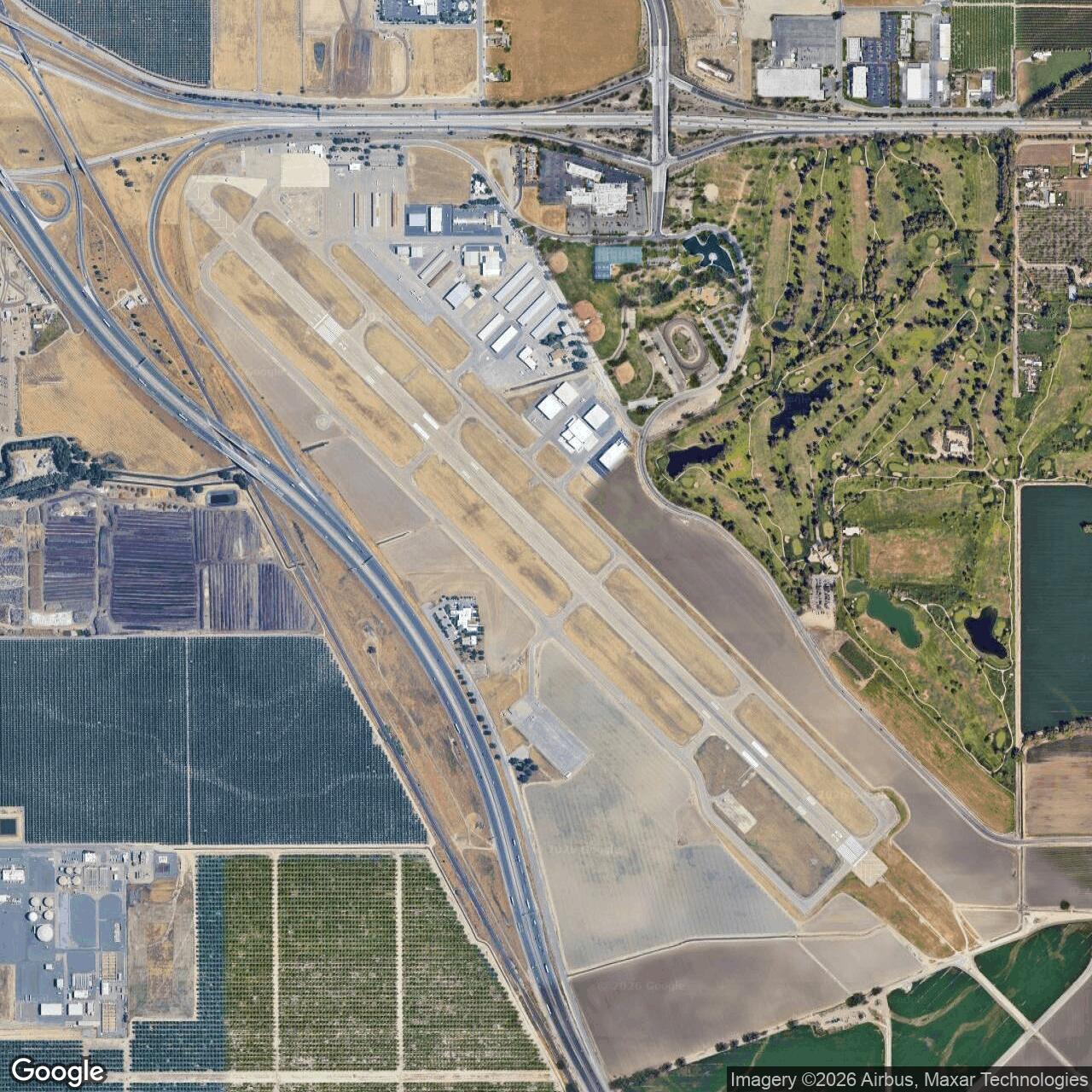
The wartime field is now Visalia Municipal Airport, owned by the City of Visalia. Current FAA-derived information identifies the airport as VIS/KVIS at 36.318638, -119.392861, approximately four miles west of the city. It is an uncontrolled public airport with a 6,562 by 150-foot paved runway, a parallel taxiway, instrument approaches, and a small helipad.
The airport primarily serves general aviation, business aviation, flight training, maintenance, emergency activity, and occasional military traffic. Scheduled airline service has operated intermittently during the postwar era, but the airport's current identity is principally general aviation. No active Army cantonment or assigned military unit remains.
Chronology
- 27 April 1927 Sol Sweet and Edwin Deeds dedicated an early private airstrip on the future airport site.
- 28 June 1928 Visalia voters approved bonds for municipal acquisition and improvement of the field.
- June 1928 The municipal airport began operating with two grass strips.
- 1936-1941 Works Progress Administration projects improved the runway, drainage, and lighting.
- 1939 Civilian pilot training received government approval at Visalia.
- February 1942 The War Department assumed control of Visalia Municipal Airport.
- February-June 1942 The 47th Bombardment Squadron conducted anti-submarine patrols using A-29 and later B-25 aircraft.
- 1942-1943 The Army leased and acquired adjoining parcels and expanded the military field.
- 1942-1943 Visalia became a Hammer Field sub-installation supporting bomber training and staging.
- January 1944 The Army Air Forces transferred its night-fighter training program to California under Fourth Air Force.
- 25 February 1944 The 425th Night Fighter Squadron began its documented Visalia station period.
- 1 May 1944 The 425th completed its Visalia period and continued toward overseas deployment.
- May 1944 The 425th graduated from the California night-fighter program.
- Summer 1944 The 425th entered combat in the European Theater.
- December 1944 During the Battle of the Bulge, the 425th and 422d Night Fighter Squadrons supported the 101st Airborne Division around Bastogne in night and poor-weather operations.
- 7 April 1945 An Army station list recorded a communications detachment of the 85th Army Air Forces Base Unit at Visalia.
- 1945 A War Department inventory reported 465 controlled acres and capacity for 312 enlisted personnel and 32 officers.
- 1946 The War Assets Administration began terminating military leases and returning property.
- 9 December 1946 United Airlines restored scheduled civil service.
- 1947 The City of Visalia regained the remaining airport property.
- 1949 Local government adopted a comprehensive airport master plan.
- 1971 A new airport master plan guided continued development.
- Present Visalia Municipal Airport remains an active City-owned public airport on the former Army airfield.
Sources & References
- WEB City of Visalia Airport History
- WEB City of Visalia Airfield Information
- WEB City of Visalia Visalia Municipal Airport
- PDF Air Force History and Museums Program, (0.87 MB)Stephen L. McFarland, Conquering the Night: Army Air Forces Night Fighters at War
- WEB California Military Department, California State Military Museums Program Visalia Army Air Field
- WEB AirNav, KVIS Visalia Municipal Airport Source for current airport information
- WEB SkyVector, VIS Visalia Municipal Airport -
- WEB National Museum of the United States Air Force Northrop P-61C Black Widow
- PDF Air Force Historical Studies Office, Combat Squadrons of the Air Force, World War II (98.5 MB)