
Camp White Army Base, White City Oregon
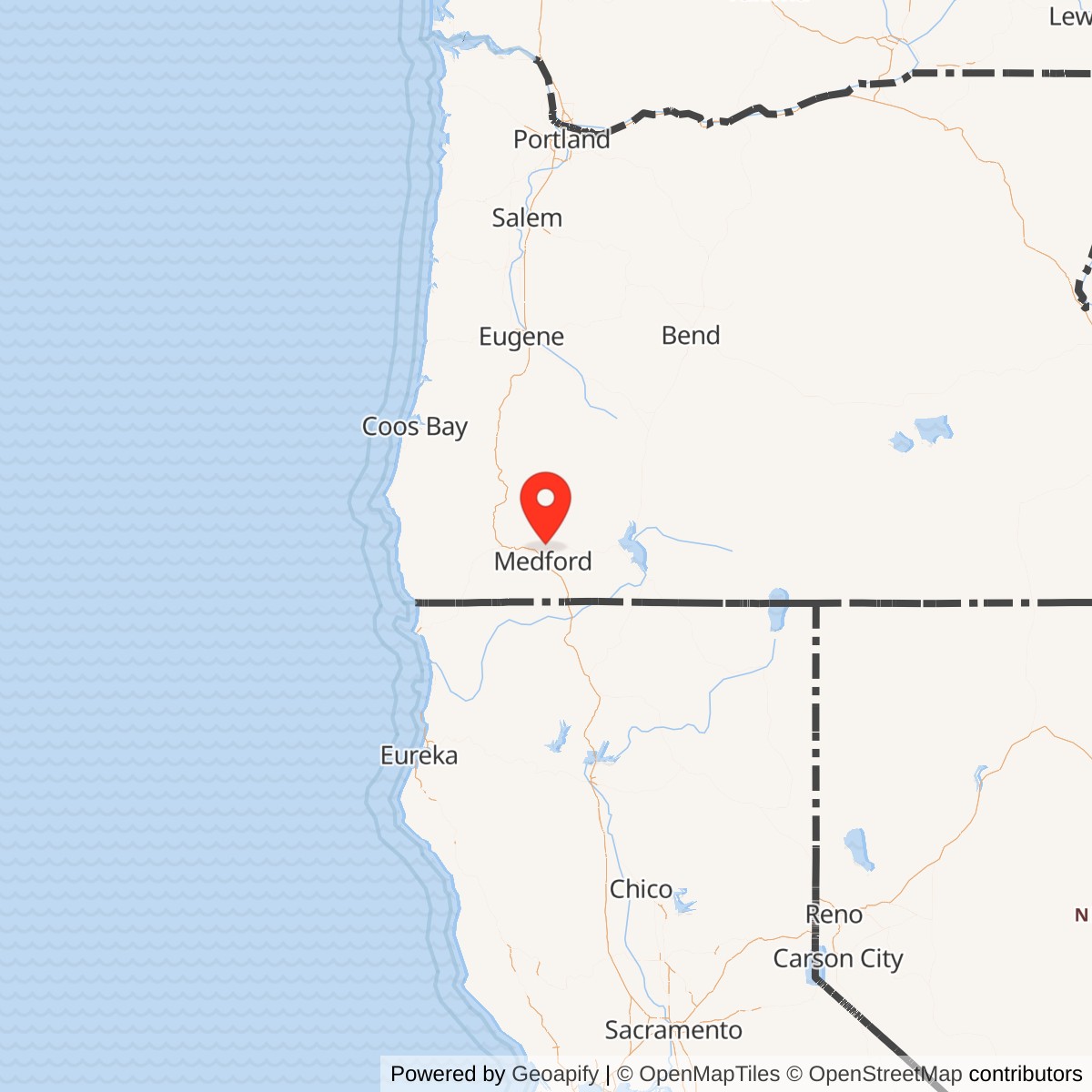
Longitude: -122.8363000
Official Base Website: Former Camp White / White City VA Medical Center and White City
Current Role: White City VA Medical Center on the former station hospital; White City industrial, commercial, residential, and county uses; Ken Denman Wildlife Area; BLM and conservation lands at Table Rocks; farms, roads, and private property
In a matter of months, the U.S. Army turned dry ranchland and open range north of Medford into a temporary city larger than almost every community in Oregon. Camp White was built in 1942 as a World War II division-training cantonment, then expanded into a complex of barracks, hospitals, warehouses, ranges, maneuver grounds, artillery positions, engineering areas, prisoner-of-war facilities, utilities, roads, rail connections, and service buildings. At its peak, the camp held more than 40,000 soldiers and military personnel, while more than 110,000 troops passed through during the war.
The installation occupied roughly 43,000 to 50,000 acres depending on the date and source used. An Army medical-unit history listed 49,638 acres, while Jackson County later recorded a peak footprint of 43,485 acres. The difference reflects changing boundaries, land accounting methods, and the distinction between the cantonment, maneuver lands, and outlying range areas. The scale was enormous in either case. Camp White spread from the Agate Desert near present White City toward the Rogue River, the Table Rocks, and rugged foothill terrain chosen specifically to harden soldiers for combat.
Camp White was named for Major General George Ared White, longtime adjutant general of the Oregon National Guard and commander of the 41st Division. White had served during the Spanish-American War, on the Mexican border, and in World War I. He died in November 1941, shortly before the United States entered World War II. Naming the camp for him connected the new federal installation to Oregon's National Guard tradition and to one of the state's most influential military leaders.
The camp's principal mission was to prepare infantry divisions and specialized units for overseas combat. The 91st Infantry Division was reactivated there on 1942-08-15. Camp White also trained the 96th Infantry Division and supported engineering, artillery, medical, transportation, signal, ordnance, quartermaster, and service organizations. Its station hospital treated the enormous military population and formed the nucleus of the present White City VA Medical Center.
Camp White was deactivated and declared surplus in spring 1946. Some accounts date the deactivation to April, while Jackson County planning records use May 1946. Most temporary buildings were sold, demolished, or moved. The station hospital transferred into the veterans' medical system, the cantonment infrastructure helped create White City and its industrial district, former training lands became farms, businesses, residences, wildlife habitat, and public lands, and concrete defensive positions and range remnants survive around the Table Rocks.
Why the Agate Desert Was Chosen
Southern Oregon civic leaders began promoting the Medford area for a military cantonment during 1941. The region offered a combination that the Army needed urgently: large tracts of lightly developed land, a relatively mild climate, rail and highway access, timber and construction labor, an existing airport, proximity to Medford, and varied terrain within a compact region.The flat Agate Desert provided space for the cantonment. Forested hills, river crossings, rocky ground, brush, and the Table Rocks supplied terrain for maneuver and weapons training. The contrast between open plain and rugged surrounding country allowed the Army to teach soldiers to operate in several environments without moving them to another installation.
The Rogue River formed an important natural barrier and training feature. Units practiced crossings, movement, engineering, and tactical problems in the river corridor. Upper Table Rock and nearby ground were used for fortified-position and infantry training, leaving concrete pillboxes and other remnants that remain visible on Bureau of Land Management property.
The site was not unoccupied wilderness. Farms, ranches, homes, roads, irrigation works, and local communities already existed across the selected land. Federal acquisition disrupted established land use and forced some residents to relocate. Construction also transformed the regional economy, pulling thousands of workers into a project operating around the clock.
Medford's business community supported the camp because it promised federal investment, employment, population growth, and permanent infrastructure. That optimism proved justified economically, but the speed and scale of construction also created shortages, congestion, housing pressure, and major social change across Jackson County.
Emergency Construction
Congressional and War Department action after Pearl Harbor moved the project from proposal to construction at extraordinary speed. The approximately $27 million program began in early 1942, with construction initiated on 1942-02-28 according to National Register documentation.The original completion target was August 1942. That date slipped as the project expanded, but the cantonment was sufficiently ready for the 91st Infantry Division's reactivation on 1942-08-15 and Camp White's formal dedication on 1942-09-15. Work continued through the fall, and the major construction program was substantially complete by 1942-12-15.
More than 1,300 buildings were erected. Most were standardized mobilization structures designed for rapid construction and short service life. Barracks, mess halls, headquarters, chapels, theaters, exchanges, warehouses, maintenance shops, motor pools, classrooms, medical buildings, fire stations, guard facilities, and recreation centers formed the temporary city.
The Army built roads, water mains, sewer systems, power distribution, telephone lines, rail spurs, fuel storage, heating systems, and waste facilities. These utility networks later became one reason civilian and industrial development took root so quickly after the war.
The construction effort consumed lumber, concrete, pipe, electrical equipment, vehicles, and skilled labor at a time when the nation was building hundreds of military installations. Local workers joined construction crews from outside the region. Businesses in Medford, Central Point, Eagle Point, and surrounding communities struggled to keep pace with demand.
The hospital differed from much of the cantonment. Its brick and masonry administrative and treatment structures were built for greater durability. That physical distinction helped the medical complex survive when most wooden buildings were later dismantled.
Physical Layout
Camp White consisted of several interdependent landscapes. The main cantonment near present White City housed troops, headquarters, schools, services, warehouses, and medical facilities. Large maneuver and range areas extended outward from this built core.The cantonment followed the grid-like planning typical of World War II mobilization camps. Repetitive blocks of barracks and mess halls could house organizations by regiment, battalion, company, or service unit. Roads connected those troop areas to motor pools, warehouses, training grounds, and the station hospital.
The station hospital occupied a separate, carefully planned complex. Buildings were connected by covered corridors so patients and staff could move between wards, treatment spaces, kitchens, administration, laboratories, and support facilities in bad weather.
Ranges supported rifles, machine guns, mortars, artillery, antitank weapons, grenades, demolitions, and other infantry systems. Impact areas and safety fans required much of the reservation's acreage.
The fortified zone near Upper Table Rock included concrete pillboxes and defensive positions. Soldiers practiced attacking prepared positions, using cover, coordinating weapons, and moving across difficult ground. BLM archaeologists continue to interpret these remnants during guided historical hikes.
Engineering areas allowed soldiers to practice road building, bridge work, obstacles, field fortifications, demolitions, utilities, and construction. Medical units trained in field-hospital setup, evacuation, sanitation, and treatment. Artillery units used firing points, observation positions, survey systems, ammunition supply, and impact areas.
The camp also depended on the nearby Medford airport and rail network. Aircraft could support liaison, observation, transport, and emergency missions, while trains moved soldiers, equipment, fuel, ammunition, food, and building materials.
The 91st Infantry Division
The 91st Infantry Division was the formation most closely identified with Camp White. The Army reactivated it there on 1942-08-15 under Major General Charles H. Gerhardt.The division included the 361st, 362nd, and 363rd Infantry Regiments; four field-artillery battalions; the 316th Engineer Combat Battalion; the 316th Medical Battalion; a mechanized reconnaissance troop; and signal, ordnance, quartermaster, military-police, and headquarters organizations.
Camp White's mission was to transform those separate organizations into a functioning division. Soldiers learned individual weapons and field skills, then progressed through squad, platoon, company, battalion, regiment, and division exercises.
Training included marching, physical conditioning, marksmanship, machine guns, mortars, grenades, antitank weapons, camouflage, field sanitation, communications, map reading, patrolling, night movement, supply, maintenance, medical evacuation, and combined use of infantry and artillery.
Gerhardt's demanding program contributed to Camp White's nickname, the "Alcatraz of Boot Camps." The phrase reflected the isolation, hard terrain, dust, heat, winter weather, and relentless training tempo rather than a formal Army title.
The division took part in the large Oregon Maneuver of 1943. That exercise moved major forces across central Oregon and tested command, logistics, mobility, communications, reconnaissance, and large-unit tactics under realistic field conditions.
The 91st departed for overseas service in 1944. It fought in Italy during the Rome-Arno, North Apennines, and Po Valley campaigns. Soldiers trained in Oregon faced mountain warfare, fortified positions, rivers, mines, artillery, and difficult supply conditions.
The division's combat record gave Camp White a direct connection to the liberation of Italy. The camp itself never saw combat, but the preparation performed there shaped units that did.
The 96th Infantry Division and Other Combat Units
Camp White also supported training by the 96th Infantry Division, although the division had been activated at Camp Adair. Army training installations frequently shared ranges, maneuver grounds, schools, and specialized facilities as units moved through progressive training.The 96th Infantry Division later fought in the Pacific at Leyte and Okinawa. Its campaigns involved jungle terrain, fortified Japanese positions, caves, artillery, disease, mud, and sustained close combat.
The contrast between southern Oregon and the tropical Pacific was considerable, but the Army's fundamental training objectives remained relevant: physical endurance, small-unit discipline, accurate fire, artillery coordination, engineering, medical evacuation, logistics, and leadership under pressure.
Camp White trained many organizations that were not part of a permanently assigned division. Engineering, artillery, medical, signal, ordnance, quartermaster, transportation, and support units cycled through the camp.
These organizations made the installation more than an infantry school. They allowed Camp White to reproduce the systems required to sustain a modern field army.
The camp's training population changed repeatedly. Divisions arrived, trained, maneuvered, and left. Specialized units activated, assembled personnel and equipment, completed training, and moved to ports or other stations.
More than 110,000 troops reportedly passed through Camp White during the war. That throughput is a better measure of its contribution than the maximum population on any single day.
Training and the Oregon Maneuver
The Oregon Maneuver of 1943 was among the largest Army training exercises conducted in the Pacific Northwest. It used a broad area of central Oregon and involved formations associated with Camp White and Camp Adair.The maneuver forced units out of fixed cantonments and into sustained field conditions. Soldiers moved by foot and vehicle, established camps, maintained communications, supplied food and fuel, crossed difficult terrain, and responded to opposing forces.
Large exercises exposed weaknesses that routine range training could not reveal. A unit could perform well on a firing range but fail when roads became congested, radios broke, fuel arrived late, or headquarters lost track of subordinate organizations.
The Army used umpires and after-action reports to evaluate decisions, discipline, security, camouflage, logistics, and tactical performance.
For Camp White soldiers, the Oregon Maneuver represented the transition from installation-based training to something closer to campaigning. It tested whether the habits learned on the Agate Desert could survive confusion, fatigue, distance, and uncertainty.
The exercise also affected civilian communities across Oregon. Military traffic crowded roads, troops crossed ranches and public lands, and residents encountered a temporary battlefield spread across a large region.
Medical Training and the Station Hospital
Medicine was one of Camp White's most important missions. A camp of tens of thousands required routine medical care, emergency treatment, surgery, dental services, preventive medicine, disease control, rehabilitation, and evacuation planning.The station hospital was built as a substantial complex rather than a collection of ordinary barracks. Its administration building, wards, treatment facilities, kitchens, utility systems, and connecting corridors formed a specialized medical campus.
The Camp White Station Hospital Administration Building, now VA Building 200, was constructed in 1942 and is the best-preserved building from the medical complex. It was listed on the National Register of Historic Places in 2016.
Medical units also activated or trained at Camp White. The 24th Field Hospital was activated there on 1942-08-19. The 82nd General Hospital was activated there on 1942-08-20. Oregon historical imagery also documents nurses of the 79th General Hospital at the camp in 1943.
Field hospitals had to be able to establish treatment near combat formations, receive casualties, perform surgery, stabilize patients, and move them rearward. General hospitals provided more extensive treatment farther behind the front.
Training included tentage, patient flow, sterilization, pharmacy, laboratories, records, supply, sanitation, ambulance operations, surgery, nursing, and mass-casualty procedures.
The station hospital also treated injuries and illnesses generated by training. Live ammunition, vehicles, construction, heat, cold, dust, disease, physical exertion, and accidents made medical support part of daily readiness.
The survival of the hospital complex gave Camp White its most direct postwar continuity. The site shifted from preparing soldiers for war to caring for veterans after service.
Engineering, Artillery, and Specialized Training
Camp White's terrain and construction resources made it valuable for engineer training. Engineers learned to build and repair roads, bridges, drainage, field fortifications, water systems, and camp utilities.Combat engineers also trained in demolitions, mine warfare, obstacle creation, obstacle reduction, and support to infantry movement. These skills were essential in Italy, France, the Pacific, and other theaters.
Artillery units practiced survey, observation, fire direction, communications, ammunition handling, maintenance, and live firing. Artillery training required coordination across large distances and depended on accurate mapping and disciplined range control.
Signal personnel established telephone, radio, and wire networks. Quartermaster units handled food, fuel, clothing, transportation, and field services. Ordnance personnel maintained weapons and vehicles.
These support missions are easy to overlook, but infantry divisions could not fight without them. Camp White's value came partly from its ability to train the division as a system.
The fortified positions around Table Rock gave infantry and engineers a controlled environment for assault training. Concrete pillboxes allowed soldiers to practice suppressing, bypassing, breaching, and clearing prepared defenses.
Prisoners of War
Camp White became a prisoner-of-war installation during the later part of the war. German prisoners were present by late 1943 or 1944, with the POW mission continuing as the training population declined.The camp provided fenced compounds, guards, barracks, kitchens, sanitation, medical care, administration, censorship, and recreation under War Department regulations and the Geneva Convention.
Prisoners performed authorized labor at Camp White and in the surrounding region. Agricultural and forestry employers faced severe labor shortages because military service and war industry had drawn workers away.
Some prisoners held at Camp White were transferred to Camp Tule Lake, where they worked for local farmers. Army trucks carried prisoners under guard to work sites.
Prisoners received limited compensation that could be used in camp canteens or retained in accounts. Their labor supported food production and other essential home-front activities.
The POW mission brought enemy soldiers captured overseas into direct contact with southern Oregon's agricultural economy. It also created a complex social environment involving guards, civilians, prisoners, local employers, and military administrators.
The camp's POW story should not be separated from its main training mission. Both were parts of the same national manpower system. American soldiers were prepared for overseas duty while captured enemy soldiers were used to relieve domestic labor shortages.
Camp Life and Southern Oregon
Camp White reshaped southern Oregon almost overnight. Medford and nearby communities experienced a sudden influx of construction workers, soldiers, civilian employees, families, contractors, and businesses.Housing became scarce. Restaurants, theaters, stores, transportation providers, and entertainment venues faced extraordinary demand. Local farms and orchards gained customers but also lost labor to construction and military employment.
The camp's population was large enough to make it, temporarily, Oregon's second-largest community. This comparison captures the scale of the installation but understates its wider regional influence.
Soldiers on leave traveled to Medford and other towns. Civic organizations, churches, USO programs, and businesses developed services for military personnel.
The camp also changed roads, utilities, land values, and employment patterns. Skills learned during construction and military support contributed to postwar industrial growth.
Tension accompanied opportunity. Traffic, noise, shortages, discipline problems, rising prices, and social change challenged communities that had been comparatively rural before 1942.
The wartime boom did not end neatly when the Army left. Businesses and workers had to adapt to the sudden collapse of military demand after 1945.
Drawdown and Closure
The need for division training declined after victory in Europe and the Pacific. Units departed, temporary organizations inactivated, and Camp White's population fell rapidly.The Army shifted toward demobilization, property disposal, and preservation of facilities judged useful for other federal purposes.
Camp White was deactivated and declared surplus in spring 1946. Secondary accounts often use April 1946, while Jackson County planning records identify May 1946.
The difference does not change the central fact. The Army installation ceased to function as an active division-training camp within months of the war's end.
Most of the wooden mobilization buildings had little peacetime value to the Army. Contractors purchased structures and materials, dismantled buildings, and reused lumber, windows, plumbing, fixtures, and equipment.
Some buildings were moved intact. The Oregon Encyclopedia records that structures went to the University of Oregon, where wartime buildings helped address postwar enrollment and housing needs.
Land returned to private ownership or transferred to public agencies. Former ranges, roads, foundations, utilities, magazines, and impact areas remained scattered across a fragmented landscape.
The Station Hospital Becomes a Veterans Facility
The station hospital survived because it offered a ready-made medical campus at a time when the federal government needed long-term facilities for veterans.National Register documentation states that the hospital transferred to the Veterans Administration Domiciliary on 1948-09-14. On 1949-02-20, the former Camp White hospital officially became the Veterans Administration Domiciliary.
The facility developed into the Southern Oregon Rehabilitation Center and Clinics and is now the White City VA Medical Center within the VA Southern Oregon Healthcare System.
The present medical center provides primary and specialty care, mental health services, rehabilitation, dentistry, laboratory services, prosthetics, vision care, and other programs.
VA reported in 2024 that White City maintained 255 residential rehabilitation beds and outpatient primary and mental health services.
The station hospital administration building continues its historic administrative function. Its preservation provides one of the clearest physical links between the World War II camp and the modern campus.
The transfer created an unusually direct continuity of mission. Army medicine had cared for soldiers in training. The Veterans Administration and later Department of Veterans Affairs used the same place to care for former service members.
White City and Industrial Reuse
Camp White's utility networks, roads, cleared land, warehouses, and service areas encouraged postwar industrial development.The former building core became the White City Industrial Park. Timber processing and related industries used the site during southern Oregon's postwar economic expansion.
The surrounding unincorporated community adopted the White City name in 1960, replacing the Camp White postal identity.
Jackson County describes White City as a major employment and industrial center developed largely on former Camp White land.
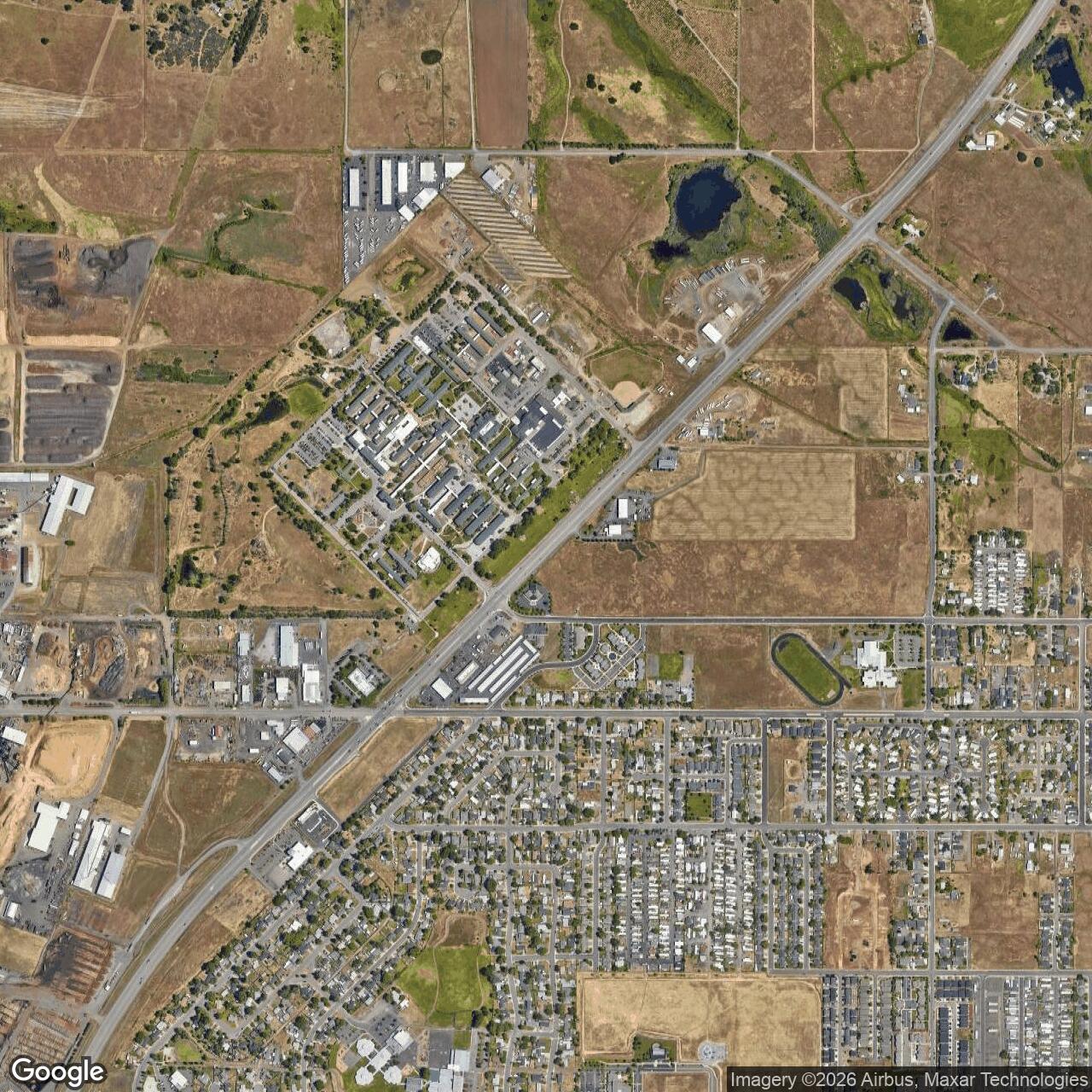
Industrial, residential, commercial, county, and transportation uses now cover much of the former cantonment. The military grid is difficult to recognize in some places, while roads, foundations, utilities, and isolated structures preserve fragments of the camp plan.
The modern community is therefore not merely near the camp site. White City grew from the infrastructure and land disposition of Camp White.
Ken Denman Wildlife Area
In 1954, the federal government conveyed 1,760 acres of the former Camp White Military Reservation to the Oregon Game Commission.That land became the wildlife area now known as the Ken Denman Wildlife Area. It preserves wetlands, ponds, river frontage, agricultural fields, wildlife habitat, and former military features.
The wildlife area demonstrates one path of postwar reuse. Land once used for troop training and military storage became a state-managed habitat and recreation area.
Former ammunition-storage structures and other military remnants remain within or near the wildlife area.
The shift did not erase military history. It layered conservation and recreation over a landscape shaped by wartime construction and training.
Table Rocks and the Fortified Zone
The Table Rocks preserve some of Camp White's most dramatic training remnants. Concrete pillboxes and fortified positions remain in areas managed by the Bureau of Land Management and The Nature Conservancy.BLM has offered guided hikes focusing on the "Fortified Zone" and Camp White's reputation as the "Alcatraz of Boot Camps."
These features show how the Army used permanent concrete structures to create repeatable training problems. Units could attack the same defensive positions under controlled conditions while instructors evaluated tactics.
The Table Rocks also carry a much older and more important Indigenous history. They are culturally significant to Native peoples of the Rogue Valley and are managed with tribal consultation.
Camp White's military use represents only one period in a landscape shaped by Takelma and other Native communities, removal, agriculture, conservation, and recreation.
Munitions and Environmental Legacy
Camp White used live ammunition, artillery, mortars, grenades, antitank weapons, demolitions, and small arms across a large reservation.Not every munition fired during training detonated. Construction, erosion, forestry, farming, recreation, and development can expose military debris or unexploded ordnance decades later.
Former range lands require caution. Anyone encountering a suspicious military item should not touch or move it and should follow the standard Recognize, Retreat, and Report guidance.
Environmental concerns also include former fuel storage, vehicle maintenance, waste disposal, hospital operations, sewage systems, firing ranges, and industrial reuse.
The fragmented ownership of the former reservation complicates investigation and cleanup. Federal, state, county, private, conservation, industrial, and residential owners now control different portions.
Preservation presents a related challenge. Temporary buildings disappeared by design, while concrete features, foundations, roads, and archaeological remains survive without unified protection.
Current Status
Camp White is closed and no longer exists as an active Army installation.Its former station hospital is now the White City VA Medical Center, an active Department of Veterans Affairs health-care and rehabilitation campus.
The former cantonment core became White City, including industrial, commercial, residential, county, and public-service uses.
Former reservation land also includes the Ken Denman Wildlife Area, BLM and conservation lands around the Table Rocks, farms, roads, private property, and other public and private uses.
The Camp White Station Hospital Administration Building remains the best-preserved major building and is listed on the National Register of Historic Places.
Pillboxes, magazines, foundations, roads, and other remnants survive across the former military landscape.
Chronology
- 1941 Medford and Jackson County civic leaders promoted the Agate Desert as a site for a major Army cantonment.
- 1941-11 Major General George A. White died shortly before the United States entered World War II.
- 1941-12 Federal action after Pearl Harbor accelerated selection and funding of the Medford cantonment.
- 1942-02-28 Major construction began.
- 1942-08-15 The 91st Infantry Division was reactivated at Camp White under Major General Charles H. Gerhardt.
- 1942-08-19 The 24th Field Hospital was activated at Camp White.
- 1942-08-20 The 82nd General Hospital was activated at Camp White.
- 1942-09-15 Camp White was formally dedicated.
- 1942-12-15 The principal construction program was substantially complete.
- 1942-1945 Camp White trained the 91st and 96th Infantry Divisions and numerous engineering, artillery, medical, signal, ordnance, quartermaster, and service organizations.
- 1943 The 91st Infantry Division and other Camp White troops participated in the Oregon Maneuver.
- Late 1943-1944 German prisoners of war began arriving as Camp White assumed a POW mission.
- 1944 The 91st Infantry Division deployed overseas and entered combat in Italy.
- 1944-1945 The 96th Infantry Division fought at Leyte and Okinawa after training that included use of Camp White facilities.
- 1945 The camp began rapid drawdown after victory in Europe and the Pacific.
- 1946-04 to 1946-05 Camp White was deactivated and declared surplus. Sources differ by one month on the formal date.
- 1946-1948 Most temporary buildings were sold, dismantled, removed, or reused.
- 1948-09-14 The Camp White hospital transferred to the Veterans Administration Domiciliary.
- 1949-02-20 The former hospital officially became the Veterans Administration Domiciliary at White City.
- 1954 The federal government conveyed 1,760 acres of former Camp White land to the Oregon Game Commission for a wildlife management area.
- 1960 The Camp White postal and community name changed to White City.
- 2016-12-20 The Camp White Station Hospital Administration Building was listed on the National Register of Historic Places.
- 2025 BLM continued public interpretation of Camp White's fortified training zone through guided Table Rocks hikes.
- Present The former camp is divided among the White City VA Medical Center, White City industrial and residential development, Denman Wildlife Area, BLM and conservation lands, farms, roads, and other public and private uses.
Sources & References
- WEB The Oregon Encyclopedia Camp White
- WEB Oregon History Project German POWs, 1944
- WEB Oregon History Project World War II Opens New Doors
- WEB Oregon History Project media collection World War II Opens New Doors
- WEB National Register of Historic Places nomination Camp White Station Hospital Administration Building
- WEB Oregon Historic Sites Database Camp White Station Hospital Administration Building
- WEB White City VA Medical Center
- WEB White City VA Medical Center campus map and official coordinates
- WEB VA Southern Oregon Healthcare System About Us
- WEB VA VA Plans to Modernize Facilities at White City
- WEB Bureau of Land Management Table Rocks Management Area
- WEB Bureau of Land Management Explore the Table Rocks with Free Guided Hikes 2025
- PDF Oregon Department of Fish and Wildlife Denman Wildlife Area Management Plan
- PDF Jackson County Comprehensive Plan Urban Lands and White City
- PDF U.S. Army Center of Military History Soldiers' Art from the 91st Infantry Division in Italy
- WEB Army Historical Foundation 96th Infantry Division
- WEB WWII Medical Research Centre 24th Field Hospital unit history
- WEB WWII Medical Research Centre 82nd General Hospital unit history
- WEB American Legion Our WWII Story: The Namesake of Oregon's Camp White
- WEB Southern Oregon PBS The Camp White Story: Southern Oregon Goes to War
- WEB Oregon Military Department Records Guide