
Sondrestrom Air Base, Greenland
The Greenland staging and support base behind the DEW East stations, from the wartime ferry route to Kangerlussuaq's later civil and military roles.
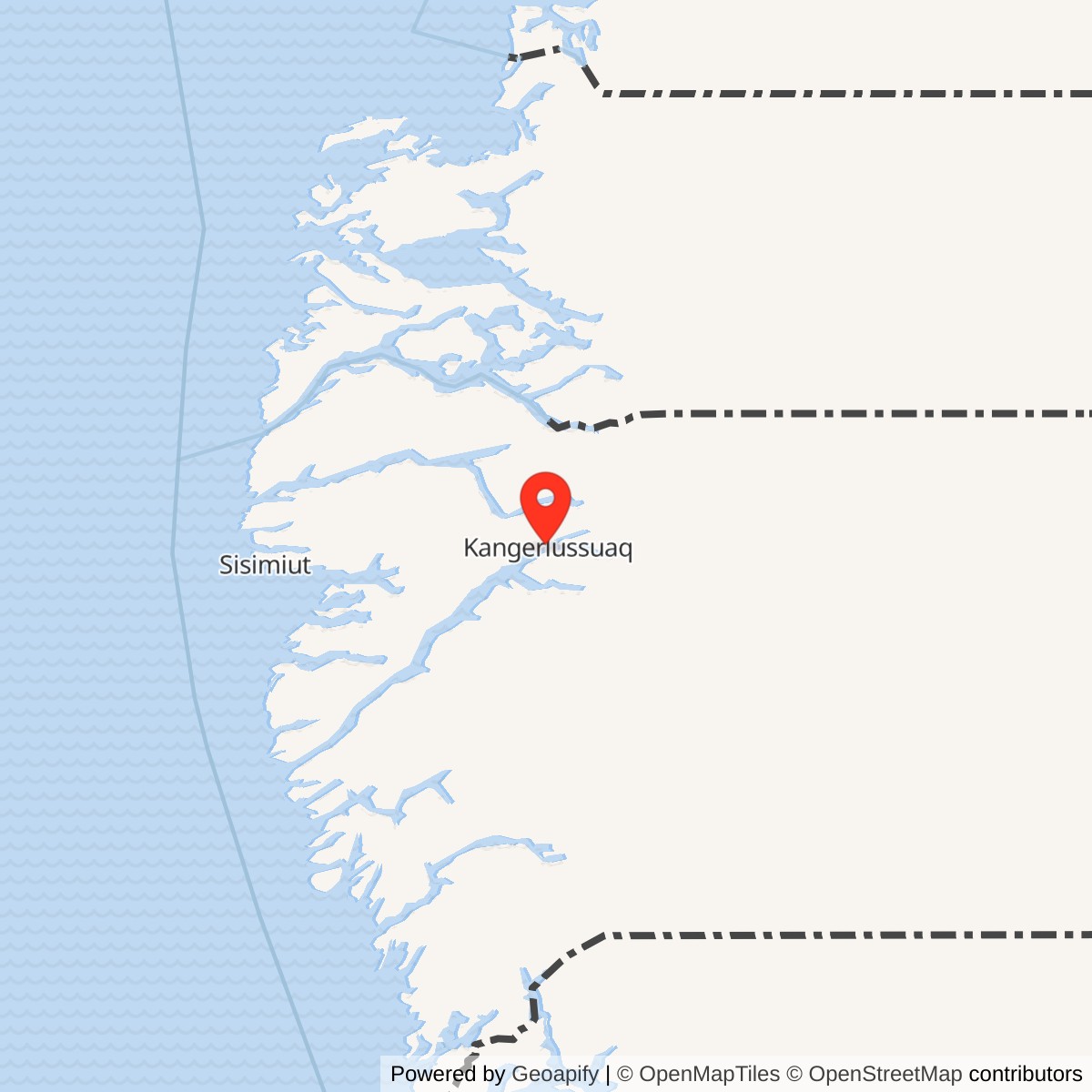
Longitude: -50.711
Site Number: BW-8; DYE-6 support headquarters
Airport ICAO ID: BGSF
Official Base Website: Kangerlussuaq Airport
Current Role: Kangerlussuaq civil airport and settlement; seasonal polar-science airlift documented in 2019; Danish Arctic training school opened 2024; allied winter training and Danish F-35 visit documented in 2026. Current use does not constitute continued USAF base operation.
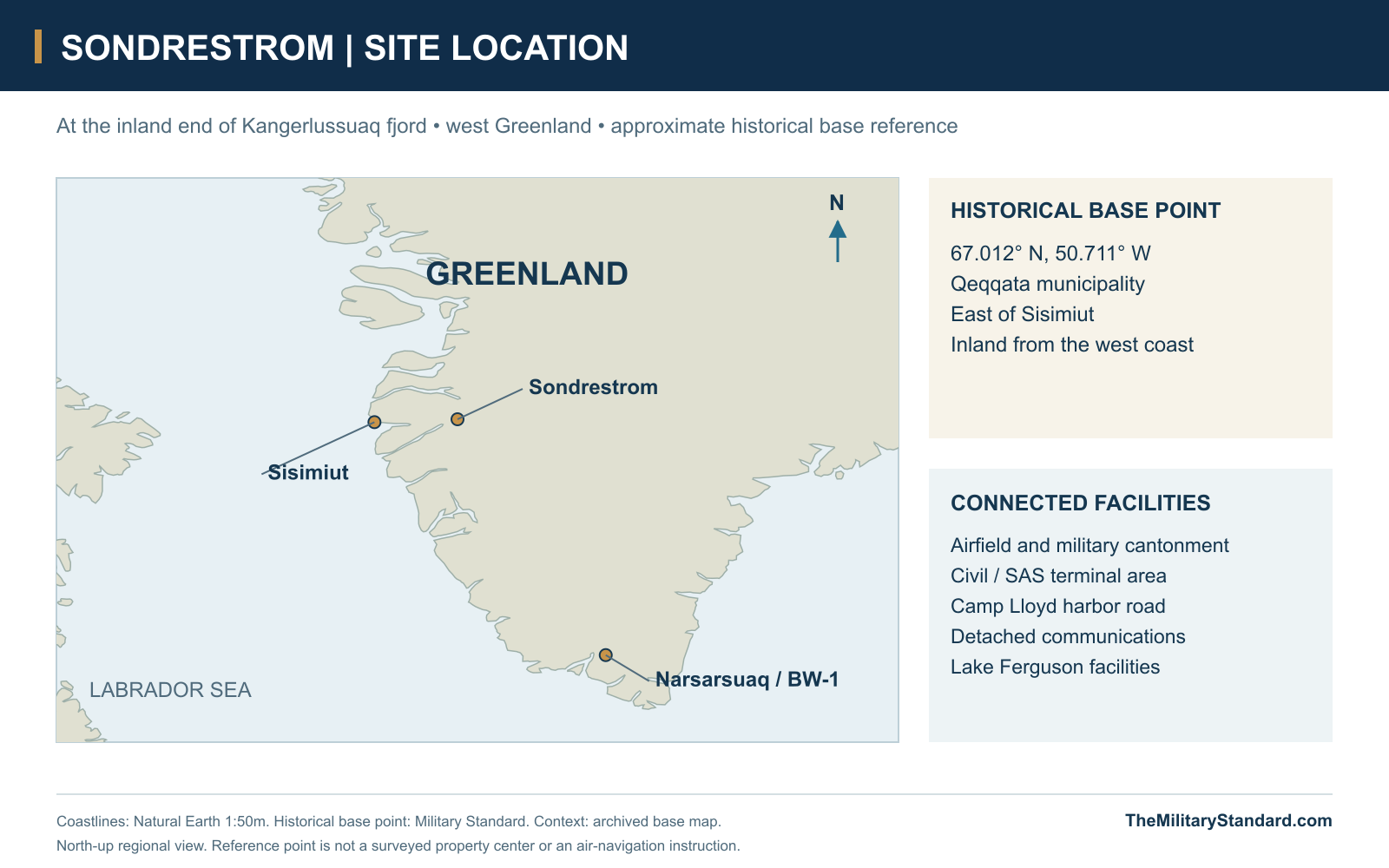
Historical base reference 67.012, -50.711. View map Approximate installation reference, not a runway threshold or property survey. [1]
- Historical codes
- BW-8; DYE-6 survey/support headquarters
- Role
- North Atlantic staging, communications and Greenland DEW logistics
- Host organizations
- 4684th Air Base Group; later 1015th Air Base Squadron documented
- Communications
- 2004th AACS / Communications Squadron; air traffic control and long-distance circuits
- Ski-airlift
- C-130D and later LC-130; 17th TAS and 109th TAG
- U.S. base period
- 1941 to September 30, 1992, with a 1950-1951 Danish control interval
- Successor airport
- Kangerlussuaq Airport, BGSF / SFJ
- Location
- Inland end of Kangerlussuaq fjord, Qeqqata municipality, west Greenland
History
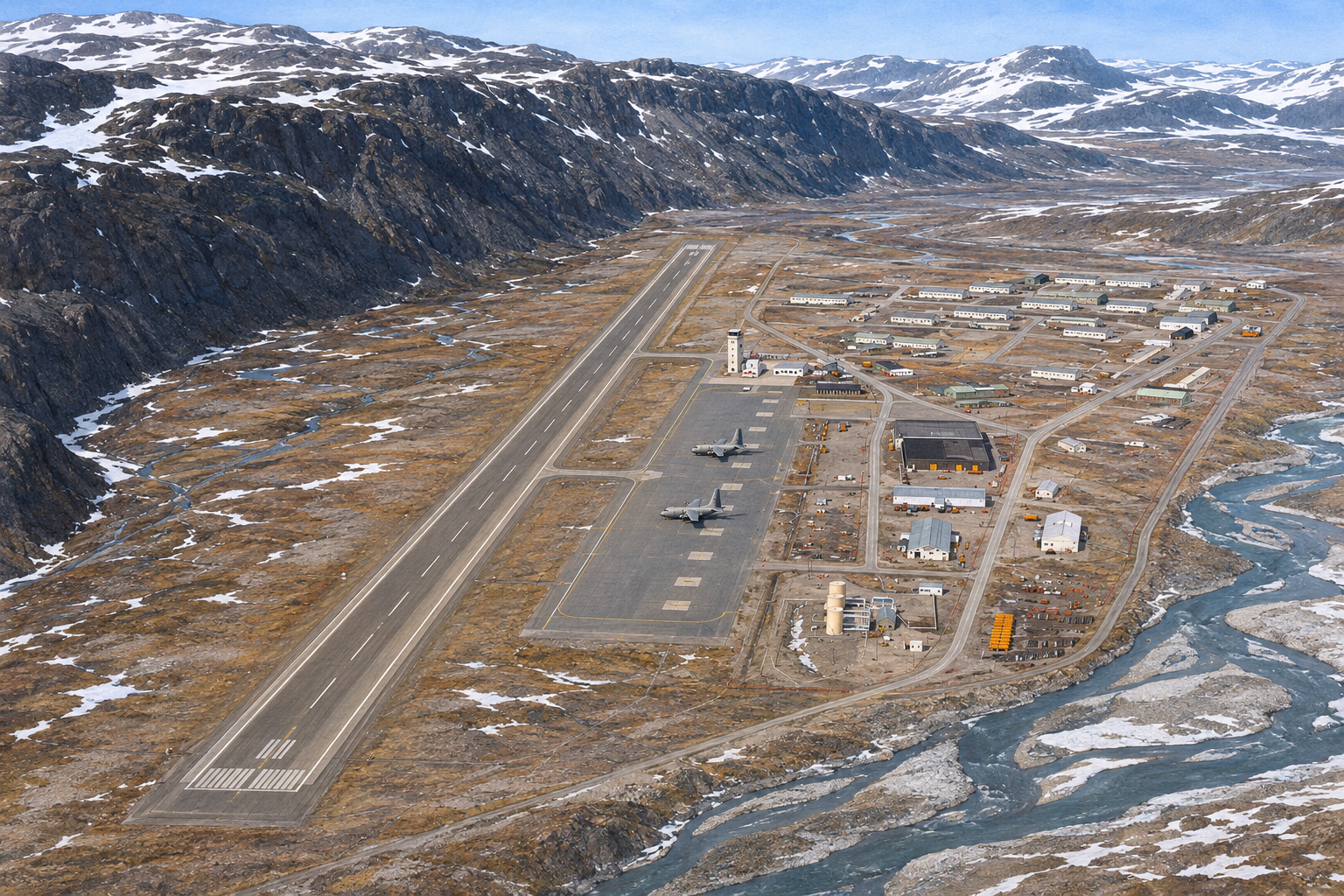
Sondrestrom Air Base grew from the wartime Bluie West Eight airfield into the principal supply and aviation-support center for the Greenland DEW stations. It occupied a valley at the inland end of the long fjord now called Kangerlussuaq, north of the Arctic Circle. Its runway connected transatlantic aircraft movements with a port, fuel stores, workshops and a substantial living community. The DYE-6 designation described a survey headquarters and support role associated with the Greenland warning extension; it did not make the base another AN/FPS-30 radar station on the ice sheet. The base sustained the people and machines that kept those remote stations operating. [4] [8]
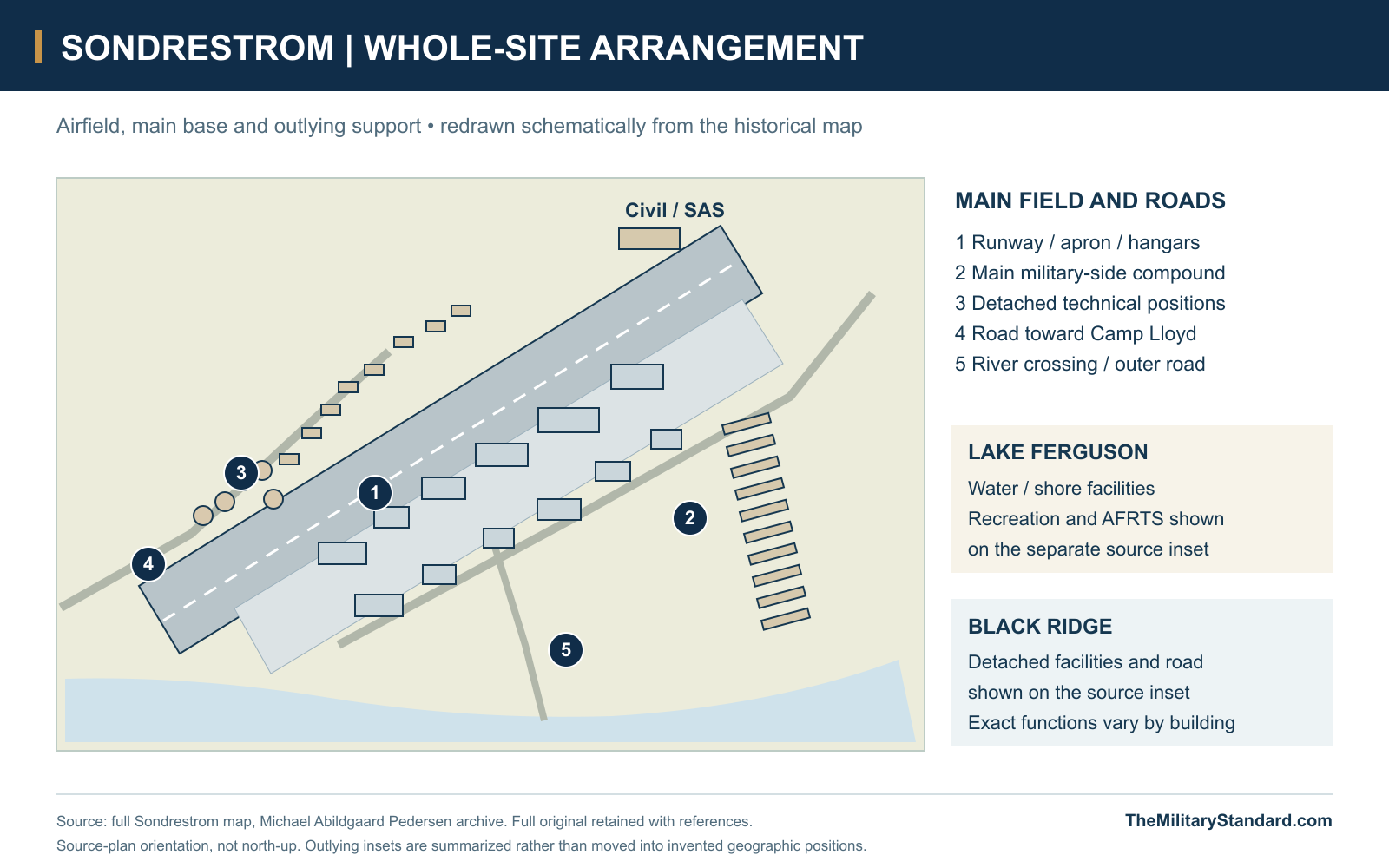
The historical installation reference used here is 67.012 north, 50.711 west, as published in the existing base history. It identifies the former base area rather than a runway threshold or a surveyed property boundary. The airfield, military cantonment, civil terminal, harbor connection and detached communications facilities occupied different parts of the landscape. U.S. Air Force base operation ended in September 1992, but the runway and community continued as Kangerlussuaq. Subsequent American scientific airlift and Danish military activity used that continuing aviation infrastructure under different arrangements. [1] [5] [20] [25] [27]
Building Bluie West Eight
The need for a second Greenland landing field arose from the limits of the North Atlantic ferry route. An aircraft unable to land at Bluie West One near Narsarsuaq required a usable alternative before its remaining fuel became critical. A civilian construction party reached the Sondrestrom area in autumn 1941, and the Army engineering history records runway work during November and substantial grading by early January 1942. Bernt Balchen's work at the site belonged to this effort to turn a valley and a sea-supply connection into an airfield. Establishment, radio service and completion of a landing strip were successive steps rather than one opening ceremony. [2] [3]
The base chronology associates Balchen's arrival and initial construction with October 7, 1941, and radio operation with October 20. By spring 1942 Bluie West Eight was available on the ferry route. Its comparatively dependable flying weather made it valuable beyond its original alternate-field purpose. Aircraft could stage through Greenland on journeys between North America and Britain, while meteorological reports and communications helped crews prepare for the next leg. The airfield therefore supported the movement of combat aircraft without itself being a forward bomber base attacking Europe. [1] [3]
Camp Lloyd, the harbor southwest of the airfield, formed the sea end of the supply system. Cargo brought through the fjord had to be unloaded, stored and carried over the connecting road before it could serve the runway or base buildings. That relationship remained important after air transport improved: ships could deliver bulky stores and fuel that were costly to move by aircraft. The base developed as a set of connected facilities, with the harbor outside the close airfield view. A plan that shows only the runway omits the route by which much of the installation was built and sustained. [4] [5]
War Service and the First Drawdown
During the war, Bluie West Eight supported aircraft ferrying, weather reporting and the pathfinder work needed along the Atlantic route. Its early plant included a 5,000-by-300-foot asphalt runway and a large heated steel hangar. Heating and maintenance space were operational necessities when aircraft and crews might have to wait for weather farther along the route. Runway construction alone could not provide a dependable staging field: communications, accommodation, medical support, fuel and repair facilities were also required. The 417th Base Headquarters and Air Base Squadron appears in the base chronology from September 1942 as part of that supporting establishment. [1]
The end of the European war reduced this demand. Bluie West Eight became an emergency field in 1945, while excess equipment and supplies were moved away. Work resumed on runway restoration, water lines, power and roads in 1947, followed by further winterization. The installation passed through the names Sondrestromfjord Army Air Base and Sondrestromfjord Air Base before becoming Sondrestrom Air Base in January 1952. It briefly returned to Danish control in October 1950. The subsequent American return was a Cold War reopening of an existing airfield, rather than the construction of a completely new base on an unoccupied site. [1] [7]
The Cold War Reopening and the Base Plant
The 1951 Greenland defence arrangements brought American personnel back to Sondrestrom, where rehabilitation supported Operation Blue Jay and the development of Thule. The operating-unit sequence moved through the 6621st Air Base Squadron and Group and the 4084th Air Base Group before the 4684th Air Base Group appeared in 1960. These organizations provided the installation services on which visiting aircraft and remote-site support depended. Their succession should not be confused with a permanently resident fighter wing: Sondrestrom's strength lay in staging, servicing, movement and support rather than a single combat aircraft establishment. [7]
Sondrestrom also supported Strategic Air Command's tanker operations. The command's fortieth-anniversary history lists KC-97s on ground alert at Sondrestrom in its 1963 account of Reflex consolidation, alongside other North Atlantic staging bases. A forward tanker presence required dependable servicing, fuel, maintenance and crew support. That work used the same broad airfield capabilities that made the station useful for ferrying and later DEW resupply. It establishes a strategic-air support role without proving a permanently based bomber wing or assigning a particular weapons-storage mission to the base. [29]
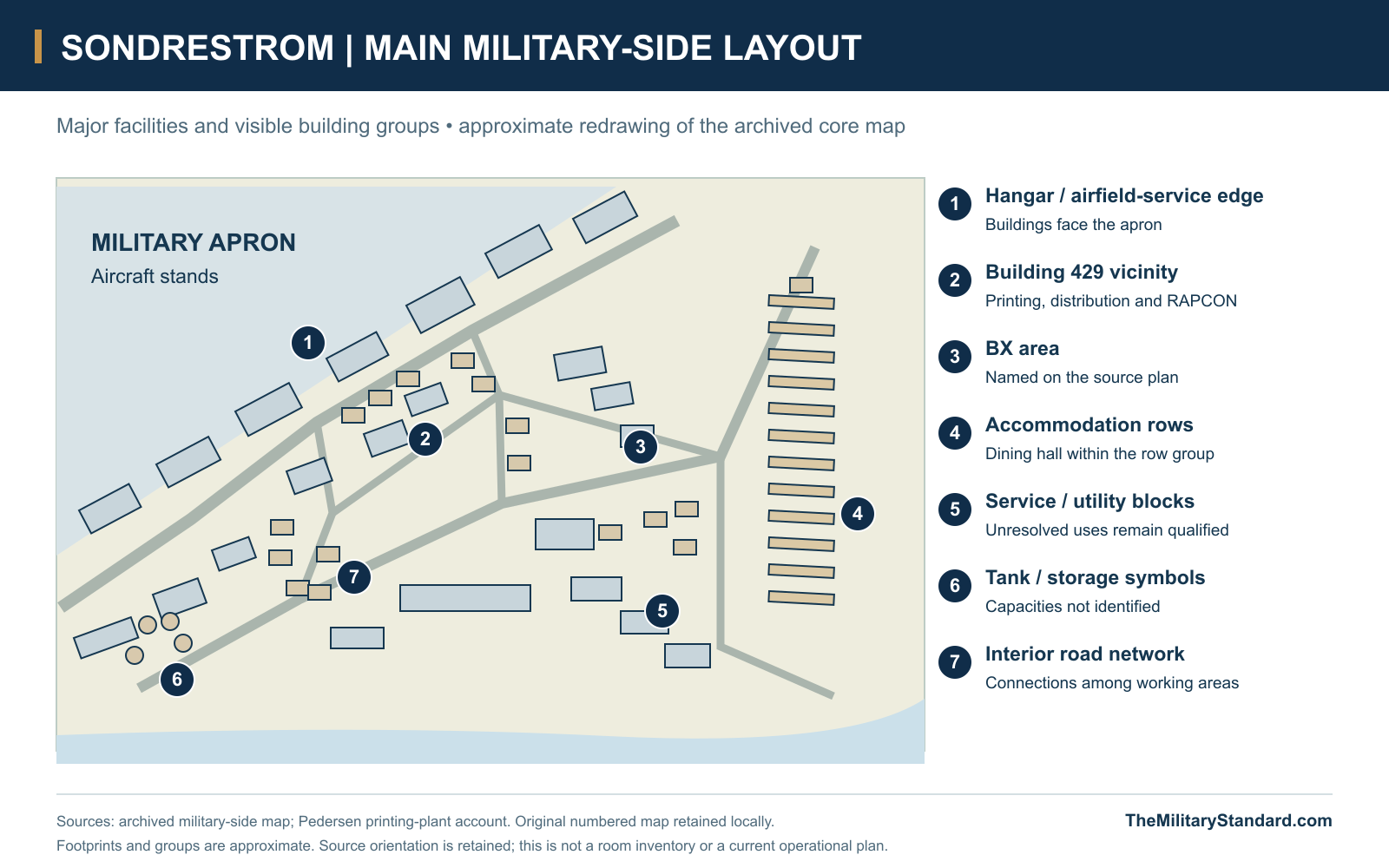
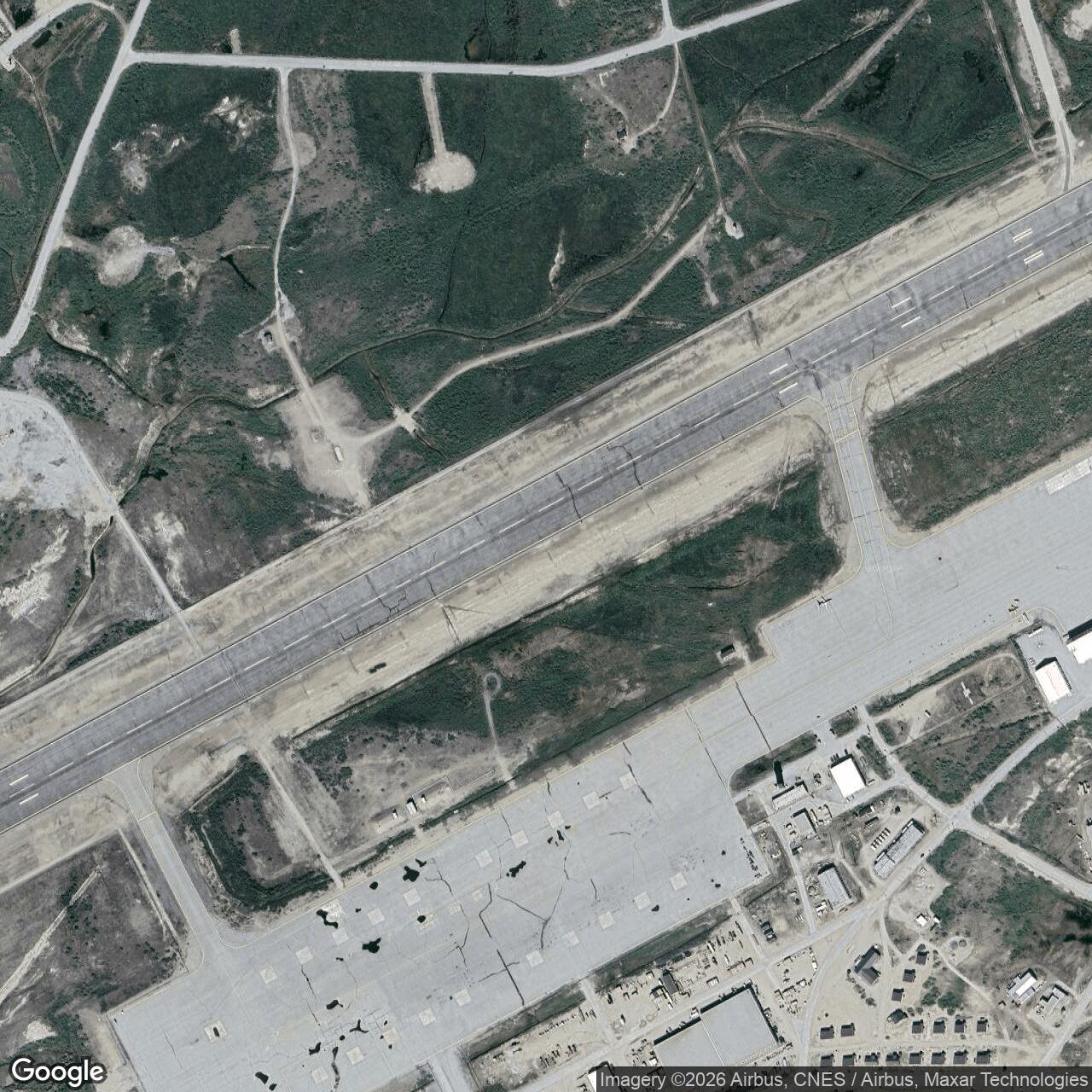
The period maps show how the plant served that mission. The runway and broad apron occupied the center of the valley, with hangar and operating facilities along the military side. Roads led back through numbered workshops, service buildings, stores and accommodation rows toward the river. A separate civil/SAS area lay across the field. The full map also marks communications positions, the harbor road and detached facilities around Lake Ferguson and Black Ridge. These separations mattered in daily movement: freight, fuel, passengers, technical staff and off-duty personnel shared an installation whose functions extended well beyond the aircraft parking stands. [5] [6]
Danish contractors performed much of the continuous work that made this arrangement usable. The contractor account distinguishes transportation, civil engineering, communications, fire, medical and base-service departments. Their responsibilities included air and sea cargo handling, vehicles, fuel distribution, roads, building maintenance, water, heat, electricity, airport electronics, firefighting and health services. Military command did not mean that every task was performed by uniformed personnel. A fuel delivery, runway repair or aircraft turnaround could depend on several civilian trades working together, while military staff retained their operational responsibilities. [15]
Buildings in a Freezing Climate
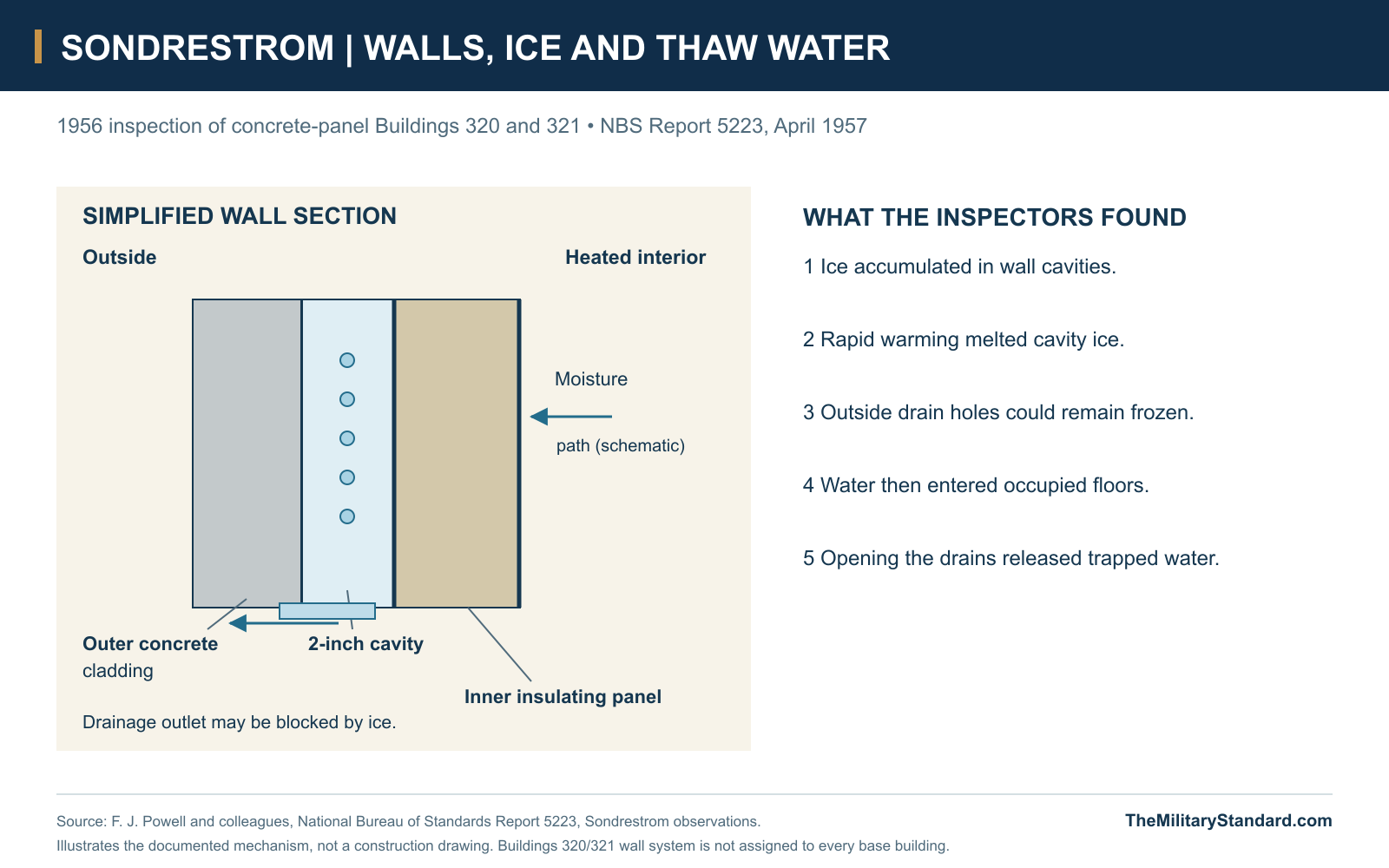
A National Bureau of Standards investigation in 1956 examined a less visible weakness in Sondrestrom's permanent buildings. Airmen's Dormitory 320 and Bachelor Officers' Quarters 321 used prefabricated reinforced-concrete outer panels, an air cavity and insulating inner panels. Ice accumulated inside the walls, and rapid warming during foehn conditions could melt it before the exterior drainage holes thawed. Water then reached occupied floors; clearing the holes released trapped water. Building 321 stood above a crawlspace, whereas Building 320 was on grade. The findings show why keeping a heated building usable involved moisture and drainage control as well as insulation. They describe specific inspected buildings, not a single construction type used throughout the base. [28]
DYE-6, Communications and Air Traffic Control
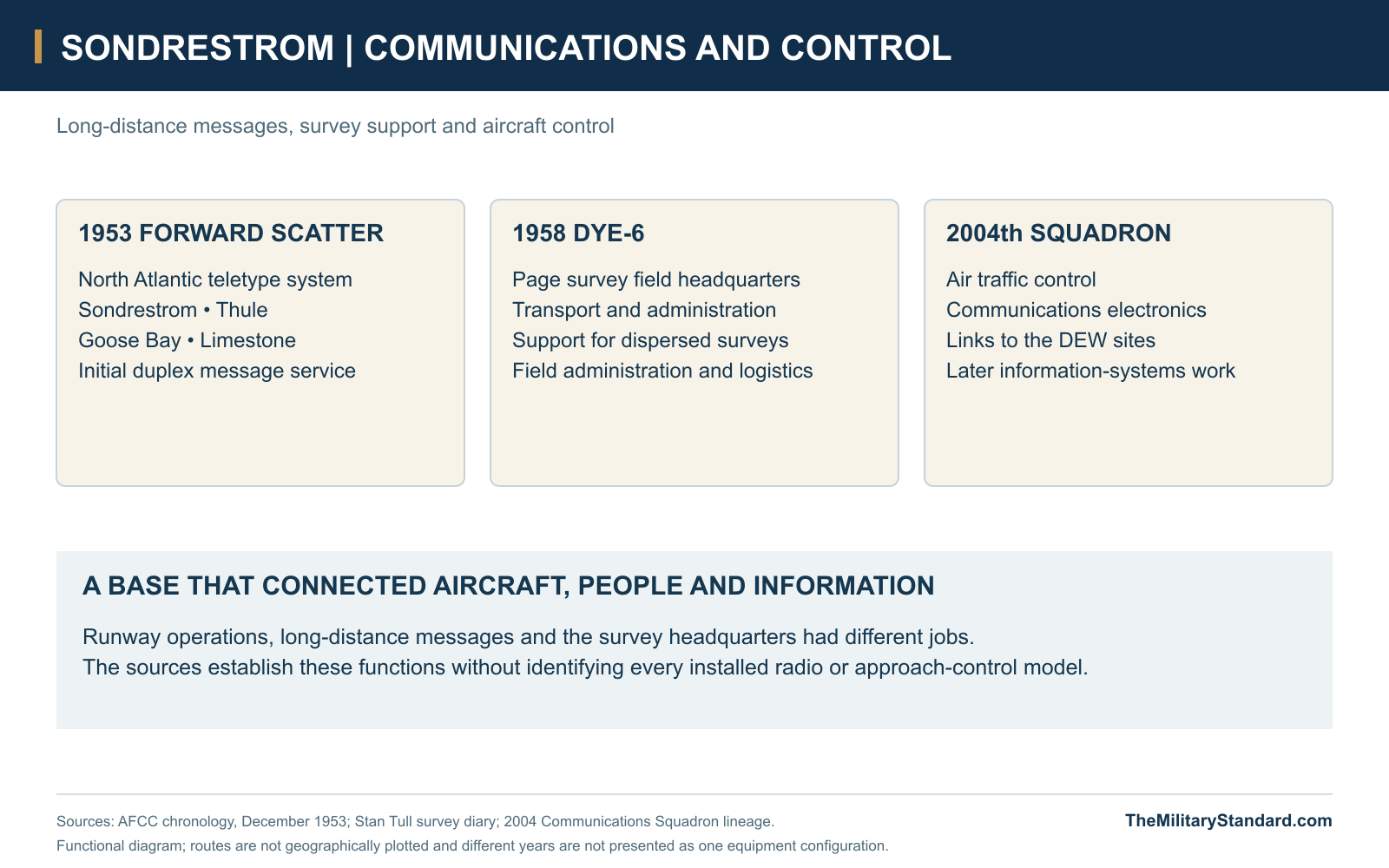
During the 1958 DEW East survey, Page Communications Engineers used Sondrestrom as a field headquarters designated DYE-6. Stan Tull's diary distinguishes this headquarters from the coastal and ice-cap survey camps where radio paths and station positions were being tested. The headquarters connected a dispersed construction and survey effort to transport and administration at the existing air base. It explains the DYE designation without requiring an unsupported assignment of the Greenland stations' search-radar model to Sondrestrom itself. The airfield's lasting contribution was the support, communications and access that allowed the remote network to function. [8]
Long-distance communications predated the Greenland DEW extension. The Air Force communications chronology records a North Atlantic forward-scatter system in December 1953, linking Sondrestrom with Thule, Goose Bay and the temporary continental terminal at Limestone. Its initial duplex teletype capability provided a route for messages across distances where reliable circuits could not be assumed. This system belongs to the base's communications history and should be kept distinct from the later Greenland radar chain. It illustrates how Sondrestrom's airfield and its communications facilities developed together as links across a remote region. [9]
The 2004th Airways and Air Communications Service Squadron was organized in July 1952 and became the 2004th Communications Squadron in July 1961. Its documented work included air traffic control and communications electronics linking the base with the DEW sites and the outside world. It later used the Information Systems Squadron designation before reverting to Communications Squadron in 1986 and inactivating in July 1990. These changes reflect the growth of information and communications duties alongside traditional airfield services. They do not establish the model of every radar, radio or approach-control set used at the base. [10]
Ski Aircraft and the Greenland Supply Mission
The 17th Tactical Airlift Squadron maintained a Sondrestrom detachment from July 1969 to June 1975 while supporting the ice-cap stations and scientific work. Its ski-equipped C-130s linked a conventional paved runway with landing areas on snow. The aircraft could carry loads that a small utility aircraft could not, including fuel and machinery needed to keep a remote station habitable. The detachment was part of a wider squadron based elsewhere, not an independent Sondrestrom combat wing. This distinction helps explain why a small number of deployed aircraft could have a large effect on the endurance of the Greenland warning sites. [13]
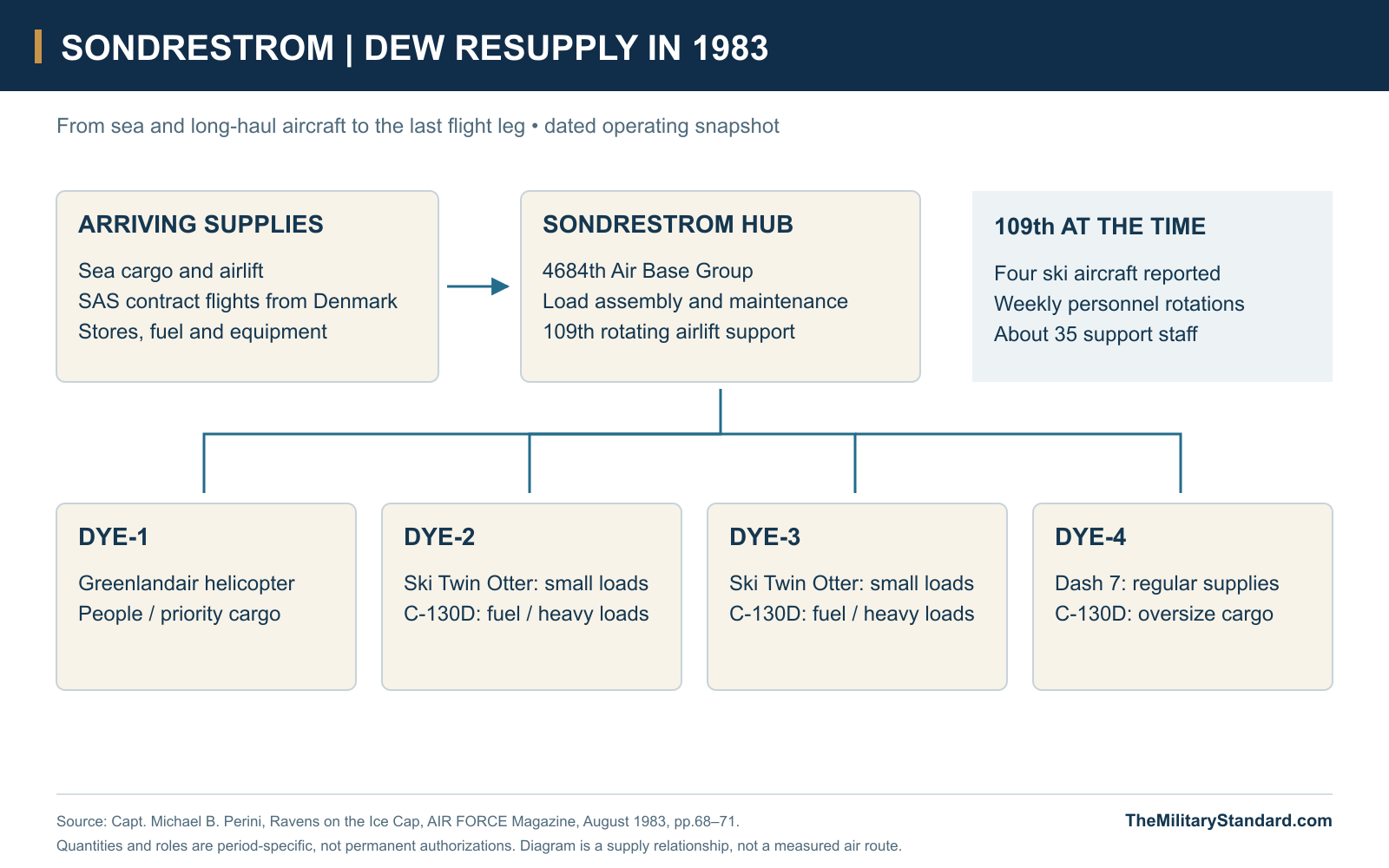
The New York Air National Guard's 109th Tactical Airlift Group took over the Greenland mission during its 1975 conversion to C-130D aircraft. Its official history records replacement of the older aircraft by C-130H and ski-equipped LC-130 variants in October 1984, and a final DYE-3 flight in December 1989. The mission required more than summer cargo flying: aircraft crews, maintainers and support staff had to sustain a specialised capability far from their home station. Sondrestrom provided the place where crews rotated, loads were assembled and aircraft could be serviced before attempting the ice-cap leg. [12]
A contemporary 1983 account describes the practical division of work. The 4684th Air Base Group received supplies arriving by sea and air, while contracted Scandinavian Airlines flights brought Denmark-purchased equipment to Sondrestrom about every four weeks. Greenlandair helicopters served DYE-1, a ski-equipped Twin Otter carried smaller loads to DYE-2 and DYE-3, and a Dash 7 served DYE-4. The 109th handled annual fuel resupply to the ice-cap sites and oversize cargo. The article identifies four ski aircraft, weekly rotations of aircrews and about thirty-five support personnel, and a season extended for construction work. These are 1983 operating details, not permanent staffing authorizations for every year. [11]
Working and Living at Sondrestrom
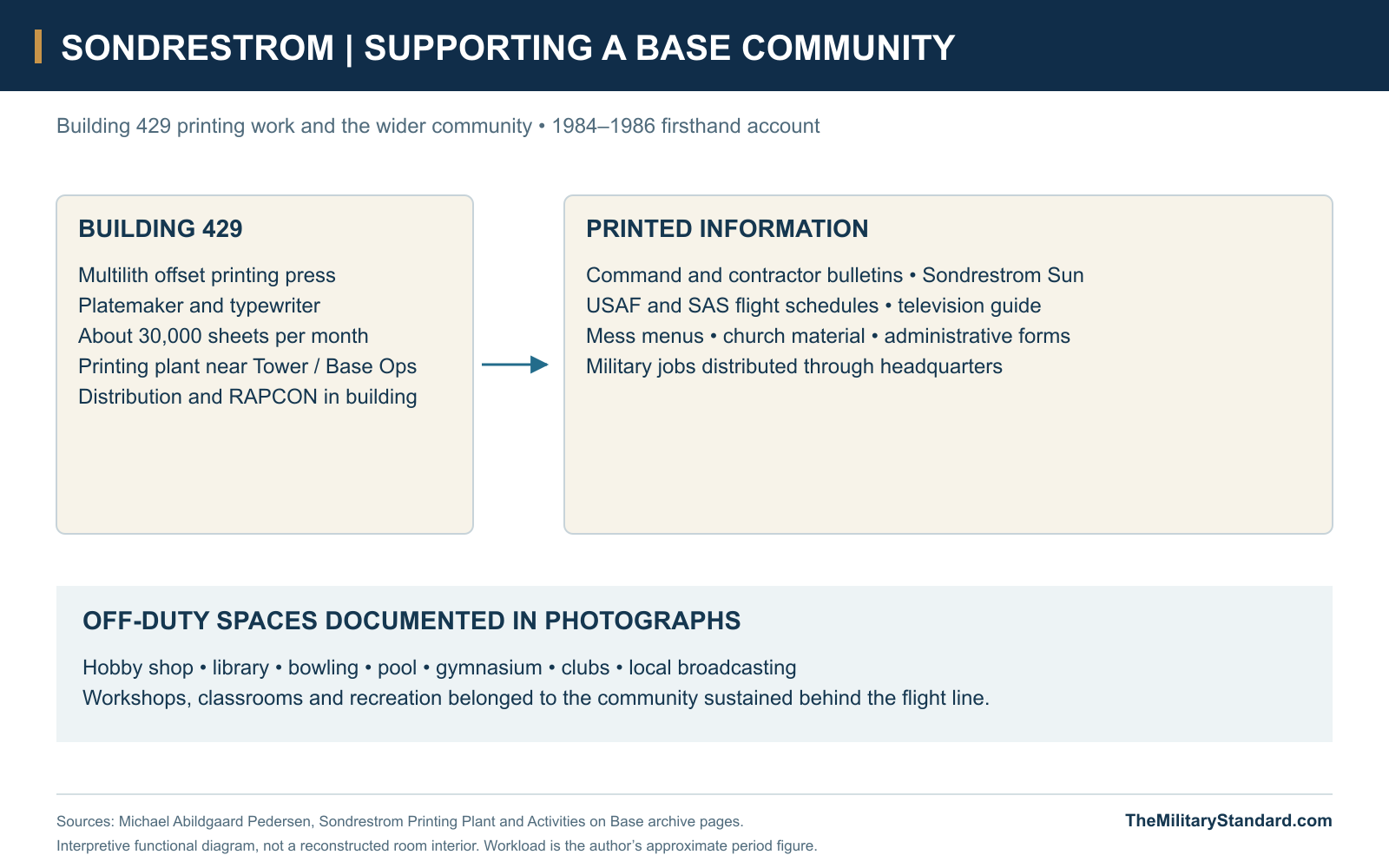
The base community included a considerable range of indoor activities. Pedersen's photographs document a hobby shop, library, bowling alley, swimming pool and gymnasium, as well as clubs and a local radio and television service. Such facilities made a long winter tour more manageable and gave military and civilian residents ways to meet outside their work sections. The photographs are especially useful because they show occupied rooms and ordinary activities rather than only empty buildings or aircraft. A complete base layout therefore needs space for recreation and community services alongside its hangars, stores and communications equipment. [17]
Pedersen's own job provides a more detailed view of supporting work. From 1984 to 1986 he operated the printing plant in Building 429 near the tower and Base Operations. The building also accommodated distribution and air-traffic-related offices. He described a platemaker, a one-colour Multilith offset press and an IBM typewriter, with roughly 30,000 printed sheets a month. The work included the Sondrestrom Sun, command and contractor bulletins, television schedules, menus, church material and flight schedules. Printing connected the administrative, operational and social sides of the station; it was one of the small services that made a remote installation work as a community. [16]
The 1976 Airlift Tragedy
On August 28, 1976, a C-141 Starlifter crashed following an aborted landing at Sondrestrom, killing twenty-three of the twenty-seven people aboard. The memorial record identifies the aircraft as 67-0008 and associates its crew with the 18th Military Airlift Squadron and 438th Military Airlift Wing. The loss brought the hazards of the transport mission directly onto the base. It was separate from the second McGuire C-141 accident that day near Mildenhall in Britain, where eighteen people died. Combining the two aircraft, death tolls or locations would obscure the Sondrestrom event and the people it commemorates. [18] [19]
Space Command and the 1992 Handover
By 1983, Sondrestrom's support mission had come under Space Command. Perini's contemporary account dates the operational transfer from Strategic Air Command to May of that year and names Colonel Hamilton W. Kennedy as commander of the 4684th Air Base Group. A March 1992 Defense Department audit separately identifies commander and operations-director billets in the 1015th Air Base Squadron at Sondrestrom within its Space Command review. The later evidence establishes that a simple account carrying SAC uninterrupted through to closure is incomplete. The host organization and command relationships changed while the same airfield continued to support Greenland operations. [11] [14]
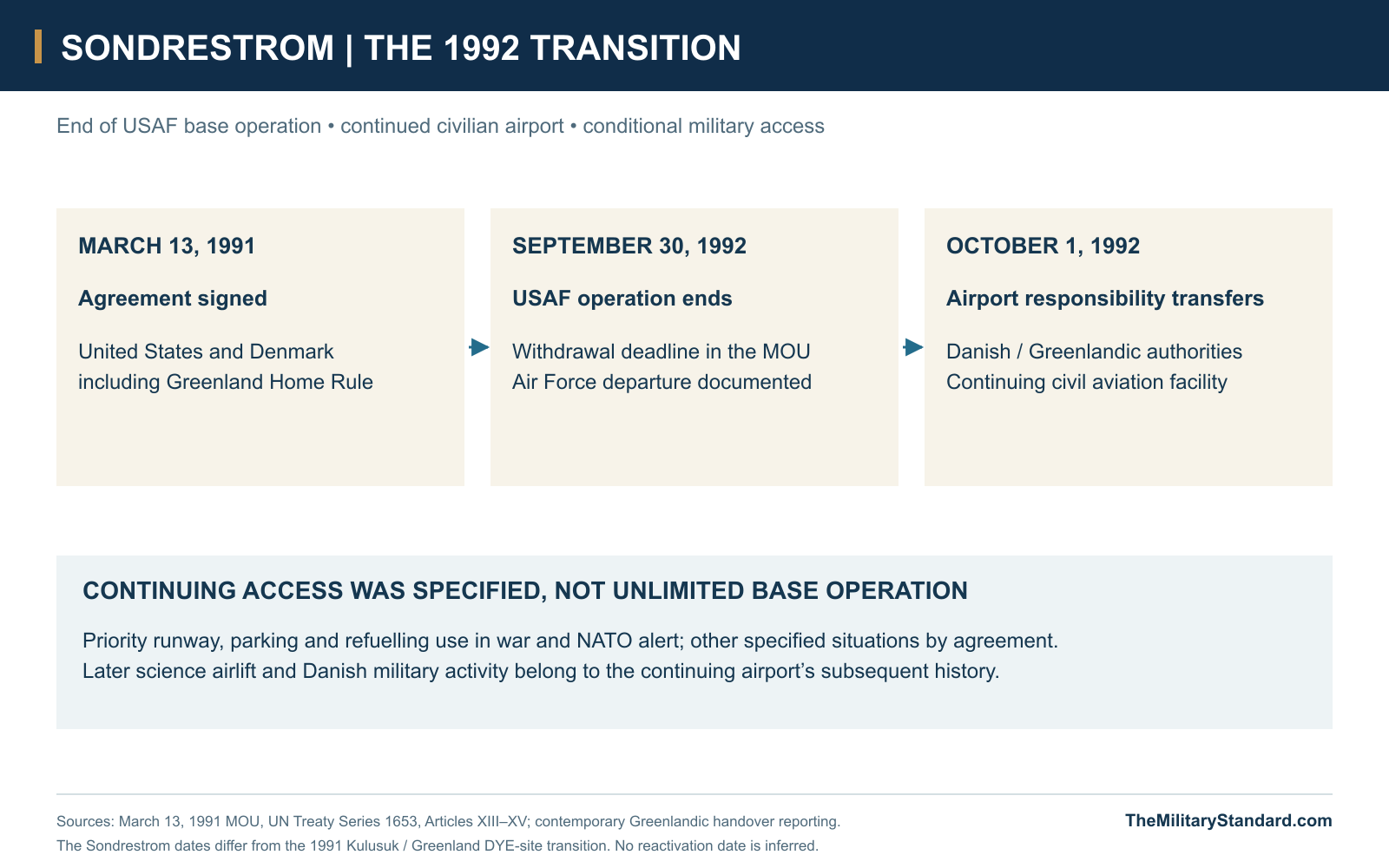
The March 13, 1991 memorandum between the United States and Denmark, including Greenland's Home Rule Government, set out the withdrawal. The USAF was to stop operating Sondrestrom by September 30, 1992, with full Danish/Greenlandic responsibility from October 1. A transition committee supervised the transfer of services and facilities. The agreement also preserved conditional priority use of the runway, parking and refuelling facilities for U.S. forces during war, NATO alert and other mutually agreed circumstances. Ending the American-operated base therefore changed responsibility for the airfield while allowing later military access under specified arrangements. [20]
The contemporary Greenlandic newspaper supplement reported the October 1, 1992 takeover as a change affecting employees, airport administration and the settlement. The heritage account records the departure of USAF personnel on September 30. This is the appropriate closure sequence for the American base, distinct from earlier DEW station shutdowns or the inactivation of individual support units. Kangerlussuaq continued as a civilian airport and community. Its subsequent use by military aircraft does not reverse the handover or turn every later deployment into a reactivation of Sondrestrom Air Base. [21] [4] [25]
Scientific Airlift and Danish Military Use After Closure
The airfield continued to support polar research after the DEW supply mission ended. In April 2019, for example, the 109th Airlift Wing sent about eighty airmen and three LC-130s from New York to Kangerlussuaq for National Science Foundation support. This was a seasonal deployment to the continuing airport, using the ski-airlift capability developed for remote operations. Scientific aviation and the nearby research facilities belong to the later use of the area; they should not be confused with a surviving American DEW search-radar mission. The former base's runway and support spaces remained useful even as its original institutional purpose changed. [27]
Danish military and emergency-services training gained a new permanent foothold in May 2024 when Arktisk Basisuddannelse opened at Kangerlussuaq with twenty-two Greenlandic students. The six-month programme combined military skills with first aid, firefighting and rescue work, using renovated accommodation and teaching facilities. It connected the former base area to training for Greenland's own communities rather than to the former American host-unit structure. The continuing use of existing buildings is a practical part of the installation's afterlife, although it does not establish that every Cold War structure survives or has the same function. [22]
Kangerlussuaq also hosted allied exercise activity in 2026. Danish Defence reported Engineer Regiment and Jutland Dragoon Regiment personnel training with French troops during Arctic Endurance, including protection of infrastructure, patrol work and winter skills. In September, two Danish F-35s made their first landing at Kangerlussuaq during multinational training involving American F-16s and Canadian F-18s, with French tanker, NATO AWACS and Danish Challenger support. These are documented uses of the modern airport and Arctic Command facilities. They demonstrate a continuing military connection while remaining separate from the American base that closed in 1992. [23] [24]
Chronology
- Autumn 1941 A civilian construction party began establishing Bluie West Eight and its runway. [2]
- October 7, 1941 The base chronology dates Balchen's arrival and initial field construction to this day. [1]
- October 20, 1941 The historical base chronology records radio operation and establishment of BW-8. [1]
- Spring 1942 The airfield was available to the North Atlantic ferry route. [3]
- September 26, 1942 The 417th Base Headquarters and Air Base Squadron appears in the operating-unit sequence. [1]
- 1945 The field entered its postwar drawdown and the Sondrestromfjord Army Air Base name. [1]
- June 1947 Runway and utility rehabilitation began. [1]
- October 9, 1950 The base was returned to Danish control. [7]
- July 20, 1951 American operating personnel returned in the Cold War reopening sequence. [7]
- January 10, 1952 The installation was named Sondrestrom Air Base. [1]
- July 1, 1952 The 2004th AACS Squadron was organized. [10]
- December 1953 The North Atlantic forward-scatter system began its initial duplex teletype service. [9]
- 1958 The DEW East survey headquarters at Sondrestrom used the DYE-6 designation. [8]
- July 1, 1960 The operating-unit sequence records the 4684th Air Base Group at Sondrestrom. [7]
- July 1, 1961 The 2004th AACS Squadron became the 2004th Communications Squadron. [10]
- July 9, 1969-June 30, 1975 The Firebirds history records a 17th Tactical Airlift Squadron detachment at Sondrestrom. [13]
- 1975 The 109th Tactical Airlift Group converted for the Greenland DEW resupply mission. [12]
- August 28, 1976 C-141 67-0008 crashed at Sondrestrom; twenty-three people died. [18] [19]
- May 1983 Contemporary reporting records transfer of operational control from SAC to Space Command. [11]
- October 1984 The 109th began replacing its C-130D fleet with C-130H and LC-130 aircraft. [12]
- December 1989 The 109th flew its final DYE-3 mission. [12]
- July 1, 1990 The 2004th Communications Squadron inactivated. [10]
- March 13, 1991 The U.S.-Danish/Greenland memorandum established the base transition framework. [20]
- March 4, 1992 A Defense Department audit identified 1015th Air Base Squadron command and operations billets at Sondrestrom. [14]
- September 30, 1992 USAF base operation ended under the transition agreement. [20] [4]
- October 1, 1992 Danish/Greenlandic authorities assumed full airport operating responsibility. [20] [21]
- April 2019 A 109th LC-130 deployment used Kangerlussuaq for National Science Foundation support. [27]
- May 5, 2024 Arktisk Basisuddannelse opened at Kangerlussuaq. [22]
- January 2026 Danish Defence reported allied winter training at Kangerlussuaq during Arctic Endurance. [23]
- September 2026 Danish F-35s landed at Kangerlussuaq during multinational training. [24]
Related Sites
Information sources (29)
- WEBThe Military Standard, Sondrestrom Air Base Greenland, legacy base history
Published base-reference coordinate and early construction, names, units, wartime and Cold War capability chronology.
- PDFStetson Conn, Rose C. Engelman and Byron Fairchild, Guarding the United States and Its Outposts, U.S. Army Center of Military History
Civilian construction party, autumn 1941 runway works and engineering progress at Bluie West Eight.
- PDFArmy History, No. 123, Spring 2022, North Atlantic aircraft movement account
Spring 1942 operational airfield, alternate-field purpose and the ferry route through Greenland to Britain.
- PDFJens Fog Jensen, Inge Bisgaard and Jens Heinrich, Anlaeg fra Den Kolde Krig i Groenland, Field Report 34, 2013, pages 13-15
Camp Lloyd harbor, valley setting, base development, preserved military fabric and later scientific and civil activity.
- WEBSondrestrom archive, historical full-base map, preserved by Michael Abildgaard Pedersen
Runway, civil and military areas, harbor-road connection, communication sites and Lake Ferguson and Black Ridge insets.
- WEBSondrestrom archive, historical main-base map detail
Numbered facilities, Building 429 near Tower/Base Ops, BX, dining hall, accommodation blocks and service streets.
- WEBMichael Abildgaard Pedersen, Sondrestrom archive, base history and personal introduction
Base operating-unit sequence and the author's documented 1984-1986 employment and accommodation.
- PDFStan Tull, Greenland Diary, DEW East survey expedition, 1958
Page Communications Engineers survey headquarters at Sondrestrom designated DYE-6, with Greenland survey and support context.
- PDFAir Force Communications Command, Window to the Future, chronology 1938-1988, December 1953 entry
North Atlantic forward-scatter system linking Sondrestrom, Thule, Goose Bay and the temporary Limestone terminal; duplex teletype service.
- PDFUSAF Unit Histories, 2004 Communications Squadron, citing AFHRA and 1990 AFCC lineage history
1952 organization, communications and information-systems redesignations, air-traffic-control role and July 1990 inactivation.
- PDFCapt. Michael B. Perini, Ravens on the Ice Cap, AIR FORCE Magazine, August 1983, pages 68-71
4684th Air Base Group logistics, May 1983 Space Command transfer, contracted flights, ski-airlift staffing and cargo roles.
- WEB109th Airlift Wing, official history
1975 Greenland mission conversion, October 1984 aircraft replacement and December 1989 last DYE-3 mission.
- PDFHistory of the 517th Airlift Squadron Firebirds, reproduced by the Firebirds Association
17th Tactical Airlift Squadron Sondrestrom detachment, July 1969-June 1975, ice-cap support and later redesignation context.
- PDFDepartment of Defense Inspector General, Aviation-Rated Manpower Positions at U.S. Space Command and U.S. Air Force Space Command, March 4, 1992
Contemporary identification of 1015th Air Base Squadron command/operations billets at Sondrestrom and planned reductions.
- WEBMichael Abildgaard Pedersen, Danish Arctic Contractors / Greenland Contractors at Sondrestrom
Contractor work divisions, administration, transport, utilities, communications, fire and medical services.
- WEBMichael Abildgaard Pedersen, The Sondrestrom Printing Plant
Building 429 work, printing equipment, approximate workload, publications and co-located offices in 1984-1986.
- WEBMichael Abildgaard Pedersen, Activities on Base
Photographed hobby shop, library, bowling, pool, gymnasium, clubs and local broadcasting in the operating-era community.
- WEBPeter G. Park Jr., JAC NCOs Restore Memorial to 1976 C-141 Crash; Honor Fallen Airmen, 501st Combat Support Wing, December 8, 2011
August 28, 1976 Sondrestrom accident, 23 fatalities among 27 people and distinction from the same-day UK accident.
- WEBC-141 Flying Squadrons, Aircraft 67-0008 memorial record
Aircraft serial, 18th Military Airlift Squadron / 438th Military Airlift Wing connection and crew remembrance.
- PDFDenmark including Greenland and United States, Memorandum of Understanding, March 13, 1991, UN Treaty Series 1653, No. 28453, Articles XIII-XV
September 30, 1992 USAF operating deadline, October 1 civilian responsibility, phased services and conditional continuing U.S. access.
- PDFAtuagagdliutit / Groenlandsposten, Kangerlussuaq Tillykke, contemporary handover supplement, preserved by Sondrestrom archive
Greenland Home Rule takeover on October 1, 1992 and civilian-airport transition reporting.
- WEBDanish Defence, Arktisk Basisuddannelse er skudt i gang, May 5, 2024
First 22 Greenlandic students, renovated Kangerlussuaq accommodation and military/emergency-services curriculum.
- WEBDanish Defence, Arctic Endurance continues throughout 2026, January 23, 2026
Engineer Regiment, Jutland Dragoon Regiment and French Army winter training around Kangerlussuaq.
- WEBDanish Defence, Danske F-35-piloter traener med USA og Canada i Groenland, September 17, 2026
First Danish F-35 landing at Kangerlussuaq, allied training, tanker/AWACS support and Danish Challenger rescue cover.
- WEBGreenland Airports, Kangerlussuaq Airport
Continuing civilian airport operation and present airport identity.
- WEBNatural Earth, 1:50 million Admin 0 countries
Public-domain coastline geometry for the separate regional location diagram.
- WEBAir Force, Wing begins annual mission to Greenland, April 2019
Post-closure 109th Airlift Wing LC-130 deployment to Kangerlussuaq for National Science Foundation research support.
- PDFF. J. Powell and colleagues, National Bureau of Standards Report 5223, Vapor Barrier Investigation, April 8, 1957
May 1956 engineering inspection, Sondrestrom Buildings 320 and 321, concrete-panel construction and freeze/thaw drainage failures.
- WEBOffice of the Historian, Strategic Air Command, The Development of Strategic Air Command 1946-1986, 1963 entry, preserved by Generalstaff.org
KC-97 ground-alert tanker force at Sondrestrom during the period of Reflex consolidation.