
Driftwood Bay Air Force Station / Driftwood Bay Radio Relay Station, Alaska
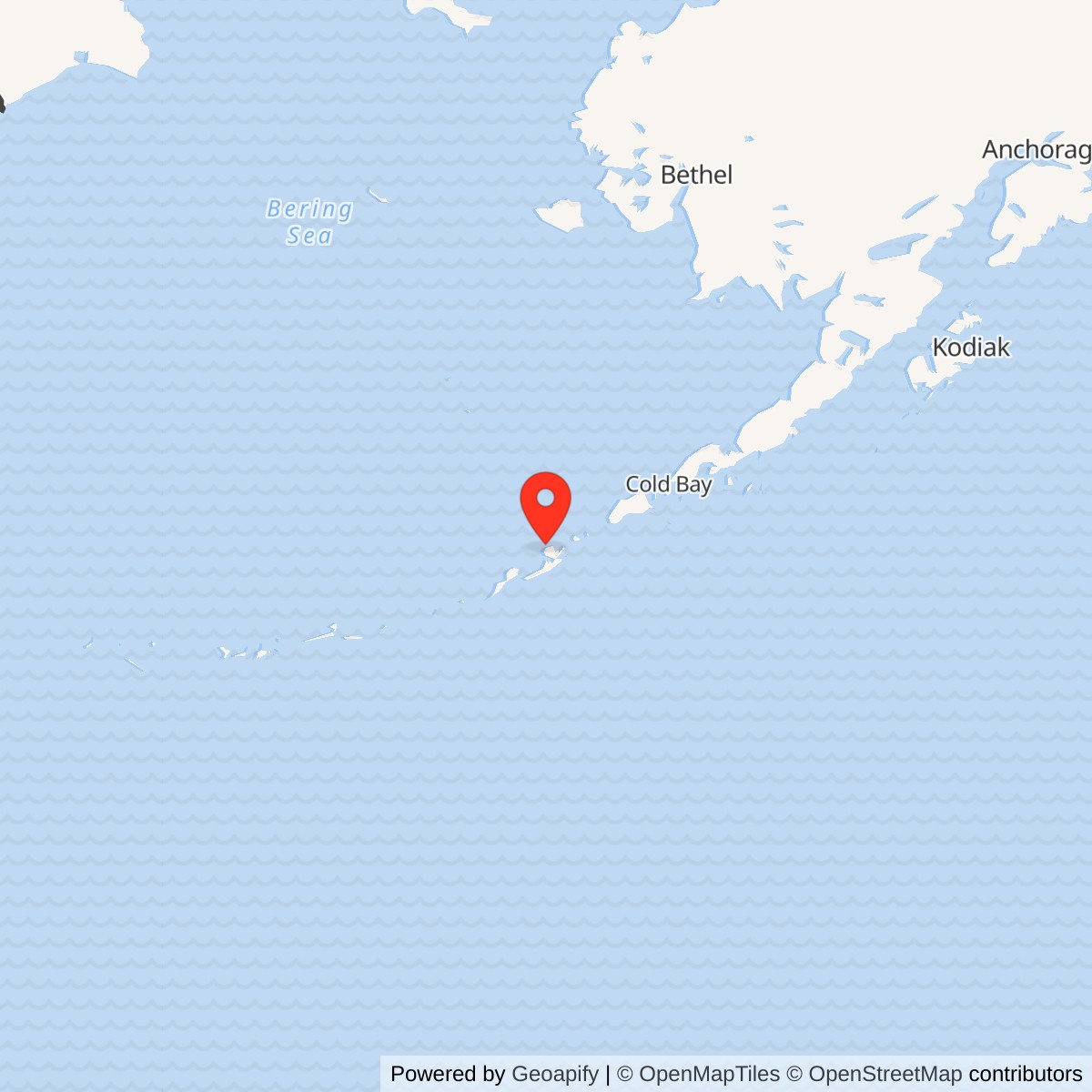
Longitude: -166.9055310
Site Number: COB-2
Current Role: Former military station with no current radar or relay function documented. Buildings were demolished or removed by 1991; environmental monitoring and land-use controls continue at selected source areas.
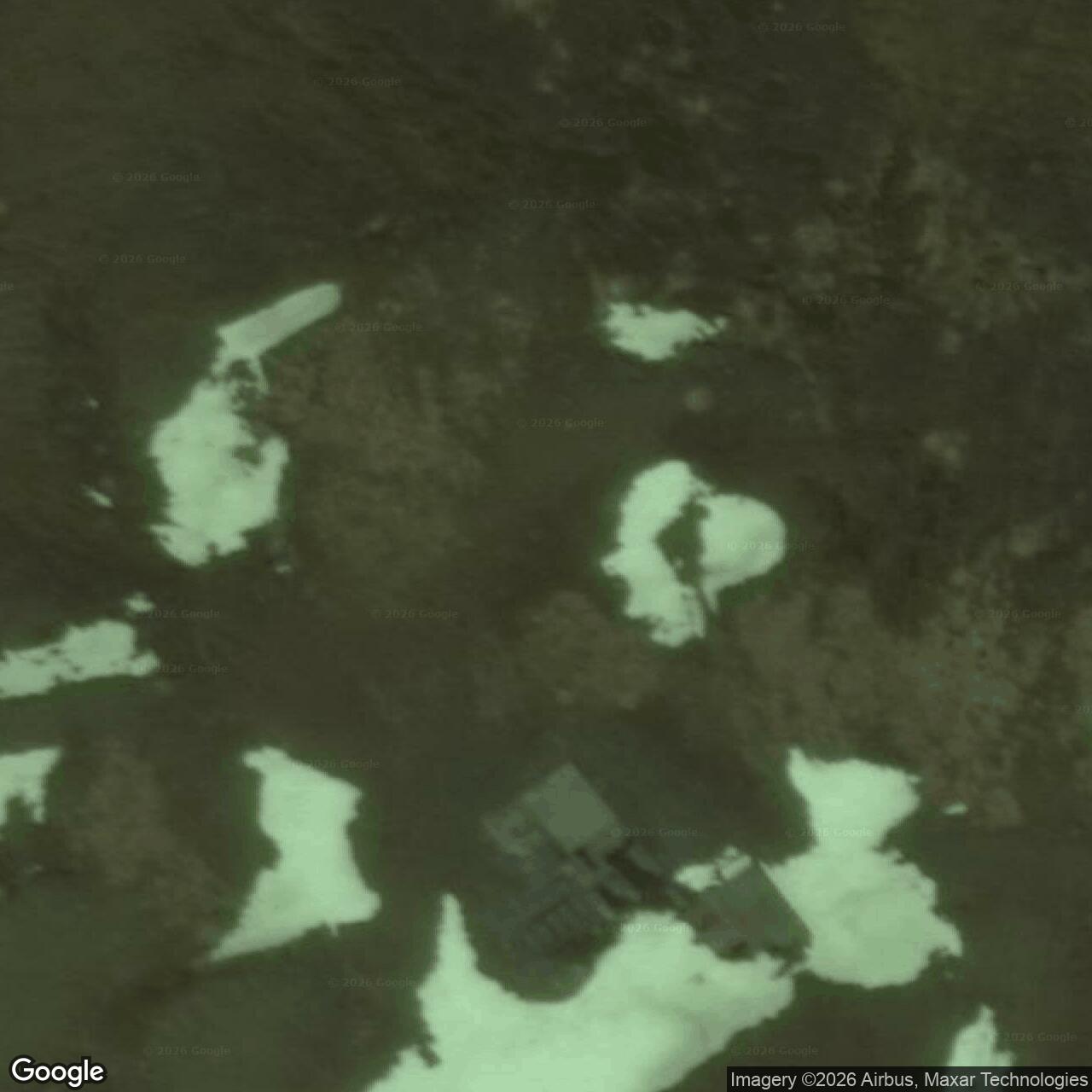
Approximate location: 53.975233 N, 166.905531 W. This Alaska DEC reference point is near the former composite building; it is not a surveyed installation boundary.
- Station code
- COB-2, Aleutian DEW Line extension.
- Radar
- AN/FPS-19, April 1959-June 1, 1969.
- Communications
- White Alice relay to Nikolski and Cape Sarichef, through 1977 in Corps station histories.
- Location
- North coast of Unalaska Island, above Driftwood Bay.
Overview
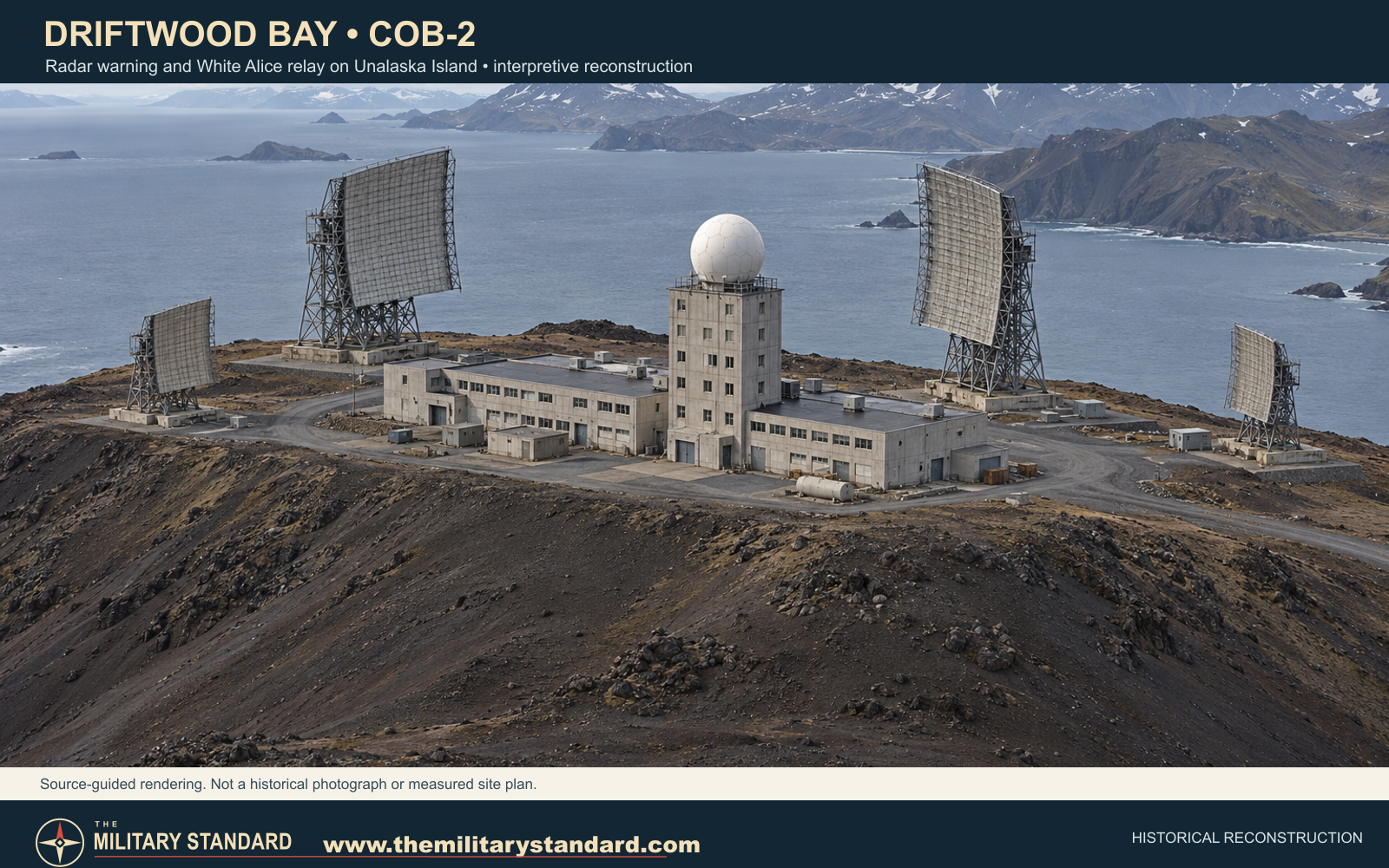
Driftwood Bay Air Force Station, code COB-2, stood above Driftwood Bay on the north coast of Unalaska Island. It was one of the Aleutian extension stations of the Distant Early Warning (DEW) Line. The installation combined an AN/FPS-19 aircraft-search radar with a White Alice long-distance radio relay. The radar mission ended in 1969; the relay continued into the late 1970s. [1] [2] [3]
Cold Bay was the main station for the Aleutian sector. Driftwood Bay was the relay between Nikolski to the west and Cape Sarichef to the east. Its two roles belonged to one physical station, with radar and communications equipment housed in the same large hilltop building. [1] [2]
Project Stretchout and Construction
The Aleutian warning extension, known as Project Stretchout, was approved in 1957. Construction at Driftwood Bay began that year and was completed in 1959. Crews placed the main station on a cinder dome about 1,350 feet above sea level, with an airstrip in the valley about three miles away by road. The hilltop gave the radar an exposed view and the White Alice antennas long paths toward neighboring stations. [1]
The poured-concrete composite building placed a radome atop its five-story central section; the rest was two stories. Inside were radar operations, communications equipment, offices, living space and two 350-kilowatt generators. Outside stood four galvanized-steel billboard reflectors on large concrete foundations: two 60-foot structures and two 30-foot structures. A storage bunker, water pump house, fuel system, airstrip storage building and runway-lighting generator vault completed the remote support system. [1]
Radar Warning Mission
Air Force records give March 31, 1959 as the station activation date. Aerospace Defense Command records place its AN/FPS-19 radar in the Aleutian warning network in April 1959. The equipment searched for aircraft approaching through the western North Pacific and Bering Sea region. Its warning information moved along the sector communications network toward Cold Bay. [3] [4]
The 714th Aircraft Control and Warning Squadron maintained its headquarters at Cold Bay and staffed detachments at the Aleutian auxiliary stations. Driftwood Bay operated as COB-2 in that chain. The Aleutian DEW radar extension closed on June 1, 1969, ending Driftwood Bay's aircraft-warning role. [1] [3] [7]
White Alice Communications
White Alice used fixed, broad billboard reflectors to send radio signals by tropospheric scatter beyond ordinary line-of-sight ranges. From Driftwood Bay, one path ran approximately 106 miles west to Nikolski and the other about 93 miles east to Cape Sarichef. The 1988 Corps inventory specifically describes 60-foot antennas on these links. Cold Bay lay farther east beyond Cape Sarichef. [1] [2]
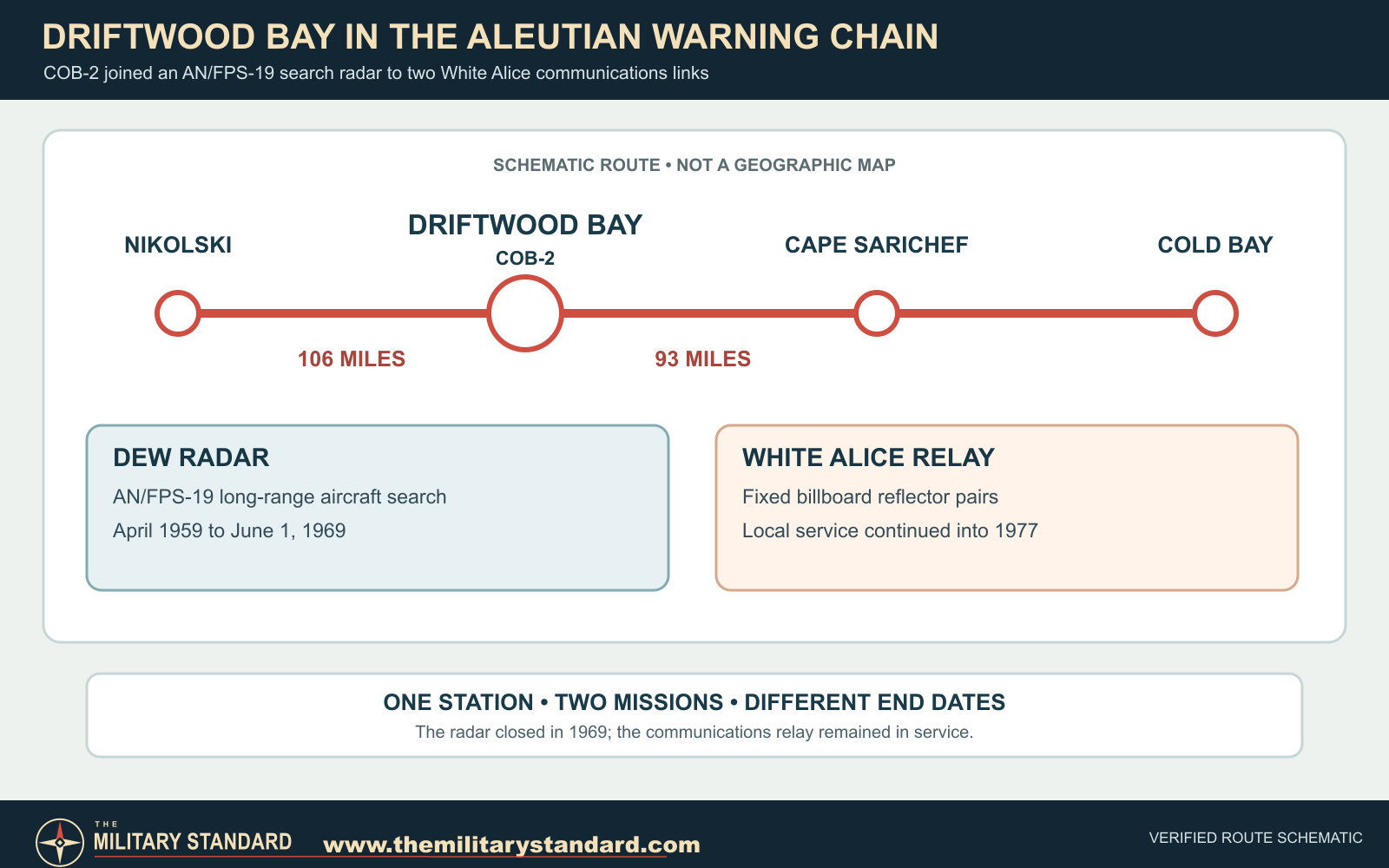
The relay continued operating after the radar closed. Corps station-specific histories give 1977 as Driftwood Bay's communications closing year. The wider Aleutian White Alice network is also described as lasting until November 1978; that later date describes the network, not necessarily the operating period of COB-2. [1] [2]
The Airstrip and Daily Support
The exposed hilltop was tied to its lower airstrip by a three-mile road. Aircraft brought people and supplies to a place without a road connection to Dutch Harbor. The Corps documented a 24-by-100-foot wood storage building and a concrete runway-lighting generator vault at the strip. A pumphouse and storage bunker stood along the road between the valley and the station. [1]
A March 1959 Anchorage Museum photo series records the hilltop radome and White Alice antennas, the airstrip, winter buildings and the route between them. The photographs provide a rare view of how the radar and relay station fit into the coastal landscape. [8]
Closure and Remains
After the 1977 relay shutdown, the remote station was abandoned. The Corps reported vandalism by the late 1980s and documented demolition of the main facility under a 1991 contract. Building foundations, segments of the former fuel system and the airstrip have appeared in later site records. [1] [2] [5]
The former military property remains an environmental-management area rather than an operating radar or communications site. Alaska DEC continues to review selected former source areas and land-use controls. Those later records also preserve the history of the station's support facilities. [5] [6]
Historical Photographs and Graphics
The reconstruction above shows the documented five-story radome tower, two-story concrete wings and four White Alice reflectors on the cinder hill. The route diagram below identifies the station's direct communications neighbors and the shorter radar service period. [1] [2]
Actual Driftwood Bay photographs are cataloged in the Anchorage Museum's William C. and Frances P. Ray Slides. Images made in March 1959 include the radome and antennas, the hilltop building, the airstrip and the lower camp. A 1958 radome-installation photograph from the Jonish papers is reproduced in an Alaska historic-architecture study. [8] [9]
Explore the Anchorage Museum catalog for the March 1959 Driftwood Bay photo series (slides .2715-.2740).
Chronology
- 1957 Project Stretchout approved and Driftwood Bay construction begins.
- 1958 Radome installation and airstrip work photographed during construction.
- March 31, 1959 Air Force station activation recorded.
- April 1959 COB-2 AN/FPS-19 radar enters the Aleutian DEW network.
- June 1, 1969 Aleutian DEW radar extension closes.
- 1977 Corps station histories date the end of Driftwood Bay White Alice service.
- Late 1980s Corps inventory describes the abandoned station.
- 1991 Main station structures demolished under Corps contract.
- 2026 Alaska DEC continues long-term management of selected former source areas.
Information sources (9)
- PDF1. The Cold War in Alaska: A Management Plan for Cultural Resources, U.S. Army Corps of Engineers, 1994
Source for: Project Stretchout history; Driftwood Bay building, hilltop, antennas, support road and airstrip; 1991 demolition.
- PDF2. Historical Overview and Inventory: White Alice Communications System, U.S. Army Corps of Engineers, 1988
Source for: Driftwood Bay to Nikolski and Cape Sarichef White Alice links; local 1959-1977 service dates.
- PDF3. Historical Data of the Aerospace Defense Command, 1946-1973
Source for: COB-2 AN/FPS-19 and April 1959-June 1, 1969 radar service.
- PDF4. Air Force Bases: Within the United States, Air Force Historical Research Agency
Source for: Driftwood Bay Air Force Station designation and 31 March 1959 activation.
- PDF5. Driftwood Bay Radio Relay Station Proposed Plan, U.S. Air Force, 2011
Source for: Historic 333.54-acre withdrawal, airstrip, site disposition and 1961-1977 relay-site period in restoration records.
- WEB6. Alaska DEC Driftwood Bay Site Report, Hazard ID 90
Source for: Present environmental management and dated site actions.
- WEB7. Information on Alaska for Air Force Personnel and Their Families, Air Force Pamphlet 34-8-6, 1964
Source for: 714th Aircraft Control and Warning Squadron headquartered at Cold Bay with Aleutian detachments.
- PDF8. William C. and Frances P. Ray Slides, Anchorage Museum
Source for: March 1959 Driftwood Bay radar, antenna, airstrip and lower-camp photograph inventory; external archive reference only.
- PDF9. Mid-Twentieth-Century Architecture in Alaska, Alaska Office of History and Archaeology
Source for: Reproduced 1958 Driftwood Bay radome-installation photograph and construction context; photo credited to UAA Jonish papers.