
Northway ACS Radio Relay Site, Alaska
A roadside communications compound from the Army Signal Corps to the Air Force.
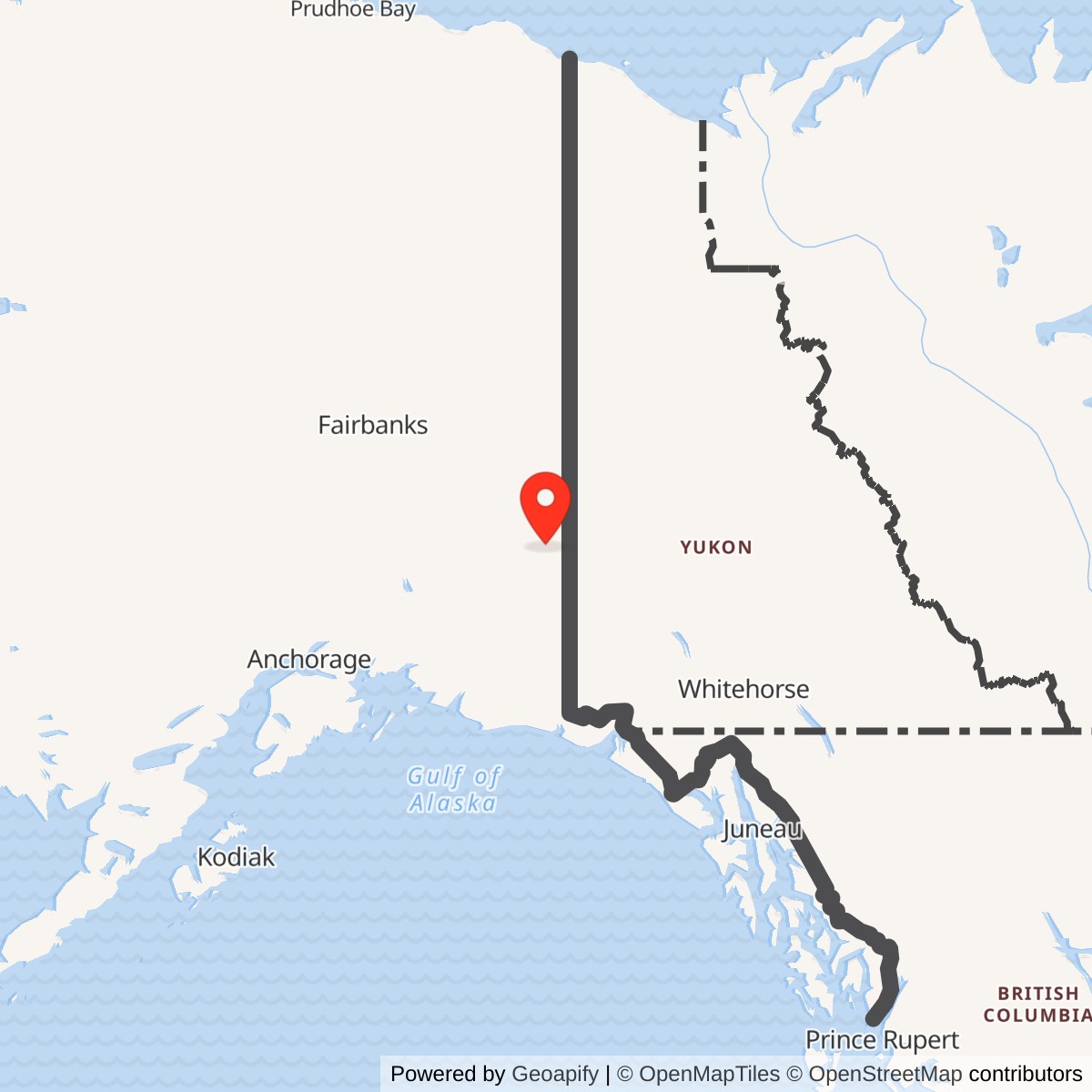
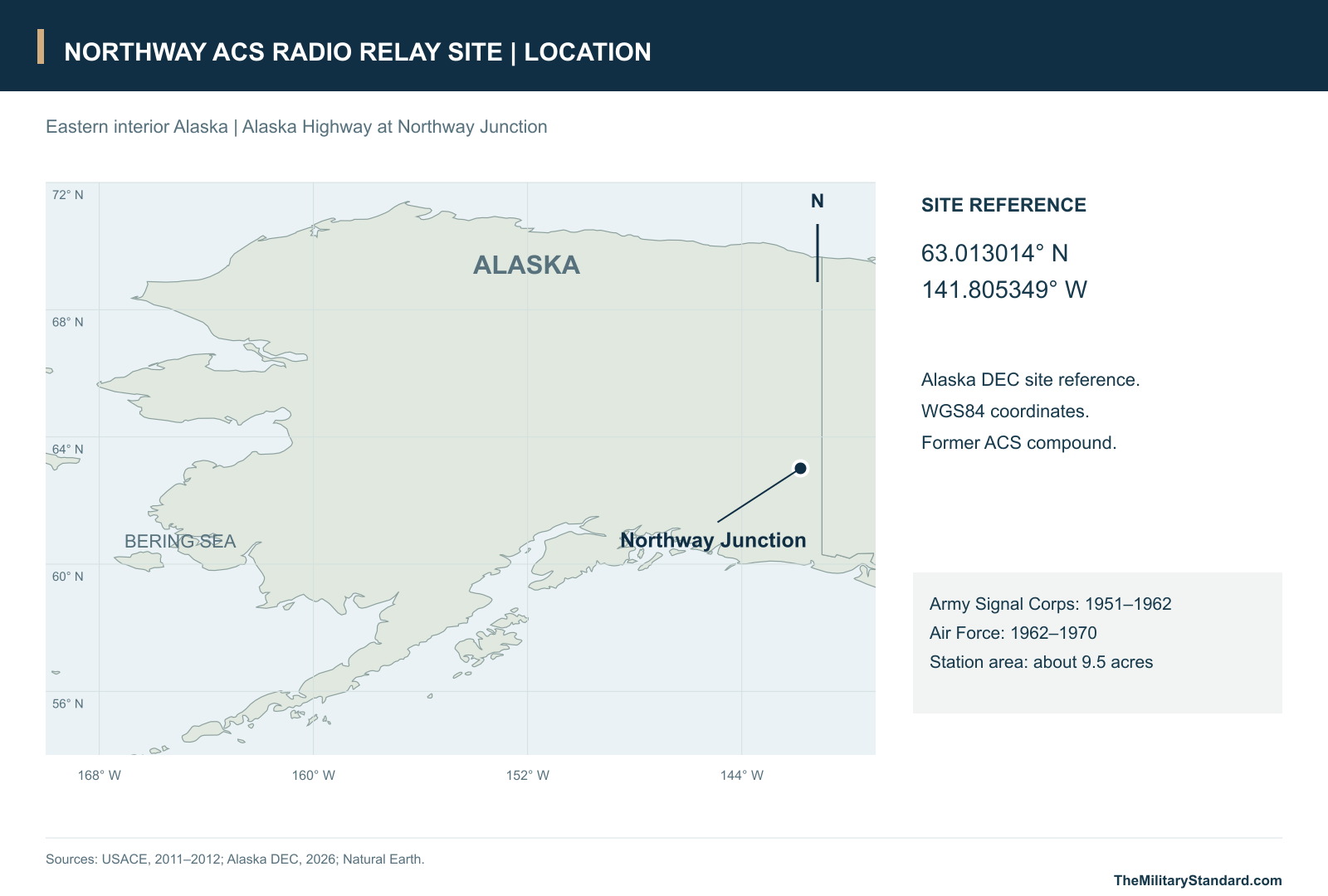
Longitude: -141.805349
Current Role: Former communications compound; community/private reuse documented2011-2012,ongoing environmental management in2026;present occupancy/title unverified
- System
- Alaska Communications System (ACS)
- Role
- Radio relay and repeater station
- Army phase
- 1951-1962, Army Signal Corps
- Air Force phase
- 1962-1970
- Service organization
- Air Force Communications Service (AFCS)
- Communications facilities
- Radio relay building and office building
- Support facilities
- Power plant, vehicle maintenance garage and housing
- Fuel storage
- Two underground tanks and four aboveground tanks in the historical inventory
- Area
- Approximately 9.5 acres
- Location
- Alaska Highway near the Northway road junction
- Later uses
- Community activities, storage and residences documented in 2012
A Signal Post at Northway Junction
Northway ACS Radio Relay Site occupied a small roadside compound in eastern interior Alaska, near the meeting of the Alaska Highway and the road to Northway village and airport. The Army phase at Northway ACS Station began in 1951, and the Air Force operated the compound from 1962 through 1970. Its work belonged to the Alaska Communications System, which carried long-distance communications for military and civilian users. A relay building, power plant, homes and service buildings gave that communications mission a permanent physical presence at the junction. [1] [2] [3]
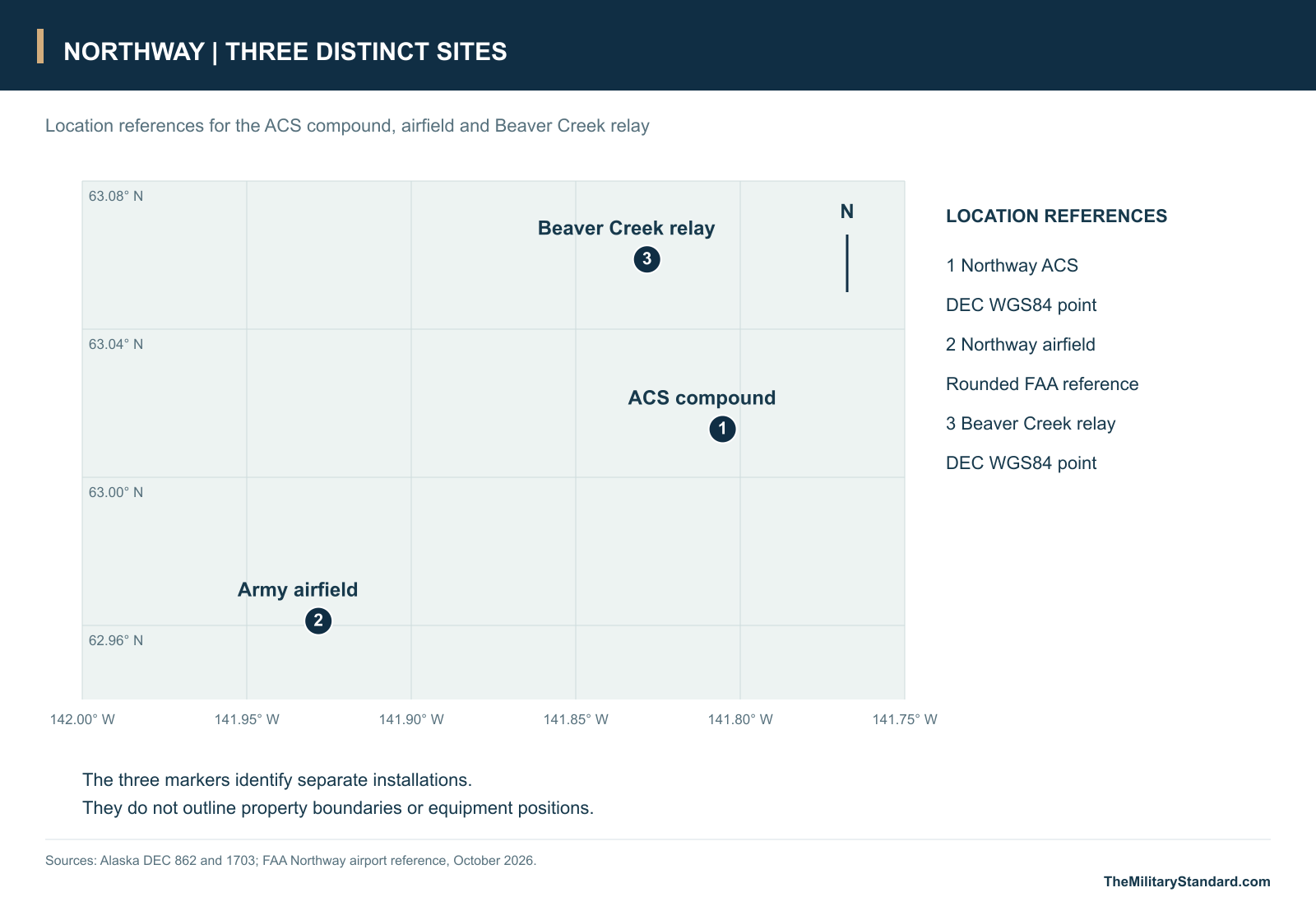
The approximately 9.5-acre ACS site was separate from Northway Army Airfield, whose wartime runways and dispersed garrison lay closer to the Nabesna River. It was also distinct from Beaver Creek Radio Relay Station, the later Air Force relay northwest of the junction. These installations belonged to the same region's communications and transportation landscape, but their properties and operating histories differed. At Northway ACS, the central story is the development of a permanent Signal Corps station, its transfer to the Air Force and the subsequent reuse of its buildings. [1] [2] [8] [10] [11]
Building the Permanent ACS Station
Congress had already identified Northway for substantial ACS construction before the compound's documented operating period began. Public Law 414, approved on October 27, 1949, authorized family quarters, operational buildings, a warehouse, garages and utilities at Northway, with an estimated amount of $377,204. The program joined technical accommodation to the practical needs of a resident workforce. Its scope provided for a station with its own operations, supplies, maintenance and domestic services, establishing the principal groups of facilities that supported the communications mission. [4]
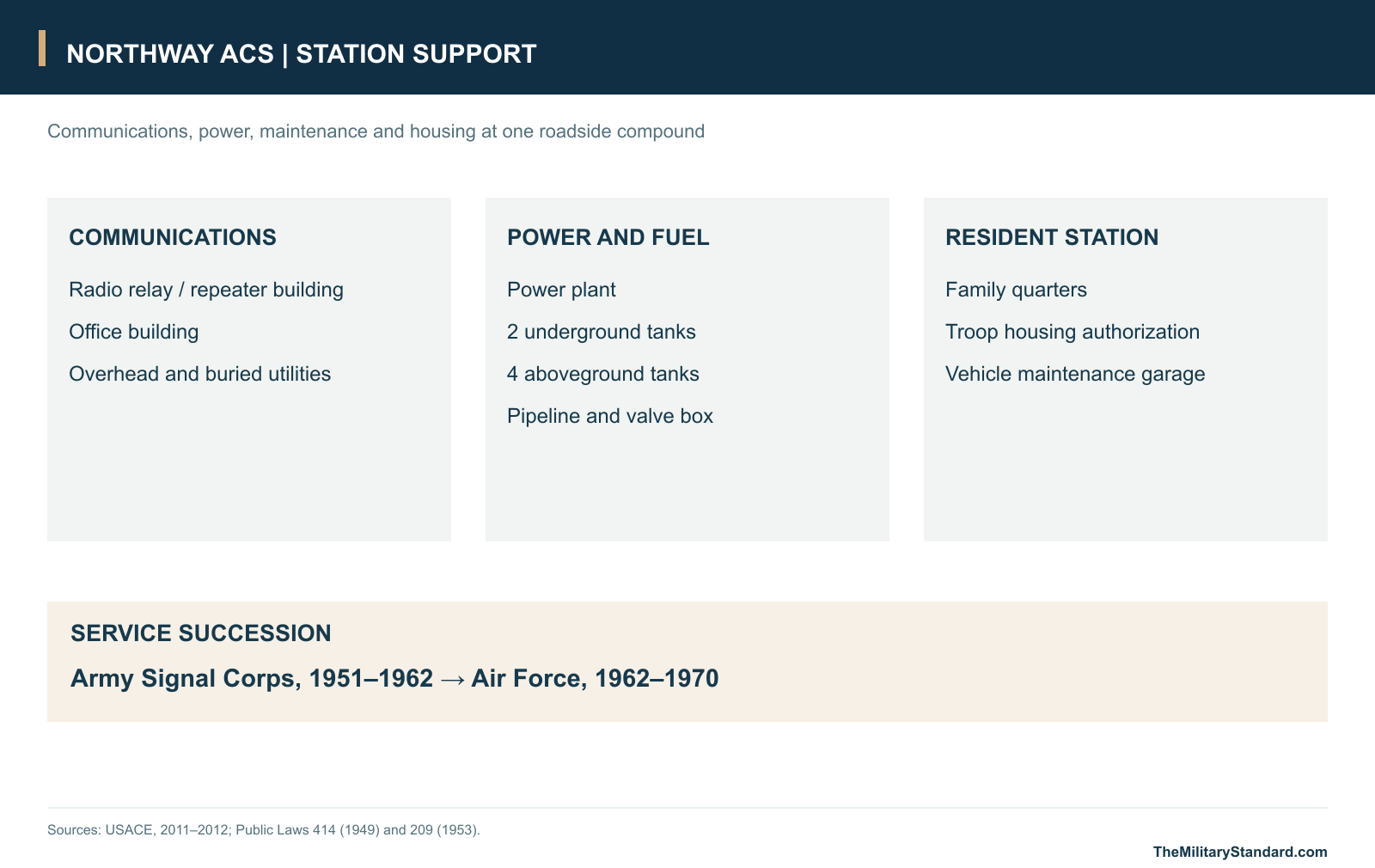
The Corps of Engineers' station history dates Army Signal Corps operation from 1951 to 1962. Its facility inventory describes the resulting compound as a radio relay building, power plant, family housing, vehicle maintenance garage and office building, connected by overhead and underground utilities. Aboveground and buried fuel lines linked the buildings and storage areas. This arrangement concentrated the work of communications, power generation and vehicle support on a compact parcel beside the highway, while housing allowed personnel and families to live at the station. [1] [2]
Housing remained part of the construction program after the station opened. On August 7, 1953, Public Law 209 authorized another $94,800 for Northway family quarters, troop housing and utilities. This continued the earlier emphasis on accommodation and the services needed to support people at the communications post. The authorization describes planned work, while the later aerial shows housing that survived into civilian use. The station's residential buildings placed personnel and their domestic lives within the same compact roadside setting as the technical and maintenance facilities. [2] [5]
The Air Force Takes Over
The change of service at Northway followed a much larger consolidation. On July 1, 1962, the Alaska Communications System passed from the Army Signal Corps to the Air Force Communications Service, or AFCS. The Air Force's command history describes the acquisition as a network of long-line facilities serving both military and civilian needs. Northway's local service sequence fits that system-wide change: the Corps records Air Force operation from 1962 through 1970. The mission continued as communications, with the existing compound carrying forward into a new service organization. [1] [3]
Long-line communications connected widely separated places rather than serving only the people inside a single base. Their operation required both communications equipment and the utilities that kept it working, which explains the prominence of Northway's power plant, fuel storage and maintenance facilities. The relay function also explains why the station should be read separately from the airfield's aviation facilities and the nearby Beaver Creek Radio Relay Station. The ACS compound was one part of a broader regional infrastructure whose individual sites had different equipment, property arrangements and service responsibilities. [1] [2] [3]
Buildings, Power and Life at the Station
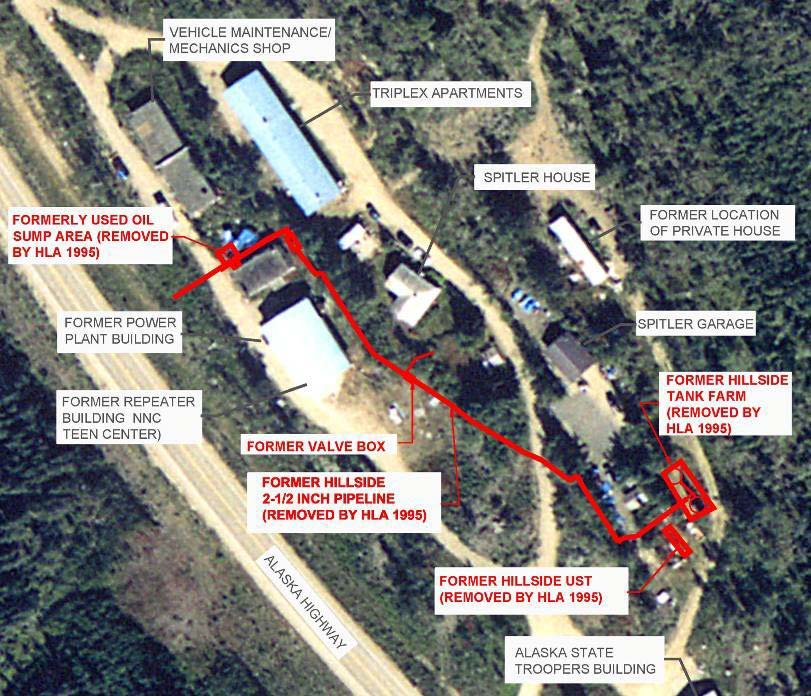
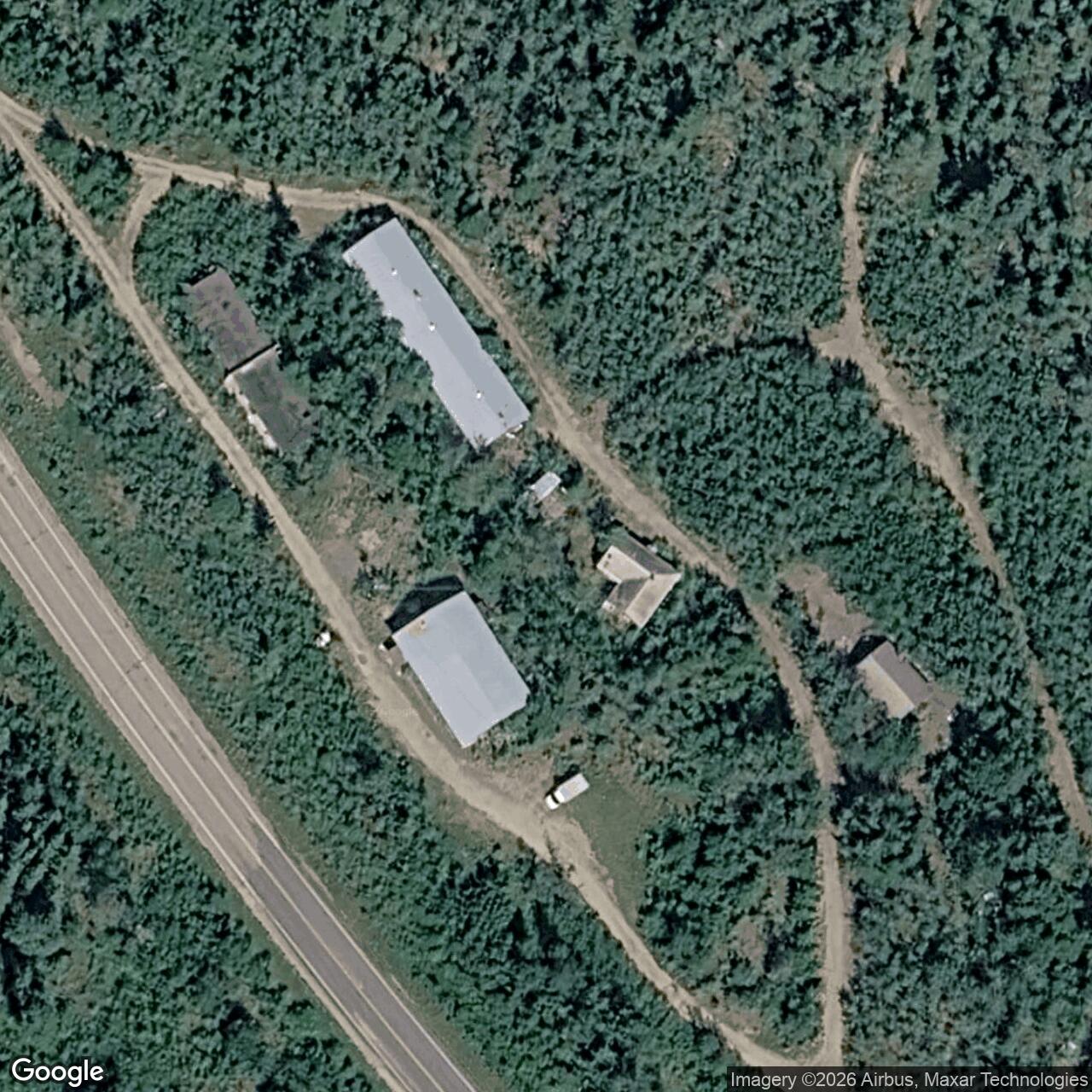
The later Corps aerial makes the compound's principal groups easy to distinguish. The former relay building and power plant stand near the highway frontage. A vehicle maintenance or mechanics shop lies farther along the access drive beside a long triplex apartment building. Private residential structures and another building later used by Alaska State Troopers appear in the same mapped area. The aerial combines former military facilities with later uses, so its labels describe a layered property history rather than a single frozen view of the station in its operating years. [1] [2]
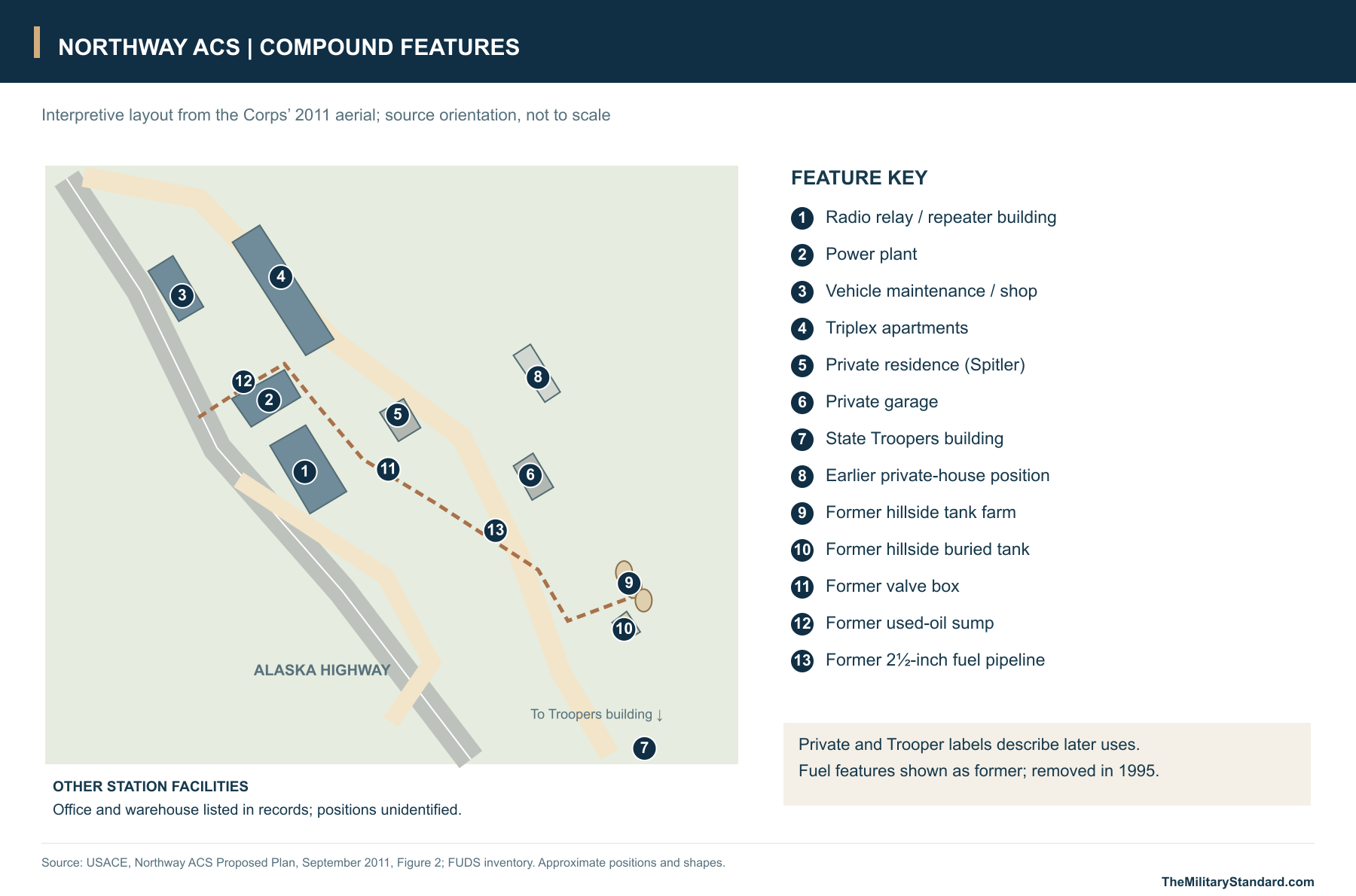
The power plant and fuel system formed an essential support group. The original inventory included two underground tanks and four aboveground tanks, together with aboveground and buried pipelines. The aerial identifies a hillside tank farm, a hillside underground tank and a former 2½-inch pipeline running toward the power-plant area. A valve box and a used-oil sump also appear. These features show how fuel storage, distribution and waste handling were integrated into the compound; the same infrastructure later became the focus of removal and cleanup work. [1] [2]
Family quarters and troop housing were explicitly provided for in the construction laws, and the later apartment building preserves the residential side of the station's layout. Housing, offices, vehicle maintenance and a local power plant placed work and home close together on the roadside property. The scale was much smaller than a major air base, but the compound still required several kinds of support beyond the relay equipment itself. Its built form expresses that combination: a technical workplace supported by accommodation, administration, fuel, utilities and a shop. [1] [2] [4] [5]
Military Closure and Civilian Reuse
By the late 1960s, federal policy was moving toward disposal of Alaska's government-owned long-distance communications facilities. AFCS became the Air Force manager for the ACS disposal program in May 1967. The Alaska Communications Disposal Act, signed on November 14 of that year, authorized transfers of long-lines facilities and associated property interests. The command history records a recommendation to sell the system to RCA Global Communications in June 1969 and a contract signed by the end of that year. Those system-wide milestones provide the setting for Northway's recorded end of Air Force operation in 1970. [3] [6] [1]
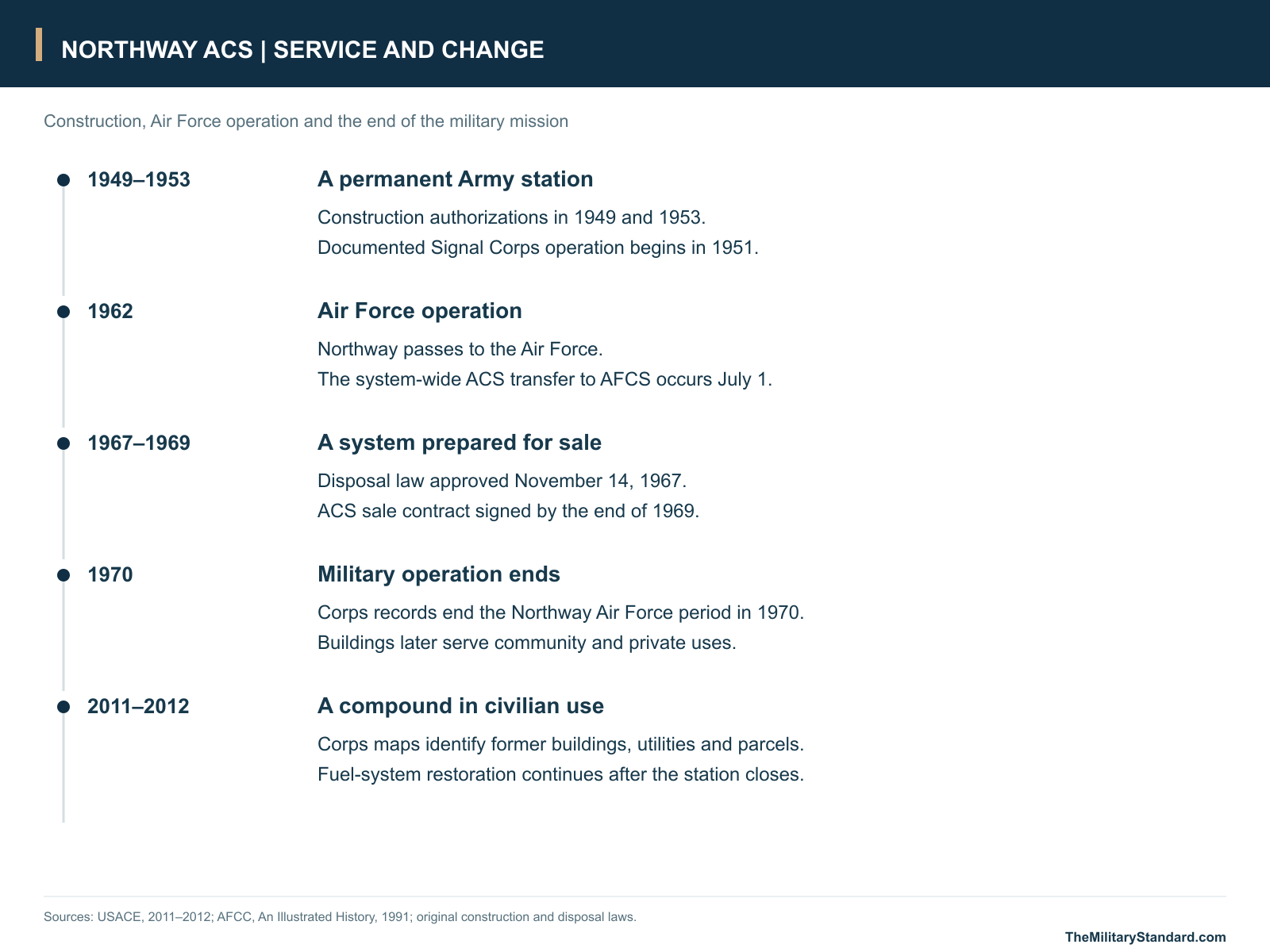
The end of military operation did not mean the immediate disappearance of the compound. In 2012, the Corps described the former relay building being used for community activities, including bingo, while its aerial retained a teen-center label from an earlier use. The former vehicle maintenance building served as storage. The mapped triplex was no longer occupied, and another building was used by State Troopers and as a residential rental. Such changes kept parts of the station in local use while replacing the military functions for which the buildings had been constructed. [1] [2]
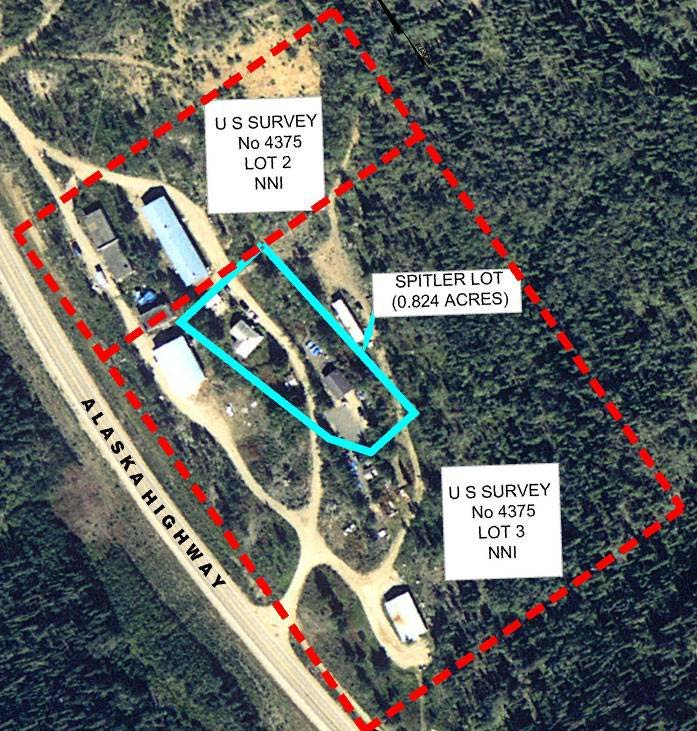
The property had also been divided among civilian interests. The 2011 plan identifies U.S. Survey 4375 Lots 2 and3 with Northway Natives, Inc., and shows a separate 0.824-acre private residential parcel within the larger mapped area. The 2012 report describes Naabia Niign Ltd., part of Northway Natives, as owner of most of the buildings, with Doyon, Limited holding subsurface interests and a separate private residence held by the Spitler estate. These are descriptions of ownership at the report dates. They explain the later mixture of community, rental, storage and private residential uses on the former station property. [1] [2]
The Fuel System's Lasting Legacy
Restoration work followed the military fuel system into the ground. In 1995, crews decommissioned two buried tanks, four aboveground tanks and associated piping, removing drums and petroleum-contaminated soil. Additional work at the hillside tank farm in 2000 removed 191 cubic yards of affected soil. Investigations then examined contamination around the former power plant, used-oil sump and pipeline. Fuel had moved through soil and fractured bedrock into groundwater, making the legacy of the station's utility system more persistent than the visible tanks and pipes. [1]
The October 2012 decision document selected a remedy combining land-use controls, an alternative water supply, well decommissioning and continued groundwater monitoring. Later work included a power-house demolition and well-decommissioning report reviewed in 2015. Environmental management remained active in November 2026: DEC had declined to concur with the protectiveness finding of the 2023 periodic review and approved further monitoring work in September 2026. That plan included three new monitoring wells at Northway ACS. The station's military role had ended decades earlier, while the effects of its fuel infrastructure continued to require attention. [1] [7]
Chronology
- October 27, 1949 Congress authorizes Northway ACS quarters, operational buildings, warehouse, garages and utilities. [4]
- 1951 The documented Army Signal Corps operating period begins at the postwar ACS compound. [1] [2]
- August 7, 1953 Congress authorizes $94,800 for Northway family quarters, troop housing and utilities. [5]
- 1962 The Northway station passes from Army to Air Force operation; the system-wide ACS transfer to AFCS occurs on July 1. [1] [3]
- 1967 AFCS takes responsibility for ACS disposal management in May; the Alaska Communications Disposal Act is signed on November 14. [3] [6]
- 1969 The Air Force recommends sale of ACS to RCA Global Communications; the command history records a contract signed by year's end. [3]
- 1970 The Corps records the end of Air Force operation at Northway ACS. [1] [2]
- 1995 Two underground tanks, four aboveground tanks and associated piping are decommissioned. [1]
- 2000 A hillside tank-farm removal takes out 191 cubic yards of petroleum-contaminated soil. [1]
- 2011-2012 Corps plans document former military buildings in community, storage, rental and private use. [1] [2]
- October 2012 The decision document selects controls, an alternative water supply and continued monitoring. [1]
- 2015 DEC reviews a power-house demolition and well-decommissioning report. [7]
- December 31, 2024 DEC records non-concurrence with the periodic review's protectiveness determination. [7]
- September 21, 2026 DEC approves further fieldwork, including three new monitoring wells at Northway ACS. [7]
Related Sites
Information sources (11)
- PDFU.S. Army Corps of Engineers, Northway Alaska Communication System Decision Document, October 2012
Station history and approximately 9.5-acre scope; former buildings, labeled aerial, fuel infrastructure, civilian reuse and restoration, pp.5-6,11-15,29-32.
- PDFU.S. Army Corps of Engineers, Northway ACS Proposed Plan, September 2011
Army and Air Force operating periods, facility inventory, former fuel system, and U.S. Survey 4375 property diagram, p.2, Figures2-3.
- PDFAir Force Communications Command, An Illustrated History, 1991
System-wide July 1, 1962 ACS transfer to AFCS, management of long-distance communications and the late 1960s disposal program, pp.100-102.
- PDFUnited States, Public Law 414, October 27, 1949, 63 Stat.934-935
Authorized Northway family quarters, operational buildings, warehouse, garages and utilities, with an estimated amount of $377,204.
- PDFUnited States, Public Law 209, August 7, 1953, 67 Stat.440-460
Section401 authorized $94,800 for Northway ACS family quarters, troop housing and utilities; authorization is distinct from construction completion.
- PDFUnited States, Alaska Communications Disposal Act, November 14, 1967, Public Law 90-135
Authorized transfer of federally owned Alaska long-lines facilities, including associated property and rights of way.
- WEBAlaska Department of Environmental Conservation, Northway ACS/DERP, Site862
WGS84 location reference, active environmental status, later building and well work, December 2024 protectiveness dispute and September 2026 monitoring plan.
- WEBU.S. Army Corps of Engineers, FUDS Property Inventory, Northway entries, FY2024
Separate Northway ACS property F10AK0177 and its Army/Air Force sequence, distinguished from Northway Staging Field and later Army property.
- WEBAlaska State Library, Alaska Communications System Photograph Collection, PCA64
Archival collection of station, equipment and personnel photographs; Northway images are listed as1563-1620 in Volume6.
- WEBAlaska Department of Environmental Conservation, Beaver Creek RRS Repeater Site, Site1703
Separate relay northwest of Northway Junction and its WGS84 environmental-site location reference.
- PDFFederal Aviation Administration, Northway airport entry, Alaska Chart Supplement, October 29, 2026
Public-airport reference coordinates used to locate the former Army airfield separately from the ACS compound.