
Santa Ana Army Air Field - John Wayne Airport, Santa Ana California
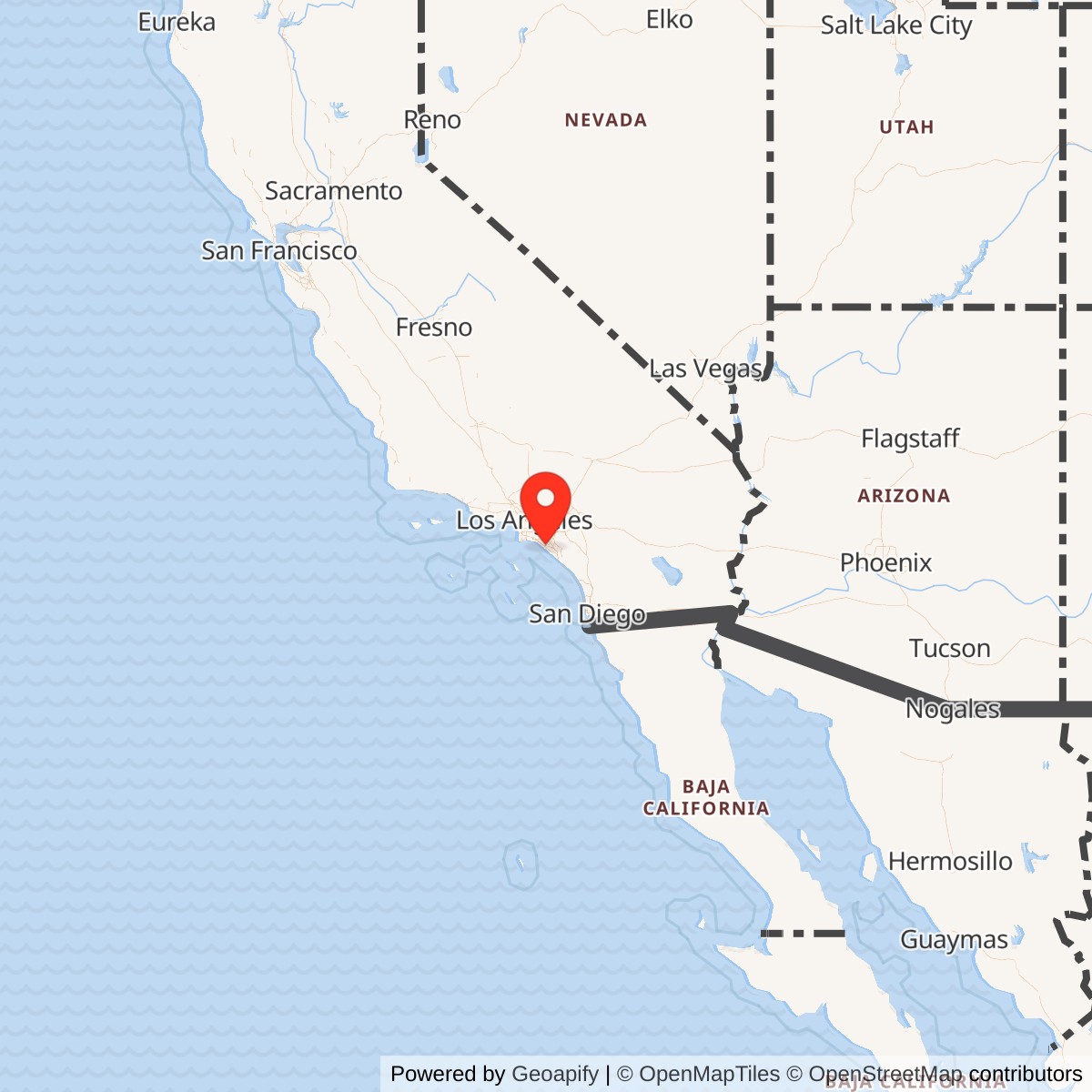
Longitude: -117.8682000
Airport ICAO ID: KSNA
Official Base Website: John Wayne Airport, Orange County
Current Role: John Wayne Airport, Orange County, an active county-owned commercial-service, cargo, general-aviation, and public-service airport with no permanently assigned military flying unit.
For a few critical years, the bean fields beside Orange County Airport held rows of revetted P-38 Lightnings instead of civilian trainers. The airport had opened at its present location only months before the United States entered World War II. It was still a small county airfield when the Army Air Forces took control, lengthened its runway, added lighting and a tower, expanded the property, and made it the flying component of the much larger Santa Ana military aviation complex.
The wartime installation must be distinguished from Santa Ana Army Air Base. The main Santa Ana Army Air Base was a 1,336-acre classification, preflight, redistribution, and separation center in present-day Costa Mesa. It had no runway and was never an operational flying field. Orange County Airport, at the present John Wayne Airport site, supplied the aircraft, runway, hangars, and flight-line functions that the main base lacked. Official Orange County records say the airport became part of Santa Ana Army Air Base during the war. Local historical sources identify the flying installation as Santa Ana Army Air Field and Orange County Army Air Field. Army Air Forces station records sometimes placed flying units at "Santa Ana Army Air Base," a label that could refer to the combined station system rather than to the non-flying cantonment alone.
The airfield performed several related wartime missions. It provided headquarters and liaison aviation for the West Coast Air Corps Training Center and its successor, Western Flying Training Command. It supported P-38 Lightning operational and replacement training connected with the 329th Fighter Group and 332d Fighter Squadron. It also held a small fighter force for Southern California and West Coast patrol and defense duties. These missions made the airport a communications and fighter-training node in a regional network that included Santa Ana Army Air Base, Grand Central Air Terminal, Ontario Army Air Field, Mines Field, March Field, and dozens of western flying schools.
The military period was brief. Army flying activity declined as the danger of direct attack on the West Coast receded and the fighter-training system reorganized. The Army left the airfield in 1946. Orange County resumed airport operations under an interim federal lease on 1946-06-18, and the War Assets Administration returned title in 1948. The airport then entered a second life as a rapidly growing civil aviation center. It became John Wayne Airport in 1979 and remains the only commercial-service airport in Orange County.
Origins Before World War II
Orange County aviation at this location grew from the work of Eddie Martin, a Santa Ana mechanic, pilot, and entrepreneur. In 1923 Martin leased land from the Irvine Company near South Main Street and opened Eddie Martin Airport, a flying school, and Martin Aviation. The field was typical of early local aviation. It served barnstorming, instruction, private flying, and the small but growing community of aircraft owners in Southern California.
The county began acquiring land for a public airport in the 1920s, but the present airport site emerged from a 1939 land exchange involving Orange County, the Irvine Company, and Martin Aviation. The Federal Aviation Administration predecessor assigned the designator SNA, derived from nearby Santa Ana. Orange County then built a new 2,500-foot paved runway and taxi strip about a mile south of the old Martin field. An office, hangar, and field lighting followed, and Martin Aviation moved to the new facility in August 1941.
The timing could hardly have been more consequential. The new county field was only about three months old when Japan attacked Pearl Harbor on 1941-12-07. Civilian flying was soon restricted along the West Coast, and the airport became valuable to a federal government suddenly responsible for protecting Southern California while expanding an enormous aviation-training system. Orange County had created the basic airfield. The Army transformed it into a military installation.
Army Takeover and Wartime Construction
Federal interest had begun before Pearl Harbor. During 1941 the Civil Aeronautics Administration and War Department sought airport land, and Orange County leased additional property from the Irvine Company to satisfy federal requirements. The government entered into a nominal one-dollar annual arrangement for wartime use. County chronology records that in 1942 the United States appropriated the county-owned and leased airport property, incorporated the airport into Santa Ana Army Air Base, and began military operations.
The Army did not merely occupy the existing strip. It built a control tower, extended and improved the runway, added runway lighting, installed taxiways and hardstands, and constructed new support buildings. Field-specific aviation histories describe a 4,780-foot asphalt runway and an expanded wartime footprint created from the approximately 138-acre county airport and roughly 140 additional acres. The Army also built dispersal and revetment areas capable of sheltering fighter aircraft. Photographs and later site descriptions show the P-38 parking revetments that gave the field a markedly military appearance.
The work served two needs. The first was immediate continental defense. In 1942 military planners still had to consider carrier raids, submarine activity, sabotage, and possible Japanese air attack against the Pacific Coast. A fighter field near the growing defense industries and training installations of Orange and Los Angeles Counties had direct value. The second need was training. The Army Air Forces had to turn pilots who had completed basic and advanced schools into combat-capable fighter pilots, and it had to move command officers, inspectors, and specialists among a huge number of western training installations.
The wartime property boundaries did not correspond exactly to the present airport. The modern John Wayne Airport covers 510.15 acres and has two parallel runways. The Army's field was smaller, although considerably larger than the 1941 county airport. Postwar runway construction, terminal projects, freeway development, land acquisition, and airport modernization reshaped the site.
Mission and Operational Role
Orange County Airport's most visible military mission was fighter aviation. Local historical accounts describe a small force of P-38 Lightnings based at the field for patrol duty. The P-38 was a twin-engine, long-range fighter whose speed, climb, and range made it suitable both for coastal defense and for preparing pilots for overseas combat. Aircraft stationed at Orange County could train over Southern California, patrol the coast, and disperse away from larger, more obvious military targets.
The field also supported operational and replacement training. Operational Training Units used oversized parent organizations to create cadres for new groups. Replacement Training Units prepared individual pilots and crews to fill vacancies in combat organizations. Orange County's P-38 activity fit that system. Pilots arriving with general flying qualifications needed transition work in the Lightning's twin-engine layout, high performance, armament, systems, and emergency procedures before they could be sent to an operational unit or overseas replacement pool.
Training sorties would have included takeoffs and landings, formation work, navigation, instrument procedures, emergency drills, high-altitude handling, and tactical familiarization. The airfield's proximity to other Southern California bases allowed pilots and aircraft to move through a network rather than remain tied to one station. Orange County was not a complete standalone fighter school with every phase of instruction on one field. It was a specialized operational site within a larger training system.
The airfield also functioned as the flying outlet for command activity centered at Santa Ana. The West Coast Air Corps Training Center had originally been headquartered at Moffett Field. When the Navy took over Moffett for lighter-than-air operations, the Army shifted the western replacement and training headquarters to the Santa Ana area. The main Santa Ana base supplied offices, schools, barracks, classification facilities, and command administration. Orange County Airport supplied the runway and aircraft.
Historical accounts describe a headquarters squadron and a group of liaison aircraft that operated as a military "taxi service." Their purpose was practical. Western Flying Training Command supervised schools and bases spread across eleven western states. Commanders, staff officers, inspectors, medical personnel, technical specialists, and couriers needed to reach distant installations faster than surface travel allowed. The Orange County flight line linked Santa Ana headquarters to the flying schools and operational fields it controlled.
The P-38 Mission and the 332d Fighter Squadron
The unit most closely associated with Orange County's fighter mission was the 332d Fighter Squadron, a two-engine fighter organization assigned to the 329th Fighter Group. The squadron was activated in July 1942, equipped with P-38 Lightnings, and employed in operational and replacement training. Published station records list the squadron at Santa Ana Army Air Base beginning in September 1942, followed by Ontario Army Air Field in 1943, a return to the Santa Ana station, and disbandment on 1944-03-31.
That station record requires explanation. The main Santa Ana cantonment had no runway. Field-specific Orange County histories identify Orange County Airport as the operational flying field where the P-38s were based. The most reasonable reading is that the Army Air Forces station designation grouped the squadron administratively under Santa Ana Army Air Base while its aircraft operated from the associated Orange County field. This is a common problem in wartime station histories, where a unit may be credited to a parent post while physically flying from a nearby municipal or auxiliary field.
The squadron belonged to the 329th Fighter Group, whose organizations were spread among several Southern California fields. Group headquarters operated from Grand Central Air Terminal at Glendale, while squadrons used fields including Santa Ana, Mines Field, Van Nuys, and Ontario during different periods. This dispersion reduced congestion, made use of available civilian airports, and supported both training and coastal defense.
One pilot who passed through the field was Thomas B. McGuire Jr. He reported to Orange County Airport in February 1943 for transition training in the P-38. McGuire later became one of the leading American fighter aces of World War II and received the Medal of Honor for combat in the Southwest Pacific. Those later honors belong to McGuire and his combat organizations, not to Orange County Airport. His presence is nevertheless important because it illustrates the airfield's role in the personnel pipeline. The field helped pilots master the Lightning before they entered the combat organizations where their wartime records were made.
The fighter mission appears to have diminished by 1944. By then the immediate coastal-defense emergency had eased, training organizations were being consolidated, and the Army Air Forces was replacing traditional squadrons at many training stations with more flexible numbered base units. The 332d was disbanded on 1944-03-31 as part of that broader reorganization. Liaison, administrative, and station-support flying continued, but Orange County's period as a conspicuous P-38 field was relatively short.
Command and Liaison Aviation
The liaison mission was less dramatic than rows of fighters, but it was central to the airfield's strategic value. Western Flying Training Command supervised an enormous production system. It had to coordinate civilian contract primary schools, Army basic and advanced flying schools, bombardier and navigator programs, replacement centers, specialized schools, maintenance arrangements, and the movement of trainees.
Orange County Airport allowed the command to operate aircraft without attempting to build a runway inside the crowded Santa Ana cantonment. Headquarters aircraft could carry officers to inspection visits, deliver documents and small cargoes, move specialists, and maintain contact with subordinate installations. In an era before secure digital communications and routine long-distance commercial air travel, a dedicated command flight saved time and gave headquarters direct access to the system it managed.
The term "headquarters airdrome" accurately describes the function, but it was not necessarily the field's formal wartime name. Official county records call it Orange County Airport and say it became part of Santa Ana Army Air Base. Local histories use Santa Ana Army Air Field and Orange County Army Air Field. The installation's identity is therefore best presented as a county airport under Army Air Forces control, serving as the flying field for the Santa Ana and Western Flying Training Command complex.
Relationship to Santa Ana Army Air Base
Confusion between Orange County Airport and Santa Ana Army Air Base has persisted because the two facilities were administratively linked, geographically close, and often described under the same station name. They were nevertheless different physical installations.
Santa Ana Army Air Base occupied a large cantonment centered in what is now Costa Mesa. Its mission was people, not airplanes. It received aviation cadets, gave them military indoctrination, tested and classified them for pilot, navigator, and bombardier training, and later processed returning combat personnel and separations. Its built environment consisted of barracks, classrooms, headquarters, medical facilities, recreation buildings, warehouses, mess halls, and support infrastructure. It had no operational runway.
Orange County Airport was the flying field. Its military landscape consisted of runways, taxiways, lighting, tower facilities, hangars, hardstands, fighter revetments, fuel and maintenance functions, and the smaller number of buildings needed for flight operations. A person could be assigned to the Santa Ana station while working or flying at Orange County Airport. A unit history could list Santa Ana Army Air Base even when its aircraft could only have operated from the county field.
The distinction also matters after the war. The Santa Ana cantonment closed in 1946 and was divided among Orange Coast College, the Orange County Fairgrounds, Vanguard University, parks, schools, housing, civic facilities, and commercial development. Orange County Airport resumed aviation use and remains an active airport. The two places followed separate postwar paths even though their wartime histories were intertwined.
Units, Organizations, and Aircraft
The following organizations and systems are directly or closely associated with Orange County Airport's military period:
- West Coast Air Corps Training Center and Western Flying Training Command. These headquarters organizations supervised Army Air Forces flying training across the western United States. Orange County supplied their practical flight and liaison connection.
- Santa Ana Army Air Base. The non-flying parent station provided the administrative, classification, preflight, redistribution, and separation functions to which the airfield was linked.
- 329th Fighter Group. This P-38 training group dispersed its headquarters and squadrons among Southern California fields. Orange County's P-38 activity formed part of that regional organization.
- 332d Fighter Squadron (Two Engine). The squadron trained P-38 pilots and performed operational or replacement training. Its official station credit to Santa Ana is reconciled with field-specific evidence placing P-38 operations at Orange County Airport.
- Headquarters and liaison flight elements. A small fleet moved Western Flying Training Command personnel and provided command communications among western installations.
- Lockheed P-38 Lightning. The P-38 was the defining wartime aircraft at the field. It served training and coastal patrol purposes and connected Orange County to the Army Air Forces fighter replacement system.
Other transient military aircraft almost certainly used the field, especially command, transport, and trainer types, but the surviving public record does not justify treating every photographed or reported aircraft as permanently assigned. The history should therefore emphasize the documented P-38 and liaison roles while distinguishing them from occasional visits.
Facilities and Physical Layout
The county airport that the Army inherited had a 2,500-foot paved runway, taxi strip, office, hangar, and lighting. Military construction expanded the field into an installation capable of supporting high-performance fighters. The improved runway was approximately 4,780 feet long, sufficient for P-38 operations under normal conditions. The Army added taxiways, hardstands, a control tower, lighting, hangars or maintenance space, and dispersed parking.
Fighter revetments were among the most distinctive additions. Revetments separated parked aircraft with earth or other protective barriers, reducing the chance that one attack, explosion, or fire would destroy an entire line. Their construction reflected the defensive atmosphere of 1942, when planners could not dismiss the possibility of an attack on Southern California. The revetments remained visible after the war and were removed as the county rebuilt the airport.
The additional runway or paved strip on the west side also had an unusual postwar life. Once it was no longer needed for normal airport operations, it became a drag-racing strip during the 1950s. That reuse preserved the geometry of the military expansion for a time even as the site returned to civilian control.
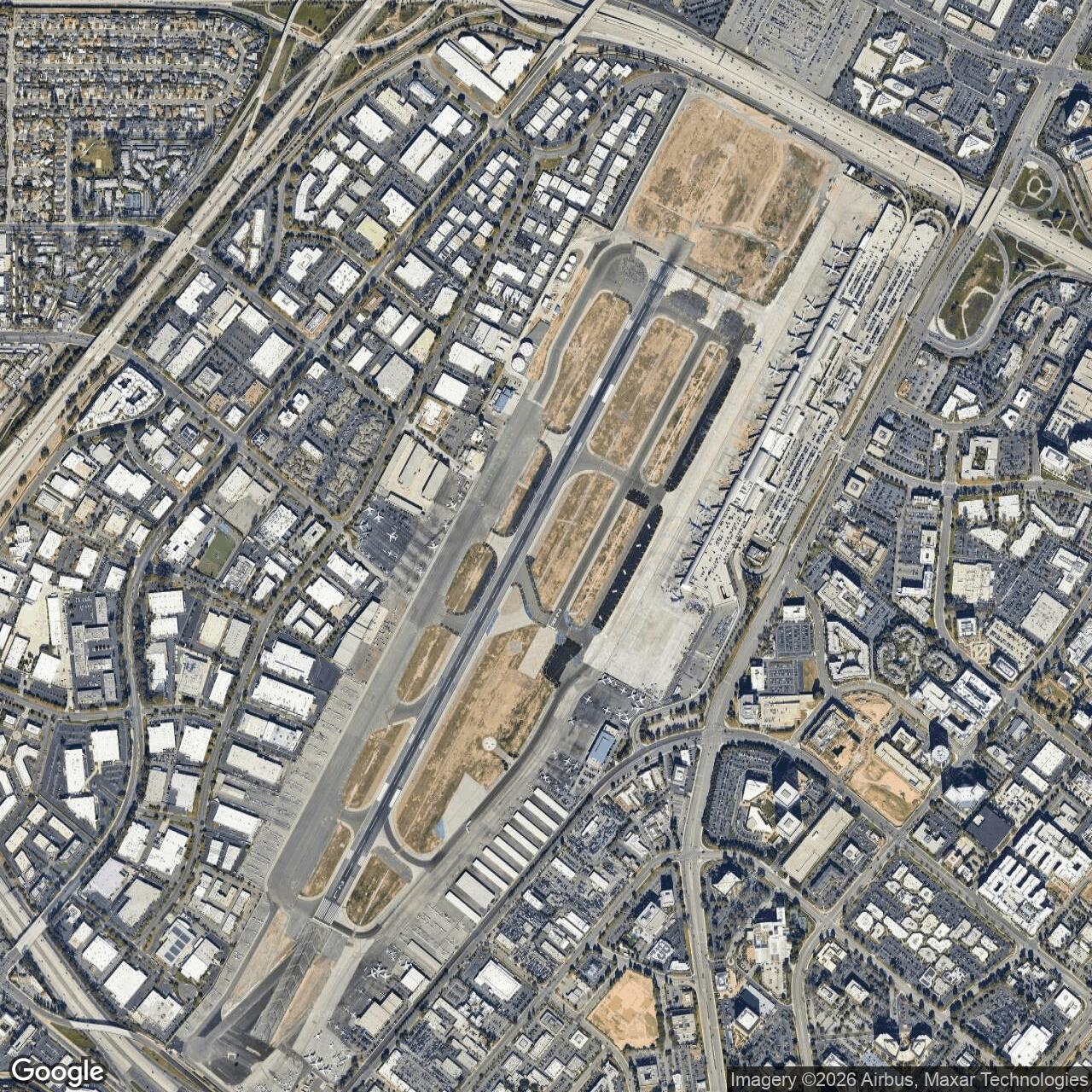
The modern airport bears only partial resemblance to the wartime field. The present main runway is 5,700 feet long, and the parallel general-aviation runway is 2,887 feet long. Terminals, parking structures, aprons, taxiways, utility facilities, freeways, and dense urban development now surround the airfield. The military tower, wartime buildings, and P-38 revetments are gone. The runway orientation and continuing aviation use preserve the strongest physical continuity.
Demobilization and Return to Orange County
Army activity contracted rapidly after victory. Local aviation histories say the Army left the field in March 1946 and that Orange County reopened it for civil flying in May. The most precise official administrative milestone is 1946-06-18, when the county entered an interim lease with the federal government and resumed airport operation. The War Assets Administration returned ownership in 1948.
The return carried an important federal condition. The airport was to remain available to all forms of aviation use. Such restrictions were common when the government transferred improved wartime airfields to local authorities. Federal investment had enlarged and modernized the facility, and the government wanted the resulting aviation infrastructure preserved rather than immediately converted to unrelated development.
Orange County inherited both opportunity and excess capacity. The Army had left a longer runway, lighting, a tower, paved surfaces, and support structures far beyond what the young county airport possessed in 1941. Some military features were removed, while others became the foundation for civil growth. The western runway became a drag strip until 1959. P-38 revetments were cleared. Hangars and paved areas supported a revived general-aviation community.
The military period thus changed the airport's future. Without wartime construction, Orange County might have returned to a modest local field. Instead, it possessed an improved airfield capable of attracting flight businesses, private owners, airline service, and later commercial expansion.
Postwar Civil Aviation and Rebuilding
Aviation entrepreneur and film pilot Paul Mantz moved his operation to Orange County in 1950, bringing aircraft, publicity, and a strong connection to Hollywood aviation. Scheduled airline service began in 1952 when Bonanza Airlines used Douglas DC-3s for routes linking Orange County with Los Angeles, San Diego, El Centro-Yuma, and Phoenix.
Growth accelerated with Orange County's postwar population boom. Private aircraft numbers increased, an FAA control tower opened in 1959, and county planners considered major runway and terminal improvements. A new runway opened in 1965. In 1967 the Eddie Martin Terminal opened and the main runway was extended to 5,700 feet, allowing broader airline service. The Tallmantz aviation collection and museum also made the airport a center of historic and film aviation during the 1960s.
The airport was renamed John Wayne Airport in 1979 in memory of the actor and Newport Beach resident. The Thomas F. Riley Terminal opened in 1990, replacing the smaller 1967 terminal as the center of passenger operations. Later terminal and parking projects created the present three-terminal complex.
The site's success produced a new strategic constraint. The wartime Army had selected and expanded a field amid open agricultural land. Postwar Orange County urbanized around it. Freeways, offices, homes, and commercial districts left little room for runway expansion and brought aircraft noise into direct conflict with surrounding communities.
Noise, Urbanization, and Environmental Context
No major public record was identified that treats the former wartime airfield as a separate military environmental cleanup site. The most prominent continuing environmental and land-use issue is aircraft noise rather than a documented Army remediation program.
Orange County began a formal noise-management program in 1971, hired an airport noise-abatement officer, and installed an early computerized monitoring system. Noise disputes, lawsuits, flight restrictions, and community negotiations shaped airport development through the 1970s and 1980s. The 1985 Settlement Agreement established controls on noise, passenger capacity, and commercial operations while allowing terminal improvements.
This postwar history reflects the transformation of the site. During the war, distance from dense development made the airfield useful for fighters and training. By the late twentieth century, the airport was embedded in one of the most urbanized counties in the nation. Its operational limits became the product of community agreements, runway length, surrounding development, and environmental review rather than military requirements.
Current Status
The former Army Air Forces field is now John Wayne Airport, Orange County, an active county-owned commercial-service and general-aviation airport. The airport covers 510.15 acres and operates two runways. The 5,700-foot main runway serves commercial and general aviation aircraft, while the 2,887-foot parallel runway primarily serves general aviation.
No permanent Army or Air Force flying unit is assigned to the airport today. Military aircraft may use it as transient traffic under normal civil-airport procedures, but that does not create a continuing military installation. The wartime Army mission ended in 1946, and the airport's current identity is civilian.
Very little military fabric remains obvious to present passengers. The control tower, revetments, temporary buildings, and wartime runway system were replaced or absorbed by later development. Continuity lies in the ground itself, the SNA identifier, and the fact that a public airport created in 1939 was greatly strengthened by Army construction and returned to the county for permanent aviation use.
Chronology
- 1923 Eddie Martin opens Eddie Martin Airport, a flying school, and Martin Aviation on Irvine Company land near Santa Ana.
- 1925-1928 Orange County acquires parcels for a possible county airport south of the original Martin field.
- 1928 Charles Lindbergh visits Eddie Martin Airport.
- 1939-11-28 Orange County acquires the airport through a land exchange with the Irvine Company and makes it a public facility.
- 1939 The airport receives the designator SNA, based on nearby Santa Ana.
- 1940 Orange County begins construction of a new airport at the present site, including a 2,500-foot paved runway and taxi strip.
- 1941-08 The new county airfield is completed, and Martin Aviation moves to the site.
- 1941 Orange County completes an office, hangar, and field lighting while federal agencies seek wartime use of the property.
- 1941-12-07 Japan attacks Pearl Harbor.
- Late 1941 Civilian flying is restricted along the West Coast, and federal control of Orange County Airport begins to develop.
- 1942 The United States appropriates or leases the county-owned and Irvine Company airport property, incorporates it into the Santa Ana Army Air Base system, and begins military operations.
- 1942-08 Field-specific aviation history identifies selection of Orange County Airport as a West Coast defense and fighter-dispersal field.
- 1942 The Army builds a control tower, extends the runway, adds lighting, taxiways, hardstands, support buildings, and fighter revetments.
- 1942-09 The 332d Fighter Squadron receives station credit at Santa Ana Army Air Base; field-specific histories place associated P-38 operations at Orange County Airport.
- 1942-1944 P-38 Lightning training, replacement activity, and coastal patrol operations are conducted from the field.
- 1943-02 Thomas B. McGuire Jr. reports to Orange County Airport for P-38 transition training before later combat service in the Southwest Pacific.
- 1943-08 The 332d Fighter Squadron moves to Ontario Army Air Field.
- 1943-10 The 332d returns to the Santa Ana station system.
- 1944-03-31 The 332d Fighter Squadron is disbanded during the Army Air Forces reorganization of training units.
- 1944-12 Local historical accounts place the formal one-dollar annual county lease documentation in this period, although military control and improvements had begun earlier.
- 1944-1945 Command, liaison, and station-support flying continues as Santa Ana shifts toward redistribution and separation work.
- 1946-03 Local aviation history records the Army's departure from Orange County Airport.
- 1946-03-31 Santa Ana Army Air Base is deactivated.
- 1946-05 Orange County reopens the airport for civilian flying according to local histories.
- 1946-06-18 Orange County enters an interim lease with the federal government and resumes official airport operation.
- 1948 The War Assets Administration returns title to Orange County.
- 1949 Remaining P-38 revetments and other wartime features are removed during civil-airport redevelopment.
- 1950 Paul Mantz moves his aviation operation and aircraft collection to Orange County Airport.
- 1950-1959 An abandoned western runway is used for drag racing before being converted to aircraft parking and other airport use.
- 1952 Bonanza Airlines begins the airport's first regular scheduled airline service.
- 1959 A new FAA control tower opens.
- 1963 Tallmantz Movieland of the Air opens on airport property.
- 1965 Orange County Airport opens a new main runway.
- 1967-05-06 The Eddie Martin Terminal opens, and the main runway is extended to 5,700 feet.
- 1971 The airport establishes an early comprehensive noise-management program and formal jet curfew policy.
- 1979-06-20 Orange County Airport is renamed John Wayne Airport.
- 1985 The landmark airport settlement framework establishes operational, passenger, and noise controls while permitting major improvements.
- 1990-09-16 The Thomas F. Riley Terminal opens.
- 1994 The original Eddie Martin Terminal is demolished.
- 2011 Terminal C and related improvements open as part of a major airport expansion program.
- 2023 The airport marks the centennial of Eddie Martin's original aviation enterprise.
- Present John Wayne Airport remains an active County of Orange commercial and general-aviation airport on the former World War II Army Air Forces field.
Information sources (14)
- WEBJohn Wayne Airport
History
- WEBJohn Wayne Airport
100-Year Timeline
- PDFJohn Wayne Airport
JWA Chronology
- WEBJohn Wayne Airport
JWA Overview
- WEBJohn Wayne Airport
Statistics
- WEBOC Historyland
Orange County's World War II Military Bases
- WEBAero Vintage Books
History of Orange County Airport
- WEBCalifornia State Military Museum
Santa Ana Army Air Base
- PDFAir Education and Training Command
We Wanted Wings: A History of the Aviation Cadet Program
- PDFDepartment of the Air Force Historical Research Agency
Air Force Combat Units of World War II
- PDFDepartment of the Air Force Historical Research Agency
Combat Squadrons of the Air Force, World War II
- WEBCosta Mesa Historical Society
Santa Ana Army Air Base
- WEBJohn Wayne Airport
1985 Settlement Agreement
- WEBJohn Wayne Airport
Access and Noise