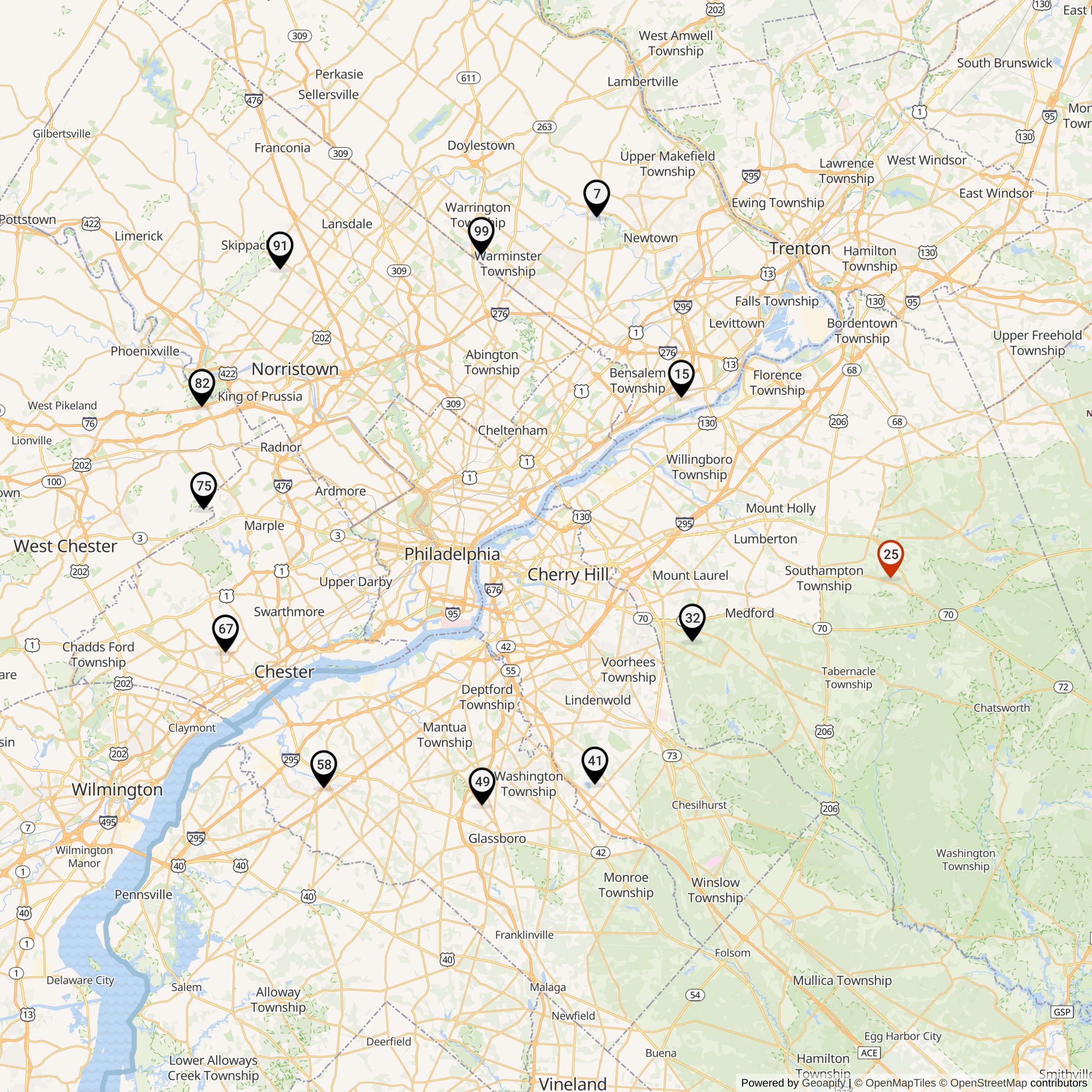
Nike Missile Site PH-25 IFC, Lumberton New Jersey
Longitude: -74.6621
This location was part of the Philadelphia Defense Area
Site ID: PH-25
This site controlled the missiles at the Launch Area located here.
Site Role: IFC
A typical Nike air defense site consisted of two separate parcels of land. One area was known as the Integrated Fire Control (IFC) Area. This site contained the Nike system's ground-based radar and computer systems designed to detect and track hostile aircraft, and to guide the missiles to their targets.
The second parcel of land was known as the Launcher Area. At the launcher area, Nike missiles were stored horizontally within heavily constructed underground missile magazines. A large, missile elevator brought the Nikes to the surface of the site where they would be pushed across twin steel rails to one of four satellite launchers.
Elaboration on how Nike worked here.
Nike Missile Site PH-25 was one half of the U.S. Army's double Nike missile battery at Lumberton, New Jersey, in the Philadelphia Defense Area. The installation is usually identified as PH-23/25 because it was a dual battery: two Nike batteries built side-by-side with a shared double launcher area and two separate Integrated Fire Control areas. PH-23 and PH-25 were therefore not two completely separate missile bases miles apart from one another; they were paired parts of the same Lumberton Nike installation, with PH-25 representing one of the two fire-control / battery identities tied to the shared launch complex.
The Lumberton Nike installation became operational during the mid-1950s as a Nike Ajax site, was quickly converted to the more powerful Nike Hercules system, and remained active until April 1974. It was one of the Philadelphia Defense Area sites retained after many Ajax-only batteries were closed in the early 1960s. The site's active military mission ended in 1974, after which the former launch area and fire-control properties were transferred into township, private, and other civilian uses.
Naming and Double-Site Clarification
PH-25 should be treated carefully because sources refer to it in several overlapping ways. Federal Nike inventories often list PH-25 at Lumberton with a large Hercules-capable missile configuration. Local and site-specific histories normally call the installation PH-23/25 because the site functioned as a double Nike battery.PH-25 is treated as the PH-25 half of the Lumberton double battery, not as a separate single-battery installation. The history therefore discusses the complete Lumberton PH-23/25 complex where necessary, while preserving the PH-25-specific control-area coordinate and identity.
History
The Lumberton Nike site was part of the Philadelphia Defense Area, the Cold War air-defense network built to protect Philadelphia, Camden, and surrounding military and industrial targets. During the early 1950s, U.S. air-defense planners assumed that Soviet long-range bombers could strike major American cities and industrial regions. Philadelphia was an obvious defense priority. It was a major population center, a transportation hub, a port and shipbuilding region, and an industrial area with military and logistical significance. The Nike program placed radar-guided surface-to-air missile batteries around such high-value areas as the final ground-based layer of defense.The Philadelphia District of the U.S. Army Corps of Engineers supervised construction of a ring of Nike Ajax sites around the region, averaging roughly twenty-five miles from Center City. Several of those sites were built in Pennsylvania, while the New Jersey side included batteries such as Lumberton, Marlton, Berlin / Clementon, Mantua, Gibbsboro, and Woolwich. The geographic purpose of the New Jersey batteries was to cover eastern and southeastern approaches to the Philadelphia-Camden region, including routes over South Jersey and the Delaware River corridor.
Lumberton was agricultural when the Army arrived. Local histories describe the area as still largely farmland, with the launch area placed on former farm property near Newbolds Corner Road, now Municipal Drive, and Eayrestown Road. That rural character made the location attractive for a missile battery: there was enough land for a large secure launch complex, open terrain around the site, and enough distance from dense city development to handle the safety requirements of missile storage, radar operations, and, later, nuclear-capable Hercules operations.
The Lumberton site also mattered because it was a double site. Most Nike batteries were single batteries with one launcher area and one fire-control area. PH-23/25 was larger and more complex, in effect two batteries located side-by-side. That made it one of the more substantial Philadelphia Defense Area installations and helped explain why it was retained and modernized rather than closed during the early-1960s Ajax drawdown.
Units and Manning
The Lumberton site was first manned by the Army's 738th Anti-Aircraft Artillery Guided Missile Battalion. This was the Regular Army phase of the installation's operation, when active-duty Army air-defense personnel manned the Nike Ajax and early Hercules mission.During 1963, control of the site transferred from the Regular Army to the New Jersey Army National Guard as part of a broader national effort to divide continental air-defense responsibilities between active and reserve forces. The New Jersey Army National Guard's 112th Artillery assumed command of the site. A former Lumberton launcher-area platoon sergeant later identified his service at the site from October 1963 to September 1969 with Battery A, 7th Hercules Battalion, 112th Artillery, New Jersey Army National Guard. The local history record also states that the New Jersey Army National Guard's 254th Artillery assumed command of the site during 1971 and continued to operate it until closure in 1974.
The Guard phase altered the local rhythm of operations. A smaller core of full-time personnel remained associated with the base, while guardsmen rotated in for drills and readiness requirements. Even under Guard manning, the site remained an operational Nike Hercules battery. Personnel still had to maintain missiles, launchers, radars, generators, communications systems, security, and warhead-control procedures, and they remained subject to rapid recall requirements.
Mission and Operation
PH-25's mission was to detect, track, and, if ordered, engage hostile aircraft approaching the Philadelphia-Camden region. As part of the larger Philadelphia Defense Area, the Lumberton battery did not operate as an isolated weapon. It was tied into an Army and Air Force air-defense network that included regional command-and-control facilities, acquisition radars, target-tracking radars, missile-tracking radars, and ground-based fire-control computers.The Nike system used command guidance. The missile did not independently search for its target. Radar and computer equipment in the Integrated Fire Control area tracked both the incoming aircraft and the missile. The ground system calculated an intercept point and transmitted steering commands to the missile. When the target and missile trajectories converged, detonation was commanded from the ground.
In the Ajax period, the site was designed to engage bomber targets with conventionally armed Nike Ajax missiles. In the Hercules period, PH-25 became part of a smaller group of more powerful batteries that could engage targets at greater range and altitude and could use nuclear warheads against bomber formations. The shift to Hercules was central to the history of the Lumberton site. It explains both the modernization of the launch magazines and radar equipment and the site's survival after many Ajax-only batteries in the Philadelphia Defense Area were closed.
Site Layout
The Lumberton Nike installation was built as a dual battery. It included a shared launcher area, an adjacent administrative / support area, and two separate Integrated Fire Control areas located to the east.The shared PH-23/25 launch area was at approximately 39.96121987187595, -74.79756895759334. This was the missile storage and launch side of the installation. In its original form, the launch area contained six underground missile storage magazines, elevator platforms, launch rails, missile-handling pavement, support buildings, roads, fencing, security features, and launch-control functions. The administrative area with offices was located adjacent to the launcher area. Local accounts describe the launcher area as being on Newbolds Corner Road, now Municipal Drive.
The PH-25 IFC / control area was at approximately 39.96295528962273, -74.7807778053925. The companion PH-23 IFC was very nearby at approximately 39.96427141794708, -74.78074063677641. The IFC areas were located near Eayrestown Road, roughly one-half mile east of the launch complex. Each IFC area contained the radar and guidance equipment for one side of the double battery. Radar towers held acquisition and tracking antennas; associated buildings housed electronics, communications equipment, power systems, and operator stations.
The separation between the launch and IFC areas was fundamental to Nike design. The radar site needed line-of-sight and proper separation from the launch area, while the launcher site required secure land for magazines, launchers, safety arcs, and missile handling. In a double site such as PH-23/25, this arrangement was repeated and expanded, producing a larger and more complicated installation than a standard single battery.
Nike Ajax Period
The Lumberton installation became operational during 1956 as a component of the Philadelphia Defense Area. In its first operational period, the site housed Nike Ajax missiles. Local and federal sources describe the installation as initially having six underground storage magazines and as many as sixty Nike Ajax missiles.Nike Ajax was the Army's first operational guided surface-to-air missile. It represented a major change from earlier gun-based continental air defense. The system required trained radar operators, launcher crews, missile maintenance personnel, and constant readiness drills. At Lumberton, residents recalled that most local people were not permitted behind the barbed-wire perimeter, and the arrival of the Army in a farm community was a major local event.
The Ajax missile was a liquid-fueled weapon. Its sustainer used liquid fuel and oxidizer, which required specialized handling and safety precautions. The missile was stored horizontally below ground and raised to the surface by elevator when needed. Crews then manually moved missiles on rails to launch positions. The system was labor-intensive and required repeated training to maintain the ability to respond quickly.
Local memory preserved the contrast between quiet farm-country surroundings and the intense military operation behind the fence. Residents near the site remembered frequent drills, security patrols, and the general mystery of a military installation whose true mission and capabilities were only partly understood by the surrounding community.
Conversion to Nike Hercules
PH-25 was one of the first Nike sites in the country converted from Ajax to Hercules. Appendix D of the Nike Hercules history lists PH-25 among converted defense sites with a 2B and 2C box / magazine configuration. That same Appendix D table gives a construction / conversion period beginning in June 1958 and a Hercules operational date of October 10, 1958.The local Lumberton history also emphasizes the early conversion. It states that, two years into operation, the Hercules system replaced Ajax at the site and that four of the six underground magazines were converted for Hercules. Newspaper coverage announced that the Lumberton unit was receiving Hercules missiles in August 1958, and local reporting in October 1958 documented the Hercules rollout. The conversion reduced the number of active magazines from the original six Ajax magazines to four Hercules-capable magazines, leaving two older Ajax sections closed.
Federal site inventory data lists PH-25 as Nike 2B,4C/24H,60A/22L-UA, with fourteen launchers converted to Hercules. The "24H" component corresponds with the local interpretation that four Hercules magazines could hold six Hercules missiles each. Local historical discussion suggests that many of the Hercules missiles likely carried nuclear warheads of varying yields, while a smaller number may have carried conventional warheads. The exact live warhead mix at any given time is not generally available in open public records, but the site was part of the nuclear-capable Nike Hercules system.
Hercules altered the character of the Lumberton site. The missile was larger, more powerful, and solid-fueled, making it safer to handle than Ajax in some respects but more strategically consequential because of its nuclear role. The site also required upgraded radar and fire-control equipment. Security increased after the Hercules conversion, including a more robust launch-area perimeter, sentry dogs, and stricter two-person or dual-key procedures for sensitive weapons-related materials.
Security and Nuclear-Capable Operations
The Hercules era brought a more intense security environment to PH-25. Local accounts note that, with the advent of Hercules and nuclear-capable missiles, the Army increased security in several ways. A second fence was installed around the launch area, with an inner guarded gate. Sentry dogs and handlers were used during hours of darkness around the launch-area perimeter. Sensitive warhead-control procedures involved armed officers and locked safes with dual-key controls.This security environment reflected the seriousness of the Hercules mission. Nike Hercules was designed to destroy formations of attacking aircraft, not simply individual bombers. Its nuclear capability meant that the launch area was not just a missile-storage facility but a controlled weapons area. Even though local residents could see fences, towers, buildings, and occasional public open-house displays, much of the site's actual readiness posture, warhead status, and firing doctrine remained classified or only generally understood.
The planned firing geometry also mattered. Local history describes the Lumberton missiles as pointing generally eastward when lifted to the surface, reflecting the expected direction of hostile bomber approach, but not standing perfectly vertical when raised for launch. Booster drop-zone calculations were built into base design. Local accounts suggest the anticipated booster fall area was east of Route 206, in a less populated area than Lumberton itself.
Command and Control
The Philadelphia Defense Area's command-and-control functions were eventually hosted by a Missile Master facility at Gibbsboro / Pedricktown, New Jersey. This regional command system coordinated target information and engagement assignments for the Philadelphia Nike batteries. For PH-25, that meant the battery's local radar and launch crews were part of a regional defense network. The site could track and engage locally, but the wider air-defense system governed identification, assignment, and engagement authority.This command structure is important because it prevents misunderstanding PH-25 as a simple "missile silo" site. The Lumberton battery was one part of an integrated air-defense system combining local fire-control radars, launcher operations, higher command centers, Air Force radar inputs, and North American air-defense coordination.
Relationship to Other Philadelphia Sites
PH-25's history is closely tied to the larger Philadelphia Defense Area. The Philadelphia ring included sites in both Pennsylvania and New Jersey. On the Pennsylvania side were batteries such as Richboro, Bristol / Newportville / Croydon, Chester / Media, Edgemont / Delaware County, Valley Forge / Paoli, Worcester / Center Square, and Warrington / Eureka. On the New Jersey side were Lumberton, Marlton, Berlin / Clementon, Mantua, Gibbsboro, and Woolwich.After Hercules entered service, the Army no longer needed all of the original Ajax batteries. Only five of the twelve sites defending the Philadelphia region received Hercules. Lumberton was one of them. The increased range and capability of Hercules allowed the Army to close Ajax-only sites such as Pitman and Marlton while retaining the more powerful batteries. PH-25 therefore represents the modernized, longer-lived phase of Philadelphia Nike defense.
Daily Life and Community Memory
PH-25 occupied an unusual place in Lumberton's local life. The site was highly restricted, but it was not socially invisible. Soldiers lived and worked in and around the community. Local residents remembered sentries, fences, drills, security, and the presence of young servicemen far from home. Some local families interacted with soldiers through ordinary community life, holiday meals, local businesses, and chance encounters. Others remembered the base as mysterious and intimidating.Open houses also formed part of the site's public relationship with the community. Newspaper accounts documented press tours and open-house events in the 1950s and early 1960s. These events displayed some aspects of the Nike system, but they did not reveal the full details of warhead status or operational procedures. The public saw a Cold War defensive installation, but not the entire operational reality of a nuclear-capable air-defense battery.
The site's local memory is especially strong because the physical remains endured for decades after closure. Radar towers, deteriorating buildings, old roads, launch-area structures, and municipal reuse kept the base visible in the landscape long after the missiles were gone.
Across the country, the Army began closing Nike sites as strategic priorities changed, costs rose, and continental air defense was reduced. The South Jersey Nike batteries that remained into the 1970s closed in 1974. The Lumberton site's deactivation ended nearly two decades of active military use.
Post-Closure Use and Current Condition
After closure, Lumberton Township sought to acquire the property. Local history states that the township acquired the launch area for $60,000 and received the radar property at no additional cost because it was planned for educational use. The former launch area became part of Lumberton's municipal property and public-works landscape. Federal inventory descriptions identify the launch site as Township of Lumberton property, with some buildings still in use and magazines visible and functional. Later local accounts describe municipal storage, recycling, and public-works uses in and around the former launch complex.The radar / IFC property had a more fragmented post-closure history. Federal inventory material describes the control-site condition / ownership as Township of Lumberton and private owner. The Midway School used part of the property after the Army period. Later, the school was demolished in 2016 to make way for housing, while two radar towers reportedly remained on adjacent private property owned by a landscaping company. Photographer Richard Lewis documented the site shortly before major demolition, noting that the command and control section with radar-tower remains was the most visually intact portion by that time.
The launch area has been more durable than the control area because it was useful to the township. The underground magazine area and associated pavement could be adapted for storage, municipal work, and public-works functions. By contrast, radar towers and IFC buildings were more vulnerable to redevelopment once the school and private-property uses changed. Today, the former PH-25 / PH-23/25 landscape is best understood as a partially surviving, heavily altered Cold War military site embedded in municipal and suburban development.
List of all Nike Installations in the Philadelphia Defense AreaList of all Nike Installations in New Jersey