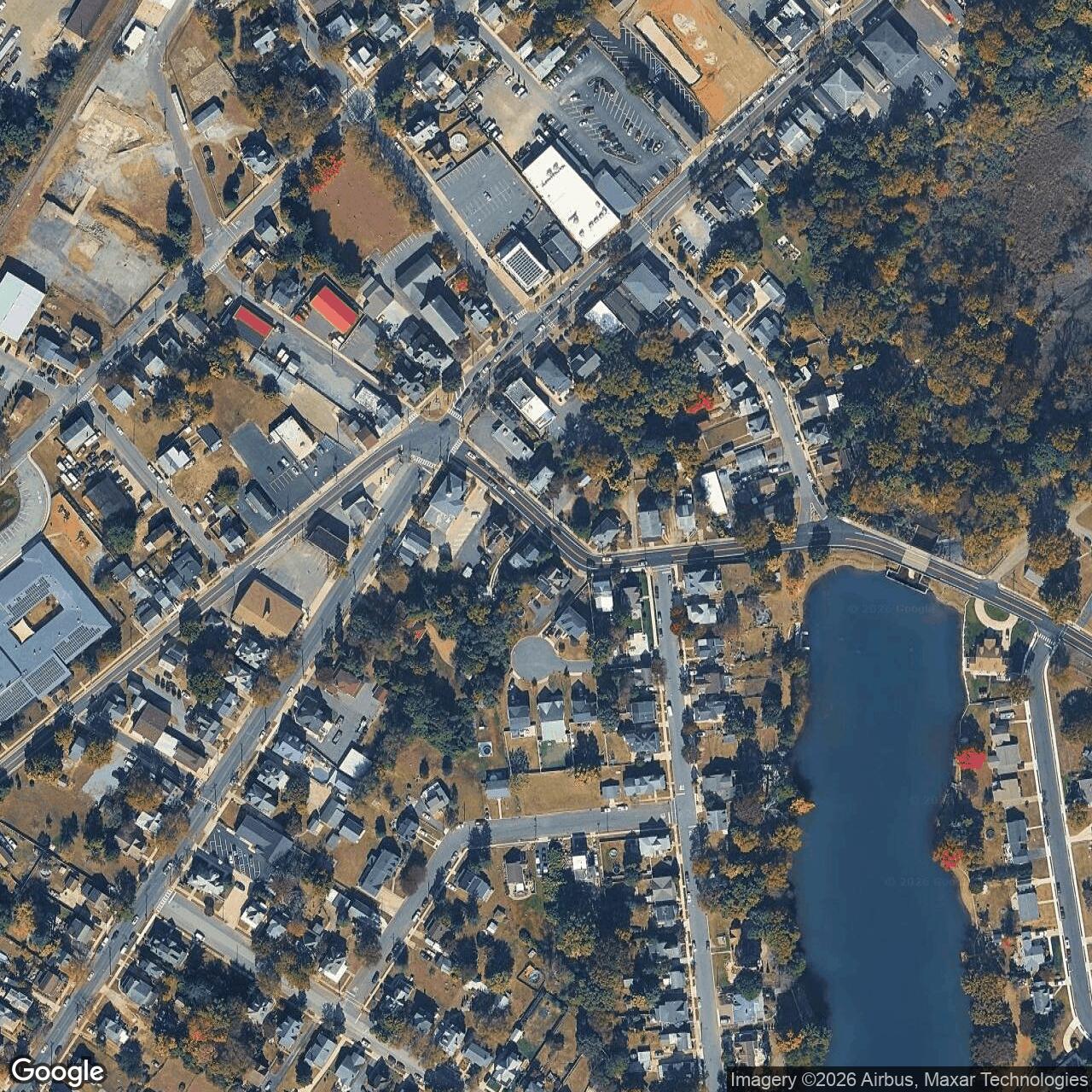
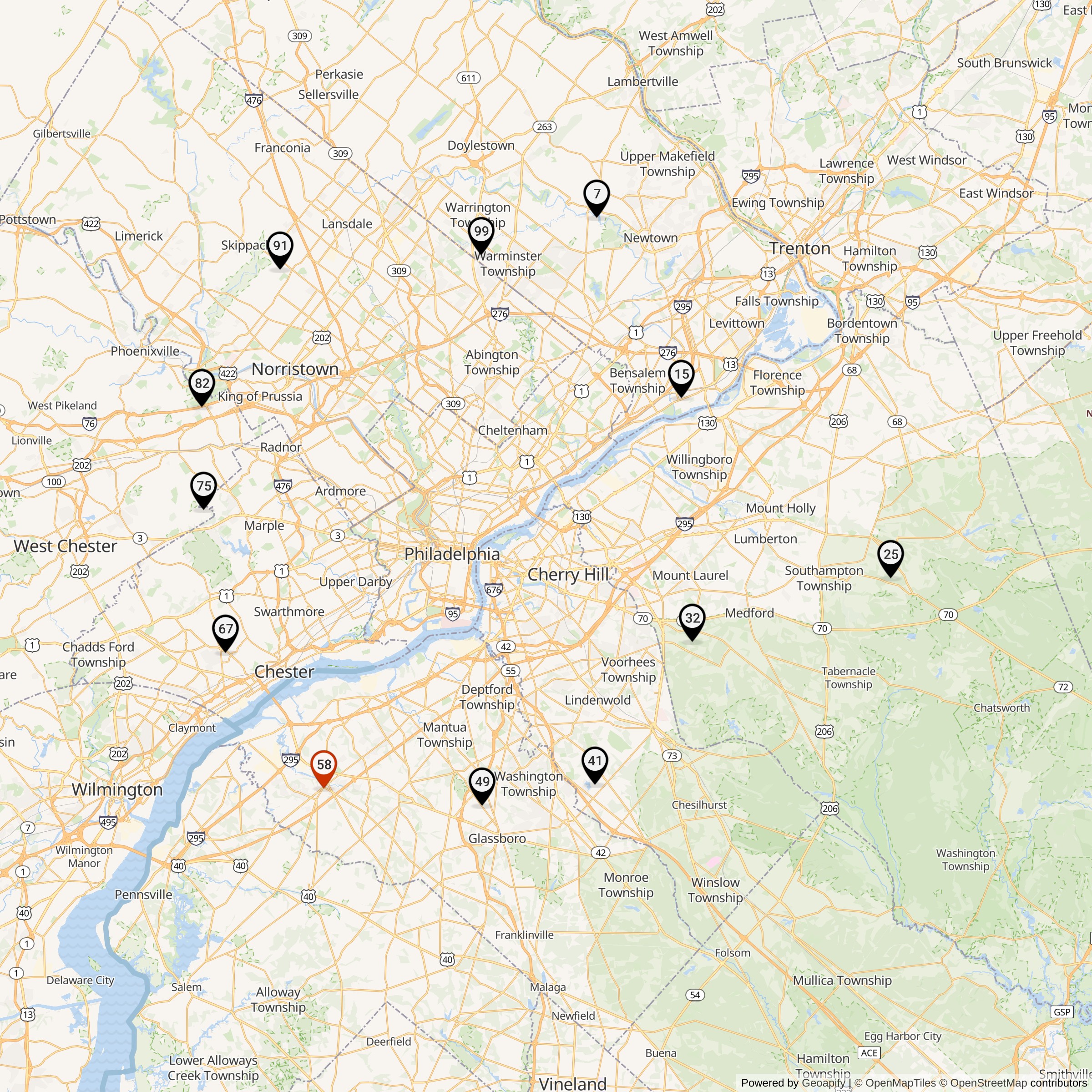
Nike Missile Site PH-58 IFC, Swedesboro New Jersey
Longitude: -75.3102
This location was part of the Philadelphia Defense Area
Site ID: PH-58
This site controlled the missiles at the Launch Area located here.
Site Role: IFC
A typical Nike air defense site consisted of two separate parcels of land. One area was known as the Integrated Fire Control (IFC) Area. This site contained the Nike system's ground-based radar and computer systems designed to detect and track hostile aircraft, and to guide the missiles to their targets.
The second parcel of land was known as the Launcher Area. At the launcher area, Nike missiles were stored horizontally within heavily constructed underground missile magazines. A large, missile elevator brought the Nikes to the surface of the site where they would be pushed across twin steel rails to one of four satellite launchers.
Elaboration on how Nike worked here.
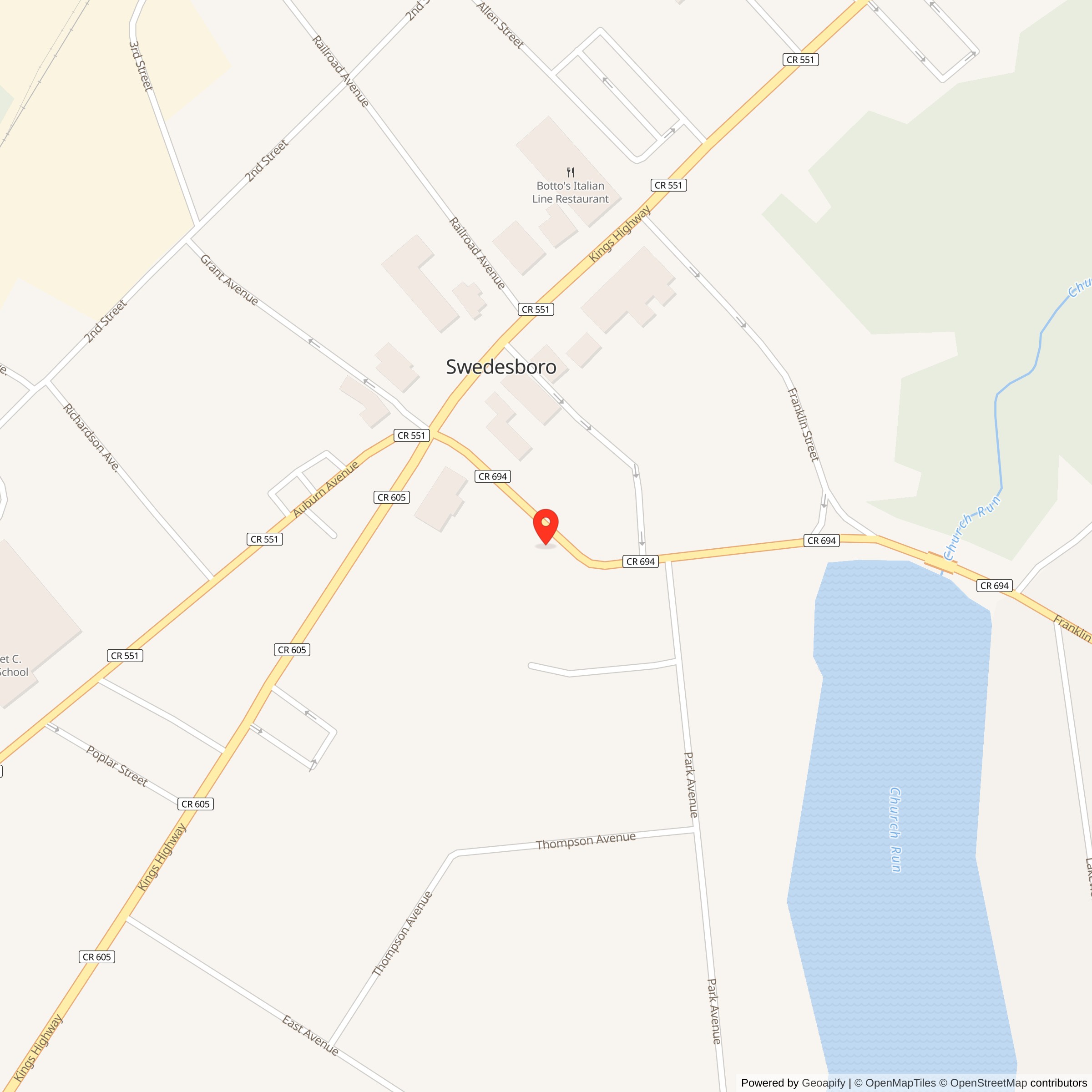
Nike Missile Site PH-58 was a U.S. Army Nike Ajax and Nike Hercules air-defense missile battery in the Philadelphia Defense Area. The site was located in Woolwich Township near Swedesboro, Repaupo, Bridgeport, and Paulsboro, New Jersey. It was one of the New Jersey-side Nike batteries built to protect Philadelphia, Camden, the Delaware River industrial corridor, and the wider metropolitan region from Soviet bomber attack during the Cold War.
It became operational in 1957, originally with Nike Ajax missiles, was later converted to Nike Hercules, and remained active until April 1974. After closure, the Army removed the missiles and cleaned out the site, but many buildings, roads, magazines, radar-tower remnants, and launch-area features survived for decades. The property later passed into Woolwich Township ownership and became the subject of cleanup, redevelopment, sale, and preservation debates.
History
PH-58 was part of the Philadelphia Defense Area, a Cold War Nike missile network built to defend Philadelphia, Camden, and the surrounding industrial and transportation region. Philadelphia was an obvious target in Cold War air-defense planning. It was a major city, port, shipbuilding and industrial center, rail and highway hub, and part of the dense Delaware River metropolitan corridor. South Jersey sites such as Woolwich extended the defensive ring outward from the city and gave the Army missile coverage over approaches from the south and southeast.The Nike program grew out of the fear that Soviet long-range bombers could attack major American urban and industrial regions with nuclear weapons. Earlier gun-based defenses were inadequate against jet bombers, high altitude, and modern air attack. Nike Ajax gave the Army a guided surface-to-air missile capable of intercepting hostile aircraft. Nike Hercules, the later system used at PH-58, increased range, altitude, and destructive power, and could carry nuclear warheads intended to destroy bomber formations rather than a single aircraft.
The Philadelphia Nike system included both Pennsylvania and New Jersey sites. In New Jersey, the Philadelphia Defense Area included places such as Lumberton, Marlton, Berlin / Clementon, Mantua, Gibbsboro, and Woolwich. PH-58 was the southwestern New Jersey member of that ring. Its rural Woolwich location gave the Army open land for a split radar-and-launch installation while still placing the site within the defensive geometry needed to protect Philadelphia and Camden.
Units and Manning
PH-58 was manned by active U.S. Army units throughout its operational life.- D Battery, 176th Artillery: 1957-1958
- D Battery, 2nd Missile Battalion, 59th Artillery: 1958-1961
- B Battery, 3rd Missile Battalion, 43rd Artillery: 1961-1974
The site therefore appears to have remained an active Army site rather than shifting to Army National Guard operation during the 1960s. That distinction matters because many Nike sites transferred to state National Guard manning after the early Regular Army period. PH-58's known unit sequence instead shows continuous Regular Army operation from initial activation through final deactivation.
The site's radar was ABAR type. The fire-control side of the site included multiple radar towers and the control and generator buildings needed to acquire targets, track both the target and missile, and guide the missile by command signals.
Mission and Operation
PH-58's mission was to detect, track, and, if ordered, engage hostile aircraft approaching the Philadelphia-Camden region. Like all Nike batteries, PH-58 was not an independent strategic missile base. It was a fixed surface-to-air missile battery tied into a regional air-defense system. Its launch crews, radar operators, communications personnel, maintenance soldiers, guards, and officers worked within a larger command structure that coordinated the Nike sites defending the Philadelphia area.Nike batteries used command guidance. The missile did not guide itself independently to the target. Radar equipment at the Integrated Fire Control area tracked the incoming target and the missile. Ground-based computers calculated an intercept course and transmitted steering commands to the missile in flight. At the calculated intercept point, the warhead was detonated by command.
During the Ajax period, PH-58's missiles were conventionally armed Nike Ajax weapons. During the Hercules period, the site housed the larger Nike Hercules missile. Hercules was solid-fueled, longer-ranged, and capable of carrying either conventional or nuclear warheads. Local accounts describe the Hercules warhead as a small nuclear payload intended to destroy an entire formation of Soviet bombers. Open-source site inventories generally list PH-58 as Nike 1B, 2C/18H, 30A/12L-UA, meaning it had one Type B magazine and two Type C magazines, a listed capacity of 18 Nike Hercules missiles and 30 Nike Ajax missiles, and 12 launchers with a conversion to universal / Hercules-capable use.
Site Layout
PH-58 followed the standard split Nike layout, with a radar / control area and a separate launch area.The Integrated Fire Control area, also described locally as the administrative or control area, was along Swedesboro-Paulsboro Road. It contained the radar and guidance side of the installation. This area included radar towers, control buildings, generator facilities, administrative buildings, quarters, support structures, and other facilities used by the soldiers assigned to the control section. Richard Lewis's photographic documentation identified four radar towers at the IFC and described surviving control and generator buildings as of 2016.
The launch area was north of the control site and reached by an access easement rather than ordinary street frontage. Woolwich Township's redevelopment plan identifies the launch parcel as Lot 4 and describes it as approximately 18.7 acres. Local-history accounts often round the launch area to about 20 acres. This area contained the underground missile magazines, launch pads, launch-support structures, warhead and generator buildings, kennel and security-related features, pavement, fencing, and the operational spaces where missiles were stored, maintained, elevated, and prepared for launch.
The two areas were separated because Nike radar and launcher functions had different physical requirements. The IFC needed a radar position with suitable line-of-sight, while the launch area needed secure land for magazines, launchers, safety zones, roads, and restricted access. Local tradition records that a nearby family had to sell land rights of way because the Army needed a clear operational relationship between the control area along Paulsboro Road and the launch area behind it.
The launcher area had three underground missile magazines about 30 feet deep. Missiles were stored horizontally below ground. Elevator platforms raised the missiles to the surface, where crews moved them on launch rails. In the Hercules era, the magazines and launchers were adapted to accommodate the larger missile. Later site observers noted hatches, magazine openings, and other remains tied to the former underground missile vaults.
Nike Ajax Period
PH-58 became operational in 1957 with Nike Ajax. The Ajax system was the Army's first operational guided surface-to-air missile and was deployed around major American cities, industrial centers, and military installations during the 1950s. At Woolwich, the system represented a sudden military presence in what had been a rural farming area.Ajax missiles were liquid-fueled and smaller than Hercules. They required specialized missile maintenance and handling procedures. Launch crews worked around underground magazines, elevators, rails, fueling-related systems, and the missile assembly and readiness areas. Fire-control soldiers worked in the IFC area with radar, computers, and tracking systems.
During the Ajax period, PH-58 was part of the first-generation dense Nike ring around Philadelphia. The large number of Ajax sites reflected the missile's shorter range and conventional warhead. Multiple batteries were needed to cover different approaches to the defended city and industrial region.
Conversion to Nike Hercules
PH-58 was converted to Nike Hercules during the early 1960s. The uploaded example states that the site began housing Nike Hercules in the early 1960s. Federal and compiled Nike site inventories identify PH-58 as an Ajax-to-Hercules site and list the site with Hercules missile capacity. Appendix D of the Nike Hercules history includes PH-58 among the Philadelphia converted defense sites and lists it as one of the later conversions, with the Hercules operational date recorded as October 1961.The conversion changed PH-58's military significance. Nike Hercules was larger, had greater range and altitude, and could carry a nuclear warhead. The strategic purpose shifted from engaging individual bombers with a conventional warhead to providing a wider-area defense against bomber formations. Because Hercules could cover more airspace, many Ajax-only batteries around the country were closed in the 1960s. PH-58 survived that drawdown because it was one of the Philadelphia Defense Area sites selected for Hercules.
The Hercules era also brought stricter security. A nuclear-capable Nike Hercules battery required secure warhead storage, controlled access, armed guards, sensitive communications, and carefully regulated procedures. PH-58's launch area included security fencing, controlled access, and support buildings consistent with that role. Post-closure descriptions of the site identify remnants including a guard shack, spare-parts building, pump house, mess hall, officers' and enlisted quarters, radio towers, sheds, and a drained swimming pool.
Relationship to the Philadelphia Defense Area
PH-58 operated within a larger command-and-control system for the Philadelphia Defense Area. The region's Nike batteries were coordinated by higher air-defense command facilities, including the Philadelphia-area Missile Master / command site at Gibbsboro / Pedricktown. Target information, identification procedures, and engagement authority were part of a regional air-defense network, not merely local battery judgment.PH-58's southwestern New Jersey location gave the Philadelphia ring an important South Jersey component. The site complemented other New Jersey batteries at Lumberton, Marlton, Berlin / Clementon, Mantua, and Gibbsboro, and Pennsylvania batteries such as Richboro, Bristol / Croydon, Chester / Media, Edgemont, Paoli / Valley Forge, Worcester, and Warrington / Eureka. The site's continued operation until 1974 places it among the longer-lived Philadelphia-area Nike batteries.
Daily Life and Community Setting
The Woolwich site sat in a rural South Jersey landscape. Most of the soldiers who operated the base lived in or around Swedesboro, Repaupo, and Bridgeport. The base was visible enough to be part of local memory but restricted enough to remain mysterious. Local residents saw fences, buildings, radio towers, soldiers, and traffic, but the operational details of the nuclear-capable Hercules mission remained largely hidden.The split between the IFC and launch areas also affected daily life inside the battery. Radar and fire-control personnel worked in the control area, while launcher crews worked around missiles, magazines, elevators, launch rails, warhead-support buildings, generators, and security features. Richard Lewis's 2016 photographic account notes the standard difference between the "radar guys" at the IFC and the launcher crews who maintained the missiles, a common cultural division at Nike sites.
The soldiers at PH-58 performed a mission that was both high-stakes and monotonous. The site's purpose was to be ready for a Soviet bomber attack that never came. Crews drilled, maintained equipment, stood watches, secured the property, and kept missiles and radars ready. Its importance lay in preparedness, deterrence, and the defensive posture of the Cold War.
Deactivation
PH-58 was decommissioned in 1974. By that time, the strategic environment had changed. In the 1950s, the primary continental air-defense fear was Soviet bomber attack. By the late 1960s and early 1970s, intercontinental ballistic missiles and submarine-launched ballistic missiles had become the dominant strategic threat. Nike Hercules remained useful against aircraft, but it could not defend a city against a large ballistic-missile strike.The Army phased out the Nike network during the 1960s and 1970s. PH-58 survived longer than many Ajax-only sites because it had been converted to Hercules, but it closed with the final reduction of the Philadelphia Defense Area's Nike system. After deactivation, the Army removed the missiles and sensitive military equipment. The Army Corps of Engineers later cleaned out the site, covered or secured the underground magazines, and left many buildings and surface features in place.
Post-Closure Use and Current Condition
After closure, PH-58 remained abandoned for decades. The property deteriorated but also retained an unusually visible collection of Cold War remains. Woolwich Township acquired the control and launch parcels from the federal government in 2009. The township paid $828,000 for the 14-acre administrative / control section, while the launch site remained a roughly 20-acre tract with dilapidated buildings, overgrown vegetation, high fences, barbed wire, and surviving missile-magazine features. Woolwich Township's redevelopment plan identifies the combined redevelopment area as Block 14, Lots 2 and 4, with a total of approximately 33.2 acres and more than 90 percent undeveloped at the time of the plan.The township's 2017 redevelopment planning described the former Nike base as decommissioned in 1974, abandoned ever since, and still containing deteriorated structures, broken pavement, overgrowth, and remnants of its Cold War role. The plan identified Lot 2 as the Control Site, formerly used as a command center with radar towers, offices, and barracks. Lot 4 was identified as the Launch Site, containing the former underground missile bays that held Nike Ajax and nuclear-tipped Hercules missiles.
By 2016, Richard Lewis documented the site photographically with township permission. His photographs captured the IFC control building, radar towers and tower bases, generator building, launcher area, overgrown roads, and deteriorated military structures. At that time, the site still had enough physical integrity to convey its original Nike layout, even though many buildings were badly damaged.
In 2020, Woolwich Township put the former base up for sale with a minimum bid of $1.8 million, seeking commercial redevelopment. Contemporary reporting described the property as one of the few remaining Nike bases in the region and noted that the township hoped to attract uses such as offices, restaurants, retail, breweries, distilleries, or indoor recreation. Later public references indicate that the control-area property was redeveloped or cleared and that the launch area remained more heavily overgrown, with magazine remains and foundations still visible from aerial imagery or local observation.
Because the site has undergone cleanup, redevelopment planning, sale efforts, demolition discussions, and changing ownership or use, current physical integrity should be field-verified. The most defensible summary is that PH-58's active military use ended in 1974; the site retained significant ruins and remnants for decades; the township acquired the property in 2009; and by the 2010s and 2020s the property became a redevelopment and documentation subject rather than a preserved military museum site.
List of all Nike Installations in the Philadelphia Defense AreaList of all Nike Installations in New Jersey