
JSS Modernized Height-Finder Radar AN/FPS-116
- Role
- Fixed height-finding radar used with a companion search radar
- Family
- Modernized AN/FPS-6 and AN/FPS-90 configuration
- Band
- S-band, 2700 to 2900 MHz in the 1983 NTIA family table
Identity and historical importance
The AN/FPS-116 was a late Cold War designation for a modernized long-range height-finding radar in the General Electric AN/FPS-6 and AN/FPS-90 family. It was not a new three-dimensional search radar or an entire Joint Surveillance System installation. Its job was to determine the elevation and altitude of an aircraft already found by a companion search radar. That distinction matters: a 1980s radar site might have an FAA-maintained search set, an Air Force-operated height finder, shared buildings and data links, and a regional control center. Calling all of that equipment an FPS-116 would conceal the division of labor that made the site useful.
The equipment has a documented place in the transition from staffed Air Defense Command radar squadrons to the smaller Air Force and Federal Aviation Administration joint-use system. The National Telecommunications and Information Administration described AN/FPS-116 in 1983 as essentially an upgrade package for AN/FPS-6 and AN/FPS-90 height finders. The official Air Force-commissioned history Searching the Skies calls it another modernized version of AN/FPS-6. These descriptions make the correct historical starting point clear: an FPS-116 should be traced through the earlier height-finder installation and its modifications, not treated as though an entirely separate radar station appeared when the designation changed.
Origins in the height-finding problem
The postwar air-defense network had to obtain three coordinates for an aircraft: range, azimuth and height. A rotating two-dimensional long-range search radar gave controllers a broad picture of aircraft approaching a defended area, but it generally could not supply sufficiently precise altitude by itself. An AN/FPS-6-family height finder turned toward a selected contact and scanned its beam vertically so an operator could determine the target's elevation angle and estimate height from that angle and slant range. The work was especially important to ground-controlled interception, where directing a fighter to the wrong altitude could squander the time available to identify or engage an intruder.
General Electric's AN/FPS-6 entered service in the 1950s and became a principal American height finder. The AN/FPS-90 was a related later configuration rather than a search radar. The early system depended on operators, maintenance crews, motors, a high-power transmitter, receiver equipment, communications, and a suitable companion search set. As site staffing and control architecture changed, retaining workable height-finder hardware while upgrading its electronics offered a practical alternative to rebuilding every tower and operations area. This was the setting in which the AN/FPS-116 designation appears at selected sites in the late 1970s.
The exact modification-contract boundary remains less clear than the family relationship. The reviewed NTIA report says that FPS-116 was an upgrade package for both the FPS-6 and FPS-90. Individual station accounts often describe an FPS-90 becoming an FPS-116, but this is not proof that every FPS-116 began as precisely the same FPS-90 configuration. Nor does the designation, by itself, identify a universal receiver cabinet, one manufacturer for every replacement part, or one conversion date. A site-specific engineering order or maintenance record is needed to settle those details at each installation.
Technical configuration and careful interpretation
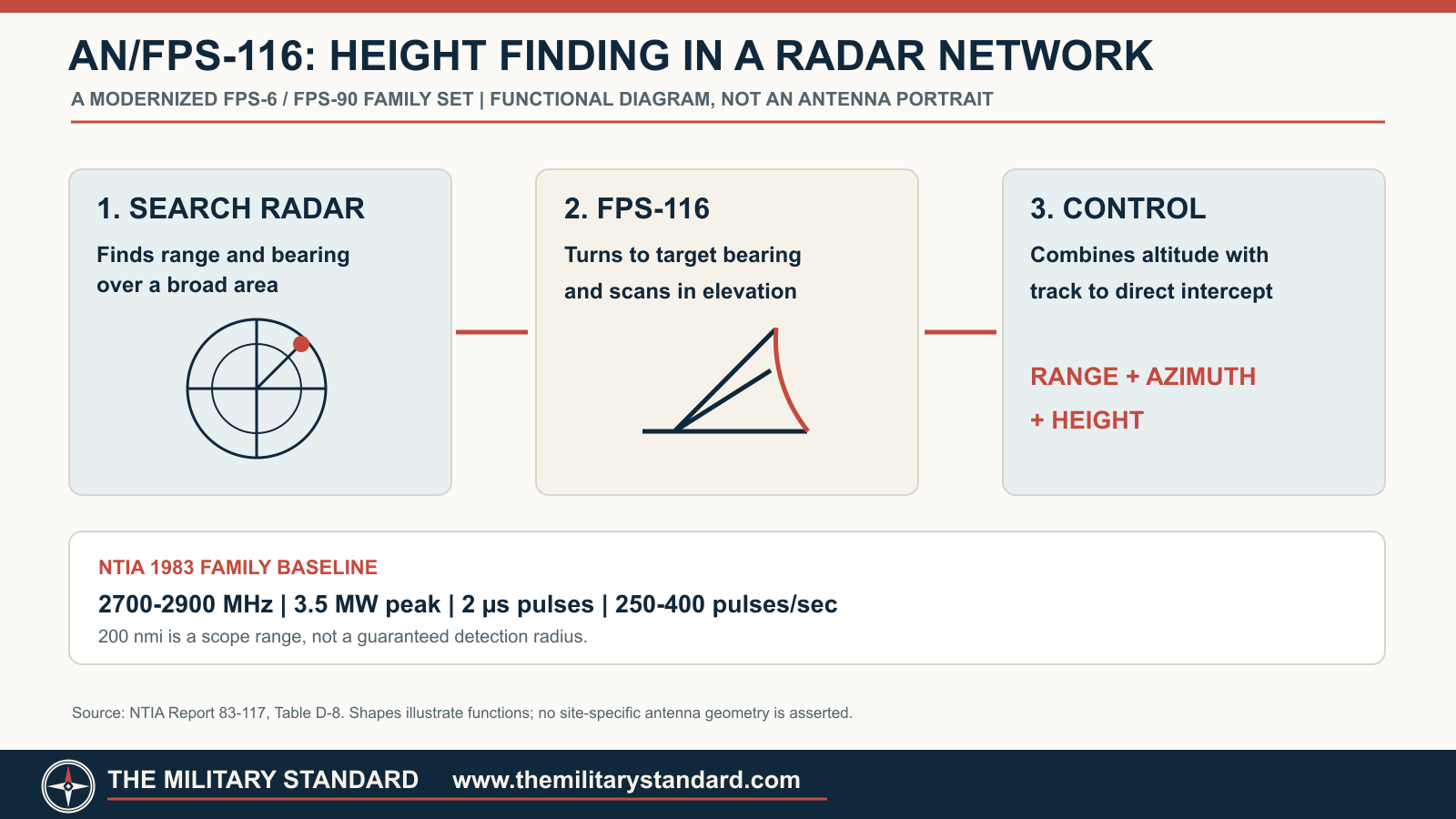
The strongest accessible primary technical baseline is Appendix D, Table D-8 of NTIA Report 83-117, published in April 1983. The table is headed AN/FPS-6 System Parameters but explicitly says the values also apply to AN/FPS-90 and AN/FPS-116. It describes a tunable 2700 to 2900 MHz S-band radar with a coaxial VSM-1143 magnetron, 3.5 megawatts peak transmitter output, a 2.0 microsecond pulse, and 250 to 400 pulses per second. The separate 1982 NTIA measurement study shows why a coaxial magnetron mattered: measured AN/FPS-90 examples had substantially different emission spectra before and after a magnetron change. These are family and measurement records, not proof that every FPS-116 at every station always used one exact tube suffix.
Peak radio-frequency power is not continuous station power. Multiplying the published 3.5 megawatt peak rating by the 2 microsecond pulse width and 250 to 400 pulses each second yields about 1.75 to 2.8 kilowatts as a simple calculated average transmitted pulse power. This is an arithmetic inference, not a separately published FPS-116 rating; it excludes the substantial electrical load of the antenna drive, transmitter auxiliaries, cooling, receivers, indicators, communications and site buildings. No verified universal FPS-116 total facility-load figure has been found, so a single generator or utility demand should not be claimed.
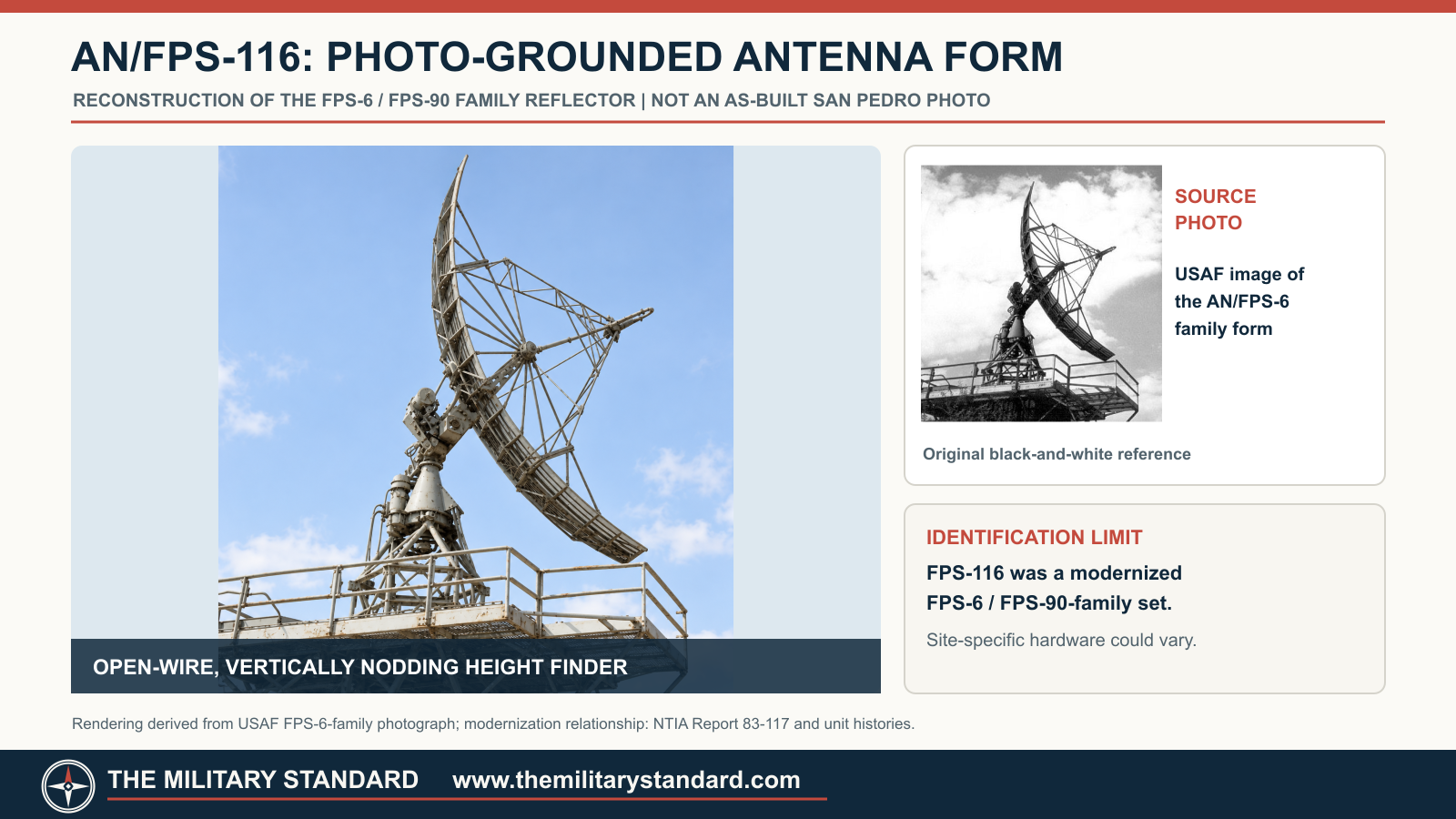
Table D-8 describes the antenna as a shaped beam, fan-shaped in azimuth, with stated gain of 39 dBi and listed beamwidths of 0.85 degree vertically and 3.2 degrees horizontally. It gives 7.5 revolutions per minute in azimuth and 20 to 30 cycles per minute in the height scan. The dimensions and visible support geometry of an individual antenna cannot safely be reconstructed from these electrical specifications alone.
The same NTIA table lists an 8 dB receiver-system noise figure, 800 kHz receiver bandwidth, and a normal minimum discernible signal of minus 106 dBm. It lists a 200 nautical mile scope range. That last figure describes a display or ranging scale, not a guarantee that every target could be detected, tracked and height-measured 200 nautical miles away. Radar horizon, terrain shielding, target reflectivity, weather, interference, transmitter condition, and the search radar's ability to designate a contact all affected usable service. A broad 1982 NTIA discussion describes the FPS-6/90 family as having a height-finding capability around 75,000 feet, but it does not establish a universal, separately tested FPS-116 altitude ceiling.
The height finder was a mechanically scanning instrument, not an all-azimuth three-dimensional search radar. Its antenna had to be pointed toward a target's bearing and then scan in elevation; the search radar supplied the broad-area contact first. The operator interpreted height information on an indicator and passed a usable altitude to the site's command-and-control process. Depending on period and installation, that process could include manual reporting, automated digitization, a SAGE direction center, or later regional operations and control arrangements. A digitizer associated with a site should not be mistaken for an FPS-116 component without a site equipment list.
The modernization also sat in a crowded radio environment. NTIA's 1983 report was written to examine efficient use of the 2700 to 2900 MHz band, not primarily to tell the institutional history of one radar model. It notes that a conventional magnetron could have broad sideband emissions and that a coaxial magnetron had a sharper falloff near its fundamental frequency and longer service life. The report's inclusion of FPS-116 in the family parameter table therefore has practical significance beyond cataloging power: the upgraded height finders were part of a federal spectrum-management problem involving neighboring radars and shared airspace.
Verified service at Makah
Makah Air Force Station in Washington supplies an unusually well-documented conversion example. A National Archives historical account places an AN/FPS-90 and AN/FPS-26A at the station by 1963. It says the FPS-90 was modified to AN/FPS-116 circa 1977, while the station's search-radar lineage changed independently. By around 1980, an AN/FPS-91A served as the search set; the 116 did not replace that search function. The 758th Radar Squadron reported aircraft information to the regional air-defense system from a remote coastal installation on land leased from the Makah Tribe. This example documents a real conversion at a real site, not a nationwide introduction date.
The Makah account also clarifies the end of service. The 758th Radar Squadron inactivated on 15 June 1988, and the Air Force station closed on 30 June 1988. The National Archives describes the AN/FPS-116 as retired circa 1988; the FAA continued operating a search radar at the former radar site afterward. It would be inaccurate to write that the entire Makah radar mission ended when the height finder went away. The abandoned or transferred cantonment, the FAA-controlled radar area, and the disposed FPS-116 are different historical subjects with different end dates.
Joint Air Force and FAA operation at San Pedro
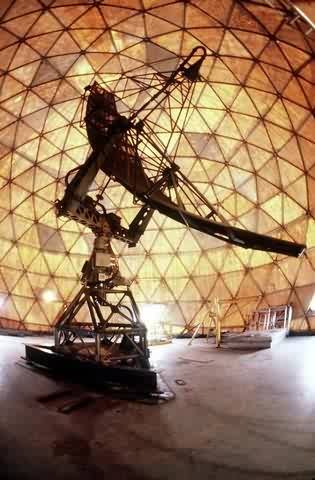
A dated United States government photograph provides rare direct visual and operational evidence for the AN/FPS-116. Its original finding-aid caption identifies an FPS-116 height finder at the San Pedro Joint Surveillance System site in California on 9 January 1988. The caption says the system was operated by the Air Force and maintained by the FAA. It credits Chief Master Sergeant Don Sutherland as photographer. This is stronger visual evidence than an undated generic radar image because the designation, place, date and agency relationship are all present in the archival description.
The San Pedro record does not mean that every FPS-116 had the same local staffing agreement. It demonstrates one late-service case in which Air Force and civilian federal responsibilities overlapped after large radar squadrons had been reduced or inactivated. The accompanying image is an authentic government photograph, not an artist's reconstruction. Its precise radar-site coordinate has not been derived from the aggregator's geocoded 'San Pedro Berth 58' label, which is not a reliable surveyed location for the hilltop radar. The photograph shows the actual antenna inside a radome; the separate family-based exterior rendering is not a literal portrait of the San Pedro equipment.
Fort Fisher and the limits of site lists
Fort Fisher Air Force Station and its later joint-use complex in North Carolina provide a different conversion path. A compiled 701st Air Defense Squadron record, citing Air Force Historical Research Agency material, says the site's AN/MPS-14 was modified to AN/FPS-116 circa 1977. After the 701st Radar Squadron inactivated, the FAA operated the site as part of the Joint Surveillance System with an AN/FPS-91A search radar. The record says the FPS-116 was moved into the former AN/FPS-107 tower and retired circa 1988. This sequence is valuable precisely because it differs from Makah's FPS-90-to-FPS-116 description. It remains a compiled unit account, so its tower move and exact sequence should be checked against original site equipment logs before being treated as an engineering as-built record.
The Fort Fisher sequence also helps disentangle two geographically related properties. The former Air Force radar area and the later FAA radar facility at the detached former Ground-Air Transmit-Receive location did not share an identical equipment history. The compiled account says that the original site was deactivated in the mid-1990s when a new ARSR-4 operated at the former GATR area north of it. Thus the existence of a present radar near Fort Fisher does not mean the FPS-116 survived there. The site history must map each building and radar tower to the correct phase rather than slide the modern ARSR-4 backward into the 1980s height-finder installation.
Empire Air Force Station in Michigan illustrates another operational handover. A compiled 752nd Radar Squadron record says that after the squadron's April 1978 inactivation the FAA assumed most radar-area operations, but an AN/FPS-6 height finder, by then modified to the FPS-116 variant, remained an exception. The search radar later became an FAA ARSR-3, while the separate height finder was reportedly removed circa 1988. The point is not that Empire establishes a universal retirement year; it shows the practical possibility of civil search-radar operation and residual military height-finding at the same site under different administrative arrangements.
From SAGE to the Joint Surveillance System
The FPS-116 crossed an organizational boundary in the American radar network. It grew out of the AN/FPS-6 family associated with staffed air-defense squadrons and SAGE reporting. During the late 1970s and 1980s, the Air Force reduced many staffed radar stations while maintaining selected military surveillance functions at FAA-controlled or jointly used facilities. The Joint Surveillance System linked civil air-route radar information to military air-defense control. A height finder could remain useful at such a site even as its search radar, owner, technicians, and data route changed.
That gradual transition explains why 'replaced by ARSR-4' is too simple as a blanket equipment statement. ARSR-4 was a later three-dimensional search radar able to provide altitude information without a separate FPS-116 at many sites, but particular FPS-116 sets could disappear earlier through station closure, reduction in mission, replacement of a companion search set, or a local decision to stop separate height-finding service. Makah's height finder left around 1988 while the FAA search-radar site remained active. The located sources do not establish a single Air Force-wide removal order or a final operational FPS-116 anywhere in the network.
Technical summary
- Designation
- AN/FPS-116, modernized fixed long-range height-finding radar in the AN/FPS-6 / AN/FPS-90 family.
- Role
- Target altitude determination in conjunction with a companion search radar; not a stand-alone three-dimensional search system.
- Frequency
- Tunable 2700 to 2900 MHz, S-band, per NTIA Report 83-117 Table D-8.
- Transmitter
- Coaxial VSM-1143-family magnetron, 3.5 MW peak, 2.0 microsecond pulses at 250 to 400 pulses per second in the NTIA family table.
- Calculated average RF pulse power
- Approximately 1.75 to 2.8 kW from the stated pulse parameters; not a published total electrical-load rating.
- Antenna and scan
- Shaped fan beam; listed 39 dBi gain, 0.85 degree vertical and 3.2 degree horizontal beamwidth, 7.5 rpm azimuth rotation and 20 to 30 cycles/minute height scan.
- Receiver
- Listed 8 dB system noise figure, 800 kHz bandwidth and normal minus 106 dBm minimum discernible signal.
- Scope range
- 200 nautical miles in the NTIA table; not a guaranteed detection radius.
- Documented conversion
- AN/FPS-90 to AN/FPS-116 at Makah circa 1977. Other site-specific configurations require individual verification.
- Documented late service
- San Pedro government photo dated 9 January 1988; Makah example retired circa 1988.
- Manufacturer qualification
- General Electric built the parent AN/FPS-6 family; the FPS-116-specific modification-contract boundary has not been established in reviewed primary records.
- Preservation
- No complete publicly authenticated surviving FPS-116 set verified in this review.
Chronology
- 1950s The General Electric AN/FPS-6 family enters U.S. long-range air-defense height-finding service.
- 1960s AN/FPS-90 configurations continue the FPS-6-family height-finding role at selected staffed stations.
- Circa 1977 Makah's AN/FPS-90 is modified to an AN/FPS-116, according to the National Archives station history.
- Late 1970s Selected Air Force and FAA joint-use radar sites retain separate height-finding while control and maintenance arrangements change.
- 1982 NTIA publishes measurements comparing conventional- and coaxial-magnetron emissions in FPS-6/FPS-90-family height finders.
- April 1983 NTIA Report 83-117 identifies AN/FPS-116 as an upgrade package and publishes a family parameter table expressly applicable to it.
- 9 January 1988 A government photograph documents an Air Force-operated, FAA-maintained AN/FPS-116 at San Pedro, California.
- Circa 1988 Compiled Fort Fisher and Empire unit histories report retirement or removal of their FPS-116 height finders.
- 15 June 1988 The 758th Radar Squadron at Makah inactivates.
- 30 June 1988 Makah Air Force Station closes; its FPS-116 is reported retired circa 1988 while FAA search-radar service continues.
- After 1988 Site-specific search-radar and three-dimensional radar transitions continue; no single verified fleet-wide FPS-116 retirement date is established.
Information sources (9)
- WEBBackground Study on Efficient Use of the 2700-2900 MHz Band, NTIA Report 83-117, Robert L. Hinkle, April 1983
Source for the AN/FPS-116 upgrade-package identification, spectrum context, and Appendix D Table D-8 family parameters including frequency, pulse, antenna, receiver and scope range.
- PDFNTIA Report 83-117, full text and Appendix D Table D-8
Source for the exact Table D-8 statement that its AN/FPS-6 parameters are also applicable to AN/FPS-90 and AN/FPS-116.
- PDFOutput Tube Emission Characteristics of Operational Radars, NTIA Report 82-92
Source for measured conventional and coaxial magnetron emission spectra of FPS-6 and FPS-90 family examples, and the broad family height-finding discussion.
- WEBSearching the Skies: The Legacy of the United States Cold War Defense Radar Program, David F. Winkler and Julie L. Webster, 1997
Source for the official historical classification of AN/FPS-116 as a modernized version of AN/FPS-6 and the predecessor family's role.
- WEBA Front Line of Defense: The 758th Radar Squadron and the Makah Air Force Station, Neah Bay, Washington, 1950-1988, National Archives, 2020
Source for Makah's AN/FPS-90 to AN/FPS-116 conversion circa 1977, 758th unit chronology, 1988 height-finder retirement and continued FAA search-radar use.
- WEBAN/FPS-116 Height Finder Radar at the San Pedro Joint Surveillance System Site, U.S. government photograph, 9 January 1988
Source for a dated authentic equipment image and the original caption's Air Force operation and FAA maintenance description. The hosting site is an independent archive aggregator, not the National Archives itself.
- PDFHistoric Structures Survey Report, Building 116, Former Fort Fisher Air Force Radar Station, North Carolina Historic Preservation Office, 2020
Source for Fort Fisher's late radar-site context and building history; individual equipment claims are drawn from the separately listed compiled 701st account.
- PDF701st Air Defense Squadron compiled history
Source for the reported Fort Fisher AN/MPS-14-to-AN/FPS-116 conversion, later tower move, paired AN/FPS-91A, circa-1988 retirement and GATR-area ARSR-4 successor. This is a compilation citing AFHRA records, not the original equipment log.
- PDF752nd Radar Squadron compiled history
Source for the reported Empire Air Force Station FAA handover, continued FPS-116 height-finder role and removal circa 1988. This is a compiled unit account, not a dated station engineering order.