
AN/FPS-107 Single-Beam Long-Range Search Radar
Equipment designation: AN/FPS-107, including documented V1 and V2 variants
Manufacturer of conversion:
Westinghouse
Type: Fixed L-band long-range search radar
Lineage: Single-beam modification of selected AN/FPS-7
installations
Primary role: Two-dimensional air surveillance for SAGE and ground-controlled interception
Historical Overview
The AN/FPS-107 was a fixed L-band long-range air-surveillance radar created by modifying selected AN/FPS-7 installations. Air Defense Command described the work as the AN/FPS-107 Single-Beam Modification of the AN/FPS-7. Westinghouse supplied the modernization, while the underlying AN/FPS-7 family had originated with General Electric and the Naval Research Laboratory's stacked-beam development program.
The designation therefore represents both continuity and change. An FPS-107 reused major FPS-7 site infrastructure and antenna heritage, but it was not simply an informal alternate name for every FPS-7. The conversion changed the operating configuration sufficiently to receive a separate Joint Electronics Type Designation System identity, including documented AN/FPS-107V1 and AN/FPS-107V2 variants.
The radar served Air Force and joint-use surveillance stations during the late Cold War. It detected aircraft, supplied range and azimuth information, supported ground-controlled interception, and fed SAGE or successor command systems. Separate height-finding radars remained important because the AN/FPS-107 is officially described as a two-dimensional search radar despite its FPS-7 stacked-beam ancestry.
An official Air Defense Command chronology records that North Truro Air Force Station completed the final conversion among eleven scheduled ADC sites on 28 April 1972. The program therefore had a limited, identifiable field scope rather than replacing every AN/FPS-7 in North America. Canadian conversions and site-specific suffix histories require separate accounting from the eleven-site ADC statement.
Origins in the AN/FPS-7
The AN/FPS-7 was developed during the 1950s as the first American production stacked-beam radar. Multiple vertically separated beams allowed the system to compare target returns and derive limited height-related information while performing long-range search. General Electric produced the original equipment, which entered operational service at Highlands Air Force Station in 1959 and spread to selected SAGE stations.
The original radar operated in the L-band and used a large rotating antenna protected at many sites by a radome. Its transmitter, receivers, beam-forming feed system, signal processing, indicators, and SAGE interfaces formed an integrated facility. The system represented an important advance over earlier single-beam search radars, but its complexity also created maintenance, countermeasures, and modernization requirements.
Air Defense Command installed AN/ECP-91 electronic-counter-countermeasures changes in the FPS-7 family during the early 1960s. That program should not automatically be equated with AN/FPS-107. ECP-91 was an earlier improvement path, while the later FPS-107 designation is specifically tied by ADC to the single-beam modification program.
The surviving public record does not yet provide a complete engineering-change package showing every retained and replaced component. It does establish that Westinghouse built the FPS-107 search-radar configuration, that it operated in the same 1250 to 1350 MHz L-band region, and that field histories consistently describe selected FPS-7 sets as converted or modified into FPS-107 variants. Unverified component substitutions are therefore excluded.
Why a Single-Beam Conversion
Stacked beams could provide useful elevation discrimination, but air-defense stations increasingly relied on dedicated AN/FPS-6, AN/FPS-26A, AN/FPS-90, and later AN/FPS-116 height finders. A single-beam search configuration could concentrate the modernized FPS-7 facility on two-dimensional surveillance while separate equipment supplied altitude. The exact performance and maintenance trade study has not been recovered in a public primary engineering report.
The modification also occurred as ADC sought to extend the useful life of expensive fixed radar plants. Reusing towers, radomes, antenna structures, power systems, operations buildings, and SAGE connections could preserve coverage without constructing an entirely new station. The new designation allowed configuration control, training, supply, and technical orders to distinguish the converted system from its FPS-7 predecessor.
The word single-beam should not be interpreted as a reduction to primitive short-range operation. The completed radar remained a ten-megawatt-class long-range search sensor in the L-band. Official spectrum measurements in the early 1980s describe it as a two-dimensional radar designed for ground-controlled-intercept applications with a 260-nautical-mile range.
The conversion boundary must nevertheless remain explicit. Original FPS-7 performance figures, beam counts, height estimates, and variant descriptions cannot all be transferred to the FPS-107 without qualification. Likewise, later site histories that use FPS-7 as a family shorthand do not prove that the hardware remained in its original stacked-beam configuration.
AN/FPS-107V1 and AN/FPS-107V2
Field and unit histories document AN/FPS-107V1 and AN/FPS-107V2. Makah Air Force Station's AN/FPS-7A is reported as becoming AN/FPS-107V1. North Bend, North Truro, and Fort Fisher are associated in specialist or unit-history records with AN/FPS-107V2, although some summaries shorten the final designation to AN/FPS-107.
This pattern suggests that the V suffixes preserved differences in the host FPS-7 configuration or conversion package. The available sources do not provide a complete verified component matrix for V1 versus V2. The history therefore records the suffix at each documented station without inventing universal transmitter, receiver, antenna, or performance distinctions.
Mill Valley is commonly described as progressing from AN/FPS-7C to AN/FPS-107 without a suffix in the accessible unit history. Lockport and Cambria are likewise documented as having later FPS-107 configurations, but surviving summaries do not always specify V1 or V2. Those records support installation identity but not a precise variant assignment.
The designation AN/FPS-107 must also remain distinct from AN/FPS-107V. Fort Fisher material occasionally uses a truncated V without a number while other unit summaries identify V2.
Frequency and Transmitter
The Air Force-sponsored historic context identifies the Westinghouse FPS-107 as operating from 1250 to 1350 MHz. This is L-band under the classification used by the source and matches the broad operating region of the parent FPS-7 family. The value is treated as a system tuning range, not proof that every field set used every frequency continuously.
The National Telecommunications and Information Administration measured an operational FPS-107 while documenting radar emission spectra. Its report identifies a klystron transmitter producing 10 megawatts peak power. The measured spectrum provided a real operational example rather than a value inherited solely from the FPS-7 specification.
The same report praises the klystron as an example of spectrum conservation. A high-power radar must confine energy near its assigned frequency to limit harmful interference. The published spectrum plot compares measured emissions with the applicable Radar Spectrum Engineering Criteria and places the FPS-107 beside contemporary long-range air-route-surveillance equipment.
No defensible average RF output is assigned in this history. Peak power, pulse width, pulse-repetition rate, and duty cycle are all needed to calculate average power, and a complete model-specific operating set has not been recovered from the reviewed primary sources. A site description gives a six-microsecond pulse, but it does not establish every pulse-repetition mode.
Range and Coverage
The NTIA report gives the AN/FPS-107 a 481-kilometer, or 260-nautical-mile, range. This figure belongs to an operational-spectrum discussion and is the strongest located model-specific range statement. It should not be confused with guaranteed detection of every target under every atmospheric, clutter, jamming, antenna, and maintenance condition.
Mill Valley interpretive material describes a 250-mile detection range and coverage to approximately 100,000 feet. The difference between 250 statute miles and 260 nautical miles is too large to treat as simple rounding. This history uses the official NTIA 260-nautical-mile figure while preserving the local 250-mile and 100,000-foot statements as source-specific operating descriptions.
As a two-dimensional search radar, the FPS-107 primarily measured range and azimuth. A target could be detected at high altitude, but precise altitude determination generally depended on an associated height finder, beacon Mode C information, or later integrated surveillance processing. The 100,000-foot statement is coverage context, not proof of independent precision height measurement.
Terrain and radar horizon still shaped actual low-altitude coverage. A powerful mountaintop system could see far over ocean or plains, yet hills, earth curvature, ground clutter, and propagation conditions created gaps. ADC relied on site placement, overlapping long-range radars, gap fillers, and aircraft identification systems rather than treating nominal maximum range as uniform coverage.
Antenna and Rotation
The converted radar retained the large rotating search-radar form associated with the FPS-7 installation. Photographs show a broad antenna assembly operating inside substantial radomes at many stations. Dismantling photographs from North Truro reveal the backbone, feed region, rotary joint, pedestal, and sectional construction, providing unusually useful evidence of the actual antenna form.
Mill Valley documentation gives a continuous 360-degree rotation rate of five revolutions per minute. One complete scan therefore took about twelve seconds. This rate is consistent with long-range surveillance that balances revisit time, antenna gain, dwell, and mechanical loading, but no recovered technical order establishes five rpm as the only permissible mode for every FPS-107 variant.
The antenna should not be drawn as a simple parabolic dish without reference photographs. FPS-7-derived equipment used a distinctive broad reflector and feed structure, and the FPS-107 conversion may have altered the feed or beam-forming arrangement. Any depiction of the converted set should therefore be tied to site- and variant-specific photographs, especially when showing V1 or V2.
The radome protected the rotating assembly from wind, precipitation, ice, and salt exposure while imposing its own maintenance burden. North Truro's coastal environment and Mill Valley's exposed mountain summit illustrate why weather protection mattered. Radome panels, seals, lightning protection, ventilation, and internal access were part of radar availability even though they did not radiate RF.
Receiver and Signal Processing
The accessible technical record establishes a klystron transmitter but does not fully document the receiver chain, moving-target indication, pulse-repetition modes, beamwidth, gain, noise figure, or every counter-countermeasures feature. These values should not be copied automatically from baseline FPS-7 or a different Westinghouse radar. The missing values remain qualified instead of being reconstructed.
At a SAGE station, radar video and azimuth information passed into local processing and data-transmission equipment. AN/FST-2 or later AN/FYQ-47 common digitizers could format target information for narrowband lines to a direction center. The radar remained the sensor, while those processors performed digitization and remoting; they are associated systems rather than components of the FPS-107 designation.
Identification friend or foe and beacon equipment complemented primary surveillance. Beacon replies could improve aircraft identity and supply altitude through compatible modes, while the primary radar detected reflecting targets regardless of cooperation. Controllers and command centers correlated these sources to maintain the recognized air picture.
Dedicated height finders supplied altitude for noncooperative tracks. FPS-107 sites frequently paired the search radar with AN/FPS-26A, AN/FPS-90, or later AN/FPS-116 equipment. This operational pairing supports the two-dimensional classification and cautions against transferring the parent FPS-7's stacked-beam height-information claim to the converted system without variant evidence.
SAGE and Ground-Controlled Interception
The AN/FPS-107 served within the Semi-Automatic Ground Environment and later continental surveillance systems. SAGE direction centers received digitized radar observations, combined tracks from multiple sites, compared them with flight information, and supported weapons-control decisions. The modernized radar extended the service life of existing sensor locations during this automated period.
Ground-controlled interception remained an explicit mission. The NTIA report calls the radar designed for GCI applications in the air-defense system. Controllers used search tracks, height information, identification, and ground-air radio to direct interceptor aircraft toward unknown or hostile targets, while the radar itself maintained surveillance rather than transmitting commands to pilots.
Selected stations also performed Backup Interceptor Control. North Bend supported BUIC II, and Fort Fisher operated a BUIC III capability. In those configurations, local facilities could assume limited control if a SAGE direction center failed. The FPS-107 contributed sensor data, but BUIC included computers, displays, communications, trained controllers, and procedures beyond the radar set.
As bomber-defense priorities declined, many sites transferred to Air Defense, Tactical Air Command in 1979 or moved toward joint Air Force and Federal Aviation Administration operation. The FPS-107 bridged that transition at some locations until replaced by AN/FPS-91A, AN/FPS-66A, or newer FAA and Joint Surveillance System equipment. Local replacement dates differed substantially.
Documented United States Installations
North Truro Air Force Station, Massachusetts, provides the strongest program milestone. ADC records that the AN/FPS-107 single-beam modification was completed there on 28 April 1972, the last of eleven scheduled ADC sites. Later evidence identifies the configuration as V2 and shows the radar remaining until replacement by an FAA-operated AN/FPS-91A by 1985.
North Bend Air Force Station, Oregon, began operating AN/FPS-7 in 1960 and later converted it to AN/FPS-107V2. The radar supported SAGE and BUIC II with AN/FPS-90 and AN/FPS-26A height finders. The station transferred to Tactical Air Command jurisdiction and ended Air Force operations in February 1980.
Makah Air Force Station, Washington, operated AN/FPS-7A before conversion to AN/FPS-107V1. Around 1980, the FPS-107V1 was replaced by AN/FPS-91A, with an AN/TPS-43E temporarily supporting surveillance during the change. This is the clearest documented V1 lineage and should anchor variant mapping.
Fort Fisher Air Force Station, North Carolina, converted an AN/FPS-7C to an AN/FPS-107V2 after the station entered SAGE. Its wider mission included BUIC III and an AN/FSS-7 submarine-launched-ballistic-missile warning conversion. Later Joint Surveillance System equipment replaced the FPS-107-era configuration.
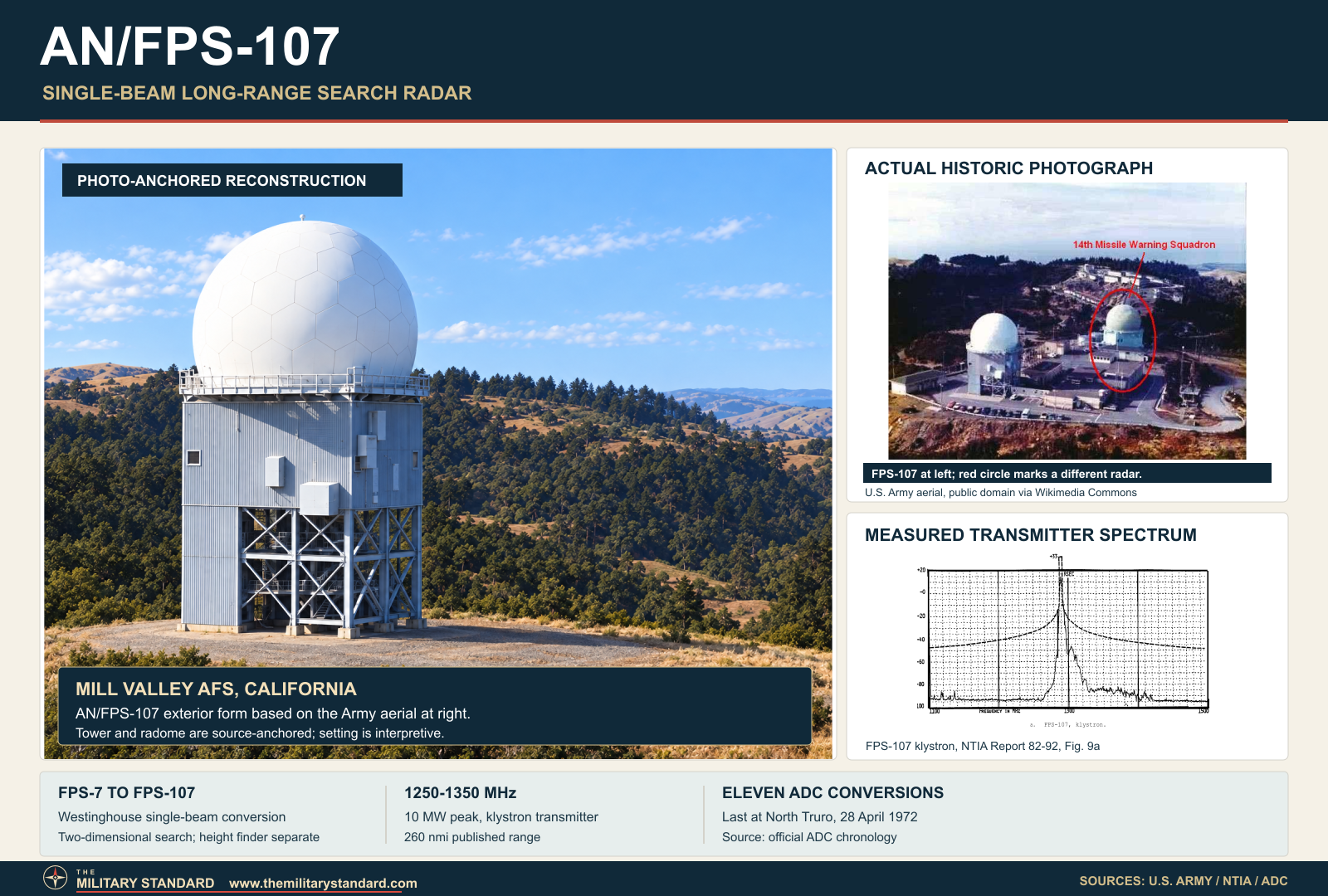
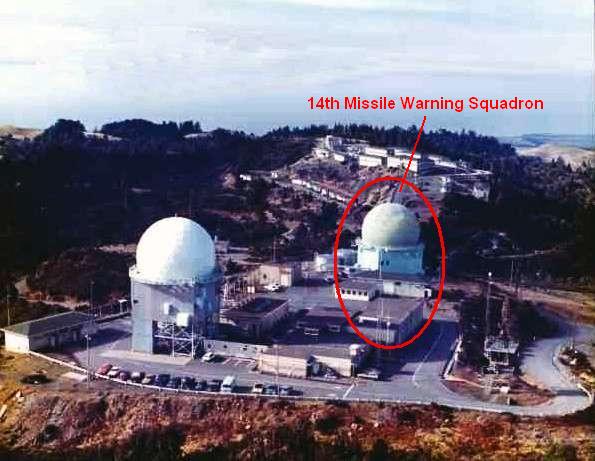
Mill Valley Air Force Station, California, operated AN/FPS-7C before the search radar became AN/FPS-107. The site also supported Army Nike air defense, SAGE, an AN/FSS-7 missile-warning sensor, and later JSS operations. The search-radar tower subsequently carried AN/FPS-66A and was eventually demolished.
Lockport Air Force Station, New York, received AN/FPS-7 in 1960 and later modified it to AN/FPS-107. A New York State environmental site-history report documents this sequence using archival imagery and station records. That public-agency study provides stronger installation evidence than a generic site list.
Cambria Air Force Station, California, is documented in specialist site photography as having an AN/FPS-107 tower with an AN/FPS-26A height finder nearby. The conversion followed earlier AN/FPS-7C service. Exact suffix and completion date remain unresolved in the reviewed sources, so neither is assigned without qualification.
Other station histories identify additional conversions, but the complete official list of eleven ADC sites has not been recovered from one authoritative table. This history identifies only sites supported by specific evidence. The complete roster, conversion dates, and variant suffixes remain open research questions. No unsupported station is added merely to reach eleven.
Canadian Service
Canadian Pinetree Line stations also used FPS-107 equipment. CFS Sioux Lookout is reported with AN/FPS-107, and a surviving antenna from the site entered the Canadian military communications and electronics museum collection at Kingston. CFS Alsask documentation records redesignation to FPS-107 and return to SAGE service on 25 April 1972.
Canadian evidence should not be merged automatically with the ADC eleven-site statement. ADC's wording says eleven scheduled ADC sites, which may exclude Royal Canadian Air Force or Canadian Forces conversions even though both networks served NORAD. Separate national procurement, acceptance, and configuration records are needed for an accurate continental total.
The Canadian examples are historically important because they extend the system beyond the United States and provide preservation evidence. They also demonstrate the danger of treating one program count as worldwide production. Converted host radars, spare assemblies, and separately contracted work can produce different totals depending on whether a source counts stations, sets, or modifications.
Maintenance and Operational Hazards
The FPS-107 combined very high peak power with a large continuously rotating mechanical system. Maintenance involved high voltage, RF exposure control, transmitter and receiver servicing, cooling, lubrication, radome work, and heavy mechanical components. Lockout procedures and coordination with operations were necessary before personnel entered hazardous areas.
North Truro photographs document replacement of the antenna rotary joint. The entire antenna assembly had to be dismantled, and a crane with a sufficiently high boom was required to reach the equipment inside the tower and radome. The sequence shows the scale of maintenance better than a specification table alone.
Coastal and mountain stations imposed additional stresses. Salt air, condensation, wind-driven moisture, ice, temperature changes, and lightning could degrade radomes, waveguides, electrical contacts, and structural components. Maintaining five-rpm continuous surveillance required preventive work even when no component had failed visibly.
Spectrum management was another operational obligation. Ten-megawatt pulses could interfere with other services if emissions escaped the assigned band or if nearby receivers lacked protection. NTIA measurement of the radar reflects the broader federal effort to characterize emissions, enforce spectrum standards, and accommodate military and civil surveillance systems in crowded L-band allocations.
Replacement and Retirement
There was no single retirement date for AN/FPS-107. Makah replaced its V1 around 1980, North Truro had transitioned to AN/FPS-91A by 1985, and North Bend closed in 1980. Other sites moved to AN/FPS-66A, FAA radars, or Joint Surveillance System sensors on local schedules.
The replacement sequence reflected both equipment age and network consolidation. Long-range radar coverage increasingly combined Air Force and FAA requirements, while automated regional operations control centers replaced older SAGE structures. Newer radars and digital processors reduced dependence on separate military-only stations and aging converted FPS-7 plants.
AN/FPS-91A was a common replacement at Makah and North Truro. Mill Valley later used AN/FPS-66A, and the surviving JSS mission ultimately moved to AN/ARSR-4. The successor field must therefore remain site-specific rather than naming one universal replacement.
Removal could involve dismantling antennas, reusing towers, transferring property, or demolishing the radar plant. At Mill Valley, the former FPS-107 search tower later supported another radar and was ultimately removed. At North Truro, later surveillance equipment continued at the Cape Cod location while the historic FPS-107 hardware disappeared.
Preservation and Surviving Evidence
No complete operational AN/FPS-107 installation has been confirmed as publicly preserved in the United States. Towers, foundations, radomes, mechanical parts, photographs, manuals, and station records survive in varying condition. The absence of a complete set makes careful identification of components especially important.
The strongest preserved component claim concerns the former Sioux Lookout antenna at the Canadian Forces communications and electronics museum in Kingston. Accounts state that the antenna was reduced in size and that some panels were reused locally. Museum catalog confirmation and a current condition survey would strengthen this evidence before describing it as a complete original antenna.
North Truro's dismantling photographs preserve visual evidence of the antenna backbone, rotary joint, pedestal, and assembly sequence. Mill Valley and Cambria photographs document radome and tower relationships. These sources are valuable for accurate graphics because they show scale and geometry that terse equipment descriptions do not convey.
Historical Assessment
The AN/FPS-107 extended the life of selected first-generation SAGE stacked-beam radar sites by converting them to a Westinghouse single-beam configuration. Its importance lies less in creating a nationwide new-build network than in preserving valuable coverage through controlled modernization of existing AN/FPS-7 infrastructure. The separate designation made that configuration change visible.
The radar also demonstrates how equipment identities change during field conversion. AN/FPS-7 ancestry explains the tower and antenna heritage, yet the FPS-107 designation records a new controlled configuration. Treating the two as identical would erase the modernization program; treating them as unrelated would erase the reused plant and lineage.
Evidence is high for the Westinghouse attribution, L-band 1250 to 1350 MHz operation, single-beam FPS-7 conversion identity, 10-megawatt klystron peak power, 260-nautical-mile official range, GCI and SAGE roles, V1/V2 existence, eleven scheduled ADC conversions, and the North Truro completion milestone. Average RF power, exact V1/V2 engineering differences, complete eleven-site roster, full electrical load, and final continental retirement remain qualified. These limitations remain open research questions.
Chronology
- 1955 Air Defense Command receives authorization to acquire the AN/FPS-7 family that later supplies host installations for FPS-107 conversion.
- 1959 The first operational AN/FPS-7 enters service at Highlands Air Force Station, New Jersey.
- 1960 AN/FPS-7 sets enter service at North Truro, North Bend, Mill Valley, Lockport, and other SAGE stations.
- Early 1960s AN/ECP-91 improves electronic-counter-countermeasures capability in portions of the FPS-7 family; it remains distinct from the later FPS-107 single-beam program.
- 1962 AN/FPS-7C equipment becomes operational at Fort Fisher and other stations that later receive FPS-107 conversions.
- 1963 ADC station tables document FPS-7 variants across the permanent network.
- Late 1960s to early 1970s Westinghouse single-beam modifications convert selected FPS-7 installations to AN/FPS-107, AN/FPS-107V1, or AN/FPS-107V2.
- 1972-04-25 CFS Alsask returns to SAGE operation after equipment redesignation to FPS-107, according to Canadian historical documentation.
- 1972-04-28 North Truro completes the last of eleven scheduled ADC AN/FPS-107 single-beam modifications.
- 1973 Period imagery documents AN/FPS-107 operation at Mill Valley.
- 1979 Surviving Air Force stations begin transfer to Air Defense, Tactical Air Command jurisdiction as Aerospace Defense Command is inactivated.
- Circa 1980 Makah replaces AN/FPS-107V1 with AN/FPS-91A, using AN/TPS-43E temporarily during the transition.
- 1980-02-11 North Bend Air Force Station and its FPS-107-era mission close.
- 1980-09-30 The 666th Radar Squadron at Mill Valley inactivates; FAA and later JSS activity continues at the site.
- By 1985 North Truro's AN/FPS-107 has been replaced by an FAA-operated AN/FPS-91A.
- 1980s-1990s Remaining FPS-107 configurations disappear through station closure, AN/FPS-66A or AN/FPS-91A replacement, and JSS modernization.
Historic Photographs and Diagrams
The archival aerial above directly identifies the Mill Valley AN/FPS-107 radome. North Truro dismantling photographs document the antenna backbone, feed area, rotary joint, and scale of the converted set. The NTIA report supplies a measured transmitter spectrum. These records are stronger visual controls than a generic FPS-7 photograph.
- 1975 U.S. Army Mill Valley aerial photograph.
- North Truro FPS-107 antenna dismantling photographs.
- NTIA measured radar-emission report.

Sources & References
- PDF NTIA Report 82-92, Characteristics of Radar Emissions Primary federal technical source for the operational FPS-107 classification, two-dimensional GCI role, klystron transmitter, 10-megawatt peak power, 481-kilometer or 260-nautical-mile range, and measured emission spectrum.
- PDF A Chronology of Air Defense, 1914-1972 Official Air Defense Command history establishing that North Truro completed the last of eleven scheduled FPS-107 single-beam modifications on 28 April 1972.
- PDF Searching the Skies: The Legacy of the United States Cold War Defense Radar Program Air Force-sponsored historic context identifying AN/FPS-107 as a Westinghouse L-band search radar operating from 1250 to 1350 MHz and explaining FPS-7, SAGE, GCI, and radar-station development.
- PDF Historical Data of the Aerospace Defense Command, 1946-1973 Official ADC source for FPS-7 host-radar variants, station equipment, SAGE network chronology, and the organizational setting for later FPS-107 conversion.
- WEB National Archives, A Front Line of Defense: Makah Air Force Station Official archival history documenting Makah's AN/FPS-7A lineage, AN/FPS-107V1 service, circa-1980 AN/FPS-91A replacement, and temporary AN/TPS-43E operation.
- PDF Former Lockport Air Force Station Site History Report New York State environmental history using archival evidence to document the 1960 AN/FPS-7 installation and later AN/FPS-107 modification.
- PDF 666th Radar Squadron Unit History Air Force Historical Research Agency-derived source for Mill Valley's AN/FPS-7C to AN/FPS-107 lineage, SAGE and Nike relationships, later equipment, and transition to FAA/JSS use.
- PDF 701st Radar Squadron / Air Defense Squadron Unit History Air Force unit-history source for Fort Fisher's AN/FPS-7C to AN/FPS-107V2 conversion, BUIC III, AN/FSS-7, and later JSS equipment.
- PDF 761st Radar Squadron Unit History Air Force unit-history source for North Bend's AN/FPS-7 to AN/FPS-107V2 conversion, SAGE, BUIC II, height finders, and closure.
- PDF 758th Radar Squadron Unit History Air Force unit-history source supporting Makah's AN/FPS-7A to AN/FPS-107V1 lineage.
- WEB Online Air Defense Radar Museum Equipment Directory Specialist cross-reference for AN/FPS-107, V1 and V2 as Westinghouse L-band SAGE search-radar modifications of AN/FPS-7.
- WEB North Truro AN/FPS-107 Antenna Rotary Joint Replacement Firsthand photographic documentation of antenna disassembly, rotary-joint replacement, pedestal, backbone, feed region, crane access, and mechanical scale.
- WEB Canadian Civil Defence Museum, CFS Alsask Additional Information Canadian historical source for redesignation to FPS-107 and return to SAGE service on 25 April 1972.
- WEB Capt. Curtis W. Brunt Jr., Mill Valley Air Force Station aerial photograph, 1975 Public-domain U.S. Army photograph identifying the AN/FPS-107 radar radome at left and the separate 14th Missile Warning Squadron radar at right.