
AN/FPS-91 and AN/FPS-91A High-Gain Long-Range Search Radar
- Role
- Two-dimensional long-range aircraft search radar with high-gain antenna and improved ECCM.
- Lineage
- Bendix AN/FPS-20 / AN/FPS-20A family with OA-3424 high-gain antenna; MK-747 package details remain source-qualified.
- Documented service
- Fielded by 1965; examples remained in FAA and JSS service into the 1990s.
- Frequency
- L-band, 1,250 to 1,350 MHz in a federal technical table.
- Site evidence
- Station-specific records document AN/FPS-91A at multiple SAGE and JSS radar sites; one anomalous Barter Island entry remains unconfirmed.
Designation and Common Name
AN/FPS-91 and AN/FPS-91A belong to the large Bendix AN/FPS-20 family of L-band long-range search radars that formed a major part of the United States continental air-defense network. The most important primary-source definition is in Aerospace Defense Command's 1973 equipment list, which identifies AN/FPS-91A as an AN/FPS-20A equipped with OA-3424. The same list describes OA-3424 as a high-gain antenna that provided more effective electronic-counter-countermeasures capability. This makes the AN/FPS-91A best understood not as a clean-sheet radar but as a major antenna and RF-path modernization of an existing AN/FPS-20A search set.
The base AN/FPS-91 designation is less cleanly documented in the surviving primary record. ADC's equipment list explicitly prints FPS-91A but does not separately define FPS-91. A specialist AN/FPS-20 modification tree, however, maps AN/FPS-20 plus modification kit MK-747 to AN/FPS-91 and AN/FPS-20A plus MK-747 to AN/FPS-91A. That same specialist source describes MK-747 as adding a Raytheon antenna, bandpass filter, and dual high-power rotary-joint modification.
The designation also appears in an awkward place in ADC's DEW Line table. Barter Island, the BAR-Main station, is shown with AN/FPS-19 and FPS-91. Independent histories of the DEW Line and Barter Island instead identify AN/FPS-19 as the main search radar and later AN/FPS-117 as the North Warning System replacement. No corroborating Barter Island evidence for an operational AN/FPS-91 was located.
No official popular nickname has been found for the AN/FPS-91 family. In operational records it appears simply as FPS-91 or, much more commonly in surviving station histories, FPS-91A. The most useful descriptive name is "high-gain long-range search radar" because the defining ADC description centers on the OA-3424 high-gain antenna and improved ECCM effectiveness. Later FAA and Joint Surveillance System documents often treated the radar as a continuing long-range surveillance sensor rather than emphasizing the Cold War modification lineage that had produced the designation.
Equipment Type
The AN/FPS-91 family was a fixed, ground-based, two-dimensional long-range air-surveillance radar operating in the L band. Its primary job was continuous search over a broad azimuth sector, supplying range and bearing for aircraft targets. It did not independently provide precise target altitude in the manner of a height finder. At Air Force stations the search set therefore worked with a companion height-finding radar such as the AN/FPS-6, AN/FPS-26A, AN/FPS-90, or later AN/FPS-116. Together the search radar and height finder produced the range, bearing, and altitude information needed for warning, identification, and interceptor control.
That division of labor was standard in the SAGE era. The search radar rotated continuously and created a plan-position view of the surrounding airspace. A height finder could then be directed toward a selected target azimuth to obtain altitude. The AN/FPS-91 family improved the search side of this relationship by changing the antenna and associated RF path while retaining the underlying AN/FPS-20-family transmitter and system architecture. The result was a radar that could be inserted into established radar stations without rebuilding the entire command-and-control chain.
The system was also a product of electronic warfare. By the late 1950s and early 1960s, Air Defense Command could not assume that a hostile bomber force would approach in a clean electromagnetic environment. Jamming, interference, clutter, and deliberate attempts to exploit radar sidelobes had to be considered. ADC's description of OA-3424 as a high-gain antenna providing more effective ECCM capability shows the operational purpose of the modification. The AN/FPS-91 family was not just another long-range radar. It was a way to make an existing high-power surveillance family more resistant to the conditions expected in a sophisticated attack.
Manufacturer and Development Lineage
The underlying radar lineage was Bendix. Searching the Skies, the official Cold War radar-program study prepared for Air Combat Command, describes AN/FPS-91 as another version of the Bendix-produced AN/FPS-20 search radar. The AN/FPS-20 itself descended from the earlier Bendix AN/FPS-3 and became one of the most widely deployed fixed long-range search-radar families in North American air defense. The broad family used L-band transmission, mechanically rotated reflectors, high-power pulse transmitters, moving-target and clutter-rejection functions, and site equipment that was repeatedly modified rather than discarded whenever new requirements appeared.
Raytheon enters the AN/FPS-91 story through the high-gain antenna modernization. Federal supply data for reflector part number 4447-5001G2, identified as AS-1561/FPS, names Raytheon and ties the reflector through Technical Order 31P6-2FPS20-4-8E to AN/FPS-64A, AN/FPS-65A, AN/FPS-66A, AN/FPS-67B, AN/FPS-91, and AN/FPS-91A. The catalog describes a truncated parabolic aluminum reflector with nominal overall dimensions of about 45 feet in length, 20 feet in depth, and 8 feet in width. Those dimensions are logistics-catalog overall dimensions and should not automatically be treated as the pure electromagnetic aperture dimensions without the referenced technical drawing.
The surviving documentation therefore points to a mixed manufacturer story typical of a mature radar family. Bendix supplied the base AN/FPS-20-family architecture, while Raytheon hardware was associated with the high-gain antenna configuration. ADC identifies OA-3424 as the high-gain antenna. The specialist modification tree identifies MK-747 as the broader change package and specifically calls out the Raytheon antenna, bandpass filter, and dual high-power rotary-joint modification.
The development path also intersected with other FPS-20-family modifications. GPA-102 and GPA-103 created the AN/FPS-64 through AN/FPS-67 ECCM variants. A Canadian receiver modification produced the AN/FPS-93 and AN/FPS-93A according to ADC. The AN/FPS-91 therefore belongs to a larger evolutionary tree in which the Air Force repeatedly upgraded transmitter, receiver, antenna, filtering, and signal-processing portions of a proven radar rather than replacing the whole network at once.
Development and Service Dates
The exact beginning of AN/FPS-91 development has not been reduced to one contract date in the surviving public sources located. The system clearly belongs to the early-to-mid-1960s modernization wave. ADC's own equipment table shows AN/FPS-91A appearing at Lackland by 1965 and at Texarkana and West Mesa by 1966. Searching the Skies states that Lackland hosted AN/FPS-91A by 1966, while the detailed ADC table gives the earlier 1965 equipment-change notation. Those records establish that the high-gain configuration was operational in the field by the middle of the decade.
Service did not proceed as one fleet-wide installation followed by one fleet-wide retirement. At some sites the AN/FPS-91A was a relatively short-lived SAGE-era conversion. Lackland changed from AN/FPS-20A to AN/FPS-91A and then moved to AN/FPS-66A before the 741st Radar Squadron was inactivated. Texarkana and West Mesa also received AN/FPS-91A shortly before their Air Force radar squadrons closed in 1968. In those cases the radar was part of the last generation of improvements applied to an older permanent-network station before major force reductions changed the system.
At other locations the same designation had a much later life. The radar became especially useful in the Joint Surveillance System era because the Federal Aviation Administration and Air Force could continue to exploit proven L-band surveillance sites while converting command-and-control and data processing around them. Makah, Point Arena, Port Austin, Calumet, Fort Fisher, North Truro, Oceana, and other sites carried AN/FPS-91A into the 1980s and 1990s. In 1995, official and semi-official site records still identify AN/FPS-91A at Makah, Fort Fisher, North Truro, and Oceana.
No single retirement date can represent the family. Makah's AN/FPS-91A survived until the latter 1990s, when the FAA replaced it with ARSR-4. North Truro followed a similar late-1990s replacement path. Port Austin closed in 1988 and reverted to data from the FAA Canton radar. Calumet closed the same year after a JSS-era AN/FPS-91A installation.
Purpose and Operational Role
The core purpose of the AN/FPS-91 family was long-range detection, track support, and surveillance of aircraft approaching or moving through a defended sector. A rotating search radar had to maintain continuous coverage, distinguish real targets from clutter and interference, and provide data that could be combined with identification and altitude information. In the SAGE system, local radar information was digitized and transmitted to a direction center where computer processing and weapons-direction personnel assembled the regional air picture. The value of a radar therefore depended not only on how far its transmitter could reach but on how reliably it could create useful tracks inside that larger system.
The high-gain antenna addressed part of that problem at the RF front end. Antenna gain concentrates transmitted energy and receiving sensitivity in the intended beam. A better controlled pattern can improve target-to-interference relationships and reduce the relative effect of signals entering through unwanted directions. ADC's description is deliberately concise, stating that OA-3424 provided more effective ECCM capability.
The specialist MK-747 description adds useful context. A bandpass filter would reduce reception of energy outside the desired operating band, while high-power rotary-joint changes would support RF transfer through a rotating antenna assembly. The specialist account's reference to a Diplex Gating Unit suggests further changes in the management of transmitter and receiver paths. These features are technically plausible as parts of a high-gain modernization, but they are not all explicitly described in the ADC equipment list.
Operationally, the AN/FPS-91A had two major careers. The first was the classic Air Defense Command career at staffed SAGE radar stations, where military operators used the radar for warning and interceptor support. The second was a joint or FAA-centered career in which the radar supported both civil air traffic surveillance and the military Joint Surveillance System. The second career was long enough that some AN/FPS-91A sets outlived the Air Force squadrons and original SAGE facilities that had once surrounded them.
Frequency and RF Characteristics
The strongest model-specific federal characteristics table located lists AN/FPS-91 and AN/FPS-91A together at 1250 to 1350 MHz. That places the family in the L band used by the AN/FPS-20 family. The same table gives 2,000,000 watts peak output and 4,320 watts average output. These values are important because they are explicitly attached to AN/FPS-91 and AN/FPS-91A rather than copied from a related model by assumption.
The table lists a pulse repetition rate of 360 pulses per second and a pulse width of 6 microseconds. It gives a rotation range of 3.3 to 10 revolutions per minute and a nominal beamwidth of 1.3 degrees horizontal by 5.0 degrees vertical. Taken together, these values describe a long-range rotating search radar whose antenna produced a relatively narrow azimuth beam and a broader vertical beam. The broad vertical coverage allowed the search radar to detect aircraft across a useful altitude volume while the companion height finder supplied the precision altitude measurement.
The federal table does not publish an AN/FPS-91/91A range value. That blank is significant. The same table gives 230 nautical miles for AN/FPS-20 and several other FPS-20-family variants, but the AN/FPS-91 row does not repeat that figure.
The same caution applies to numerical antenna gain and facility electrical input. ADC calls OA-3424 "high gain" but does not give a decibel value in the source located here, and the federal characteristics table leaves the gain field blank for AN/FPS-91/91A. Likewise, no exact AN/FPS-91-specific site power requirement was located.
Antenna Architecture
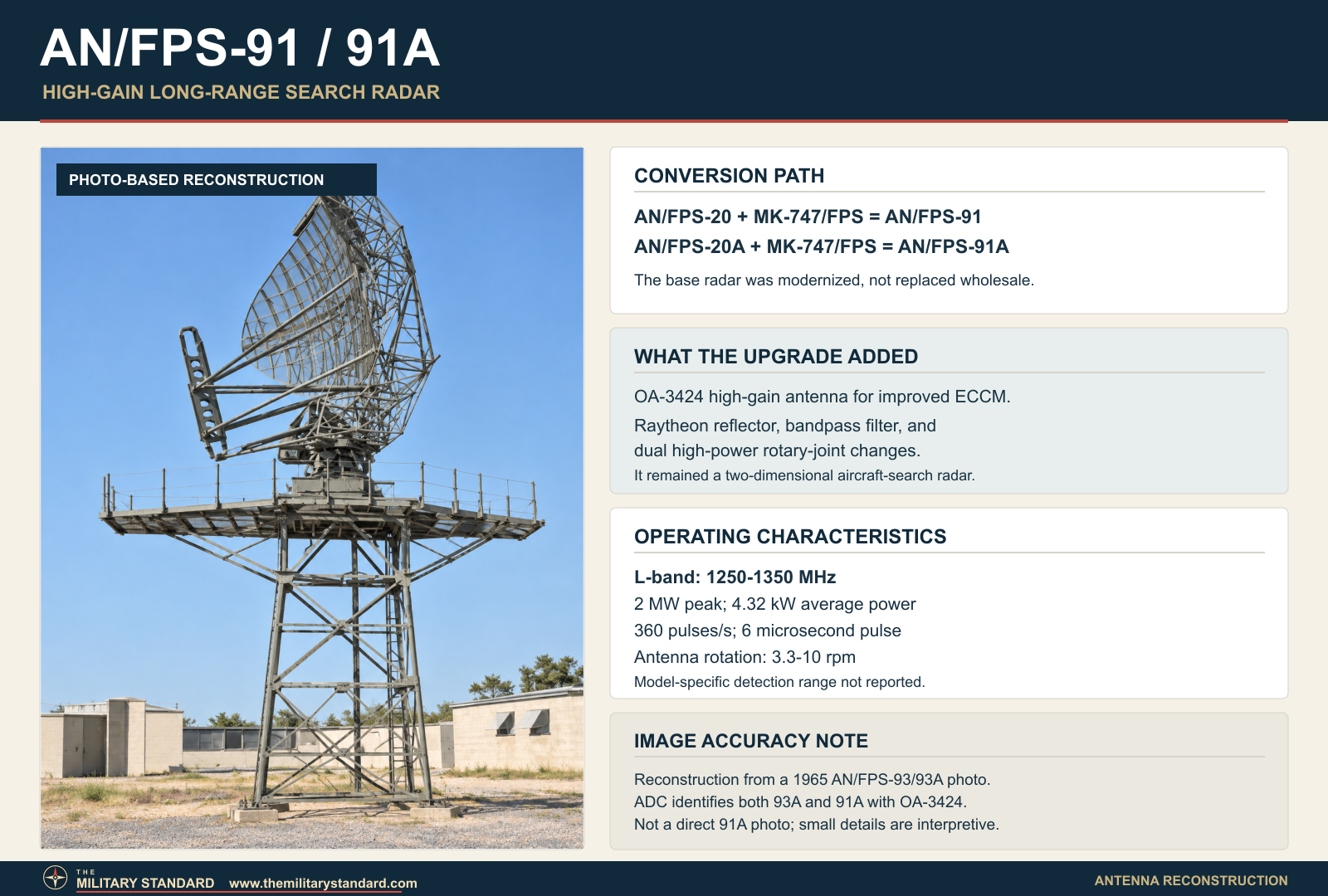
The defining visible feature of the AN/FPS-91 modernization was the large high-gain reflector. Federal supply data for the AS-1561/FPS reflector identify a truncated parabolic aluminum dish associated with the AN/FPS-91 and AN/FPS-91A technical-order family. The catalog dimensions are approximately 45 feet overall length, 20 feet overall depth, and 8 feet overall width. Because catalog orientation terms can reflect packaging or assembly geometry rather than the intuitive face dimensions of the radar aperture, the values are reported exactly as catalog dimensions rather than rearranged into an assumed width-by-height statement.
The reflector sat on the rotating antenna system above the radar operations structure or tower. RF energy had to pass between stationary transmitter/receiver equipment and the rotating antenna assembly. That made the rotary joint an important component. The MK-747 specialist description specifically refers to a dual high-power rotary-joint modification, showing that the antenna modernization was not a matter of bolting a larger reflector onto an unchanged pedestal. High-power RF transfer, feed arrangement, filtering, mechanical balance, drive loading, and maintenance access all had to be considered.
The high-gain antenna also helps explain why later photographs of AN/FPS-91A sites can look different from the earlier AN/FPS-20 family. The family ancestry is in the electronics and site lineage, but the most visually obvious part of the system had changed. At long-lived FAA/JSS sites the antenna could be enclosed by a radome, further altering the appearance. Site histories and photographs should therefore be interpreted by date. A location that once displayed an exposed AN/FPS-20 family reflector might later show a high-gain AN/FPS-91A configuration and then, after another modernization, an ARSR-4 or CARSR installation.
How the Radar Worked
At the transmitter, the AN/FPS-91 family generated short high-power L-band pulses at a repetition rate on the order of 360 pulses per second according to the federal characteristics table. Each pulse traveled through the RF transmission path and rotating joint to the antenna, which concentrated the energy into the search beam. The antenna then rotated continuously in azimuth. At 3.3 rpm a full revolution took a little more than eighteen seconds, while at 10 rpm it took six seconds, allowing operators to trade update rate against other operating considerations.
When a pulse struck an aircraft, terrain feature, weather cell, or other reflecting object, a small portion of the energy returned to the antenna. The receiver amplified and processed those echoes. The time interval between transmission and reception represented target range, while the antenna's azimuth at the moment of reception represented bearing. Repeated returns on successive scans allowed the local display and later automated systems to develop a track. The radar did not directly measure precise altitude, so controllers used paired height-finding equipment when the tactical situation required a third coordinate.
The high-gain antenna improved the front-end geometry of this process. More useful energy could be concentrated in the intended direction, and the receive pattern could become less vulnerable to some forms of off-axis interference. Filtering and associated RF-path changes further helped control what energy entered the receiver. The result was not immunity to electronic warfare. It was an incremental improvement in the probability that useful target returns would remain distinguishable in a difficult electromagnetic environment.
At SAGE stations, radar video did not remain only on the local scope. Coordinate data transmitting equipment converted selected radar information into a form that could be sent to the regional direction center. There computers and weapons controllers combined tracks from many sites, correlated identification information, and supported interceptor direction. The AN/FPS-91's operational effect therefore extended far beyond the antenna tower. It was one sensor feeding a distributed continental network.
ECCM and the High-Gain Concept
The AN/FPS-91 family should be placed in the larger Air Defense Command response to jamming. Early long-range radars had been designed primarily around detection range and reliable operation. As Soviet electronic-warfare capability became a more serious planning factor, the Air Force added frequency diversity, receiver improvements, sidelobe suppression, moving-target functions, filters, and other ECCM features across several radar families. The FPS-20 tree is one of the clearest examples of this incremental modernization philosophy.
OA-3424 was specifically described by ADC as a high-gain antenna providing more effective ECCM. High gain alone does not solve every jamming problem. A jammer positioned within the main beam can still be powerful, and radar performance still depends on transmitter stability, receiver dynamic range, clutter rejection, target cross section, propagation, and operator or processor performance. What the antenna can do is shape where the radar sends and receives energy. A better controlled main lobe and reduced sensitivity to unwanted directions can improve the signal-to-interference environment.
The specialist MK-747 lineage suggests that the Air Force treated this as a package rather than a reflector-only change. The bandpass filter would help reject out-of-band energy. The dual high-power rotary-joint modification would support the new antenna/feed arrangement and high-power transmission through the rotating structure. Secondary summaries mention a Diplex Gating Unit, which may have helped manage transmitter/receiver routing or gating.
The AN/FPS-91 also demonstrates how ECCM could be achieved without replacing a whole radar system. Reusing an existing transmitter, operations building, site utilities, and SAGE data path reduced cost and installation time. The high-gain package addressed a specific vulnerability while preserving an enormous sunk investment in the AN/FPS-20 network. That was particularly attractive during a period when the Air Force was simultaneously funding new search radars, height finders, SAGE computers, communications links, interceptor aircraft, missile warning, and other expensive air-defense programs.
Transmitter, Receiver, and Control Commonality
Formal technical-order relationships show that AN/FPS-91 and AN/FPS-91A remained inside the AN/FPS-20 family for maintenance purposes. Federal logistics records for radar-set control equipment IC-6109/FPS reference Technical Order 31P6-2FPS20-4-8 and list AN/FPS-64A, AN/FPS-65A, AN/FPS-66A, AN/FPS-67B, AN/FPS-91, and AN/FPS-91A together. The shared technical-order family is strong evidence of equipment commonality even when individual antenna and RF components differed.
This matters for interpretation of photographs and site inventories. A radar station labeled "AN/FPS-91A" could still contain cabinets, control assemblies, transmitters, indicators, and power-distribution components descended directly from the AN/FPS-20 family. The designation did not imply that every rack inside the operations building had been replaced. A modification package could change the antenna and selected RF components while leaving much of the electronics and facility wiring intact.
It also means that later FAA life-extension work could create additional configuration drift without necessarily producing a new familiar site designation. The Joint Surveillance System period stretched some legacy radars far beyond their original expected lives. Solid-state receiver improvements, digitizers, replacement power supplies, data links, and maintenance substitutions could accumulate over time. By 1995 an AN/FPS-91A site was operationally part of a very different command-and-control environment from a 1965 SAGE site even if the same designation still appeared in records.
Power Requirements
No AN/FPS-91-specific facility input specification was located in the reviewed federal characteristics and logistics material. The parent AN/FPS-20 family required substantial three-phase site power, and the high-power transmitter, antenna drives, cooling, ventilation, controls, and support electronics made the radar a significant electrical load. That family context explains why AN/FPS-91 conversions were normally installed at established radar stations rather than on minimally prepared ground.
The correct technical treatment is nevertheless to leave the precise value unresolved. A power figure copied from an AN/FPS-20 manual might be close, but the OA-3424/MK-747 antenna and RF-path changes could affect drive loads, auxiliary equipment, or distribution arrangements. Later FAA modifications could alter the requirement again.
Facilities and Physical Installation
AN/FPS-91A sites inherited the architecture of the permanent radar network. The principal components normally included the radar operations building, the antenna tower or roof-mounted pedestal, transmitter and receiver spaces, indicator and control areas, mechanical and electrical rooms, emergency generation, cooling and ventilation, cable or waveguide routes, and communications equipment linking the site to command centers. Staffed Air Force stations added barracks, dining, administration, motor pools, maintenance shops, security functions, and often a separate family-housing area.
The radar itself occupied only part of that landscape. Search performance depended on the site having an unobstructed horizon, reliable electrical power, precise antenna alignment, low-loss RF paths, and communications connectivity. Height-finder radars were usually placed on separate towers to reduce physical and electromagnetic interference. Ground-to-air radio facilities were frequently separated from the main radar compound for the same reason. At mountain and coastal sites, weather protection and access could become major engineering problems.
Later FAA/JSS operation often shrank the military footprint while preserving the radar compound. When an Air Force squadron inactivated, barracks and administrative buildings could close or transfer while the antenna, operations space, and communications functions remained active. West Mesa, Makah, and other sites demonstrate this selective continuity. The civilian or joint radar mission could survive after the classic Air Force station had ceased to exist as a full garrison.
Lackland Air Force Base
Lackland provides one of the clearest early AN/FPS-91A conversion examples. The 741st Aircraft Control and Warning Squadron had operated earlier search and height-finding radars at the site, and the station had a joint air-traffic-control relationship with the Federal Aviation Administration by the late 1950s. ADC's equipment table records AN/FPS-20A followed by AN/FPS-91A in 1965. Searching the Skies describes the site as hosting AN/FPS-91A by 1966.
The AN/FPS-91A did not remain the final search configuration at Lackland. ADC's table records later AN/FPS-66A equipment, and the 741st was deactivated in December 1969 as the FAA assumed control. This sequence is historically useful because it shows that the AN/FPS-91A was one branch among several possible FPS-20-family modernization paths. A site could receive the high-gain antenna configuration and later change again as network requirements, available hardware, and joint-use arrangements evolved.
Lackland also illustrates the close Air Force-FAA relationship that would become even more important during the JSS era. The radar did not serve only a military warning mission. By the time of the AN/FPS-91A conversion, the site was already involved in air traffic control. This dual-use context made long-lived surveillance radars more valuable because one sensor could support both national air defense and civil traffic management.
Texarkana Air Force Station
Texarkana Air Force Station in Arkansas offers a second mid-1960s example. By 1958 the 703rd Radar Squadron operated AN/FPS-20-series search equipment with an AN/MPS-14 height finder, and the station also supported FAA air traffic control. ADC records the search radar changing to AN/FPS-91A in 1966. The site then closed in September 1968 as part of the continuing reduction of the continental manned radar network.
The short interval between AN/FPS-91A conversion and Air Force closure shows why a radar's technical life cannot be inferred from the life of one military unit. The Air Force could invest in a modernization only to close the squadron a few years later because strategic planning had changed. Equipment could remain, transfer, be reused, or serve civilian needs after the blue-suit organization disappeared. Photographs of the Texarkana radar site from later decades have been interpreted by the Air Defense Radar Museum as showing an FAA-retained AN/FPS-91A and radome, although the exact final operating date requires additional FAA documentation.
The Texarkana case also reinforces the distinction between a system designation and a permanent physical object. A modernized AN/FPS-20A could become AN/FPS-91A at one date, continue after a unit inactivation, receive later maintenance changes, and still be called by the same radar designation in site histories.
West Mesa Air Force Station
West Mesa, associated with Kirtland Air Force Base and Albuquerque, was another early AN/FPS-91A site. ADC's table records the 687th Radar Squadron changing from AN/FPS-20A to AN/FPS-91A in 1966. The squadron inactivated on 8 September 1968. A later Air Force unit-history source records the radar mission and shows how the site continued to matter after the military unit left.
The post-closure property history is especially relevant. Federal historic summaries note that the radar operations area was transferred to the FAA in January 1970. The FAA continued long-range radar operations on the site, and later histories associate the location with AN/FPS-91A service in the joint surveillance network. The site therefore demonstrates the institutional transition that preserved the radar family: the Air Force could stop manning the station while the national requirement for long-range air surveillance remained.
Mather and Sacramento Joint-Use Radar
The Mather radar site in California was another long-running joint-use location with AN/FPS-20-family ancestry. Unit histories for the 668th Aircraft Control and Warning Squadron list the station's progression through CPS-6B, AN/FPS-20A, AN/FPS-6, and AN/FPS-6B equipment, with AN/FPS-91A appearing in the later equipment record. The site eventually became primarily an FAA facility and is often identified in later sources as the Sacramento radar site.
Mather's importance is not a dramatic single incident but continuity. It demonstrates how the AN/FPS-91A could bridge the period between staffed Air Force radar stations and increasingly civilian-operated long-range surveillance. The equipment remained useful because the FAA had the same basic need to know where aircraft were over a large region, even though the mission emphasis shifted from bomber warning and interceptor control toward civil traffic surveillance and joint national airspace monitoring.
That continuity also complicates retirement accounting. A military organizational history may end in 1966, while the radar mission continues. The equipment can no longer be treated as "retired" simply because the squadron inactivated. For this reason, family retirement is based on actual radar evidence from later JSS locations rather than on the closing dates of early ADC units.
Point Arena and the JSS Transition
Point Arena Air Force Station on the northern California coast became an important JSS-era AN/FPS-91A example. The station had previously operated several search-radar generations, including AN/FPS-24 and AN/FPS-93A. A 2011 historic-resource study for the former Almaden Air Force Station lists AN/FPS-91A among the radars that served at Point Arena, while a detailed 776th Radar Squadron history states that by 1979 the site was operating AN/FPS-91A and AN/FPS-116 under the Joint Surveillance System program.
The pairing is significant. AN/FPS-91A remained a two-dimensional search radar, and AN/FPS-116 supplied the height-finding function. JSS did not immediately replace every older sensor with a modern three-dimensional radar. Instead, it reused and digitized legacy search and height-finder systems at selected sites while consolidating command-and-control functions. This extended the useful life of the AN/FPS-91A into a period when SAGE itself was disappearing.
Point Arena also illustrates the eventual replacement path. The old site was later closed and replaced by an FAA/USAF JSS site at Rainbow Ridge using ARSR-4. That transition captures the technological end state of the AN/FPS-91A era. Modern three-dimensional or more highly integrated long-range radars could provide improved reliability, digital interfaces, and reduced dependence on separate height finders and legacy support equipment.
Makah Air Force Station
Makah Air Force Station on Bahokus Peak near Neah Bay, Washington, provides the strongest documented late-service history. The 758th Radar Squadron began with AN/FPS-3 and AN/CPS-4 equipment, later operated AN/FPS-7A search and AN/FPS-90 and AN/FPS-26A height finders, and entered the SAGE system. Around 1980, the AN/FPS-107V1 search radar was replaced by AN/FPS-91A. During the changeover an AN/TPS-43E temporarily maintained search coverage from an existing tower.
The radar survived the end of the staffed Air Force station. On 15 June 1988 the 758th Radar Squadron was inactivated, and the station closed at the end of the month. The radar site then passed to FAA operation, with a small Air Force maintenance presence for a time. National Archives history specifically records that the FAA was operating AN/FPS-91A at Makah in 1995. This is one of the clearest official confirmations that the equipment family remained operational decades after its mid-1960s introduction.
The end came in the latter 1990s when the FAA replaced the AN/FPS-91A with ARSR-4. Makah therefore supplies a nearly complete late-life arc: legacy search radar replaced by AN/FPS-91A, Air Force station closure, FAA/JSS continuation, documented 1995 operation, and late-1990s replacement by a new-generation radar. The site is also visually useful because many station structures survive under Makah Tribal ownership, allowing the radar mission to be interpreted in relation to the physical landscape even though the AN/FPS-91A itself has been removed.
Port Austin and Emergency Replacement
Port Austin Air Force Station in Michigan shows the AN/FPS-91A being used as a practical contingency replacement rather than simply as an orderly planned conversion. The station's AN/FPS-24 search radar suffered a catastrophic main-bearing failure around 1982. The failure left the search mission without its normal sensor, so the FAA long-range radar at Canton, near Detroit, was temporarily tied into the defense network to provide data while a replacement was arranged.
An AN/FPS-91A was installed at Port Austin in 1983. At the same time the AN/FPS-26A height finder was replaced by an AN/FPS-116 for the JSS program. The combination restored local search and height coverage without rebuilding the site around an entirely new radar family. Port Austin continued as a blue-suit JSS station until 1988, when the Air Force closed it and again relied on the FAA Canton radar.
This episode is one of the most useful operational events in the AN/FPS-91A history because it shows why an older radar could remain strategically valuable. The system was mature, supportable, compatible with existing infrastructure, and capable of being installed quickly enough to restore coverage after a major mechanical failure of another radar. Its value in 1983 was not technological novelty. It was available, understood capability that could be integrated into an existing surveillance network.
Calumet Air Force Station
Calumet in Michigan's Upper Peninsula underwent a similar late transition. The station had used AN/FPS-27 search radar with AN/FPS-26A and AN/FPS-90 height finders. A planned closure around 1979 was reversed, and the site was reconfigured as a blue-suit JSS station. During the later equipment transition, an AN/MPS-11 provided temporary search coverage while the AN/FPS-27 was decommissioned and an AN/FPS-91A was commissioned. An AN/FPS-116 later supplied height finding.
The Calumet case shows the continuing patchwork character of JSS modernization. The system did not move from one nationwide radar generation to the next on a single date. Individual sites received replacement radars when existing equipment became unsupportable, when command arrangements changed, or when local coverage needs justified continued operation. A mobile or transportable radar could provide temporary coverage during the transition, after which a legacy-derived but still useful AN/FPS-91A took over.
Calumet finally closed in 1988. The property later passed to local and private uses, but radar structures and the mountaintop setting remained part of the physical legacy. The equipment history therefore intersects with preservation even where the radar itself is gone. Surviving towers, foundations, support buildings, and photographs can identify where the AN/FPS-91A operated and how it fit into the station.
Fort Fisher Radar Station
Fort Fisher in North Carolina provides unusually strong late operational documentation because a state historic-structures survey describes the radar mission in the 1980s. The 701st Air Defense Group supplied search and height data to the 23 NORAD Region/Air Division Regional Operations Control Center, supported the Navy's Fleet Area Control and Surveillance Facility, and provided data to FAA air traffic control centers. The survey identifies AN/FPS-91A search radar, AN/FPS-116 height finder, and AN/FYQ-47 Common Digitizer as the key radar-system components.
That combination shows the mature JSS operating model. The AN/FPS-91A was no longer serving only a local GCI room or a single SAGE direction center. Its data could feed military regional control, naval airspace management, and civilian air traffic control. The common digitizer translated legacy radar information into a form suitable for newer automated networks. In effect, digital data handling prolonged the strategic relevance of analog-era radar hardware.
Fort Fisher closed as an Air Force radar station in June 1988, but the FAA continued radar activity at the site as JSS Site J-02. A 701st unit-history summary states that an AN/FPS-91A still performed search duties in 1995. Later radar modernization replaced the legacy system. Fort Fisher is therefore another strong example of AN/FPS-91A surviving beyond the institutional life of the Cold War station that had hosted it.
North Truro Air Force Station
North Truro on Cape Cod followed a comparable path. The station had operated several generations of search and height-finding radar, including AN/FPS-7 and later AN/FPS-107V2. By 1985, site history records the AN/FPS-107 as replaced by an FAA-operated AN/FPS-91A. The site retained a military and joint surveillance role even as the organizational structure of continental air defense changed.
In 1995 the FAA was still operating AN/FPS-91A at North Truro. The radar's long survival at a prominent coastal site underscores the importance of civil-military integration. A radar that had begun as a modification of a 1950s Bendix search set remained useful because its basic task, long-range aircraft surveillance, did not disappear. Digital data links and new command centers could consume its output even if the front-end antenna and transmitter were from an older lineage.
The AN/FPS-91A was replaced by ARSR-4 in the late 1990s. Like Makah, North Truro therefore demonstrates the transition from FPS-20-family hardware to a newer FAA/JSS radar generation. The replacement was not merely a new antenna on the same old set. It marked the eventual retirement of an architecture that had survived through decades of incremental modification.
Oceana and Other 1995 JSS Sites
Searching the Skies identifies the Oceana JSS site at Virginia Beach, J-01, as operating AN/FPS-91A in 1995. This is important because Oceana was not simply a fading remnant of an old isolated Air Force station. It was part of the active Joint Surveillance System serving one of the most heavily used military and civil aviation regions on the East Coast. The radar's continued presence there shows that AN/FPS-91A remained operationally accepted within the national surveillance network.
Other sources document AN/FPS-91A at Mather/Sacramento and additional FAA or JSS locations. The exact fleet count at any one date is not established. The evidence instead supports a representative-site approach. The radar was sufficiently widespread and long-lived to appear in early ADC conversion tables, 1980s JSS station histories, and 1995 network descriptions, but the total number of systems and their exact movement between sites require a separate inventory reconstruction.
The broad geography is notable. AN/FPS-91A served in Texas, Arkansas, New Mexico, California, Washington, Michigan, North Carolina, Massachusetts, Virginia, and elsewhere. That distribution placed it on Gulf approaches, the Pacific coast, the Great Lakes, the Atlantic coast, and major inland aviation corridors. The family was not tied to one regional command or one environmental setting.
SAGE Integration
In its original military context, AN/FPS-91A served a SAGE network built around centralized processing of many radar sites. The radar's rotating search beam generated target detections at the local station. Coordinate data transmission equipment and associated electronics converted selected information into digital messages for the direction center. There the AN/FSQ-7 computer and operations staff combined data from multiple radars into a regional tactical picture.
This system architecture changed the meaning of radar performance. A local operator might see a return, but the real measure of usefulness was whether that return could become a stable track available to the direction center and weapons controllers. Antenna pattern, clutter rejection, receiver behavior, communications reliability, and digitizer performance therefore mattered as much as raw transmitter power. The AN/FPS-91's high-gain/ECCM purpose was directly relevant to that network-level need for dependable data.
SAGE also encouraged incremental radar modernization. Because direction centers represented enormous investments, replacing every field radar simultaneously would have been impractical. Upgrading the FPS-20 family allowed ADC to improve sensors while retaining established data links and operating procedures. The AN/FPS-91A was one product of that strategy, providing an upgraded front end to a radar family already embedded in the system.
NORAD and Continental Defense
Above the local and SAGE levels, the radar contributed to NORAD's continental surveillance mission. Radar stations were arranged to create overlapping coverage of approaches to the United States and Canada. Search radars detected and tracked aircraft; height finders supplied altitude; identification systems and flight-plan information helped distinguish friendly traffic; and direction centers could order interceptors toward unknown or hostile tracks.
The AN/FPS-91 family entered service as the manned bomber threat remained a central planning problem but ballistic missiles were increasingly dominating strategic attention. That shift eventually reduced the number of staffed aircraft-warning stations. It did not eliminate the need for atmospheric surveillance. Unknown aircraft, Soviet long-range aviation, civil traffic, training, and later cruise-missile concerns all kept ground-based air surveillance relevant.
This changing threat environment explains the radar's unusually long life. The original SAGE-centered mission contracted, but FAA air-route surveillance and the joint military requirement for a national air picture persisted. The same radar could therefore transition from classic interceptor-control support to JSS data provision without changing its fundamental physical task of detecting aircraft at long range.
FAA and Joint Surveillance System Integration
FAA Order 1812.8 provides direct agency confirmation of the AN/FPS-91 family's joint-use afterlife. It lists FPS-91 among existing search radars at joint-use facilities and explicitly names FPS-91A among the legacy radars to be replaced by ARSR-4. The order also identifies paired height finders and digitizers at those facilities. This is program-level evidence for the replacement path, not proof that every listed station received ARSR-4 on the same date.
The Joint Surveillance System formalized a civil-military partnership that had existed at many radar stations since the 1950s. The FAA needed long-range radar to manage en route civil traffic, while the Air Force needed surveillance data for air defense. Maintaining separate radars at every location would have duplicated cost and spectrum use. Shared facilities and data therefore made operational and economic sense.
AN/FPS-91A fit this model well. It was already compatible with permanent long-range radar sites, had a large maintenance knowledge base, and could be paired with newer digitizers and communications. At Fort Fisher, the AN/FYQ-47 Common Digitizer is explicitly documented with AN/FPS-91A and AN/FPS-116. At Makah and North Truro, FAA operation kept the search radar active after the Air Force station itself closed. At Port Austin and Calumet, AN/FPS-91A helped sustain blue-suit JSS coverage through the 1980s.
The JSS era also demonstrates why the designation cannot be treated as a frozen hardware standard. A 1995 FAA-operated AN/FPS-91A almost certainly existed in a different maintenance and data environment from a 1965 ADC set. Components could be replaced, receiver technology improved, and external digitizers added. The historically responsible approach is to preserve the designation while acknowledging that the configuration evolved over decades.
Relationship to Height-Finder Radars
Because AN/FPS-91A was two-dimensional, its usefulness in the military air-defense system depended on altitude information from another source. Early sites could pair FPS-20-family search with AN/FPS-6 or AN/MPS-14. Later AN/FPS-91A sites frequently used AN/FPS-116, itself an upgrade path from the AN/FPS-6/FPS-90 family. The pairing is documented at Point Arena, Port Austin, Calumet, Makah, and Fort Fisher.
This arrangement imposed operational and maintenance costs. Two large radar systems meant two antennas, two drive systems, two transmitter/receiver chains, separate towers or foundations, and additional technicians. The advantage was that each sensor was optimized for its job. The search radar swept continuously, while the height finder concentrated on selected targets and measured elevation with a narrow vertical beam.
Three-dimensional search radars eventually made that arrangement less attractive. Systems such as AN/FPS-117 and newer ARSR variants could provide range, azimuth, and altitude more directly while using modern solid-state and digital technology. The retirement of AN/FPS-91A and AN/FPS-116 pairs at late JSS sites was therefore part of a larger technological transition away from separate search and height-finder architectures.
Barter Island Source Anomaly
ADC's DEW Line table is the most unusual piece of evidence in the AN/FPS-91 record. It lists BAR-Main at Barter Island with AN/FPS-19 and FPS-91. If taken at face value, that would place an FPS-91 on the Arctic DEW Line. The problem is that other sources describing Barter Island's actual radar equipment consistently identify AN/FPS-19 as the long-range search radar during the DEW era and AN/FPS-117 as the later North Warning System long-range radar.
A U.S. Army Corps of Engineers cultural-resource management study of Cold War Alaska states that Barter Island's normal radar facilities used AN/FPS-19, while supporting gap coverage came from FPS-23 sites. A later Air Force remote-sites integrated natural-resources plan documents the North Warning System modernization and AN/FPS-117 installation at Barter Island, with the site operational in the new system in 1990. Specialist radar-site records tell the same broad story and do not identify AN/FPS-91 as an established Barter Island search set.
The discrepancy could reflect a transcription error, temporary equipment, planning data that never became operational, or another designation issue. The current evidence does not establish which.
Variants and Modification Relationships
The working family map is AN/FPS-20 plus the high-gain modernization equals AN/FPS-91, while AN/FPS-20A plus the same broad modernization equals AN/FPS-91A. ADC directly supports only the AN/FPS-91A side by stating FPS-20A with OA-3424. The specialist MK-747 tree supplies the base FPS-91 mapping. The difference between AN/FPS-20 and AN/FPS-20A involved the parent radar's modulator configuration, so retaining the suffix distinction is consistent with the broader FPS-20 lineage.
OA-3424 and MK-747 should not be treated as proven synonyms. ADC identifies OA-3424 as the high-gain antenna. The specialist tree identifies MK-747 as a broader modification that included the Raytheon antenna plus other RF-path changes. It is reasonable to interpret OA-3424 as a major component within a larger conversion, but the exact Air Force configuration-control relationship requires the missing modification order or equivalent technical manual.
AN/FPS-93 and AN/FPS-93A were related but not identical. ADC describes AN/FPS-93A as AN/FPS-87A with OA-3424. The specialist tree similarly maps the high-gain modification onto AN/FPS-87 and AN/FPS-87A. This means the AN/FPS-91 and AN/FPS-93 families shared a high-gain modernization concept while starting from different FPS-20-family receiver/configuration branches.
AN/FPS-64A through AN/FPS-67B also appear in the AS-1561/FPS technical-order family. That shared reflector and control-equipment evidence demonstrates parts commonality across several late FPS-20 derivatives. It does not erase the underlying receiver and ECCM differences that produced separate designations. The family tree should therefore be understood as a network of shared components and modifications, not as a set of names for one completely identical radar.
Operational Incidents and Unusual Service
The Port Austin bearing failure is the most direct operational event tied to AN/FPS-91A installation. When the large AN/FPS-24 search radar suffered catastrophic bearing failure around 1982, coverage had to be maintained by tying in data from the FAA Canton radar. AN/FPS-91A was then installed at Port Austin in 1983. This was a real network resilience action: a mature legacy-derived radar restored local search capability after a mechanically complex frequency-diversity radar became unusable.
Makah's changeover provides another operationally revealing episode. Around 1980, when AN/FPS-91A replaced AN/FPS-107V1, a transportable AN/TPS-43E temporarily maintained search coverage from an existing tower. The temporary radar prevented the surveillance gap that would otherwise have occurred while the permanent system was being changed. The episode shows that radar modernization was an operational event requiring continuity planning, not simply a maintenance action performed with the site offline.
Calumet's transition used AN/MPS-11 in a similar temporary role while AN/FPS-27 was decommissioned and AN/FPS-91A commissioned. These episodes demonstrate that radar networks had contingency procedures and movable sensors available to protect coverage during major equipment changes. They also show that AN/FPS-91A could be integrated into stations whose immediately preceding search radar was not an FPS-20 derivative.
Replacement and Retirement
The AN/FPS-91A did not have one standardized successor. At some locations the site closed, making replacement unnecessary. Port Austin and Calumet ended blue-suit operations in 1988. At other locations the FAA continued the mission and eventually installed ARSR-4. Makah and North Truro clearly followed that path in the latter 1990s. Point Arena was replaced by a newer JSS site at Rainbow Ridge using ARSR-4.
ARSR-4 represented a generational change. It provided modern three-dimensional surveillance, improved digital integration, and a more maintainable architecture than the heavily modified 1950s-derived FPS-20 family. As such systems spread, the operational rationale for keeping separate AN/FPS-91A search and AN/FPS-116 height-finder sets weakened. The transition reduced the number of rotating legacy systems and consolidated functions.
Other FAA/JSS locations eventually received CARSR or related modernization. The exact final retirement date of every AN/FPS-91A has not been reconstructed. The strongest conclusion from the current evidence is that the family persisted through at least 1995 at multiple sites and that prominent surviving examples were being replaced in the latter 1990s. Any nationwide "retired in 1975" or similarly early date would be demonstrably incorrect.
Preservation and Surviving Evidence
No complete, publicly documented preserved AN/FPS-91 or AN/FPS-91A radar has been confirmed in a museum collection. The absence is not surprising. These were extremely large systems installed on towers, and late-service sets were usually replaced in place by newer FAA/JSS equipment. Antennas, pedestals, waveguide, and cabinets were more likely to be scrapped or removed than preserved as complete museum artifacts.
The strongest surviving evidence is therefore documentary and architectural. Federal supply records preserve the AS-1561/FPS reflector identity and dimensions. Technical-order references preserve the relationship among AN/FPS-91/91A and other FPS-20-family variants. Site photographs at Texarkana, Calumet, Port Austin, North Truro, Makah, and other locations preserve antenna towers, radomes, operations buildings, and later replacement installations. Historic-resource studies at Point Arena and Fort Fisher document how the radar fit into the physical and command landscape.
At Makah, many former station buildings survive in tribal use, although the AN/FPS-91A itself has been replaced. At Calumet and Port Austin, surviving station fabric allows the radar story to be interpreted against the original mountaintop or rural site. At North Truro, the former Air Force station has been incorporated into the Cape Cod National Seashore landscape while modern radar operations continue nearby. These places preserve the setting even when the specific radar hardware is gone.
Technical Uncertainties and Source Safeguards
The first unresolved issue is the exact AN/FPS-91 versus AN/FPS-91A engineering boundary. ADC directly defines AN/FPS-91A as AN/FPS-20A plus OA-3424. The specialist modification tree maps AN/FPS-20 plus MK-747 to AN/FPS-91 and AN/FPS-20A plus MK-747 to AN/FPS-91A. The mapping is coherent, but a primary Air Force modification order for MK-747 was not located.
The second issue is OA-3424 versus MK-747. ADC calls OA-3424 a high-gain antenna. The specialist source describes MK-747 as a broader package including a Raytheon antenna, bandpass filter, and rotary-joint changes, while other summaries add a Diplex Gating Unit. Until the original modification documentation is found, the history does not state that OA-3424 and MK-747 are the same item. It treats OA-3424 as the ADC-defined antenna component and MK-747 as a source-qualified broader modernization label.
The third issue is range. The federal radar characteristics table lists 230 nautical miles for several nearby FPS-20-family rows but deliberately leaves the AN/FPS-91/91A range cell blank.
The fourth issue is numerical antenna gain. The system is explicitly called high gain, yet no reliable model-specific decibel gain value was located. A label such as "high gain" describes the design objective, not a substitute for a measured or published number. The fifth unresolved technical field is exact facility electrical input.
Historical Significance
AN/FPS-91 is historically important because it represents the mature phase of incremental Cold War radar modernization. The Air Force did not always solve a new threat by buying a new radar from the ground up. In this case it took a widely deployed Bendix AN/FPS-20-family platform, changed the antenna and associated RF path, and created a high-gain configuration intended to improve ECCM effectiveness. That approach preserved infrastructure, operator familiarity, technical support, and SAGE connectivity while addressing new electronic-warfare concerns.
The radar also shows how military technology can outlive the doctrine that created it. AN/FPS-91A entered service in the SAGE bomber-defense era. By the 1980s SAGE was disappearing, the number of manned Air Force radar stations was shrinking, and the continental defense system was reorganizing. Yet AN/FPS-91A survived because the basic need for long-range aircraft surveillance remained. Through FAA partnerships and JSS digitization, the same family continued to support civil and military users.
Its late service is a reminder that "legacy" does not mean irrelevant. At Port Austin the radar restored coverage after a catastrophic failure. At Fort Fisher it supplied data to NORAD, Navy, and FAA users. At Makah and North Truro it remained in FAA operation in 1995. Its eventual replacement by ARSR-4 and other modern systems came only after a service life spanning the transformation from vacuum-tube SAGE stations to digital joint surveillance.
Chronology
- 1950s Bendix AN/FPS-20 and AN/FPS-20A become major L-band long-range search radars in the permanent continental air-defense network.
- Late 1950s Air Defense Command accelerates ECCM and radar-modernization work as deliberate jamming becomes a more important planning threat.
- Early 1960s High-gain antenna modernization of the FPS-20 family develops into the AN/FPS-91 / AN/FPS-91A branch.
- 1963 ADC equipment definitions identify OA-3424 as a high-gain antenna providing more effective ECCM capability.
- 1965 ADC records AN/FPS-91A entering the Lackland radar configuration after AN/FPS-20A.
- 1966 Texarkana Air Force Station changes its search radar to AN/FPS-91A.
- 1966 West Mesa Air Force Station changes its search radar to AN/FPS-91A.
- 1966 Searching the Skies records AN/FPS-91A at Lackland by this year.
- 1968-09-08 The 703rd Radar Squadron at Texarkana is inactivated after a short AN/FPS-91A period.
- 1968-09-08 The 687th Radar Squadron at West Mesa is inactivated; the radar mission later continues under FAA control.
- 1969 Lackland's radar configuration moves beyond AN/FPS-91A to AN/FPS-66A before final Air Force squadron inactivation.
- 1969-12 The 741st Radar Squadron at Lackland is inactivated and the FAA assumes the long-range radar role.
- 1970-01 The former West Mesa radar operations area is transferred to the FAA.
- 1970s AN/FPS-91A remains in long-range surveillance service at selected joint-use and FAA-linked sites as manned Air Force radar stations are reduced.
- Late 1970s JSS planning increasingly reuses legacy search radars with newer digitizers, communications, and height-finder upgrades.
- 1979 Point Arena is documented operating AN/FPS-91A with AN/FPS-116 under the JSS program.
- 1979-10 Former Aerospace Defense Command radar sites, including several later AN/FPS-91A locations, move under Tactical Air Command / ADTAC jurisdiction.
- Circa 1980 Makah replaces AN/FPS-107V1 with AN/FPS-91A; AN/TPS-43E temporarily maintains search coverage during the changeover.
- Early 1980s Calumet is reconfigured as a blue-suit JSS site and later receives AN/FPS-91A.
- Circa 1982 Port Austin's AN/FPS-24 suffers catastrophic main-bearing failure.
- 1982-1983 FAA radar at Canton temporarily supplies data for the Port Austin sector.
- 1983 AN/FPS-91A is installed at Port Austin with AN/FPS-116 height finder for the JSS mission.
- 1983 The Joint Surveillance System replaces SAGE as the principal joint USAF-FAA atmospheric surveillance architecture.
- By 1985 North Truro's earlier AN/FPS-107 search radar has been replaced by an FAA-operated AN/FPS-91A.
- 1980s Fort Fisher operates AN/FPS-91A search, AN/FPS-116 height finder, and AN/FYQ-47 Common Digitizer while supporting NORAD, Navy, and FAA users.
- 1980s Calumet uses AN/MPS-11 temporarily during the transition from AN/FPS-27 to AN/FPS-91A.
- 1988-06 Fort Fisher Radar Station closes as an Air Force facility; FAA/JSS radar operation continues at Site J-02.
- 1988-06-15 The 758th Radar Squadron at Makah is inactivated.
- 1988-06-30 Makah Air Force Station closes; the radar site continues under FAA operation.
- 1988-09-30 Port Austin closes after its AN/FPS-91A JSS period, with surveillance again provided from the FAA Canton site.
- 1988-09-30 Calumet closes after its late AN/FPS-91A / AN/FPS-116 JSS configuration.
- 1995 National Archives and unit-history sources record FAA AN/FPS-91A operation at Makah.
- 1995 Fort Fisher records identify AN/FPS-91A performing search duties under the continuing FAA/JSS mission.
- 1995 North Truro records identify FAA operation of AN/FPS-91A.
- 1995 Searching the Skies identifies AN/FPS-91A at Oceana JSS Site J-01 in Virginia Beach.
- Latter 1990s FAA replaces AN/FPS-91A at Makah with ARSR-4.
- Late 1990s ARSR-4 replaces AN/FPS-91A at North Truro.
- Late 1990s Newer ARSR/JSS systems increasingly replace remaining AN/FPS-91A installations and separate legacy height-finder pairings.
- Present historical record No complete preserved AN/FPS-91/91A has been confirmed in a public museum collection; technical records, station structures, towers, photographs, and replacement radar sites remain the principal surviving evidence.
Photographs and diagrams
- Aerospace Defense Command, Historical Data, 1946-1973: Primary ADC equipment tables and network context. The PDF includes maps and period radar photographs useful for explaining the wider system in which the AN/FPS-91 family operated.
- Online Air Defense Radar Museum, AN/FPS-20 family modification tree: Diagram showing the specialist-source relationship among AN/FPS-20, MK-747, AN/FPS-91/91A, and related FPS-20-family modernization branches.
- National Archives, Makah Air Force Station: Archival article with station photographs and historical context for the late AN/FPS-91A / FAA-JSS period.
- Online Air Defense Radar Museum, Makah AFS: Specialist photo and site-history page for the Bahokus Peak radar station and later JSS equipment.
- Online Air Defense Radar Museum, Port Austin AFS: Photo and site-history page showing the station where AN/FPS-91A replaced the failed AN/FPS-24 in 1983.
- Online Air Defense Radar Museum, Calumet AFS: Photo and site-history page for the late blue-suit JSS site that converted from AN/FPS-27 to AN/FPS-91A.
- Online Air Defense Radar Museum, North Truro AFS: Photo and site-history page documenting the FAA-operated AN/FPS-91A and later ARSR-4 replacement.
- Online Air Defense Radar Museum, Texarkana AFS recent photographs: Photographs of the former station and FAA-retained radar area associated with the AN/FPS-91A period.
- Online Air Defense Radar Museum, Lackland AFB radar site: Site photographs and history for one of the earliest documented AN/FPS-91A conversions.
- Fort Fisher Historic Structures Survey: State historic-preservation report containing site maps, structure photographs, and discussion of the 1980s AN/FPS-91A / AN/FPS-116 / AN/FYQ-47 system.
- Searching the Skies: Official USAF-sponsored Cold War radar-program study with maps, station histories, radar illustrations, and 1995 JSS equipment references.
- Point Arena / Almaden historic-resource study: Historic-resource report with radar-station photographs and equipment context that includes Point Arena's AN/FPS-91A service.
- Federal supply record for AS-1561/FPS reflector: Technical catalog page identifying the Raytheon truncated parabolic reflector and the AN/FPS-91/91A technical-order family.
- U.S. Geological Survey, Barter Island Long Range Radar Site: Public-domain aerial photograph of BAR-Main's later North Warning System site, useful for illustrating why the ADC FPS-91 table entry requires caution.
Information sources (22)
- PDFAerospace Defense Command, Historical Data, 1946-1973
SOURCE FOR: Primary source for the ADC radar-designation list, the AN/FPS-91A = AN/FPS-20A with OA-3424 definition, the OA-3424 ECCM description, early site conversion tables, and the anomalous Barter Island FPS-91 entry.
- PDFU.S. Department of Transportation / NTIA, IVHS Roadway Environment
SOURCE FOR: Federal technical source for AN/FPS-91/91A frequency, peak and average power, PRF, pulse width, scan rate, and beamwidth, while importantly leaving the model-specific range and antenna-gain fields blank.
- PDFDavid F. Winkler, Searching the Skies: The Legacy of the United States Cold War Defense Radar Program
SOURCE FOR: Official USAF-sponsored historical source identifying AN/FPS-91 as a Bendix AN/FPS-20 derivative and documenting Lackland, Makah, Oceana, and other SAGE/JSS site histories.
- WEBOnline Air Defense Radar Museum, AN/FPS-20 family modification tree
SOURCE FOR: Specialist technical source for the working MK-747 lineage, mapping AN/FPS-20 to AN/FPS-91 and AN/FPS-20A to AN/FPS-91A and describing Raytheon antenna, bandpass-filter, and rotary-joint changes.
- WEBFederal supply record for AS-1561/FPS reflector antenna, NSN 5985-00-904-6227
SOURCE FOR: Logistics source for the Raytheon reflector, nominal overall dimensions, truncated parabolic construction, and Technical Order 31P6-2FPS20-4-8E association with AN/FPS-91 and AN/FPS-91A.
- PDFSearching the Skies, Lackland AFB station entry
SOURCE FOR: Official USAF-sponsored station history documenting AN/FPS-91A at Lackland by 1966 and the site's early joint FAA role.
- WEBOnline Air Defense Radar Museum, Lackland AFB
SOURCE FOR: Specialist site-history source for the 1965 AN/FPS-20A to AN/FPS-91A conversion and later transition to AN/FPS-66A.
- WEBOnline Air Defense Radar Museum, Texarkana AFS
SOURCE FOR: Specialist site-history source for the 1966 AN/FPS-91A conversion, joint FAA activity, 1968 Air Force closure, and later radar-site evidence.
- PDFU.S. Air Force Unit History, 687 Aircraft Control and Warning / Radar Squadron
SOURCE FOR: Unit-history source for West Mesa's AN/FPS-91A period, 1968 inactivation, and the radar site's Air Force lineage.
- PDFU.S. Air Force Unit History, 668 Aircraft Control and Warning Squadron
SOURCE FOR: Unit-history source for the Mather/Sacramento radar site's AN/FPS-20A lineage and later AN/FPS-91A equipment record.
- PDFU.S. Air Force Unit History, 776 Radar Squadron
SOURCE FOR: Unit-history source for Point Arena's late AN/FPS-91A and AN/FPS-116 JSS configuration and replacement by the Rainbow Ridge ARSR-4 site.
- WEBNational Archives, A Front Line of Defense: The 758th Radar Squadron and the Makah Air Force Station
SOURCE FOR: Official archival source for the circa-1980 AN/FPS-91A installation, temporary AN/TPS-43E coverage, 1988 Air Force closure, 1995 FAA operation, and late-1990s ARSR-4 replacement.
- PDFU.S. Air Force Unit History, 758 Radar Squadron
SOURCE FOR: Unit-history source confirming Makah's 1995 FAA AN/FPS-91A operation and JSS equipment lineage.
- PDFU.S. Air Force Unit History, 754 Radar Squadron
SOURCE FOR: Unit-history source for the Port Austin AN/FPS-24 bearing failure, temporary Canton radar data tie, 1983 AN/FPS-91A installation, and 1988 closure.
- PDFU.S. Air Force Unit History, 665 Radar Squadron
SOURCE FOR: Unit-history source for Calumet's late JSS configuration, AN/MPS-11 interim coverage, AN/FPS-91A replacement of AN/FPS-27, and 1988 closure.
- PDFNorth Carolina Historic Preservation Office, Fort Fisher Historic Structures Survey Report
SOURCE FOR: State historic source documenting the 1980s AN/FPS-91A, AN/FPS-116, and AN/FYQ-47 system and Fort Fisher's NORAD, Navy, FAA, and JSS roles.
- PDFU.S. Air Force Unit History, 701 Air Defense Squadron
SOURCE FOR: Unit-history source confirming AN/FPS-91A search duty at Fort Fisher in 1995 after Air Force station decommissioning and FAA/JSS continuation.
- WEBOnline Air Defense Radar Museum, North Truro AFS
SOURCE FOR: Specialist site-history source for AN/FPS-91A installation by 1985, FAA operation, and late-1990s ARSR-4 replacement.
- PDFPage & Turnbull, Former Almaden Air Force Station Historic Resource Study
SOURCE FOR: Historic-resource source listing AN/FPS-91A among Point Arena's radar equipment and placing the system in the physical context of long-lived California radar stations.
- PDFU.S. Army Corps of Engineers, The Cold War in Alaska: A Management Plan for Cultural Resources
SOURCE FOR: Government historical source identifying Barter Island's normal DEW radar facilities as AN/FPS-19, which conflicts with the isolated ADC table entry for FPS-91.
- PDFU.S. Air Force 611th Air Support Group Remote Sites Integrated Natural Resources Management Plan
SOURCE FOR: Official Air Force environmental/history source for Barter Island's North Warning System modernization and AN/FPS-117 replacement, providing additional evidence against treating the ADC FPS-91 entry as an established operational installation.
- PDFFederal Aviation Administration, Order 1812.8, System Requirements Statement for ARSR-4
SOURCE FOR: Primary FAA source listing FPS-91 at joint-use facilities and FPS-91A among the legacy radars targeted for ARSR-4 replacement.