
Oklahoma City Air Force Station / Manual Direction Center P-86, Oklahoma
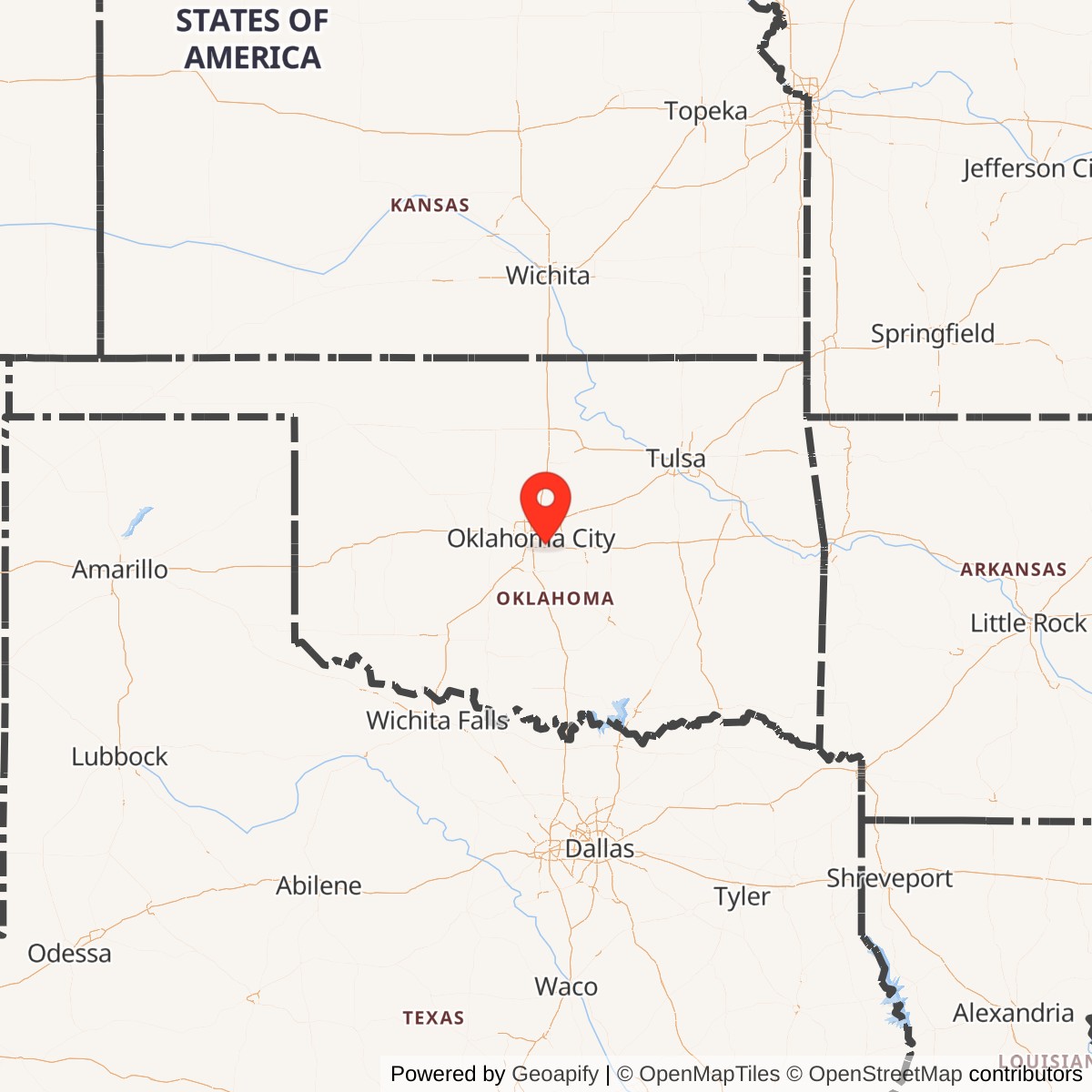
Longitude: -97.35874
Site Number: P-52; Z-52; P-86; MCC-11
Official Base Website: Tinker Air Force Base / Oklahoma City FAA Radar Site / 38th Cyberspace Engineering Installation Group campus
Current Role: Active federal use within Tinker AFB. Former Oklahoma City AFS command/cantonment campus supports the 38th Cyberspace Engineering Installation Group and related Tinker functions; the former P-52 radar compound remains an active FAA long-range radar/JSS site feeding civil and military surveillance systems.
Historical site designations: P-52 / Z-52 radar station; P-86 / MCC-11 manual direction center
Location: Former Area D southeast of Tinker Air Force Base, Oklahoma County
Radar operation: May 1952
Formal station naming: April 20, 1956
Separate administrative identity ended: October 1, 1983, with an address change to Tinker AFB
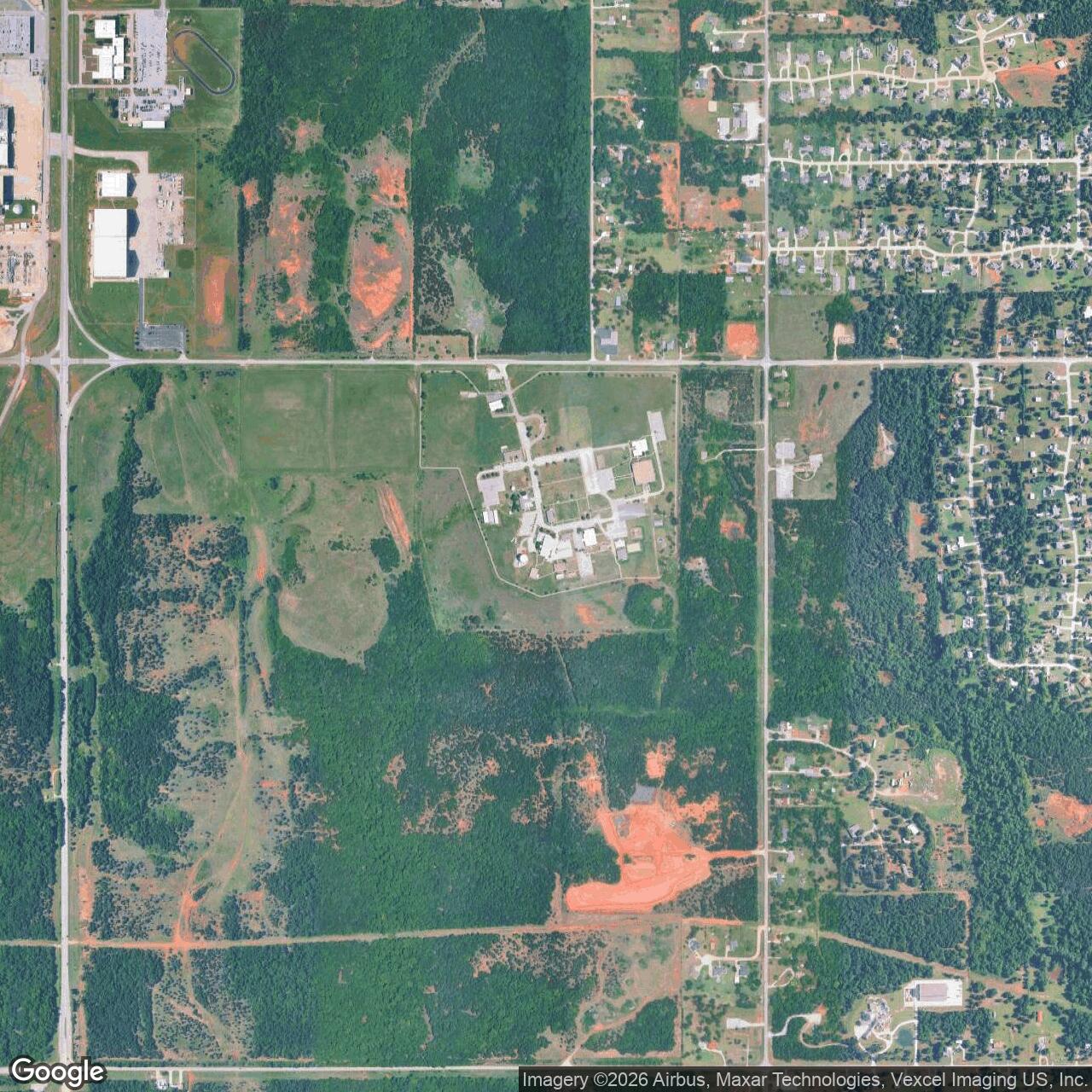
Representative radar-site coordinates: Latitude 35.4024, longitude -97.35874 (decimal degrees). This secondary-source point locates the former radar compound only. It is not a verified location for Building 4029, an entrance or a surveyed property centroid. View the approximate former radar-site point on Google Maps.
Installation Identity
Oklahoma City Air Force Station combined a permanent radar station with a regional manual air-defense command center. Its sensor function was P-52, later Z-52. Its command function was P-86, subsequently known as MCC-11. These designations identified different operational components, not four separate installations. The station's later communications headquarters added another layer of activity without erasing its earlier identity. Its history extends beyond the 746th Aircraft Control and Warning Squadron and beyond the end of the local Air Defense Command mission.
The contemporary installation directory provides an unusually clear identity anchor. On March 31, 1957, the Air Force listed Oklahoma City Air Force Station with P52 and P86 together under property installation number 2253. Tinker AFB furnished logistical support. The directory separately identified an Oklahoma City Transmitter Annex and an Oklahoma City Air Defense Filter Center.
Tinker's official chronology calls the station Area D, southeast of the base, and dates its formal naming to April 20, 1956. It expressly describes the station as a separate entity supported by Tinker. The geographical distinction matters because the main depot and airfield, the radar compound, and the headquarters facilities were not interchangeable places. Oklahoma City AFS was neither a second flying base nor simply a new name for Tinker. It was a neighboring, separately accounted installation whose missions relied on Tinker's support.
Origins, Establishment and Construction
The Korean War buildup accelerated the development of continental air defense. The Air Force needed additional radar coverage, trained controllers, interceptor coordination, and regional command organizations while permanent facilities were being prepared. Oklahoma City offered an established federal support base in the center of the country. Tinker could supply the administrative and logistical framework for a technical station, while the new air-defense organizations concentrated on aircraft surveillance and control. This relationship helps explain why early organizational addresses refer to Tinker before the separate station name appears consistently.
The 33rd Air Division was activated at Tinker on March 19, 1951. California's 148th Aircraft Control and Warning Squadron was also part of the mobilized radar force associated with the Oklahoma City buildup. Its published unit-history compilation places it at Tuttle on May 12, 1951, at Tinker on August 15, and under the 33rd Air Division in February 1952. It was relieved from active duty on February 1, 1953. These are unit and deployment milestones. They do not establish an original legal order creating Oklahoma City AFS on May 1, 1951.
The Air Defense Command statistical history records manual operations at P-52 beginning in May 1952. The same source and the organizational handbook date the activation of the 746th AC&W Squadron to February 1, 1953, at Tinker. This sequence resolves a misleading shorthand in Searching the Skies, which attributes the May 1952 operation to the 746th even though that unit had not yet been activated. The radar mission preceded the permanent squadron's activation. The predecessor force and the later regular squadron must be distinguished rather than compressed into a single opening event.
Formal station naming followed on April 20, 1956. The handbook places the 33rd Air Division's move from Tinker to Oklahoma City AFS in the summer of 1956, and ADC's stationing record gives July 1956 for the 746th's move. Published specialist accounts supply more exact days for some of these events, but the primary records reviewed support summer or month precision. Construction therefore belongs to an incremental development process: radar operation, establishment of the regular squadron, separate station naming, and movement into the station were related but different milestones.
A complete construction schedule, original establishment order, and station-specific land-acquisition file have not been located in the reviewed record. Building 4029 is the strongest identified surviving headquarters resource, but its existence should not be used to assign an unverified construction date to the entire station. Tinker's wartime depot construction, subsequent land donations, family housing projects, and airfield improvements likewise belong to the supporting base unless a source explicitly connects them to Area D. They are not substitutes for the station's missing construction and estate records.
P-52 and Z-52 Radar Operations
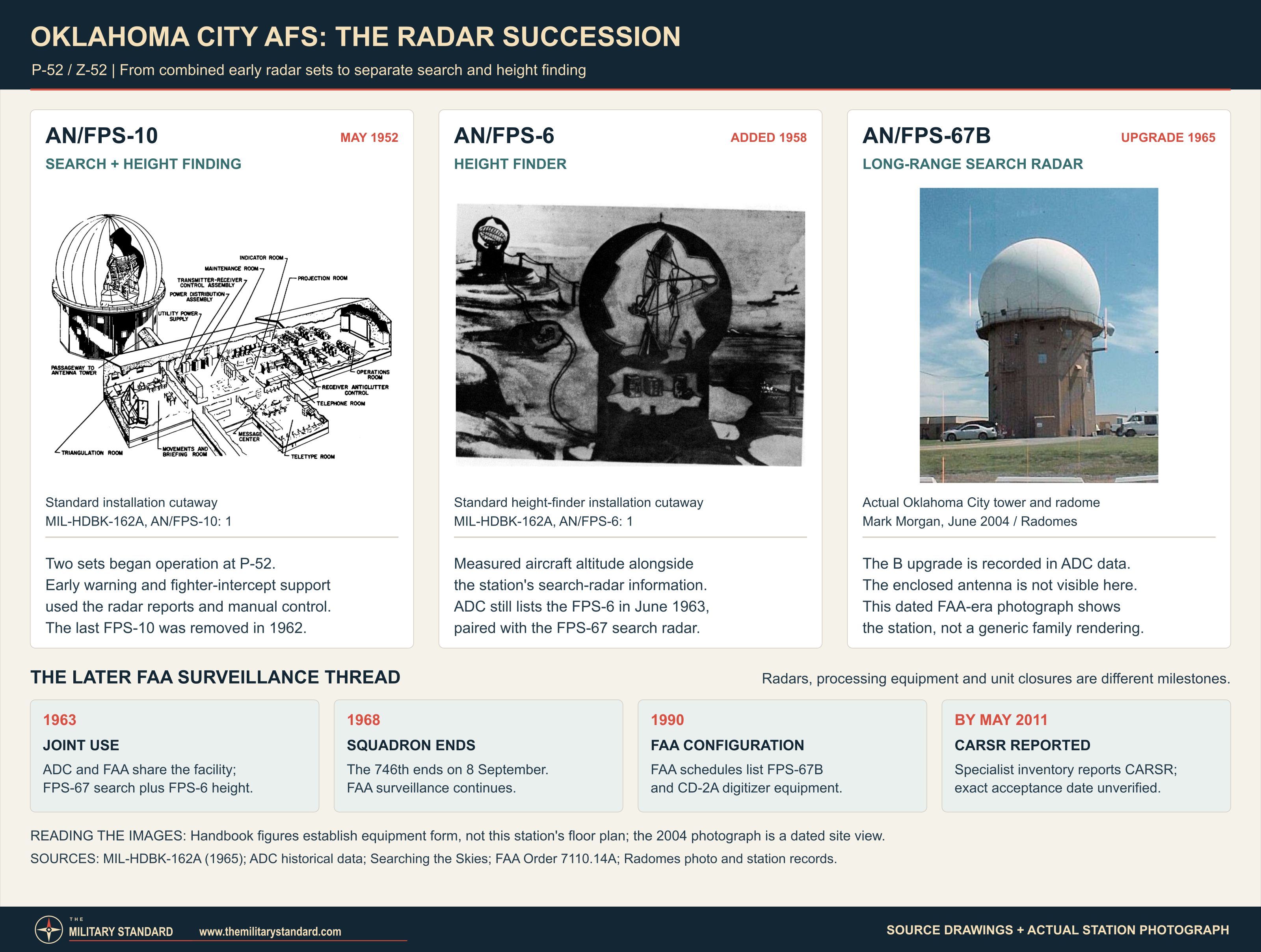
P-52's original radar complement consisted of two AN/FPS-10 sets. Searching the Skies records that configuration at the May 1952 operational opening. The station furnished aircraft surveillance and Ground-Control Intercept support, the latter involving the use of radar information to help direct fighters toward an interception. Radar operators, controllers, maintainers, and communications personnel performed different parts of that process. Identifying an aircraft on a display was only the beginning; usable information had to reach the organization responsible for evaluating the track and arranging an appropriate response.
The radar installation and the regional command center were complementary. P-52 supplied local sensor information, while P-86 assembled a broader air picture from reporting organizations across its command area. Their collocation reduced the physical separation between a radar station and a higher headquarters, but it did not make the local squadron identical to the air division or sector staff. A squadron assignment in a headquarters record can describe a command relationship with a distant radar station rather than the presence of that station's antenna or operating crew in Oklahoma City.
The equipment sequence is documented more securely than many of the individual construction dates. Searching the Skies states that an AN/FPS-6 height finder was added in 1958 and that the last AN/FPS-10 was removed in 1962. The original ADC equipment table independently lists AN/FPS-67 and AN/FPS-6 equipment for June 1963. Its matching continuation row records an AN/FPS-67B addition in 1965. The resulting picture is a transition from the early FPS-10 configuration to a separate long-range search radar and height-finding system.
Height finding was a distinct operational task. Search information established where an aircraft was in range and direction, while altitude information helped the controller understand the interception problem. The later combination of FPS-67-family search equipment and an FPS-6 height finder reflects that division of functions. The accompanying handbook cutaways show standard equipment forms, not a verified floor plan of Oklahoma City AFS. The dated station photograph shows the FPS-67B tower and radome without exposing its antenna.
In 1963 the installation became a joint Air Defense Command and Federal Aviation Agency radar facility. Shared use gave the search radar a civil air-traffic purpose as well as a military surveillance role. The name Federal Aviation Agency is appropriate to that period; the later Federal Aviation Administration name belongs to the subsequent organization. Joint use did not mean that every Air Force activity at the station transferred to the civil agency. The radar equipment, squadron, manual center, and headquarters continued to have distinct responsibilities and endings.
The 746th AC&W Squadron was discontinued on September 8, 1968. Both the organizational handbook and ADC equipment record support that date. It ended the local staffed ADC squadron, not all surveillance on the property and not the station's entire military life. The FAA successor retained a long-range radar role. The manual command organization remained in Oklahoma City into 1969, and the communications headquarters that followed used the installation into the 1980s. Describing Oklahoma City AFS as simply closing in 1968 loses those later mission layers.
Organizing the Wider Radar Network
Oklahoma City also acted as an organizing location for squadrons destined for other permanent stations. The handbook identifies the 732nd, 733rd, and 742nd AC&W Squadrons as activated at Oklahoma City AFS during 1956. They subsequently moved to Ozona, Eagle Pass, and Zapata Air Force Stations in Texas. The 732nd moved on July 25, 1957; the 733rd on July 3; and the 742nd on July 1. Those transfers connect headquarters activity at Oklahoma City to the expansion of the southern radar network.
ADC's location index additionally associates the 811th, 812th, 813th, 814th, and 815th squadrons with Oklahoma City. The index supports the broader organizational role, but it is not a detailed station occupancy roster or a complete movement narrative for each unit. Their presence in the record should not be turned into claims about eight additional antenna systems at P-52. A headquarters and organizing station could prepare new units, administer them, and dispatch them to their operating locations while its own resident squadron continued to run the local radar mission.
The distinction between units based temporarily at the station and radar units assigned to its headquarters is particularly important after 1960. The 746th's own assignment history passes through Oklahoma City Air Defense Sector, the 4752nd Air Defense Wing, the restored sector, and the 31st Air Division. Comparable assignment changes affected radar squadrons elsewhere. The station's importance was therefore partly organizational: it was a place where operational control and the administration of a distributed network were concentrated, even though much of the network's physical equipment stood elsewhere.
Manual Direction Center P-86 and MCC-11
P-86 was a manual regional control center, not a SAGE computer blockhouse. The Air Force's use of sector and division headquarters terminology can obscure that distinction. A command could participate in the larger air-defense structure and interact with SAGE-era organizations while continuing to use manual plotting at its own control center. The original ADC table leaves the local SAGE operational date blank. Neither a regional headquarters designation nor Searching the Skies' broad SAGE heading proves that an AN/FSQ-7 computer system was installed at Oklahoma City.
When the 33rd Air Division moved into the station in 1956, the headquarters role enlarged the site's responsibilities beyond local radar reporting. On January 1, 1960, the division moved to Richards-Gebaur, while Oklahoma City Air Defense Sector was activated at Oklahoma City AFS. The sector was transferred to the 32nd Air Division on July 1, 1961, and discontinued on September 1. The 32nd itself moved to Oklahoma City on August 1, 1961. The different dates reflect changes in higher headquarters and subordinate command arrangements, not the repeated construction of new stations.
The 4752nd Air Defense Wing appears in the intervening squadron assignment record. Oklahoma City Air Defense Sector was reactivated on June 25, 1963, under the 29th Air Division, and the 32nd's Oklahoma City period ended on September 4, 1963. The restored sector was discontinued on April 1, 1966, when the 31st Air Division was organized at the station. The manual center is identified in specialist histories as MCC-11 or a NORAD Sector Combat Center (Manual). These names describe the evolving control function within the existing installation.
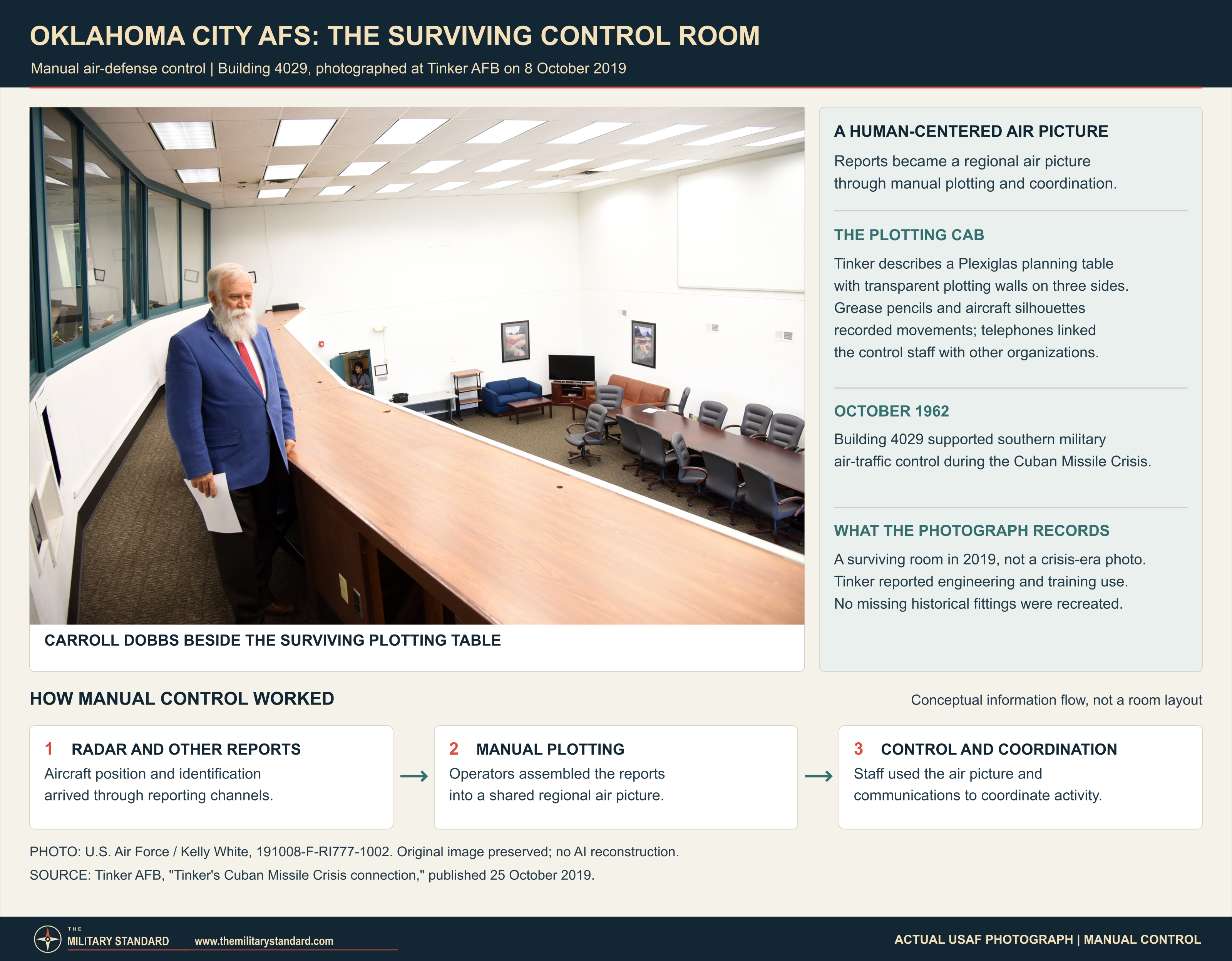
Tinker's 2019 account describes Building 4029's cab: a Plexiglas planning table with transparent plotting walls on three sides. Crews used grease pencils, aircraft silhouettes and telephones. Kelly White photographed Carroll Dobbs beside the surviving table in October 2019.
Cuban Missile Crisis
During the October 1962 Cuban Missile Crisis, Building 4029 supported southern military air-traffic control. Tinker's retrospective account connects the room, the 746th and the 32nd Air Division with the emergency, but supplies no daily logs or track totals.
The 32nd was an air division, not a bomber squadron, despite an erroneous description in the 2019 article. Its headquarters function must also be separated from the launch and employment of strategic aircraft. Oklahoma City's contribution was surveillance, identification, control, and coordination within the defense system. The surviving plotting room gives that abstract role a physical setting: human operators converted reports and communications into a regional picture during a national emergency. It is the strongest specifically documented episode in the station's air-defense operational history.
Staffing and the Headquarters Community
Federal personnel tables help establish the station's scale without relying on unsupported acreage. The Congressional Record of July 23, 1969, lists 376 military personnel at Oklahoma City AFS as of June 30, 1968. The column heading is explicit. It does not describe 376 acres, and Tinker is listed separately. This is a late air-defense-era staffing snapshot, taken before the 746th's September discontinuance. It should not be read as a lifetime maximum, a count of everyone under the division's command, or a measure of the station's land.
The Defense Department's September 30, 1976, distribution table lists Oklahoma City AFS with 567 personnel: 231 military and 336 civilian. Tinker again has its own entry. That later count belongs to the Southern Communications Area period and demonstrates the substantial civilian component of the headquarters workforce. The two tables do not establish a simple growth rate, because the earlier table counts military personnel while the later one includes civilians. Their value is in describing two dated organizational settings rather than manufacturing a numerical trend.
The available sources provide better evidence of technical work than of recreation, housing, or household life. Controllers and radar maintainers dominated the air-defense story; engineers, installation managers, supply personnel, administrators, and civilians became central to the communications mission. A complete station-specific inventory of barracks, family housing, clubs, medical facilities, and daily routines has not been recovered. Tinker's documented amenities cannot automatically be assigned to Area D. This limitation is preferable to describing a generic radar-station community as though every facility had been verified locally.
Communications Service Reuse, 1970-1981
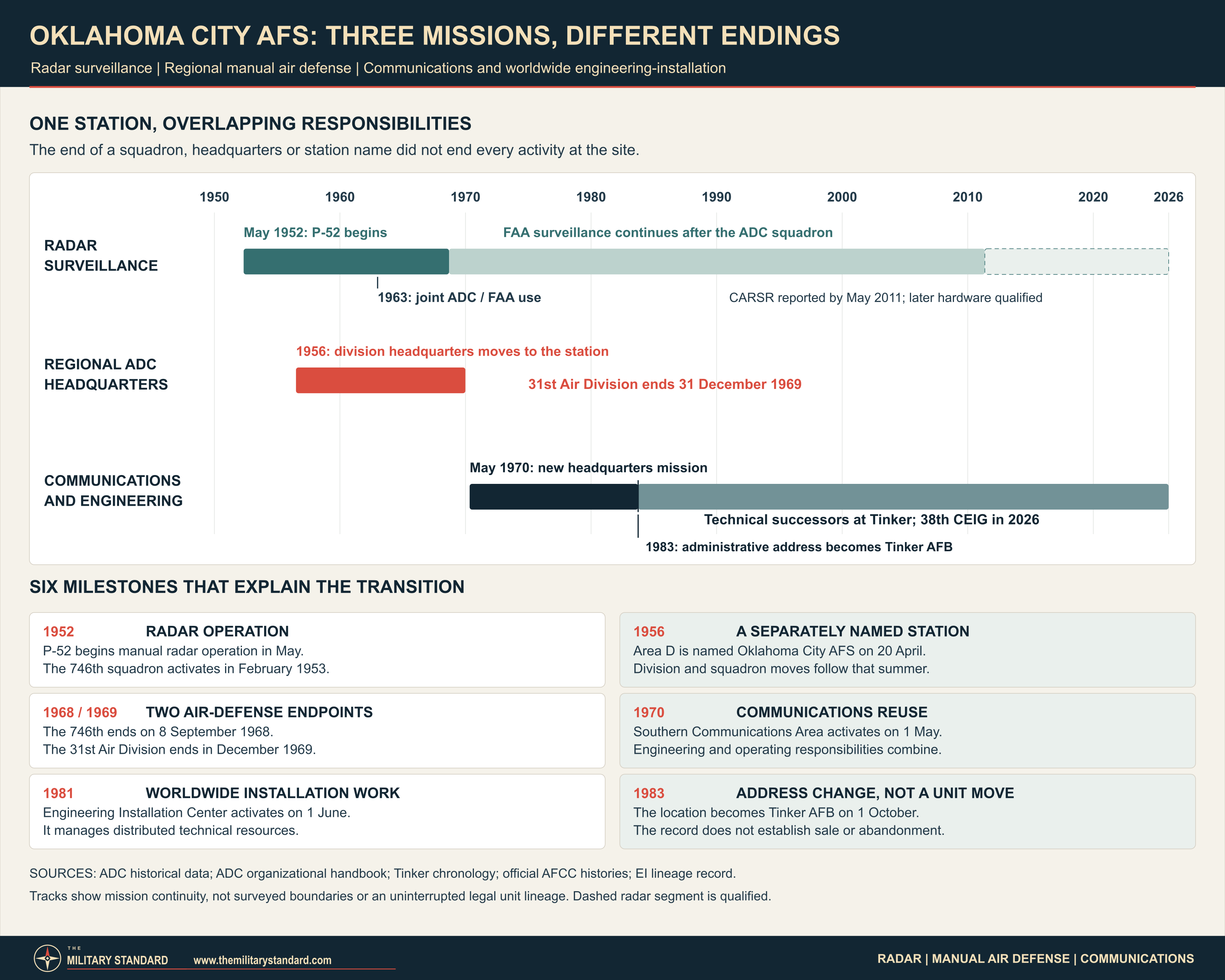
The 31st Air Division was inactivated on December 31, 1969. The station then acquired a new headquarters purpose rather than passing directly into abandonment. On May 1, 1970, Air Force Communications Service activated Southern Communications Area at Oklahoma City AFS. Both the official Tinker chronology and the two AFCC histories confirm the event. Northern Communications Area was headquartered at Griffiss AFB. The change replaced the earlier continental regional structure as AFCS absorbed the Ground Electronics Engineering Installation Agency's engineering and installation responsibilities.
The merger joined work that had previously been divided between operating communications equipment and designing or installing it. AFCS now handled engineering and installation in addition to communications-electronics, meteorological, and air-traffic equipment management, operation, and maintenance. Oklahoma City's former air-defense station became a headquarters for that expanded technical enterprise. The initial Southern Communications Area included 42 communications squadrons, four electronics installation squadrons, one electronics engineering group, and one electronics engineering squadron. These were distributed subordinate organizations, not 48 units physically crowded into the former radar station.
The official illustrated history connects the reorganization with reduced budgets and the search for centralized management. Modern communications systems increasingly required common standards rather than separate arrangements for each supported command. Oklahoma City's headquarters had to coordinate workload, installations, resources, and maintenance across a broad customer area. The station's continuing importance came from staff expertise and command communications, not from retaining the former radar squadron's mission. Tinker's logistical support remained useful while the technical headquarters addressed a different set of Air Force requirements.
A specific example of Southern Communications Area's work appears in the AFCC chronology for November 1, 1976. The area initiated a regionalization test in the San Antonio area, concentrating maintenance control, quality control, training management, and maintenance analysis under a communications group. Some work centers retained personnel on site because their customers needed immediate service; other work could be handled by dispatching technicians. This operational detail shows the headquarters trying to reconcile centralized management with local responsiveness, rather than merely appearing as another name in a lineage list.
By February 20, 1981, the organization was preparing for a different division of responsibilities. Northern Communications Area transferred engineering and installation management and units to Southern Communications Area, while most Southern operation-and-maintenance units went in the opposite direction. Exceptions remained for Military Airlift Command base units and the 1926th Communications Installation Group. The exchanges were preparation for the June reorganization. They show that the later Engineering Installation Center was created through a deliberate redistribution of functions, not simply by changing the sign outside a building.
Engineering Installation Center and Administrative Incorporation
On June 1, 1981, Southern Communications Area was inactivated and the Engineering Installation Center was activated at Oklahoma City AFS. Tinker's chronology names Colonel David B. Bartholomew as its first commander. The AFCC chronology explains that the center consolidated ten engineering and installation units and also received the 1842nd Electronics Engineering Group. The 1843rd Engineering Installation Group was formed through a Pacific reorganization and assigned to the center. The 1954th Radar Evaluation Squadron subsequently joined it. Organizational assignment did not relocate all those units to Oklahoma City.
The center's remit was wider than the former Southern Communications Area's geographic role. It centralized management of engineering and installation resources needed by Air Force customers worldwide. Programming, engineering, supply, and installation were interdependent: a requirement had to be defined, designed, provided with equipment, and implemented. The official illustrated history also records consolidation of communications-electronics installation equipment and associated management functions at Tinker. The headquarters and the supporting logistics base thus worked together, while the physical locations of overseas projects remained separate from the Oklahoma City campus.
The engineering-installation lineage compilation gives October 1, 1983, as the date the center's location changed from Oklahoma City AFS to Tinker AFB, explicitly calling it an address change without a unit move. This is the administrative endpoint used for the station's separate identity. It is not evidence that the headquarters staff moved across town, that every building was vacated, or that the government sold the former station. A cadastral transfer deed has not been reviewed, so the address record should be described as administrative incorporation rather than a complete legal account of property conveyance.
The center was designated primary alternate headquarters for AFCC on February 25, 1985, and redesignated Engineering Installation Division on March 1. The chronology separately states that it officially assumed the alternate-headquarters role on October 1. Those are successive steps, not conflicting dates requiring one to be discarded. On October 4-6, the division headquarters hosted the sixth annual Engineering and Installation Shootout competition, won by the 1827th Electronics Installation Squadron. The event adds a concrete training and professional-community episode to the post-radar history.
Programs and Post-Cold War Successors
The headquarters managed programs whose equipment could be far from Oklahoma. On October 25, 1983, AFCC designated the Engineering Installation Center program manager for Scope Signal II, IV, and V, efforts to consolidate and modernize high-frequency single-sideband facilities in different world regions. Funding reductions made the programs unexecutable, and they were abandoned in August 1985. A replacement effort, Scope Command, was planned. This documents both the center's international responsibilities and the limits imposed by budgets, without claiming that the radio facilities themselves stood on the former station property.
Other changes addressed the growing relationship between communications and data systems. The illustrated history identifies an office for local-area-network implementation within the engineering-installation organization in 1984. Its use of the later division title is retrospective; the formal redesignation did not occur until March 1985. During the October 1990 AFCC restructuring, much routine operation and maintenance responsibility went to supported bases, while engineering, installation, standards, integration, and interoperability remained central responsibilities. The Engineering Installation Division at Tinker was retained within that narrower technical structure.
The official group history records Engineering Installation Division becoming Communications Systems Center on October 1, 1991, entering Air Force Materiel Command in 1993, and being replaced by the 38th Engineering Installation Wing on November 8, 1994. The wing ended on February 4, 2000, with responsibilities concentrated in the 38th Engineering Installation Group. These changes continued the technical mission; they were not reopenings of an independent Oklahoma City AFS.
The later organization also participated in local and overseas emergencies. Tinker's retrospective account of the April 19, 1995, Oklahoma City bombing includes the 38th Engineering Installation Wing among the responding organizations. That contribution belongs to the successor community, not to an active 746th radar squadron. It should not absorb every action performed by Tinker into the former station's history. The source establishes participation in the larger base response, not a separate station-specific casualty list or rescue total.
By July 2009, official reporting described the 38th Engineering Installation Group providing engineering, contracting, acquisition, and wartime deployment support worldwide. It had supported coalition bases in Iraq, Afghanistan, and the Persian Gulf, assisted Iraqi air-force training, and improved infrastructure used in Operations Enduring Freedom and Iraqi Freedom. Its workforce was largely civilian but deployed overseas. The same account describes tools for tracking communications systems and making infrastructure diagrams available across installations. This illustrates how the former regional headquarters mission had developed into global technical support.
The group became the 38th Cyberspace Engineering Group effective August 18, 2009, and the 38th Cyberspace Engineering Installation Group on January 6, 2012. The later date also saw activation at Tinker of the 38th Engineering, Operations Support, and Contracting Squadrons. Their stated functions included engineering solutions, workforce and financial management, infrastructure planning, and contracts. The terminology changed with the Air Force's cyberspace organization, but the practical requirement remained recognizable: turn communications and network requirements into functioning infrastructure. A 2026 official Tinker leadership page still identifies 38th CEIG as a mission partner.
Detached Components and the Property Record
The 1957 directory lists Oklahoma City Transmitter Annex as installation number 4993, subordinate to the P-52/P-86 station and logistically supported by Tinker. That is adequate evidence for a distinct annex inventory identity. It is not adequate evidence for the annex's entire land area, operational dates, antenna arrangement, or later title history. The directory's coarse coordinates do not distinguish it precisely from the main station. A possible connection to a later training annex remains a research lead rather than a confirmed historical name or automatic physical-site merger.
The same directory lists Oklahoma City Air Defense Filter Center as installation number 3365 at 1300 North Harvey Avenue. Its separate urban address distinguishes it from P-86's collocated command function. The published latitude is inconsistent with the downtown address and has not been converted into an exact modern point. Its appearance in the inventory is not proof of a particular operating date or of every presumed Ground Observer Corps activity. A dedicated history is needed to resolve its staffing, procedures, lease or ownership interests, and surviving structure.
The main station's land record also requires caution. No reviewed station-estate source establishes its acreage. The 376 figure must remain a personnel statistic, while Tinker's multi-thousand-acre totals describe a much larger installation. Administrative incorporation likewise does not produce a verified historic polygon. Maps should identify known components, dated reference points, and uncertainties, rather than draw a precise former boundary from a convenient modern fence line. The radar point supplied above is useful for orientation but cannot represent every part of the headquarters station.
FAA Radar Continuity
FAA records document surveillance after the ADC squadron ended. Order 7110.14A's 1990 implementation schedules include Oklahoma City with an FPS-67B and CD-2A equipment in a three-level weather-display modernization program. This is evidence of a dated FAA configuration and planned technical work, not an installation acceptance certificate. A scheduled delivery day should not be turned into a confirmed commissioning event. It also should not be confused with the equipment used at the FAA's separate training facilities elsewhere in Oklahoma City.
Specialist inventories describe the former P-52 site as an active FAA long-range radar tied into the Joint Surveillance System and identify a Common Air Route Surveillance Radar, or CARSR, configuration. Radomes reports CARSR operation as of May 11, 2011. That is a reported in-service observation, not an independently checked contractual acceptance date. The reviewed current official material did not supply a site-specific hardware inventory establishing every component in September 2026. Historical continuity is well supported; the exact present equipment statement remains qualified to the specialist source.
Surviving Structures, Preservation and Environmental Context
The strongest documented survivor is Building 4029, reported in engineering and training use in 2019. That dated observation does not establish present visitor access or complete preservation of its historical fittings. The October 2020 B-21 depot environmental assessment lists 4029 among Tinker's individually National Register-eligible historic buildings.
Environmental records for Tinker must be kept at their stated geographical scope. Oklahoma DEQ identifies contamination associated with the industrial northeastern base, including Building 3001, the North Tank Area, and Pit Q-51. It records the July 22, 1987, National Priorities List entry and ongoing cleanup, describing contaminated-soil, tank, and groundwater remedies. Its cited protective-remedy review dates to 2007 and is not a fresh station-specific certification.
No original investigation or remediation report specifically defining the former Oklahoma City AFS estate was found in the material reviewed. The base-wide environmental context belongs in the record, but it does not prove contamination at the plotting room or a clean bill of health for the radar compound. Likewise, the continuing 38th CEIG mission at Tinker does not establish current occupancy of every former station building. Parcel-level conditions, an exact former boundary, and a comprehensive surviving-building inventory remain matters for additional archival or real-property research.
Historical Significance
Oklahoma City AFS illustrates how a technical military installation could survive the retirement of its original mission. It began with radar coverage and regional manual air defense, then supported a national emergency through the control room in Building 4029. Its radar-squadron, manual-command, and separate-installation identities ended at different times. Communications management and worldwide engineering-installation work provided continuing uses for the headquarters community. The FAA successor preserved another aspect of the site's surveillance role. Its significance lies in that documented succession, not in treating every activity at Tinker as part of one station.
Chronology
- 1951-03-19 The 33rd Air Division was activated at Tinker AFB.
- 1951-05-12 The 148th AC&W Squadron unit-history compilation places the mobilized unit at Tuttle, Oklahoma.
- 1951-08-15 The 148th AC&W Squadron moved to Tinker AFB according to its published stationing summary.
- 1952-05 ADC records manual radar operations at permanent site P-52; the initial equipment was two AN/FPS-10 sets.
- 1953-02-01 The 746th AC&W Squadron activated at Tinker; the 148th was relieved from active duty.
- 1956-04-20 Tinker's Area D was formally named Oklahoma City Air Force Station, a separate entity supported by Tinker.
- 1956 summer The 33rd Air Division moved its headquarters from Tinker to Oklahoma City AFS.
- 1956-07 ADC's stationing record places the 746th's move from Tinker to Oklahoma City AFS in this month.
- 1956 The 732nd, 733rd, and 742nd AC&W Squadrons activated at Oklahoma City AFS before moving to Texas stations.
- 1957-03-31 The USAF directory lists combined P52/P86 station PIN2253, transmitter annex PIN4993, and urban filter center PIN3365.
- 1957-07-01 The 742nd moved from Oklahoma City AFS to Zapata AFS.
- 1957-07-03 The 733rd moved to Eagle Pass AFS.
- 1957-07-25 The 732nd moved to Ozona AFS.
- 1958 An AN/FPS-6 height finder was added, according to Searching the Skies.
- 1960-01-01 Oklahoma City Air Defense Sector activated; the 33rd Air Division moved to Richards-Gebaur.
- 1961-07-01 Oklahoma City Air Defense Sector transferred to the 32nd Air Division.
- 1961-08-01 The 32nd Air Division moved to Oklahoma City AFS.
- 1961-09-01 Oklahoma City Air Defense Sector was discontinued; squadron assignments passed to the 4752nd Air Defense Wing.
- 1962 The last AN/FPS-10 was removed, according to Searching the Skies.
- 1962-10 Building 4029's manual combat-control room supported the southern military air-traffic response during the Cuban Missile Crisis.
- 1963 The radar site became a joint ADC and Federal Aviation Agency facility.
- 1963-06 ADC's equipment table lists AN/FPS-67 search and AN/FPS-6 height-finding equipment.
- 1963-06-25 Oklahoma City Air Defense Sector was reactivated under the 29th Air Division.
- 1963-09-04 The 32nd Air Division's Oklahoma City period ended.
- 1965 ADC's equipment table records the AN/FPS-67B upgrade.
- 1966-04-01 Oklahoma City Air Defense Sector ended and the 31st Air Division was organized at the station.
- 1968-06-30 A later federal table records 376 military personnel at Oklahoma City AFS on this date, not 376 acres.
- 1968-09-08 The 746th AC&W Squadron was discontinued; the FAA surveillance successor continued.
- 1969-12-31 The 31st Air Division was inactivated, ending the station's regional ADC headquarters era.
- 1970-05-01 Southern Communications Area activated at Oklahoma City AFS under Air Force Communications Service.
- 1976-09-30 The Defense Department records 567 station personnel: 231 military and 336 civilian.
- 1976-11-01 Southern Communications Area began a regionalized maintenance-management test in the San Antonio area.
- 1981-02-20 Engineering-installation and operation-and-maintenance responsibilities were redistributed between the continental communications areas ahead of reorganization.
- 1981-06-01 Engineering Installation Center activated at Oklahoma City AFS; Southern Communications Area was inactivated.
- 1983-10-01 The center's location changed administratively to Tinker AFB without a unit move, according to the lineage record.
- 1983-10-25 AFCC designated the center program manager for Scope Signal II, IV, and V.
- 1985-02-25 The center was designated AFCC's primary alternate headquarters.
- 1985-03-01 Engineering Installation Center was redesignated Engineering Installation Division.
- 1985-08 Funding reductions led to abandonment of Scope Signal II, IV, and V.
- 1985-10-01 Engineering Installation Division officially assumed the AFCC alternate-headquarters role.
- 1985-10-04 to 1985-10-06 The division headquarters hosted the sixth annual engineering-installation competition.
- 1987-07-22 Tinker entered the National Priorities List; this is base-wide environmental context, not a finding for the former AFS parcel.
- 1990 FAA weather-modernization schedules list Oklahoma City FPS-67B and CD-2A equipment.
- 1990-10-01 AFCC's restructuring retained the Engineering Installation Division at Tinker while shifting many routine operating responsibilities elsewhere.
- 1991-10-01 Engineering Installation Division became Communications Systems Center.
- 1993-10-01 Communications Systems Center entered Air Force Materiel Command.
- 1994-11-08 The 38th Engineering Installation Wing replaced Communications Systems Center.
- 1995-04-19 The wing participated in Tinker's response to the Oklahoma City bombing.
- 2000-02-04 The wing ended and engineering-installation responsibilities were concentrated in the 38th Engineering Installation Group.
- 2009-08-18 The group was redesignated 38th Cyberspace Engineering Group and reassigned to the developing cyberspace command structure.
- 2011-05-11 Radomes reports the FAA successor radar operating CARSR by this date; exact acceptance documentation was not reviewed.
- 2012-01-06 The organization became 38th CEIG; Engineering, Operations Support, and Contracting Squadrons activated at Tinker.
- 2019-10 Official photography and reporting document the former Building 4029 control room and plotting table in continuing use.
- 2020-10 Tinker's draft B-21 assessment identifies Building 4029 as individually National Register eligible.
- 2026 Current official Tinker leadership information continues to identify 38th CEIG as a mission partner; exact former-station parcel and radar hardware conditions remain qualified.
Information sources (24)
- PDFHistorical Data of the Aerospace Defense Command, 1946-1973
SOURCE FOR: Original P-52/Z-52 identity, May 1952 manual operation, 746th activation and movement, June 1963 equipment, 1965 FPS-67B, September 1968 discontinuance, and indexed organizing units; PDF pages 26, 37, 182-183.
- PDFA Handbook of Aerospace Defense Organization, 1946-1980, Cornett and Johnson
SOURCE FOR: Primary organizational account of the 33rd, 32nd, and 31st divisions, sector succession, 4752nd assignment, and 732nd/733rd/742nd/746th stationing; printed pages 55, 58, 100-101.
- PDFUSAF Installation Directory, March 31, 1957
SOURCE FOR: Contemporary single P52/P86 station PIN 2253, separate transmitter PIN 4993 and filter center PIN 3365, Tinker support, urban address and coarse coordinate limitations; printed page 30.
- PDFTinker AFB Chronology of Events
SOURCE FOR: Official April 20, 1956, naming of southeast Area D; May 1, 1970, SCA activation; June 1, 1981, EIC activation and first commander; printed pages 10, 17, 24. Supplied PDF reviewed at relevant entries.
- PDFSearching the Skies: The Legacy of the United States Cold War Defense Radar Program, David F. Winkler
SOURCE FOR: Official retrospective radar sequence, FPS-10 pair, FPS-6 addition in 1958, FPS-10 removal in 1962, joint use in 1963; printed page 148. Early squadron attribution reconciled against original ADC lineage.
- PDF148 Aircraft Control and Warning Squadron, USAF Unit Histories compilation
SOURCE FOR: Published predecessor unit's Tuttle/Tinker stationing and February 1953 release; PDF page 1. Secondary lineage compilation, not an original station-establishment order.
- PDFCongressional Record, July 23, 1969, Major Domestic Military Installations
SOURCE FOR: Original column heading identifies 376 as military personnel on June 30, 1968, not acreage; Tinker independently listed; printed page 20507, PDF page 64.
- PDFDepartment of Defense, Distribution of Personnel by State and Selected Locations, September 30, 1976
SOURCE FOR: Original Oklahoma City AFS staffing: 567 total, 231 military, 336 civilian; separate Tinker entry; printed page 48, PDF page 53, visually checked because OCR is unreliable.
- PDFAir Force Communications Command 1938-1991: An Illustrated History
SOURCE FOR: AFCS/GEEIA merger, SCA composition, 1981 EIC and Tinker equipment consolidation, LAN office, Scope Signal and 1990 restructuring; printed pages 142, 149-150, 210, 225, 261. Supplied PDF reviewed in relevant sections.
- PDFA Window to the Future: Air Force Communications Command Chronology, 1938-1988
SOURCE FOR: 1970 reorganization, 1976 regionalization, 1981 functional exchanges and EIC composition, 1985 alternate-headquarters designation and assumption, competition; printed pages 75, 81, 95-97, 109, 115. Supplied PDF reviewed at relevant entries.
- PDFEngineering Installation Division, USAF Unit Histories compilation
SOURCE FOR: October 1, 1983, address change without a unit move and March 1985 redesignation; PDF page 2, corroborated where possible by supplied official AFCC histories.
- WEBTinker's Cuban Missile Crisis connection, Tinker AFB, October 25, 2019
SOURCE FOR: Manual plotting, crisis role, 2019 reuse and Kelly White photograph; unit error corrected against primary records.
- WEB38th Cyberspace Engineering Installation Group, Tinker AFB fact sheet, current as of March 2018
SOURCE FOR: Dated 1991-2012 successor sequence; obsolete command chain and workforce totals excluded.
- WEB38th CEIG stands up three new Tinker squadrons, January 19, 2012
SOURCE FOR: January 6 activation of Engineering, Operations Support and Contracting Squadrons and their functional responsibilities.
- WEBCol. Cotts takes over at 38th EIG, Tinker AFB, July 10, 2009
SOURCE FOR: Dated worldwide engineering, acquisition and deployment role, coalition support, Iraqi training, operational infrastructure and largely civilian workforce.
- WEBTinker recalls the OKC bombing 25 years later, April 18, 2020
SOURCE FOR: Explicit 38th Engineering Installation Wing participation in the April 1995 base-wide emergency response; unrelated Tinker actions not assigned automatically to AFS.
- PDFFAA Order 7110.14A, Three Level Weather for ARTCC Displays Project Implementation Plan, 1990
SOURCE FOR: Original dated Oklahoma City FPS-67B/CD-2A configuration and planned weather-modernization schedules; not an acceptance certificate.
- WEBFortWiki, Oklahoma City Air Force Station
SOURCE FOR: Qualified secondary MCC-11 nomenclature and representative radar-site coordinate 35.4024, -97.35874. Early establishment/unit claims conflict with original records and are not adopted.
- WEBRadomes, Oklahoma City AFS station record
SOURCE FOR: Qualified specialist report of FAA/JSS continuity and CARSR operation as of May 11, 2011; not official 2026 hardware verification.
- WEBOklahoma DEQ, Tinker Air Force Base Superfund Site
SOURCE FOR: Base-wide industrial cleanup scope, Building 3001, North Tank Area, Pit Q-51, NPL date, remedies and dated review; explicitly not station-specific contamination or acreage.
- PDFDraft Environmental Assessment for B-21 Depot Maintenance Activation, Tinker AFB, October 2020
SOURCE FOR: Official architectural-resources section, printed page 3-73, PDF page 111, identifying Building 4029 as individually NRHP eligible. Relevant text reviewed; full PDF download and map rendering blocked, so no unseen-map conclusions used.
- WEBChief Master Sergeant Malcolm O. Summers II, Tinker AFB official leadership biography
SOURCE FOR: Current 2026 installation-support context listing 38th CEIG as a mission partner; not per-building occupancy or local radar hardware.
- PDFMIL-HDBK-162A, Volume 1, Electronic Equipment Descriptions, 15 December 1965
SOURCE FOR: Original AN/FPS-10 combined search/height-finding installation cutaway and AN/FPS-6 height-finder illustration reproduced in the equipment graphic; supplied PDF pages 98 and 86, sheets AN/FPS-10: 1 and AN/FPS-6: 1. These are standard-equipment references, not a station-specific floor plan.
- WEBOklahoma City AFS recent photographs, Radomes, June 2004 contribution by Mark Morgan
SOURCE FOR: Identity, date, credit and south-looking caption of the actual FAA FPS-67B tower/radome photograph reproduced in the equipment graphic. The antenna is concealed. Attribution does not establish a reproduction license.