Nike Missile Site BU-34/35 IFC #1, Orchard Park / Aurora New York
Longitude: -78.6986950352771
This location was part of the Niagara Falls-Buffalo Defense Area
Site ID: BU-34/35
Missile / battery configuration: Nike 2B,4C/60A/24L-AA
This site controlled the missiles at the Launch Area located here.
Site Role: IFC #1
A typical Nike air defense site consisted of two separate parcels of land. One area was known as the Integrated Fire Control (IFC) Area. This site contained the Nike system's ground-based radar and computer systems designed to detect and track hostile aircraft, and to guide the missiles to their targets.
The second parcel of land was known as the Launcher Area. At the launcher area, Nike missiles were stored horizontally within heavily constructed underground missile magazines. A large, missile elevator brought the Nikes to the surface of the site where they would be pushed across twin steel rails to one of four satellite launchers.
Elaboration on how Nike worked here.
Missile Type: Ajax
The Nike Ajax was the first in the Army's family of guided missiles, and the world's first operational, guided, surface-to-air missile system. Nike Ajax had a burnout speed of Mach 2.3, a range of 25-30 miles, and a ceiling of 65,000 feet.
Designed to carry either nuclear and/or high-explosive warheads, the Nike Hercules missile could attack supersonic aircraft operating at altitudes in excess of 150,000 feet and at a range of more than 87 miles.
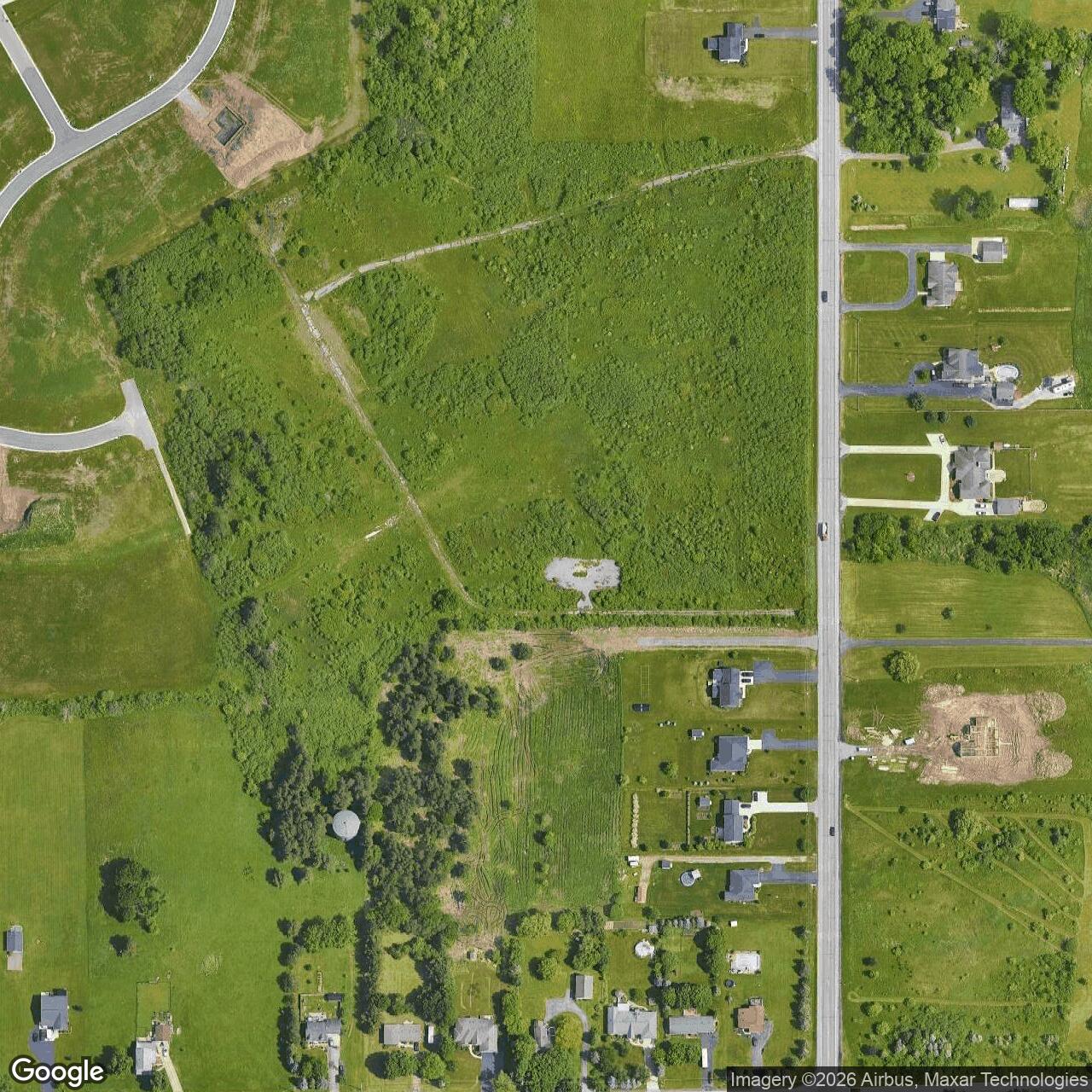
BU-34/35 was built to put twice the usual Ajax firepower on Buffalo's southeastern flank. Hidden among the roads, fields, and wooded ground between Orchard Park and Aurora, the installation was not one ordinary Nike battery. It was a dual site. Two fire-control sections directed a shared, double-capacity launch complex containing six underground missile magazines and twenty-four launchers.
That scale made BU-34/35 one of the most substantial early Nike positions in western New York. It also gave the site a distinctive operational history. Regular Army soldiers opened it in the final weeks of 1956. A second Regular Army organization inherited it in 1958. In 1960, two New York Army National Guard batteries took over the paired position. Yet BU-34/35 never received Nike Hercules. It remained committed to the liquid-fueled, conventionally armed Nike Ajax until the Army retired the site during the regional contraction of 1962-1963.
Today, the two halves of BU-34/35 tell very different afterlives. The Orchard Park control property passed into state-affiliated health research use and was eventually cleared of its military buildings. The Aurora launch property retained its massive underground magazines for decades, but environmental work between 2016 and 2019 ended with all six missile magazines demolished and removed. The place that once held sixty guided missiles now survives primarily through its access roads, altered terrain, government records, and the paired site code BU-34/35.
Location and the Split Installation
BU-34/35 occupied two separate properties southeast of Buffalo in Erie County. The Integrated Fire Control, or IFC, property was in Orchard Park near the Windyshire Road area. The launch property was farther southeast in the Town of Aurora near Willardshire Road. The separation gave the fire-control radars a useful tracking baseline and kept the missile storage and launch operations away from the radar, administration, and command compound.The U.S. Army Corps of Engineers later described the former control property as approximately twenty-six acres. It held the radar and computer systems required to detect, track, and engage aircraft. The former launch property covered approximately nineteen acres. It contained the barracks area, missile assembly and service facilities, utilities, and six underground missile storage and launching structures.
This was not simply one site divided into an office area and a firing area. The paired designation reflected a dual installation. The Orchard Park control property supported two fire-control sections associated with the BU-34 and BU-35 identities, while the Aurora launch property was constructed at twice the capacity of a standard Ajax battery.
Why This Sector Mattered
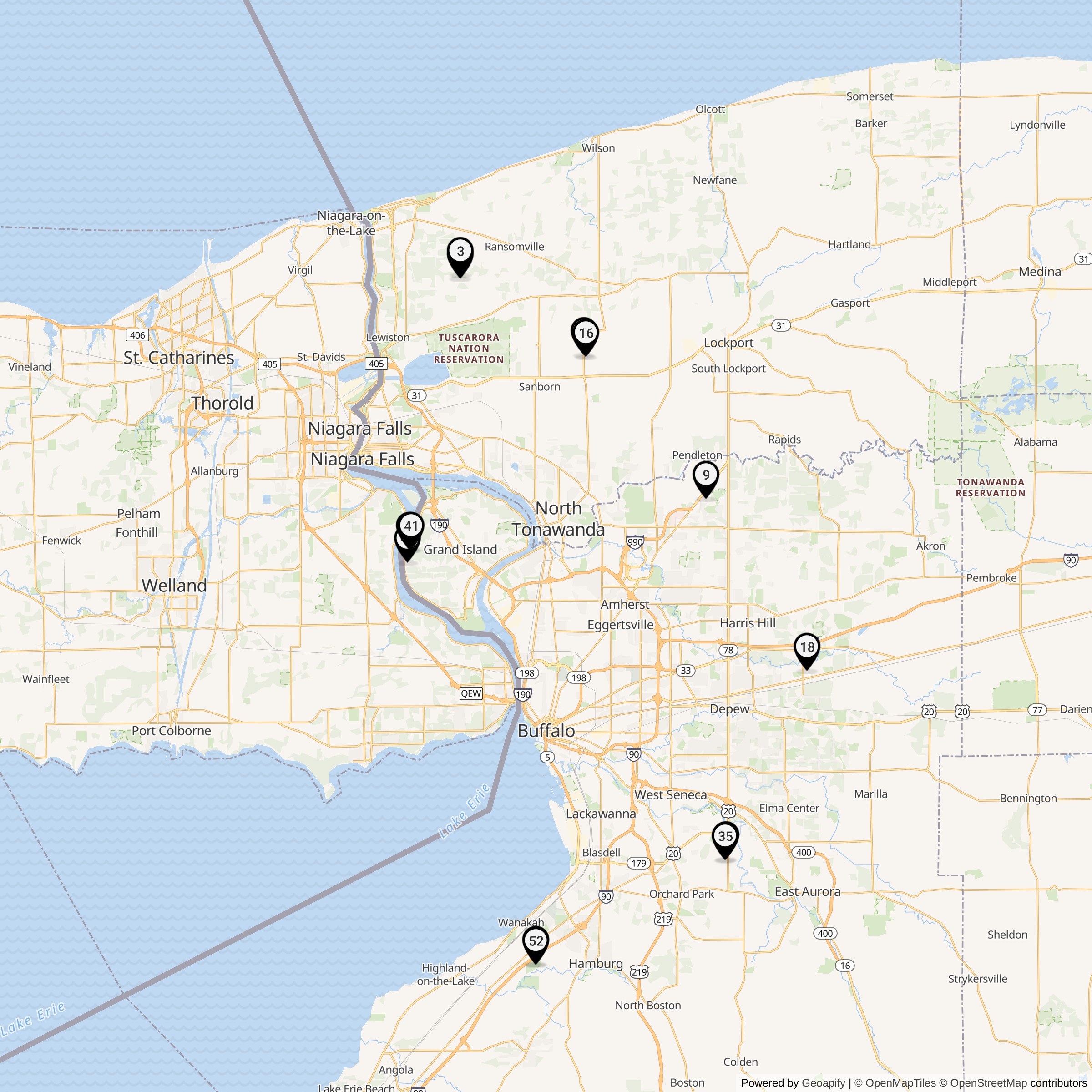
Buffalo's Cold War importance extended far beyond its population. The city and its suburbs formed a Great Lakes transportation and industrial center, linked to steel production, grain handling, railroads, highways, manufacturing, and the Niagara power region. In an era when military planners expected Soviet bombers to approach across northern routes, western New York sat inside a strategic corridor leading toward major industrial targets in the Northeast.BU-34/35 occupied the southeastern portion of the Buffalo defense ring. BU-09 covered the northeastern side of the city, BU-18 operated east of Buffalo, and BU-52 stood south of the city near Hamburg. The Orchard Park and Aurora battery filled a critical sector between the eastern and southern sites. Its dual layout added firepower where planners wanted dense overlapping coverage rather than a single standard battery.
The site also complemented the separate Niagara Falls defense network to the north. Before the Buffalo and Niagara Falls areas were merged in December 1961, the two groups protected related but distinct concentrations of population, industry, transportation, and electric-power infrastructure. BU-34/35 belonged to the Buffalo side of that regional shield.
Construction and Opening
Army construction records summarized by the U.S. Army Corps of Engineers place construction of the launch equipment and facilities between December 1955 and January 1957. Contemporary unit-history material shows that the Army was already moving troops into the completed Orchard Park position before the end of 1956.The 465th Antiaircraft Artillery Missile Battalion activated at Fort Niagara on 1956-06-01. Its batteries left Fort Niagara in stages as the new Buffalo-area Nike sites became ready. Battery C was assigned to BU-34/35. A contemporary Niagara Falls Gazette report stated that the battery would move into the dual Orchard Park Nike Ajax facility on 1956-11-27 under Captain Hames M. Elder.
This evidence explains the slight date variation found in later summaries. The site was occupied and entering service in November 1956, while the Corps of Engineers describes the launch property's period of use as January 1957 through March 1963. The difference likely reflects the transition from military occupancy and acceptance to fully documented operational use.
Site Configuration and Decoded Meaning
The recorded configuration for BU-34/35 is Nike 2B,4C/60A/24L-AA.Decoded in plain English, the launch area had two B-type underground missile magazines and four C-type underground magazines. Together, the six magazines supported a nominal load of sixty Nike Ajax missiles. The launch area had twenty-four Ajax launchers. The final AA identifies a double Ajax launcher arrangement associated with a dual battery site.
The magazine letters describe the underground structures and elevator designs. The C magazine was the original Ajax-only type. The B magazine could hold Ajax and could be modified to handle the larger Hercules launcher, although BU-34/35 was never converted. At this site, all six magazines served the Ajax mission throughout the operational period.
The numbers show why BU-34/35 should not be interpreted as a routine single battery. A standard Ajax site generally had thirty missiles and twelve launchers. BU-34/35 doubled both figures. Its two B magazines, four C magazines, sixty-missile authorization, and twenty-four launchers made it a full double site.
The U.S. Army Corps of Engineers used the word silos for the six underground structures. In Nike terminology, they are more accurately described as underground magazines with elevators. Missiles were stored horizontally below ground, raised to the surface, moved or positioned on launchers, and prepared for firing. They were not vertical ballistic-missile silos.
The Six-Magazine Launch Area
The Aurora launch area was the physical center of BU-34/35's unusual capacity. The Corps of Engineers described each underground structure as approximately sixty feet by sixty feet. The tops lay about three feet below the surrounding surface, while the floors were approximately sixteen feet below grade.In addition to the magazines and launch positions, the compound included barracks, a missile assembly building, an acid mixing and wash-rack area, a generator building, a diesel-fuel underground storage tank, water facilities, sanitary systems, security features, and the roads needed to move personnel and equipment around the installation.
Ajax missiles required more hands-on servicing than the later solid-fueled Hercules. The missile's liquid sustainer used hazardous propellants, and the launch area needed specialized areas for assembly, testing, fueling-related support, washing, maintenance, and safe handling. The acid mixing and wash-rack area documented at BU-34/35 is therefore not a generic detail. It is a physical signature of the Ajax mission.
The dual battery arrangement also demanded more people, equipment, and coordination than a single site. Two firing elements depended on the same expanded launch property. Launcher crews had to maintain readiness across twenty-four positions while magazine crews cared for a sixty-missile inventory.
The Two Fire-Control Sections
The Orchard Park control property was the eyes and brain of BU-34/35. Each Nike firing section required acquisition and tracking radars, identification and communications equipment, and a fire-control computer. The paired site designation and two IFC component locations reflect the dual arrangement.The acquisition radar searched for aircraft and presented potential targets. Once an engagement was authorized, the Target Tracking Radar followed the aircraft while the Missile Tracking Radar followed the outbound Nike Ajax. The ground-based computer compared the two tracks, calculated steering corrections, and transmitted commands to the missile. At the proper intercept point, the system issued the burst command.
Because Ajax used command guidance, the missile could not complete its mission independently. The radar and computer sections had to maintain accurate tracks for both target and missile throughout the engagement. A failure at the IFC could make the entire twenty-four-launcher complex ineffective. That dependence explains why Nike sites invested so heavily in radar calibration, electronics maintenance, generator reliability, communications, and operator training.
Regular Army Operations
Battery C of the 465th Antiaircraft Artillery Missile Battalion opened BU-34/35. The battalion had been activated to man the four Buffalo-area Nike positions at Millersport, Lancaster, Orchard Park, and Hamburg. Its movement into local communities was treated as a major civic event because hundreds of soldiers and their families were becoming part of suburban western New York.Captain Hames M. Elder was identified as the Orchard Park battery commander when Battery C moved into the site in November 1956. The unit's mission was continuous readiness. Radar crews watched assigned airspace, launcher crews maintained missiles and launchers, and maintenance personnel kept the two separated compounds linked as one weapon system.
On 1958-09-01, the 465th was inactivated and its Buffalo mission passed through the Army's Combat Arms Regimental System reorganization. BU-34/35 became Battery C, 2nd Missile Battalion, 62nd Artillery. The personnel and site mission continued even though the unit title changed.
The new battalion took its Ajax batteries to Red Canyon, New Mexico, for Short Notice Annual Proficiency exercises. A November 1958 report described the 2nd Missile Battalion, 62nd Artillery departing for Red Canyon to fire Nike Ajax missiles at radio-controlled targets. For the Orchard Park crew, this meant proving that the skills practiced daily in Erie County could produce an actual missile intercept at a firing range.
Transfer to the New York Army National Guard
BU-34/35 became one of the first Niagara-Buffalo Nike positions transferred from the Regular Army to the New York Army National Guard. In August 1960, the 2nd Missile Battalion, 106th Artillery, NYARNG assumed control of the Orchard Park dual site. Two Guard firing batteries were assigned, Battery A and Battery D.That two-battery assignment matched the site's physical design. BU-34/35 was not merely a large stockpile operated by one ordinary battery. It was a dual combat position capable of supporting two firing elements. The Guard inherited both the operational responsibility and the burden of keeping a large Ajax complex ready around the clock.
The National Guard Nike system combined full-time and traditional Guard service. Full-time technicians maintained security, equipment, communications, and daily readiness. Other Guardsmen trained regularly and were expected to report rapidly when alerted. This community-based model placed part of the active continental air-defense mission in the hands of soldiers who also lived and worked in western New York.
On 1962-05-01, the 106th Artillery organization was redesignated as the 2nd Missile Battalion, 209th Artillery, NYARNG. The unit name changed, but Batteries A and D remained associated with the Orchard Park dual site through its final period.
Why BU-34/35 Was Not Converted to Hercules
The paired site's B magazines gave it some theoretical adaptability, but BU-34/35 was not converted to Hercules. That distinction matters because some later popular accounts have incorrectly associated Hercules with the Orchard Park site.Official inventories and the regional unit history identify BU-34/35 as Ajax-only. The three western New York batteries converted to Hercules were BU-18 at Lancaster, NF-16 at Cambria, and NF-41 on Grand Island. Those three sites formed the reduced Niagara-Buffalo Hercules ring.
Several factors worked against converting BU-34/35. Four of its six magazines were C-type, the original Ajax-only design. A conversion would also have required changes to launchers, handling equipment, radar and fire-control systems, security, and nuclear-capable operational procedures. By 1960, the Army was already preparing to close many Ajax sites and concentrate the regional mission at fewer Hercules positions.
As a result, BU-34/35's impressive size did not guarantee longevity. The Army preferred a smaller number of longer-range Hercules sites over the older double-capacity Ajax installation.
Role in the Wider Military Network
BU-34/35 operated as one element in a layered continental air-defense system. At the local level, its coverage overlapped with other Buffalo-area Nike batteries. At the regional level, higher headquarters coordinated the Buffalo and Niagara Falls sites so that target assignments could be distributed and multiple batteries would not waste missiles on the same aircraft.Fort Niagara initially served as the principal Army command location for the Niagara frontier. In 1961, the regional Army Air Defense Command Post moved to Lockport Air Force Station. Missile Master and later BIRDIE equipment linked Army missile operations to the wider radar picture and helped coordinate the Nike batteries with Air Force warning and interceptor systems.
BU-34/35 also depended on regional maintenance and supply support. The Combined Field Maintenance Shop at the Niagara Falls U.S. Army Support Center assisted the Niagara-Buffalo Nike sites. This larger network supplied specialized parts and expertise that could not be duplicated at every battery.
The site therefore functioned on several levels at once. It was a local military installation in Orchard Park and Aurora, a Buffalo-sector firing unit, a component of the Niagara-Buffalo defense area, and a terminal weapon in the North American air-defense system.
Closure and the Conflicting Dates
Official Department of Defense inventory material and the U.S. Army Corps of Engineers give March 1963 as the end of BU-34/35's active service or use. Regional unit-history tables also show the National Guard assignment continuing to March 1963.Another entry in the same regional history states that Batteries A and D closed the Orchard Park site in October 1962. The most reasonable interpretation is that the firing batteries stood down or ceased operational alert in October 1962, while formal deactivation, property processing, or the documented Army-use period continued into March 1963.
The closure came during the rapid retirement of Ajax sites across the country. The Soviet threat was shifting from bomber attack toward ballistic missiles, while the Army's remaining bomber-defense mission was being concentrated at selected Hercules sites. BU-34/35 had served for only about six years, but in that brief period it passed through three unit identities and from Regular Army to National Guard operation.
Post-Military Use of the Control Area
The control area's post-Army operations created their own environmental issues. Health Research Incorporated conducted investigations and cleanup actions from 1991 through 2002 to address conditions associated with its use of the property after transfer. The Corps of Engineers distinguished those later issues from the former Army mission and concluded that Department of Defense activities at the control area did not leave an unacceptable risk to human health or the environment.The former military buildings were eventually demolished. Later site surveys describe the control area as open or abandoned ground with the old access road providing one of the clearest surviving clues to its original layout. The radar towers, operations buildings, and administrative structures that once made the IFC recognizable are no longer known to survive.
Post-Military Use of the Launch Area
The Aurora launch property was transferred to the estate of Marjorie K. C. Klopp after Army use. The Corps of Engineers reported Waterhill Evergreen Holdings, LLC as the owner in its 2019 public documents.For a time, the former enlisted men's barracks and bachelor officers' quarters remained in use. Those buildings were later razed by the property owner. The underground magazines, however, remained a far more difficult legacy. Their reinforced-concrete construction and below-grade position preserved them long after most surface features disappeared.
Environmental evaluations began in 1988. A limited remedial investigation followed in 1995, including work on groundwater and water that had accumulated in the former magazines. Later inspections found the underground spaces water-filled, requiring drainage and confined-space precautions before structural observations could be made.
From 2016 through 2019, the Corps of Engineers conducted a broader remedial investigation and closure program. The work included soil and groundwater sampling, removal of an approximately 8,000-gallon diesel underground storage tank, closure of the septic tank, and closure of all six former missile magazines.
The final action was decisive. After sampling and risk assessment, the six underground magazines were demolished and removed, and clean topsoil was placed over the affected area. Unlike many Nike launch sites where the magazine slabs and doors remain visible, BU-34/35 lost the core of its launch architecture during the environmental closure.
The 2020 No Further Action Decision
In 2020, the U.S. Army Corps of Engineers finalized its decision for the former BU-34/35 control and launch properties. The Corps concluded that no unacceptable risks from historic Department of Defense activities remained. The New York State Department of Environmental Conservation and Department of Health concurred.The resulting decision was No Further Action for the former DoD activities at both properties. USACE also stated that future use of the properties was unrestricted from the standpoint of the investigated military contamination.
That decision does not mean the site was preserved. In fact, the environmental work removed its most important surviving launch structures. It means that the military environmental case was closed after investigation, removal, demolition, and risk review.
Current Condition and Access
The Orchard Park control area is largely cleared. The access-road pattern is more legible than the former radar and operations structures. Because the property has had post-military institutional ownership and use, current access should not be assumed.The Aurora launch area is privately owned. The barracks and quarters have been razed, and the six underground magazines were demolished and removed during the 2016-2019 closure work. The former launch landscape has been substantially altered and is not a public museum or interpreted historic site.
Chronology
- 1955-12 Construction began on the expanded Orchard Park and Aurora dual Ajax installation.
- 1956-11-27 Battery C, 465th Antiaircraft Artillery Missile Battalion, moved into the dual Orchard Park site under Captain Hames M. Elder.
- 1957-01 The documented construction period for the launcher facilities reached completion.
- 1958-09-01 Battery C became part of the 2nd Missile Battalion, 62nd Artillery.
- 1960-08 Batteries A and D of the 2nd Missile Battalion, 106th Artillery, New York Army National Guard, assumed the paired site.
- 1962-05-01 The Guard organization was redesignated as the 2nd Missile Battalion, 209th Artillery.
- 1962-10 Unit-history evidence indicates that the two Guard firing batteries stood down or ceased normal operational alert.
- 1963-03 Formal Army use and the recognized service period ended.
- 1991-2002 Health Research Incorporated investigated and addressed environmental conditions associated with its post-military use of the former control property.
- 2016-2019 The Army Corps of Engineers removed an underground fuel tank, investigated soil and groundwater, and demolished and removed all six underground missile magazines at the launch property.
- 2020 The federal decision document selected No Further Action for the investigated former Department of Defense activities.
List of all Nike Installations in the Niagara Falls-Buffalo Defense Area
List of all Nike Installations in New York