
Adak Naval Operating Base / Naval Air Facility Adak, Alaska
A wartime harbor and aviation base became a Cold War center for maritime patrols in the North Pacific.
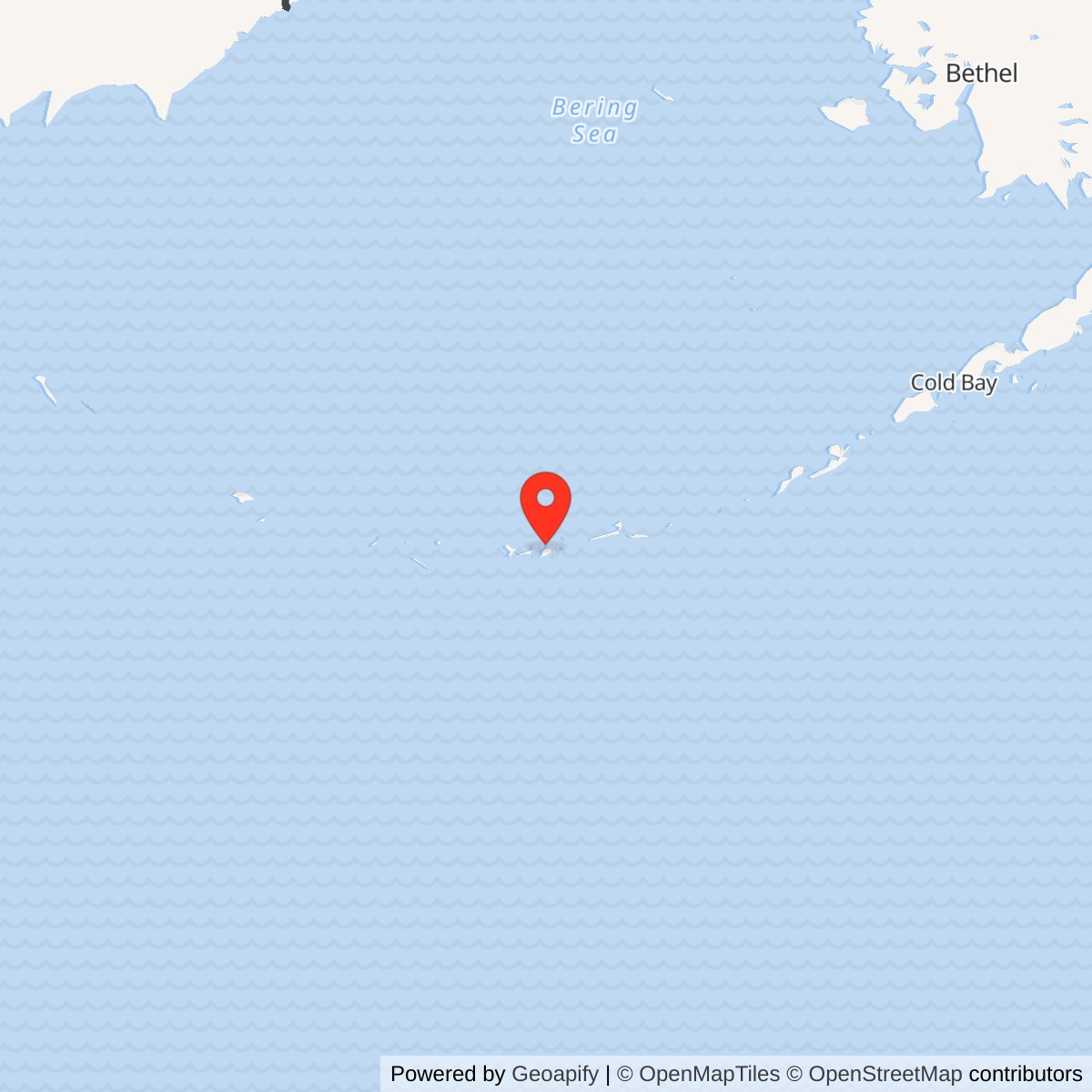
Longitude: -176.6425
Current Role: Civilian Adak Airport, port, community and mixed reuse on former base lands; Navy environmental restoration continues.
- Naval role
- Fleet support, maritime patrol, antisubmarine operations and shore services
- Initial naval development
- 1942, alongside the Army base
- Naval Air Station established
- May 15, 1943
- Naval Operating Base established
- July 14, 1943
- Principal wartime builders
- 32nd Naval Construction Battalion and other Seabee units
- Wartime naval runways
- 5,277 x 200 feet and 7,145 x 200 feet at Mitchell Field
- Seaplane waters
- Andrew Lake and Clam Lagoon
- Small-craft repair
- 100- and 400-ton pontoon drydocks
- Patrol aircraft
- PBY Catalina, PV-1 Ventura, P2V Neptune and P-3 Orion
- Later name changes
- Naval Air Station, 1984; Naval Air Facility, July 1, 1994
- Mission closure
- March 31, 1997
- Location
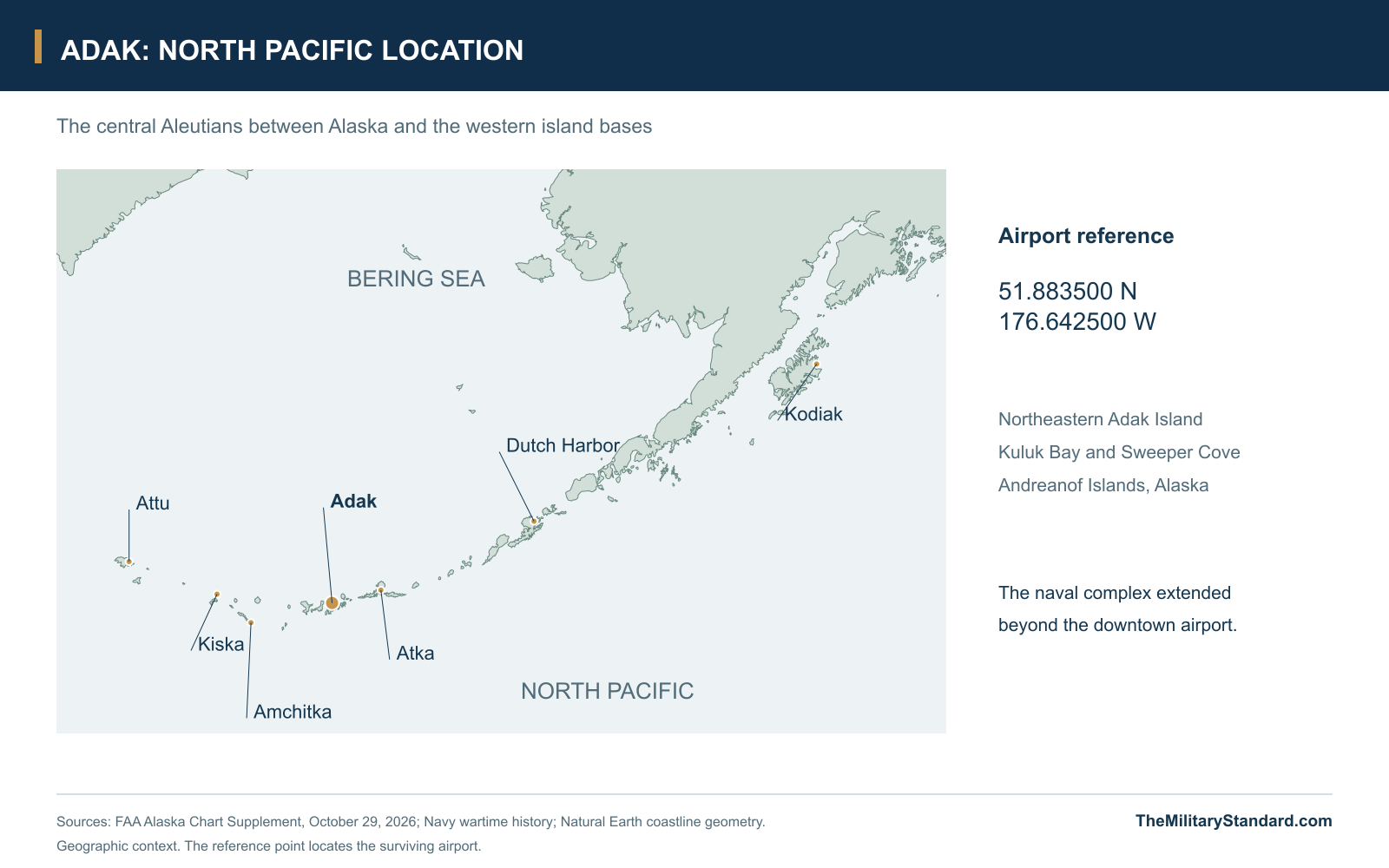
- Northeastern Adak Island, Andreanof Islands, Alaska
- Latitude / longitude
- 51.883500 N, 176.642500 W; present airport reference point
A Naval Base in the Central Aleutians
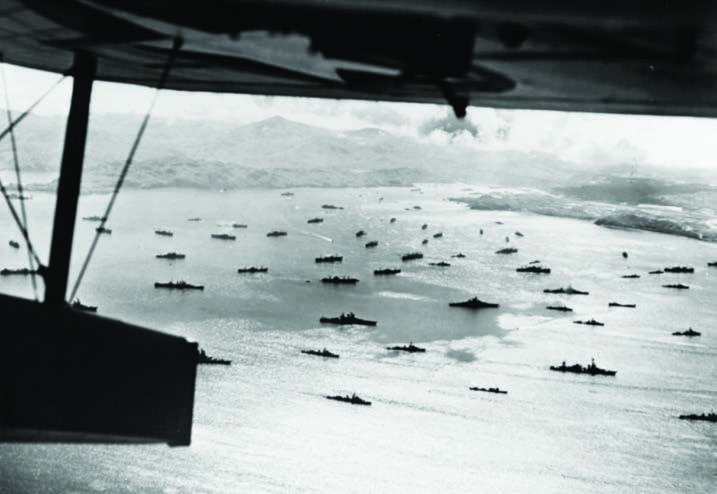
Adak Naval Operating Base brought together air patrols, fleet support and shore services on northeastern Adak Island in the Andreanof group of the Aleutians. Kuluk Bay provided an anchorage, Sweeper Cove became a working harbor, and flying facilities connected the island with bases to the east and the war zone farther west. After World War II, Adak remained useful because aircraft operating from the island could watch the North Pacific approaches and support forces far from the continental United States. [1] [3] [12]
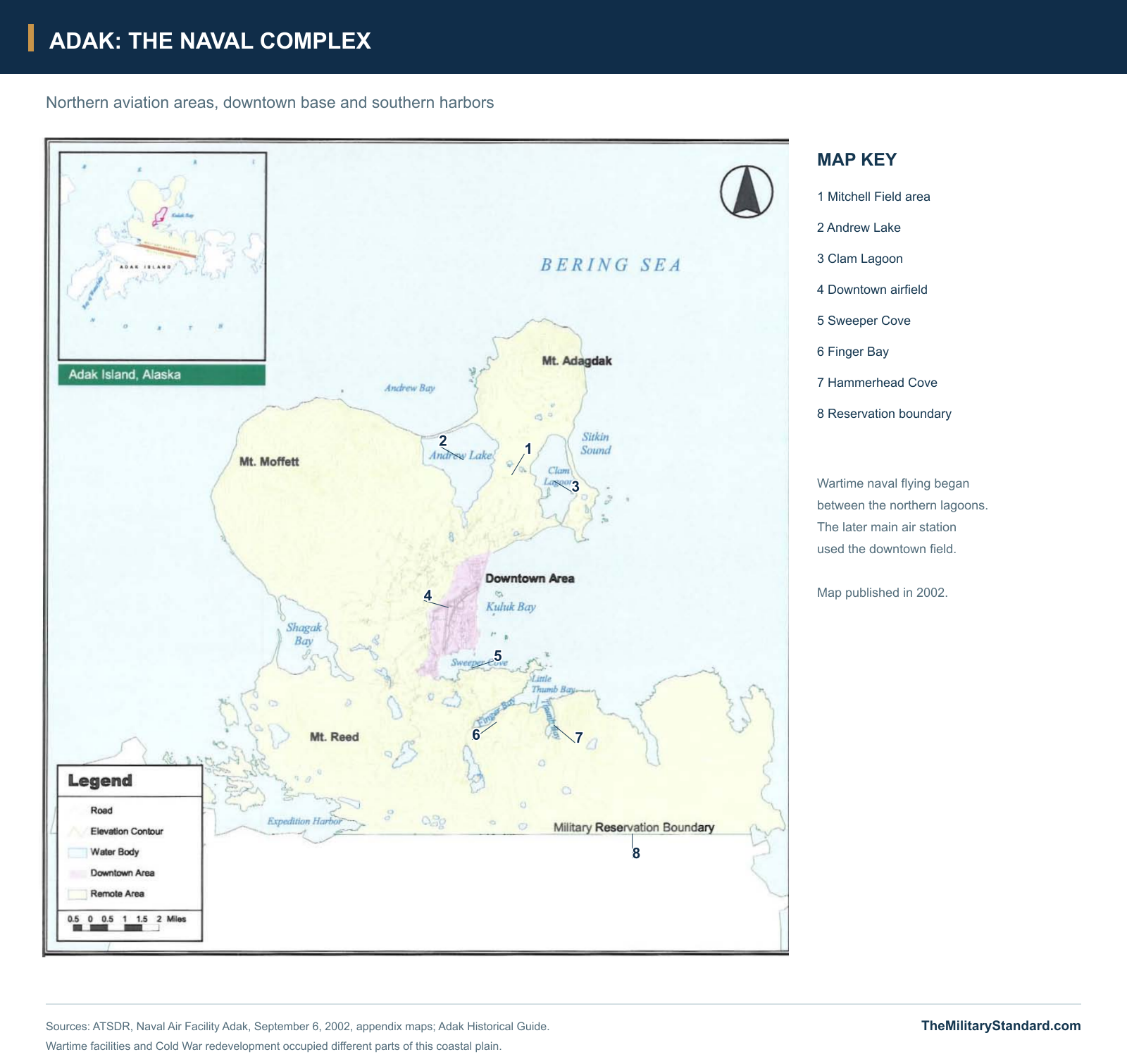
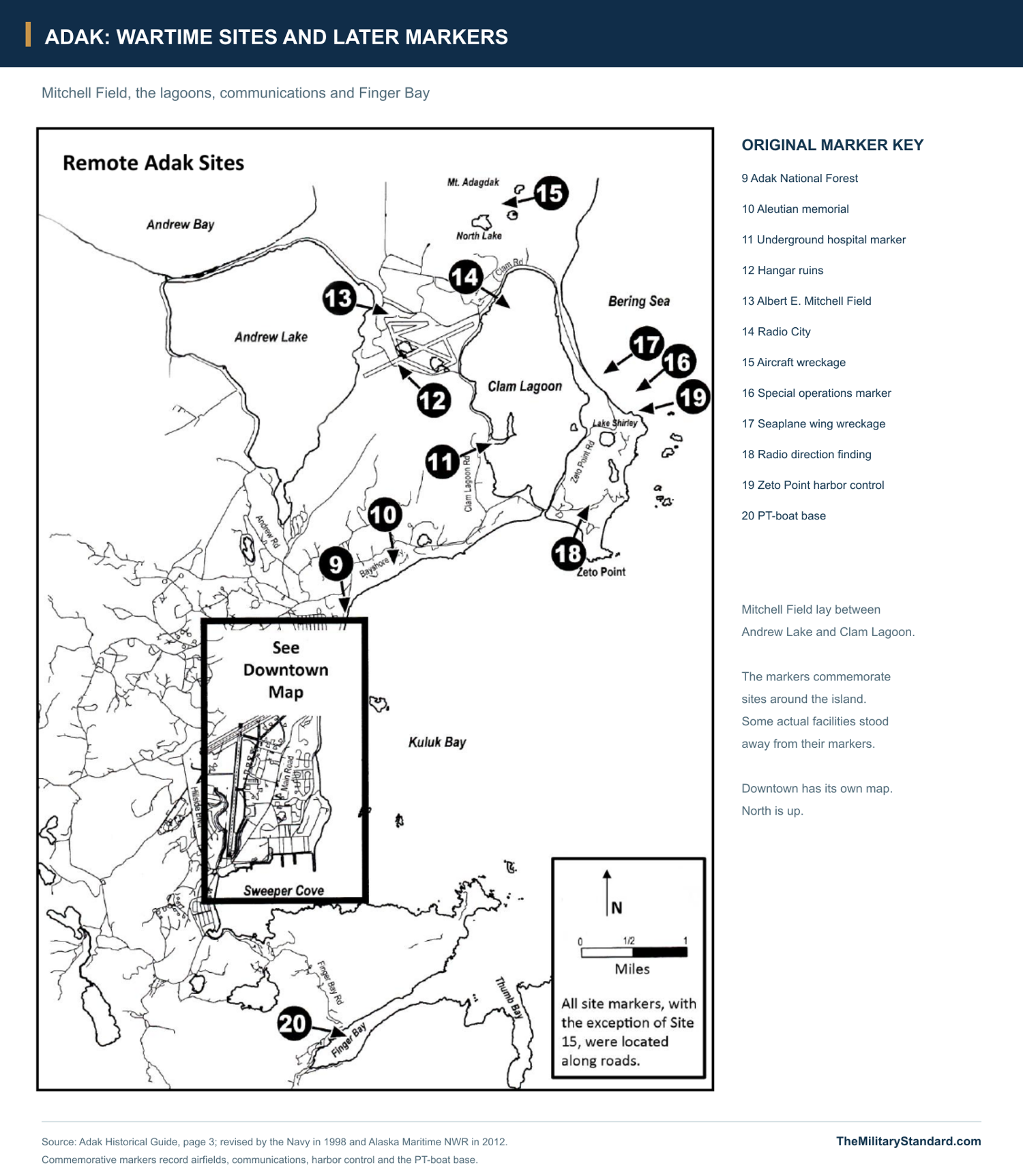
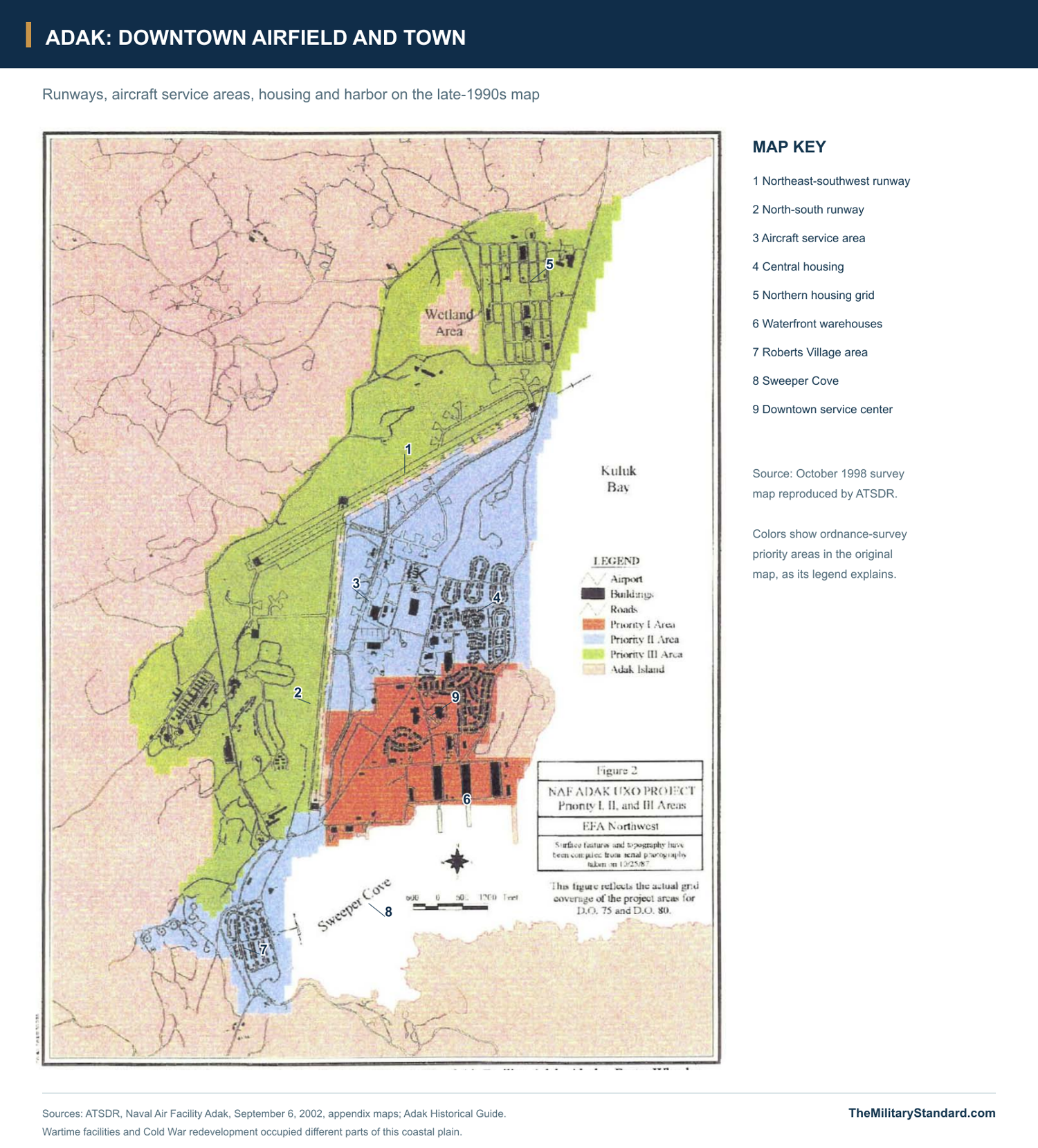
The naval establishment occupied several distinct places. Its wartime landplane and seaplane station developed in the north around Andrew Lake and Clam Lagoon, while repair, stores, hospitals and small-craft facilities spread around the southern harbors. After the Navy took over the former Davis airfield in 1950, the principal flying and residential center developed around the downtown field. The separate Naval Security Group Activity at Clam Lagoon became another major part of Adak's military community, with its own command and mission. [4] [12] [14]
From the 1942 Landing to the Operating Base
American troops landed on Adak on August 30, 1942, as the United States advanced against Japanese forces occupying Attu and Kiska. Engineers at Adak Army Base opened an airfield on drained tidal ground, bringing the offensive much closer to Kiska than aircraft based at Dutch Harbor. The Navy initially worked alongside this Army effort with limited facilities for Fleet Air Wing patrol searches. Small detachments of the 4th and 8th Naval Construction Battalions helped establish this first naval foothold before a much larger construction organization arrived. [1] [3] [4]
The first group of the 32nd Naval Construction Battalion reached Adak on Christmas Day 1942, and the whole battalion was present by the end of January 1943. These Seabees undertook the principal naval air-station construction. The 6th Naval Construction Regiment was organized in February to direct an expanding program that drew on several battalions and special detachments. Building continued while ships and aircraft were already using Adak, so temporary accommodation, cargo handling and operating facilities had to develop together. [1]
Naval Air Station Adak was formally established on May 15, 1943. Naval Operating Base Adak followed on July 14, creating an organization whose responsibilities extended beyond flying to vessels, stores, repairs and services across the dispersed shore establishment. The contemporary Navy campaign account counted 19,067 Army and 7,811 Navy personnel at Adak at the end of April 1943. This snapshot captures the scale of a rapidly growing joint base before the summer campaign brought further movements of troops and shipping. [2] [3]
Adak helped assemble the forces that recovered Attu in May 1943 and landed on Kiska in August. Once the occupied islands had been regained, the base continued to serve the wider North Pacific campaign rather than losing its purpose. Fleet Air Wing 4, the North Pacific Force and other headquarters used the island's communications and support facilities. The Seventeenth Naval District, established on April 15, 1944, was assigned headquarters at Kodiak, temporarily at Adak, reflecting the island's continuing place in the regional naval organization. [3] [4] [11]
Mitchell Field and the Seaplane Lagoons
The northern naval airfield, known as Albert E. Mitchell Field, was a separate flying ground from the Army field beside Sweeper Cove. The Navy construction history records two pierced-steel-plank runways, 5,277 by 200 feet and 7,145 by 200 feet. Five Kodiak-type hangars and a smaller building supported the landplane station. Approximately 14,000 feet of 60-foot-wide taxiway and more than 1.5 million square feet of parking area connected runways with aircraft servicing and dispersal space. [1] [4]
A two-story control tower, photographic laboratories and aircraft-repair shops made the air station more than a place to land. Four repair buildings supplied 24,700 square feet of workshop space, while three photographic buildings provided another 10,150 square feet. The Navy also used the Army flying field, where Seabees built a hangar and minor-repair facilities. Fuel trucks carried aviation gasoline from Army-controlled supplies, illustrating the practical sharing of resources across the two services during construction and operations. [1]
Seaplane operations depended on two different water environments. The freshwater basin called Andrew Lagoon in the construction history, now Andrew Lake, held the main seaplane facilities: two large patrol-plane hangars, a smaller observation-plane hangar, steel-plank parking and a 50-by-70-foot ramp. When the freshwater surface froze, aircraft shifted to saltwater Clam Lagoon. The ability to use both bodies of water helped sustain patrol flying, although wind, visibility and icing still complicated daily operations. [1] [4]
Patrol aircraft searched for submarines and enemy shipping and also attacked Japanese positions. VB-136 redeployed to Adak in April 1943 and moved from PBY-5A Catalinas to PV-1 Venturas during 1943. Its searches covered the approaches between Umnak, Adak and Kiska; ground attacks against Kiska began in May and continued through the invasion preparations. Adak therefore supported both surveillance over a large ocean area and direct offensive flying, with the workshops, photographic work and fuel system contributing to each mission. [7]
Harbor, Fleet Repair and Supply
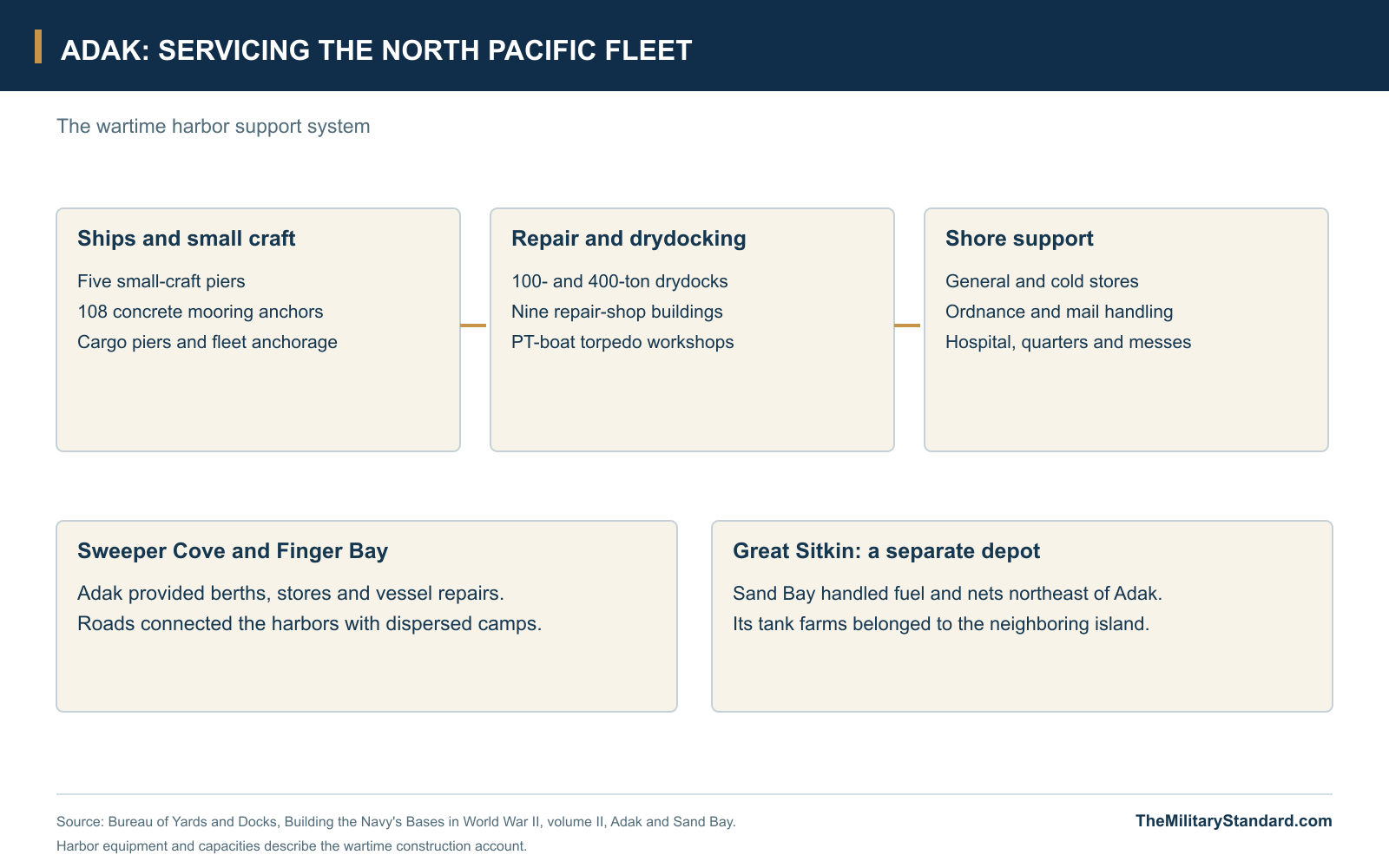
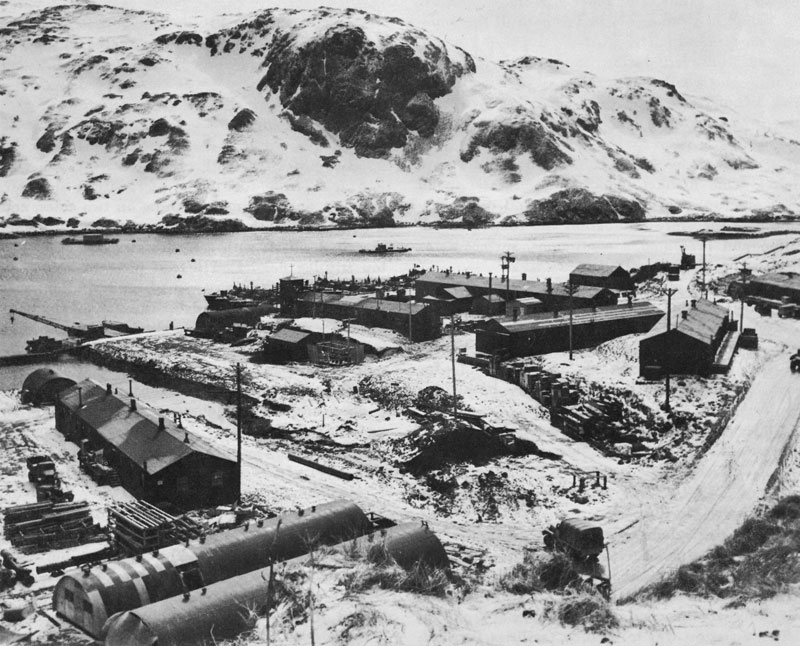
Sweeper Cove and the neighboring bays gave the operating base a maritime character distinct from its airfields. The Navy built five small-craft piers and placed 108 concrete mooring anchors, weighing between two and five tons, in the harbor. Larger piers handled cargo and ship support, including structures 75 by 392 feet and 55 by 600 feet. These facilities turned an undeveloped shore into a place where vessels could berth, unload, obtain stores and receive attention without returning east for every requirement. [1]
The PT-boat and section-base facilities supported smaller vessels, with Finger Bay forming an important part of that landscape. Pontoon drydocks rated at 100 and 400 tons allowed work below the waterline, and nine shop buildings supplied 42,125 square feet for repairs. Torpedo overhaul and compressor facilities occupied three Quonset huts. Harbor support thus required a combination of berths, lifting and docking equipment, specialist shops, ammunition handling and trained personnel rather than a pier alone. [1] [4]
The shore supply organization included 41 general-store buildings with approximately 234,000 square feet of space and five cold-storage units totaling 77,000 cubic feet. Twenty-seven ordnance buildings served ammunition requirements. A fleet post office and a large administrative complex sustained the flow of messages, records and mail as well as material. Great Sitkin Island's Sand Bay fueling and net depot, established in May 1943 northeast of Adak, complemented this system from a separate island; its tank farms belonged to that depot. [1]
Some of the most conspicuous waterfront buildings were originally Army projects. Three enormous reserve-depot warehouses and their associated piers and breakwater were built in 1943-1944 for possible further operations toward Japan from the North Pacific. They later became familiar features of the naval town. Their red, white and blue paint scheme dates to the 1976 Bicentennial, long after their wartime construction, so their later appearance tells a different chapter from the emergency Quonset camps surrounding the original operating base. [4] [5]
Building and Living on the Island
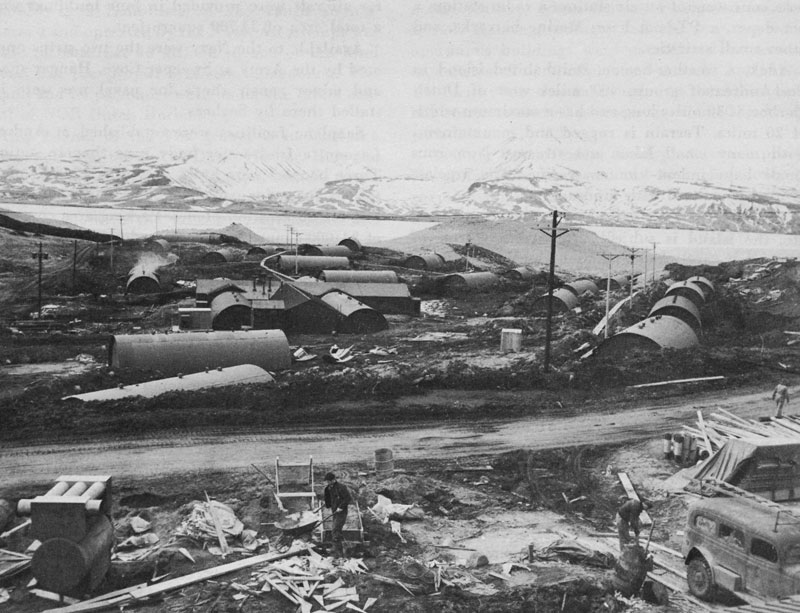
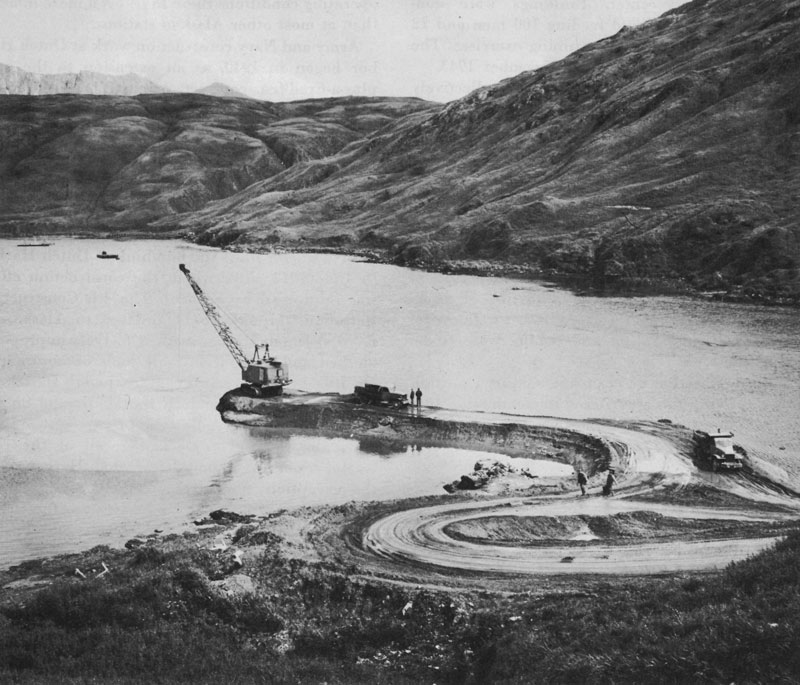
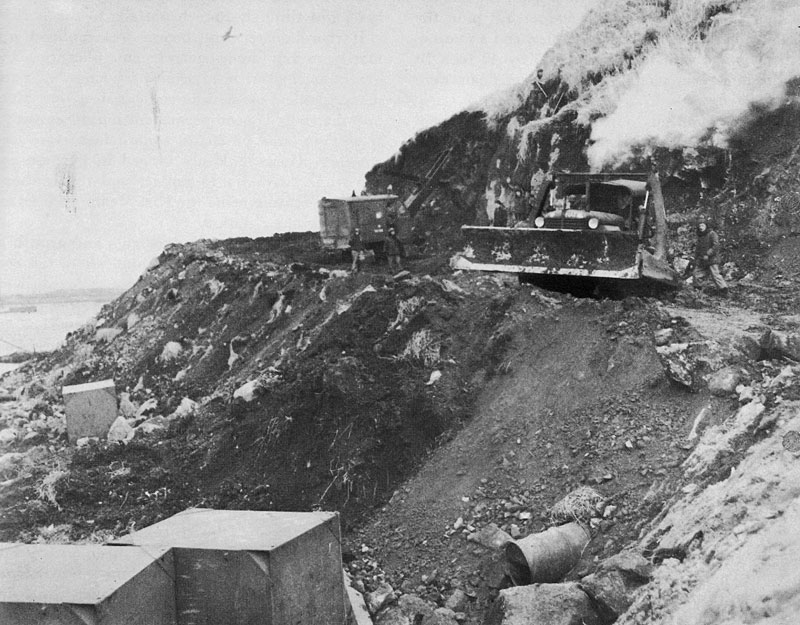
Seabee construction extended well beyond runways and docks. The 42nd, 23rd, 52nd and other construction battalions and special detachments joined the program at different stages. Construction Battalion Maintenance Unit 510 arrived on May 22, 1943, and the 86th Battalion later carried a substantial maintenance workload before departing in November 1944. Roads had to cross wet ground and follow the hills, and photographs show crews dredging surfacing material from Finger Bay and cutting a road toward the naval hospital. [1]
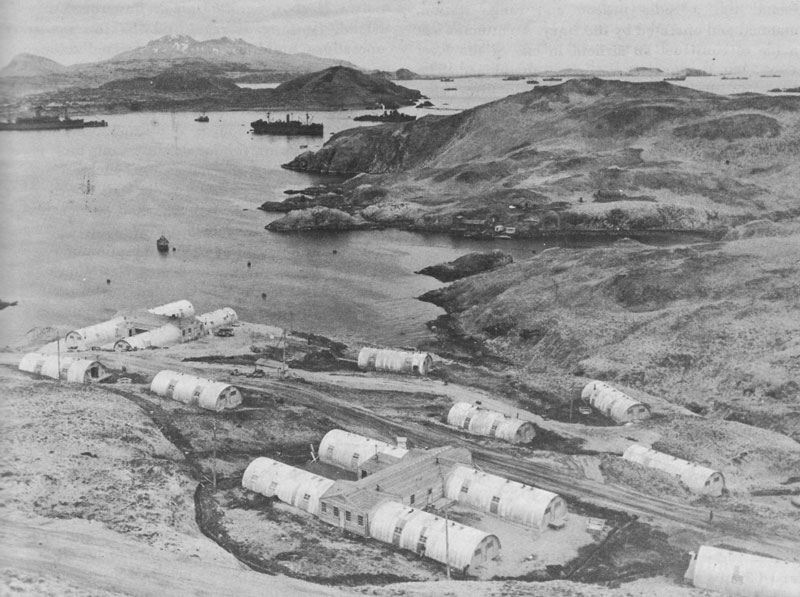
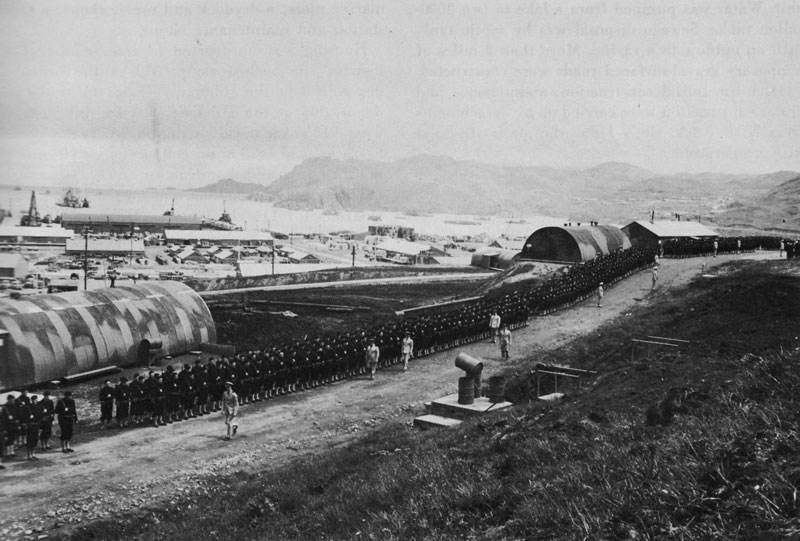
The wartime naval accommodation system combined tents, Quonset huts and larger service buildings. The construction account lists 1,049 tents accommodating 1,234 men and 421 Quonset huts providing places for 7,379, with separate officers' quarters. Sixteen mess halls and ten wardrooms fed the naval establishment. These were construction and accommodation figures for the developed base, whose strength changed as units arrived, staged for operations or moved onward to other islands. [1]
Medical and recreational facilities helped make sustained service possible in the remote setting. The hospital was built as a linked group of Quonset structures, with surgery, wards, mess and supporting departments. Five theaters, a large air-station recreation center and a section-base gymnasium provided indoor activity away from the weather. Mail, chapel services and organized recreation connected the dispersed camp groups socially, while road work and transport linked them physically across the island. [1] [4]
Power and water were supplied through numerous local systems. The Navy construction account lists twenty 75-kilowatt and eleven 50-kilowatt diesel generators, distributed around the establishment, together with wells and wooden storage tanks. The installation also developed radio and radar buildings, workshops and roughly 30 to 40 miles of roads and walks. Keeping these services operating required continuing maintenance in a wet, windy maritime climate, even after the urgent first construction campaign had ended. [1]
A Postwar Naval Station at Davis Field
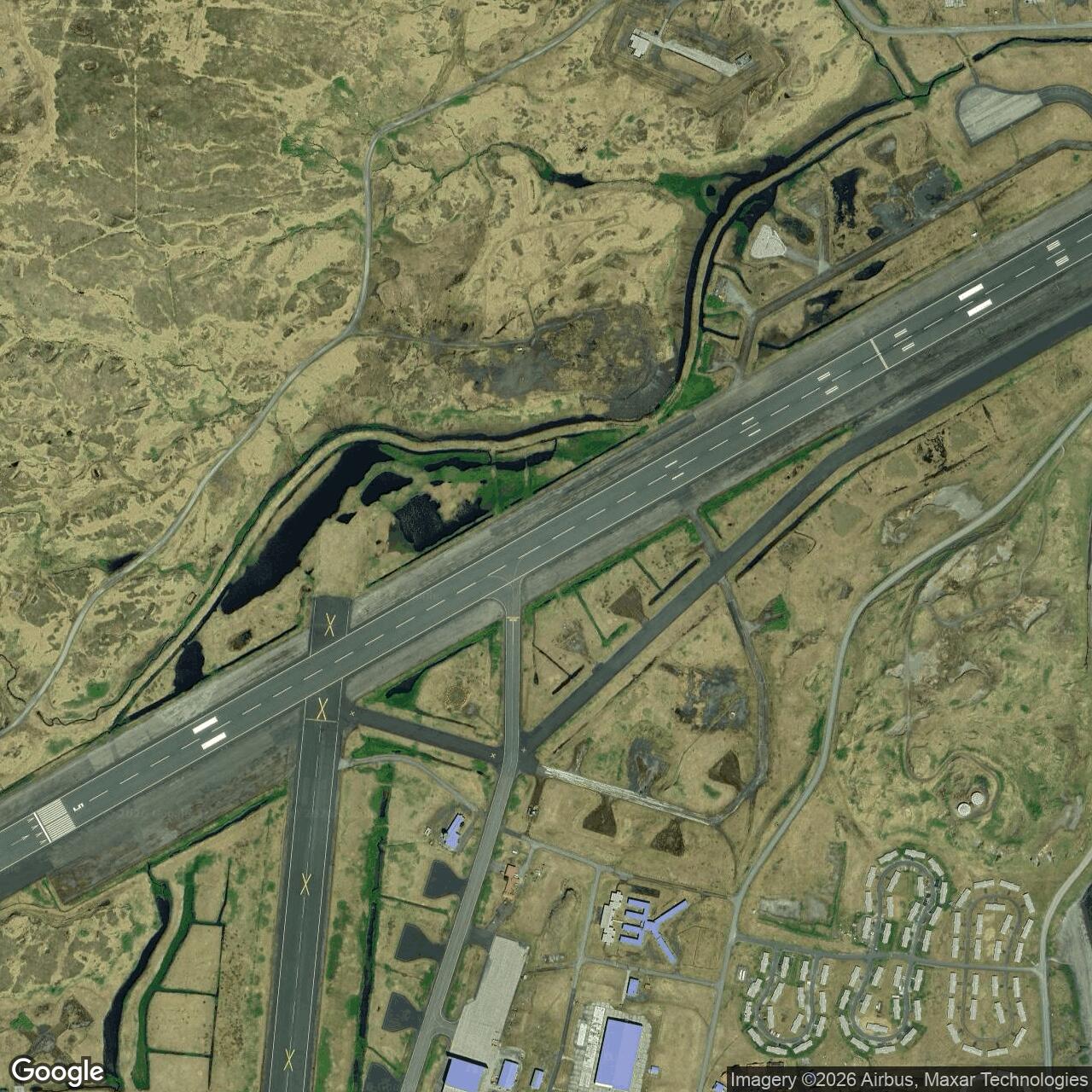
The end of the war reduced Adak's huge transient population, but the island retained military value. The Army airfield passed through the Davis Air Force Base period before the Navy assumed control in July 1950. The principal naval flying operation then centered on the downtown former Davis field, while the northern Mitchell Field landscape took on other uses. This movement explains why wartime naval-air-station plans show a different location from the airfield most visitors associate with later Naval Air Station Adak. [4] [5] [12]
The reduced station still had to support a broad range of work. The Navy's fiscal 1953 organization described transport and transient aircraft support, search and rescue, local service craft, voyage repairs and assistance to Army and Air Force activities at Adak and Shemya. Aerological and ground-controlled-approach support helped aircraft operate in difficult conditions. The station was also expected to expand support for two patrol squadrons and a fleet aircraft service squadron in an emergency, a contingency requirement that differed from its normal flying establishment. [6]
Cold War expansion gradually produced a more substantial permanent community. Housing, schools, medical services, recreation, utilities and port and aviation support grew around the operating base. The former Army depot and wartime roads remained part of this developing landscape, alongside newer construction. A 1959 withdrawal reserved approximately 79,200 acres for Navy use, a broad military land reservation encompassing far more than the runways, hangars and residential center. [12] [15]
Naval Station Adak was redesignated Naval Air Station Adak in 1984 as aviation remained central to its work. The air station supported deployed patrol squadrons, while communications and surveillance commands elsewhere on the island added different missions. Naval Security Group Activity Adak at Clam Lagoon and Naval Facility Adak, another surveillance activity, were separate organizations from the air station. Their presence helped make Adak a larger naval complex, but their names did not designate the same command as Naval Air Facility Adak. [12] [13] [14] [19]
Neptunes, Orions and North Pacific Patrols
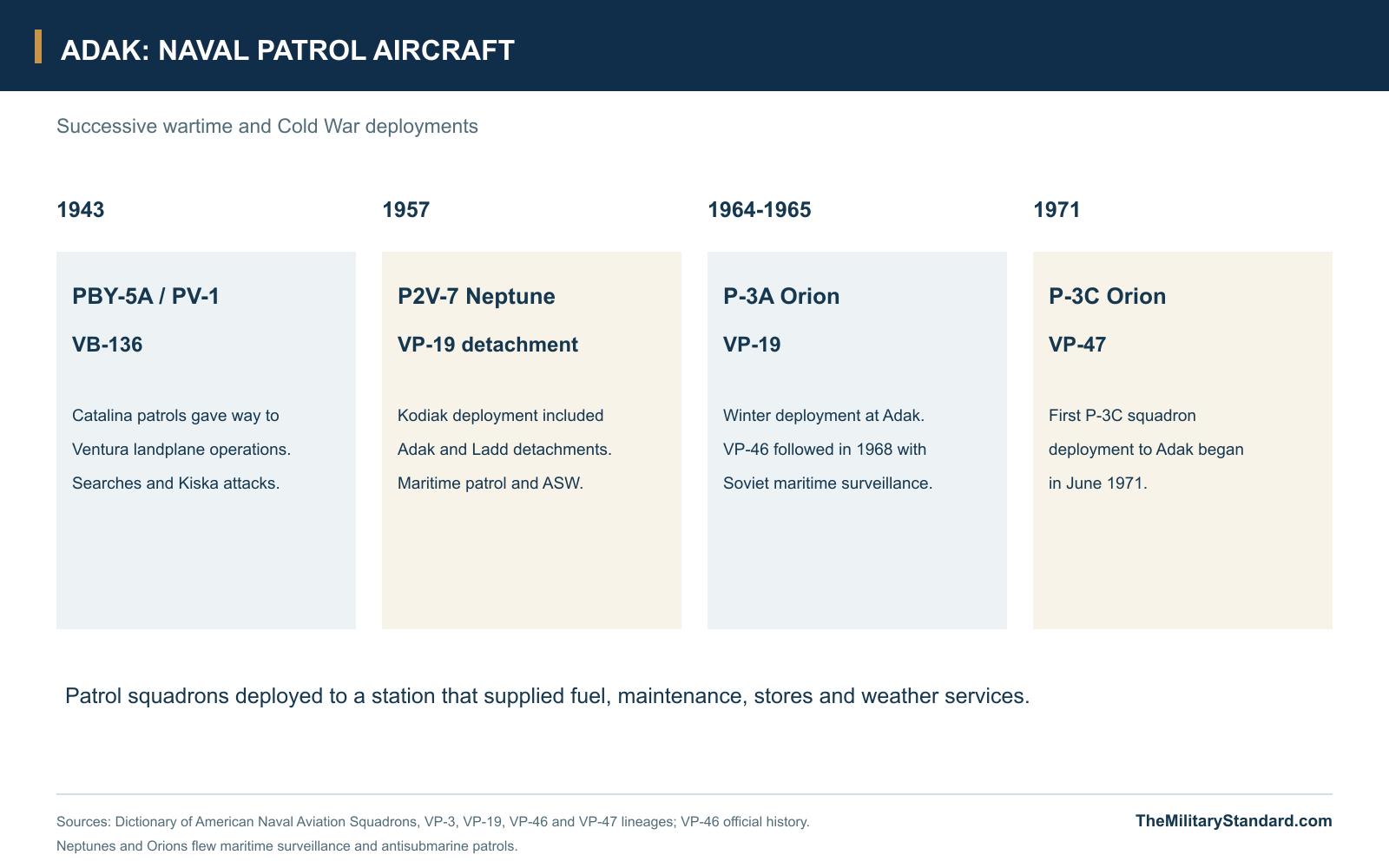
Postwar patrol deployments connected Adak with a much wider network of naval air stations. In 1957, VP-19 operated P2V-7 Neptune detachments at Adak and Ladd while deployed to Kodiak. The Neptune brought long-range maritime search and antisubmarine capability, but the success of a deployment depended on ground support: fuel, ordnance, spare parts, maintenance space and communications all had to be available at the forward field. Adak supplied these services close to the North Pacific operating areas. [8]
The turboprop P-3 Orion became a defining aircraft of the later base. From October 1964 to July 1965, VP-19 completed a winter deployment at Adak with P-3As. VP-46 arrived for a six-month deployment in May 1968 and conducted surveillance of Soviet submarines and surface ships. VP-47 brought the first P-3C squadron deployment to Adak in June 1971. These successive deployments show the changing patrol equipment and the continuing importance of the island as an operating location. [8] [9] [10]
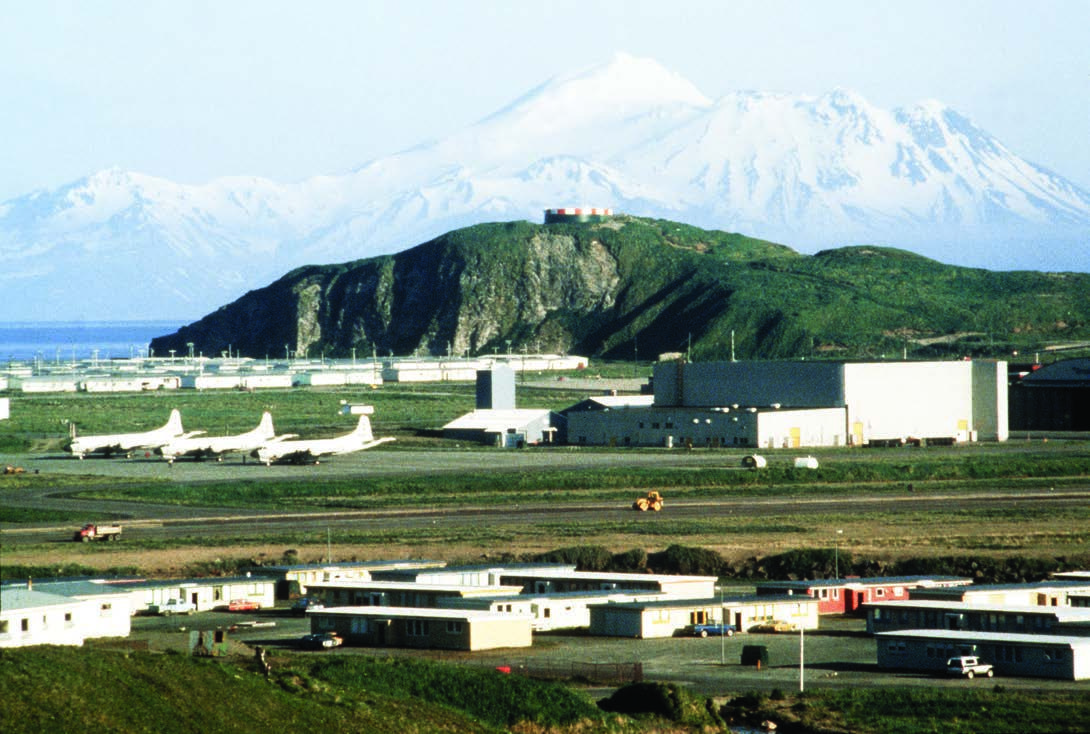
The patrol mission required both aircraft endurance and a shore organization that could turn aircraft around for the next flight. Hangars sheltered maintenance, aprons handled parked aircraft, and the airfield's approach and weather services supported arrivals in low cloud and strong winds. Crews arriving from other naval air stations joined a resident community of sailors, Marines, civilians and families. As the Cold War base grew, the port, airport, housing and public services formed a small town whose working rhythms followed the deployment schedule. [6] [12] [19]
Marines supplied security for the weapons-storage compound and other naval installations and could reinforce the naval police. Their barracks stood on Bering Hill above the town. A Marine who served on Adak around 1980 recalled an organization of roughly 150 to 160 Marines divided between administrative and guard platoons. Guard duty, barracks life and the long separation from home were part of the station's daily experience alongside the more visible patrol aircraft and visiting ships. [19]
Adak's position made it valuable because it placed aircraft and support nearer the ocean approaches between Alaska and the Soviet Far East. Patrol flying complemented the separate communications and surveillance installations on the island and worked alongside ships operating in the North Pacific. The same geography imposed costs: supplies traveled a long way, aircraft faced difficult weather, and the community depended on reliable air and sea connections. The base's strategic usefulness and its expensive shore infrastructure were closely connected. [10] [12] [14]
Drawdown, Closure and Civilian Adak
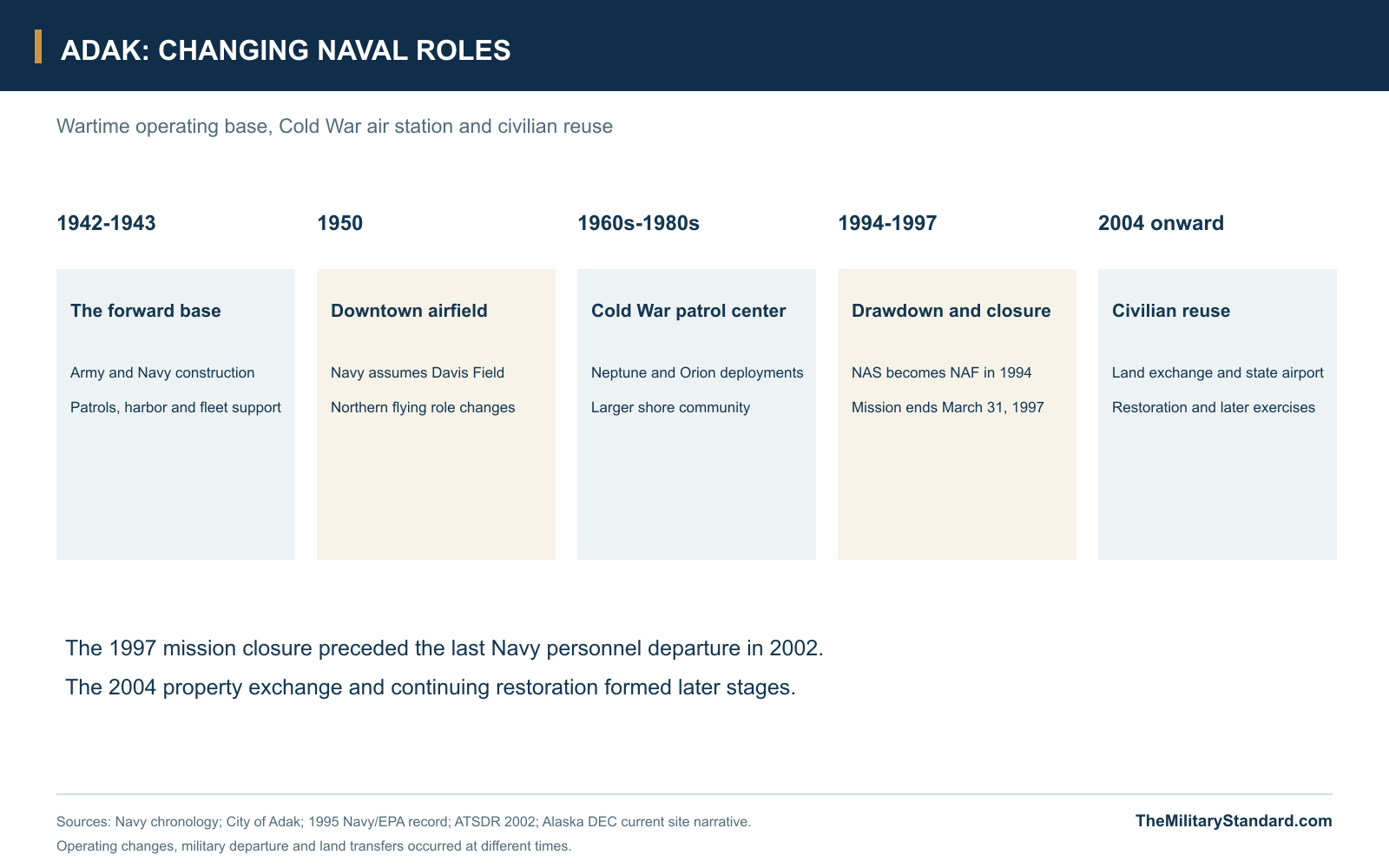
The end of the Cold War brought a rapid contraction. Dependents left in 1994, and Naval Air Station Adak became Naval Air Facility Adak on July 1 of that year. The 1995 Base Realignment and Closure process selected the remaining facility for closure. The military mission ended on March 31, 1997, closing the operating chapter of the base, while environmental work, property management and a small residual Navy presence continued afterward. The last Navy personnel departed in 2002. [12] [13] [14] [16]
Civil reuse required a further set of decisions about land, infrastructure and the airfield. In March 2004, a land exchange transferred former-base property to The Aleut Corporation, including the downtown area, port, utilities, commercial and residential facilities. Alaska assumed operation and maintenance of the airfield. The exchange covered 47,271 acres according to Alaska DEC, a different measure from the earlier 79,200-acre military withdrawal. The present town, port and state airport continue to use parts of the military landscape. [15] [16] [18]
Restoration remains part of Adak's postmilitary history. The Navy, EPA and Alaska DEC continue to address former fuel systems, disposal areas, contaminated soil and groundwater, and legacy munitions. Chemical sites and ordnance sites are managed through separate restoration programs, with monitoring and land-use controls continuing where required. These responsibilities extend beyond the former operating airfield into the wider reservation and help explain why mission closure, land transfer and completion of cleanup have different timelines. [16]
Adak has also hosted later military exercises. In September 2019, Navy, Marine Corps and Coast Guard forces conducted amphibious operations during Arctic Expeditionary Capabilities Exercise, with landing craft and amphibious vehicles coming ashore from USS Somerset. Such visits demonstrate the continuing value of the island's harbor, airfield and location. The surviving wartime landscape, recognized as a National Historic Landmark in 1987, and the later naval town together preserve the physical record of a base that served two very different eras of North Pacific strategy. [5] [17]
Chronology
- August 30, 1942 U.S. forces land on Adak; naval patrol and support facilities develop alongside the Army airfield. [1] [4]
- December 25, 1942 The first group of the 32nd Naval Construction Battalion arrives. [1]
- February 1943 The 6th Naval Construction Regiment is organized to direct expanding naval construction. [1]
- May 15, 1943 Naval Air Station Adak is established. [2]
- July 14, 1943 Naval Operating Base Adak is established. [2]
- 1943-1944 Harbor, repair, air-station, hospital and shore-support construction expands. [1]
- April 15, 1944 The Seventeenth Naval District is established, with headquarters at Kodiak temporarily at Adak. [11]
- July 1950 The Navy assumes control of the former Davis airfield. [12]
- 1959 Approximately 79,200 acres are withdrawn for Navy use. [15]
- October 1964-July 1965 VP-19 completes a winter P-3A deployment to Adak. [8]
- May 1968 VP-46 begins its first Adak deployment. [9] [10]
- June 1971 VP-47 brings a P-3C squadron deployment to Adak. [10]
- 1984 Naval Station Adak becomes Naval Air Station Adak. [12]
- 1987 The Army base and naval operating-base landscape receives National Historic Landmark designation. [5]
- July 1, 1994 Naval Air Station Adak is redesignated Naval Air Facility Adak. [13]
- 1995 Adak is selected for closure under BRAC. [16]
- March 31, 1997 The operational military mission ends. [12] [16]
- 2002 The last Navy personnel leave the former base. [14]
- March 2004 Former-base land is exchanged and the airfield passes to state operation. [15] [16]
- September 18, 2019 Navy, Marine Corps and Coast Guard forces conduct an amphibious exercise at Adak. [17]
- 2026 Restoration, monitoring and work toward an OU B-2 ordnance decision continue. [16]
Related Sites
Information sources (19)
- WEBBureau of Yards and Docks, Building the Navy's Bases in World War II, volume II, chapter XXIII, 1947, Adak section and photographs
Seabee construction, northern naval airfield, seaplanes, harbor and repair facilities, accommodation, medical care, utilities and dated construction photographs.
- WEBRobert J. Cressman, The Official Chronology of the U.S. Navy in World War II, 1943, May 15 and July 14 entries
Separate establishment dates for Naval Air Station Adak and Naval Operating Base Adak.
- WEBOffice of Naval Intelligence, The Aleutians Campaign, June 1942-August 1943, Combat Narratives, 1945
Naval patrols, North Pacific operations, Adak as a staging base and the April 1943 garrison snapshot.
- WEBAdak Historical Society, U.S. Navy and Alaska Maritime National Wildlife Refuge, Adak Historical Guide, revised 1998 and 2012
Locations of Mitchell Field, seaplane facilities, Navytown, Roberts Village, Finger Bay, hospital, chapel, warehouses and wider wartime landscape.
- WEBNational Park Service, Adak Army Base and Adak Naval Operating Base, National Historic Landmark nomination, 1987
Wartime joint-service development, surviving historic features and landscape, 1943 Army airfield map and landmark designation context.
- PDFU.S. Navy, Naval Aeronautical Organization, fiscal year 1953, June 1952, Naval Station Adak entry
Postwar station mission, transient flying, search and rescue, service craft, ground-controlled approach and contingency patrol-squadron support.
- PDFNaval Historical Center, Dictionary of American Naval Aviation Squadrons, volume II, chapter 3, VP-3 lineage
VB-136 at Adak in April-August 1943, the PBY-5A to PV-1 transition, patrols and attacks on Kiska.
- PDFNaval Historical Center, Dictionary of American Naval Aviation Squadrons, volume II, chapter 3, VP-19 lineage
P2V-7 detachment service in 1957 and VP-19's first complete winter P-3A deployment at Adak in 1964-1965.
- WEBU.S. Navy, Patrol Squadron 46 official history
P-2 and P-3 aircraft transitions and the squadron's May 1968 deployment to Adak.
- PDFNaval Historical Center, Dictionary of American Naval Aviation Squadrons, volume II, chapter 3, VP-46 and VP-47 lineages
Adak patrol deployments, Soviet submarine and surface-ship surveillance, and VP-47's June 1971 P-3C deployment.
- WEBNaval History and Heritage Command, Seventeenth Naval District
District establishment on April 15, 1944, temporary Adak headquarters and disestablishment on June 30, 1971.
- WEBCity of Adak, Former Naval Air Facility Adak
1950 Navy assumption, postwar station growth, 1984 and 1994 name changes, dependent departure and the March 1997 mission closure.
- PDFU.S. Navy and U.S. EPA, Adak Naval Air Station Operable Unit 1 Record of Decision, March 31, 1995
Base history, July 1, 1994 Naval Air Facility redesignation and downtown airfield, street and harbor mapping.
- PDFAgency for Toxic Substances and Disease Registry, Naval Air Facility Adak Public Health Assessment, September 6, 2002
Former-base facilities, final personnel withdrawal in 2002 and appendix maps of the military reservation and downtown area.
- WEBU.S. Navy BRAC Program Management Office, Former Naval Air Facility Adak
1959 withdrawal, former-base extent, March 2004 transfer and remaining Navy restoration property.
- WEBAlaska Department of Environmental Conservation, Adak Former Naval Air Facility, including 2026 updates
1995 BRAC decision, March 31, 1997 mission closure, March 2004 land exchange, state airport transfer and continuing restoration.
- WEBCommander, U.S. Third Fleet, U.S. Navy and Marine Corps Conduct Amphibious Landing During AECE 2019, September 18, 2019
Postclosure amphibious exercise at Adak, USS Somerset, Navy and Marine landing forces and Coast Guard participation.
- PDFFederal Aviation Administration, Alaska Chart Supplement, effective October 29, 2026, Adak Airport
Present airport reference coordinate and ADK/PADK identifiers for the surviving downtown airfield.
- PDFLeatherneck, January 2022, Adak Island article, printed pages 57 and 63, photographs credited to the National Archives
Reproductions of a 1943 fleet anchorage photograph and an undated view of base housing, hangars and three P-3C Orion aircraft.