
R-01 Missile Alert Facility and Romeo Flight (), Meriden Wyoming
Longitude: -104.499827
Site Type: Missile Alert Facility (MAF) - Launch Control Center (LCC)
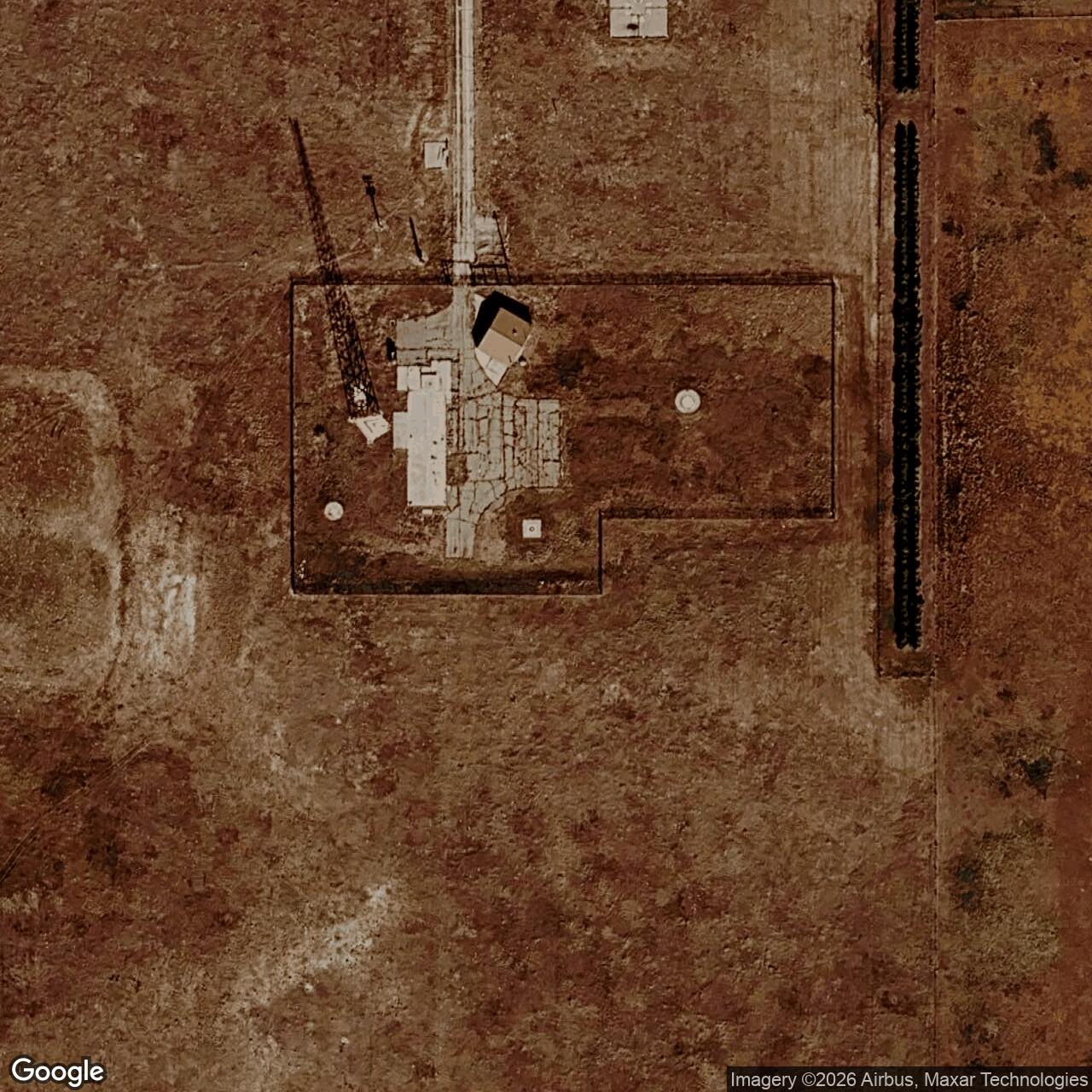
A MAF is located within a fenced area averaging about 5.5 acres. All facilities are enclosed by a security fence, except for a helicopter pad and a buried antenna consisting of two intersecting rings (each about four feet in diameter) buried four feet below surface. The sewage lagoon is enclosed by a separate fence. Top-side structures include a launch control support building (LCSB) and a detached garage. Subsurface structures include a launch control center (LCC) and a launch control equipment building (LCEB). Each MAF Controlled 10 Launch Facilities and their missile.
Missile Type: LGM-30B Minuteman I; LGM-30G Minuteman III; LGM-118A Peacekeeper
Parent Base: F.E. Warren AFB
Missile Wing: 90th Strategic Missile Wing; 90th Missile Wing
Missile Squadron: 400th Strategic Missile Squadron / 400th Missile Squadron
Permanent Installation Number: 8696
Installation Location Code: GHYV
Current Site Use: Former Minuteman / Peacekeeper Missile Alert Facility; public field-photo source reported R-01 LCSB removed and elevator-shaft area capped by 2016; no public access.
Site Ownership: Former Air Force missile real property; current ownership requires county/federal real-estate verification.
Accessible: No public access; verify ownership and permissions before visiting.
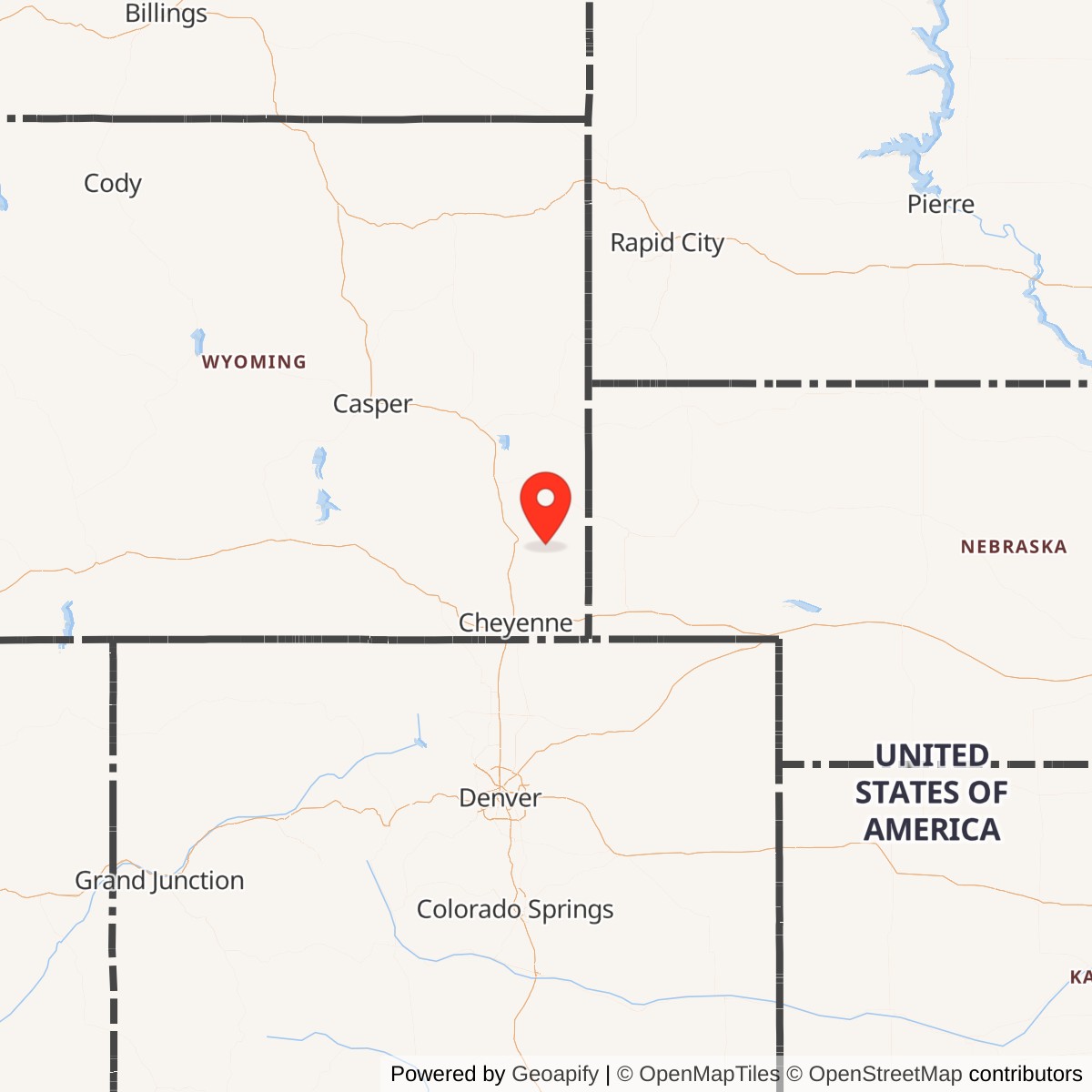
From the road, R-01 was never meant to look dramatic. It was a fenced support compound on the high plains north of Cheyenne, the kind of place a passerby could mistake for a utility installation or a ranch service yard. Its purpose was underground and strategic: R-01 was the crewed control site for Romeo Flight, one of the five F.E. Warren missile flights later converted to operate the LGM-118A Peacekeeper, the most powerful land-based ICBM ever placed on alert by the United States.
R-01 was a Missile Alert Facility / Launch Control Facility associated with the underground Launch Control Center for Romeo Flight. It was part of the F.E. Warren Air Force Base missile field, operated by the 90th Strategic Missile Wing during the Strategic Air Command era and later by the 90th Missile Wing. During the Peacekeeper period, Romeo Flight belonged to the 400th Strategic Missile Squadron / 400th Missile Squadron, the only operational Peacekeeper missile squadron.
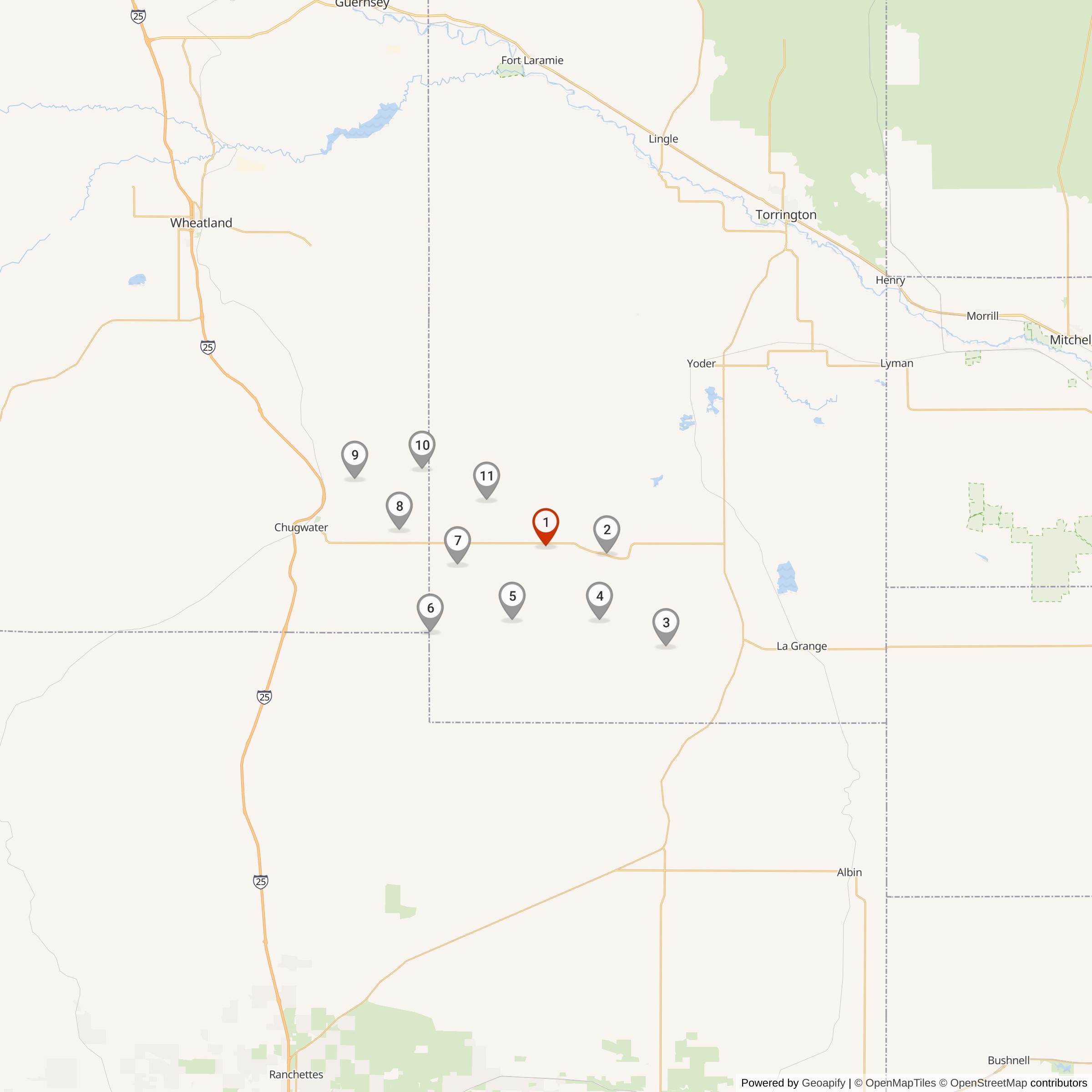
The site is located near Meriden in Goshen County, Wyoming. Public field-photo documentation identifies it as Francis E. Warren AF Missile Site R-01, PIN 8696, ILC GHYV, with the DMS coordinate 41-44-19, 104-30-00. The coordinate used here marks the missile-alert facility / launch-control compound rather than a missile silo. R-01 controlled the ten unmanned Romeo Flight launch facilities, R-02 through R-11.
R-01 began as a Minuteman-era facility in the F.E. Warren missile field. Romeo Flight originally supported LGM-30B Minuteman I missiles, later became part of F.E. Warren's Minuteman III force, and then entered the Peacekeeper era when the 400th Missile Squadron's Papa, Quebec, Romeo, Sierra, and Tango flights were converted to the LGM-118A Peacekeeper. The Peacekeeper mission ended at F.E. Warren in September 2005. R-01 is now inactive and decommissioned. It is not a public historic site, and public-source field documentation indicates that by 2016 the Launch Control Support Building had been removed and the elevator-shaft area was covered by a thick concrete cap.
Location, Landscape, and Flight Layout
R-01 stood in the open agricultural landscape of southeastern Wyoming, northwest of Meriden and northeast of F.E. Warren Air Force Base. This was classic Minuteman country: long roads, broad views, sparse settlement, and enough distance between sites to make each launch facility a separate target. The geography also tied Romeo Flight to the older military landscape of Cheyenne, where F.E. Warren had already served as an early Atlas missile base before Minuteman replaced the first-generation ICBMs.The aboveground R-01 compound included the features typical of a Minuteman / Peacekeeper missile-alert facility: a Launch Control Support Building, vehicle garage, entry gate, antennas, air intake and exhaust structures, utility features, fuel-tank support structure, sewage lagoons, parking area, and hardened intersite-cable markers. The real mission center was below the surface. The underground Launch Control Center was the hardened capsule where a missile combat crew monitored Romeo Flight's launch facilities and remained connected to the wider command-and-control network.
Romeo Flight consisted of one crewed control site and ten unmanned launch facilities:
R-01 Missile Alert Facility / Launch Control Center
R-02 Launch Facility, PIN 9233, ILC GHYW
R-03 Launch Facility, PIN 8697, ILC GHYX
R-04 Launch Facility, PIN 8509, ILC GHYY
R-05 Launch Facility, PIN 8698, ILC GHYZ
R-06 Launch Facility, PIN 8699, ILC GHZA
R-07 Launch Facility, PIN 8700, ILC GHZB
R-08 Launch Facility, PIN 8701, ILC GHZC
R-09 Launch Facility, PIN 8510, ILC GHZD
R-10 Launch Facility, PIN 8702, ILC GHZE
R-11 Launch Facility, PIN 8511, ILC GHZF
Strategic and Cold War Context
R-01 existed because the United States wanted a missile force that could survive attack, remain on alert, and provide a credible retaliatory capability without keeping crews at every silo. Minuteman solved many of the problems of earlier liquid-fueled ICBMs. It was solid-fueled, compact, remotely monitored, and capable of remaining in an underground launch facility for long periods with a much smaller operating crew than Atlas or Titan.The F.E. Warren Minuteman field was part of a national move from vulnerable first-generation ICBM complexes to hardened, dispersed, solid-fueled missiles. R-01 and Romeo Flight were one piece of that system. The launch facilities were unmanned; the crewed work of monitoring and command took place at the associated LCC / MAF. That separation of crew, missile, and support functions defined the Minuteman basing concept.
The Peacekeeper conversion gave R-01 a second Cold War identity. The LGM-118A Peacekeeper, originally developed as the MX missile, grew out of the 1970s and 1980s debate over how to modernize the land-based leg of the nuclear triad. The missile promised greater accuracy and payload than Minuteman, but its basing plan became one of the most contested defense issues of the late Cold War. After years of controversy over mobile, multiple-shelter, and hardened basing schemes, the United States deployed Peacekeeper in 50 modified Minuteman III silos in the F.E. Warren field. Those 50 sites were the 400th Missile Squadron's Papa, Quebec, Romeo, Sierra, and Tango flights.
Construction and Activation
The F.E. Warren Minuteman field was built after the early Atlas era and was one of the major Minuteman deployments on the northern plains. The 90th Strategic Missile Wing was activated at F.E. Warren on 1963-07-01. The 400th Strategic Missile Squadron, which later operated the Peacekeeper force, was activated as part of the wing's Minuteman force. Warren's first Minuteman missiles were LGM-30B Minuteman I models, and by 1965 the base had its full Minuteman force on alert.The Omaha District of the U.S. Army Corps of Engineers played a central role in Minuteman ground-facility construction across the northern plains, including the F.E. Warren missile field. Construction required the dispersed placement of launch-control and launch facilities across large rural areas, with attention to soil, topography, road access, hardening, communications, and spacing between sites.
R-01 was not a launch silo. It was the alert and control facility for Romeo Flight. The missile crew worked underground in the LCC, while the topside facility supported security, communications, maintenance coordination, power, lodging, and day-to-day alert operations. The ten Romeo launch facilities held the missiles.
Missile System and Technical Role
R-01's technical role changed as the missile field evolved. In its first phase, Romeo Flight supported the LGM-30B Minuteman I, a three-stage, solid-fueled ICBM that represented a major break from earlier liquid-fueled systems. Warren's Minuteman I missiles later gave way to Minuteman III. The 90th Missile Wing states that Minuteman III replaced Minuteman I at F.E. Warren in 1975 and that Minuteman II was never deployed at the base.The Peacekeeper conversion was a much larger change than a normal missile upgrade. The LGM-118A Peacekeeper was a four-stage ICBM. Its first three stages used solid-fuel rocket motors, while the fourth stage, or post-boost vehicle, was liquid-fueled and carried the guidance and reentry systems. The missile used a cold-launch system: steam pressure ejected the missile from the modified Minuteman silo, and the first-stage motor ignited after the missile cleared the silo. Public Air Force sources describe the Peacekeeper as carrying up to ten Avco Mk-21 reentry vehicles and using multiple independently targetable reentry vehicle technology.
For R-01, the Peacekeeper conversion meant that its associated flight became part of the nation's only operational Peacekeeper field. The launch facilities, not the MAF itself, held the missiles; R-01 remained the crewed command and support node for Romeo Flight. The control relationship between a crewed LCC and unmanned launch facilities remained central to the system.
Launch Control, Alert Duty, and Daily Operations
The heart of R-01 was the underground launch-control capsule. A missile combat crew normally consisted of two officers who served alert duty in the LCC. Topside personnel, including a facility manager and security personnel, supported the crew and controlled access to the compound. Maintenance and communications teams visited the MAF and launch facilities as needed. The individual launch facilities in Romeo Flight were normally unmanned.Daily operations were built around readiness, communications, security, and routine maintenance rather than dramatic launch activity. Crews monitored equipment status, responded to higher-headquarters messages, practiced procedures, and maintained the constant alert posture expected of an ICBM wing. Security forces protected both the MAF and the remote launch facilities. Maintenance teams kept the missile, power, environmental, guidance, and communications systems available for alert duty.
The dispersed field made R-01 part of a larger network rather than a standalone installation. Its importance came from connection: to its ten launch facilities, to other launch-control centers, to wing command channels, and to national command authority. This networked design was what made Minuteman and Peacekeeper different from the earlier Atlas and Titan complexes, where far larger crews were tied to fewer missiles.
Operational History
Romeo Flight's history followed the larger path of the F.E. Warren missile field. The field began with Minuteman I, moved to Minuteman III, and then placed 50 former Minuteman III silos into Peacekeeper service under the 400th Missile Squadron.The 90th Strategic Missile Wing was activated on 1963-07-01. Warren's Minuteman force replaced the earlier Atlas mission and used hardened, widely dispersed underground silo launchers. The base eventually operated 200 Minuteman I missiles. The 400th Strategic Missile Squadron, which later became the Peacekeeper squadron, was one of the missile squadrons in this wing.
In the 1970s, F.E. Warren moved from Minuteman I to Minuteman III. The wing history notes that the 400th became the first all-Minuteman III squadron at Warren and that the last Minuteman IB went off alert on 1974-09-03. The 90th Missile Wing's public fact sheet states that Minuteman III replaced Minuteman I in 1975 and that Minuteman II was never deployed at F.E. Warren. For Romeo Flight, this meant a transition from the earlier Minuteman IB alert mission to the newer Minuteman III configuration.
The Peacekeeper era began with national strategic-modernization decisions made in the early 1980s. President Ronald Reagan announced the MX / Peacekeeper deployment plan in 1982. Support-facility work at F.E. Warren began in the mid-1980s, and the Peacekeeper was deployed in converted Minuteman III silos rather than in a new missile field. The first Peacekeeper site at Warren was strategically postured in 1986, initial operational capability was achieved later that year, and by 1988 the Air Force had 50 Peacekeepers in service at F.E. Warren. Romeo Flight was one of the five converted flights.
The operational Peacekeeper mission was short compared with Minuteman. It lasted from 1986 to 2005, spanning the last years of the Cold War and the first decade and a half afterward. Peacekeeper strengthened the ground-based deterrent during its operational life, but arms-control agreements and changing strategic requirements made its multiple-warhead ICBM role increasingly difficult to justify after the Cold War. The 400th Missile Squadron brought its full complement of Peacekeepers online in 1988, and the Peacekeeper mission ended at F.E. Warren on 2005-09-19.
Public field documentation from 2010 photographed R-01 with its Launch Control Support Building, entry gate, vehicle garage, air intake and exhaust stacks, hard HF receive antenna, radio relay tower, vehicle parking area, sewage lagoons, fuel-tank support structure, site sign, and HICS markers. A 2016 return visit reported that the Launch Control Support Building at R-01 had been removed and that a thick concrete cap covered the elevator-shaft area. The same source observed intact Launch Control Support Buildings at P-01, Q-01, S-01, and T-01 at that time. This makes R-01 an important example of the less-preserved outcome for former Peacekeeper control sites, especially when compared with Q-01, which later became a Wyoming State Historic Site and National Historic Landmark.
Deactivation and Disposal
The Peacekeeper force was deactivated between 2003 and 2005. Air Force public reporting states that the Peacekeeper mission ended during a ceremony at F.E. Warren on 2005-09-19, when a missile combat crew officer at Papa-01 confirmed that no Peacekeeper ICBMs remained on strategic alert in the 400th Missile Squadron. The Warren wing history also notes the final Peacekeeper deactivation in September 2005 and the later deactivation of the 400th Missile Squadron.The former Peacekeeper launch facilities then entered the New START elimination process. The treaty entered into force in February 2011, and the Air Force selected the 50 deactivated F.E. Warren Peacekeeper launch facilities for permanent elimination. F.E. Warren's public release stated that the former Peacekeeper silos would be filled with earth and gravel and that the land would later be available for purchase or other disposition in accordance with federal law. AFCEC's environmental-assessment summary stated that the associated MAFs were also analyzed, even though MAF dismantlement was not required by treaty, and that MAF subsurface portions would be filled with concrete and clean fill.
For R-01, the public field record indicates that the Launch Control Support Building was removed by 2016 and that the elevator-shaft area was capped.
Current Status and Site Use
R-01 is inactive and decommissioned. It is a former Minuteman / Peacekeeper Missile Alert Facility, not an active Minuteman III site and not a public historic site. Public field documentation indicates that by 2016 the Launch Control Support Building had been removed and a concrete cap covered the elevator-shaft area. Surface remnants and access-road traces may be visible from public mapping or from lawful public viewpoints, but current ownership and access status require county or federal real-estate verification.The site should be treated as private or restricted property unless a current public agency record states otherwise.
Chronology
- 1962 Construction planning and field work for the F.E. Warren Minuteman missile field were underway during the early 1960s.
- 1963-07-01 The 90th Strategic Missile Wing was activated at F.E. Warren Air Force Base.
- 1964-07-01 The 400th Strategic Missile Squadron was activated as part of the F.E. Warren Minuteman force.
- 1965-06-15 F.E. Warren's 200th Minuteman missile was placed on alert, completing the original Minuteman force.
- 1972 F.E. Warren began major force-modernization work associated with conversion from Minuteman I to Minuteman III.
- 1974-09-03 The last Minuteman IB at F.E. Warren went off alert.
- 1975 Minuteman III replaced Minuteman I at F.E. Warren; Minuteman II was never deployed at the base.
- 1982-11-22 President Ronald Reagan announced the plan to deploy the MX / Peacekeeper missile at F.E. Warren.
- 1984-07 Construction began for Peacekeeper support facilities at F.E. Warren.
- 1986-10-10 The first Peacekeeper site at F.E. Warren was strategically postured.
- 1986-12-16 F.E. Warren achieved Peacekeeper initial operational capability.
- 1988 The Air Force had 50 Peacekeeper missiles in service at F.E. Warren.
- 1991-09-01 The 90th Strategic Missile Wing was redesignated the 90th Missile Wing.
- 2005-09-19 The Peacekeeper missile mission ended at F.E. Warren; no Peacekeeper ICBMs remained on strategic alert in the 400th Missile Squadron.
- 2011-02 New START entered into force, setting the arms-control framework for later elimination of deactivated silos.
- 2013-08-23 The Air Force announced permanent elimination of 50 previously deactivated F.E. Warren Peacekeeper launch facilities.
- 2016 Public field documentation reported that the R-01 Launch Control Support Building had been removed and that a thick concrete cap covered the elevator-shaft area.
Read about the Peacekeeper Missile at F.E. Warren AFB
All Peacekeeper Missile Silo Locations
All Minuteman/Peacekeeper Missile Silo Locations