
Minuteman T-01 Missile Alert Facility and Tango Flight (), Wheatland Wyoming
Longitude: -104.792212
Site Type: Missile Alert Facility (MAF) - Launch Control Center (LCC)
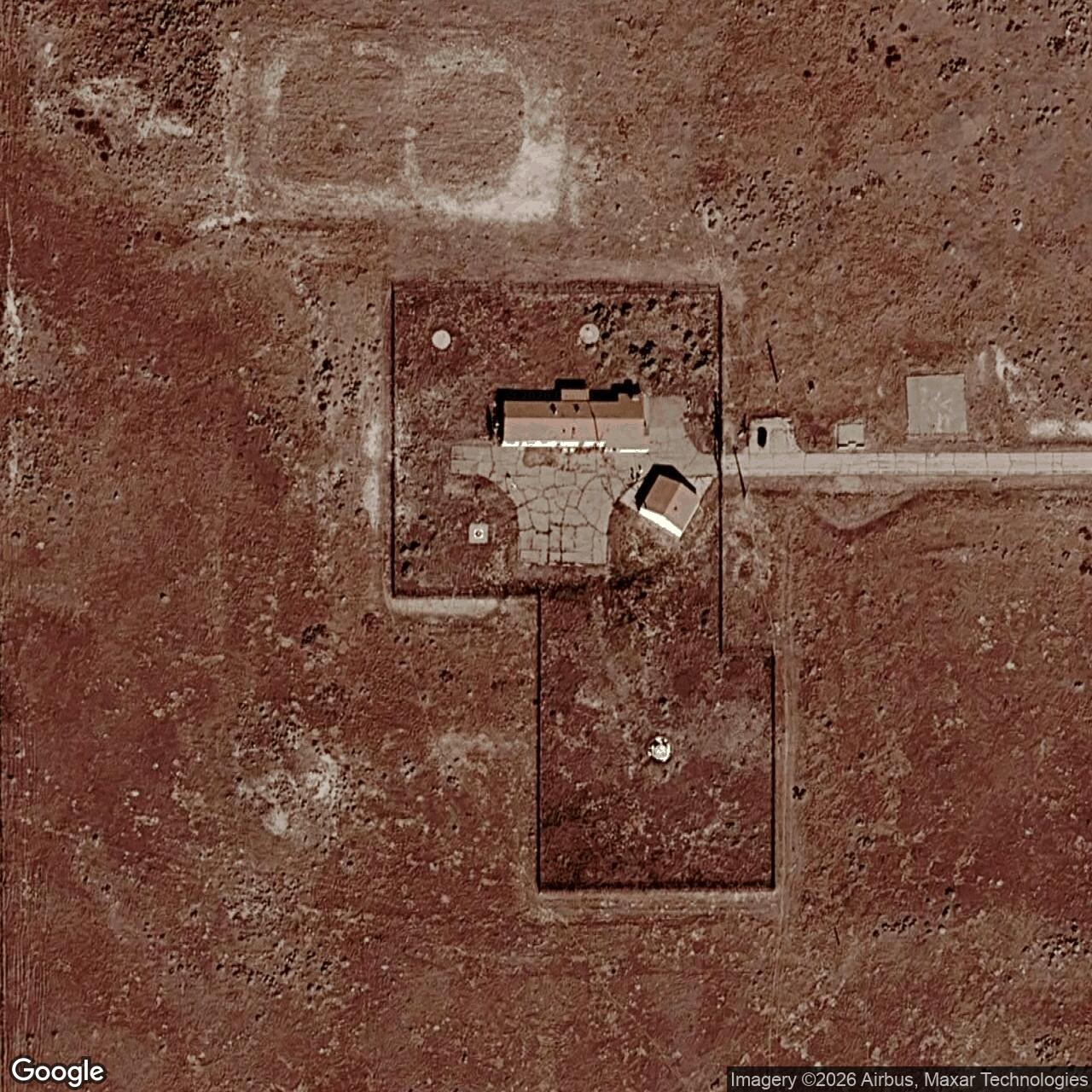
A MAF is located within a fenced area averaging about 5.5 acres. All facilities are enclosed by a security fence, except for a helicopter pad and a buried antenna consisting of two intersecting rings (each about four feet in diameter) buried four feet below surface. The sewage lagoon is enclosed by a separate fence. Top-side structures include a launch control support building (LCSB) and a detached garage. Subsurface structures include a launch control center (LCC) and a launch control equipment building (LCEB). Each MAF Controlled 10 Launch Facilities and their missile.
Missile Type: LGM-30B Minuteman I; LGM-30G Minuteman III; LGM-118A Peacekeeper
Parent Base: F.E. Warren AFB
Missile Wing: 90th Strategic Missile Wing; 90th Missile Wing
Missile Squadron: 400th Strategic Missile Squadron / 400th Missile Squadron
Permanent Installation Number: 8709
Installation Location Code: GHZT
Current Site Use: Former Minuteman / Peacekeeper Missile Alert Facility; 2013 New START-era EA stated MAF surface buildings would remain as real property while underground LCC/LCEB access would be sealed/backfilled; public 2016 field-photo source observed an intact LCSB at T-01; current parcel-level reuse not verified.
Site Ownership: Former U.S. Air Force missile field property; post-New START real-estate disposition/current ownership not verified from public parcel records.
Accessible: No public access confirmed; view only from public roads where legal; do not enter former MAF or surrounding land without current owner permission.
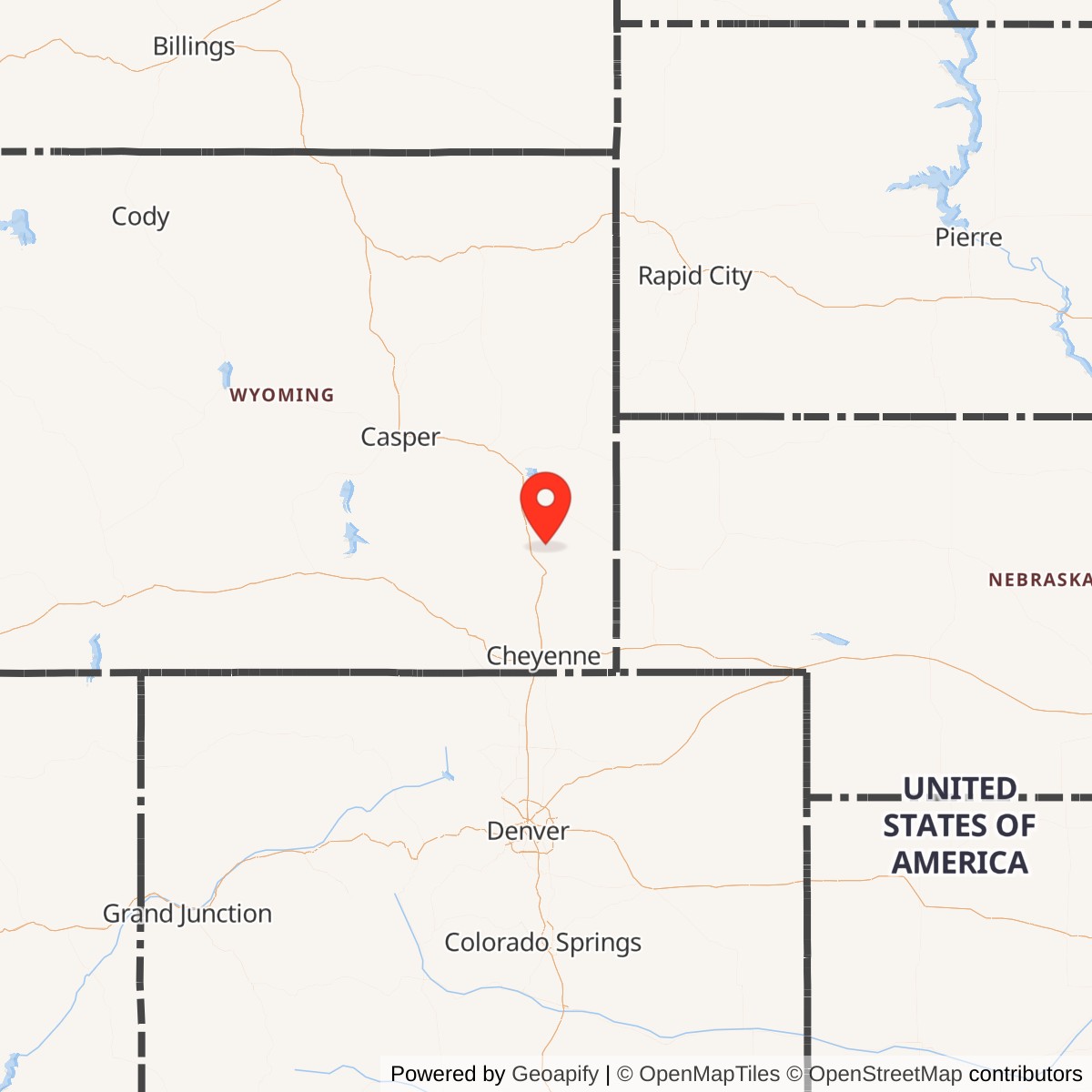
On the high plains east-southeast of Wheatland, T-01 looked like a fenced utility compound with a support building, garage, antennas, helipad, and sewage lagoons. Its purpose was far larger than its footprint. Below the surface was the hardened Launch Control Center for Tango Flight, one of the five F.E. Warren flights converted from Minuteman III to Peacekeeper duty and tied to the only operational Peacekeeper missile field ever deployed by the United States.
T-01 was the Missile Alert Facility / Launch Control Center for Tango Flight in the former Peacekeeper-converted portion of the F.E. Warren Air Force Base missile field. The associated Tango Flight launch facilities were T-02 through T-11.
T-01 belonged to the F.E. Warren AFB missile field, the 90th Strategic Missile Wing during the Strategic Air Command era, and the 400th Strategic Missile Squadron. In later terminology, after the end of Strategic Air Command and several command realignments, the missile field was associated with the 90th Missile Wing and the 400th Missile Squadron. The facility originated as part of F.E. Warren's Minuteman force, was modernized with the field, and later became part of the LGM-118A Peacekeeper deployment. The Peacekeeper alert mission ended on 2005-09-19, and T-01 is treated here as a decommissioned former Missile Alert Facility and Launch Control Center, not as an active Minuteman III site.
Location, Landscape, and Flight Layout
T-01 stood in a rural high-plains setting in Platte County, Wyoming, east-southeast of Wheatland and north of F.E. Warren AFB. The landscape around the former facility is open ranch and agricultural country: long sightlines, county roads, rangeland, irrigated fields in places, and broad visibility across the plains. This geography suited the Minuteman concept. Rather than concentrating missiles at one large base, the Air Force dispersed launch facilities and control centers across a wide missile field so that an enemy attack would have to strike many separate targets.The T-01 compound was the crewed support and control site for Tango Flight. A Minuteman / Peacekeeper Missile Alert Facility was not itself a missile silo. The aboveground Missile Alert Facility supported crews, security personnel, communications equipment, power and maintenance needs, vehicle storage, food service, rest areas, and alert logistics. The Launch Control Center below the surface was the hardened capsule where a two-officer missile combat crew monitored and controlled assigned launch facilities under national command authority and strict authentication procedures.
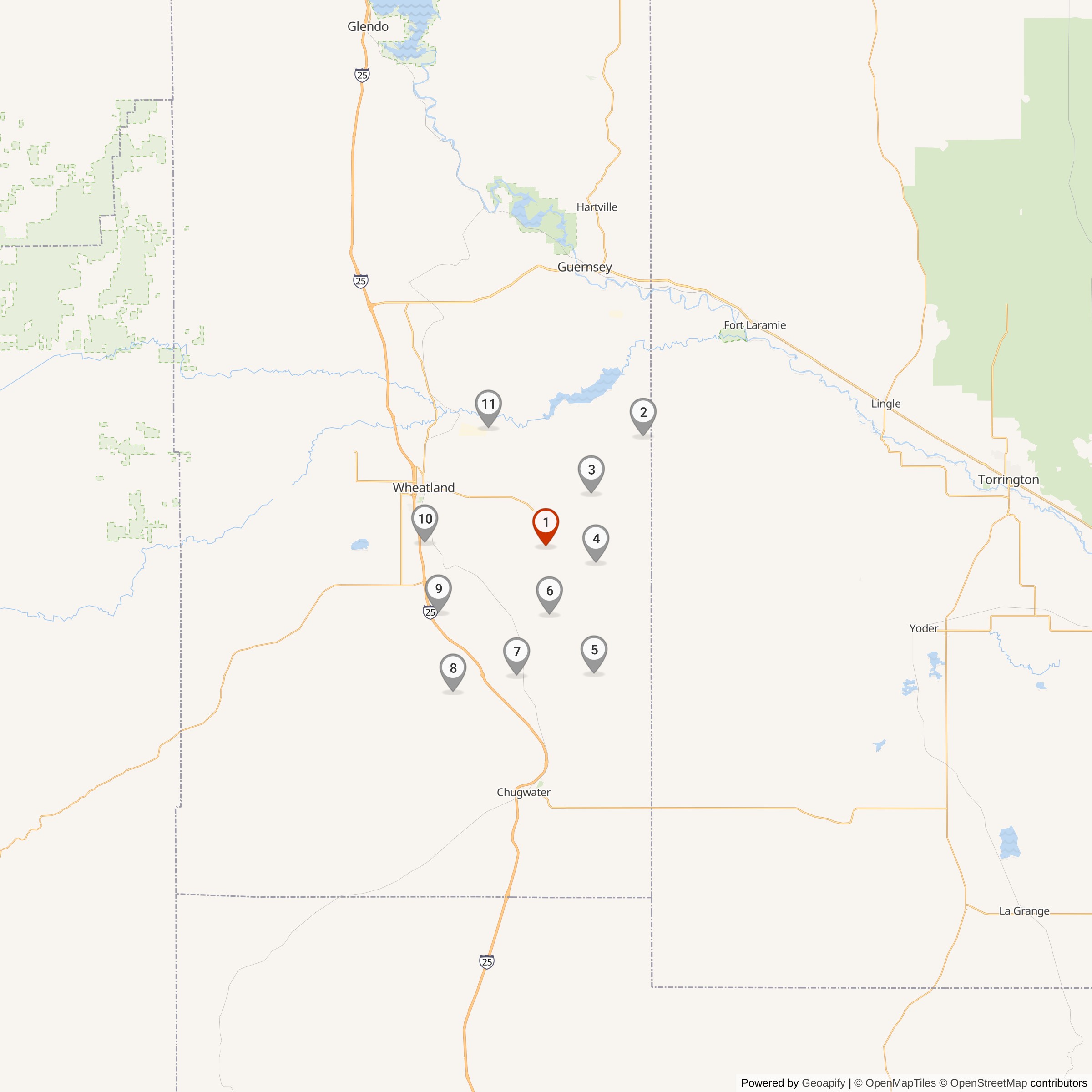
Tango Flight's launch facilities were distributed around the Wheatland area:
T-01 MAF / LCC was at 41.997213, -104.792212
T-02 was at 42.048985, -104.731887>
T-03 was at 42.104926, -104.664634>
T-04 was at 41.980775, -104.726810>
T-05 was at 41.872758, -104.728563>
T-06 was at 41.930402, -104.787464>
T-07 was at 41.870850, -104.830820>
T-08 was at 41.855678, -104.913780>
T-09 was at 41.931743, -104.933067>
T-10 was at 42.000914, -104.951750>
T-11 was at 42.111972, -104.867453>
Strategic and Cold War Context
T-01 existed because the Minuteman system changed the physical and operational logic of land-based nuclear deterrence. Earlier Atlas and Titan systems had depended on large, complex, liquid-fueled missiles. Minuteman used solid propellant, dispersed hardened silos, remote monitoring, and buried launch-control centers. It could remain ready for long periods without the hazardous prelaunch fueling cycle that defined the first generation of ICBMs.F.E. Warren AFB was already deeply tied to the American ICBM program before Tango Flight entered Peacekeeper service. Warren had hosted Atlas missiles and then became a major Minuteman base. The 90th Strategic Missile Wing was activated on 1963-07-01 as the Air Force built a Minuteman field across Wyoming, Nebraska, and Colorado. The 400th Strategic Missile Squadron was organized in 1964 and operated the northern group of flights later converted to Peacekeeper: Papa, Quebec, Romeo, Sierra, and Tango.
Peacekeeper gave T-01 and Tango Flight their second historical identity. The LGM-118A Peacekeeper, originally developed as the MX missile, was a more accurate, multiple-warhead ICBM. After years of debate over basing concepts, the Air Force placed the deployed Peacekeeper force in modified Minuteman III silos at F.E. Warren rather than building a completely new operational missile field. That decision made the former 400th Strategic Missile Squadron field the only operational Peacekeeper field in the United States.
Minuteman and Peacekeeper missiles were solid-fueled weapons housed inside hardened launch facilities. The launch facilities were normally unmanned. Being on alert meant that the missiles, silos, communications links, control equipment, crews, maintenance system, and security forces were maintained in an operational readiness posture under national command authority. The purpose was deterrence: to convince any adversary that a first strike could not eliminate the United States' ability to respond.
Construction and Activation
T-01 was built as part of the F.E. Warren Minuteman missile field, not as an original Peacekeeper facility. The exact site-level construction acceptance date for T-01 was not located. Public Warren histories state that Minuteman replaced Atlas at Warren after the early Atlas era and that the 90th Strategic Missile Wing was activated on 1963-07-01. The 400th Strategic Missile Squadron was activated in December 1963 and organized at F.E. Warren on 1964-07-01.The Minuteman construction program required coordination among the Air Force, the Army Corps of Engineers, Boeing, and multiple specialized contractors. The basic Minuteman field design placed one crewed control facility at the center of a flight of ten launch facilities. The individual launch facilities were unmanned and dispersed across miles of open country, while the MAF / LCC provided the crewed command point, communications node, and topside support compound.
F.E. Warren's Minuteman force was later modernized. Public Warren histories state that the Minuteman III replaced the Minuteman I at F.E. Warren in the 1970s, and that in November 1973 the 400th Strategic Missile Squadron became the first all-Minuteman III squadron at Warren. That conversion mattered because the 400th SMS was then selected for Peacekeeper conversion. The Peacekeeper did not create Tango Flight from scratch; it overlaid a new missile system on an existing Minuteman III infrastructure.
Peacekeeper conversion followed national basing decisions in the early 1980s. President Ronald Reagan announced plans in November 1982 to deploy the MX / Peacekeeper at F.E. Warren, and Peacekeeper support-facility construction began in July 1984. From 1986 through 1988, 50 former Minuteman III launch facilities of the 400th Strategic Missile Squadron were backfitted for Peacekeeper. T-01 and Tango Flight were part of that converted field.
Missile System and Technical Role
T-01 did not house a missile. Its technical role was command, control, communications, security support, crew support, and alert operations for Tango Flight. The missiles themselves were located at T-02 through T-11. During its active history the flight was associated with the Minuteman force and later the Peacekeeper force.The original missile family associated with T-01 was the LGM-30 Minuteman. F.E. Warren's original Minuteman deployment used LGM-30B Minuteman I missiles, later replaced by LGM-30G Minuteman III missiles. Minuteman III brought improved guidance, a larger missile, and a post-boost vehicle compared with earlier Minuteman models. The Air Force describes Minuteman III as a quick-reacting, inertially guided, survivable component of the strategic triad.
The Peacekeeper system was different from the Minuteman missiles it replaced. Public Air Force sources describe the LGM-118A Peacekeeper as a four-stage ICBM with three solid-fuel booster stages and a liquid-fueled post-boost vehicle. It used a cold-launch method: high-pressure steam ejected the missile from a modified Minuteman underground silo before first-stage ignition occurred above the launcher. Air Force public data identify Peacekeeper as approximately 71 feet high, about 195,000 pounds, with inertial guidance, a range greater than 6,000 miles, and a payload of up to ten Avco Mk 21 reentry vehicles.
Launch Control, Alert Duty, and Daily Operations
T-01's daily mission centered on the buried Launch Control Center and the aboveground support compound. A missile combat crew occupied the underground capsule during alert tours. Above ground, the Launch Control Support Building and associated structures supported the facility manager, security forces, communications systems, food service, rest areas, vehicle operations, and routine facility functions. The MAF was both a workplace and a remote-duty station.The launch facilities assigned to Tango Flight were normally unmanned. Maintenance teams, security forces, and communications personnel visited them as required, but missile crews did not sit at the individual silos. The crew's duty station was the LCC beneath T-01. From there, the crew monitored status, maintained communications, and participated in the larger wing and national command-and-control system.
Public environmental documentation describes the general MAF physical arrangement in the deactivated force. A MAF contained a fenced compound, Launch Control Support Building, garage, helicopter pad outside the main fence, sewage lagoon, and buried antenna features. Subsurface structures included the Launch Control Center and Launch Control Equipment Building. The 2013 EA also describes HICS, the Hardened Intersite Cable System, as the buried cable network connecting launch facilities and MAFs for operational and security purposes.
T-01's public photo documentation is unusually useful for a non-preserved MAF. A public Peacekeeper field listing shows general views, the Launch Control Support Building, air intake and exhaust stacks, hard HF and UHF antenna features, helipad, fuel-tank support structure, sewage lagoons, a sign, and a feature described by the photographer as not found at the other four Peacekeeper LCFs. The same source also noted a soft HF transmit-and-receive antenna, suggesting T-01 may have had an alternate wing command post role. That interpretation should be treated as a public-source observation, not as a confirmed operational detail.
Assigned Launch Facilities
Tango Flight consisted of T-01 plus ten launch facilities: T-02 through T-11. The flight layout is important because it shows the Minuteman / Peacekeeper system as a network, not as a single isolated silo. The MAF / LCC at T-01 was the crewed control point. The launch facilities were dispersed across the Wheatland area to complicate attack planning and reduce the chance that one strike could disable the entire flight.
Operational History
Tango Flight's operational history is part of the broader 400th Strategic Missile Squadron story. The 400th SMS was organized at F.E. Warren on 1964-07-01 as an LGM-30B Minuteman I squadron. It later modernized to LGM-30G Minuteman III, and public unit-history sources list Minuteman III as a weapon system beginning in 1973. The squadron's northern flights, including Tango, were then selected for Peacekeeper conversion.The conversion from Minuteman III to Peacekeeper was not a simple missile swap. Peacekeeper was larger and used a cold-launch system. Former Minuteman launch facilities required modification, and public Warren histories state that 50 Peacekeepers were placed on alert in modified Minuteman III silos in 1988. SAC chronology pages for 1986 through 1988 show the transition as an active, staged process: Peacekeeper deployment faced legal challenges, the Airborne Launch Control Center was tested for Peacekeeper launch capability, operationally configured Peacekeeper launch hardware was tested at Vandenberg, SAC owned 32 Peacekeepers by the end of 1987 with 18 on alert, F.E. Warren removed the fiftieth and last Minuteman III from alert on 1988-04-04, and the 400th SMS completed its Minuteman III phaseout on 1988-04-11.
Public Air Force accounts describe the 400th Missile Squadron bringing its full Peacekeeper complement online in 1988. The Peacekeeper remained in service after the Cold War ended, but its political and strategic context changed. Arms-control agreements, budget considerations, and the reduced post-Cold War requirement for multiple-warhead land-based ICBMs led to retirement. The Peacekeeper mission ended in a formal ceremony at F.E. Warren on 2005-09-19, when public Air Force reporting stated that no Peacekeeper ICBMs remained on strategic alert in the 400th Missile Squadron.
T-01 has more public site-specific detail than many former Missile Alert Facilities because it was photographed after deactivation. The public Peacekeeper field photo page identifies T-01 as Francis E. Warren AF Missile Site T-01, PIN 8709, ILC GHZT, and lists a set of T-01-specific exterior photographs dated to 2010 and a 2016 update. These photographs document that the site retained visible surface elements including the Launch Control Support Building, air intake and exhaust stacks, antennas, helipad, fuel tank support structure, sewage lagoons, and signage at the time of those visits.
The most distinctive T-01-specific public note is the antenna observation. The photo listing identifies a soft HF transmit-and-receive antenna and states that it suggested T-01's status as an alternate wing command post. It also identifies an unidentified feature that the photographer did not find at the other four Peacekeeper Launch Control Facilities. These observations do not prove the details of T-01's operational tasking, but they do make T-01 more visually and interpretively distinctive than a generic decommissioned MAF.
The 2013 EA also provides site-specific environmental references. Its bibliography lists a June 2007 Tank Closure Report for Missile Alert Facility Tango-1 and a 2007 Wyoming Department of Environmental Quality UST Minimum Site Assessment Report for Missile Alert Facility Tango-1. The same EA references a 2011 F.E. Warren pre-construction notification to Wyoming DEQ for lagoon closure activities at P-01, Q-01, R-01, S-01, and T-01. These entries show that T-01 was part of the post-Peacekeeper environmental closeout and real-property preparation process.
Deactivation and Disposal
The Peacekeeper system was deactivated after the Cold War as the United States reduced its deployed strategic force. F.E. Warren public histories state that the Peacekeeper missiles were deactivated on 2005-09-19. The 400th Missile Squadron was inactivated that same date. Public Air Force reporting described the Peacekeeper mission ending at F.E. Warren and specifically noted that the final confirmation showed no Peacekeeper ICBMs remained on strategic alert in the 400th MS.The physical disposal process took longer than the mission-ending ceremony. The 2013 Final Environmental Assessment for Minuteman III and Peacekeeper Silo Elimination evaluated dismantlement of 50 Peacekeeper launch facilities and five MAFs assigned to F.E. Warren. The action was tied to New START implementation, which required elimination of selected deactivated ICBM launch facilities by 2018. Although New START focused on launch facilities, the EA included associated MAFs because they no longer supported missile operations.
For former Peacekeeper MAFs such as T-01, the 2013 EA described a method different from the launch-facility silo eliminations. The surface buildings at the MAFs would remain as part of the real property, while access to the underground Launch Control Center and Launch Control Equipment Building would be sealed. The LCC blast door and LCEB door would be welded shut, the elevator shaft and vestibule areas would be filled, and a reinforced concrete cap would be placed over the shaft to prevent settling and deny access to abandoned underground spaces. Air intakes and exhaust ducts would be filled and sealed with reinforced concrete.
T-01 was not selected for preservation. Quebec-01 became the preserved Peacekeeper Missile Alert Facility and later a National Historic Landmark. That contrast is part of T-01's significance. T-01 represents the normal post-Peacekeeper fate of a former control facility: deactivation, environmental closeout, removal from the operational force, sealed underground spaces, and uncertain post-military real-estate disposition. Quebec-01 represents the preserved exception.
Current Status and Site Use
T-01 is a decommissioned former Missile Alert Facility / Launch Control Center.Public environmental documents indicate that the former Peacekeeper MAFs were subject to caretaker status, removal of salvageable and classified items, closure or removal of tanks, lagoon-closure actions, and dismantlement/backfill actions for underground access points. The 2013 EA stated that future use of LF and MAF property was speculative and beyond the scope of the environmental analysis, and that real-estate interests at Montana and Wyoming LF/MAF locations would be terminated after dismantlement and grading. Current parcel-level ownership and reuse for T-01 were not verified.
A public field-photo source observed an intact Launch Control Support Building at T-01 in 2016. That observation is useful but should not be treated as a current access or preservation statement. The safe public-use rule remains straightforward: do not enter the former facility or surrounding land without current owner permission.
The 2013 EA states that MAFs averaged approximately five acres, but no documented T-01-specific acreage value was found.
Chronology
- 1963-07-01 The 90th Strategic Missile Wing was activated at F.E. Warren AFB.
- 1964-07-01 The 400th Strategic Missile Squadron was organized at F.E. Warren AFB.
- 1965-06 F.E. Warren's Minuteman field reached full operational status at the wing level; T-01 is treated as part of that mid-1960s operational Minuteman field.
- 1973-11 The 400th Strategic Missile Squadron became the first all-Minuteman III squadron at F.E. Warren.
- 1975 F.E. Warren was selected for Peacekeeper basing in the former 400th Strategic Missile Squadron field.
- 1982-11 President Ronald Reagan renamed MX as Peacekeeper and announced plans to deploy the missile at F.E. Warren.
- 1984-07 Construction began for Peacekeeper support facilities at F.E. Warren.
- 1986-01-23 The 400th Strategic Missile Squadron began phasing out Minuteman III missiles in preparation for Peacekeeper deployment.
- 1986-02-20 Two lawsuits seeking to block Peacekeeper deployment were dismissed in U.S. District Court in Lincoln, Nebraska.
- 1986-08-27 SAC Flyover Test 11-7-4 confirmed the ability of the Airborne Launch Control Center to launch Peacekeeper ICBMs using equipment originally designed for the Minuteman missile system.
- 1986-08-31 A Peacekeeper missile launch from Vandenberg AFB represented the first launch of a completely operational hardware-configured missile and launch facility and the first Peacekeeper launch by a SAC combat crew under Air Force Systems Command control.
- 1987-12-31 SAC owned 32 Peacekeeper missiles, 18 of which were on alert.
- 1988-04-04 Missile maintenance technicians at F.E. Warren removed the fiftieth and last Minuteman III from alert before conversion of that launch facility for Peacekeeper use.
- 1988-04-11 The 400th Strategic Missile Squadron completed the phaseout of Minuteman III missiles that had begun on 1986-01-23 in preparation for Peacekeeper deployment.
- 1988-12 Public Warren histories describe 50 Peacekeeper missiles as on alert in modified Minuteman III silos in 1988.
- 1991-09-01 The 400th Strategic Missile Squadron was redesignated the 400th Missile Squadron.
- 1992-06-01 Strategic Air Command inactivated, and former SAC missile forces entered the post-SAC command structure.
- 1993-07-01 Twentieth Air Force and the ICBM force realigned under Air Force Space Command.
- 1999-06-11 A Federal Register notice announced the Air Force's intent to prepare an environmental impact statement for Peacekeeper deactivation and dismantlement at F.E. Warren.
- 2005-09-19 The Peacekeeper alert mission ended at F.E. Warren; public Air Force reporting stated that no Peacekeeper ICBMs remained on strategic alert in the 400th Missile Squadron.
- 2005-09-19 The 400th Missile Squadron was inactivated.
- 2007-06 Public EA references identify a Toltest Tank Closure Report for Missile Alert Facility Tango-1.
- 2007 Public EA references identify a Wyoming Department of Environmental Quality UST Minimum Site Assessment Report for Missile Alert Facility Tango-1.
- 2011-07 Public EA references identify an F.E. Warren pre-construction notification to Wyoming DEQ for lagoon closure activities at P-01, Q-01, R-01, S-01, and T-01.
- 2011-02-05 New START entered into force, setting treaty deadlines that shaped elimination of selected deactivated silos and associated alert facilities.
- 2013-03 The Final Environmental Assessment for Minuteman III and Peacekeeper Silo Elimination evaluated dismantlement of 50 Peacekeeper launch facilities and five MAFs assigned to F.E. Warren AFB.
- 2016-08-27 A public field-photo source documented an intact Launch Control Support Building at T-01.
- 2018 New START elimination deadlines applied to selected deactivated ICBM launch facilities.
Read about the Peacekeeper Missile at F.E. Warren AFB
All Peacekeeper Missile Silo Locations
All Minuteman/Peacekeeper Missile Silo Locations