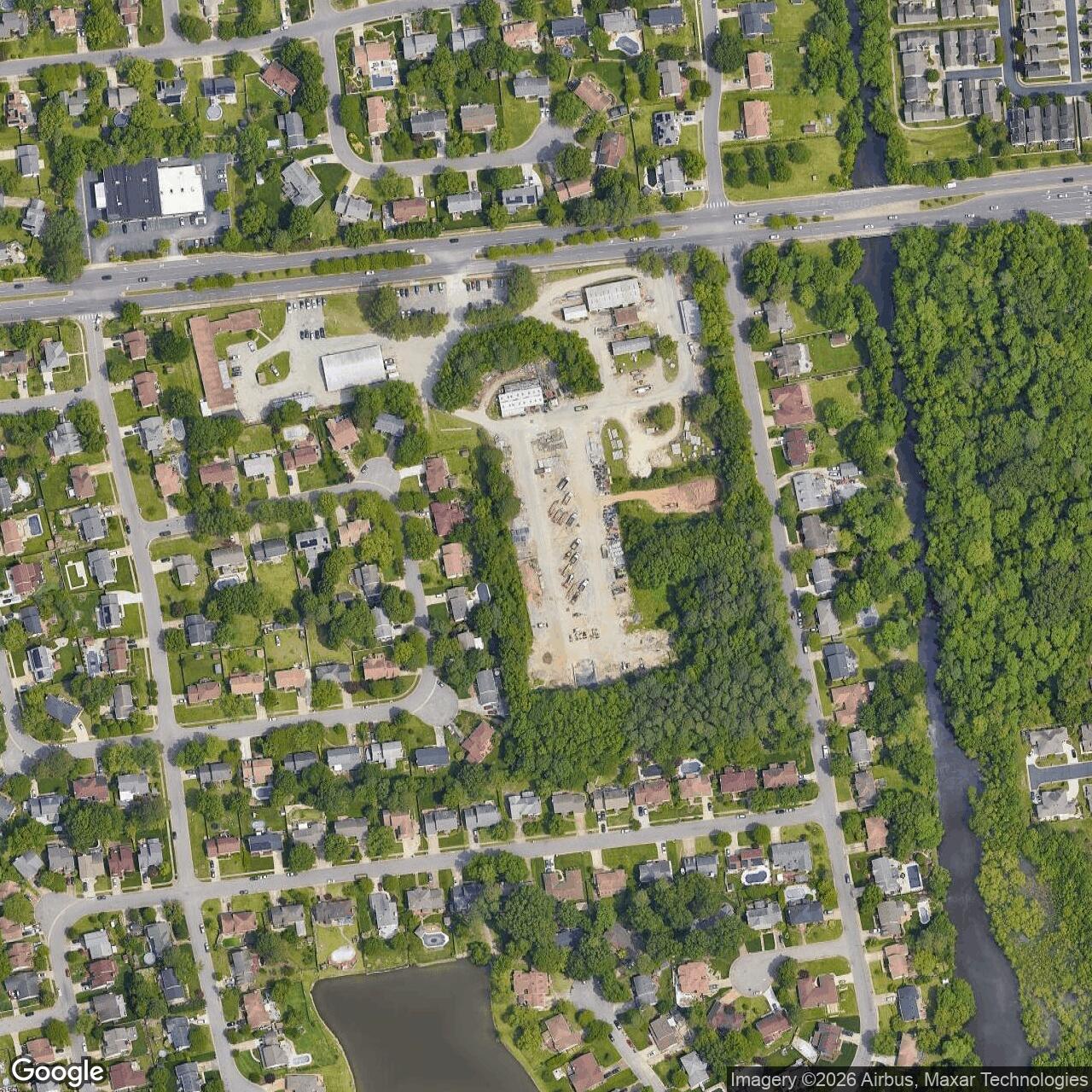
Nike Missile Site N-36 Launcher, Kempsville Virginia
Longitude: -76.129853858857
This location was part of the Norfolk Defense Area
Site ID: N-36
The missiles at this Launch Area were controlled by the Integrated Fire Control site located here.
Site Role: Launcher
A typical Nike air defense site consisted of two separate parcels of land. One area was known as the Integrated Fire Control (IFC) Area. This site contained the Nike system's ground-based radar and computer systems designed to detect and track hostile aircraft, and to guide the missiles to their targets.
The second parcel of land was known as the Launcher Area. At the launcher area, Nike missiles were stored horizontally within heavily constructed underground missile magazines. A large, missile elevator brought the Nikes to the surface of the site where they would be pushed across twin steel rails to one of four satellite launchers.
Elaboration on how Nike worked here.
Current site status: Parks and Recreation maintenance
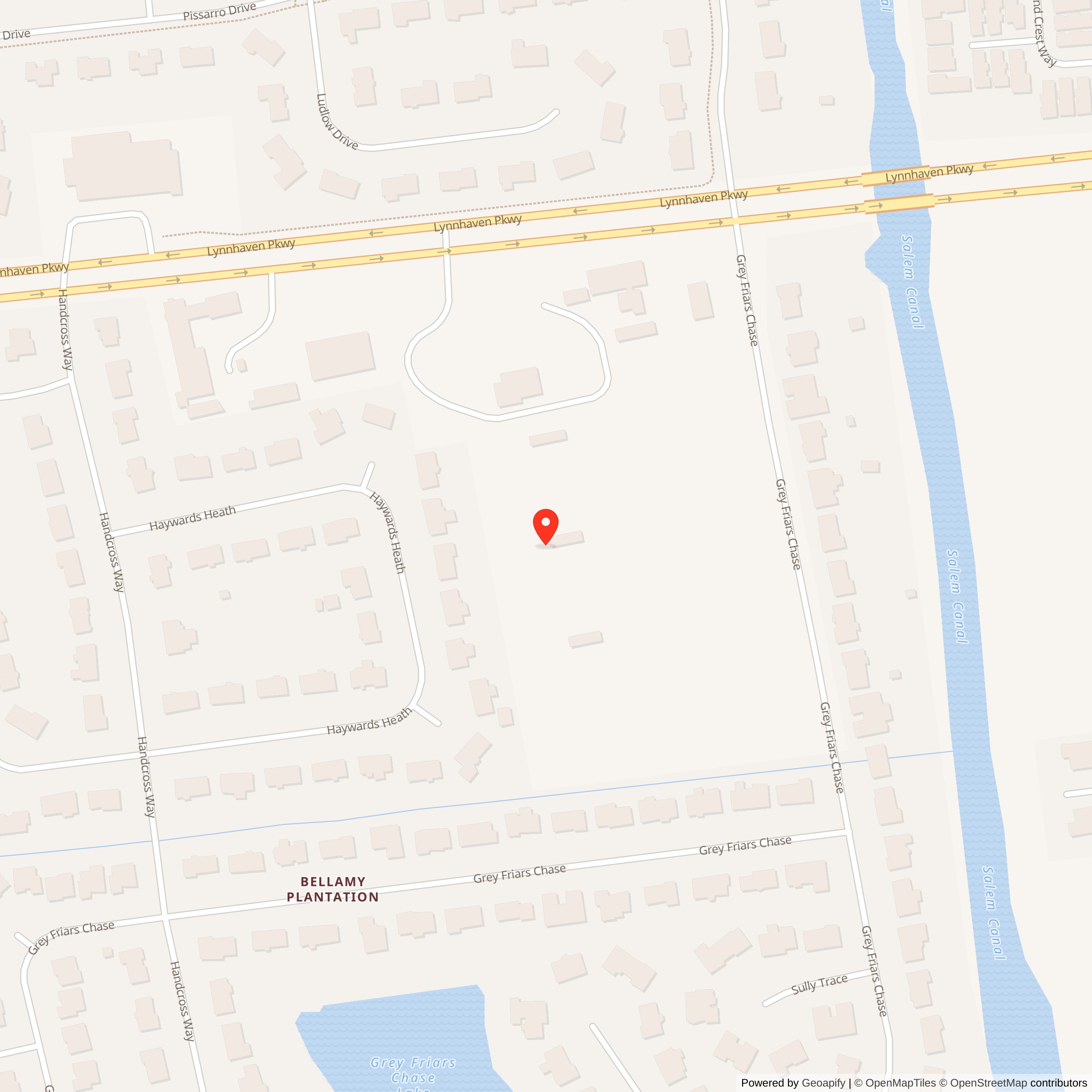
Nike Missile Site N-36 was a Cold War U.S. Army Nike Ajax air-defense battery in the Norfolk Defense Area. It was located in the Kempsville section of what is now Virginia Beach, Virginia, with its integrated fire-control area on the west side of the site pair and its launch area farther east along the Lynnhaven Parkway corridor. It was one of the ring of Nike batteries built in the mid-1950s to defend the Hampton Roads region, including the Norfolk naval complex, nearby Army facilities, airfields, port facilities, shipyards, and military-industrial infrastructure concentrated around the lower Chesapeake Bay.
It operated from 1955 to 1964 as a Nike Ajax site and was not converted to Nike Hercules. Its missile type is listed as Nike 1B, 2C/30A/12L-A, meaning it was an Ajax-era underground-magazine site with Ajax launch equipment rather than a later Hercules conversion. After military use ended, the property entered municipal reuse. The City of Virginia Beach used the former Nike properties for Parks and Recreation administrative, maintenance, landscape, and support functions, and the launch property is also tracked environmentally as NIKE SITE N-36 LAUNCH at 2150 Lynnhaven Road / Lynnhaven Parkway, Virginia Beach.
Location and Site Setting
N-36 occupied two separated but coordinated parcels in the Kempsville / Lynnhaven Parkway area of Virginia Beach.This separation was typical of Nike sites. The IFC area required radar line-of-sight and room for the acquisition radar, target-tracking radar, missile-tracking radar, computer equipment, control vans or buildings, barracks/support structures, and communications equipment. The launch area required secure missile magazines, launchers, assembly and handling space, fueling and warheading support for Ajax operations, guard facilities, and clear missile firing arcs. The two areas had to operate as a single tactical battery even though they were physically separated.
The Kempsville location placed the site inland from the Atlantic coast and Chesapeake Bay but still within the defended Hampton Roads air-defense belt. This positioning mattered because the Norfolk Defense Area was not built merely to protect a city. It was built to defend one of the most important naval and military regions in the United States. Hampton Roads contained the world's largest naval complex, major fleet-support and shipyard functions, coastal entrances into the Chesapeake Bay, and military transportation infrastructure that would have been extremely valuable targets in a Cold War bomber attack.
The Norfolk Defense Area
The Norfolk Defense Area was one of the Army's major urban and military air-defense networks. In the mid-1950s, the United States still expected that a Soviet nuclear attack, if it came, would most likely arrive by long-range bomber. The Air Force built early-warning, interceptor, and command-and-control systems to detect and engage bombers at distance, while the Army's Nike batteries formed the last ground-based guided-missile layer around high-value targets.The Hampton Roads region was a natural candidate for Nike protection. It included Norfolk naval facilities, the Hampton Roads port system, nearby Army and Air Force activities, and a concentration of military logistics and repair infrastructure. An attack on the region could have damaged naval readiness, Atlantic Fleet operations, port throughput, ship repair, and military movement along the East Coast. The Nike system was therefore not only a city-defense system but also a defense of strategic mobility and naval power.
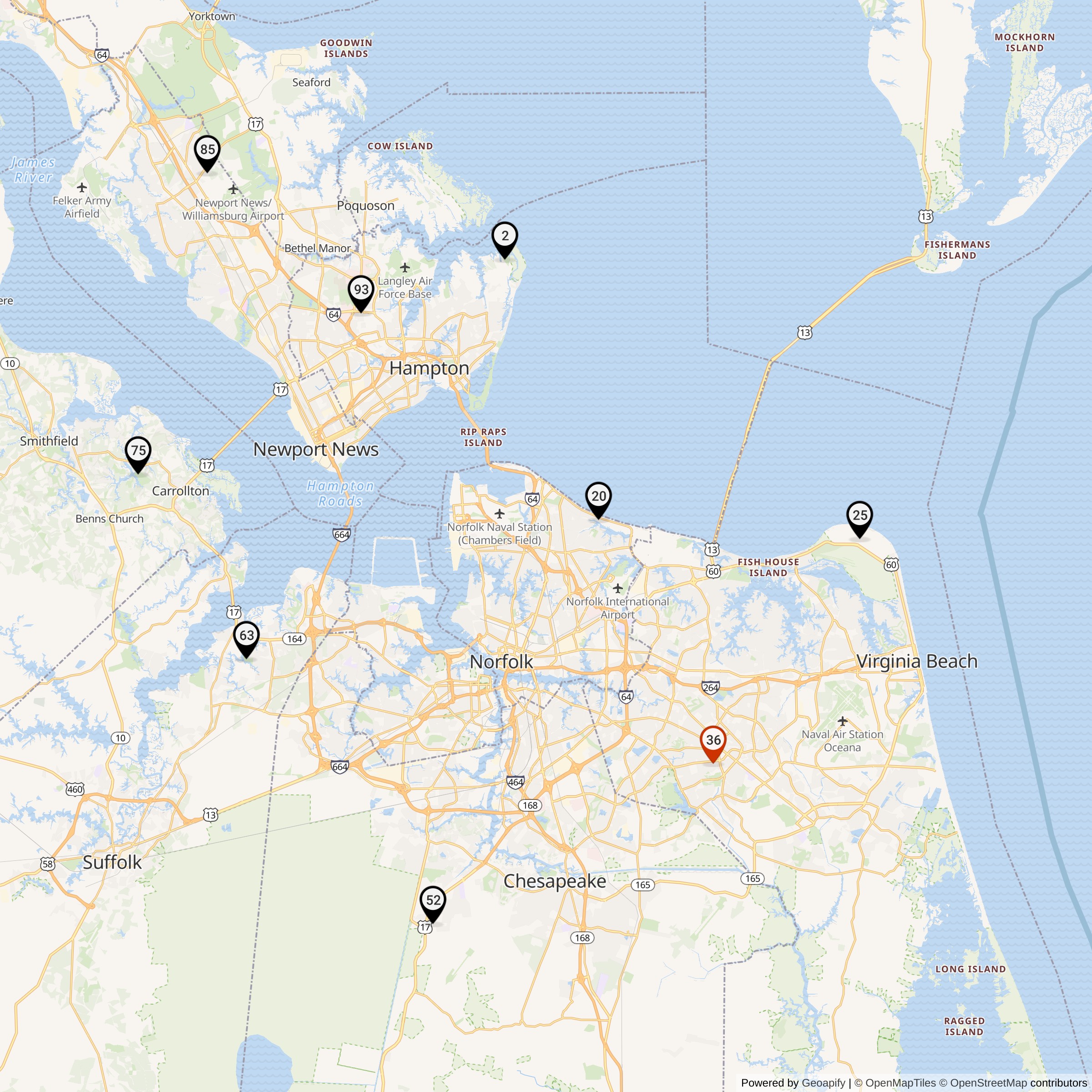
Within that system, N-36 formed part of a multi-site defensive ring. Norfolk-area Nike site designations included Fox Hill (N-02), Ocean View temporary site (N-20), Fort Story (N-25/later N-29), Kempsville (N-36/later N-49), Deep Creek/Portsmouth (N-52/later N-59), Nansemond/Suffolk (N-63/later N-69), Smithfield/Carrollton (N-75), Denbigh/Patrick Henry (N-85/later N-97), and Hampton/Spiegelville (N-93/later N-99). Headquarters and command-related facilities were associated with places such as Fort Monroe, Ballantine School in Norfolk, Reedsville/South Norfolk, Craddock Branch/Portsmouth, Newport News, and later regional air-defense command systems.
N-36's position in Kempsville helped cover the southeastern and inland side of the Hampton Roads defense pattern. It was not a coastal gun battery and did not defend against ships. Its mission was to engage hostile aircraft, especially bomber formations, after warning and tracking data identified them as threats to the defended area.
The Nike Ajax System at N-36
N-36 was an Ajax-only site. Nike Ajax was the Army's first operational surface-to-air guided missile system and the first widely deployed guided missile air-defense system in the United States. The system was designed to intercept high-flying bomber aircraft before they could release nuclear or conventional weapons over defended targets.A Nike Ajax battery depended on two major site components. The IFC area found and tracked both the target and the missile. Radar data fed into the battery's analog computer system, which calculated the intercept point and transmitted steering commands to the missile in flight. The launch area stored, prepared, elevated, and fired the missiles. Once launched, the Ajax missile did not autonomously seek the target like later homing missiles. It was command-guided from the ground, meaning the IFC area remained central throughout the engagement.
The Ajax missile itself carried conventional high-explosive fragmentation warheads. It was a liquid-fueled missile with solid boosters, and its ground handling required trained crews, careful procedures, and secure infrastructure. The launch area's underground magazines protected missiles and allowed them to be raised to the surface on elevators for firing. The N-36 type listing, Nike 1B, 2C/30A/12L-A, indicates a site with one B-type and two C-type magazines and Ajax launch capability rather than a Hercules universal launcher layout.
The fact that N-36 was not converted to Hercules is historically meaningful. Nike Hercules had greater range, higher altitude capability, solid-fuel handling advantages, and the ability to carry nuclear warheads. In the Norfolk Defense Area, the Army selected N-25, N-52, and N-85 for Hercules modernization. N-36 remained part of the first-generation Ajax network until its closure in 1964. This places it in the early phase of Cold War air defense, before the Army reduced and consolidated many Ajax batteries in favor of fewer Hercules sites and increasingly centralized command-and-control networks.
Construction and Activation
N-36 was part of the mid-1950s wave of Nike construction around Hampton Roads. The national Nike program expanded rapidly after the Korean War and after the Soviet Union's acquisition of nuclear weapons made continental air defense a central policy concern. By the time N-36 entered service, the Army was building Nike sites around major metropolitan regions, industrial centers, and military installations throughout the country.The site became active in 1955. This placed N-36 among the early operational Nike batteries in the Norfolk Defense Area. It came online during the period when the Army was replacing or supplementing older antiaircraft gun defenses with guided missiles. The site was designed around the Nike Ajax system rather than retrofitted for a later missile, and its geography reflected the standard Nike layout: separated control and launch areas connected operationally by communications and command procedures.
Because N-36 was intended for local-area defense rather than post-style garrison life, its footprint was relatively small compared with a conventional Army installation. Its importance came from specialization. A Nike battery did not need a large maneuver area or a parade-ground post layout. It needed radar exposure, secure missile storage, crew facilities, communications links, power, roads, and a cleared launch environment. This made sites like N-36 physically modest but strategically significant.
Operations
During its active years, N-36 formed part of the Army air-defense shield for Hampton Roads. The battery's crews maintained radars, launchers, missiles, communications systems, generators, magazines, fueling and handling equipment, security systems, and readiness procedures. Nike operations required constant technical discipline because the weapon system combined guided missiles, radar, analog computing, liquid-fuel rocket handling, ordnance safety, communications, and regional command-and-control integration.A typical operational cycle involved surveillance and identification through the broader air-defense network, local acquisition and target tracking at the IFC, missile preparation at the launch area, command-guidance calculations, and, if ordered, missile firing. In practice, these sites spent most of their lives in training, maintenance, readiness drills, inspections, and alert posture rather than actual firing. Live firing was generally conducted at designated ranges rather than from the operational sites around U.S. cities.
N-36's daily life would have resembled other Ajax sites. Soldiers lived and worked in a small, security-conscious technical environment. Maintenance mattered as much as tactical readiness. Radar equipment needed calibration; launchers and elevators required inspection; Ajax missiles required careful handling; and communications with regional command posts had to remain reliable. The men assigned to N-36 were part of a larger network of Regular Army and Virginia Army National Guard air-defense units that supported the Norfolk Defense Area during the 1950s and early 1960s.
Operationally, N-36's role was shaped by the limits of the Ajax system. Ajax could defend a region against bomber attack, but it had shorter range and less capability than Hercules. As Nike doctrine evolved, the Army increasingly favored fewer, more capable Hercules batteries rather than dense rings of Ajax-only sites. This was especially true as the Soviet threat shifted from manned bombers toward ballistic missiles, a threat Nike Ajax was not designed to defeat.
Deactivation
N-36 closed in 1964. Its closure fits the broader national pattern of early Nike Ajax deactivations. By the early 1960s, many Ajax-only sites were becoming less useful within the changing continental-defense system. Some locations were converted to Hercules; others were closed. Norfolk retained Hercules-capable defenses at N-25, N-52, and N-85, while Ajax-only sites such as N-36 left service.N-36's deactivation did not mean the Hampton Roads military region had become unimportant. Rather, it reflected a change in air-defense technology and force structure. The Army was consolidating air-defense sites, the Air Force was operating SAGE-linked radar and interceptor networks, and strategic attention was shifting increasingly toward missile warning and deterrence. The older Ajax battery architecture was expensive to maintain and less capable than newer systems.
Post-Closure Transfer And Municipal Reuse
After deactivation, N-36 entered a long period of municipal reuse. Virginia Beach city records identify the Lynnhaven Parks and Recreation property as the former Nike Battery N-36 facility, with the project/property identifier D-VA-557. Those city records state that in February 1967 the federal government transferred the properties to the City of Virginia Beach by restricted quitclaim deed for parkland/open-space use, and that parkland usage restrictions remained in effect at both Lynnhaven sites.By the late twentieth and early twenty-first centuries, the former control and launch properties were associated with City of Virginia Beach Parks and Recreation uses. Site summaries identify the control site with City of Virginia Beach Parks and Recreation offices and a juvenile-detention-related use, while the launch site is identified with Parks and Recreation maintenance. A 2010 Virginia Beach City Council briefing described the Lynnhaven site as part of a Parks and Recreation facilities initiative involving relocation of Parks and Recreation activities, modernization of citywide services, and removal of industrial/government functions from residential neighborhoods. The same briefing described then-current uses at 2150 Lynnhaven as including a mechanic's shop, welding shop, carpenter shop, administrative offices, storage areas, material stockpiles, utility-vehicle parking, and related functions.
This municipal reuse is typical of many former Nike sites. Because they had roads, fenced compounds, utility connections, and durable military buildings, they were often attractive for public works, park maintenance, school-district, police, fire, training, storage, and municipal support uses. The same features that made them secure missile sites also made them useful municipal yards after closure.
Physical Survival And Integrity
Field notes collected by Nike researchers describe the IFC and launch areas as gated and secure municipal properties. The IFC area was described as still used by the City of Virginia Beach, with public trucks and vehicles inside and buildings in good condition, but with no radar towers visible from outside the gate. The launch area was described as containing newer construction and maintenance sheds on and around the magazine area, with trucks, equipment, and paved or concreted surfaces. The visible missile-era features included hatches, vents, and elevator doors that appeared level with the surrounding surface.
Chronology
- 1955 Nike Missile Site N-36 became operational at Kempsville / Virginia Beach as part of the Norfolk Defense Area.
- 1955-1964 N-36 served as a Nike Ajax battery defending the Hampton Roads / Norfolk military region.
- Late 1950s The Norfolk Defense Area operated as a multi-site air-defense network around the world's largest naval complex and related military facilities.
- 1958 Men of the 4th Missile Battalion, 51st Artillery were noted in Norfolk Defense Area history for forming an integrated choral group that performed at hospitals and other venues, reflecting the presence of Regular Army and Virginia Army National Guard air-defense personnel in the region.
- 1958-1960 Selected Norfolk Nike batteries were modernized for Nike Hercules, but N-36 was not among them.
- 1964 N-36 was deactivated as an Ajax-only Nike site.
- February 1967 The federal government transferred the former N-36 Lynnhaven properties to the City of Virginia Beach by restricted quitclaim deed for parkland/open-space use, according to later Virginia Beach city records.
- By the 2000s The former site was in municipal use, with the IFC associated with City of Virginia Beach Parks and Recreation offices / related civic uses and the launch area associated with Parks and Recreation maintenance functions.
- 2007 National Park Service correspondence outlined steps associated with deed-restriction changes and replacement parkland requirements for the Lynnhaven Nike properties, according to Virginia Beach city records.
- 2010 Virginia Beach City Council received a briefing on the Lynnhaven Parks and Recreation Offices / Nike Site initiative, including modernization, relocation, deed-restriction, environmental, appraisal, and redevelopment planning issues.
List of all Nike Installations in Virginia